India Self-Propelled Harvesting Equipment Market Size & Growth Rate
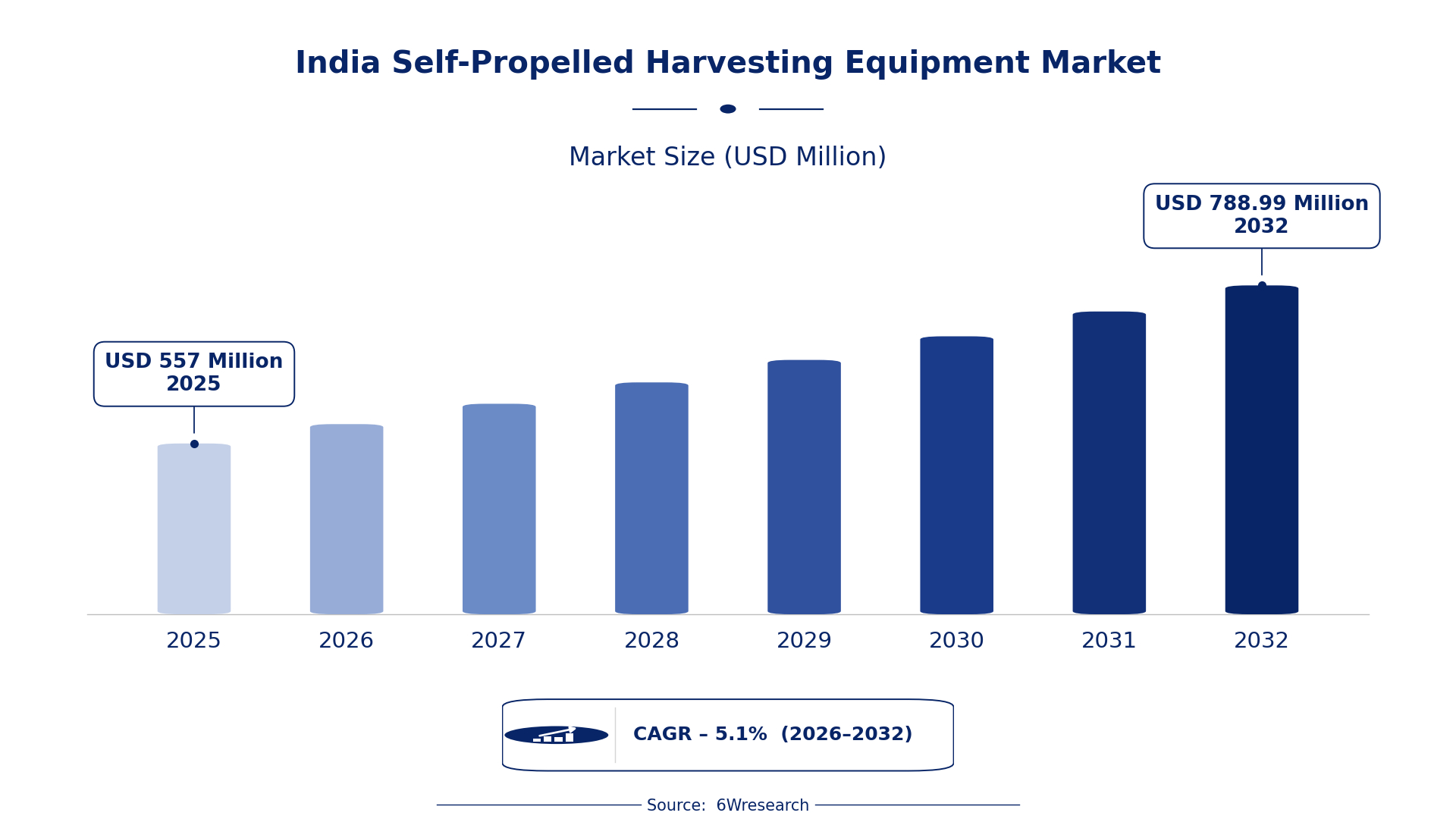
According to 6Wresearch internal database and industry insights, the India Self-Propelled Harvesting Equipment Market was valued at USD 557.0 million in 2025 and is projected to reach USD 788.99 million by 2032, growing at a CAGR of approximately 5.1% during 2026–2032.
India Self-Propelled Harvesting Equipment Market Highlights
| Report Metric | Details |
| Report Name | India Self-Propelled Harvesting Equipment Market |
| Market Size 2025 | USD 557.0 million |
| Market Size 2032 | USD 788.99 million |
| Absolute Growth 2025–2032 | USD 231.99 million |
| CAGR 2026–2032 | 5.1% |
| Peak Annual Growth | 7.5% in 2030 |
| Forecast Period | 2026–2032 |
| Historical Data | 2022–2025 |
| Base Year | 2025 |
| Leading Equipment Type, 2025 | Combine Harvesters (36% share) |
| Leading Crop Type, 2025 | Grains (41% share) |
| Leading Fuel Type, 2025 | Diesel (38% share) |
| Leading End User, 2025 | Commercial Farms (46% share) |
| Fastest-Growing Equipment Type | Sugarcane Harvesters (7.6% CAGR) |
| Fastest-Growing Crop Type | Sugarcane (6.5% CAGR) |
| Fastest-Growing Fuel Type | Hybrid (7.3% CAGR) |
| Fastest-Growing End User | Agro-Cooperatives (6.2% CAGR) |
| Growing Sector | Agricultural Machinery |
| Key End Users | Commercial Farms, Agro-Cooperatives, Textile Crop Farmers, Cattle Feed Producers |
India Self-Propelled Harvesting Equipment Market Year-wise Growth Rate and Key Drivers (2022–2032)
This graph illustrates the annual growth rates of the market from 2022 to 2032, highlighting a steady upward trajectory and projected market expansion over the forecast period.
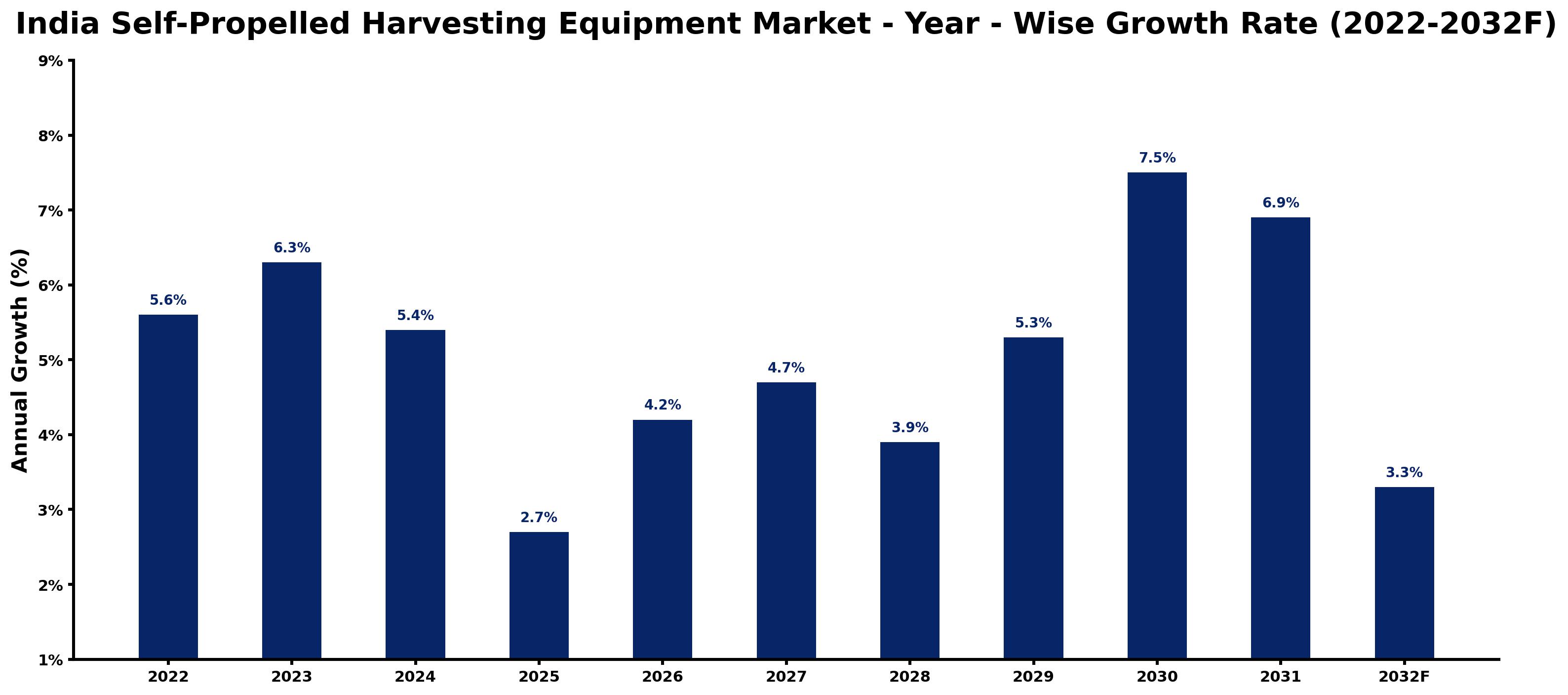
The table below sets out the estimated growth rate for each year and the main factor behind it.
| Year | Estimated Annual Growth (%) | Market Rationale |
| 2022 | 5.6 | The market showed steady growth due to rising mechanization in agriculture, particularly in Punjab and Haryana. |
| 2023 | 6.3 | Demand was boosted by the 'Sub-Mission on Agricultural Mechanization' programme promoting modern equipment. |
| 2024 | 5.4 | A slowdown occurred as farmers faced rising costs of equipment and maintenance, impacting purchasing decisions. |
| 2025 | 2.7 | Growth decreased due to saturation in regions with high mechanization rates, particularly in Punjab. |
| 2026 | 4.2 | Demand is expected to improve due to increased sugarcane production and ongoing mechanization efforts in Haryana. |
| 2027 | 4.7 | Higher demand will arise from the need for efficient harvesting solutions across commercial farms in key states. |
| 2028 | 3.9 | Growth is projected to slow as the market adjusts to new pricing structures and competitive pressures. |
| 2029 | 5.3 | Demand is anticipated to increase as commercial farms expand their operational capacities and seek efficiency. |
| 2030 | 7.5 | The peak growth will be driven by investments in modern agricultural technology and increased mechanization in the sector. |
| 2031 | 6.9 | Growth is projected to slow as the market matures following rapid expansion in previous years. |
| 2032 | 3.3 | A further slowdown is expected as the market reaches maturity and competition intensifies. |
Note: Market size estimations and growth projections presented in this report are based on 6Wresearch's proprietary forecasting methodology, utilizing the latest available industry data, government publications, and primary research inputs.
India Self-Propelled Harvesting Equipment Market Synopsis
The India Self-Propelled Harvesting Equipment Market includes advanced machinery designed for efficient crop harvesting. These machines, typically powered by diesel or hybrid engines, play a crucial role in harvesting grains, sugarcane, and cotton. This trend boosts productivity and lowers labour costs, particularly in key agricultural states like Punjab and Haryana.
Market Dynamics Impact Analysis (2026–2032)
| Factor | Type | Impact | Primary Segment Affected |
| Increased investment in agricultural technology | Driver | High | Combine Harvesters |
| Growing demand for efficient harvesting solutions | Driver | High | Sugarcane Harvesters |
| Government subsidies for equipment purchases | Opportunity | High | Commercial Farms |
| Rising sugarcane production creating demand for specialized harvesters | Opportunity | Medium | Sugarcane Harvesters |
| High initial costs of self-propelled equipment | Restraint | High | Cotton Pickers |
| Limited access to financing for small farmers | Restraint | Medium | Forage Harvesters |
| Supply chain disruptions affecting availability | Challenge | High | Combine Harvesters |
| Regulatory hurdles in equipment approval processes | Challenge | Medium | Sugarcane Harvesters |
Evaluation of Drivers in India Self-Propelled Harvesting Equipment Market (2026–2032)
The main growth drivers and the segments they affect most are set out below.
| Drivers | Primary Segment Affected | Why It Matters (Evidence) |
| Increased investment in agricultural technology | Combine Harvesters | Investment in modern machinery boosts efficiency, with the agricultural machinery market expected to grow significantly by 2025. |
| Growing demand for efficient harvesting solutions | Sugarcane Harvesters | With sugarcane production around 400 million tons annually, demand for specialized harvesters is increasing. |
| Government subsidies for equipment purchases | Commercial Farms | Subsidies can cover up to 50% of costs, encouraging farmers to adopt modern harvesting equipment. |
| Expansion of commercial farms | Cotton Pickers | The average size of commercial farms is about 1.15 hectares, necessitating efficient harvesting solutions. |
| Rising mechanization in agriculture | Forage Harvesters | The 'Sub-Mission on Agricultural Mechanization' aims for a 20% increase in mechanization by 2025. |
Expansion of the Self-Propelled Harvesting Equipment market in India benefits from heightened investment in agricultural technology and a growing interest in efficient harvesting solutions. With sugarcane production at around 400 million tons annually, the demand for specialised harvesters is substantial. The average size of commercial farms, approximately 1.15 hectares, further drives the need for efficient harvesting solutions, propelling market growth. These elements create a supportive environment for suppliers to broaden their offerings and meet increasing demands.
Evaluation of Restraints in India Self-Propelled Harvesting Equipment Market
Below mentioned are some major restraints and their influence on market dynamics.
| Market Restraint | Primary Segment Affected | Why It Matters (Evidence) |
| High initial costs of self-propelled equipment | Cotton Pickers | The cost of advanced machinery can be prohibitive for small-scale farmers, limiting adoption and increasing reliance on manual methods, with prices reaching $50,000. |
| Limited access to financing for small farmers | Forage Harvesters | Many small farmers struggle to secure loans for purchasing expensive harvesting equipment, hindering their ability to mechanize and impacting operational efficiency. |
| Supply chain inefficiencies | Combine Harvesters | A leading supplier on a limited number of suppliers leads to delays in equipment availability, impacting harvest timelines for end users, especially in rural areas. |
| Lack of skilled operators | Sugarcane Harvesters | The cost of advanced machinery can be prohibitive for small-scale farmers, limiting adoption and increasing reliance on manual methods. |
| Market saturation in high mechanization regions | Grains | Regions with high mechanization rates face decreased demand for new equipment, affecting sales growth and market dynamics. |
India Self-Propelled Harvesting Equipment Market Challenges
India's self-propelled harvesting equipment market faces a technology gap, as approximately 60% of cotton is still harvested using traditional methods, limiting efficiency and increasing operational costs by up to 30% for producers. A lack of skilled operators further complicates matters, causing delays in harvesting and risking crop losses for farmers. High initial costs of self-propelled harvesters, with prices reaching $50,000, create financial barriers for small-scale farmers, making it difficult for them to invest in modern machinery. Supply chain inefficiencies stem from reliance on a limited number of suppliers, leading to delays in equipment availability and impacting harvest timelines for end users.
Trends in the India Self-Propelled Harvesting Equipment Market
Four trends stand out in the India Self-Propelled Harvesting Equipment Market.
- Shift from Traditional to Mechanized Harvesting: In Punjab, over 60% of cotton is harvested using mechanised methods, indicating a notable shift towards efficiency in agriculture. This trend is likely to persist as farmers aim to lower labour costs.
- Rise of Hybrid Fuel Options: The adoption of hybrid engines in self-propelled harvesting equipment is gaining momentum, particularly in Haryana, where sustainability is becoming increasingly important. This shift is reflected in the growing number of hybrid models entering the market.
- Growing Adoption of Subsidy Schemes: The 'Pradhan Mantri Kisan Samman Nidhi' scheme has played a key role in boosting the uptake of modern harvesting equipment among farmers, with a budget of ₹75,000 crores supporting purchases and improving accessibility.
- Focus on Specialized Harvesters: The demand for specialised harvesters, especially for sugarcane, has surged since 2021, highlighting the need for efficiency in harvesting the 400 million tons of sugarcane produced annually.
Investment Opportunities in the India Self-Propelled Harvesting Equipment Market
Some of the investment opportunities in the India Self-Propelled Harvesting Equipment Market are mentioned below.
- Partner with Local Manufacturers: Now is an ideal time to invest in partnerships with local manufacturers to access the self-propelled harvesting equipment market, projected to reach USD 557.0 million by 2025, improving distribution capabilities.
- Invest in Financing Solutions for Farmers: With more farmers seeking modern equipment, there is an opportunity to provide financing solutions that cover initial costs, especially in rural areas where access to credit is limited.
- Expand into Emerging Regions: States like Punjab and Haryana are leading in equipment usage, offering opportunities for suppliers to broaden their reach and satisfy rising demand in these agricultural hubs, particularly for sugarcane and cotton harvesting.
- Utilize Government Subsidies: The 'Sub-Mission on Agricultural Mechanization' provides a pathway for suppliers to align with government initiatives, enhancing market penetration and assisting farmers in acquiring modern harvesting technologies.
Government Initiatives in the India Self-Propelled Harvesting Equipment Market
In 2021, the Ministry of Agriculture launched the 'Sub-Mission on Agricultural Mechanization' to promote modern harvesting equipment, aiming for a 20% increase in mechanization by 2025. This initiative encourages farmers to adopt advanced machinery, facilitating access to financial support for purchases and reducing reliance on manual harvesting methods. The scheme aims to cover up to 50% of the costs for eligible farmers, significantly alleviating the financial burden of acquiring new equipment. Additionally, the 'National Agriculture Policy' underscores mechanization's importance in improving productivity and sustainability in agriculture, reinforcing the significance of these measures for the market.
The 'Pradhan Mantri Kisan Samman Nidhi' scheme offers financial assistance for acquiring agricultural equipment, enabling farmers to invest in modern harvesting technologies. With a budget of ₹75,000 crores, this scheme supports the purchase of self-propelled harvesting equipment, improving farmers' operational efficiency. The 'Soil Health Card Scheme' also promotes the adoption of mechanization to boost productivity, further assisting farmers in enhancing their agricultural practices. These initiatives aim to increase the uptake of modern agricultural practices across the country, ensuring that farmers can access the tools they need to succeed.
Future Insight of the India Self-Propelled Harvesting Equipment Market
The self-propelled harvesting equipment market in India is set to evolve by 2032, driven by government initiatives like the 'Sub-Mission on Agricultural Mechanization' that promote mechanization. Technological advancements in hybrid engines will improve fuel efficiency, lowering operational costs for buyers. The average size of commercial farms is likely to grow, necessitating more efficient harvesting solutions. With sugarcane production around 400 million tons annually, suppliers will find opportunities to develop specialised harvesters to meet rising demand.
Market Segmentation Analysis
The analysis below covers each segmentation, its leading category in 2025 and its fastest-growing category through 2032.
By Equipment Type – Combine Harvesters Dominated, Sugarcane Harvesters Expected to Grow Fastest
According to Shubham Padhi, Research Analyst at 6Wresearch, Combine Harvesters took a 36% share of equipment type in 2025, more than any other category. Combine harvesters dominate the market because they are essential for efficiently harvesting grains, a key component of India's agricultural output. Their widespread use in regions like Punjab and Haryana, where grain production is high, solidifies their leading position. Sugarcane Harvesters are set to record the highest CAGR in this split, 7.6% over 2026–2032. Sugarcane harvesters are experiencing rapid growth due to the substantial demand for sugarcane, with production reaching approximately 400 million tons annually. This surge in demand for specialized harvesting solutions is encouraging farmers to adopt these machines more frequently. Suppliers should focus on enhancing the availability of sugarcane harvesters to capitalise on the growing interest in mechanisation within this sector.
By Crop Type – Grains Dominated, Sugarcane Expected to Grow Fastest
Grains accounted for a 41% market share by crop type in 2025. Grains account for the largest share in the self-propelled harvesting equipment market as they are the predominant crop harvested using such machinery. The extensive cultivation of grains across India's over 140 million hectares of arable land highlights their critical role in the agricultural sector. The quickest growth will come from Sugarcane, forecast to expand at a CAGR of 6.5% between 2026 and 2032. Sugarcane is the fastest-growing segment, driven by the increasing need for specialized harvesting equipment to effectively manage the substantial volume of sugarcane production. This growth underscores the importance of advancing mechanization in this crop category. Buyers should invest in sugarcane harvesting solutions to improve operational efficiency and meet rising production requirements.
By Fuel Type – Diesel Dominated, Hybrid Expected to Grow Fastest
With a 38% revenue share in 2025, Diesel was the largest fuel type category. Diesel is the leading fuel type for self-propelled harvesting equipment, primarily due to its availability and efficiency in powering heavy machinery. This widespread use reflects the established infrastructure and familiarity among users in the agricultural sector. Hybrid is projected to grow fastest, at a CAGR of 7.3% during 2026–2032. Hybrid fuel options are rapidly gaining popularity as a sustainable alternative, appealing to environmentally conscious farmers looking to reduce their carbon footprint. This shift indicates a growing interest in eco-friendly agricultural practices. Suppliers should explore hybrid fuel technologies to align with the increasing demand for sustainable harvesting solutions.
By End User – Commercial Farms Dominated, Agro-Cooperatives Expected to Grow Fastest
The largest end user category in 2025 was Commercial Farms, with a 46% share of total revenue. Commercial farms represent the largest user segment for self-propelled harvesting equipment, as they require effective solutions for managing large-scale crop production. Their operational scale necessitates reliable machinery that can optimise harvesting processes and minimise labour expenses. Over 2026–2032, Agro-Cooperatives are expected to post the fastest growth, at a CAGR of 6.2%. Agro-cooperatives are the fastest-growing segment, as they facilitate collective harvesting efforts among farmers, resulting in improved efficiency and reduced costs. This trend reflects a move towards collaborative agricultural strategies that benefit a wider range of stakeholders. Suppliers should tailor their offerings to agro-cooperatives to harness their collective purchasing capabilities and expand their market presence.
Key Attractiveness of the Report
- 10 Years of Market Numbers
- Historical Data Starting from 2022 to 2025
- Base Year 2025
- Forecast Data until 2032
- Key Performance Indicators Impacting the Market
- Major Upcoming Developments and Projects
Key Highlights of the Report:
- India Self-Propelled Harvesting Equipment Market Outlook
- Market Size of India Self-Propelled Harvesting Equipment Market, 2025
- Forecast of India Self-Propelled Harvesting Equipment Market, 2032
- Historical Data and Forecast of India Self-Propelled Harvesting Equipment Revenues & Volume for the Period 2022 - 2032F
- India Self-Propelled Harvesting Equipment Market Trend Evolution
- India Self-Propelled Harvesting Equipment Market Drivers and Challenges
- India Self-Propelled Harvesting Equipment Price Trends
- India Self-Propelled Harvesting Equipment Porter's Five Forces
- India Self-Propelled Harvesting Equipment Industry Life Cycle
- Historical Data and Forecast of India Self-Propelled Harvesting Equipment Market Revenues & Volume By Equipment Type for the Period 2022 - 2032F
- Historical Data and Forecast of India Self-Propelled Harvesting Equipment Market Revenues & Volume By Combine Harvesters for the Period 2022 - 2032F
- Historical Data and Forecast of India Self-Propelled Harvesting Equipment Market Revenues & Volume By Sugarcane Harvesters for the Period 2022 - 2032F
- Historical Data and Forecast of India Self-Propelled Harvesting Equipment Market Revenues & Volume By Cotton Pickers for the Period 2022 - 2032F
- Historical Data and Forecast of India Self-Propelled Harvesting Equipment Market Revenues & Volume By Forage Harvesters for the Period 2022 - 2032F
- Historical Data and Forecast of India Self-Propelled Harvesting Equipment Market Revenues & Volume By Crop Type for the Period 2022 - 2032F
- Historical Data and Forecast of India Self-Propelled Harvesting Equipment Market Revenues & Volume By Grains for the Period 2022 - 2032F
- Historical Data and Forecast of India Self-Propelled Harvesting Equipment Market Revenues & Volume By Sugarcane for the Period 2022 - 2032F
- Historical Data and Forecast of India Self-Propelled Harvesting Equipment Market Revenues & Volume By Cotton for the Period 2022 - 2032F
- Historical Data and Forecast of India Self-Propelled Harvesting Equipment Market Revenues & Volume By Fodder Crops for the Period 2022 - 2032F
- Historical Data and Forecast of India Self-Propelled Harvesting Equipment Market Revenues & Volume By Fuel Type for the Period 2022 - 2032F
- Historical Data and Forecast of India Self-Propelled Harvesting Equipment Market Revenues & Volume By Diesel for the Period 2022 - 2032F
- Historical Data and Forecast of India Self-Propelled Harvesting Equipment Market Revenues & Volume By Hybrid for the Period 2022 - 2032F
- Historical Data and Forecast of India Self-Propelled Harvesting Equipment Market Revenues & Volume By Electric-Diesel for the Period 2022 - 2032F
- Historical Data and Forecast of India Self-Propelled Harvesting Equipment Market Revenues & Volume By Biofuel for the Period 2022 - 2032F
- Historical Data and Forecast of India Self-Propelled Harvesting Equipment Market Revenues & Volume By End User for the Period 2022 - 2032F
- Historical Data and Forecast of India Self-Propelled Harvesting Equipment Market Revenues & Volume By Commercial Farms for the Period 2022 - 2032F
- Historical Data and Forecast of India Self-Propelled Harvesting Equipment Market Revenues & Volume By Agro-Cooperatives for the Period 2022 - 2032F
- Historical Data and Forecast of India Self-Propelled Harvesting Equipment Market Revenues & Volume By Textile Crop Farmers for the Period 2022 - 2032F
- Historical Data and Forecast of India Self-Propelled Harvesting Equipment Market Revenues & Volume By Cattle Feed Producers for the Period 2022 - 2032F
- India Self-Propelled Harvesting Equipment Import Export Trade Statistics
- Market Opportunity Assessment By Equipment Type
- Market Opportunity Assessment By Crop Type
- Market Opportunity Assessment By Fuel Type
- Market Opportunity Assessment By End User
- India Self-Propelled Harvesting Equipment Top Companies Market Share
- India Self-Propelled Harvesting Equipment Competitive Benchmarking By Technical and Operational Parameters
- India Self-Propelled Harvesting Equipment Company Profiles
- India Self-Propelled Harvesting Equipment Key Strategic Recommendations
Market Covered
The report offers an extensive study of the following market segments.
By Equipment Type
- Combine Harvesters
- Sugarcane Harvesters
- Cotton Pickers
- Forage Harvesters
By Crop Type
- Grains
- Sugarcane
- Cotton
- Fodder Crops
By Fuel Type
- Diesel
- Hybrid
- Electric-Diesel
- Biofuel
By End User
- Commercial Farms
- Agro-Cooperatives
- Textile Crop Farmers
- Cattle Feed Producers































