China Self-Propelled Harvesting Equipment Market Size & Growth Rate
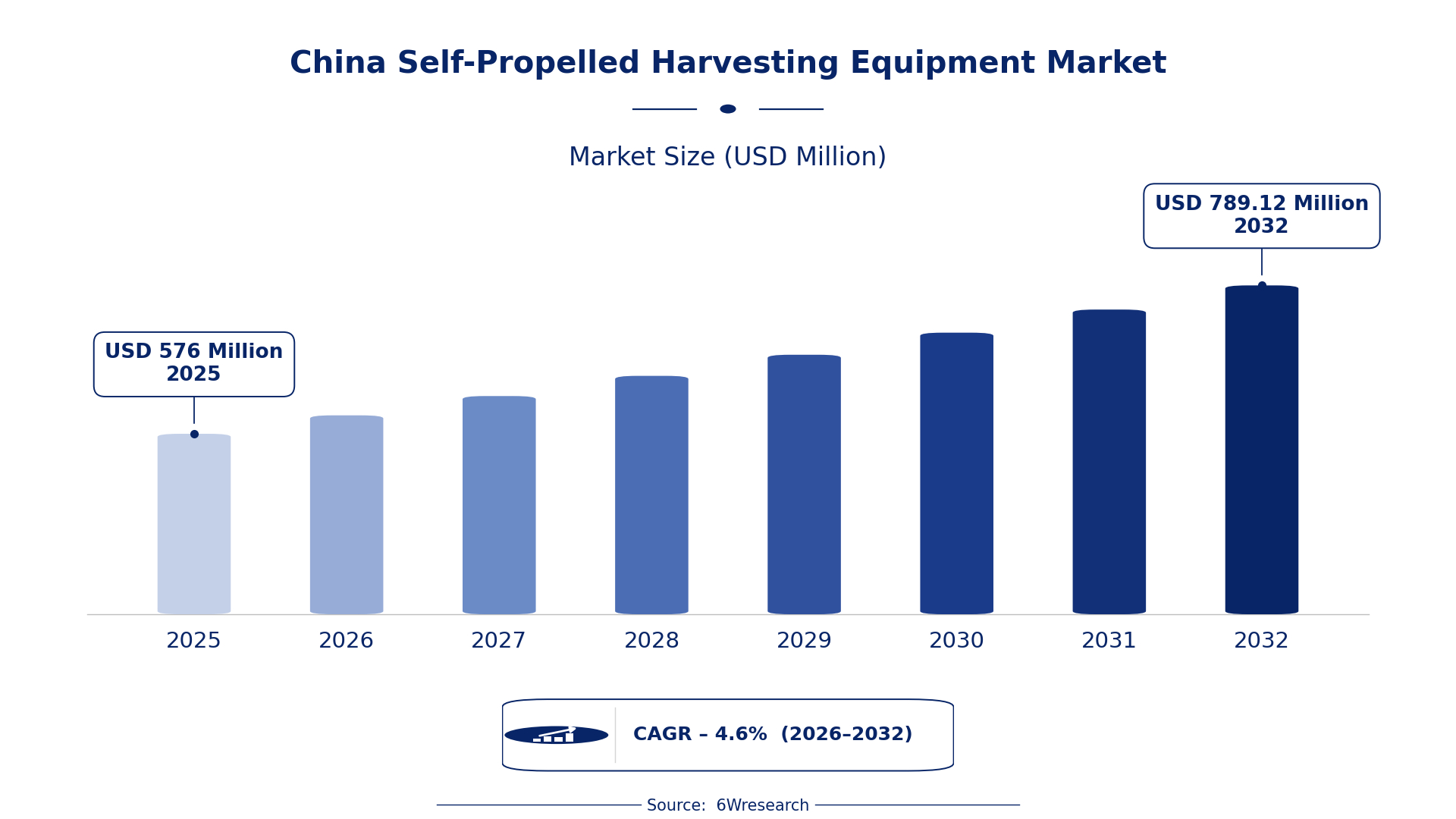
According to 6Wresearch internal database and industry insights, the China Self-Propelled Harvesting Equipment Market was valued at USD 576.0 million in 2025 and is projected to reach USD 789.12 million by 2032, growing at a CAGR of approximately 4.6% during 2026–2032.
China Self-Propelled Harvesting Equipment Market Highlights
| Report Metric | Details |
| Report Name | China Self-Propelled Harvesting Equipment Market |
| Market Size 2025 | USD 576.0 million |
| Market Size 2032 | USD 789.12 million |
| Absolute Growth 2025–2032 | USD 213.12 million |
| CAGR 2026–2032 | 4.6% |
| Peak Annual Growth | 6.6% in 2031 |
| Forecast Period | 2026–2032 |
| Historical Data | 2022–2025 |
| Base Year | 2025 |
| Leading Equipment Type, 2025 | Combine Harvesters (42% share) |
| Leading Crop Type, 2025 | Grains (41% share) |
| Leading Fuel Type, 2025 | Diesel (39% share) |
| Leading End User, 2025 | Commercial Farms (36% share) |
| Fastest-Growing Equipment Type | Sugarcane Harvesters (7.3% CAGR) |
| Fastest-Growing Crop Type | Sugarcane (5.9% CAGR) |
| Fastest-Growing Fuel Type | Hybrid (7.2% CAGR) |
| Fastest-Growing End User | Agro-Cooperatives (6.1% CAGR) |
| Growing Sector | Commercial Farming |
| Key End Users | Commercial Farms, Agro-Cooperatives, Cotton Producers, Cattle Feed Producers |
China Self-Propelled Harvesting Equipment Market Year-wise Growth Rate and Key Drivers (2022–2032)
This graph illustrates the annual growth rates of the market from 2022 to 2032, highlighting a steady upward trajectory and projected market expansion over the forecast period.
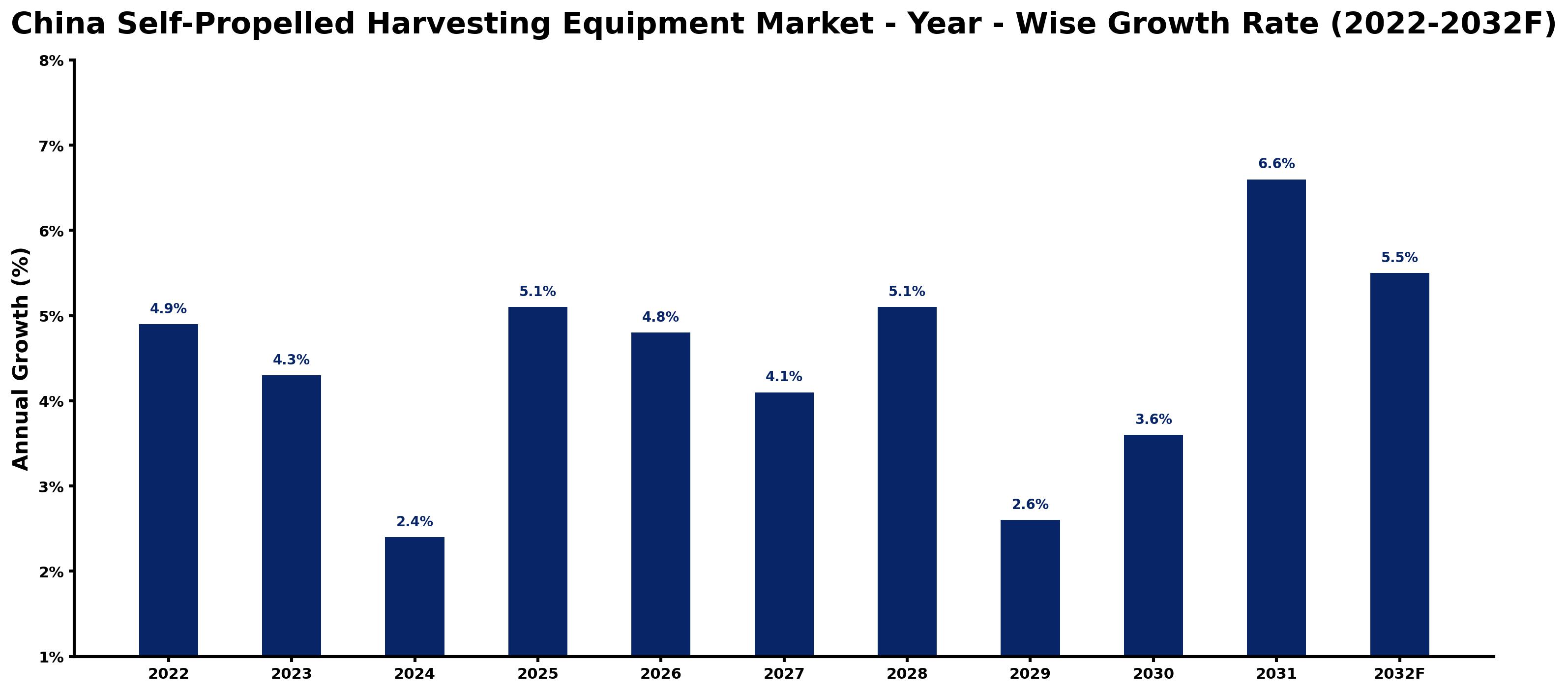
Each row of the following table gives one year's estimated growth and the event or demand shift that explains it.
| Year | Estimated Annual Growth (%) | Market Rationale |
| 2022 | 4.9 | The market experienced steady growth due to increased agricultural mechanization efforts. |
| 2023 | 4.3 | Demand growth slowed as farmers adjusted to rising equipment costs and supply chain issues. |
| 2024 | 2.4 | Market growth continued to slow, reflecting cautious investment in new harvesting technologies. |
| 2025 | 5.1 | A surge in grain production boosted demand for combine harvesters significantly. |
| 2026 | 4.8 | Growth slowed as the market faced challenges from fluctuating fuel prices. |
| 2027 | 4.1 | Continued investment in mechanization led to a further slowdown in growth rates. |
| 2028 | 5.1 | A recovery in demand for sugarcane harvesters contributed to a faster growth rate. |
| 2029 | 2.6 | Growth slowed again as market saturation began to impact purchasing decisions. |
| 2030 | 3.6 | Increased demand for efficient harvesting methods drove growth higher once more. |
| 2031 | 6.6 | The market peaked with significant investments in modern agricultural technologies. |
| 2032 | 5.5 | Growth slowed as the market stabilised after reaching a peak in demand. |
Note: Market size estimations and growth projections presented in this report are based on 6Wresearch's proprietary forecasting methodology, utilizing the latest available industry data, government publications, and primary research inputs.
China Self-Propelled Harvesting Equipment Market Synopsis
Self-Propelled Harvesting Equipment Market in China includes mechanised machines designed for autonomous crop harvesting. These advanced machines improve efficiency in harvesting grains, sugarcane, cotton, and forage crops. The market is expanding due to increased agricultural mechanisation and growing demand from commercial farms and agro-cooperatives. With over 200 million hectares of arable land, the need for effective harvesting solutions is critical. Government initiatives, such as the 'Modern Agricultural Equipment Promotion Plan', are further propelling this growth.
Market Dynamics Impact Analysis (2026–2032)
| Factor | Type | Impact | Primary Segment Affected |
| Rising agricultural mechanization initiatives are increasing demand for efficient harvesting solutions. | Driver | High | Combine Harvesters |
| The growing scale of commercial farms is driving the need for advanced harvesting equipment. | Driver | High | Sugarcane Harvesters |
| The increasing cotton production presents opportunities for efficient harvesting equipment. | Opportunity | High | Cotton Pickers |
| Agro-cooperatives are expanding their operations, creating demand for modern harvesting solutions. | Opportunity | Medium | Forage Harvesters |
| High initial costs of self-propelled harvesting equipment can deter potential buyers. | Restraint | High | Commercial Farms |
| Supply chain disruptions have impacted the availability of harvesting equipment. | Restraint | Medium | Sugarcane Harvesters |
| Fluctuating fuel prices create uncertainty for buyers of diesel-powered equipment. | Challenge | High | Combine Harvesters |
| Approval delays for new equipment standards hinder timely market entry. | Challenge | Medium | Cotton Pickers |
Evaluation of Drivers in China Self-Propelled Harvesting Equipment Market (2026–2032)
Below mentioned are some major drivers and their influence on market dynamics.
| Drivers | Primary Segment Affected | Why It Matters (Evidence) |
| Increased investment in agricultural mechanization promotes the adoption of self-propelled equipment, with the installed base of combine harvesters estimated at 1.5 million units in 2023. | Combine Harvesters | This investment drives demand from commercial farms seeking efficiency. |
| The rise in grain production, reaching 650 million tons in 2022, fuels the need for efficient harvesting solutions. | Grains | Farmers are purchasing more combine harvesters to manage larger yields. |
| The 'National Plan for Agricultural Mechanization Development (2021-2025)' aims for a 70% mechanization rate by 2025, boosting demand for harvesting equipment. | Sugarcane Harvesters | This plan encourages farmers to invest in modern harvesting technologies. |
| The average size of commercial farms in China is around 50 hectares, leading to increased demand for efficient harvesting solutions. | Commercial Farms | Larger farm sizes necessitate advanced equipment for productivity. |
| The annual cotton production of approximately 5.5 million tons drives demand for efficient cotton harvesting equipment. | Cotton Pickers | Producers require effective solutions to enhance yield and quality. |
Market growth in China for Self-Propelled Harvesting Equipment rests on increased investment in agricultural mechanization, expanding end-use demand, and rising production levels. The installed base of combine harvesters, estimated at 1.5 million units in 2023, reflects significant investment in this sector. Grain production reached 650 million tons in 2022, prompting farmers to seek efficient harvesting solutions. The 'National Plan for Agricultural Mechanization Development (2021-2025)' targets a 70% mechanization rate by 2025, further driving demand. Additionally, the average size of commercial farms is around 50 hectares, necessitating advanced harvesting equipment to enhance productivity.
Evaluation of Restraints in China Self-Propelled Harvesting Equipment Market
The table below lists the restraints and the evidence behind each.
| Market Restraint | Primary Segment Affected | Why It Matters (Evidence) |
| High initial costs of self-propelled harvesting equipment can deter potential buyers, impacting commercial farm investments. | Commercial Farms | This financial barrier limits the adoption of advanced harvesting technologies, making it difficult for farmers to upgrade their equipment. |
| Supply chain disruptions have impacted the availability of harvesting equipment, causing delays in procurement for farmers. | Sugarcane Harvesters | Farmers are unable to acquire necessary equipment in a timely manner, affecting their operational efficiency during peak seasons. |
| Fluctuating fuel prices create uncertainty for buyers of diesel-powered equipment, affecting operational costs. | Cotton Pickers | This volatility complicates budgeting for farmers, impacting their purchasing decisions for new equipment. |
| Limited awareness of hybrid and electric-diesel options restricts market expansion for alternative fuel types. | Forage Harvesters | Farmers may overlook these options, missing out on potential benefits, which hinders market growth. |
| Regulatory compliance with updated safety standards increases operational costs for manufacturers, affecting pricing. | Combine Harvesters | Manufacturers face challenges in meeting new regulations, which can delay product launches and increase costs. |
China Self-Propelled Harvesting Equipment Market Challenges
Producers in the China self-propelled harvesting equipment market face rising costs driven by increased raw material prices, which can elevate production expenses by up to 15% within a year. Compliance with national standards like GB/T 19283-2019 complicates the approval process, causing delays that hinder suppliers from launching new products promptly. Many buyers contend with outdated technology, limiting their operational efficiency and competitiveness in a rapidly changing market. Supply chain disruptions in securing diesel, the primary fuel for over 80% of these machines, can lead to operational delays during critical harvesting seasons.
Trends in the China Self-Propelled Harvesting Equipment Market
Several trends are reshaping the China Self-Propelled Harvesting Equipment Market; the most important are set out below.
- Shift from Diesel to Hybrid Fuel Types: In 2023, the Ministry of Industry and Information Technology released guidelines to promote hybrid harvesting equipment. This shift is projected to increase adoption rates, with hybrid models expected to grow at a CAGR of 7.2%. Buyers are increasingly interested in environmentally friendly options.
- Transition to Larger Commercial Farms: The average size of commercial farms in China is around 50 hectares, leading to a greater need for efficient harvesting solutions. This trend is driving demand for advanced self-propelled equipment, as larger operations require improved productivity.
- Emergence of Advanced Safety Standards: The updated 'Standards for Agricultural Machinery Safety' in 2022 aim to improve safety regulations for harvesting equipment. This change ensures that manufacturers meet higher safety standards, benefiting both producers and buyers by increasing equipment reliability.
- Increasing Adoption of Mechanization Initiatives: The 'Modern Agricultural Equipment Promotion Plan' initiated in 2023 aims to promote mechanization in farming. With a budget of 1 billion yuan, this initiative is expected to accelerate the adoption of self-propelled harvesting equipment among farmers.
Investment Opportunities in the China Self-Propelled Harvesting Equipment Market
Some of the investment opportunities in the China Self-Propelled Harvesting Equipment Market are mentioned below.
- Commercial Farms Seeking Efficiency: With the average size of commercial farms at 50 hectares, there is a growing demand for efficient harvesting solutions. Investing in self-propelled harvesting equipment can meet this need, particularly among large-scale operations in regions like Guangdong.
- Agro-Cooperatives Expanding Operations: The annual production of cotton in China is approximately 5.5 million tons, highlighting a demand gap for efficient cotton harvesting equipment. Suppliers can target this sector by offering advanced harvesting solutions to cotton producers.
- Rural Revitalization Strategy Implementation: The 'Rural Revitalization Strategy' initiated in 2020 promotes modern agricultural technologies. This provides an opportunity for investment in self-propelled harvesting equipment, particularly in rural areas looking to improve productivity.
- Investment in Mechanization Technologies: With the goal of achieving a 70% mechanization rate by 2025, there is a significant opportunity for suppliers to invest in advanced harvesting technologies. Targeting agro-cooperatives will be key to capturing this growing market.
Government Initiatives in the China Self-Propelled Harvesting Equipment Market
The 'Agricultural Machinery Purchase Subsidy Program' launched in 2021 supports farmers in acquiring self-propelled harvesting equipment, with a budget of 1 billion yuan. This program aims to reduce the financial burden on farmers and encourage the adoption of modern harvesting technologies. Additionally, the 'National Agricultural Mechanization Development Plan (2021-2025)' targets a 70% mechanization rate by 2025, promoting the market for self-propelled equipment. These initiatives are vital for improving agricultural efficiency and productivity across the sector.
The Ministry of Agriculture and Rural Affairs oversees agricultural mechanization initiatives in China, ensuring effective implementation of programs like the 'Modern Agricultural Equipment Promotion Plan'. This agency funds various projects aimed at enhancing mechanization levels in farming. Furthermore, the Ministry of Industry and Information Technology provides guidelines and support for the development of electric-diesel hybrid harvesting equipment, facilitating innovation in the sector. These efforts are essential for advancing agricultural practices and meeting the increasing need for efficient harvesting solutions.
Future Insight of the China Self-Propelled Harvesting Equipment Market
By 2032, the China self-propelled harvesting equipment market is set to evolve significantly, propelled by government initiatives such as the 'Modern Agricultural Equipment Promotion Plan' and the 'National Plan for Agricultural Mechanization Development (2021-2025)', which aims to boost mechanization rates. The installed base of harvesting equipment is projected to surpass 2 million units, providing buyers with enhanced productivity. Advancements in technology will lead to the development of more efficient harvesting solutions, benefiting both suppliers and producers. Furthermore, the expansion of arable land, exceeding 200 million hectares, will drive increased demand for modern harvesting solutions.
Market Segmentation Analysis
The report offers a comprehensive study of the following market segments and their leading categories in the market.
By Equipment Type – Combine Harvesters Dominated, Sugarcane Harvesters Expected to Grow Fastest
According to Shubham Padhi, Research Analyst at 6Wresearch, Combine Harvesters accounted for a 42% market share by equipment type in 2025. Combine harvesters hold the largest market share due to their essential role in efficiently harvesting grains, which are vital for food security in China. With an installed base of approximately 1.5 million units, they are indispensable for large-scale agricultural operations. The quickest growth will come from Sugarcane Harvesters, forecast to expand at a CAGR of 7.3% between 2026 and 2032. Sugarcane harvesters are experiencing rapid growth as demand for sugar production rises, particularly in key regions like Guangdong and Guangxi. The government's initiatives to promote modern agricultural practices are significantly increasing the adoption of these machines. Suppliers should focus on developing sugarcane harvesting equipment to capitalise on this growing market segment.
By Crop Type – Grains Dominated, Sugarcane Expected to Grow Fastest
Grains took a 41% share of crop type in 2025, more than any other category. Grains dominate the market share as they are the primary crops harvested using self-propelled harvesting equipment, highlighted by China's grain production of 650 million tons in 2022. This substantial output creates a robust demand for effective harvesting solutions. Sugarcane is set to record the highest CAGR in this split, 5.9% over 2026–2032. Sugarcane is the fastest-growing crop segment, driven by its importance in sugar production and the increasing area designated for its cultivation, especially in southern provinces. Government initiatives aimed at enhancing mechanization in this crop further accelerate its growth. Buyers should consider investing in sugarcane harvesting technologies to align with the rising demand and improve their operational efficiency.
By Fuel Type – Diesel Dominated, Hybrid Expected to Grow Fastest
Diesel held a 39% share of the China Self-Propelled Harvesting Equipment Market by fuel type in 2025. Diesel is the predominant fuel type for self-propelled harvesting equipment, accounting for over 80% of usage, due to its availability and efficiency in powering these machines. This widespread adoption solidifies diesel's position as the market leader. Over 2026–2032, Hybrid is expected to post the fastest growth, at a CAGR of 7.2%. Hybrid fuel types are gaining traction as they offer potential environmental benefits, aligning with global trends towards sustainability in agriculture. The increasing awareness and government support for cleaner technologies are expected to boost hybrid adoption. Suppliers need to innovate and expand their hybrid fuel offerings to meet the changing preferences of environmentally conscious buyers.
By End User – Commercial Farms Dominated, Agro-Cooperatives Expected to Grow Fastest
The largest end user category in 2025 was Commercial Farms, with a 36% share of total revenue. Commercial farms represent the largest end-user segment for self-propelled harvesting equipment, as the average size of around 50 hectares necessitates efficient harvesting solutions. Their operational scale ensures a consistent demand for these machines. Agro-Cooperatives are projected to grow fastest, at a CAGR of 6.1% during 2026–2032. Agro-cooperatives are the fastest-growing end-user segment, as collective farming initiatives gain momentum, enhancing productivity and resource sharing among farmers. This trend is supported by government efforts to advance agricultural mechanization. Suppliers should tailor their offerings to meet the specific needs of agro-cooperatives, ensuring they provide effective solutions for collaborative farming.
Key Attractiveness of the Report
- 10 Years of Market Numbers
- Historical Data Starting from 2022 to 2025
- Base Year 2025
- Forecast Data until 2032
- Key Performance Indicators Impacting the Market
- Major Upcoming Developments and Projects
Key Highlights of the Report:
- China Self-Propelled Harvesting Equipment Market Outlook
- Market Size of China Self-Propelled Harvesting Equipment Market, 2025
- Forecast of China Self-Propelled Harvesting Equipment Market, 2032
- Historical Data and Forecast of China Self-Propelled Harvesting Equipment Revenues & Volume for the Period 2022 - 2032F
- China Self-Propelled Harvesting Equipment Market Trend Evolution
- China Self-Propelled Harvesting Equipment Market Drivers and Challenges
- China Self-Propelled Harvesting Equipment Price Trends
- China Self-Propelled Harvesting Equipment Porter's Five Forces
- China Self-Propelled Harvesting Equipment Industry Life Cycle
- Historical Data and Forecast of China Self-Propelled Harvesting Equipment Market Revenues & Volume By Equipment Type for the Period 2022 - 2032F
- Historical Data and Forecast of China Self-Propelled Harvesting Equipment Market Revenues & Volume By Combine Harvesters for the Period 2022 - 2032F
- Historical Data and Forecast of China Self-Propelled Harvesting Equipment Market Revenues & Volume By Sugarcane Harvesters for the Period 2022 - 2032F
- Historical Data and Forecast of China Self-Propelled Harvesting Equipment Market Revenues & Volume By Cotton Pickers for the Period 2022 - 2032F
- Historical Data and Forecast of China Self-Propelled Harvesting Equipment Market Revenues & Volume By Forage Harvesters for the Period 2022 - 2032F
- Historical Data and Forecast of China Self-Propelled Harvesting Equipment Market Revenues & Volume By Crop Type for the Period 2022 - 2032F
- Historical Data and Forecast of China Self-Propelled Harvesting Equipment Market Revenues & Volume By Grains for the Period 2022 - 2032F
- Historical Data and Forecast of China Self-Propelled Harvesting Equipment Market Revenues & Volume By Sugarcane for the Period 2022 - 2032F
- Historical Data and Forecast of China Self-Propelled Harvesting Equipment Market Revenues & Volume By Cotton for the Period 2022 - 2032F
- Historical Data and Forecast of China Self-Propelled Harvesting Equipment Market Revenues & Volume By Fodder Crops for the Period 2022 - 2032F
- Historical Data and Forecast of China Self-Propelled Harvesting Equipment Market Revenues & Volume By Fuel Type for the Period 2022 - 2032F
- Historical Data and Forecast of China Self-Propelled Harvesting Equipment Market Revenues & Volume By Diesel for the Period 2022 - 2032F
- Historical Data and Forecast of China Self-Propelled Harvesting Equipment Market Revenues & Volume By Hybrid for the Period 2022 - 2032F
- Historical Data and Forecast of China Self-Propelled Harvesting Equipment Market Revenues & Volume By Electric-Diesel for the Period 2022 - 2032F
- Historical Data and Forecast of China Self-Propelled Harvesting Equipment Market Revenues & Volume By Biofuel for the Period 2022 - 2032F
- Historical Data and Forecast of China Self-Propelled Harvesting Equipment Market Revenues & Volume By End User for the Period 2022 - 2032F
- Historical Data and Forecast of China Self-Propelled Harvesting Equipment Market Revenues & Volume By Commercial Farms for the Period 2022 - 2032F
- Historical Data and Forecast of China Self-Propelled Harvesting Equipment Market Revenues & Volume By Agro-Cooperatives for the Period 2022 - 2032F
- Historical Data and Forecast of China Self-Propelled Harvesting Equipment Market Revenues & Volume By Textile Crop Farmers for the Period 2022 - 2032F
- Historical Data and Forecast of China Self-Propelled Harvesting Equipment Market Revenues & Volume By Cattle Feed Producers for the Period 2022 - 2032F
- China Self-Propelled Harvesting Equipment Import Export Trade Statistics
- Market Opportunity Assessment By Equipment Type
- Market Opportunity Assessment By Crop Type
- Market Opportunity Assessment By Fuel Type
- Market Opportunity Assessment By End User
- China Self-Propelled Harvesting Equipment Top Companies Market Share
- China Self-Propelled Harvesting Equipment Competitive Benchmarking By Technical and Operational Parameters
- China Self-Propelled Harvesting Equipment Company Profiles
- China Self-Propelled Harvesting Equipment Key Strategic Recommendations
Market Covered
This report examines the market across the segments below.
By Equipment Type
- Combine Harvesters
- Sugarcane Harvesters
- Cotton Pickers
- Forage Harvesters
By Crop Type
- Grains
- Sugarcane
- Cotton
- Fodder Crops
By Fuel Type
- Diesel
- Hybrid
- Electric-Diesel
- Biofuel
By End User
- Commercial Farms
- Agro-Cooperatives
- Textile Crop Farmers
- Cattle Feed Producers































