India Self-Service Laundry Systems Market Size & Growth Rate
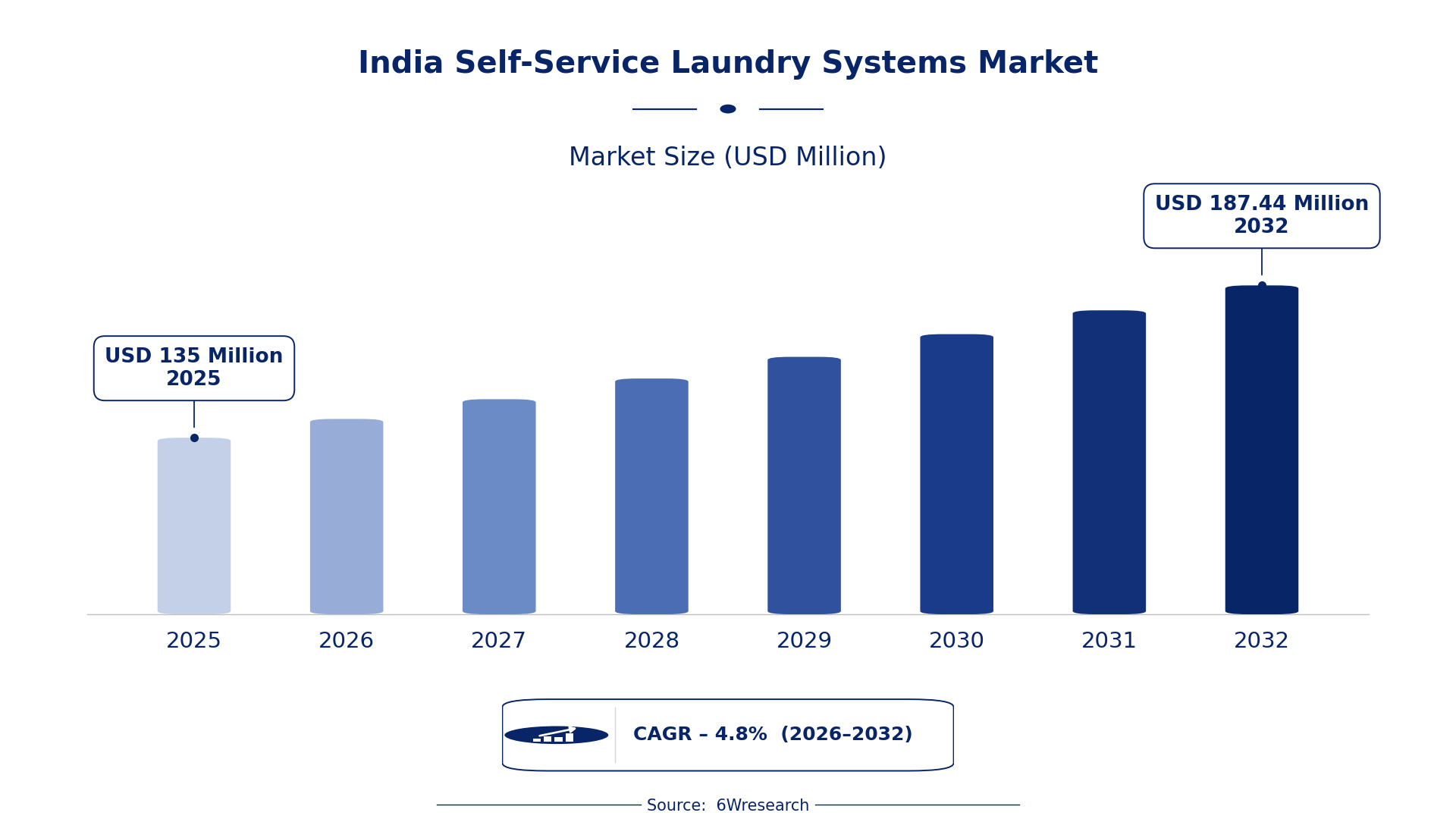
According to 6Wresearch internal database and industry insights, the India Self-Service Laundry Systems Market was valued at USD 135.0 million in 2025 and is projected to reach USD 187.44 million by 2032, growing at a CAGR of approximately 4.8% during 2026–2032.
India Self-Service Laundry Systems Market Highlights
| Report Metric | Details |
| Report Name | India Self-Service Laundry Systems Market |
| Market Size 2025 | USD 135.0 million |
| Market Size 2032 | USD 187.44 million |
| Absolute Growth 2025–2032 | USD 52.44 million |
| CAGR 2026–2032 | 4.8% |
| Peak Annual Growth | 7.5% in 2032 |
| Forecast Period | 2026–2032 |
| Historical Data | 2022–2025 |
| Base Year | 2025 |
| Leading System Type, 2025 | Fully Automated Units (38% share) |
| Leading Operation Type, 2025 | App-Controlled (48% share) |
| Leading Payment Mode, 2025 | UPI/Wallet (46% share) |
| Leading End User, 2025 | Urban Laundromats (44% share) |
| Fastest-Growing System Type | Smart Wash Stations (7.2% CAGR) |
| Fastest-Growing Payment Mode | Coin/Card (7.5% CAGR) |
| Fastest-Growing End User | Residential Complexes (6.9% CAGR) |
| Growing Sector | Urban Laundromats |
| Key End Users | Urban Laundromats, Student Hostels, Residential Complexes, Hotels & Hospitals |
India Self-Service Laundry Systems Market Year-wise Growth Rate and Key Drivers (2022–2032)
This graph illustrates the annual growth rates of the market from 2022 to 2032, highlighting a steady upward trajectory and projected market expansion over the forecast period.
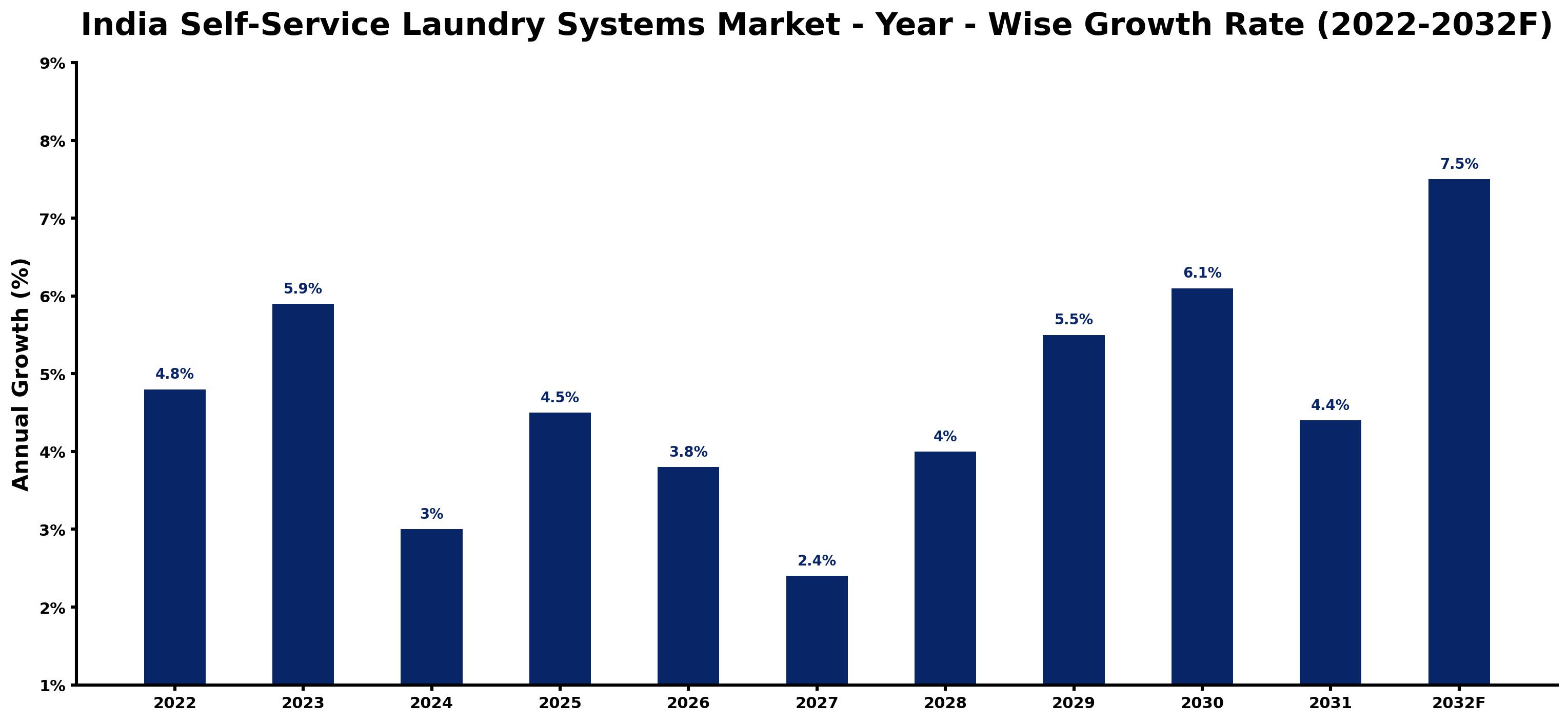
Year by year, the estimates below pair each growth rate with the development that shaped it.
| Year | Estimated Annual Growth (%) | Market Rationale |
| 2022 | 4.8 | The market experienced steady growth, driven by increasing urbanisation and the National Cleanliness Programme promoting modern laundry facilities. |
| 2023 | 5.9 | Demand surged as more urban laundromats adopted self-service systems, enhancing convenience for users. |
| 2024 | 3.0 | Growth slowed as some urban areas faced saturation in laundry services, impacting new installations. |
| 2025 | 4.5 | A rise in student hostels adopting self-service systems boosted market performance, reflecting changing consumer preferences. |
| 2026 | 3.8 | Growth decelerated due to increasing competition among service providers, affecting pricing strategies. |
| 2027 | 2.4 | Demand continued to slow as market maturity set in, influencing expansion plans for operators. |
| 2028 | 4.0 | A resurgence in urban laundromat installations led to improved growth rates, driven by rising disposable incomes. |
| 2029 | 5.5 | Increased preference for self-service options among urban residents drove demand higher, particularly in metropolitan areas. |
| 2030 | 6.1 | Growth accelerated as premium hotels installed more fully automated units, catering to high-demand settings. |
| 2031 | 4.4 | A slight slowdown occurred as market conditions began to stabilise, influencing new investments. |
| 2032 | 7.5 | The market peaked as urbanisation and digital payment adoption surged, enhancing consumer access to services. |
Note: Market size estimations and growth projections presented in this report are based on 6Wresearch's proprietary forecasting methodology, utilizing the latest available industry data, government publications, and primary research inputs.
India Self-Service Laundry Systems Market Synopsis
Self-Service Laundry Systems in India offer automated solutions for efficient laundry services, primarily catering to urban laundromats, student hostels, and residential complexes. The India Self-Service Laundry Systems Market is expanding due to urbanisation, rising disposable incomes, and a transition towards digital payment methods. The National Cleanliness Programme and a growing student population are key drivers of this expansion, as they increase the demand for convenient laundry solutions. In 2023, more than 1,000 urban laundromats are employing these systems, showcasing the market's growth.
Market Dynamics Impact Analysis (2026–2032)
| Factor | Type | Impact | Primary Segment Affected |
| Urbanisation is increasing demand for convenient laundry solutions in cities. | Driver | High | Urban Laundromats |
| The rise of digital payment methods is facilitating easier transactions. | Driver | High | UPI/Wallet |
| Growing student populations in urban areas create a need for laundry services. | Opportunity | High | Student Hostels |
| The trend towards modern amenities in residential complexes presents new markets. | Opportunity | High | Residential Complexes |
| Competition among service providers may lead to price wars affecting margins. | Restraint | Medium | Urban Laundromats |
| Limited consumer awareness about advanced laundry technologies can hinder growth. | Restraint | Medium | Smart Wash Stations |
| High initial investment costs for setting up self-service systems can deter new entrants. | Challenge | High | Fully Automated Units |
| Technological integration challenges may slow down operational efficiency improvements. | Challenge | Medium | App-Controlled |
Evaluation of Drivers in India Self-Service Laundry Systems Market (2026–2032)
Key forces behind demand, with the segment each one moves most, are listed below.
| Drivers | Primary Segment Affected | Why It Matters (Evidence) |
| Increasing urbanisation drives demand for self-service laundry systems. | Urban Laundromats | With over 1,000 urban laundromats in India, the need for efficient laundry solutions is growing. |
| Rising disposable incomes are leading to higher spending on laundry services. | Residential Complexes | As disposable income rises, more residents are willing to invest in convenient laundry options. |
| The National Cleanliness Programme promotes modern laundry facilities in urban areas. | Student Hostels | This initiative encourages hostels to adopt self-service systems to improve hygiene standards. |
| Digital payment adoption simplifies transactions for consumers. | UPI/Wallet | The Digital India initiative supports the use of digital payments, making laundry services more accessible. |
| Smart wash stations are gaining popularity among tech-savvy users. | Smart Wash Stations | Metropolitan cities like Mumbai and Delhi are seeing increased installations of these modern conveniences. |
Growth in the Self-Service Laundry Systems market in India stems from rising urbanisation, increasing disposable incomes, and a shift towards digital payment methods. In metropolitan areas, the preference for self-service laundry options is on the rise, with over 60% of urban residents choosing these services for their convenience. As disposable income increases, more residents are inclined to invest in convenient laundry solutions, resulting in a higher number of fully automated units being installed in premium hotels. The move towards cashless transactions is also making these services more accessible to consumers, further propelling market growth.
Evaluation of Restraints in India Self-Service Laundry Systems Market
The main factors holding the market back are set out below.
| Market Restraint | Primary Segment Affected | Why It Matters (Evidence) |
| High initial investment costs for self-service systems can deter new entrants. | Fully Automated Units | The cost of setting up fully automated units can be prohibitive for many potential operators. |
| Limited consumer awareness about advanced laundry technologies can hinder growth. | Smart Wash Stations | Many consumers remain unaware of the benefits of smart wash stations, affecting adoption rates. |
| Competition among service providers may lead to price wars affecting margins. | Urban Laundromats | As more players enter the market, aggressive pricing strategies can reduce profitability. |
| Technological integration challenges may slow down operational efficiency improvements. | App-Controlled | Operators may struggle with integrating new technologies into existing systems, delaying upgrades. |
| Regulatory compliance costs can burden operators of self-service systems. | Coin-Operated Washers | Meeting safety standards set by the Bureau of Indian Standards requires additional investment. |
India Self-Service Laundry Systems Market Challenges
The India Self-Service Laundry Systems market faces high initial investment costs, with producers needing to allocate approximately 20% of their budget for equipment and technology. Urban laundromats struggle with fluctuating operational costs due to inconsistent energy prices, which can increase expenses by up to 15%. Regulatory compliance with safety guidelines from the Bureau of Indian Standards can delay equipment deployment for up to six months, affecting buyers' service offerings. Supply chain disruptions stem from limited availability of advanced technology components, resulting in increased costs and extended delivery timelines for producers.
Trends in the India Self-Service Laundry Systems Market
Several trends are reshaping the India Self-Service Laundry Systems Market; the most important are set out below.
- Shift towards Smart Wash Stations: In 2023, smart wash stations gained popularity in urban areas, particularly in Mumbai and Delhi, with a reported increase of 15% in installations. This trend indicates a growing preference for technology-driven convenience among users.
- Rise of Digital Payments: Since the launch of the Digital India initiative in 2020, digital payment methods have surged in popularity, with over 60% of urban residents now opting for cashless transactions for laundry services. This shift simplifies payment processes for consumers.
- Increased Adoption in Student Hostels: Starting in 2022, over 30% of student hostels in major cities adopted self-service laundry systems, catering to the expanding student population. This trend underscores the demand for convenient laundry solutions among younger demographics.
- Modern Amenities in Residential Complexes: Since 2021, the Pradhan Mantri Awas Yojana has promoted modern amenities in residential complexes, including self-service laundry facilities. This initiative is driving demand for laundry solutions in urban living spaces.
Investment Opportunities in the India Self-Service Laundry Systems Market
Investors looking at the India Self-Service Laundry Systems Market should consider the following areas.
- Growing Demand in Urban Areas: With urbanisation on the rise, there is an opportunity to supply self-service laundry systems in urban laundromats, particularly in densely populated cities like Mumbai, where demand is increasing rapidly.
- Investment in Student Hostels: As over 30% of student hostels adopt self-service laundry systems, suppliers can focus on providing tailored solutions for this demographic, capitalising on the growing student population in urban areas.
- Expansion into Residential Complexes: The drive for modern amenities in residential complexes presents an opportunity to supply self-service laundry systems, especially in regions like Delhi, where demand is rising due to urbanisation.
- Collaborations for Digital Payment Solutions: With the rise of digital payments, forming partnerships with local payment providers can facilitate smoother transactions in self-service laundry systems, improving user experience and driving adoption.
Government Initiatives in the India Self-Service Laundry Systems Market
The National Cleanliness Programme, launched by the Ministry of Housing and Urban Affairs in 2021, promotes modern laundry facilities in urban areas to improve hygiene standards. This initiative encourages the installation of self-service systems in laundromats and residential complexes, enhancing public health. The programme aims to transform urban sanitation through modern solutions, thereby increasing the adoption of self-service laundry options among consumers. Additionally, the Skill India Mission includes training programs for operators of self-service laundry systems, enhancing employment opportunities in this sector. The initiative has allocated significant resources to support the training of operators, ensuring they are equipped with the necessary skills to manage these systems effectively.
The Digital India initiative, initiated by the Ministry of Electronics and Information Technology in 2020, encourages the adoption of digital payment solutions in self-service laundry systems. This initiative supports the integration of cashless transactions, making it easier for consumers to access laundry services. By promoting digital payments, the initiative aims to improve convenience and efficiency in the laundry sector, benefiting both consumers and operators. The Bureau of Indian Standards also updated safety standards for laundry equipment in 2022 to ensure consumer protection and equipment reliability. These standards require that all laundry equipment meets specific safety criteria, ensuring a safer environment for users.
Future Insight of the India Self-Service Laundry Systems Market
Several forward-looking factors should support the India Self-Service Laundry Systems market over the coming years. The National Cleanliness Programme will drive demand for modern laundry solutions in urban areas. The push for digital payment methods under the Digital India initiative will simplify transactions, enhancing accessibility for buyers. By 2032, smart wash stations are expected to proliferate in metropolitan cities like Mumbai and Delhi, improving user experience. Initiatives from the Indian Laundry Association will promote industry standardisation, elevating service quality across the sector.
Market Segmentation Analysis
Each segment group is reviewed below, with the leader by share and the fastest grower by CAGR.
By System Type – Fully Automated Units Dominated, Smart Wash Stations Expected to Grow Fastest
According to Shubham Padhi, Research Analyst at 6Wresearch, the largest system type category in 2025 was Fully Automated Units, with a 38% share of total revenue. Fully automated units command the largest share in the India self-service laundry systems market as they provide a hands-free laundry experience, particularly in high-demand settings like premium hotels. Their efficiency appeals to urban residents who prioritise convenience, making them a preferred choice in bustling cities. Over 2026–2032, Smart Wash Stations are expected to post the fastest growth, at a CAGR of 7.2%. Smart wash stations are experiencing rapid growth in metropolitan areas such as Mumbai and Delhi, driven by their modern conveniences that resonate with urban users seeking efficiency. As urbanisation continues, the demand for these user-friendly solutions is expected to rise significantly, widening the gap in market share. Suppliers should focus on enhancing features in smart wash stations to effectively capture the expanding urban market.
By Operation Type – App-Controlled Dominated and Is Expected to Record the Fastest Growth
App-Controlled took a 48% share of operation type in 2025, more than any other category. App-controlled systems lead the market as they cater to the preferences of tech-savvy users who value convenience in their laundry experiences. This trend is particularly pronounced among younger demographics who appreciate seamless technology integration, solidifying their market share. Its lead should widen, with a projected CAGR of 6.4% during 2026–2032, the highest in this split. The app-controlled segment is also the fastest-growing, attracting more users who prefer the convenience of managing laundry remotely through their devices. This trend reinforces the lead of app-controlled systems, ensuring their market share continues to expand as demand rises. Suppliers must prioritise app development to align with the increasing demand for convenience in laundry operations.
By Payment Mode – UPI/Wallet Dominated, Coin/Card Expected to Grow Fastest
With a 46% revenue share in 2025, UPI/Wallet was the largest payment mode category. UPI/wallet payment methods hold the largest share due to the increasing popularity of digital payment trends among urban residents. This method is particularly appealing in self-service setups where quick transactions are essential for user satisfaction. Coin/Card is set to record the highest CAGR in this split, 7.5% over 2026–2032. Coin/card payments are experiencing rapid growth as they remain common in self-service setups, providing users with familiar and straightforward transaction options. This segment's growth indicates a diversification in payment preferences among consumers. Suppliers should consider integrating multiple payment options to cater to varying consumer preferences.
By End User – Urban Laundromats Dominated, Residential Complexes Expected to Grow Fastest
Urban Laundromats accounted for a 44% market share by end user in 2025. Urban laundromats serve as the primary market for self-service systems, driven by the high density of urban populations seeking efficient laundry solutions. Their established presence and operational scale significantly contribute to their market share, making them a cornerstone of the industry. The quickest growth will come from Residential Complexes, forecast to expand at a CAGR of 6.9% between 2026 and 2032. Residential complexes are emerging as the fastest-growing segment as more of these developments adopt self-service laundry solutions, reflecting a shift in consumer behaviour towards convenience at home. This growth indicates a potential expansion of the market beyond traditional laundromats, signalling new opportunities for suppliers. Suppliers should strategically target residential complexes to tap into this growing demand for self-service laundry systems.
Key Attractiveness of the Report
- 10 Years of Market Numbers
- Historical Data Starting from 2022 to 2025
- Base Year 2025
- Forecast Data until 2032
- Key Performance Indicators Impacting the Market
- Major Upcoming Developments and Projects
Key Highlights of the Report:
- India Self-Service Laundry Systems Market Outlook
- Market Size of India Self-Service Laundry Systems Market, 2025
- Forecast of India Self-Service Laundry Systems Market, 2032
- Historical Data and Forecast of India Self-Service Laundry Systems Revenues & Volume for the Period 2022 - 2032F
- India Self-Service Laundry Systems Market Trend Evolution
- India Self-Service Laundry Systems Market Drivers and Challenges
- India Self-Service Laundry Systems Price Trends
- India Self-Service Laundry Systems Porter's Five Forces
- India Self-Service Laundry Systems Industry Life Cycle
- Historical Data and Forecast of India Self-Service Laundry Systems Market Revenues & Volume By System Type for the Period 2022 - 2032F
- Historical Data and Forecast of India Self-Service Laundry Systems Market Revenues & Volume By Coin-Operated Washers for the Period 2022 - 2032F
- Historical Data and Forecast of India Self-Service Laundry Systems Market Revenues & Volume By Smart Wash Stations for the Period 2022 - 2032F
- Historical Data and Forecast of India Self-Service Laundry Systems Market Revenues & Volume By Fully Automated Units for the Period 2022 - 2032F
- Historical Data and Forecast of India Self-Service Laundry Systems Market Revenues & Volume By Industrial Wash Systems for the Period 2022 - 2032F
- Historical Data and Forecast of India Self-Service Laundry Systems Market Revenues & Volume By Operation Type for the Period 2022 - 2032F
- Historical Data and Forecast of India Self-Service Laundry Systems Market Revenues & Volume By Manual Start for the Period 2022 - 2032F
- Historical Data and Forecast of India Self-Service Laundry Systems Market Revenues & Volume By App-Controlled for the Period 2022 - 2032F
- Historical Data and Forecast of India Self-Service Laundry Systems Market Revenues & Volume By Load Sensing for the Period 2022 - 2032F
- Historical Data and Forecast of India Self-Service Laundry Systems Market Revenues & Volume By Heavy-Duty for the Period 2022 - 2032F
- Historical Data and Forecast of India Self-Service Laundry Systems Market Revenues & Volume By Payment Mode for the Period 2022 - 2032F
- Historical Data and Forecast of India Self-Service Laundry Systems Market Revenues & Volume By Coin/Card for the Period 2022 - 2032F
- Historical Data and Forecast of India Self-Service Laundry Systems Market Revenues & Volume By UPI/Wallet for the Period 2022 - 2032F
- Historical Data and Forecast of India Self-Service Laundry Systems Market Revenues & Volume By Contactless NFC for the Period 2022 - 2032F
- Historical Data and Forecast of India Self-Service Laundry Systems Market Revenues & Volume By Membership-Based for the Period 2022 - 2032F
- Historical Data and Forecast of India Self-Service Laundry Systems Market Revenues & Volume By End User for the Period 2022 - 2032F
- Historical Data and Forecast of India Self-Service Laundry Systems Market Revenues & Volume By Urban Laundromats for the Period 2022 - 2032F
- Historical Data and Forecast of India Self-Service Laundry Systems Market Revenues & Volume By Student Hostels for the Period 2022 - 2032F
- Historical Data and Forecast of India Self-Service Laundry Systems Market Revenues & Volume By Residential Complexes for the Period 2022 - 2032F
- Historical Data and Forecast of India Self-Service Laundry Systems Market Revenues & Volume By Hotels & Hospitals for the Period 2022 - 2032F
- India Self-Service Laundry Systems Import Export Trade Statistics
- Market Opportunity Assessment By System Type
- Market Opportunity Assessment By Operation Type
- Market Opportunity Assessment By Payment Mode
- Market Opportunity Assessment By End User
- India Self-Service Laundry Systems Top Companies Market Share
- India Self-Service Laundry Systems Competitive Benchmarking By Technical and Operational Parameters
- India Self-Service Laundry Systems Company Profiles
- India Self-Service Laundry Systems Key Strategic Recommendations
Market Covered
This report examines the market across the segments below.
By System Type
- Coin-Operated Washers
- Smart Wash Stations
- Fully Automated Units
- Industrial Wash Systems
By Operation Type
- Manual Start
- App-Controlled
- Load Sensing
- Heavy-Duty
By Payment Mode
- Coin/Card
- UPI/Wallet
- Contactless NFC
- Membership-Based
By End User
- Urban Laundromats
- Student Hostels
- Residential Complexes
- Hotels & Hospitals































