China Self-Service Laundry Systems Market Size & Growth Rate
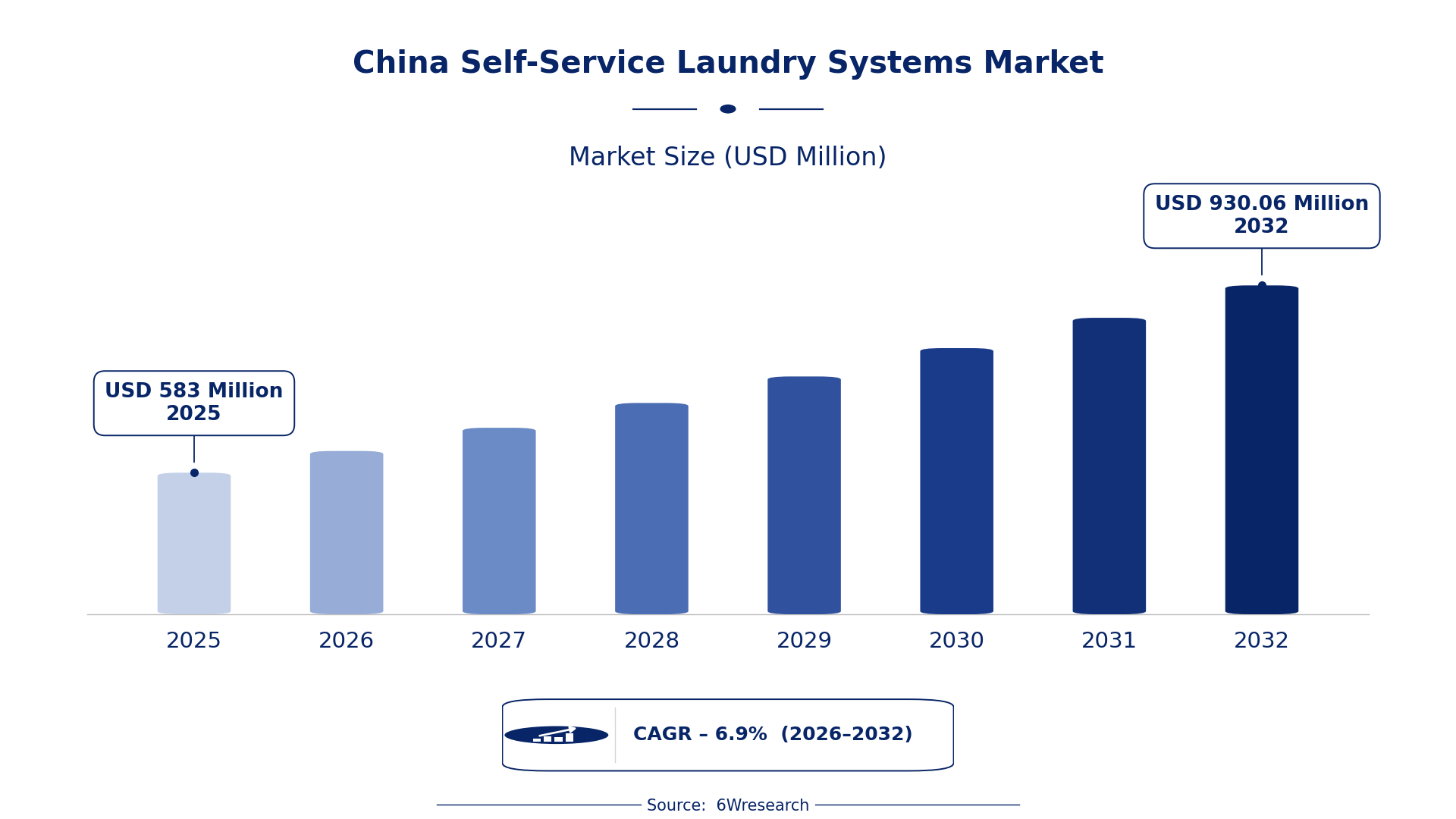
According to 6Wresearch internal database and industry insights, the China Self-Service Laundry Systems Market was valued at USD 583.0 million in 2025 and is projected to reach USD 930.06 million by 2032, growing at a CAGR of approximately 6.9% during 2026–2032.
China Self-Service Laundry Systems Market Highlights
| Report Metric | Details |
| Report Name | China Self-Service Laundry Systems Market |
| Market Size 2025 | USD 583.0 million |
| Market Size 2032 | USD 930.06 million |
| Absolute Growth 2025–2032 | USD 347.06 million |
| CAGR 2026–2032 | 6.9% |
| Peak Annual Growth | 8.8% in 2031 |
| Forecast Period | 2026–2032 |
| Historical Data | 2022–2025 |
| Base Year | 2025 |
| Leading System Type, 2025 | Fully Automated Units (42% share) |
| Leading Operation Type, 2025 | App-Controlled (46% share) |
| Leading Payment Mode, 2025 | UPI/Wallet (47% share) |
| Leading End User, 2025 | Urban Laundromats (50% share) |
| Fastest-Growing System Type | Smart Wash Stations (8.3% CAGR) |
| Fastest-Growing Payment Mode | Contactless NFC (9.6% CAGR) |
| Fastest-Growing End User | Hotels & Hospitals (8.4% CAGR) |
| Growing Sector | Hotels & Hospitals |
| Key End Users | Urban Laundromats, Hotels & Hospitals, Student Hostels, Residential Complexes |
China Self-Service Laundry Systems Market Year-wise Growth Rate and Key Drivers (2022–2032)
This graph illustrates the annual growth rates of the market from 2022 to 2032, highlighting a steady upward trajectory and projected market expansion over the forecast period.
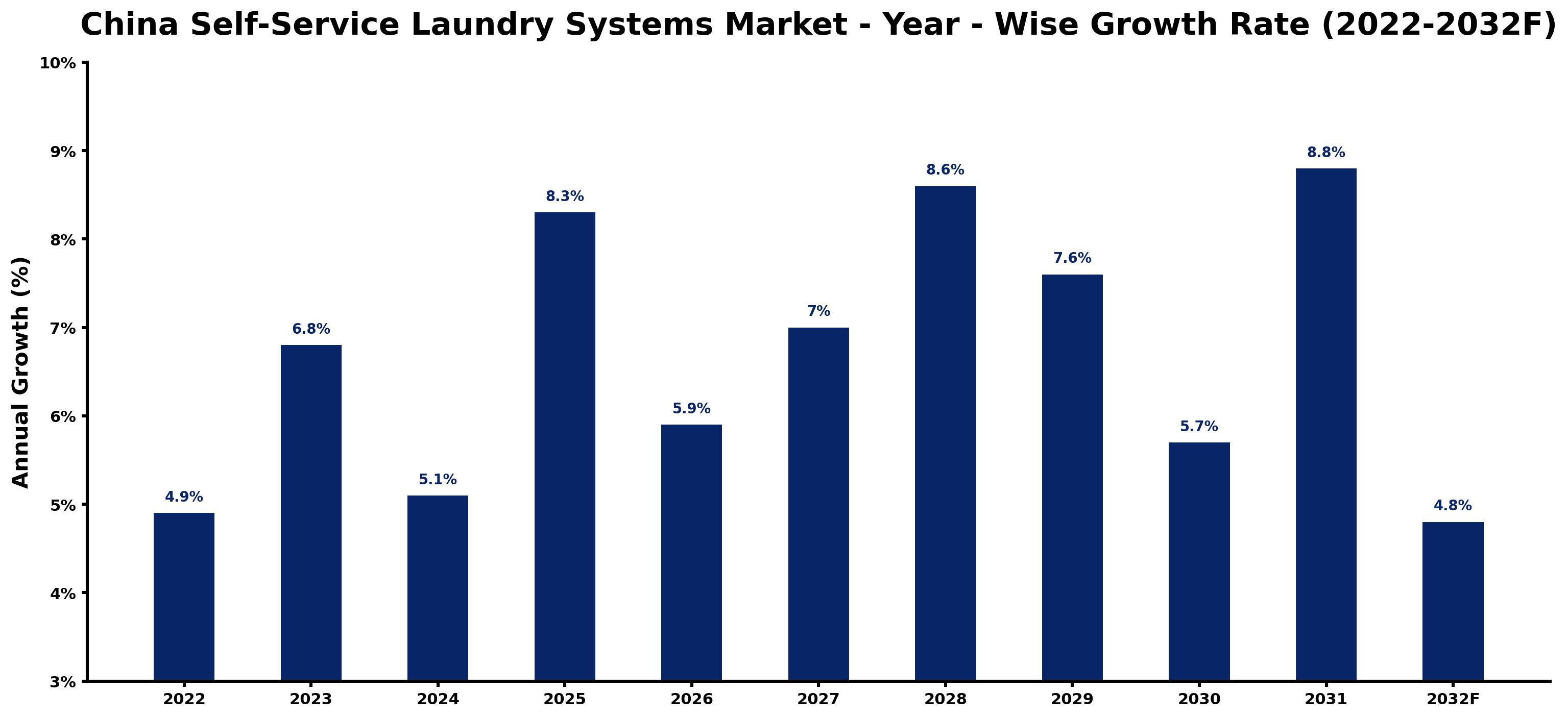
Each row of the following table gives one year's estimated growth and the event or demand shift that explains it.
| Year | Estimated Annual Growth (%) | Market Rationale |
| 2022 | 4.9 | The market showed steady activity with established urban laundromats serving local residents. |
| 2023 | 6.8 | Demand increased due to the growing number of urban laundromats and student hostels. |
| 2024 | 5.1 | Growth slowed as market adjustments occurred following rapid expansion in previous years. |
| 2025 | 8.3 | The market experienced a surge driven by the rising popularity of fully automated units. |
| 2026 | 5.9 | Growth slowed as investment levels stabilised after a period of rapid increase. |
| 2027 | 7.0 | Demand rose again as urban laundromats expanded their service offerings. |
| 2028 | 8.6 | The market accelerated with the adoption of smart wash stations in major cities. |
| 2029 | 7.6 | Growth slowed as competition intensified among service providers in urban areas. |
| 2030 | 5.7 | The market continued to grow, albeit at a slower pace due to market maturation. |
| 2031 | 8.8 | A peak in growth occurred as automated solutions gained widespread acceptance. |
| 2032 | 4.8 | Growth slowed as the market reached a more stable phase with established players. |
Note: Market size estimations and growth projections presented in this report are based on 6Wresearch's proprietary forecasting methodology, utilizing the latest available industry data, government publications, and primary research inputs.
China Self-Service Laundry Systems Market Synopsis
Self-Service Laundry Systems in China include automated machines that allow users to wash and dry clothes independently. These systems are predominantly found in urban laundromats, student accommodations, and hospitality services. The China Self-Service Laundry Systems Market is growing, propelled by increasing urbanisation and a rising demand for convenient laundry options. The introduction of the 'Smart City Initiative' has further encouraged investment in automated services. With over 1,000 urban laundromats currently operating, the market is set for ongoing expansion.
Market Dynamics Impact Analysis (2026–2032)
| Factor | Type | Impact | Primary Segment Affected |
| Increased urbanisation driving demand for convenient laundry solutions | Driver | High | Urban Laundromats |
| Rising adoption of smart wash stations among tech-savvy consumers | Driver | High | Smart Wash Stations |
| Growing demand for energy-efficient solutions in urban areas | Opportunity | High | Fully Automated Units |
| Expansion of student hostels requiring efficient laundry systems | Opportunity | High | Student Hostels |
| High initial investment costs for setting up self-service systems | Restraint | Medium | Coin-Operated Washers |
| Limited awareness of automated laundry solutions among consumers | Restraint | Medium | Smart Wash Stations |
| Competition from traditional laundry services affecting market share | Challenge | High | Urban Laundromats |
| Technological barriers in adopting advanced laundry systems | Challenge | Medium | Fully Automated Units |
Evaluation of Drivers in China Self-Service Laundry Systems Market (2026–2032)
Below mentioned are some major drivers and their influence on market dynamics.
| Drivers | Primary Segment Affected | Why It Matters (Evidence) |
| Investment in urban laundromats to meet rising demand | Urban Laundromats | The average investment in self-service laundry setups in urban areas is around 500,000 CNY, encouraging new laundromats to open. |
| Adoption of smart wash stations for user convenience | Smart Wash Stations | In 2023, smart wash stations saw a 20% increase in installations, improving service efficiency and attracting tech-savvy users. |
| Government initiatives promoting energy-efficient technologies | Fully Automated Units | The 'Green Technology Fund' allocates 100 million CNY for eco-friendly laundry solutions, boosting demand for modern units. |
| Increased student population in urban areas | Student Hostels | As of 2023, there are over 5 million students in Chinese universities, increasing demand for laundry services in hostels. |
| Expansion of hospitality services requiring efficient laundry management | Hotels & Hospitals | With over 1,000 hotels and hospitals in urban areas, the need for efficient laundry management drives demand for self-service systems. |
Growth across the Self-Service Laundry Systems market in China is anchored in rising investment in urban laundromats, driven by the increasing population density in cities. The average investment in self-service laundry setups is around 500,000 CNY, which encourages new laundromats to emerge. The adoption of smart wash stations is gaining traction in major cities like Shanghai and Beijing, improving user convenience. The growing student population, with over 5 million students in universities, is also increasing the need for laundry services in student hostels.
Evaluation of Restraints in China Self-Service Laundry Systems Market
The following restraints limit how fast demand can grow.
| Market Restraint | Primary Segment Affected | Why It Matters (Evidence) |
| Skills shortage among technicians | Urban Laundromats | This gap exists due to rapid technological advancements, making it difficult for producers to find qualified personnel. |
| High operational costs for new entrants | Urban Laundromats | The average investment for setting up a self-service laundry is around 500,000 CNY, leading to financial strain. |
| Fluctuating demand during peak periods | Student Hostels | With over 5 million students in universities, peak usage can overwhelm existing capacity, affecting service quality. |
| Supply chain disruptions due to reliance on imports | Fully Automated Units | Delays in machine availability can impact service delivery for urban laundromats. |
| Limited awareness of energy-efficient technologies | Fully Automated Units | Many operators are unaware of available technologies, hindering their ability to modernise operations. |
China Self-Service Laundry Systems Market Challenges
The China Self-Service Laundry Systems market encounters several practical issues, starting with a skills shortage among technicians. This gap arises from rapid technological advancements in automated systems, complicating the search for qualified personnel and resulting in increased machine downtime and service delays. High operational costs are another challenge, as the average investment for establishing a self-service laundry is around 500,000 CNY, placing financial pressure on new entrants. Moreover, with over 1,000 urban laundromats catering to approximately 10,000 residents each, fluctuating demand can strain existing capacity, impacting service quality. Supply chain disruptions further complicate operations, as reliance on imported components can delay machine availability, affecting urban laundromats' service delivery.
Trends in the China Self-Service Laundry Systems Market
Below mentioned are some of the trends shaping the China Self-Service Laundry Systems Market growth.
- Shift Towards Smart Wash Stations: In 2023, urban areas saw a 20% increase in the adoption of smart wash stations. This trend is particularly notable in cities like Shanghai, where tech-savvy users are opting for automated solutions.
- Growing Demand from Student Hostels: The number of self-service laundry systems in student hostels rose by 30% in 2023, reflecting the increasing student population. This trend underscores the need for convenient laundry options in educational settings.
- Expansion of Urban Laundromats: The 'Urban Laundromat Development Plan' launched in 2023 aims to boost the number of self-service laundromats by 30% by 2025. This initiative highlights the rising demand for laundry services in urban environments.
- Focus on Energy Efficiency: The 'Green Laundry Program' seeks to promote energy-efficient washing technologies by 2025. This initiative is expected to encourage the adoption of eco-friendly solutions within the self-service laundry market.
Investment Opportunities in the China Self-Service Laundry Systems Market
The following opportunities in the China Self-Service Laundry Systems Market pair current demand with a clear way in.
- Investment in Urban Laundromats: With over 1,000 urban laundromats currently in operation, there is a chance to invest in new locations. The average investment is around 500,000 CNY, making this market appealing for new entrants.
- Supply of Smart Wash Stations: The demand for smart wash stations is anticipated to rise, especially in major cities. With a projected 20% increase in installations, suppliers can capitalise on this trend by collaborating with local laundromats.
- Expansion into Student Hostels: The growing student population, now exceeding 5 million, offers a unique opportunity to provide laundry solutions in hostels. Forming partnerships with educational institutions can facilitate market entry.
- Focus on Energy-Efficient Technologies: The 'Green Technology Fund' supports eco-friendly laundry solutions, presenting an opportunity for suppliers to innovate. Investing in energy-efficient products can attract environmentally aware consumers.
Government Initiatives in the China Self-Service Laundry Systems Market
The Ministry of Housing and Urban-Rural Development launched the 'Smart City Initiative' in 2021 to improve urban infrastructure, including self-service laundry systems. This initiative aims to enhance service efficiency and accessibility in urban areas. In 2022, the 'National Energy Efficiency Program' was introduced to promote energy-efficient laundry technologies, targeting a 15% reduction in energy consumption by 2025. This program aids producers in modernising operations and minimising environmental impact.
The Ministry of Industry and Information Technology endorses the 'Laundry Equipment Modernization Plan', which facilitates technological upgrades in the laundry sector. This plan is designed to improve service quality and operational efficiency. Additionally, the 'Green Technology Fund' allocates resources for eco-friendly laundry solutions, promoting sustainability in the industry. By supporting innovative technologies, this initiative encourages producers to adopt greener practices.
Future Insight of the China Self-Service Laundry Systems Market
Several forward-looking factors are expected to support the China Self-Service Laundry Systems market by 2032. The 'Smart City Initiative' will drive the integration of automated services, improving user convenience and operational efficiency. By 2025, the 'Green Laundry Program' aims to promote energy-efficient technologies, appealing to environmentally conscious consumers. The Ministry of Industry and Information Technology reported a 20% rise in automated solutions, indicating a growing trend that will benefit both buyers and suppliers. The implementation of the 'National Cleanliness Standard' will elevate hygiene expectations, prompting operators to adopt higher operational standards.
Market Segmentation Analysis
The analysis below covers each segmentation, its leading category in 2025 and its fastest-growing category through 2032.
By System Type – Fully Automated Units Dominated, Smart Wash Stations Expected to Grow Fastest
According to Shubham Padhi, Research Analyst at 6Wresearch, with a 42% revenue share in 2025, Fully Automated Units was the largest system type category. Fully automated units command the largest share in the market due to their efficiency and capacity to manage significant laundry volumes, making them ideal for urban laundromats. With over 1,000 urban laundromats in China utilising these systems, they are the go-to choice for users seeking reliable laundry solutions. The quickest growth will come from Smart Wash Stations, forecast to expand at a CAGR of 8.3% between 2026 and 2032. Smart wash stations are rapidly gaining traction, particularly in major cities like Shanghai and Beijing, where tech-savvy users are increasingly embracing advanced features. This trend suggests that the demand for smart technology in laundry systems will continue to rise, potentially widening the lead of fully automated units. Suppliers should focus on integrating advanced technology into fully automated units to meet the evolving expectations of urban laundromat users.
By Operation Type – App-Controlled Dominated and Is Expected to Record the Fastest Growth
App-Controlled held a 46% share of the China Self-Service Laundry Systems Market by operation type in 2025. App-controlled systems dominate the market share as they resonate with younger demographics who prefer seamless technology integration. Their widespread adoption in urban laundromats underscores their appeal for enhancing user convenience and experience. The same category is also set to grow fastest, at a CAGR of 8.9% during 2026–2032. The app-controlled segment is also the fastest-growing, as managing laundry through smartphones aligns perfectly with a tech-savvy population. This dual role as both leader and fastest indicates that the popularity of app-controlled systems will continue to expand significantly. Investing in app technology will be crucial for suppliers to meet modern user demands and maintain a competitive edge.
By Payment Mode – UPI/Wallet Dominated, Contactless NFC Expected to Grow Fastest
In 2025, UPI/Wallet led the payment mode split with a 47% share. UPI/wallet payment modes are the most widely adopted in self-service laundry systems, appealing to users who prefer cashless transactions. This trend is evident as more laundromats integrate these payment options, aligning with consumer preferences for convenience. Over 2026–2032, Contactless NFC is expected to post the fastest growth, at a CAGR of 9.6%. Contactless NFC payments are emerging as the fastest-growing mode, driven by increasing consumer demand for quick and efficient transaction methods. As users seek faster payment solutions, this segment is likely to see substantial growth in the coming years. Suppliers should integrate contactless payment solutions to enhance user experience and remain competitive in the self-service laundry market.
By End User – Urban Laundromats Dominated, Hotels & Hospitals Expected to Grow Fastest
Urban Laundromats took a 50% share of end user in 2025, more than any other category. Urban laundromats hold the largest market share, serving as the primary destination for self-service laundry systems. With an average of approximately 10,000 residents per laundromat, they play a vital role in meeting the laundry needs of urban populations. Hotels & Hospitals are set to record the highest CAGR in this split, 8.4% over 2026–2032. Hotels and hospitals represent the fastest-growing end users, as they require efficient laundry management solutions to handle high volumes of linens and garments. This growth reflects an increasing demand for self-service systems in the hospitality and healthcare sectors. Targeting hotels and hospitals with tailored laundry solutions will enable suppliers to capitalise on the rising demand for efficient laundry services in these industries.
Key Attractiveness of the Report
- 10 Years of Market Numbers
- Historical Data Starting from 2022 to 2025
- Base Year 2025
- Forecast Data until 2032
- Key Performance Indicators Impacting the Market
- Major Upcoming Developments and Projects
Key Highlights of the Report:
- China Self-Service Laundry Systems Market Outlook
- Market Size of China Self-Service Laundry Systems Market, 2025
- Forecast of China Self-Service Laundry Systems Market, 2032
- Historical Data and Forecast of China Self-Service Laundry Systems Revenues & Volume for the Period 2022 - 2032F
- China Self-Service Laundry Systems Market Trend Evolution
- China Self-Service Laundry Systems Market Drivers and Challenges
- China Self-Service Laundry Systems Price Trends
- China Self-Service Laundry Systems Porter's Five Forces
- China Self-Service Laundry Systems Industry Life Cycle
- Historical Data and Forecast of China Self-Service Laundry Systems Market Revenues & Volume By System Type for the Period 2022 - 2032F
- Historical Data and Forecast of China Self-Service Laundry Systems Market Revenues & Volume By Coin-Operated Washers for the Period 2022 - 2032F
- Historical Data and Forecast of China Self-Service Laundry Systems Market Revenues & Volume By Smart Wash Stations for the Period 2022 - 2032F
- Historical Data and Forecast of China Self-Service Laundry Systems Market Revenues & Volume By Fully Automated Units for the Period 2022 - 2032F
- Historical Data and Forecast of China Self-Service Laundry Systems Market Revenues & Volume By Industrial Wash Systems for the Period 2022 - 2032F
- Historical Data and Forecast of China Self-Service Laundry Systems Market Revenues & Volume By Operation Type for the Period 2022 - 2032F
- Historical Data and Forecast of China Self-Service Laundry Systems Market Revenues & Volume By Manual Start for the Period 2022 - 2032F
- Historical Data and Forecast of China Self-Service Laundry Systems Market Revenues & Volume By App-Controlled for the Period 2022 - 2032F
- Historical Data and Forecast of China Self-Service Laundry Systems Market Revenues & Volume By Load Sensing for the Period 2022 - 2032F
- Historical Data and Forecast of China Self-Service Laundry Systems Market Revenues & Volume By Heavy-Duty for the Period 2022 - 2032F
- Historical Data and Forecast of China Self-Service Laundry Systems Market Revenues & Volume By Payment Mode for the Period 2022 - 2032F
- Historical Data and Forecast of China Self-Service Laundry Systems Market Revenues & Volume By Coin/Card for the Period 2022 - 2032F
- Historical Data and Forecast of China Self-Service Laundry Systems Market Revenues & Volume By UPI/Wallet for the Period 2022 - 2032F
- Historical Data and Forecast of China Self-Service Laundry Systems Market Revenues & Volume By Contactless NFC for the Period 2022 - 2032F
- Historical Data and Forecast of China Self-Service Laundry Systems Market Revenues & Volume By Membership-Based for the Period 2022 - 2032F
- Historical Data and Forecast of China Self-Service Laundry Systems Market Revenues & Volume By End User for the Period 2022 - 2032F
- Historical Data and Forecast of China Self-Service Laundry Systems Market Revenues & Volume By Urban Laundromats for the Period 2022 - 2032F
- Historical Data and Forecast of China Self-Service Laundry Systems Market Revenues & Volume By Student Hostels for the Period 2022 - 2032F
- Historical Data and Forecast of China Self-Service Laundry Systems Market Revenues & Volume By Residential Complexes for the Period 2022 - 2032F
- Historical Data and Forecast of China Self-Service Laundry Systems Market Revenues & Volume By Hotels & Hospitals for the Period 2022 - 2032F
- China Self-Service Laundry Systems Import Export Trade Statistics
- Market Opportunity Assessment By System Type
- Market Opportunity Assessment By Operation Type
- Market Opportunity Assessment By Payment Mode
- Market Opportunity Assessment By End User
- China Self-Service Laundry Systems Top Companies Market Share
- China Self-Service Laundry Systems Competitive Benchmarking By Technical and Operational Parameters
- China Self-Service Laundry Systems Company Profiles
- China Self-Service Laundry Systems Key Strategic Recommendations
Market Covered
Segments analysed in this report are listed below.
By System Type
- Coin-Operated Washers
- Smart Wash Stations
- Fully Automated Units
- Industrial Wash Systems
By Operation Type
- Manual Start
- App-Controlled
- Load Sensing
- Heavy-Duty
By Payment Mode
- Coin/Card
- UPI/Wallet
- Contactless NFC
- Membership-Based
By End User
- Urban Laundromats
- Student Hostels
- Residential Complexes
- Hotels & Hospitals































