India Semiconductor IP Core Market Size & Growth Rate
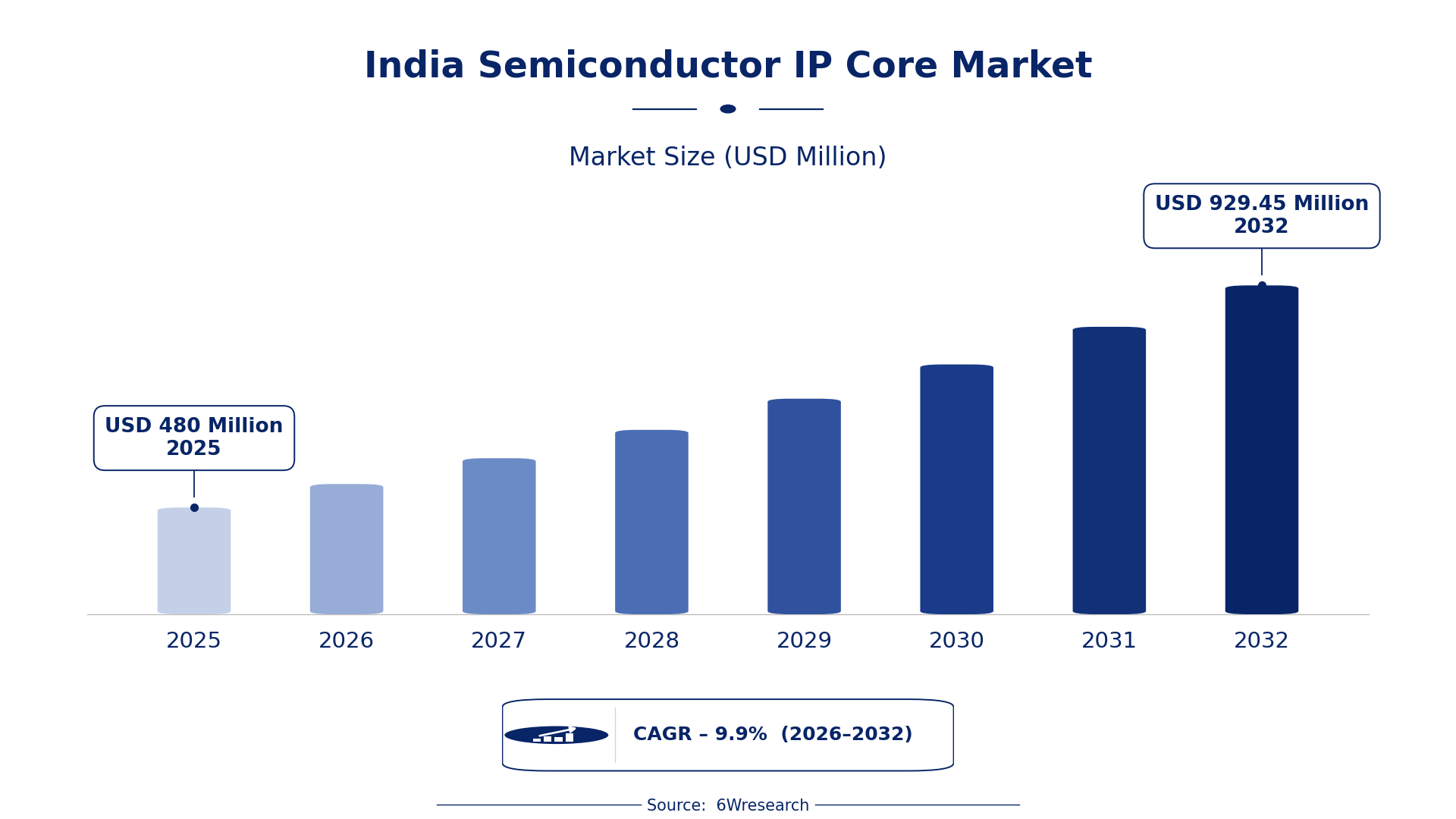
According to 6Wresearch internal database and industry insights, the India Semiconductor IP Core Market was valued at USD 480.0 million in 2025 and is projected to reach USD 929.45 million by 2032, growing at a CAGR of approximately 9.9% during 2026–2032.
India Semiconductor IP Core Market Highlights
| Report Metric | Details |
| Report Name | India Semiconductor IP Core Market |
| Market Size 2025 | USD 480.0 million |
| Market Size 2032 | USD 929.45 million |
| Absolute Growth 2025–2032 | USD 449.45 million |
| CAGR 2026–2032 | 9.9% |
| Peak Annual Growth | 11.2% in 2032 |
| Forecast Period | 2026–2032 |
| Historical Data | 2022–2025 |
| Base Year | 2025 |
| Leading IP Core Type, 2025 | Processor Cores (40% share) |
| Leading Functionality, 2025 | Computation Engine (49% share) |
| Leading Licensing Model, 2025 | Royalty-Based (43% share) |
| Leading End User, 2025 | SoC Designers (47% share) |
| Fastest-Growing IP Core Type | Memory Cores (10.9% CAGR) |
| Fastest-Growing Functionality | Storage Blocks (11.6% CAGR) |
| Fastest-Growing Licensing Model | One-Time License (11.3% CAGR) |
| Fastest-Growing End User | Chipmakers (11.6% CAGR) |
| Growing Sector | Chipmakers |
| Key End Users | SoC Designers, Chipmakers, Foundries, Embedded Device Makers |
India Semiconductor IP Core Market Year-wise Growth Rate and Key Drivers (2022–2032)
This graph illustrates the annual growth rates of the market from 2022 to 2032, highlighting a steady upward trajectory and projected market expansion over the forecast period.
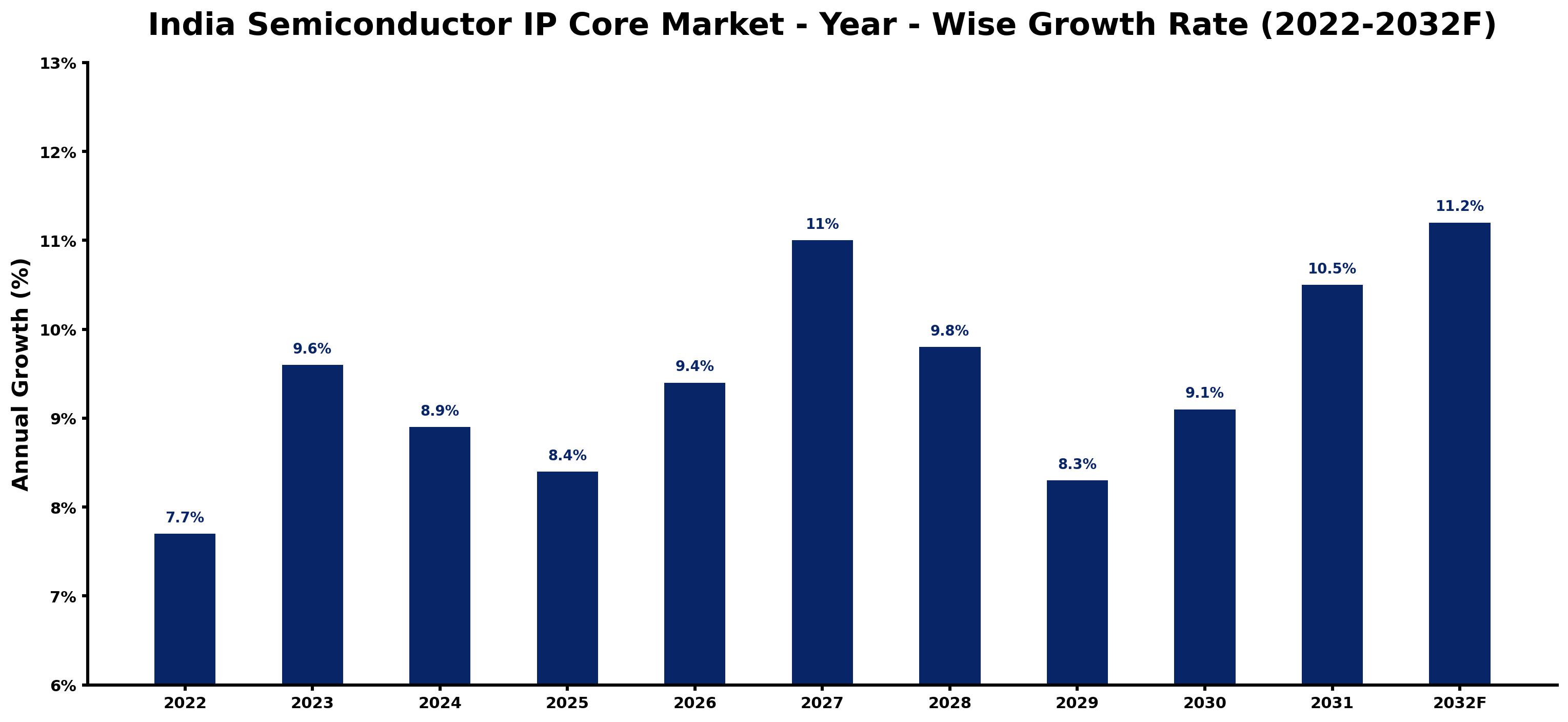
The table below sets out the estimated growth rate for each year and the main factor behind it.
| Year | Estimated Annual Growth (%) | Market Rationale |
| 2022 | 7.7 | The market experienced steady growth due to increasing domestic demand for semiconductor products. |
| 2023 | 9.6 | Growth accelerated as the government launched the Semiconductor Mission to boost local manufacturing. |
| 2024 | 8.9 | The growth rate slowed as the market adjusted to new production capacities and demand levels. |
| 2025 | 8.4 | Continued growth was noted, albeit at a slower pace as the market adjusted post-initiative. |
| 2026 | 9.4 | Growth is expected to pick up as investments in semiconductor design yield results. |
| 2027 | 11.0 | A surge in demand will be driven by rising exports and local consumption of semiconductor products. |
| 2028 | 9.8 | The market growth rate is projected to slow as competition intensifies among domestic design companies. |
| 2029 | 8.3 | A further slowdown is anticipated as the market faces challenges in scaling production efficiently. |
| 2030 | 9.1 | Growth is expected to resume as new technologies are adopted in semiconductor design and manufacturing. |
| 2031 | 10.5 | The market will grow faster, supported by increased employment in the semiconductor sector. |
| 2032 | 11.2 | The peak growth will be driven by advancements in technology and rising demand. |
Note: Market size estimations and growth projections presented in this report are based on 6Wresearch's proprietary forecasting methodology, utilizing the latest available industry data, government publications, and primary research inputs.
India Semiconductor IP Core Market Synopsis
The India Semiconductor IP Core Market encompasses reusable logic units used in integrated circuits. These cores improve design efficiency and reduce time-to-market for semiconductor products. The market is growing due to strong domestic demand, active exports, and government initiatives like the Semiconductor Mission. With over 100 semiconductor design companies, India's semiconductor consumption is projected to reach USD 929.45 million by 2032, reflecting the sector's expansion and innovation.
Market Dynamics Impact Analysis (2026–2032)
| Factor | Type | Impact | Primary Segment Affected |
| Growing domestic semiconductor consumption driven by local design firms. | Driver | High | Processor Cores |
| Increasing exports of semiconductor products to global markets. | Driver | High | Memory Cores |
| Rising demand for advanced semiconductor designs in consumer electronics. | Opportunity | High | Interface Cores |
| Investment in semiconductor research institutes to foster innovation. | Opportunity | Medium | Security Cores |
| Challenges in scaling production capacity to meet demand. | Restraint | High | Computation Engine |
| High competition among design companies affecting pricing strategies. | Restraint | Medium | Storage Blocks |
| Delays in regulatory approvals for new semiconductor projects. | Challenge | High | I/O Integration |
| Shortage of skilled workforce in semiconductor design and manufacturing. | Challenge | Medium | Encryption/Authentication |
Evaluation of Drivers in India Semiconductor IP Core Market (2026–2032)
Key forces behind demand, with the segment each one moves most, are listed below.
| Drivers | Primary Segment Affected | Why It Matters (Evidence) |
| Increasing investments in semiconductor design and manufacturing. | Processor Cores | This investment is expected to boost production capabilities, leading to a projected growth of 20% in semiconductor consumption from 2023 to 2025. |
| Government initiatives to support local semiconductor production. | Memory Cores | The Semiconductor Mission aims to boost local manufacturing, increasing demand for memory cores in various applications. |
| Rising demand from consumer electronics manufacturers. | Interface Cores | As consumer electronics expand, manufacturers require more interface cores to facilitate communication between components. |
| Growth of semiconductor startups focusing on IP development. | Security Cores | These startups are driving innovation in security cores, essential for data protection in devices. |
| Expansion of the semiconductor workforce in India. | Computation Engine | With over 1 million engineers employed, the skilled workforce supports the growth of computation engines in integrated circuits. |
The Semiconductor Mission aims to boost local manufacturing, which will increase semiconductor consumption by 20% from 2023 to 2025. The growth of semiconductor startups focusing on IP development drives innovation, particularly in security cores. With over 1 million engineers employed in the sector, the skilled workforce supports the production of computation engines. As domestic design firms expand their capabilities, demand for memory cores is also expected to rise significantly.
Evaluation of Restraints in India Semiconductor IP Core Market
The main factors holding the market back are set out below.
| Market Restraint | Primary Segment Affected | Why It Matters (Evidence) |
| Delays in regulatory approvals for new semiconductor projects. | Computation Engine | These delays can extend project timelines, affecting the ability of firms to meet market demand for computation engines. |
| High competition among design companies affecting pricing strategies. | Storage Blocks | Intense competition can lead to price wars, reducing profit margins for firms producing storage blocks. |
| Challenges in scaling production capacity to meet demand. | I/O Integration | Inability to scale production can result in shortages of I/O integration components, impacting overall supply chains. |
| Shortage of skilled workforce in semiconductor design and manufacturing. | Encryption/Authentication | This shortage can hinder the development of new encryption technologies, affecting market growth. |
| Limited access to advanced manufacturing technologies. | Security Cores | Without access to advanced technologies, firms may struggle to innovate in the security cores segment. |
India Semiconductor IP Core Market Challenges
India's semiconductor IP core market struggles with supply chain inefficiencies that hinder timely product delivery. These inefficiencies arise from underdeveloped local manufacturing capabilities, leading to cost increases of up to 30% for buyers who need immediate access to components. Regulatory hurdles compound the issue; adherence to new policies can delay approvals by several months, resulting in project setbacks for design firms. Technological limitations also pose challenges, as many local companies lack access to advanced design tools, which can extend development timelines by 25%. Competition from established global players further pressures local firms, forcing them to reduce prices and impacting profit margins.
Trends in the India Semiconductor IP Core Market
Below mentioned are some of the trends shaping the India Semiconductor IP Core Market growth.
- Shift in Design Focus to Advanced Security Features: Karnataka is experiencing a shift towards the integration of advanced security features in semiconductor designs. This trend is marked by a 15% increase in projects centred on security cores, reflecting the growing need for data protection.
- Transition from Traditional to Agile Development Processes: The semiconductor design process is evolving from traditional methods to more agile practices. This shift is evidenced by a 20% rise in design firms adopting agile methodologies, enhancing efficiency and responsiveness.
- Emergence of New Licensing Models: India is observing a shift towards subscription-based licensing models in semiconductor IP. This trend is underscored by a 25% increase in firms choosing subscription models, facilitating more flexible access to IP.
- Growth in Domestic Semiconductor Startups: The semiconductor startup ecosystem in India is rapidly expanding, with over 50 new startups launched in the past two years. This growth signals a vibrant market for innovation and development in semiconductor IP.
Investment Opportunities in the India Semiconductor IP Core Market
The following opportunities in the India Semiconductor IP Core Market pair current demand with a clear way in.
- Increased Investment in Semiconductor Research: With the Semiconductor Manufacturing Fund of $10 billion, there is an opportunity to invest in research and development. This funding will support local chipmakers looking to innovate and improve production capabilities.
- Demand for Advanced IP Cores in Consumer Electronics: As consumer electronics continue to grow, the demand for advanced IP cores is rising. This presents an opportunity for SoC designers to develop solutions to meet evolving market needs.
- Expansion of Semiconductor Design Firms: The current presence of over 100 semiconductor design companies indicates a ripe opportunity for collaboration and partnerships. Firms can explore joint ventures to leverage local expertise and resources.
- Focus on Sustainable Manufacturing Practices: With rising awareness of sustainability, there is a growing demand for eco-friendly semiconductor manufacturing processes. This trend opens avenues for investment in green technologies and practices.
Government Initiatives in the India Semiconductor IP Core Market
The Semiconductor Manufacturing Fund, announced in 2021 with a budget of $10 billion, aims to enhance India's semiconductor production capabilities. This initiative builds upon the Electronics Policy 2020, which focuses on boosting domestic semiconductor manufacturing. Together, these measures create a framework for improving local production and innovation in the semiconductor sector.
The Ministry of Electronics and Information Technology manages semiconductor initiatives, approving projects that align with national objectives. The agency funds various schemes designed to support semiconductor research and development, ensuring that local firms receive the necessary assistance to thrive in a competitive market.
Future Insight of the India Semiconductor IP Core Market
By 2032, buyers and suppliers in the India semiconductor IP core market can anticipate substantial advancements driven by strategic initiatives. The government's Semiconductor Mission will strengthen local manufacturing capabilities, ensuring a more reliable supply for buyers. New semiconductor research institutes will promote innovation, facilitating the development of more sophisticated IP solutions. The Electronics Policy 2020 aims to boost domestic production, reducing reliance on imports. With semiconductor consumption projected to grow at a CAGR of 20% from 2023 to 2025, local firms are likely to experience increased demand, supported by a skilled workforce of over 1 million engineers.
Market Segmentation Analysis
The report offers a comprehensive study of the following market segments and their leading categories in the market.
By IP Core Type – Processor Cores Dominated, Memory Cores Expected to Grow Fastest
According to Shubham Padhi, Research Analyst at 6Wresearch, Processor Cores took a 40% share of ip core type in 2025, more than any other category. Processor Cores dominate the market because they are integral to system-on-chip designs, which are widely used in smartphones and other electronic devices. The robust demand from India's over 100 semiconductor design companies underscores their essential role in the industry. Memory Cores are projected to grow fastest, at a CAGR of 10.9% during 2026–2032. Memory Cores are experiencing rapid growth due to the rising demand for efficient data storage solutions, particularly as applications requiring large data processing become more prevalent. This trend ensures that the need for advanced memory management continues to drive the segment's expansion. Suppliers should prioritise the development of memory cores to align with the increasing demand in the semiconductor IP core market.
By Functionality – Computation Engine Dominated, Storage Blocks Expected to Grow Fastest
The largest functionality category in 2025 was Computation Engine, with a 49% share of total revenue. The Computation Engine is at the forefront as it executes essential processing tasks in devices, making it vital for SoC designers. Its extensive application across numerous sectors reinforces its status as the preferred choice for semiconductor IP. Over 2026–2032, Storage Blocks are expected to post the fastest growth, at a CAGR of 11.6%. Storage Blocks are experiencing the fastest growth, fuelled by the rising demand for data retention in chips, especially with the growth of data-centric applications. This trend for efficient storage solutions is accelerating the segment's development. Suppliers should concentrate on advancing storage blocks to align with the growing market requirements.
By Licensing Model – Royalty-Based Dominated, One-Time License Expected to Grow Fastest
In 2025, Royalty-Based led the licensing model split with a 43% share. The Royalty-Based licensing model is prevalent as it aligns with the common practices in the semiconductor industry, allowing for flexible payment structures that benefit both licensors and licensees. This model is particularly attractive for companies looking to maximise their IP utilisation. The quickest growth will come from One-Time License, forecast to expand at a CAGR of 11.3% between 2026 and 2032. The One-Time License model is gaining traction, particularly in high-volume markets, as it offers a straightforward payment structure that appeals to chipmakers. This shift indicates a growing preference for simplified licensing agreements among manufacturers. Suppliers may need to adapt their licensing strategies to include more one-time options to attract a broader customer base.
By End User – SoC Designers Dominated, Chipmakers Expected to Grow Fastest
SoC Designers held a 47% share of the India Semiconductor IP Core Market by end user in 2025. SoC Designers hold the largest market share as they are the primary users of IP Cores, playing a vital role in shaping the design and functionality of semiconductor products. Their significant influence in the semiconductor ecosystem ensures a consistent demand for advanced IP solutions. Chipmakers are set to record the highest CAGR in this split, 11.6% over 2026–2032. Chipmakers are the fastest-growing segment, propelled by the rising production of semiconductor products to meet global market needs. As the industry expands, chipmakers are increasingly looking for efficient IP solutions to streamline their manufacturing processes. This growth suggests that suppliers should strengthen collaborations with chipmakers to leverage new opportunities in the semiconductor IP core market.
Key Attractiveness of the Report
- 10 Years of Market Numbers
- Historical Data Starting from 2022 to 2025
- Base Year 2025
- Forecast Data until 2032
- Key Performance Indicators Impacting the Market
- Major Upcoming Developments and Projects
Key Highlights of the Report:
- India Semiconductor IP Core Market Outlook
- Market Size of India Semiconductor IP Core Market, 2025
- Forecast of India Semiconductor IP Core Market, 2032
- Historical Data and Forecast of India Semiconductor IP Core Revenues & Volume for the Period 2022 - 2032F
- India Semiconductor IP Core Market Trend Evolution
- India Semiconductor IP Core Market Drivers and Challenges
- India Semiconductor IP Core Price Trends
- India Semiconductor IP Core Porter's Five Forces
- India Semiconductor IP Core Industry Life Cycle
- Historical Data and Forecast of India Semiconductor IP Core Market Revenues & Volume By IP Core Type for the Period 2022 - 2032F
- Historical Data and Forecast of India Semiconductor IP Core Market Revenues & Volume By Processor Cores for the Period 2022 - 2032F
- Historical Data and Forecast of India Semiconductor IP Core Market Revenues & Volume By Memory Cores for the Period 2022 - 2032F
- Historical Data and Forecast of India Semiconductor IP Core Market Revenues & Volume By Interface Cores for the Period 2022 - 2032F
- Historical Data and Forecast of India Semiconductor IP Core Market Revenues & Volume By Security Cores for the Period 2022 - 2032F
- Historical Data and Forecast of India Semiconductor IP Core Market Revenues & Volume By Functionality for the Period 2022 - 2032F
- Historical Data and Forecast of India Semiconductor IP Core Market Revenues & Volume By Computation Engine for the Period 2022 - 2032F
- Historical Data and Forecast of India Semiconductor IP Core Market Revenues & Volume By Storage Blocks for the Period 2022 - 2032F
- Historical Data and Forecast of India Semiconductor IP Core Market Revenues & Volume By I/O Integration for the Period 2022 - 2032F
- Historical Data and Forecast of India Semiconductor IP Core Market Revenues & Volume By Encryption/Authentication for the Period 2022 - 2032F
- Historical Data and Forecast of India Semiconductor IP Core Market Revenues & Volume By Licensing Model for the Period 2022 - 2032F
- Historical Data and Forecast of India Semiconductor IP Core Market Revenues & Volume By Royalty-Based for the Period 2022 - 2032F
- Historical Data and Forecast of India Semiconductor IP Core Market Revenues & Volume By One-Time License for the Period 2022 - 2032F
- Historical Data and Forecast of India Semiconductor IP Core Market Revenues & Volume By Subscription-Based for the Period 2022 - 2032F
- Historical Data and Forecast of India Semiconductor IP Core Market Revenues & Volume By Per Unit Royalty for the Period 2022 - 2032F
- Historical Data and Forecast of India Semiconductor IP Core Market Revenues & Volume By End User for the Period 2022 - 2032F
- Historical Data and Forecast of India Semiconductor IP Core Market Revenues & Volume By SoC Designers for the Period 2022 - 2032F
- Historical Data and Forecast of India Semiconductor IP Core Market Revenues & Volume By Chipmakers for the Period 2022 - 2032F
- Historical Data and Forecast of India Semiconductor IP Core Market Revenues & Volume By Foundries for the Period 2022 - 2032F
- Historical Data and Forecast of India Semiconductor IP Core Market Revenues & Volume By Embedded Device Makers for the Period 2022 - 2032F
- India Semiconductor IP Core Import Export Trade Statistics
- Market Opportunity Assessment By IP Core Type
- Market Opportunity Assessment By Functionality
- Market Opportunity Assessment By Licensing Model
- Market Opportunity Assessment By End User
- India Semiconductor IP Core Top Companies Market Share
- India Semiconductor IP Core Competitive Benchmarking By Technical and Operational Parameters
- India Semiconductor IP Core Company Profiles
- India Semiconductor IP Core Key Strategic Recommendations
Market Covered
This report examines the market across the segments below.
By IP Core Type
- Processor Cores
- Memory Cores
- Interface Cores
- Security Cores
By Functionality
- Computation Engine
- Storage Blocks
- I/O Integration
- Encryption/Authentication
By Licensing Model
- Royalty-Based
- One-Time License
- Subscription-Based
- Per Unit Royalty
By End User
- SoC Designers
- Chipmakers
- Foundries
- Embedded Device Makers































