India Semiconductor Manufacturing Chemicals Market Size & Growth Rate
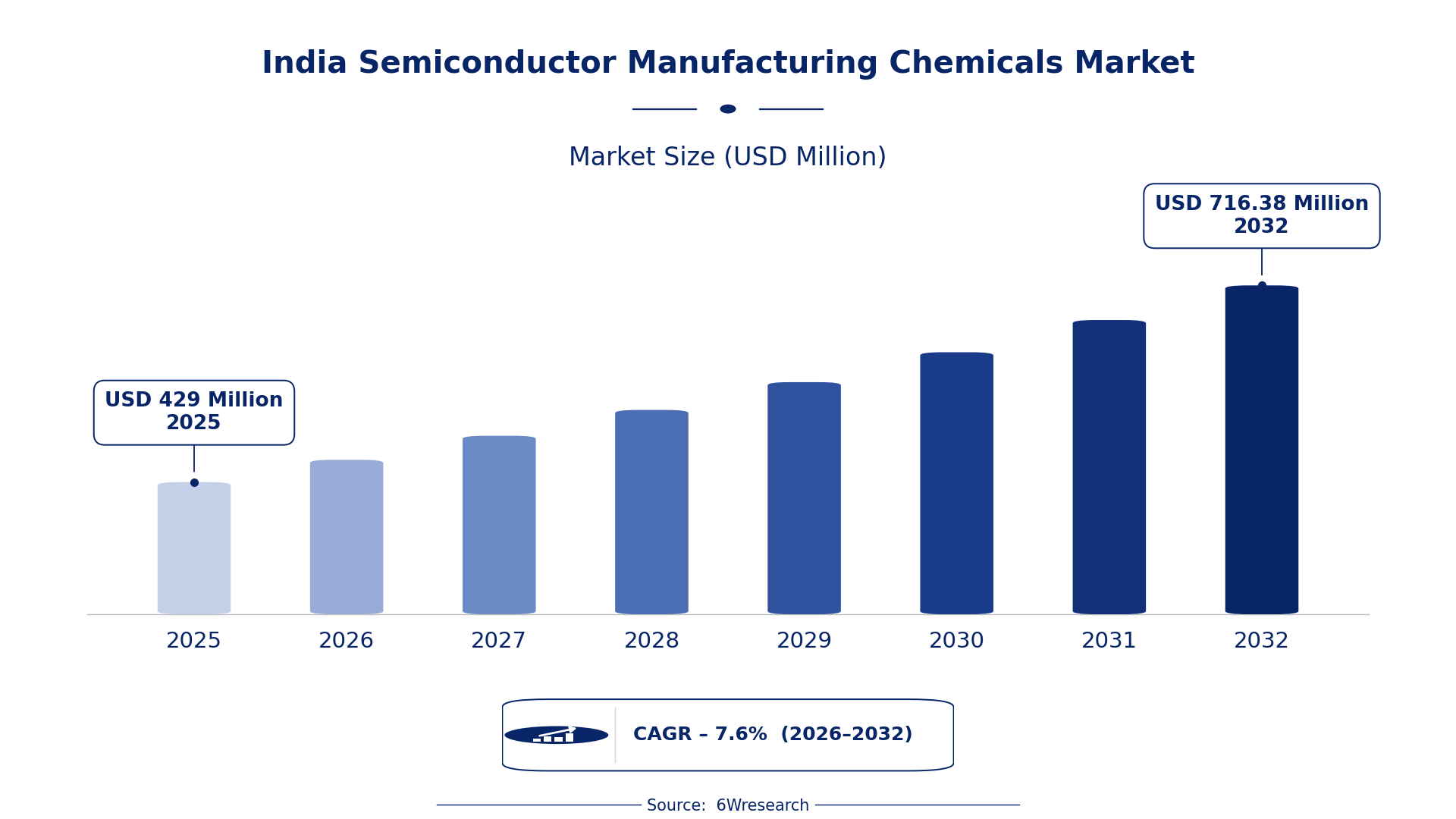
According to 6Wresearch internal database and industry insights, the India Semiconductor Manufacturing Chemicals Market was valued at USD 429.0 million in 2025 and is projected to reach USD 716.38 million by 2032, growing at a CAGR of approximately 7.6% during 2026–2032.
India Semiconductor Manufacturing Chemicals Market Highlights
| Report Metric | Details |
| Report Name | India Semiconductor Manufacturing Chemicals Market |
| Market Size 2025 | USD 429.0 million |
| Market Size 2032 | USD 716.38 million |
| Absolute Growth 2025–2032 | USD 287.38 million |
| CAGR 2026–2032 | 7.6% |
| Peak Annual Growth | 9.6% in 2027 |
| Forecast Period | 2026–2032 |
| Historical Data | 2022–2025 |
| Base Year | 2025 |
| Leading Chemical Type, 2025 | Strippers (39% share) |
| Leading Process Application, 2025 | Photoresist Removal (39% share) |
| Leading Purity Standard, 2025 | Ultra-High Purity (52% share) |
| Leading End User, 2025 | Wafer Foundries (40% share) |
| Fastest-Growing Chemical Type | Developers (9.8% CAGR) |
| Fastest-Growing Process Application | Lithography (10.1% CAGR) |
| Fastest-Growing Purity Standard | Low Metal Ion (10.0% CAGR) |
| Fastest-Growing End User | Fabless Chip Designers (10.2% CAGR) |
| Growing Sector | semiconductor manufacturing |
| Key End Users | wafer foundries, chip fabricators, fabless chip designers |
India Semiconductor Manufacturing Chemicals Market Year-wise Growth Rate and Key Drivers (2022–2032)
This graph illustrates the annual growth rates of the market from 2022 to 2032, highlighting a steady upward trajectory and projected market expansion over the forecast period.
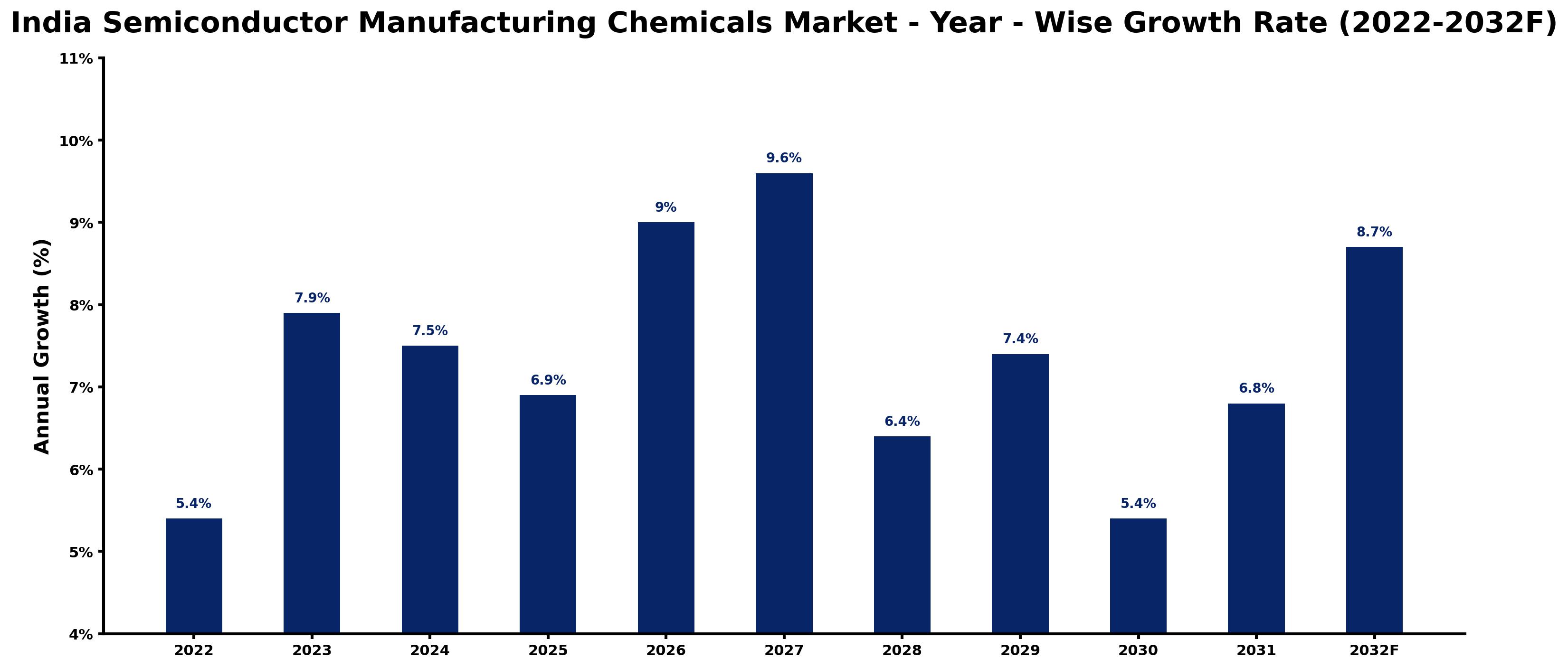
Year by year, the estimates below pair each growth rate with the development that shaped it.
| Year | Estimated Annual Growth (%) | Market Rationale |
| 2022 | 5.4 | The semiconductor sector saw steady demand from local wafer foundries and chip fabricators. |
| 2023 | 7.9 | Increased investments in semiconductor fabrication plants spurred faster growth in the market. |
| 2024 | 7.5 | Growth slowed as some projects faced delays in implementation and funding. |
| 2025 | 6.9 | Demand remained strong, but growth was constrained by supply chain challenges in the industry. |
| 2026 | 9.0 | A resurgence in investment and production capabilities is expected to drive demand higher again. |
| 2027 | 9.6 | The peak growth will be fuelled by the successful rollout of new semiconductor projects. |
| 2028 | 6.4 | Growth is projected to slow as the market adjusts to the peak levels of the previous year. |
| 2029 | 7.4 | Renewed demand from wafer foundries is expected to contribute to a rebound in growth rates. |
| 2030 | 5.4 | Growth will decelerate as market conditions stabilise following previous years' expansions. |
| 2031 | 6.8 | Increased demand for chips in consumer electronics will lead to faster growth once more. |
| 2032 | 8.7 | The market is expected to grow as new policies support semiconductor production. |
Note: Market size estimations and growth projections presented in this report are based on 6Wresearch's proprietary forecasting methodology, utilizing the latest available industry data, government publications, and primary research inputs.
India Semiconductor Manufacturing Chemicals Market Synopsis
Semiconductor Manufacturing Chemicals in India include specialized formulations essential for various semiconductor production processes such as cleaning, etching, and developing semiconductor wafers. The India Semiconductor Manufacturing Chemicals Market is set for growth, driven by rising demand from domestic wafer foundries and chip fabricators. Government initiatives like the National Semiconductor Mission support this expansion by incentivising local production and innovation. With around 1.4 billion people in the country, the demand for semiconductors is expected to increase, providing ample opportunities for suppliers.
Market Dynamics Impact Analysis (2026–2032)
| Factor | Type | Impact | Primary Segment Affected |
| Growing domestic production capabilities are driving demand for semiconductor manufacturing chemicals. | Driver | High | Strippers |
| Increasing investments in semiconductor fabrication plants enhance the need for specialized chemicals. | Driver | High | Developers |
| The rise in chip production necessitates higher-quality cleaning agents for wafer processing. | Opportunity | High | Cleaning and Patterning |
| The expansion of wafer foundries creates a demand for advanced semiconductor chemicals. | Opportunity | High | Wafer Foundries |
| Supply chain disruptions can limit the availability of essential chemicals. | Restraint | High | Slurries |
| High purity standards increase production costs for manufacturers. | Restraint | Medium | Ultra-High Purity |
| Limited access to advanced technology can hinder local manufacturers' competitiveness. | Challenge | Medium | Chip Fabricators |
| The complexity of regulatory compliance may delay product approvals. | Challenge | High | Photoresist Removal |
Evaluation of Drivers in India Semiconductor Manufacturing Chemicals Market (2026–2032)
Key forces behind demand, with the segment each one moves most, are listed below.
| Drivers | Primary Segment Affected | Why It Matters (Evidence) |
| Increased investments in semiconductor fabrication plants boost demand for strippers. | Strippers | The establishment of over 20 operational fabrication plants in India enhances the need for cleaning agents. |
| Growing demand for advanced lithography processes increases the need for developers. | Developers | The rapid expansion of semiconductor production necessitates high-quality chemical formulations. |
| The rising number of wafer foundries increases the demand for cleaning and patterning chemicals. | Cleaning and Patterning | Maharashtra and Karnataka are becoming key regions for semiconductor manufacturing. |
| The push for local production under the National Policy on Electronics drives demand for slurries. | Slurries | The policy aims to strengthen domestic semiconductor manufacturing capabilities. |
| The demand for ultra-high purity chemicals is driven by stringent quality requirements. | Ultra-High Purity | The Bureau of Indian Standards has set guidelines to ensure chemical quality. |
Growth across the Semiconductor Manufacturing Chemicals market in India is anchored in rising domestic production capabilities, increasing investments in semiconductor fabrication plants, and heightened end-use demand. The establishment of over 20 operational fabrication plants in India has significantly boosted the need for cleaning agents, particularly strippers. The rapid expansion of semiconductor production necessitates high-quality chemical formulations, driving demand for developers. Stringent quality requirements have led to a rising demand for ultra-high purity chemicals, ensuring minimal contamination in semiconductor processes. These factors are shaping a dynamic market environment.
Evaluation of Restraints in India Semiconductor Manufacturing Chemicals Market
The key brakes on demand, and where they bite hardest, are shown below.
| Market Restraint | Primary Segment Affected | Why It Matters (Evidence) |
| Supply chain disruptions can limit the availability of essential chemicals. | Slurries | Recent global supply chain issues have affected the timely delivery of critical materials. |
| High purity standards increase production costs for manufacturers. | Ultra-High Purity | Compliance with stringent purity regulations raises operational expenses for producers. |
| Limited access to advanced technology can hinder local manufacturers' competitiveness. | Chip Fabricators | The lack of advanced manufacturing technology restricts production efficiency. |
| The complexity of regulatory compliance may delay product approvals. | Photoresist Removal | Navigating regulatory requirements can prolong the time to market for new products. |
| Market volatility can affect pricing stability for semiconductor chemicals. | Developers | Fluctuations in raw material prices impact overall production costs. |
India Semiconductor Manufacturing Chemicals Market Challenges
Buyers in the India Semiconductor Manufacturing Chemicals market face technological challenges, as many local fabrication plants still rely on outdated processes that hinder production efficiency. A skills gap exists, with over 100,000 professionals in the sector but a lack of advanced training programmes, leading to delays in production timelines for manufacturers. Local producers encounter increased competition from international suppliers, which pressures them to lower prices and may compromise product quality for buyers. Additionally, the high cost of raw materials, exacerbated by global supply chain disruptions, raises input costs for manufacturers, squeezing profit margins and limiting their capacity for investment.
Trends in the India Semiconductor Manufacturing Chemicals Market
Buyers and suppliers in the India Semiconductor Manufacturing Chemicals Market are adjusting to the following trends.
- Shift Towards Advanced Lithography: Wafer foundries are increasingly adopting advanced lithography techniques to improve production efficiency. The trend is reflected in the growing need for developers, projected to grow at a CAGR of 9.8% from 2026 to 2032.
- Increased Focus on Ultra-High Purity Standards: The semiconductor industry is prioritising ultra-high purity chemicals to reduce contamination risks. This shift is illustrated as the Bureau of Indian Standards enforces stricter guidelines for semiconductor chemicals, with a projected 52% market share in 2025.
- Growth in Maharashtra and Karnataka: Maharashtra and Karnataka are emerging as key regions for semiconductor manufacturing, supported by government initiatives. The region is expected to attract significant investments, contributing to the overall market growth.
- Rising Demand for Cleaning and Patterning Chemicals: The need for effective cleaning and patterning chemicals is increasing as production scales up. This is evidenced by the growing focus on cleaning processes, which are essential for maintaining wafer quality.
Investment Opportunities in the India Semiconductor Manufacturing Chemicals Market
Investors looking at the India Semiconductor Manufacturing Chemicals Market should consider the following areas.
- Wafer Foundries Seeking Advanced Chemicals: Wafer foundries are increasingly looking for high-performance semiconductor manufacturing chemicals. With over 20 fabrication plants operational, suppliers can enter the market through partnerships with local manufacturers.
- Growing Demand for Developers: As the semiconductor market expands, there is a pressing need for advanced developers. The Electronics Policy 2020 aims to stimulate innovation, creating opportunities for suppliers to invest in this segment.
- Investment in Semiconductor Fabrication Facilities: The establishment of new semiconductor fabrication facilities opens up opportunities for suppliers. The National Semiconductor Mission, with a budget of $10 billion, encourages local partnerships to meet rising demand.
- Focus on Compliance with Purity Standards: Manufacturers are seeking suppliers that can meet ultra-high purity standards. The Bureau of Indian Standards' guidelines present an opportunity for companies to certify their products and gain market access.
Government Initiatives in the India Semiconductor Manufacturing Chemicals Market
The National Semiconductor Mission launched in 2021 by the Ministry of Electronics and Information Technology aims to promote semiconductor manufacturing with a budget of $10 billion. This initiative builds upon previous efforts under the Electronics Policy 2020, which sought to create a favourable environment for semiconductor production by focusing on investment and innovation. These measures enhance the competitiveness of local manufacturers and ensure that buyers have access to high-quality semiconductor manufacturing chemicals.
Various schemes overseen by the Ministry of Electronics and Information Technology, including the Production Linked Incentive Scheme for Semiconductors, incentivise local manufacturing. This scheme ensures that buyers can access competitively priced semiconductor chemicals while supporting domestic production. The initiative is projected to enhance the competitiveness of local manufacturers, enabling them to meet the growing demands of the market.
Future Insight of the India Semiconductor Manufacturing Chemicals Market
The India Semiconductor Manufacturing Chemicals market will undergo notable changes by 2032, driven by several key factors. The government's $10 billion incentive plan for semiconductor manufacturing will attract significant investments, boosting local production capabilities. The implementation of the Electronics Policy 2020 will streamline regulations, fostering a more competitive environment. Advancements in semiconductor production technologies will improve efficiency and reduce waste, benefiting both buyers and suppliers. With India's population of approximately 1.4 billion, the demand for semiconductors will continue to rise, creating opportunities for innovation.
Market Segmentation Analysis
The report offers a comprehensive study of the following market segments and their leading categories in the market.
By Chemical Type – Strippers Dominated, Developers Expected to Grow Fastest
According to Shubham Padhi, Research Analyst at 6Wresearch, Strippers took a 39% share of chemical type in 2025, more than any other category. Strippers dominate the market share in India Semiconductor Manufacturing Chemicals due to their critical role in removing photoresist materials during semiconductor fabrication. Their necessity is underscored by the presence of over 20 operational semiconductor fabrication plants, which rely heavily on strippers for efficient production processes. Developers are projected to grow fastest, at a CAGR of 9.8% during 2026–2032. Developers are witnessing rapid growth as they are vital for developing patterns on photoresist layers in lithography processes. The increasing number of semiconductor projects and government initiatives in India is driving the demand for developers, which will likely enhance their market share further. Suppliers should focus on expanding their product lines for developers to meet the rising demand in the semiconductor manufacturing landscape.
By Process Application – Photoresist Removal Dominated, Lithography Expected to Grow Fastest
Photoresist Removal held a 39% share of the India Semiconductor Manufacturing Chemicals Market by process application in 2025. Photoresist Removal commands the largest share as it is directly involved in the essential process of removing photoresist after patterning, a critical step in semiconductor fabrication. The reliance on this process by numerous fabrication plants solidifies its leading position in the market. Over 2026–2032, Lithography is expected to post the fastest growth, at a CAGR of 10.1%. Lithography is the fastest-growing segment due to its fundamental role in semiconductor manufacturing, relying on various chemicals to create intricate patterns. The surge in semiconductor production initiatives in India is propelling the demand for lithography applications. Buyers should prioritise sourcing high-quality lithography chemicals to ensure efficient and precise semiconductor manufacturing processes.
By Purity Standard – Ultra-High Purity Dominated, Low Metal Ion Expected to Grow Fastest
The largest purity standard category in 2025 was Ultra-High Purity, with a 52% share of total revenue. Ultra-High Purity leads the market as it is vital for minimising contamination during semiconductor processes, ensuring the integrity of the final products. The guidelines established by the Bureau of Indian Standards reinforce the necessity for ultra-high purity chemicals in manufacturing. Low Metal Ion is set to record the highest CAGR in this split, 10.0% over 2026–2032. Low Metal Ion is experiencing the fastest growth due to its role in ensuring minimal metallic contamination, which is becoming increasingly important as semiconductor technology advances. The growing complexity of semiconductor devices is driving the need for higher purity standards, boosting demand for low metal ion chemicals. Suppliers must ensure their products meet low metal ion standards to attract clients aiming to improve their semiconductor manufacturing quality.
By End User – Wafer Foundries Dominated, Fabless Chip Designers Expected to Grow Fastest
Wafer Foundries accounted for a 40% market share by end user in 2025. Wafer Foundries hold the largest market share as they are the primary users of semiconductor manufacturing chemicals necessary for wafer production. Their concentration in key regions such as Maharashtra and Karnataka reinforces their dominant position in the market. The quickest growth will come from Fabless Chip Designers, forecast to expand at a CAGR of 10.2% between 2026 and 2032. Fabless Chip Designers represent the fastest-growing segment as the demand for custom-designed chips escalates, indirectly increasing the need for semiconductor manufacturing chemicals. This trend highlights a significant shift towards specialised chip designs within the electronics sector. Suppliers should consider developing customised solutions for fabless chip designers to capitalise on this expanding segment and strengthen their market presence.
Key Attractiveness of the Report
- 10 Years of Market Numbers
- Historical Data Starting from 2022 to 2025
- Base Year 2025
- Forecast Data until 2032
- Key Performance Indicators Impacting the Market
- Major Upcoming Developments and Projects
Key Highlights of the Report:
- India Semiconductor Manufacturing Chemicals Market Outlook
- Market Size of India Semiconductor Manufacturing Chemicals Market, 2025
- Forecast of India Semiconductor Manufacturing Chemicals Market, 2032
- Historical Data and Forecast of India Semiconductor Manufacturing Chemicals Revenues & Volume for the Period 2022 - 2032F
- India Semiconductor Manufacturing Chemicals Market Trend Evolution
- India Semiconductor Manufacturing Chemicals Market Drivers and Challenges
- India Semiconductor Manufacturing Chemicals Price Trends
- India Semiconductor Manufacturing Chemicals Porter's Five Forces
- India Semiconductor Manufacturing Chemicals Industry Life Cycle
- Historical Data and Forecast of India Semiconductor Manufacturing Chemicals Market Revenues & Volume By Chemical Type for the Period 2022 - 2032F
- Historical Data and Forecast of India Semiconductor Manufacturing Chemicals Market Revenues & Volume By Strippers for the Period 2022 - 2032F
- Historical Data and Forecast of India Semiconductor Manufacturing Chemicals Market Revenues & Volume By Developers for the Period 2022 - 2032F
- Historical Data and Forecast of India Semiconductor Manufacturing Chemicals Market Revenues & Volume By Solvents for the Period 2022 - 2032F
- Historical Data and Forecast of India Semiconductor Manufacturing Chemicals Market Revenues & Volume By Slurries for the Period 2022 - 2032F
- Historical Data and Forecast of India Semiconductor Manufacturing Chemicals Market Revenues & Volume By Process Application for the Period 2022 - 2032F
- Historical Data and Forecast of India Semiconductor Manufacturing Chemicals Market Revenues & Volume By Photoresist Removal for the Period 2022 - 2032F
- Historical Data and Forecast of India Semiconductor Manufacturing Chemicals Market Revenues & Volume By Lithography for the Period 2022 - 2032F
- Historical Data and Forecast of India Semiconductor Manufacturing Chemicals Market Revenues & Volume By Cleaning and Patterning for the Period 2022 - 2032F
- Historical Data and Forecast of India Semiconductor Manufacturing Chemicals Market Revenues & Volume By CMP Process for the Period 2022 - 2032F
- Historical Data and Forecast of India Semiconductor Manufacturing Chemicals Market Revenues & Volume By Purity Standard for the Period 2022 - 2032F
- Historical Data and Forecast of India Semiconductor Manufacturing Chemicals Market Revenues & Volume By Ultra-High Purity for the Period 2022 - 2032F
- Historical Data and Forecast of India Semiconductor Manufacturing Chemicals Market Revenues & Volume By Low Metal Ion for the Period 2022 - 2032F
- Historical Data and Forecast of India Semiconductor Manufacturing Chemicals Market Revenues & Volume By Uniform Particle Distribution for the Period 2022 - 2032F
- Historical Data and Forecast of India Semiconductor Manufacturing Chemicals Market Revenues & Volume By End User for the Period 2022 - 2032F
- Historical Data and Forecast of India Semiconductor Manufacturing Chemicals Market Revenues & Volume By Wafer Foundries for the Period 2022 - 2032F
- Historical Data and Forecast of India Semiconductor Manufacturing Chemicals Market Revenues & Volume By Fabless Chip Designers for the Period 2022 - 2032F
- Historical Data and Forecast of India Semiconductor Manufacturing Chemicals Market Revenues & Volume By Chip Fabricators for the Period 2022 - 2032F
- Historical Data and Forecast of India Semiconductor Manufacturing Chemicals Market Revenues & Volume By CMP Equipment Vendors for the Period 2022 - 2032F
- India Semiconductor Manufacturing Chemicals Import Export Trade Statistics
- Market Opportunity Assessment By Chemical Type
- Market Opportunity Assessment By Process Application
- Market Opportunity Assessment By Purity Standard
- Market Opportunity Assessment By End User
- India Semiconductor Manufacturing Chemicals Top Companies Market Share
- India Semiconductor Manufacturing Chemicals Competitive Benchmarking By Technical and Operational Parameters
- India Semiconductor Manufacturing Chemicals Company Profiles
- India Semiconductor Manufacturing Chemicals Key Strategic Recommendations
Market Covered
Segments analysed in this report are listed below.
By Chemical Type
- Strippers
- Developers
- Solvents
- Slurries
By Process Application
- Photoresist Removal
- Lithography
- Cleaning and Patterning
- CMP Process
By Purity Standard
- Ultra-High Purity
- Low Metal Ion
- Uniform Particle Distribution
By End User
- Wafer Foundries
- Fabless Chip Designers
- Chip Fabricators
- CMP Equipment Vendors































