India Sensor Fusion Systems Market Size & Growth Rate
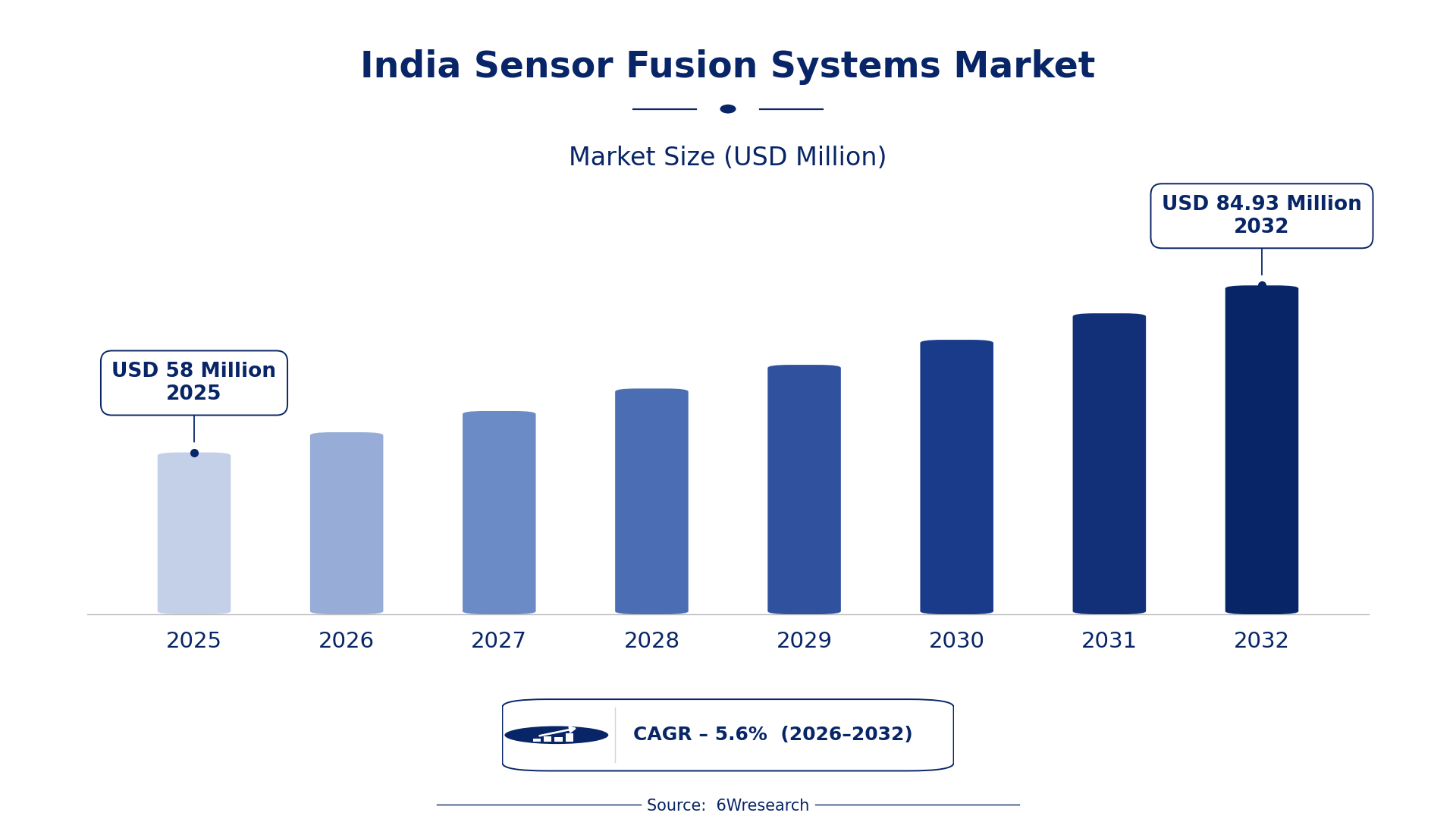
According to 6Wresearch internal database and industry insights, the India Sensor Fusion Systems Market was valued at USD 58.0 million in 2025 and is projected to reach USD 84.93 million by 2032, growing at a CAGR of approximately 5.6% during 2026–2032.
India Sensor Fusion Systems Market Highlights
| Report Metric | Details |
| Report Name | India Sensor Fusion Systems Market |
| Market Size 2025 | USD 58.0 million |
| Market Size 2032 | USD 84.93 million |
| Absolute Growth 2025–2032 | USD 26.93 million |
| CAGR 2026–2032 | 5.6% |
| Peak Annual Growth | 8.3% in 2032 |
| Forecast Period | 2026–2032 |
| Historical Data | 2022–2025 |
| Base Year | 2025 |
| Leading Fusion Type, 2025 | LiDAR + Radar Fusion (43% share) |
| Leading Sensor Inputs, 2025 | Object Detection (48% share) |
| Leading Application Area, 2025 | ADAS Systems (42% share) |
| Leading End User, 2025 | Autonomous Car OEMs (39% share) |
| Fastest-Growing Fusion Type | Multi-Sensor Fusion AI (7.6% CAGR) |
| Fastest-Growing Sensor Inputs | Motion Navigation (6.6% CAGR) |
| Fastest-Growing Application Area | Robotics/Drone Control (7.4% CAGR) |
| Fastest-Growing End User | Mobility Equipment Vendors (7.6% CAGR) |
| Growing Sector | automotive |
| Key End Users | Autonomous Car OEMs, Vehicle Electronics Makers, Mobility Equipment Vendors, Robotics Manufacturers |
India Sensor Fusion Systems Market Year-wise Growth Rate and Key Drivers (2022–2032)
This graph illustrates the annual growth rates of the market from 2022 to 2032, highlighting a steady upward trajectory and projected market expansion over the forecast period.
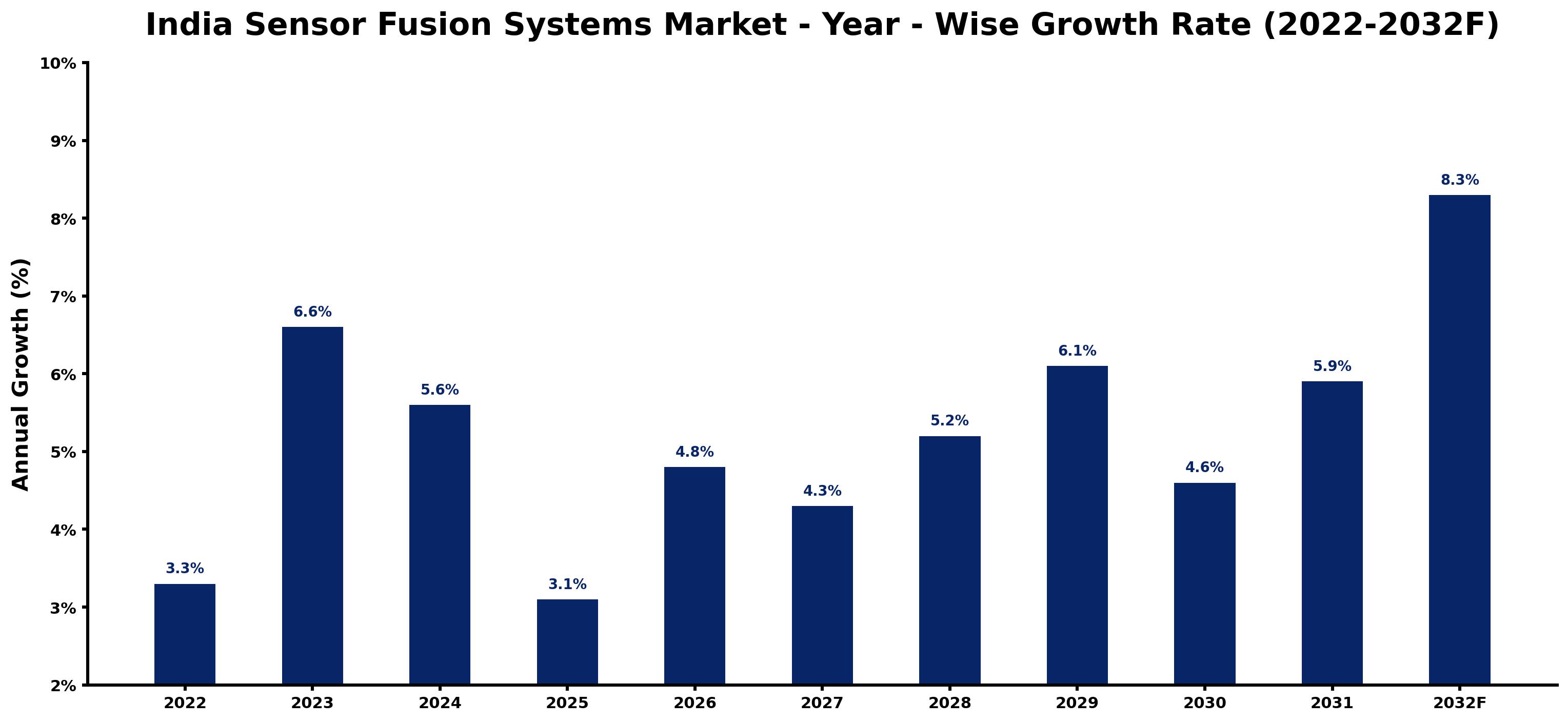
Year by year, the estimates below pair each growth rate with the development that shaped it.
| Year | Estimated Annual Growth (%) | Market Rationale |
| 2022 | 3.3 | The market experienced steady growth due to increasing investments in smart mobility solutions. |
| 2023 | 6.6 | Growth accelerated as the government introduced guidelines for autonomous vehicles, boosting sensor technology demand. |
| 2024 | 5.6 | The growth rate slowed as the market adjusted to new regulations and standards in sensor technologies. |
| 2025 | 3.1 | A further slowdown occurred as the market stabilised amid ongoing developments in smart mobility initiatives. |
| 2026 | 4.8 | Growth picked up again, driven by rising investments in sensor fusion for autonomous vehicles. |
| 2027 | 4.3 | The market saw a slight slowdown as new technologies began to mature and integrate. |
| 2028 | 5.2 | Growth resumed as demand for robotics and autonomous systems increased significantly. |
| 2029 | 6.1 | The market continued to grow, supported by advancements in sensor technologies and applications. |
| 2030 | 4.6 | Growth slowed again as the market approached saturation in certain segments. |
| 2031 | 5.9 | An increase in growth was noted as more vehicles adopted advanced safety features. |
| 2032 | 8.3 | The market is expected to peak with a surge in demand for sensor fusion in autonomous vehicles. |
Note: Market size estimations and growth projections presented in this report are based on 6Wresearch's proprietary forecasting methodology, utilizing the latest available industry data, government publications, and primary research inputs.
India Sensor Fusion Systems Market Synopsis
Sensor Fusion Systems in India integrate data from multiple sensors to improve decision-making capabilities across various applications. These systems utilise advanced algorithms and machine learning to process inputs from cameras, LiDAR, and radar. The India Sensor Fusion Systems Market is set to grow rapidly, driven by rising investments in smart mobility initiatives and the automotive industry's focus on safety. By 2025, the installed base of ADAS-equipped vehicles is projected to surpass 1 million units, underscoring the increasing demand for these technologies. The government's commitment to smart city projects further bolsters this trend, creating a strong market environment.
Market Dynamics Impact Analysis (2026–2032)
| Factor | Type | Impact | Primary Segment Affected |
| Increasing investments in smart mobility initiatives are driving demand for advanced sensor technologies. | Driver | High | ADAS Systems |
| The rise in autonomous vehicle production is creating opportunities for sensor fusion integration. | Driver | High | Autonomous Car OEMs |
| The demand for advanced driver assistance systems is surging, creating a significant market opportunity. | Opportunity | High | ADAS Systems |
| The growing urbanization trend increases the need for parking assist systems in vehicles. | Opportunity | High | Parking Assist |
| High costs associated with developing and integrating sensor technologies can limit market growth. | Restraint | High | Multi-Sensor Fusion AI |
| Regulatory challenges in testing and approving new sensor technologies may slow down market entry. | Restraint | High | Object Detection |
| Limited availability of skilled professionals in sensor technology hinders development and deployment. | Challenge | Medium | IMU + GPS Fusion |
| Supply chain disruptions for critical components can delay production timelines for sensor systems. | Challenge | Medium | Camera + Ultrasonic |
Evaluation of Drivers in India Sensor Fusion Systems Market (2026–2032)
The main growth drivers and the segments they affect most are set out below.
| Drivers | Primary Segment Affected | Why It Matters (Evidence) |
| Rising investments in smart mobility initiatives are driving sensor technology adoption. | ADAS Systems | The government plans to invest $1.5 billion in smart mobility initiatives by 2025, promoting sensor technology. |
| Increased production of autonomous vehicles is driving demand for sensor fusion systems. | Autonomous Car OEMs | The installed base of ADAS-equipped vehicles in India is projected to exceed 1 million units by 2025. |
| Growing urbanisation is increasing the need for advanced parking assist systems in vehicles. | Parking Assist | The demand for parking assist systems is rising, with over 30% of new vehicles expected to feature this technology by 2025. |
| Technological advancements in sensor fusion are improving safety features in vehicles. | Multi-Sensor Fusion AI | The Indian automotive industry is focusing on reducing accidents, with sensor fusion playing a key role in safety enhancements. |
| Research and development in robotics is expanding the application of sensor fusion technologies. | Robotics/Drone Control | The Indian Institute of Technology is conducting research on sensor fusion applications in robotics, enhancing capabilities. |
Growth in the Sensor Fusion Systems market in India stems from rising investments in smart mobility, increased production of autonomous vehicles, and urbanisation. The installed base of ADAS-equipped vehicles is expected to exceed 1 million units by 2025, driving demand for advanced safety features. Urbanisation is heightening the need for sophisticated parking assist systems, with a notable increase in new vehicles featuring this technology. Ongoing research collaborations between educational institutions and industry players will further propel advancements in sensor fusion applications, particularly in robotics and autonomous systems.
Evaluation of Restraints in India Sensor Fusion Systems Market
The table below lists the restraints and the evidence behind each.
| Market Restraint | Primary Segment Affected | Why It Matters (Evidence) |
| High costs associated with sensor technology development can limit market growth. | Multi-Sensor Fusion AI | Developing and integrating sensor technologies often requires substantial financial investment. |
| Regulatory challenges in testing new sensor technologies may slow market entry. | Object Detection | Compliance with evolving regulations can delay the approval of new sensor systems, impacting time-to-market. |
| Limited availability of skilled professionals in sensor technology hinders development. | IMU + GPS Fusion | The shortage of experts can slow down the implementation of advanced sensor systems, affecting project timelines. |
| Supply chain disruptions for critical components can delay production timelines. | Camera + Ultrasonic | Global supply chain issues have affected the availability of essential parts for sensor systems, leading to production delays. |
| Market saturation in certain segments may restrict growth opportunities. | ADAS Systems | As more vehicles adopt ADAS, the market may face challenges in expanding further, limiting new investments. |
India Sensor Fusion Systems Market Challenges
India's sensor fusion systems market faces regulatory hurdles, as new guidelines for autonomous vehicles introduced in 2023 delay product approvals for manufacturers, extending time-to-market by several months. Buyers encounter inflated costs due to the lack of standardisation in sensor technologies, which can increase prices by up to 20% for automotive components, straining their budgets. Technological challenges arise from many producers struggling to effectively integrate advanced algorithms, resulting in a slower rollout of applications that limits competitiveness. Competition intensifies as international players enter the market, forcing local suppliers to reduce prices, which can diminish their profit margins.
Trends in the India Sensor Fusion Systems Market
Four trends stand out in the India Sensor Fusion Systems Market.
- Shift from Traditional to Advanced Driver Assistance Systems: Automotive manufacturers are increasingly adopting advanced driver assistance systems to improve vehicle safety. In 2023, the installed base of ADAS-equipped vehicles in India is projected to exceed 1 million units, indicating a shift towards more automated driving solutions.
- Transition from Manual to Autonomous Navigation: A growing trend towards autonomous navigation in vehicles is clear, driven by advancements in sensor fusion technologies. The National Policy on Autonomous Vehicles launched in 2023 supports this transition, promoting the development of self-driving technologies.
- Emergence of Smart City Initiatives: Smart city projects are integrating sensor fusion technologies to enhance urban mobility solutions. The Smart Cities Mission aims to incorporate advanced technologies, with a funding target of $1.5 billion by 2025, improving urban transport systems.
- Increase in Demand for Parking Assist Systems: The demand for parking assist systems is rising due to urbanisation, with over 30% of new vehicles expected to feature this technology by 2025. This trend reflects the need for improved convenience in vehicle operations.
Investment Opportunities in the India Sensor Fusion Systems Market
Investors looking at the India Sensor Fusion Systems Market should consider the following areas.
- Investment in Smart Mobility: With the government's commitment to invest $1.5 billion in smart mobility initiatives by 2025, there is a strong opportunity to supply advanced sensor technologies to automotive manufacturers.
- Demand from Autonomous Car OEMs: Autonomous car OEMs are increasingly seeking advanced sensor fusion systems, creating an opportunity for suppliers to meet their needs for enhanced vehicle safety and automation.
- Supply of Advanced Parking Assist Technologies: The projected increase of over 30% in new vehicles featuring parking assist systems by 2025 presents an opportunity for manufacturers to develop and supply these technologies.
- Investment in Robotics and Drone Control: The growing interest in robotics and drone applications opens a window for suppliers to provide sensor fusion solutions, especially as research from the Indian Institute of Technology advances.
Government Initiatives in the India Sensor Fusion Systems Market
In 2023, the Ministry of Road Transport and Highways launched the 'National Policy on Autonomous Vehicles' to promote the development and deployment of sensor technologies in self-driving cars. This policy aims to create a regulatory framework that supports innovation and safety in autonomous vehicle operations. Additionally, the 'Make in India' initiative, launched in 2014, continues to support local manufacturing of sensor technologies, focusing on automotive applications. This initiative encourages domestic production and reduces dependency on imports, promoting growth in the sensor fusion market. The 'Digital India' program, introduced in 2021 by the Ministry of Electronics and Information Technology, promotes sensor technologies for smart city projects, enhancing urban mobility solutions.
The National Automotive Testing and R&D Infrastructure Project, updated in 2022, includes provisions for testing sensor fusion systems in vehicles, facilitating their integration into the automotive sector. The Ministry of Heavy Industries has also launched a scheme to promote electric vehicles, emphasising the integration of advanced sensor technologies for safety and efficiency. This initiative supports the adoption of electric vehicles equipped with advanced sensor systems, ensuring compliance with safety and performance requirements.
Future Insight of the India Sensor Fusion Systems Market
The India sensor fusion systems market will evolve by 2032, driven by government investments in smart mobility initiatives projected to reach $1.5 billion by 2025. New vehicle safety standards from the National Automotive Testing and R&D Infrastructure Project will promote sensor technology adoption. Demand for parking assist systems will surge, with over 30% of new vehicles expected to feature this technology by 2025, creating opportunities for suppliers. Collaborative research between educational institutions and industry will further advance sensor fusion applications, improving capabilities across various sectors.
Market Segmentation Analysis
The analysis below covers each segmentation, its leading category in 2025 and its fastest-growing category through 2032.
By Fusion Type – LiDAR + Radar Fusion Dominated, Multi-Sensor Fusion AI Expected to Grow Fastest
According to Dhaval Chaurasia, Assistant Manager at 6Wresearch, LiDAR + Radar Fusion took a 43% share of fusion type in 2025, more than any other category. LiDAR + Radar Fusion holds the largest share due to its critical role in accurate distance measurement and object detection, essential for autonomous vehicles. This technology is widely adopted in India's automotive sector, particularly in advanced driver-assistance systems, with over 1 million ADAS-equipped vehicles projected by 2025. The quickest growth will come from Multi-Sensor Fusion AI, forecast to expand at a CAGR of 7.6% between 2026 and 2032. The Multi-Sensor Fusion segment is growing rapidly as it significantly improves decision-making capabilities in complex environments. With the government's $1.5 billion investment in smart mobility initiatives, this technology is becoming integral to various applications, including autonomous vehicles. Suppliers should prioritise the development of advanced Multi-Sensor Fusion solutions to meet the rising demand in the automotive sector.
By Sensor Inputs – Object Detection Dominated, Motion Navigation Expected to Grow Fastest
Object Detection held a 48% share of the India Sensor Fusion Systems Market by sensor inputs in 2025. Object Detection leads the market as it is fundamental for safety features in vehicles and robotics, ensuring reliable operation in various conditions. Its widespread implementation in autonomous systems highlights its importance in enhancing safety and efficiency, particularly with the push for improved vehicle safety standards. Motion Navigation is set to record the highest CAGR in this split, 6.6% over 2026–2032. Motion Navigation is the fastest-growing segment, driven by its essential role in autonomous navigation across various applications. The increasing demand for advanced navigation systems in robotics and vehicles, especially in urban environments, is propelling this growth. Buyers should consider solutions that integrate advanced Object Detection and Motion Navigation capabilities to remain competitive in the market.
By Application Area – ADAS Systems Dominated, Robotics/Drone Control Expected to Grow Fastest
ADAS Systems accounted for a 42% market share by application area in 2025. ADAS Systems dominate the market due to their crucial role in enhancing vehicle safety and automation, with a growing installed base of ADAS-equipped vehicles in India. This application area is receiving significant attention from manufacturers aiming to improve safety standards, particularly through government initiatives. Over 2026–2032, Robotics/Drone Control is expected to post the fastest growth, at a CAGR of 7.4%. Robotics/Drone Control is the fastest-growing application area, essential for the autonomous operation and navigation of drones and robots. The rising demand for drone technology in India, especially for urban applications, is a key driver for this segment's rapid expansion. Suppliers must invest in developing Robotics/Drone Control solutions to capitalise on the increasing demand for autonomous systems.
By End User – Autonomous Car OEMs Dominated, Mobility Equipment Vendors Expected to Grow Fastest
In 2025, Autonomous Car OEMs led the end user split with a 39% share. Autonomous Car OEMs represent the largest share of the market as they are the primary users of sensor fusion technologies for vehicle automation. Their focus on enhancing safety and efficiency drives the adoption of these systems in new vehicle models, aligning with government safety initiatives. Mobility Equipment Vendors are projected to grow fastest, at a CAGR of 7.6% during 2026–2032. Mobility Equipment Vendors are experiencing the fastest growth as they leverage sensor fusion to develop advanced mobility solutions. The increasing emphasis on smart mobility and urban transport solutions, supported by government investments, is propelling this segment forward. Buyers should engage with Mobility Equipment Vendors to access cutting-edge sensor fusion technologies that enhance their product offerings.
Key Attractiveness of the Report
- 10 Years of Market Numbers
- Historical Data Starting from 2022 to 2025
- Base Year 2025
- Forecast Data until 2032
- Key Performance Indicators Impacting the Market
- Major Upcoming Developments and Projects
Key Highlights of the Report:
- India Sensor Fusion Systems Market Outlook
- Market Size of India Sensor Fusion Systems Market, 2025
- Forecast of India Sensor Fusion Systems Market, 2032
- Historical Data and Forecast of India Sensor Fusion Systems Revenues & Volume for the Period 2022 - 2032F
- India Sensor Fusion Systems Market Trend Evolution
- India Sensor Fusion Systems Market Drivers and Challenges
- India Sensor Fusion Systems Price Trends
- India Sensor Fusion Systems Porter's Five Forces
- India Sensor Fusion Systems Industry Life Cycle
- Historical Data and Forecast of India Sensor Fusion Systems Market Revenues & Volume By Fusion Type for the Period 2022 - 2032F
- Historical Data and Forecast of India Sensor Fusion Systems Market Revenues & Volume By LiDAR + Radar Fusion for the Period 2022 - 2032F
- Historical Data and Forecast of India Sensor Fusion Systems Market Revenues & Volume By Camera + Ultrasonic for the Period 2022 - 2032F
- Historical Data and Forecast of India Sensor Fusion Systems Market Revenues & Volume By IMU + GPS Fusion for the Period 2022 - 2032F
- Historical Data and Forecast of India Sensor Fusion Systems Market Revenues & Volume By Multi-Sensor Fusion AI for the Period 2022 - 2032F
- Historical Data and Forecast of India Sensor Fusion Systems Market Revenues & Volume By Sensor Inputs for the Period 2022 - 2032F
- Historical Data and Forecast of India Sensor Fusion Systems Market Revenues & Volume By Object Detection for the Period 2022 - 2032F
- Historical Data and Forecast of India Sensor Fusion Systems Market Revenues & Volume By Parking Assist for the Period 2022 - 2032F
- Historical Data and Forecast of India Sensor Fusion Systems Market Revenues & Volume By Motion Navigation for the Period 2022 - 2032F
- Historical Data and Forecast of India Sensor Fusion Systems Market Revenues & Volume By All Sensor Streams for the Period 2022 - 2032F
- Historical Data and Forecast of India Sensor Fusion Systems Market Revenues & Volume By Application Area for the Period 2022 - 2032F
- Historical Data and Forecast of India Sensor Fusion Systems Market Revenues & Volume By ADAS Systems for the Period 2022 - 2032F
- Historical Data and Forecast of India Sensor Fusion Systems Market Revenues & Volume By Blind Spot/Obstacle Avoidance for the Period 2022 - 2032F
- Historical Data and Forecast of India Sensor Fusion Systems Market Revenues & Volume By Robotics/Drone Control for the Period 2022 - 2032F
- Historical Data and Forecast of India Sensor Fusion Systems Market Revenues & Volume By Real-Time Decision Support for the Period 2022 - 2032F
- Historical Data and Forecast of India Sensor Fusion Systems Market Revenues & Volume By End User for the Period 2022 - 2032F
- Historical Data and Forecast of India Sensor Fusion Systems Market Revenues & Volume By Autonomous Car OEMs for the Period 2022 - 2032F
- Historical Data and Forecast of India Sensor Fusion Systems Market Revenues & Volume By Vehicle Electronics Makers for the Period 2022 - 2032F
- Historical Data and Forecast of India Sensor Fusion Systems Market Revenues & Volume By Mobility Equipment Vendors for the Period 2022 - 2032F
- Historical Data and Forecast of India Sensor Fusion Systems Market Revenues & Volume By Self-Driving Platforms for the Period 2022 - 2032F
- India Sensor Fusion Systems Import Export Trade Statistics
- Market Opportunity Assessment By Fusion Type
- Market Opportunity Assessment By Sensor Inputs
- Market Opportunity Assessment By Application Area
- Market Opportunity Assessment By End User
- India Sensor Fusion Systems Top Companies Market Share
- India Sensor Fusion Systems Competitive Benchmarking By Technical and Operational Parameters
- India Sensor Fusion Systems Company Profiles
- India Sensor Fusion Systems Key Strategic Recommendations
Market Covered
Segments analysed in this report are listed below.
By Fusion Type
- LiDAR + Radar Fusion
- Camera + Ultrasonic
- IMU + GPS Fusion
- Multi-Sensor Fusion AI
By Sensor Inputs
- Object Detection
- Parking Assist
- Motion Navigation
- All Sensor Streams
By Application Area
- ADAS Systems
- Blind Spot/Obstacle Avoidance
- Robotics/Drone Control
- Real-Time Decision Support
By End User
- Autonomous Car OEMs
- Vehicle Electronics Makers
- Mobility Equipment Vendors
- Self-Driving Platforms































