India Sensor Integration Market Size & Growth Rate
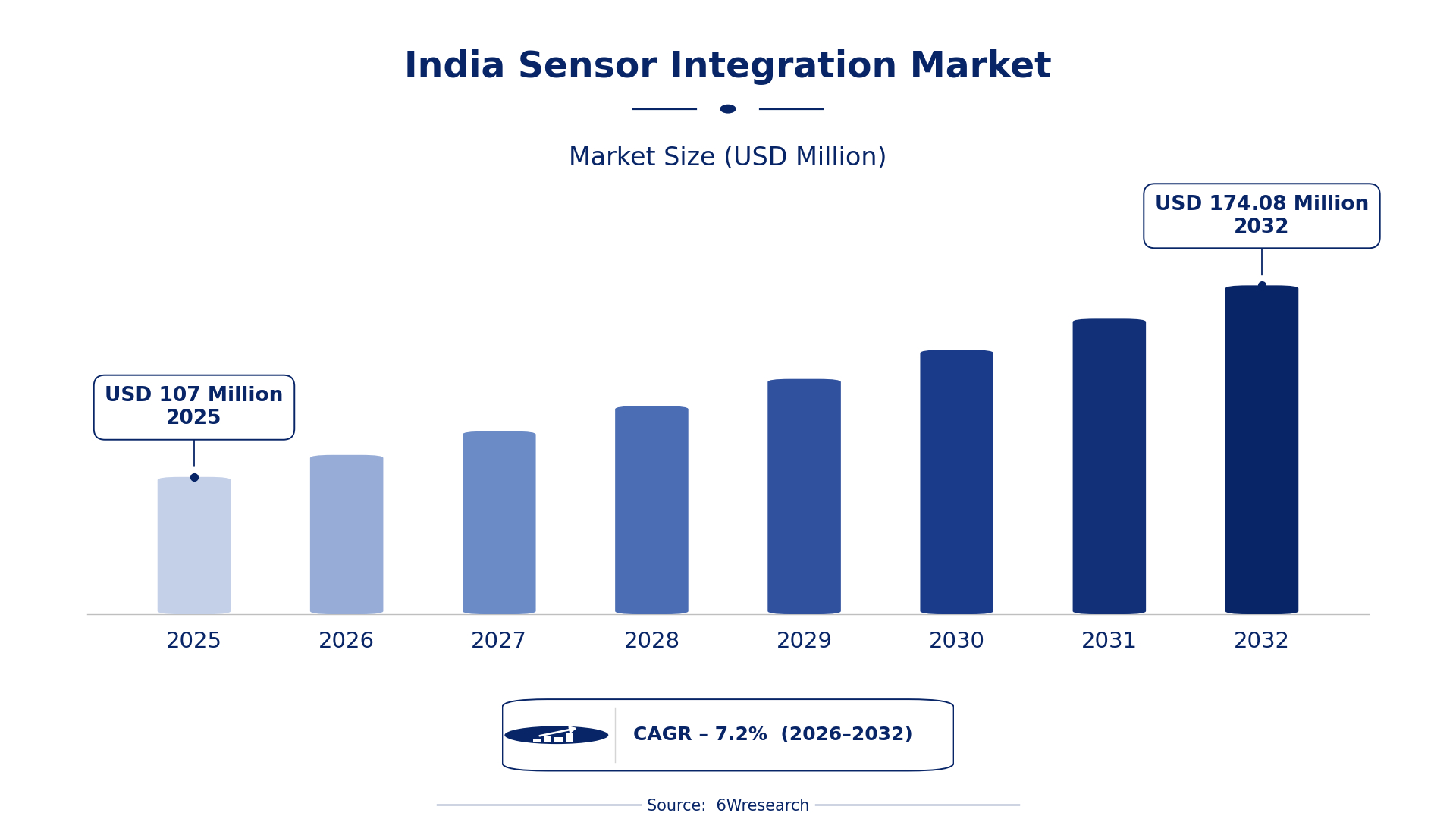
According to 6Wresearch internal database and industry insights, the India Sensor Integration Market was valued at USD 107.0 million in 2025 and is projected to reach USD 174.08 million by 2032, growing at a CAGR of approximately 7.2% during 2026–2032.
India Sensor Integration Market Highlights
| Report Metric | Details |
| Report Name | India Sensor Integration Market |
| Market Size 2025 | USD 107.0 million |
| Market Size 2032 | USD 174.08 million |
| Absolute Growth 2025–2032 | USD 67.08 million |
| CAGR 2026–2032 | 7.2% |
| Peak Annual Growth | 9.3% in 2027 |
| Forecast Period | 2026–2032 |
| Historical Data | 2022–2025 |
| Base Year | 2025 |
| Leading Integration Type, 2025 | SoC Integration (52% share) |
| Leading Sensor Technology, 2025 | Accelerometer (34% share) |
| Leading Target Device, 2025 | Smartphones (39% share) |
| Leading End User, 2025 | Consumer Electronics Brands (38% share) |
| Fastest-Growing Integration Type | AI Sensor Hubs (9.7% CAGR) |
| Fastest-Growing Sensor Technology | RF + Bluetooth (9.7% CAGR) |
| Fastest-Growing Target Device | IoT Devices (9.1% CAGR) |
| Fastest-Growing End User | Smart Home System Providers (8.6% CAGR) |
| Growing Sector | automotive |
| Key End Users | consumer electronics brands, automotive manufacturers, industrial automation companies, smart home system providers |
India Sensor Integration Market Year-wise Growth Rate and Key Drivers (2022–2032)
This graph illustrates the annual growth rates of the market from 2022 to 2032, highlighting a steady upward trajectory and projected market expansion over the forecast period.
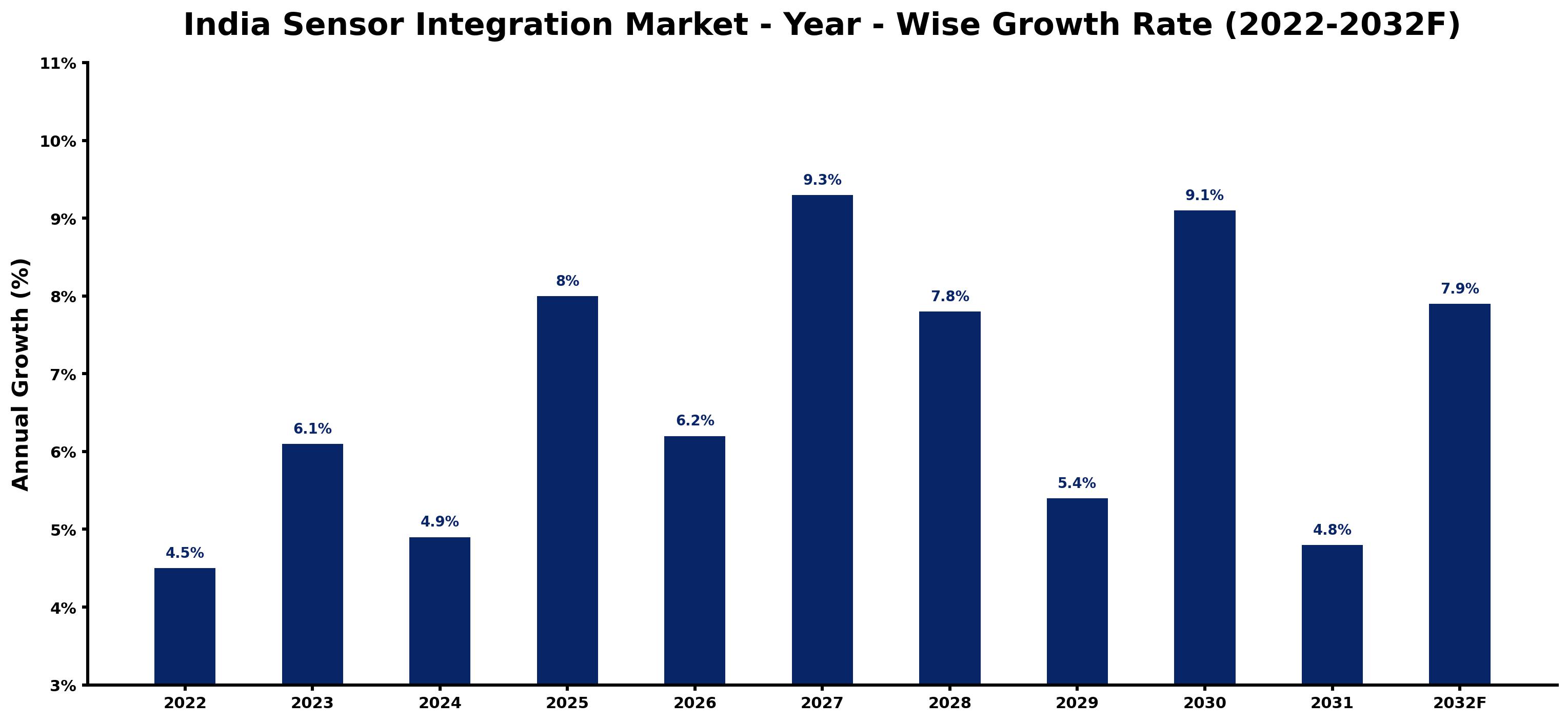
Annual growth estimates for each year appear below with the principal reason behind them, explaining the shifts that set the pace of the market.
| Year | Estimated Annual Growth (%) | Market Rationale |
| 2022 | 4.5 | The market experienced steady growth due to rising demand for smart devices, driven by the 'Digital India' initiative. |
| 2023 | 6.1 | Growth accelerated as domestic manufacturers increased sensor production capacity, aligning with the 'Make in India' programme. |
| 2024 | 4.9 | A slowdown occurred as manufacturers adjusted to fluctuations in demand for automotive sensors. |
| 2025 | 8.0 | The market reached a historical peak, driven by automotive sector expansion and increased demand for advanced sensors. |
| 2026 | 6.2 | Growth slowed again as the market adapts to new production standards set by the 'National Policy on Electronics 2021'. |
| 2027 | 9.3 | A surge in demand was noted as the automotive sector continued to expand, supported by the expected growth to $300 billion by 2026. |
| 2028 | 7.8 | Growth decelerated as the market stabilises after the previous peak in sensor integration technologies. |
| 2029 | 5.4 | Demand slowed further as manufacturers faced supply chain challenges in sourcing components for IoT devices. |
| 2030 | 9.1 | A rebound occurred as new technologies drive sensor integration needs, particularly in the automotive sector. |
| 2031 | 4.8 | Growth moderated as the market adjusted to increased competition among consumer electronics brands. |
| 2032 | 7.9 | A rise in demand is expected due to advancements in IoT applications and the Smart Cities Mission. |
Note: Market size estimations and growth projections presented in this report are based on 6Wresearch's proprietary forecasting methodology, utilizing the latest available industry data, government publications, and primary research inputs.
India Sensor Integration Market Synopsis
Sensor Integration in India combines various sensors into cohesive systems, enhancing functionality across devices. This integration utilises advanced manufacturing techniques, particularly MEMS and SoC integration. The India Sensor Integration Market is expanding as domestic manufacturers cater to the rising demand for smart devices and automotive applications. Initiatives like the 'Digital India' programme also encourage the adoption of smart technologies across multiple sectors.
Market Dynamics Impact Analysis (2026–2032)
| Factor | Type | Impact | Primary Segment Affected |
| Rising demand for smart devices fuels the need for sensor integration technologies. | Driver | High | MEMS Integration |
| Expansion of the automotive sector increases the integration of advanced sensors. | Driver | High | Automotive Modules |
| Growing urbanisation creates opportunities for smart city solutions requiring sensor integration. | Opportunity | High | Smart Home System Providers |
| The demand for wearables is surging, necessitating advanced sensor integration. | Opportunity | High | Wearables |
| Supply chain disruptions can delay the availability of essential components. | Restraint | High | SoC Integration |
| High production costs may limit the affordability of advanced sensor technologies. | Restraint | Medium | AI Sensor Hubs |
| Buyers face challenges in sourcing reliable components for sensor integration. | Challenge | High | Wireless Sensor Modules |
| Suppliers encounter difficulties in meeting the rapidly evolving technology standards. | Challenge | Medium | Gyroscope |
Evaluation of Drivers in India Sensor Integration Market (2026–2032)
Below mentioned are some major drivers and their influence on market dynamics.
| Drivers | Primary Segment Affected | Why It Matters (Evidence) |
| Increased smartphone penetration drives demand for MEMS sensors. | MEMS Integration | With over 80% market penetration, smartphones boost sensor integration needs, particularly in consumer electronics. |
| The automotive sector's growth necessitates advanced sensor integration. | Automotive Modules | The automotive market is expected to reach $300 billion by 2026, increasing the demand for advanced sensor technologies. |
| The rise of IoT devices increases the need for integrated sensor solutions. | IoT Devices | As IoT adoption grows, demand for sensor integration technologies will escalate, particularly in smart home systems. |
| Consumer electronics brands are integrating sensors for improved user experiences. | Consumer Electronics Brands | The demand for smart devices creates a need for advanced sensor integration in various electronic products. |
| Government initiatives promote local manufacturing of sensor technologies. | AI Sensor Hubs | Programs like 'Make in India' encourage the production of advanced sensor technologies, boosting local supply. |
Market growth in India for Sensor Integration rests on rising end-use demand from the automotive and consumer electronics sectors. Over 80% penetration of MEMS sensors in smartphones fuels integration technologies. The increasing adoption of IoT devices further drives this need, as manufacturers seek to create smarter products.
Evaluation of Restraints in India Sensor Integration Market
The following restraints limit how fast demand can grow.
| Market Restraint | Primary Segment Affected | Why It Matters (Evidence) |
| Supply chain disruptions impact the availability of critical sensor components. | SoC Integration | Manufacturers face delays due to global supply chain issues, affecting production timelines and delivery schedules. |
| High production costs limit the affordability of advanced sensor technologies. | AI Sensor Hubs | Rising costs can deter smaller manufacturers from adopting advanced sensor solutions, impacting market growth. |
| Limited access to skilled workforce hampers production capabilities. | Wireless Sensor Modules | A shortage of trained personnel affects the efficiency of sensor integration processes, delaying project timelines. |
| Regulatory compliance can slow down product development timelines. | Gyroscope | Manufacturers must adhere to strict standards, delaying time-to-market for new sensor products. |
| Market volatility can lead to unpredictable demand for sensor technologies. | MEMS Integration | Fluctuating consumer preferences create uncertainty for manufacturers in the sensor integration sector. |
India Sensor Integration Market Challenges
Buyers and suppliers in the India Sensor Integration Market face high costs due to reliance on imported advanced technologies, inflating prices by up to 30% for manufacturers. This reliance delays product launches, reducing competitiveness for local producers. A shortage of skilled workers in advanced sensor manufacturing exists, as local talent often lacks expertise in MEMS and SoC integration, potentially causing project delays of up to six months for producers. Supply chain disruptions, exacerbated by global events, can lead to a 20% increase in lead times for component delivery, impacting production schedules for buyers.
Trends in the India Sensor Integration Market
The trends below show where the India Sensor Integration Market is heading.
- Rising Demand for Smart Home Solutions: Urbanisation is driving the need for smart home systems integrating sensors, with the 'Smart Cities Mission' supporting this trend. Investments in urban areas are expected to improve sensor integration capabilities.
- Investment in Wearable Technology: The demand for wearables is anticipated to reach 100 million units by 2025, presenting a significant opportunity for sensor integration. Manufacturers targeting health and fitness sectors can benefit from this growth.
- Growth of IoT Devices: As IoT adoption accelerates, there is a significant gap in the market for integrated sensor solutions. Companies focusing on IoT devices can meet growing consumer needs, driving further investments in sensor technologies.
- Local Manufacturing Initiatives: The 'Make in India' program encourages investment in local sensor manufacturing. This initiative provides an opportunity for businesses to establish partnerships and improve production capabilities.
Investment Opportunities in the India Sensor Integration Market
Below are the investment opportunities with the strongest case in the India Sensor Integration Market.
- Emerging Smart Home Solutions: With urbanisation on the rise, there is a growing need for smart home systems integrating sensors. The 'Smart Cities Mission' supports this trend, with investments expected to improve urban living.
- Investment in Wearable Technology: The demand for wearables is expected to reach 100 million units by 2025, presenting a lucrative opportunity for sensor integration. Manufacturers targeting health and fitness sectors can benefit from this trend.
- Growth of IoT Devices: As IoT adoption accelerates, there is a significant gap in the market for integrated sensor solutions. Companies focusing on IoT devices can seize this opportunity to meet growing consumer needs.
- Local Manufacturing Initiatives: The 'Make in India' program encourages investment in local sensor manufacturing. This initiative provides an opportunity for businesses to establish partnerships and improve production capabilities.
Government Initiatives in the India Sensor Integration Market
The 'National Policy on Electronics 2021' aims to boost local manufacturing of electronic components, including sensors, by increasing domestic production and reducing dependency on imports. This policy supports the growth of the sensor integration market by encouraging investment in local production capabilities. The 'Production Linked Incentive (PLI) Scheme for Large Scale Electronics Manufacturing' introduced in 2020 incentivises the production of electronic goods, including sensor technologies, promoting growth in the sector.
The Electronics and Computer Software Export Promotion Council (ESC) plays a crucial role in supporting sensor technology development in India. The council facilitates funding and approvals for projects aimed at improving sensor integration capabilities. The 'Digital India Programme' seeks to transform India into a digitally empowered society, increasing demand for sensor technologies. The 'Smart Cities Mission' continues to receive funding to implement smart solutions, including sensor-based technologies across urban areas, enhancing urban infrastructure.
Future Insight of the India Sensor Integration Market
By 2032, buyers and suppliers in the India Sensor Integration Market can expect enhanced local manufacturing capabilities, driven by initiatives like 'Make in India' and the 'Digital India' programme. The automotive sector's growth will create a surge in demand for advanced sensors, particularly in automotive electronics, which is set to expand alongside the automotive market. The Smart Cities Mission will facilitate the integration of IoT solutions, improving urban sensor applications. The demand for wearables is anticipated to reach 100 million units by 2025, further advancing sensor integration.
Market Segmentation Analysis
The report offers a comprehensive study of the following market segments and their leading categories in the market.
By Integration Type – SoC Integration Dominated, AI Sensor Hubs Expected to Grow Fastest
According to Dhaval Chaurasia, Assistant Manager at 6Wresearch, in 2025, SoC Integration led the integration type split with a 52% share. SoC Integration leads the market share as it consolidates multiple functionalities into a single chip, which is vital for creating compact and efficient devices. This is especially critical in the automotive sector, where advanced sensors play a key role in enhancing vehicle safety and performance. AI Sensor Hubs are set to record the highest CAGR in this split, 9.7% over 2026–2032. AI Sensor Hubs are experiencing rapid growth due to their ability to enable smart processing for IoT applications, which are set to expand significantly alongside the rise of smart technologies. The 'Digital India' initiative is further driving this demand by promoting the integration of advanced sensors in various sectors. Suppliers should focus on developing SoC Integration and AI Sensor Hubs to meet the escalating demand in the Indian market.
By Sensor Technology – Accelerometer Dominated, RF + Bluetooth Expected to Grow Fastest
With a 34% revenue share in 2025, Accelerometer was the largest sensor technology category. The Accelerometer leads in market share due to its critical role in motion detection across various applications, including smartphones and automotive systems. Its extensive use in consumer electronics ensures a consistent demand for this technology. The quickest growth will come from RF + Bluetooth, forecast to expand at a CAGR of 9.7% between 2026 and 2032. RF + Bluetooth technology is the fastest-growing segment, propelled by the surging need for wireless communication in devices, especially within IoT applications. The anticipated growth in IoT devices will further boost this segment's expansion. Buyers should invest in RF + Bluetooth technologies to maintain competitiveness in the swiftly evolving sensor market.
By Target Device – Smartphones Dominated, IoT Devices Expected to Grow Fastest
The largest target device category in 2025 was Smartphones, with a 39% share of total revenue. Smartphones dominate the market share for sensor integration technologies, acting as the primary application for these sensors and driving substantial demand. With over 80% penetration of MEMS sensors in smartphones, this segment remains robust and influential in the market. IoT Devices are projected to grow fastest, at a CAGR of 9.1% during 2026–2032. IoT Devices represent the fastest-growing segment, essential for ensuring connectivity and data collection in smart environments. The rise of smart cities and home automation initiatives is significantly boosting the demand for these devices. Suppliers must prioritise IoT device integration to seize expanding market opportunities.
By End User – Consumer Electronics Brands Dominated, Smart Home System Providers Expected to Grow Fastest
Consumer Electronics Brands held a 38% share of the India Sensor Integration Market by end user in 2025. Consumer Electronics Brands capture the largest market share as they integrate sensors to enhance user experience in their products, resulting in substantial demand. The competitive landscape of consumer electronics necessitates the adoption of advanced sensor technologies for effective product differentiation. Over 2026–2032, Smart Home System Providers are expected to post the fastest growth, at a CAGR of 8.6%. Smart Home System Providers are the fastest-growing segment, integrating sensors for home automation solutions that resonate with the increasing consumer interest in smart living. This trend is expected to continue as more households adopt smart technologies. Suppliers should align their offerings with the needs of Smart Home System Providers to leverage growth in the smart home market.
Key Attractiveness of the Report
- 10 Years of Market Numbers
- Historical Data Starting from 2022 to 2025
- Base Year 2025
- Forecast Data until 2032
- Key Performance Indicators Impacting the Market
- Major Upcoming Developments and Projects
Key Highlights of the Report:
- India Sensor Integration Market Outlook
- Market Size of India Sensor Integration Market, 2025
- Forecast of India Sensor Integration Market, 2032
- Historical Data and Forecast of India Sensor Integration Revenues & Volume for the Period 2022 - 2032F
- India Sensor Integration Market Trend Evolution
- India Sensor Integration Market Drivers and Challenges
- India Sensor Integration Price Trends
- India Sensor Integration Porter's Five Forces
- India Sensor Integration Industry Life Cycle
- Historical Data and Forecast of India Sensor Integration Market Revenues & Volume By Integration Type for the Period 2022 - 2032F
- Historical Data and Forecast of India Sensor Integration Market Revenues & Volume By MEMS Integration for the Period 2022 - 2032F
- Historical Data and Forecast of India Sensor Integration Market Revenues & Volume By SoC Integration for the Period 2022 - 2032F
- Historical Data and Forecast of India Sensor Integration Market Revenues & Volume By AI Sensor Hubs for the Period 2022 - 2032F
- Historical Data and Forecast of India Sensor Integration Market Revenues & Volume By Wireless Sensor Modules for the Period 2022 - 2032F
- Historical Data and Forecast of India Sensor Integration Market Revenues & Volume By Sensor Technology for the Period 2022 - 2032F
- Historical Data and Forecast of India Sensor Integration Market Revenues & Volume By Gyroscope, Accelerometer for the Period 2022 - 2032F
- Historical Data and Forecast of India Sensor Integration Market Revenues & Volume By Temp + Pressure Sensors for the Period 2022 - 2032F
- Historical Data and Forecast of India Sensor Integration Market Revenues & Volume By Vision + Audio for the Period 2022 - 2032F
- Historical Data and Forecast of India Sensor Integration Market Revenues & Volume By RF + Bluetooth for the Period 2022 - 2032F
- Historical Data and Forecast of India Sensor Integration Market Revenues & Volume By Target Device for the Period 2022 - 2032F
- Historical Data and Forecast of India Sensor Integration Market Revenues & Volume By Smartphones, Wearables for the Period 2022 - 2032F
- Historical Data and Forecast of India Sensor Integration Market Revenues & Volume By Automotive Modules for the Period 2022 - 2032F
- Historical Data and Forecast of India Sensor Integration Market Revenues & Volume By Robotics & Smart Devices for the Period 2022 - 2032F
- Historical Data and Forecast of India Sensor Integration Market Revenues & Volume By IoT Devices for the Period 2022 - 2032F
- Historical Data and Forecast of India Sensor Integration Market Revenues & Volume By End User for the Period 2022 - 2032F
- Historical Data and Forecast of India Sensor Integration Market Revenues & Volume By Consumer Electronics Brands for the Period 2022 - 2032F
- Historical Data and Forecast of India Sensor Integration Market Revenues & Volume By Embedded Chip Makers for the Period 2022 - 2032F
- Historical Data and Forecast of India Sensor Integration Market Revenues & Volume By Industrial Automation Cos. for the Period 2022 - 2032F
- Historical Data and Forecast of India Sensor Integration Market Revenues & Volume By Smart Home System Providers for the Period 2022 - 2032F
- India Sensor Integration Import Export Trade Statistics
- Market Opportunity Assessment By Integration Type
- Market Opportunity Assessment By Sensor Technology
- Market Opportunity Assessment By Target Device
- Market Opportunity Assessment By End User
- India Sensor Integration Top Companies Market Share
- India Sensor Integration Competitive Benchmarking By Technical and Operational Parameters
- India Sensor Integration Company Profiles
- India Sensor Integration Key Strategic Recommendations
Market Covered
The report offers an extensive study of the following market segments.
By Integration Type
- MEMS Integration
- SoC Integration
- AI Sensor Hubs
- Wireless Sensor Modules
By Sensor Technology
- Gyroscope
- Accelerometer
- Temp + Pressure Sensors
- Vision + Audio
- RF + Bluetooth
By Target Device
- Smartphones
- Wearables
- Automotive Modules
- Robotics & Smart Devices
- IoT Devices
By End User
- Consumer Electronics Brands
- Embedded Chip Makers
- Industrial Automation Cos.
- Smart Home System Providers































