China Sensor Integration Market Size & Growth Rate
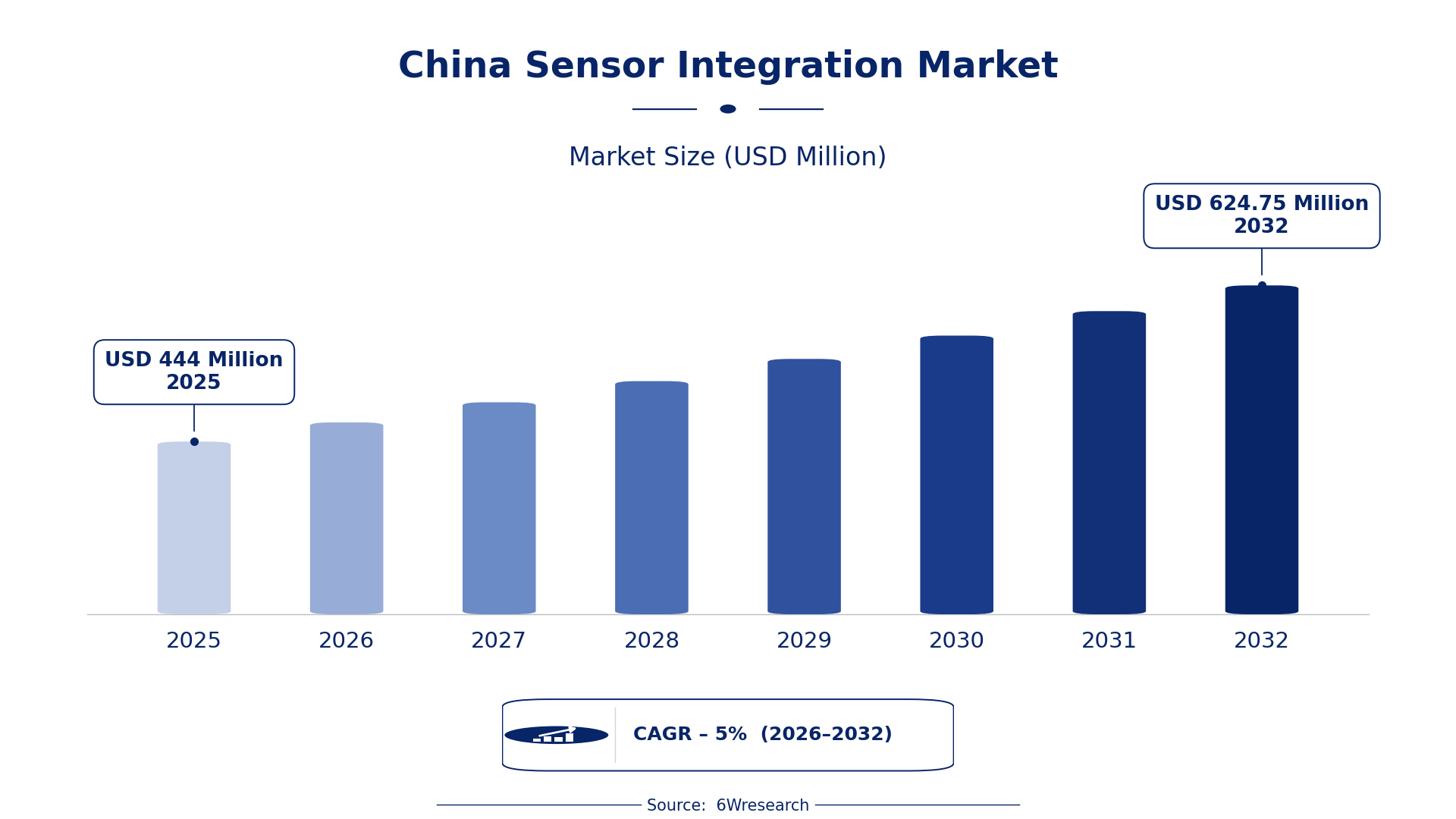
According to 6Wresearch internal database and industry insights, the China Sensor Integration Market was valued at USD 444.0 million in 2025 and is projected to reach USD 624.75 million by 2032, growing at a CAGR of approximately 5% during 2026–2032.
China Sensor Integration Market Highlights
| Report Metric | Details |
| Report Name | China Sensor Integration Market |
| Market Size 2025 | USD 444.0 million |
| Market Size 2032 | USD 624.75 million |
| Absolute Growth 2025–2032 | USD 180.75 million |
| CAGR 2026–2032 | 5% |
| Peak Annual Growth | 6.9% in 2026 |
| Forecast Period | 2026–2032 |
| Historical Data | 2022–2025 |
| Base Year | 2025 |
| Leading Integration Type, 2025 | SoC Integration (54% share) |
| Leading Sensor Technology, 2025 | Gyroscope (41% share) |
| Leading Target Device, 2025 | Smartphones (35% share) |
| Leading End User, 2025 | Consumer Electronics Brands (39% share) |
| Fastest-Growing Integration Type | AI Sensor Hubs (6.8% CAGR) |
| Fastest-Growing Sensor Technology | Vision + Audio (7.4% CAGR) |
| Fastest-Growing Target Device | IoT Devices (7.0% CAGR) |
| Fastest-Growing End User | Smart Home System Providers (7.5% CAGR) |
| Growing Sector | Consumer Electronics |
| Key End Users | Consumer Electronics Brands, Automotive Manufacturers, Smart Home System Providers, IoT Device Developers |
China Sensor Integration Market Year-wise Growth Rate and Key Drivers (2022–2032)
This graph illustrates the annual growth rates of the market from 2022 to 2032, highlighting a steady upward trajectory and projected market expansion over the forecast period.
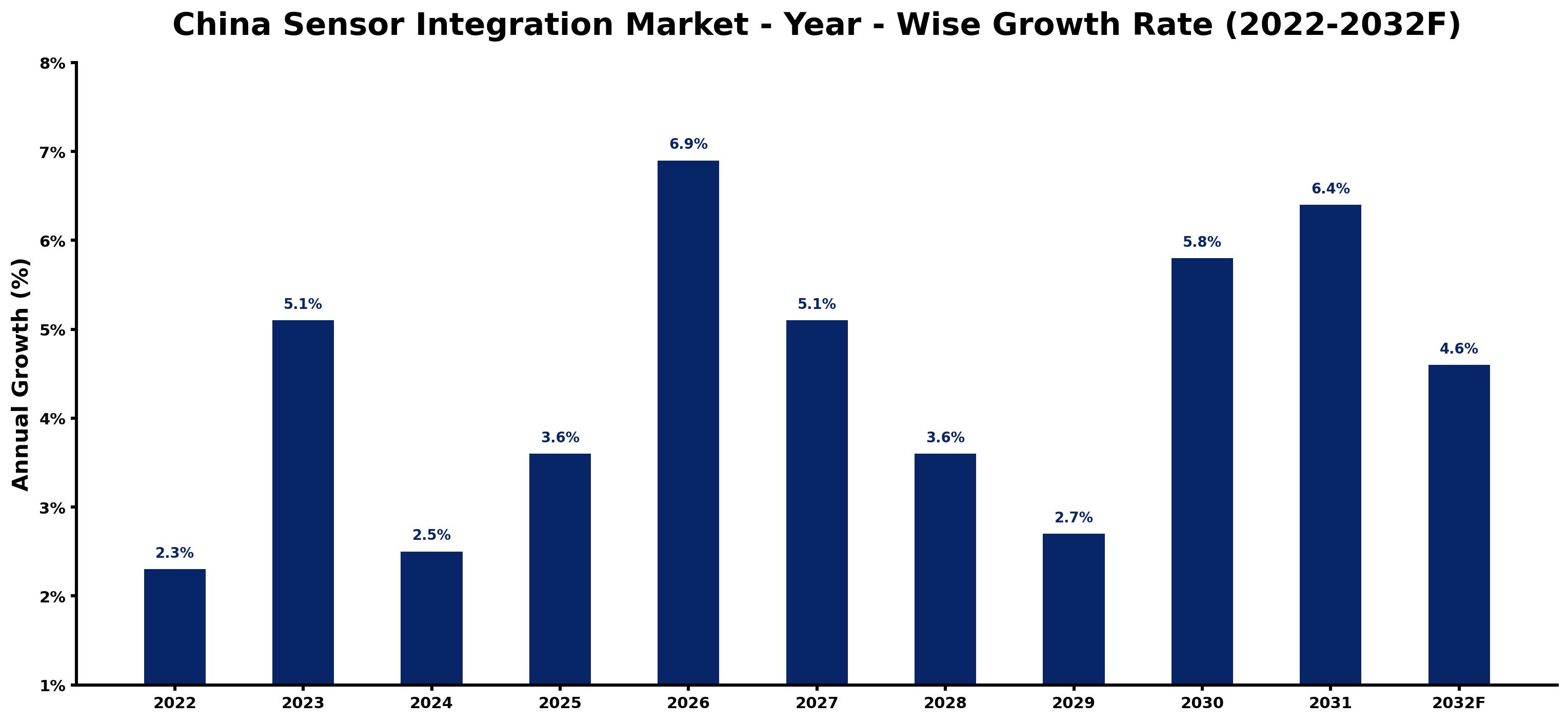
The following table presents the estimated annual growth rate for each year together with the principal factor influencing market performance.
| Year | Estimated Annual Growth (%) | Market Rationale |
| 2022 | 2.3 | The market experienced moderate growth, driven by increasing consumer electronics demand from technology firms. |
| 2023 | 5.1 | Growth accelerated as automotive production surged, boosting sensor integration needs for advanced systems. |
| 2024 | 2.5 | The market saw slower growth due to temporary supply chain disruptions affecting production schedules. |
| 2025 | 3.6 | Demand rose as smart home adoption increased, requiring advanced sensor solutions from various providers. |
| 2026 | 6.9 | The market is expected to peak with investments in IoT applications and smart devices driving demand. |
| 2027 | 5.1 | Growth will slow as the market adjusts to previous high levels of demand and production capacity. |
| 2028 | 3.6 | The 'Smart Manufacturing 2025' initiative is anticipated to support growth, though at a reduced rate. |
| 2029 | 2.7 | The market will maintain a slower growth rate, reflecting stabilisation in demand for integrated sensors. |
| 2030 | 5.8 | A resurgence in growth is projected as smart device production ramps up across industries. |
| 2031 | 6.4 | The market will continue to grow, driven by advancements in sensor technologies and new applications. |
| 2032 | 4.6 | Growth is expected to slow again as the market matures and competition intensifies among producers. |
Note: Market size estimations and growth projections presented in this report are based on 6Wresearch's proprietary forecasting methodology, utilizing the latest available industry data, government publications, and primary research inputs.
China Sensor Integration Market Synopsis
Sensor Integration in China combines various sensor technologies into cohesive systems, improving functionality across diverse applications. It primarily utilises MEMS and SoC integration techniques, with notable applications in consumer electronics and automotive systems. The China Sensor Integration Market is growing due to increasing domestic demand from technology firms and rising investments in smart devices and IoT applications. With over 300 million smart devices in use, the market is set for further expansion, bolstered by government initiatives and a thriving automotive sector.
Market Dynamics Impact Analysis (2026–2032)
| Factor | Type | Impact | Primary Segment Affected |
| Increased demand for smart devices drives sensor integration requirements. | Driver | High | Smartphones |
| The automotive sector's growth necessitates advanced sensor technologies. | Driver | High | Automotive Modules |
| The smart home market's expansion creates opportunities for sensor integration. | Opportunity | High | Smart Home System Providers |
| Investment in IoT infrastructure presents new avenues for sensor integration. | Opportunity | High | IoT Devices |
| Supply chain disruptions can hinder sensor availability for manufacturers. | Restraint | Medium | MEMS Integration |
| Regulatory compliance can increase operational costs for producers. | Restraint | Medium | SoC Integration |
| Technological advancements require constant adaptation from manufacturers. | Challenge | High | AI Sensor Hubs |
| Intense competition may pressure profit margins for producers. | Challenge | Medium | Wireless Sensor Modules |
Evaluation of Drivers in China Sensor Integration Market (2026–2032)
The factors lifting demand, and the evidence behind each, are summarised below.
| Drivers | Primary Segment Affected | Why It Matters (Evidence) |
| Rising consumer electronics demand fuels sensor integration. | Consumer Electronics Brands | In 2022, over 1.4 billion people in China drove substantial demand for consumer electronics, leading to increased sensor integration. |
| Automotive production growth necessitates advanced sensors. | Automotive Modules | In 2022, the automotive sector produced over 26 million vehicles, increasing the need for integrated sensors. |
| Smart home adoption boosts sensor integration demand. | Smart Home System Providers | The smart home market in China is projected to reach 100 million households by 2025, enhancing sensor integration needs. |
| IoT market expansion drives sensor integration requirements. | IoT Devices | China's IoT market is expected to grow to $1 trillion by 2030, heavily relying on sensor integration. |
| Government initiatives support sensor integration advancements. | AI Sensor Hubs | The 'Smart China 2025' initiative aims to enhance IoT and sensor integration capabilities across industries. |
The Sensor Integration market in China is growing on the back of rising consumer electronics demand, automotive production growth, and smart home adoption. With over 300 million smart devices in use, the market is experiencing increased sensor integration. The automotive sector produced over 26 million vehicles in 2022, necessitating advanced sensors for vehicles. The smart home market is expected to expand significantly, with a target of 100 million households by 2025, boosting sensor integration needs. Additionally, the IoT market is anticipated to reach $1 trillion by 2030, creating additional requirements for integrated sensor technologies.
Evaluation of Restraints in China Sensor Integration Market
The key brakes on demand, and where they bite hardest, are shown below.
| Market Restraint | Primary Segment Affected | Why It Matters (Evidence) |
| Supply chain disruptions can limit sensor availability. | MEMS Integration | Recent supply chain issues have affected the timely delivery of MEMS sensors, impacting production schedules and increasing lead times. |
| Regulatory compliance increases operational costs. | SoC Integration | Manufacturers must adhere to national standards, raising costs and affecting pricing strategies for integrated solutions. |
| Technological advancements require constant adaptation. | AI Sensor Hubs | Rapid advancements in AI technologies necessitate ongoing investment in R&D, straining resources and budgets for manufacturers. |
| Intense competition pressures profit margins. | Wireless Sensor Modules | With many players in the market, pricing wars can erode profit margins for producers, affecting overall profitability. |
| Market saturation may limit growth potential. | Consumer Electronics Brands | As the market matures, finding new growth avenues becomes increasingly challenging for established brands. |
China Sensor Integration Market Challenges
Producers in the China Sensor Integration Market face escalating costs due to strict regulations on quality management systems, such as the national standard GB/T 19000-2020, which can raise compliance expenses by up to 20%. Importers deal with the burden of complex compliance requirements, potentially delaying shipments and increasing costs by around 15%. Buyers feel pressure from fierce competition, as local firms benefit from government initiatives, which can reduce profit margins by 15% for foreign entities. Technological advancements require substantial investments, with firms needing to allocate about $200 million for research on new applications, limiting access for smaller buyers.
Trends in the China Sensor Integration Market
Several trends are reshaping the China Sensor Integration Market; the most important are set out below.
- Shift Towards AI Sensor Hubs: In China, the adoption of AI sensor hubs is accelerating, with the government committing $200 million for research in 2023. This trend supports the integration of advanced AI technologies in smart devices, enhancing functionality and user experience.
- Rise of Smart Home Systems: Smart home system providers are increasingly incorporating sensors into their products, with the market expected to grow to 100 million households by 2025. This rising demand underscores the need for advanced sensor integration solutions to meet consumer expectations.
- Growth in IoT Device Integration: The integration of sensors in IoT devices is rapidly expanding, with China's IoT market projected to reach $1 trillion by 2030. This shift highlights the importance of sensor integration for creating interconnected systems.
- Increased Focus on Automotive Sensors: Automotive modules are evolving with advanced sensor technologies, as the sector produced over 26 million vehicles in 2022. This trend necessitates improved sensor integration for vehicle automation and safety features.
Investment Opportunities in the China Sensor Integration Market
Some of the investment opportunities in the China Sensor Integration Market are mentioned below.
- Consumer Electronics Brands Seeking Integration: Consumer electronics brands are increasingly pursuing advanced sensor solutions, with over 300 million smart devices in use in 2023. This presents a substantial opportunity for suppliers to meet the growing demand for integrated technologies.
- Investment in Smart Home Technologies: With the smart home market projected to expand to 100 million households by 2025, there is a clear opportunity for suppliers to invest in sensor integration solutions. Collaborating with smart home system providers can facilitate market entry and growth.
- Joint Ventures in IoT Development: The expanding IoT market offers opportunities for joint ventures, particularly with the expected growth to $1 trillion by 2030. Partnering with local IoT developers can enhance market presence and drive innovation.
- Supply of Advanced Sensor Technologies: There is a pressing need for advanced sensor technologies in automotive modules, projected to grow to $40 billion by 2025. Suppliers can enter this market by forming partnerships with automotive manufacturers to provide innovative solutions.
Government Initiatives in the China Sensor Integration Market
The 'Smart Manufacturing 2025' plan, launched by the Ministry of Industry and Information Technology in 2023, aims to improve sensor integration in manufacturing processes. This initiative promotes advanced sensor technologies and ensures manufacturers meet quality standards. It also supports research and development efforts, encouraging innovation in the sensor integration sector. By aligning with national strategies, producers can access funding and resources to enhance their offerings and capabilities. The plan is expected to allocate substantial resources to support the integration of sensors across various industries.
In 2022, the National Development and Reform Commission introduced the 'IoT Development Strategy', focusing on sensor integration for smart cities. This strategy aims to streamline the integration of sensors across various sectors, improving efficiency and connectivity. The agency is responsible for approving funding for smart city projects that require advanced sensor technologies, promoting infrastructure development. As a result, companies involved in sensor integration can benefit from government support and increased project opportunities, facilitating growth in the sector. The strategy is expected to fund numerous projects aimed at enhancing smart city capabilities.
Future Insight of the China Sensor Integration Market
Several forward-looking factors should support the China Sensor Integration Market over the coming years. The automotive electronics sector will drive demand, growing to $40 billion, which will necessitate advanced technologies. The 'Smart China 2025' initiative will propel IoT capabilities, enabling broader integration across industries. Continued government funding for research will stimulate innovation in sensor technologies, enhancing overall market potential.
Market Segmentation Analysis
Each segment group is reviewed below, with the leader by share and the fastest grower by CAGR.
By Integration Type – SoC Integration Dominated, AI Sensor Hubs Expected to Grow Fastest
According to Dhaval Chaurasia, Assistant Manager at 6Wresearch, SoC Integration took a 54% share of integration type in 2025, more than any other category. SoC Integration commands the largest share as it is essential for combining multiple sensors into compact systems, particularly in consumer electronics. This integration is crucial for enhancing efficiency in high-demand sectors like automotive applications and smart devices. Over 2026–2032, AI Sensor Hubs are expected to post the fastest growth, at a CAGR of 6.8%. AI Sensor Hubs are witnessing rapid growth due to their increasing application in smart devices for advanced data processing and decision-making. The government's $200 million funding for research on these hubs is expected to further accelerate their adoption. Suppliers should prioritise the development of SoC and AI sensor hub technologies to align with the rising demand in smart devices.
By Sensor Technology – Gyroscope Dominated, Vision + Audio Expected to Grow Fastest
With a 41% revenue share in 2025, Gyroscope was the largest sensor technology category. Gyroscopes lead the market share as they are extensively utilised in smartphones and automotive applications for motion detection. Their integration into these devices is vital for improving user experience and functionality, driving significant demand. Vision + Audio is projected to grow fastest, at a CAGR of 7.4% during 2026–2032. Vision + Audio technologies are the fastest-growing segment, driven by their importance in enhancing user interaction within smart devices. As consumer demand for immersive experiences increases, the need for these integrated solutions will continue to rise. Buyers should focus on sensor technologies that enhance user interaction, especially in the rapidly advancing smart device market.
By Target Device – Smartphones Dominated, IoT Devices Expected to Grow Fastest
Smartphones accounted for a 35% market share by target device in 2025. Smartphones represent the largest share of the market as they are the primary application area for sensor integration technologies, with over 300 million smart devices currently in use. This widespread adoption drives continuous innovation and integration of advanced sensors. The quickest growth will come from IoT Devices, forecast to expand at a CAGR of 7.0% between 2026 and 2032. IoT Devices are the fastest-growing segment, reflecting the increasing need for interconnected systems in various applications. The projected growth of China's IoT market to $1 trillion by 2030 indicates a strong demand for sensor integration in this area. Suppliers need to focus on IoT device solutions to capitalise on the expanding interconnected systems market.
By End User – Consumer Electronics Brands Dominated, Smart Home System Providers Expected to Grow Fastest
The largest end user category in 2025 was Consumer Electronics Brands, with a 39% share of total revenue. Consumer Electronics Brands lead the market share as they are the primary users of integrated sensor solutions for product innovation, especially in smartphones and smart home devices. Their continuous push for advanced features drives demand for sensor integration across various applications. Smart Home System Providers are set to record the highest CAGR in this split, 7.5% over 2026–2032. Smart Home System Providers are the fastest-growing segment, utilising sensor integration to create interconnected home solutions. The projected growth of the smart home market to 100 million households by 2025 highlights this trend. Suppliers should align their product offerings with the needs of smart home system providers to capture growth opportunities in the market.
Key Attractiveness of the Report
- 10 Years of Market Numbers
- Historical Data Starting from 2022 to 2025
- Base Year 2025
- Forecast Data until 2032
- Key Performance Indicators Impacting the Market
- Major Upcoming Developments and Projects
Key Highlights of the Report:
- China Sensor Integration Market Outlook
- Market Size of China Sensor Integration Market, 2025
- Forecast of China Sensor Integration Market, 2032
- Historical Data and Forecast of China Sensor Integration Revenues & Volume for the Period 2022 - 2032F
- China Sensor Integration Market Trend Evolution
- China Sensor Integration Market Drivers and Challenges
- China Sensor Integration Price Trends
- China Sensor Integration Porter's Five Forces
- China Sensor Integration Industry Life Cycle
- Historical Data and Forecast of China Sensor Integration Market Revenues & Volume By Integration Type for the Period 2022 - 2032F
- Historical Data and Forecast of China Sensor Integration Market Revenues & Volume By MEMS Integration for the Period 2022 - 2032F
- Historical Data and Forecast of China Sensor Integration Market Revenues & Volume By SoC Integration for the Period 2022 - 2032F
- Historical Data and Forecast of China Sensor Integration Market Revenues & Volume By AI Sensor Hubs for the Period 2022 - 2032F
- Historical Data and Forecast of China Sensor Integration Market Revenues & Volume By Wireless Sensor Modules for the Period 2022 - 2032F
- Historical Data and Forecast of China Sensor Integration Market Revenues & Volume By Sensor Technology for the Period 2022 - 2032F
- Historical Data and Forecast of China Sensor Integration Market Revenues & Volume By Gyroscope, Accelerometer for the Period 2022 - 2032F
- Historical Data and Forecast of China Sensor Integration Market Revenues & Volume By Temp + Pressure Sensors for the Period 2022 - 2032F
- Historical Data and Forecast of China Sensor Integration Market Revenues & Volume By Vision + Audio for the Period 2022 - 2032F
- Historical Data and Forecast of China Sensor Integration Market Revenues & Volume By RF + Bluetooth for the Period 2022 - 2032F
- Historical Data and Forecast of China Sensor Integration Market Revenues & Volume By Target Device for the Period 2022 - 2032F
- Historical Data and Forecast of China Sensor Integration Market Revenues & Volume By Smartphones, Wearables for the Period 2022 - 2032F
- Historical Data and Forecast of China Sensor Integration Market Revenues & Volume By Automotive Modules for the Period 2022 - 2032F
- Historical Data and Forecast of China Sensor Integration Market Revenues & Volume By Robotics & Smart Devices for the Period 2022 - 2032F
- Historical Data and Forecast of China Sensor Integration Market Revenues & Volume By IoT Devices for the Period 2022 - 2032F
- Historical Data and Forecast of China Sensor Integration Market Revenues & Volume By End User for the Period 2022 - 2032F
- Historical Data and Forecast of China Sensor Integration Market Revenues & Volume By Consumer Electronics Brands for the Period 2022 - 2032F
- Historical Data and Forecast of China Sensor Integration Market Revenues & Volume By Embedded Chip Makers for the Period 2022 - 2032F
- Historical Data and Forecast of China Sensor Integration Market Revenues & Volume By Industrial Automation Cos. for the Period 2022 - 2032F
- Historical Data and Forecast of China Sensor Integration Market Revenues & Volume By Smart Home System Providers for the Period 2022 - 2032F
- China Sensor Integration Import Export Trade Statistics
- Market Opportunity Assessment By Integration Type
- Market Opportunity Assessment By Sensor Technology
- Market Opportunity Assessment By Target Device
- Market Opportunity Assessment By End User
- China Sensor Integration Top Companies Market Share
- China Sensor Integration Competitive Benchmarking By Technical and Operational Parameters
- China Sensor Integration Company Profiles
- China Sensor Integration Key Strategic Recommendations
Market Covered
This report examines the market across the segments below.
By Integration Type
- MEMS Integration
- SoC Integration
- AI Sensor Hubs
- Wireless Sensor Modules
By Sensor Technology
- Gyroscope
- Accelerometer
- Temp + Pressure Sensors
- Vision + Audio
- RF + Bluetooth
By Target Device
- Smartphones
- Wearables
- Automotive Modules
- Robotics & Smart Devices
- IoT Devices
By End User
- Consumer Electronics Brands
- Embedded Chip Makers
- Industrial Automation Cos.
- Smart Home System Providers































