India Severe Combined Immunodeficiency (SCID) Market Size & Growth Rate
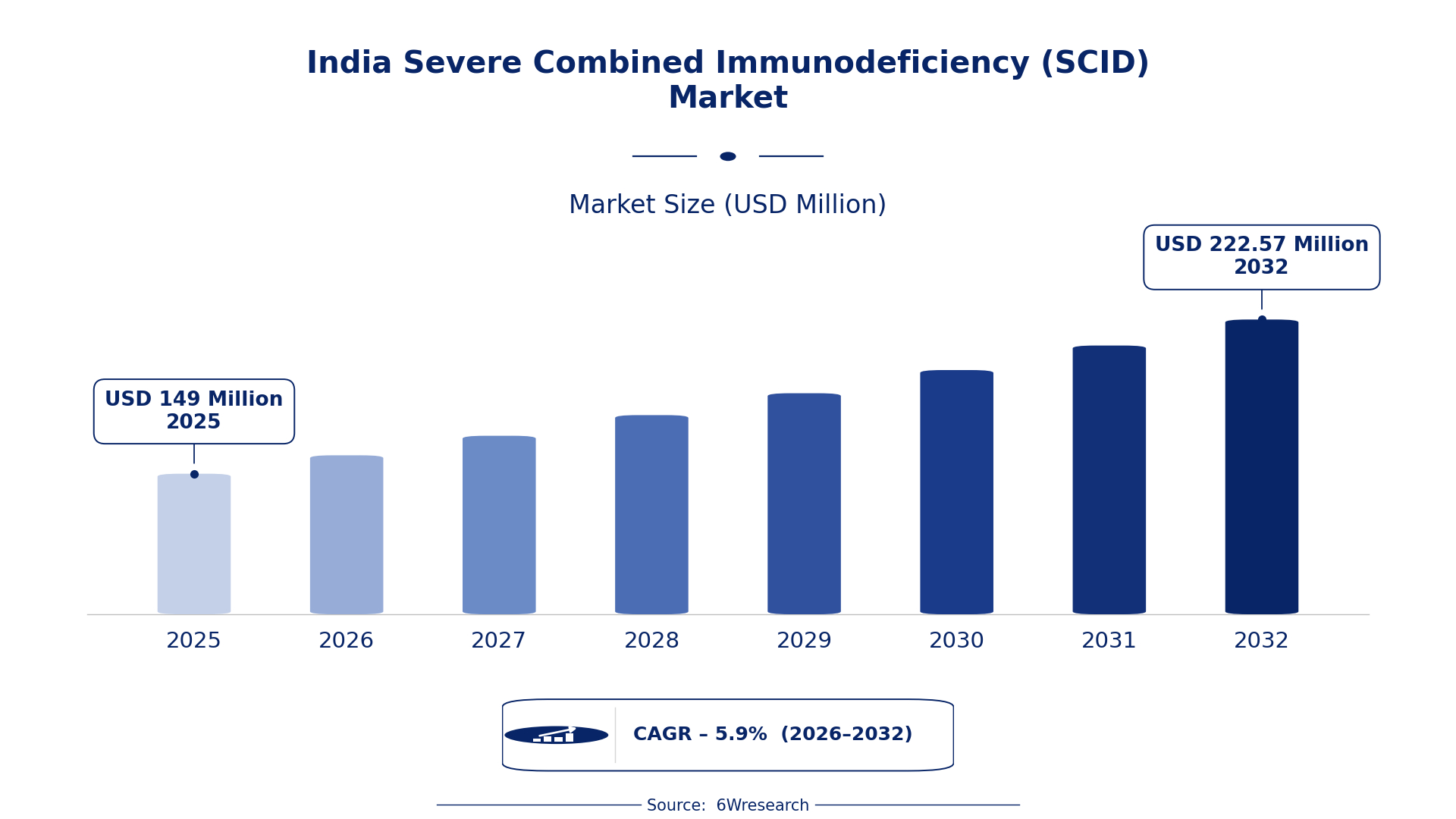
According to 6Wresearch internal database and industry insights, the India Severe Combined Immunodeficiency (SCID) Market was valued at USD 149.0 million in 2025 and is projected to reach USD 222.57 million by 2032, growing at a CAGR of approximately 5.9% during 2026–2032.
India Severe Combined Immunodeficiency (SCID) Market Highlights
| Report Metric | Details |
| Report Name | India Severe Combined Immunodeficiency (SCID) Market |
| Market Size 2025 | USD 149.0 million |
| Market Size 2032 | USD 222.57 million |
| Absolute Growth 2025–2032 | USD 73.57 million |
| CAGR 2026–2032 | 5.9% |
| Peak Annual Growth | 8.2% in 2027 |
| Forecast Period | 2026–2032 |
| Historical Data | 2022–2025 |
| Base Year | 2025 |
| Leading Treatment Type, 2025 | Gene Therapy (47% share) |
| Leading Therapy Approach, 2025 | Targeted DNA Editing (45% share) |
| Leading Delivery Mode, 2025 | IV or Injection (39% share) |
| Leading End User, 2025 | Pediatric Hospitals (37% share) |
| Fastest-Growing Therapy Approach | Donor Stem Cells (7.9% CAGR) |
| Fastest-Growing Delivery Mode | Inpatient Procedure (8.1% CAGR) |
| Fastest-Growing End User | Genetic Disorder Centers (7.4% CAGR) |
| Growing Sector | Genetic Disorder Centers |
| Key End Users | Pediatric Hospitals, Specialty Clinics, Genetic Disorder Centers, Immunology Specialists |
India Severe Combined Immunodeficiency (SCID) Market Year-wise Growth Rate and Key Drivers (2022–2032)
This graph illustrates the annual growth rates of the market from 2022 to 2032, highlighting a steady upward trajectory and projected market expansion over the forecast period.
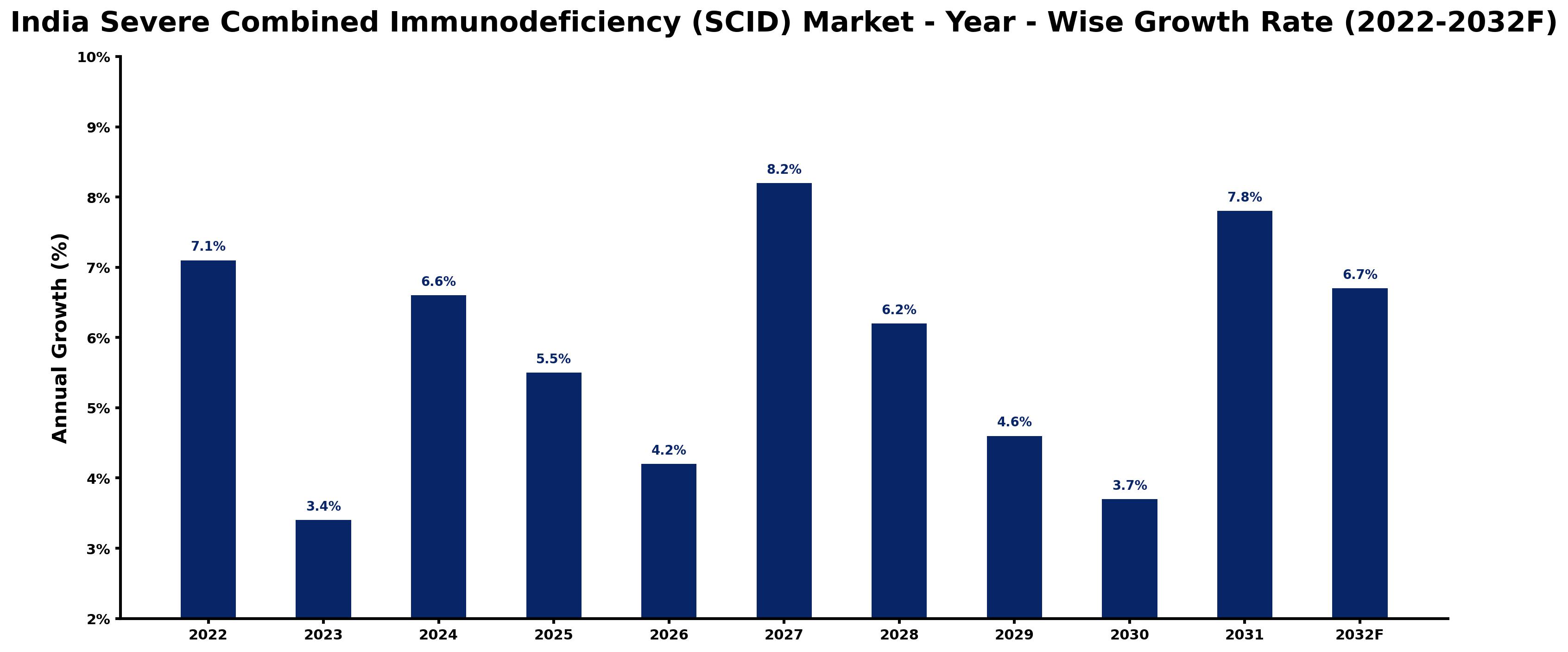
Below, each year's estimated growth is shown next to the factor that most influenced it.
| Year | Estimated Annual Growth (%) | Market Rationale |
| 2022 | 7.1 | The market experienced solid growth due to increased awareness and treatment options for SCID. |
| 2023 | 3.4 | Growth slowed as healthcare facilities faced challenges in implementing new treatment protocols. |
| 2024 | 6.6 | Demand picked up again as pediatric hospitals expanded their SCID treatment capabilities. |
| 2025 | 5.5 | Market growth decelerated due to resource allocation issues in healthcare settings. |
| 2026 | 4.2 | Growth continued to slow as the focus shifted to other genetic disorders. |
| 2027 | 8.2 | A peak in growth occurred with advancements in gene therapy and increased funding. |
| 2028 | 6.2 | Growth slowed again as healthcare providers adjusted to new treatment guidelines. |
| 2029 | 4.6 | The market faced slower growth as competition among treatment options intensified. |
| 2030 | 3.7 | Growth continued to slow as healthcare systems prioritised other pressing health issues. |
| 2031 | 7.8 | The market rebounded with renewed focus on SCID treatment and research initiatives. |
| 2032 | 6.7 | Growth slowed as the market stabilised with established treatment protocols. |
Note: Market size estimations and growth projections presented in this report are based on 6Wresearch's proprietary forecasting methodology, utilizing the latest available industry data, government publications, and primary research inputs.
India Severe Combined Immunodeficiency (SCID) Market Synopsis
The Severe Combined Immunodeficiency (SCID) market in India encompasses treatments for a rare genetic disorder affecting the immune system. Treatment primarily includes gene therapy, bone marrow transplants, and enzyme replacement therapies, aimed at restoring immune function. The SCID market is growing due to rising awareness among healthcare providers, increased funding for research, and the establishment of specialized treatment centres. In 2022, the Indian government launched a national program for rare diseases, including SCID, which has further stimulated demand. With over 200 pediatric hospitals treating genetic disorders, the market is set for continued expansion in the coming years.
Market Dynamics Impact Analysis (2026–2032)
| Factor | Type | Impact | Primary Segment Affected |
| Increased funding for genetic disorder research | Driver | High | Gene Therapy |
| Expansion of specialized treatment centres | Driver | High | Bone Marrow Transplant |
| Growing demand for gene therapy treatments | Opportunity | High | Gene Therapy |
| Rising awareness of SCID among healthcare providers | Opportunity | Medium | Pediatric Hospitals |
| Limited access to advanced treatment options | Restraint | High | Bone Marrow Transplant |
| High costs associated with SCID treatments | Restraint | Medium | Gene Therapy |
| Insufficient healthcare infrastructure in rural areas | Challenge | High | Pediatric Hospitals |
| Competition among treatment modalities | Challenge | Medium | Enzyme Replacement |
Evaluation of Drivers in India Severe Combined Immunodeficiency (SCID) Market (2026–2032)
The factors lifting demand, and the evidence behind each, are summarised below.
| Drivers | Primary Segment Affected | Why It Matters (Evidence) |
| Increased funding for genetic disorder research | Gene Therapy | In 2021, the Indian government allocated ₹150 million for genetic disorder research, boosting gene therapy development. |
| Expansion of specialized treatment centres | Bone Marrow Transplant | The establishment of genetic disorder centres in cities like Delhi improves access to bone marrow transplants for SCID patients. |
| Growing demand for gene therapy treatments | Gene Therapy | Gene therapy for SCID is available at select pediatric hospitals, increasing patient access and treatment uptake. |
| Rising awareness of SCID among healthcare providers | Pediatric Hospitals | The National Health Mission promotes awareness of SCID, leading to more pediatric hospitals offering treatments and improving patient outcomes. |
| Supportive government policies | Bone Marrow Transplant | The National Rare Diseases Policy 2021 aims to provide care for rare diseases, including SCID, enhancing treatment accessibility. |
The Severe Combined Immunodeficiency (SCID) market in India is expanding as funding for genetic disorder research increases, specialized treatment centres grow, and awareness among healthcare providers rises. The establishment of genetic disorder centres in cities like Delhi improves access to bone marrow transplants, while gene therapy is now available at select pediatric hospitals, increasing patient access. The National Health Mission's efforts to promote SCID awareness have led to more pediatric hospitals offering treatments. These factors drive demand for SCID therapies across the country.
Evaluation of Restraints in India Severe Combined Immunodeficiency (SCID) Market
The main factors holding the market back are set out below.
| Market Restraint | Primary Segment Affected | Why It Matters (Evidence) |
| Limited access to advanced treatment options | Bone Marrow Transplant | Many rural areas lack specialized centres, restricting access to necessary treatments for SCID patients. |
| High costs associated with SCID treatments | Gene Therapy | The expensive nature of gene therapy limits affordability for many families seeking treatment. |
| Insufficient healthcare infrastructure in rural areas | Pediatric Hospitals | Rural healthcare facilities often lack the resources to provide adequate SCID care, impacting patient outcomes. |
| Competition among treatment modalities | Enzyme Replacement | The variety of treatment options can confuse patients and healthcare providers, delaying decisions on SCID management. |
| Limited awareness among the general public | Gene Therapy | Many families remain unaware of SCID and available treatment options, hindering early diagnosis and intervention. |
India Severe Combined Immunodeficiency (SCID) Market Challenges
The Severe Combined Immunodeficiency (SCID) market in India faces a critical supply issue, as gene therapy is only available at select paediatric hospitals, limiting treatment access for many families. This scarcity particularly affects patients in rural areas, where awareness of SCID remains low, delaying essential care. A lack of skilled immunology specialists compounds the problem, leading to insufficient treatment plans for patients and increasing the risk of life-threatening infections. Regulatory challenges also hinder progress; guidelines from the Indian Council of Medical Research can prolong the approval timeline for new therapies, affecting timely access to crucial treatments for buyers. High costs associated with therapies, such as bone marrow transplants averaging over ₹20 lakh, place a financial burden on families, making necessary care unattainable for some.
Trends in the India Severe Combined Immunodeficiency (SCID) Market
Buyers and suppliers in the India Severe Combined Immunodeficiency (SCID) Market are adjusting to the following trends.
- Shift Towards Gene Therapy: India is experiencing a shift towards gene therapy as a primary treatment for SCID, with select paediatric hospitals adopting this advanced approach. In 2022, the government initiated a national programme for rare diseases, enhancing treatment accessibility.
- Expansion of Pediatric Hospitals: Pediatric hospitals are increasingly focusing on SCID treatment, driven by rising awareness and funding. In 2021, the Indian government allocated ₹150 million to enhance genetic disorder care, leading to more specialised facilities.
- Growth of Genetic Disorder Centres: The establishment of genetic disorder centres is on the rise, improving access to SCID treatments. In 2022, India launched a national programme for rare diseases, which supports the development of these centres.
- Increased Training for Healthcare Providers: There is a growing emphasis on training healthcare providers in SCID management, with initiatives from the Indian Society of Pediatric Hematology and Oncology. In 2023, updated training programmes were introduced to enhance skills.
Investment Opportunities in the India Severe Combined Immunodeficiency (SCID) Market
The following opportunities in the India Severe Combined Immunodeficiency (SCID) Market pair current demand with a clear way in.
- Investment in Gene Therapy: With gene therapy for SCID available at select hospitals, there is a notable opportunity for investment in this area. The Indian government allocated ₹150 million for genetic disorder research in 2021, encouraging new developments.
- Development of Specialized Treatment Centres: The need for specialised treatment centres is evident, especially in rural areas. Establishing these centres can greatly improve access to SCID treatments, supported by the National Health Mission's initiatives.
- Partnerships for Research Initiatives: Collaboration with local healthcare providers can enhance research initiatives in SCID treatment. The Indian Council of Medical Research is actively involved in funding research, creating opportunities for joint ventures.
- Focus on Public Awareness Campaigns: There is an opportunity to invest in public awareness campaigns about SCID. The National Health Mission's efforts to promote awareness can be used to reach more families in need.
Government Initiatives in the India Severe Combined Immunodeficiency (SCID) Market
The National Rare Diseases Policy 2021, launched by the Ministry of Health and Family Welfare, aims to provide comprehensive care for rare diseases including SCID. This policy enhances access to treatments and promotes research initiatives, ensuring that patients receive necessary care. The Department of Biotechnology initiated the 'National Program for Rare Diseases' in 2020, focusing on research and treatment accessibility for SCID patients. This program allocates funding to improve treatment options and support healthcare facilities.
The Indian Council of Medical Research (ICMR) approves guidelines for SCID treatment protocols, enhancing the standard of care across the country. In 2022, ICMR approved new guidelines that standardise treatment approaches, ensuring consistency in patient care. The National Health Mission funds various programs aimed at raising awareness about SCID, particularly in rural areas. Their initiatives include educational campaigns for healthcare providers, which help improve early diagnosis and treatment access.
Future Insight of the India Severe Combined Immunodeficiency (SCID) Market
Several forward-looking factors should support the Severe Combined Immunodeficiency (SCID) market in India over the coming years. The national programme for rare diseases initiated in 2022 is set to increase funding and awareness, which will improve access to treatment options. Training programmes by the Indian Society of Pediatric Hematology and Oncology will prepare more healthcare professionals to manage SCID effectively. By 2032, the National Genetic Disease Policy is expected to boost screening rates, allowing for earlier detection and intervention. Continued government support for genetic disorder research will likely lead to the development of new therapies.
Market Segmentation Analysis
The analysis below covers each segmentation, its leading category in 2025 and its fastest-growing category through 2032.
By Treatment Type – Gene Therapy Dominated and Is Expected to Record the Fastest Growth
According to Dhaval Chaurasia, Assistant Manager at 6Wresearch, Gene Therapy took a 47% share of treatment type in 2025, more than any other category. Gene therapy leads the India Severe Combined Immunodeficiency market as it effectively restores immune function in patients. Its availability at select pediatric hospitals underscores its prominence as a primary treatment method for SCID. The same category is also set to grow fastest, at a CAGR of 7.7% during 2026–2032. The growth of gene therapy is driven by heightened awareness and government initiatives supporting genetic disorder research. The recent launch of a national program for rare diseases, including SCID, will likely accelerate its adoption further. Suppliers should prioritise gene therapy solutions to cater to the increasing demand from healthcare providers treating SCID.
By Therapy Approach – Targeted DNA Editing Dominated, Donor Stem Cells Expected to Grow Fastest
Targeted DNA Editing held a 45% share of the India Severe Combined Immunodeficiency (SCID) Market by therapy approach in 2025. Targeted DNA editing leads the market share as it represents an emerging technique that is gaining attention among healthcare professionals. Although its current application is limited, it is seen as a promising future direction for SCID treatments. Donor Stem Cells are projected to grow fastest, at a CAGR of 7.9% during 2026–2032. The fastest growth is seen in donor stem cells, which are essential for successful bone marrow transplants. With the increasing number of procedures performed in major cities, this segment is expected to expand rapidly as more facilities adopt this approach. Buyers should consider investing in donor stem cell capabilities to align with the growing focus on advanced SCID therapies.
By Delivery Mode – IV or Injection Dominated, Inpatient Procedure Expected to Grow Fastest
The largest delivery mode category in 2025 was IV or Injection, with a 39% share of total revenue. IV or injection is the primary delivery mode for SCID therapies in India, widely used due to its effectiveness in administering treatments. This method is prevalent in many healthcare settings, ensuring that patients receive timely and appropriate care. Over 2026–2032, Inpatient Procedure is expected to post the fastest growth, at a CAGR of 8.1%. Inpatient procedures are experiencing rapid growth, particularly for complex treatments like bone marrow transplants that require intensive monitoring. As the need for advanced medical interventions increases, inpatient procedures will likely see further expansion. Suppliers should consider enhancing their offerings to align with the rising preference for inpatient procedures in the SCID treatment landscape.
By End User – Pediatric Hospitals Dominated, Genetic Disorder Centers Expected to Grow Fastest
With a 37% revenue share in 2025, Pediatric Hospitals was the largest end user category. Pediatric hospitals dominate the market share as they serve as the main facilities for treating SCID patients across India. With a robust network of over 200 hospitals dedicated to genetic disorders, their significance in SCID management is undeniable. The quickest growth will come from Genetic Disorder Centers, forecast to expand at a CAGR of 7.4% between 2026 and 2032. Genetic disorder centers are rapidly becoming the fastest-growing end user segment, focusing specifically on SCID treatment protocols. The rise in the establishment of these centres is expected to drive substantial growth in this area. Suppliers should target genetic disorder centers to capitalise on the increasing demand for specialised SCID treatments.
Key Attractiveness of the Report
- 10 Years of Market Numbers
- Historical Data Starting from 2022 to 2025
- Base Year 2025
- Forecast Data until 2032
- Key Performance Indicators Impacting the Market
- Major Upcoming Developments and Projects
Key Highlights of the Report:
- India Severe Combined Immunodeficiency (SCID) Market Outlook
- Market Size of India Severe Combined Immunodeficiency (SCID) Market, 2025
- Forecast of India Severe Combined Immunodeficiency (SCID) Market, 2032
- Historical Data and Forecast of India Severe Combined Immunodeficiency (SCID) Revenues & Volume for the Period 2022 - 2032F
- India Severe Combined Immunodeficiency (SCID) Market Trend Evolution
- India Severe Combined Immunodeficiency (SCID) Market Drivers and Challenges
- India Severe Combined Immunodeficiency (SCID) Price Trends
- India Severe Combined Immunodeficiency (SCID) Porter's Five Forces
- India Severe Combined Immunodeficiency (SCID) Industry Life Cycle
- Historical Data and Forecast of India Severe Combined Immunodeficiency (SCID) Market Revenues & Volume By Treatment Type for the Period 2022 - 2032F
- Historical Data and Forecast of India Severe Combined Immunodeficiency (SCID) Market Revenues & Volume By Gene Therapy for the Period 2022 - 2032F
- Historical Data and Forecast of India Severe Combined Immunodeficiency (SCID) Market Revenues & Volume By Bone Marrow Transplant for the Period 2022 - 2032F
- Historical Data and Forecast of India Severe Combined Immunodeficiency (SCID) Market Revenues & Volume By Enzyme Replacement for the Period 2022 - 2032F
- Historical Data and Forecast of India Severe Combined Immunodeficiency (SCID) Market Revenues & Volume By Antimicrobial Therapy for the Period 2022 - 2032F
- Historical Data and Forecast of India Severe Combined Immunodeficiency (SCID) Market Revenues & Volume By Therapy Approach for the Period 2022 - 2032F
- Historical Data and Forecast of India Severe Combined Immunodeficiency (SCID) Market Revenues & Volume By Targeted DNA Editing for the Period 2022 - 2032F
- Historical Data and Forecast of India Severe Combined Immunodeficiency (SCID) Market Revenues & Volume By Donor Stem Cells for the Period 2022 - 2032F
- Historical Data and Forecast of India Severe Combined Immunodeficiency (SCID) Market Revenues & Volume By PEG-ADA Therapy for the Period 2022 - 2032F
- Historical Data and Forecast of India Severe Combined Immunodeficiency (SCID) Market Revenues & Volume By Infection Prevention for the Period 2022 - 2032F
- Historical Data and Forecast of India Severe Combined Immunodeficiency (SCID) Market Revenues & Volume By Delivery Mode for the Period 2022 - 2032F
- Historical Data and Forecast of India Severe Combined Immunodeficiency (SCID) Market Revenues & Volume By IV or Injection for the Period 2022 - 2032F
- Historical Data and Forecast of India Severe Combined Immunodeficiency (SCID) Market Revenues & Volume By Inpatient Procedure for the Period 2022 - 2032F
- Historical Data and Forecast of India Severe Combined Immunodeficiency (SCID) Market Revenues & Volume By Regular Infusion for the Period 2022 - 2032F
- Historical Data and Forecast of India Severe Combined Immunodeficiency (SCID) Market Revenues & Volume By Oral/IV for the Period 2022 - 2032F
- Historical Data and Forecast of India Severe Combined Immunodeficiency (SCID) Market Revenues & Volume By End User for the Period 2022 - 2032F
- Historical Data and Forecast of India Severe Combined Immunodeficiency (SCID) Market Revenues & Volume By Pediatric Hospitals for the Period 2022 - 2032F
- Historical Data and Forecast of India Severe Combined Immunodeficiency (SCID) Market Revenues & Volume By Specialty Clinics for the Period 2022 - 2032F
- Historical Data and Forecast of India Severe Combined Immunodeficiency (SCID) Market Revenues & Volume By Genetic Disorder Centers for the Period 2022 - 2032F
- Historical Data and Forecast of India Severe Combined Immunodeficiency (SCID) Market Revenues & Volume By Immunology Specialists for the Period 2022 - 2032F
- India Severe Combined Immunodeficiency (SCID) Import Export Trade Statistics
- Market Opportunity Assessment By Treatment Type
- Market Opportunity Assessment By Therapy Approach
- Market Opportunity Assessment By Delivery Mode
- Market Opportunity Assessment By End User
- India Severe Combined Immunodeficiency (SCID) Top Companies Market Share
- India Severe Combined Immunodeficiency (SCID) Competitive Benchmarking By Technical and Operational Parameters
- India Severe Combined Immunodeficiency (SCID) Company Profiles
- India Severe Combined Immunodeficiency (SCID) Key Strategic Recommendations
Market Covered
Segments analysed in this report are listed below.
By Treatment Type
- Gene Therapy
- Bone Marrow Transplant
- Enzyme Replacement
- Antimicrobial Therapy
By Therapy Approach
- Targeted DNA Editing
- Donor Stem Cells
- PEG-ADA Therapy
- Infection Prevention
By Delivery Mode
- IV or Injection
- Inpatient Procedure
- Regular Infusion
- Oral/IV
By End User
- Pediatric Hospitals
- Specialty Clinics
- Genetic Disorder Centers
- Immunology Specialists































