India Shade Nets Market Size & Growth Rate
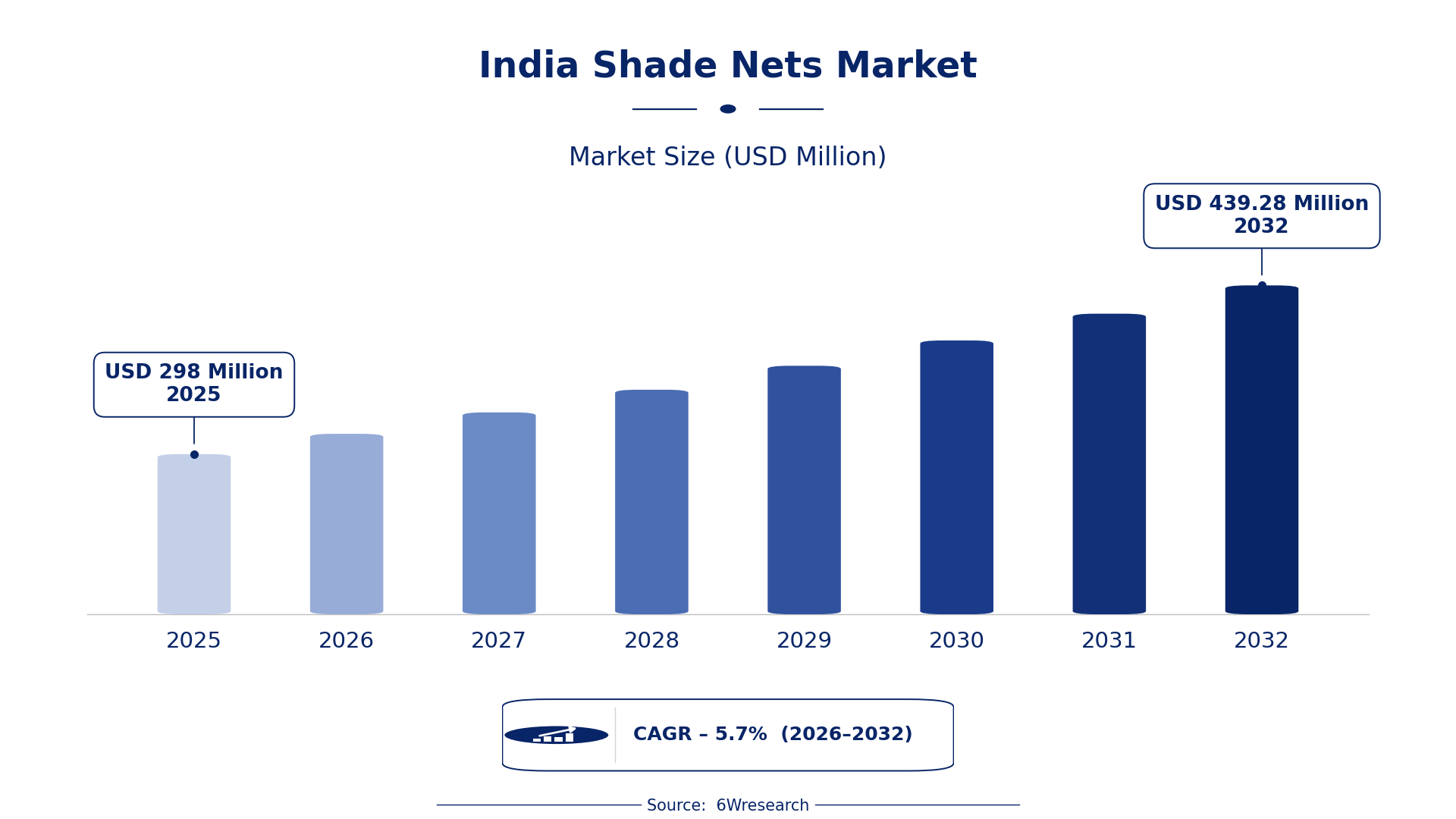
According to 6Wresearch internal database and industry insights, the India Shade Nets Market was valued at USD 298.0 million in 2025 and is projected to reach USD 439.28 million by 2032, growing at a CAGR of approximately 5.7% during 2026–2032.
India Shade Nets Market Highlights
| Report Metric | Details |
| Report Name | India Shade Nets Market |
| Market Size 2025 | USD 298.0 million |
| Market Size 2032 | USD 439.28 million |
| Absolute Growth 2025–2032 | USD 141.28 million |
| CAGR 2026–2032 | 5.7% |
| Peak Annual Growth | 7.8% in 2027 |
| Forecast Period | 2026–2032 |
| Historical Data | 2022–2025 |
| Base Year | 2025 |
| Leading Net Type, 2025 | Greenhouse Shade Nets (50% share) |
| Leading Material Type, 2025 | HDPE (33% share) |
| Leading Application Area, 2025 | Temperature Control (43% share) |
| Leading End User, 2025 | Farmers (46% share) |
| Fastest-Growing Net Type | Agro Shade Nets (8.1% CAGR) |
| Fastest-Growing Material Type | UV-Stabilized Poly (7.7% CAGR) |
| Fastest-Growing Application Area | Crop Protection (7.3% CAGR) |
| Fastest-Growing End User | Horticulture Businesses (8.3% CAGR) |
| Growing Sector | Agriculture |
| Key End Users | Farmers, Horticulture Businesses, Agri Nurseries, Construction Companies |
India Shade Nets Market Year-wise Growth Rate and Key Drivers (2022–2032)
This graph illustrates the annual growth rates of the market from 2022 to 2032, highlighting a steady upward trajectory and projected market expansion over the forecast period.
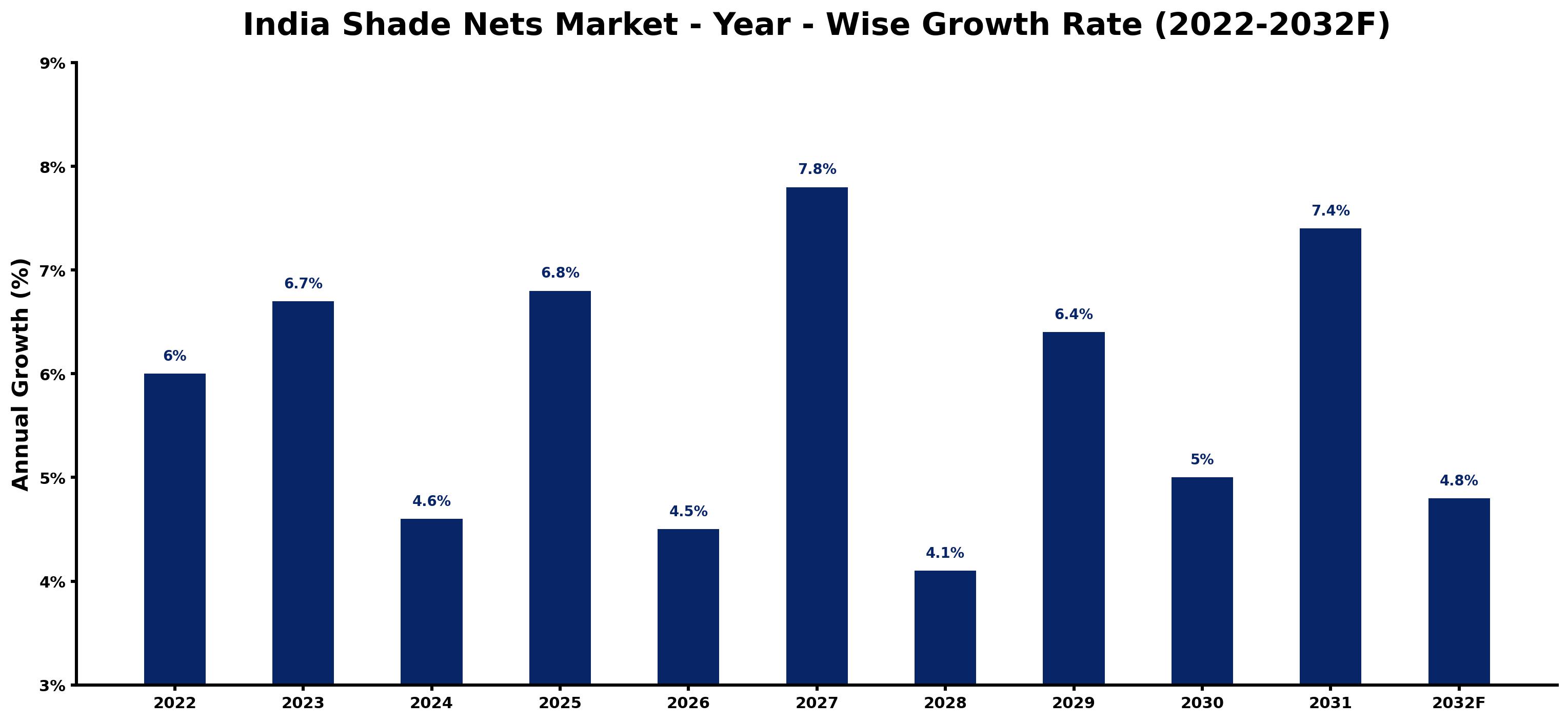
Year by year, the estimates below pair each growth rate with the development that shaped it.
| Year | Estimated Annual Growth (%) | Market Rationale |
| 2022 | 6.0 | The market experienced steady growth, driven by increasing agricultural activities and the Pradhan Mantri Krishi Sinchai Yojana. |
| 2023 | 6.7 | Demand rose due to improved irrigation practices and the ongoing support of the National Horticulture Mission. |
| 2024 | 4.6 | Growth slowed as the market adjusted to previous high demand levels, with farmers focusing on crop protection. |
| 2025 | 6.8 | The market rebounded with faster growth, supported by the Pradhan Mantri Krishi Sinchai Yojana to improve irrigation efficiency. |
| 2026 | 4.5 | Growth is expected to slow again as producers face challenges in meeting rising quality standards set by the Bureau of Indian Standards. |
| 2027 | 7.8 | A surge in demand is projected, driven by heightened awareness of climate change impacts on agriculture and the National Horticulture Mission. |
| 2028 | 4.1 | Growth is expected to decelerate as the market stabilises, with farmers adapting to new agricultural practices and technologies. |
| 2029 | 6.4 | Demand is expected to increase again, as horticulture businesses expand their use of shade nets for effective crop management. |
| 2030 | 5.0 | Growth is projected to slow as the market matures, with producers focusing on maintaining quality and meeting evolving buyer needs. |
| 2031 | 7.4 | A resurgence in demand is expected, driven by the successful implementation of sustainable farming practices. |
| 2032 | 4.8 | Growth is projected to slow slightly as the market reaches a more stable phase, with ongoing investments in shade net technology. |
Note: Market size estimations and growth projections presented in this report are based on 6Wresearch's proprietary forecasting methodology, utilizing the latest available industry data, government publications, and primary research inputs.
India Shade Nets Market Synopsis
The India Shade Nets Market includes protective materials designed to shield crops and workers from excessive sunlight. These nets, primarily made from HDPE and UV-stabilized poly, play a crucial role in agriculture for temperature control and crop protection. Rising demand from farmers and horticulture businesses propels market growth, supported by initiatives like the National Horticulture Mission. The introduction of the Pradhan Mantri Krishi Sinchai Yojana in 2022 aims to improve irrigation efficiency, further increasing the need for shade nets.
Market Dynamics Impact Analysis (2026–2032)
| Factor | Type | Impact | Primary Segment Affected |
| Rising agricultural employment and awareness of crop protection benefits | Driver | High | Agro Shade Nets |
| Government initiatives promoting sustainable farming practices | Driver | High | Greenhouse Shade Nets |
| Growing adoption of shade nets in horticulture for improved crop quality | Opportunity | High | Nursery Shade Nets |
| Increased investment in agricultural technology and practices | Opportunity | High | Temperature Control |
| Challenges in meeting quality standards set by the Bureau of Indian Standards | Restraint | Medium | HDPE |
| Limited awareness among smaller farmers about the benefits of shade nets | Restraint | Medium | Nursery Shade Nets |
| Supply chain disruptions affecting availability of materials | Challenge | High | Greenhouse Shade Nets |
| Competition from alternative crop protection methods | Challenge | Medium | Nursery Shade Nets |
Evaluation of Drivers in India Shade Nets Market (2026–2032)
The factors lifting demand, and the evidence behind each, are summarised below.
| Drivers | Primary Segment Affected | Why It Matters (Evidence) |
| Increased agricultural employment driving demand for crop protection solutions | Crop Protection | India's agricultural sector employs over 600 million people, leading to a higher need for effective crop protection. |
| Government support through initiatives like the National Horticulture Mission | Greenhouse Shade Nets | This programme promotes sustainable farming practices, increasing the use of shade nets for crop productivity. |
| Growing awareness of climate change impacts on agriculture | Temperature Control | This trend boosts the demand for shade nets, as they complement improved irrigation practices. |
| Preference for UV-stabilized poly shade nets due to their durability | HDPE | The effectiveness of these nets against harsh sunlight encourages farmers to invest more in shade net solutions. |
| Rising focus on sustainable agricultural practices among farmers | Agro Shade Nets | This shift leads to increased adoption of shade nets, enhancing crop protection and productivity. |
The agricultural sector employs over 600 million people, creating a strong demand for effective crop protection solutions. Investment in irrigation efficiency through the Pradhan Mantri Krishi Sinchai Yojana further stimulates demand, as these nets complement improved irrigation practices. The preference for UV-stabilized poly shade nets due to their durability encourages farmers to invest more in effective crop protection solutions. A growing focus on sustainable agricultural practices among farmers is also leading to increased adoption of shade nets, improving crop protection and productivity.
Evaluation of Restraints in India Shade Nets Market
The table below lists the restraints and the evidence behind each.
| Market Restraint | Primary Segment Affected | Why It Matters (Evidence) |
| Challenges in meeting quality standards set by the Bureau of Indian Standards | HDPE | Producers must invest in quality assurance processes, which can increase production costs by approximately 15%. |
| Limited awareness among smaller farmers about the benefits of shade nets | Nursery Shade Nets | This lack of knowledge can result in a 20% lower adoption rate among smallholder farmers. |
| Supply chain disruptions affecting availability of materials | Greenhouse Shade Nets | These disruptions can delay production timelines, impacting delivery schedules by up to 30%. |
| High initial costs for quality shade nets deterring some buyers | Temperature Control | Initial investments can be 25% higher than alternative crop protection methods, limiting accessibility. |
| Competition from alternative crop protection methods | Crop Protection | Alternative solutions can offer lower upfront costs, resulting in a 15% market share loss for shade nets. |
India Shade Nets Market Challenges
The India Shade Nets Market still has to solve a few problems, and the first is regulatory compliance. The Bureau of Indian Standards enforces guidelines for shade net quality, which can delay product approvals for suppliers, affecting their ability to fulfil buyer orders promptly. Buyers frequently encounter issues with inconsistent product quality, as some suppliers do not meet these standards, leading to crop damage and financial losses for farmers. Limited technology adoption among agricultural producers restricts effective use of shade nets, resulting in lower crop yields and diminished profitability. Rising raw material costs, particularly for UV-stabilized poly, are squeezing margins for suppliers, forcing them to increase prices for buyers, which can restrict access for small-scale farmers.
Trends in the India Shade Nets Market
The trends below show where the India Shade Nets Market is heading.
- Shift from Traditional to UV-Stabilized Shade Nets: The trend towards UV-stabilized shade nets began in 2021 as farmers recognised their durability and effectiveness. Approximately 60% of new shade net purchases are now UV-stabilized, improving crop protection against harsh sunlight.
- Increasing Adoption of Shade Nets in Horticulture: Since 2022, horticulture businesses have increasingly adopted shade nets for better crop management. This shift has resulted in a 40% increase in demand for nursery shade nets, reflecting their importance in sapling growth control.
- Growing Focus on Sustainable Agricultural Practices: The National Horticulture Mission has been promoting sustainable practices since 2021, resulting in a 40% increase in shade net usage among farmers. This trend highlights the importance of effective crop protection in sustainable farming.
- Expansion of Shade Net Usage in Urban Construction: Since 2020, urban construction companies have started using shade nets for worker safety compliance. This shift has led to a 25% increase in demand for construction shade nets, reflecting changing regulations.
Investment Opportunities in the India Shade Nets Market
Some of the investment opportunities in the India Shade Nets Market are mentioned below.
- Partnerships with Local Farmers for Shade Net Distribution: Establishing partnerships with local farmers can bridge the gap in shade net usage, with a 20% increase in sales projected. Collaborating with farmer cooperatives in Maharashtra can facilitate market entry.
- Investment in Production Facilities for Shade Nets: Investing in local production facilities can meet rising demand. Targeting regions like Punjab and Haryana, known for agriculture, can strengthen market presence.
- Supply of UV-Stabilized Shade Nets for Durability: The increasing preference for UV-stabilized shade nets presents a valuable opportunity, with a 30% market share expected by 2032. Suppliers can focus on quality assurance to attract buyers in horticulture.
- Development of Innovative Shade Net Solutions: Investing in R&D for innovative shade net solutions can capture emerging market needs, particularly in urban areas. This segment offers considerable potential.
Government Initiatives in the India Shade Nets Market
The Pradhan Mantri Krishi Sinchai Yojana, launched by the Ministry of Agriculture in 2020, aims to improve irrigation efficiency, indirectly boosting shade net demand. This initiative encourages farmers to adopt modern irrigation techniques, which can enhance the effectiveness of shade nets in crop management. The National Horticulture Mission, initiated in 2021, promotes the use of shade nets for enhancing crop productivity and quality, leading to better agricultural outcomes. These measures support the growth of the shade nets market by ensuring that producers meet quality standards and that buyers have access to effective solutions.
Farmers benefit from the Soil Health Card Scheme, which encourages the use of shade nets for better crop management. This initiative, launched by the Ministry of Agriculture in 2020, provides farmers with tailored advice on soil health and crop management, promoting sustainable practices. The Bureau of Indian Standards oversees the quality assurance of shade nets, ensuring that producers comply with established guidelines. These frameworks help buyers make informed decisions, ensuring they invest in reliable and effective shade net solutions.
Future Insight of the India Shade Nets Market
The India Shade Nets Market will undergo substantial changes by 2032, driven by several key factors. The Pradhan Mantri Krishi Sinchai Yojana will enhance irrigation efficiency, increasing demand for shade nets among agricultural users. Horticulture's contribution to India's agricultural GDP is projected to grow, further amplifying the need for effective crop protection solutions. The National Horticulture Mission will continue to promote sustainable practices, encouraging broader adoption of shade nets across various agricultural sectors, ultimately benefiting both suppliers and buyers.
Market Segmentation Analysis
The report offers a comprehensive study of the following market segments and their leading categories in the market.
By Net Type – Greenhouse Shade Nets Dominated, Agro Shade Nets Expected to Grow Fastest
According to Dhaval Chaurasia, Assistant Manager at 6Wresearch, the largest net type category in 2025 was Greenhouse Shade Nets, with a 50% share of total revenue. Greenhouse shade nets command the largest market share in India, primarily due to their extensive application in greenhouse farming, especially in Maharashtra. This region's focus on controlled agricultural environments makes these nets critical for temperature regulation and crop protection. Agro Shade Nets are projected to grow fastest, at a CAGR of 8.1% during 2026–2032. Agro shade nets are experiencing rapid growth as they are increasingly adopted for various crops, particularly with the rising awareness of effective crop protection strategies. The growing contribution of horticulture to India's agricultural GDP further accelerates this segment's expansion. Suppliers should focus on developing agro shade nets to capitalise on the growing market share and cater to the increasing demands of farmers.
By Material Type – HDPE Dominated, UV-Stabilized Poly Expected to Grow Fastest
In 2025, HDPE led the material type split with a 33% share. HDPE shade nets dominate the Indian market due to their robustness and effectiveness in protecting crops from intense sunlight, making them a staple for many farmers. Their widespread adoption is crucial for maintaining agricultural productivity across various states, particularly in Maharashtra. Over 2026–2032, UV-Stabilized Poly is expected to post the fastest growth, at a CAGR of 7.7%. UV-stabilized poly shade nets are experiencing rapid growth as they provide essential protection against harmful UV rays, a necessity in the face of climate change. This increasing awareness is leading more farmers to choose this material for better crop resilience. Suppliers should focus on enhancing the availability of UV-stabilized poly shade nets to cater to the growing demand and solidify their market share.
By Application Area – Temperature Control Dominated, Crop Protection Expected to Grow Fastest
Temperature Control held a 43% share of the India Shade Nets Market by application area in 2025. Temperature control is the primary application area for shade nets, as it plays a critical role in ensuring optimal growing conditions for crops. Farmers depend on these nets to effectively manage temperatures, particularly in regions with extreme weather variations. The quickest growth will come from Crop Protection, forecast to expand at a CAGR of 7.3% between 2026 and 2032. Crop protection is the fastest-growing application area, driven by the pressing need to shield plants from severe weather and pest threats. As the impacts of climate change intensify, the importance of this segment is set to increase significantly. Manufacturers should prioritise the development of solutions that enhance crop protection to meet the surging market demand.
By End User – Farmers Dominated, Horticulture Businesses Expected to Grow Fastest
Farmers took a 46% share of end user in 2025, more than any other category. Farmers are the primary end users of shade nets in India, as they directly benefit from improved agricultural practices and crop yields. This segment's substantial market share reflects the critical role farmers play in the agricultural sector. Horticulture Businesses are set to record the highest CAGR in this split, 8.3% over 2026–2032. Horticulture businesses are rapidly expanding their use of shade nets for plant protection and growth, driven by the increasing focus on quality produce. This sector's growth is likely to accelerate as more businesses recognise the benefits of shade nets. Companies should tailor their offerings to meet the specific needs of horticulture businesses to capture a larger share of this growing market.
Key Attractiveness of the Report
- 10 Years of Market Numbers
- Historical Data Starting from 2022 to 2025
- Base Year 2025
- Forecast Data until 2032
- Key Performance Indicators Impacting the Market
- Major Upcoming Developments and Projects
Key Highlights of the Report:
- India Shade Nets Market Outlook
- Market Size of India Shade Nets Market, 2025
- Forecast of India Shade Nets Market, 2032
- Historical Data and Forecast of India Shade Nets Revenues & Volume for the Period 2022 - 2032F
- India Shade Nets Market Trend Evolution
- India Shade Nets Market Drivers and Challenges
- India Shade Nets Price Trends
- India Shade Nets Porter's Five Forces
- India Shade Nets Industry Life Cycle
- Historical Data and Forecast of India Shade Nets Market Revenues & Volume By Net Type for the Period 2022 - 2032F
- Historical Data and Forecast of India Shade Nets Market Revenues & Volume By Greenhouse Shade Nets for the Period 2022 - 2032F
- Historical Data and Forecast of India Shade Nets Market Revenues & Volume By Agro Shade Nets for the Period 2022 - 2032F
- Historical Data and Forecast of India Shade Nets Market Revenues & Volume By Construction Shade Nets for the Period 2022 - 2032F
- Historical Data and Forecast of India Shade Nets Market Revenues & Volume By Nursery Shade Nets for the Period 2022 - 2032F
- Historical Data and Forecast of India Shade Nets Market Revenues & Volume By Material Type for the Period 2022 - 2032F
- Historical Data and Forecast of India Shade Nets Market Revenues & Volume By HDPE for the Period 2022 - 2032F
- Historical Data and Forecast of India Shade Nets Market Revenues & Volume By UV-Stabilized Poly for the Period 2022 - 2032F
- Historical Data and Forecast of India Shade Nets Market Revenues & Volume By Knitted Fabric for the Period 2022 - 2032F
- Historical Data and Forecast of India Shade Nets Market Revenues & Volume By Monofilament for the Period 2022 - 2032F
- Historical Data and Forecast of India Shade Nets Market Revenues & Volume By Application Area for the Period 2022 - 2032F
- Historical Data and Forecast of India Shade Nets Market Revenues & Volume By Temperature Control for the Period 2022 - 2032F
- Historical Data and Forecast of India Shade Nets Market Revenues & Volume By Crop Protection for the Period 2022 - 2032F
- Historical Data and Forecast of India Shade Nets Market Revenues & Volume By Worker Safety for the Period 2022 - 2032F
- Historical Data and Forecast of India Shade Nets Market Revenues & Volume By Sapling Growth Control for the Period 2022 - 2032F
- Historical Data and Forecast of India Shade Nets Market Revenues & Volume By End User for the Period 2022 - 2032F
- Historical Data and Forecast of India Shade Nets Market Revenues & Volume By Agri Nurseries for the Period 2022 - 2032F
- Historical Data and Forecast of India Shade Nets Market Revenues & Volume By Farmers for the Period 2022 - 2032F
- Historical Data and Forecast of India Shade Nets Market Revenues & Volume By Construction Companies for the Period 2022 - 2032F
- Historical Data and Forecast of India Shade Nets Market Revenues & Volume By Horticulture Businesses for the Period 2022 - 2032F
- India Shade Nets Import Export Trade Statistics
- Market Opportunity Assessment By Net Type
- Market Opportunity Assessment By Material Type
- Market Opportunity Assessment By Application Area
- Market Opportunity Assessment By End User
- India Shade Nets Top Companies Market Share
- India Shade Nets Competitive Benchmarking By Technical and Operational Parameters
- India Shade Nets Company Profiles
- India Shade Nets Key Strategic Recommendations
Market Covered
The report offers an extensive study of the following market segments.
By Net Type
- Greenhouse Shade Nets
- Agro Shade Nets
- Construction Shade Nets
- Nursery Shade Nets
By Material Type
- HDPE
- UV-Stabilized Poly
- Knitted Fabric
- Monofilament
By Application Area
- Temperature Control
- Crop Protection
- Worker Safety
- Sapling Growth Control
By End User
- Agri Nurseries
- Farmers
- Construction Companies
- Horticulture Businesses































