India Simulation-Based Learning Market Size & Growth Rate
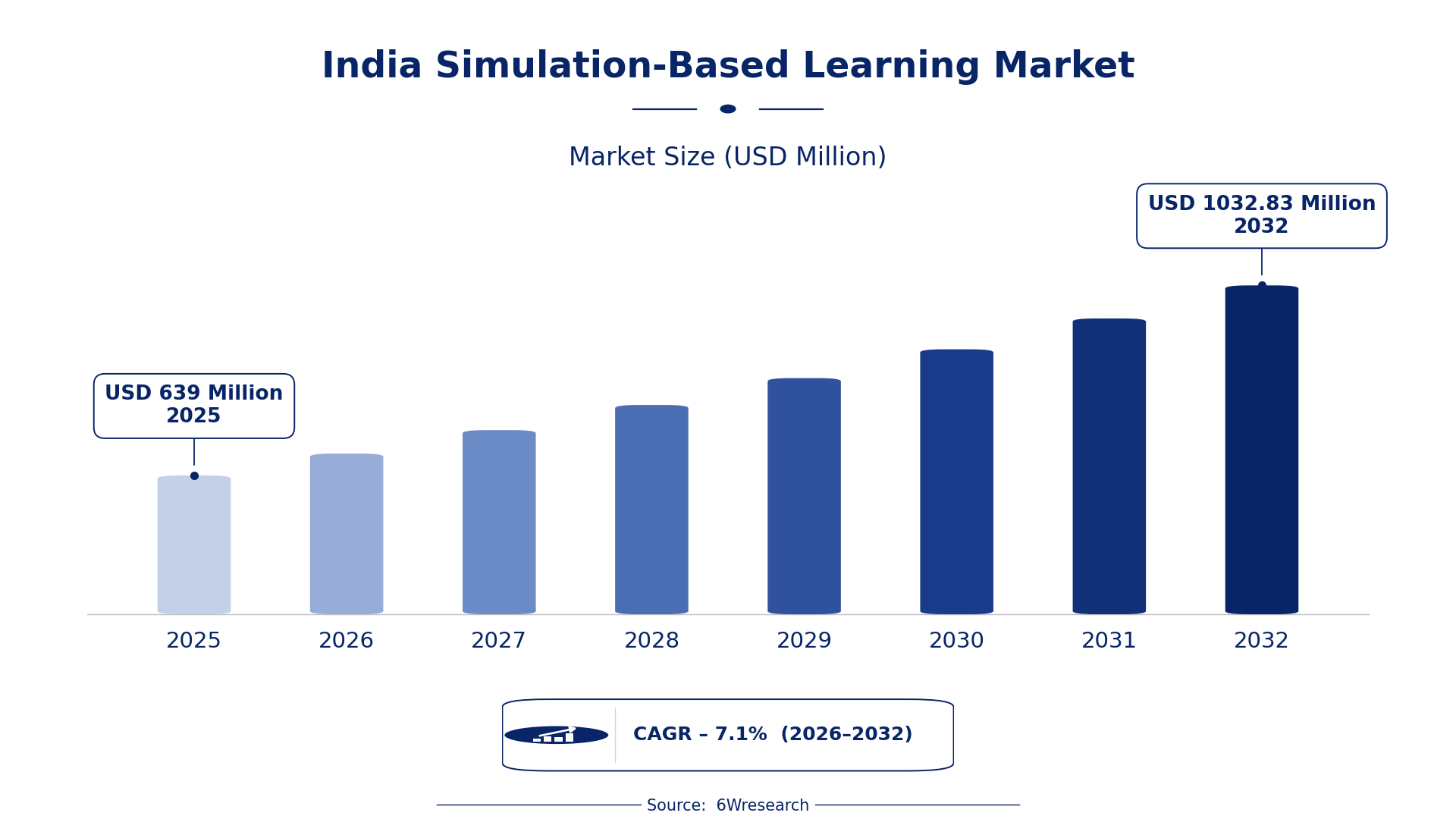
According to 6Wresearch internal database and industry insights, the India Simulation-Based Learning Market was valued at USD 639.0 million in 2025 and is projected to reach USD 1,032.83 million by 2032, growing at a CAGR of approximately 7.1% during 2026–2032.
India Simulation-Based Learning Market Highlights
| Report Metric | Details |
| Report Name | India Simulation-Based Learning Market |
| Market Size 2025 | USD 639.0 million |
| Market Size 2032 | USD 1,032.83 million |
| Absolute Growth 2025–2032 | USD 393.83 million |
| CAGR 2026–2032 | 7.1% |
| Peak Annual Growth | 8.8% in 2027 |
| Forecast Period | 2026–2032 |
| Historical Data | 2022–2025 |
| Base Year | 2025 |
| Leading Learning Type, 2025 | Medical Simulation (44% share) |
| Leading Training Field, 2025 | Aviation Training (45% share) |
| Leading Technology Used, 2025 | Browser/3D Models (34% share) |
| Leading End User, 2025 | Educational Institutes (41% share) |
| Fastest-Growing Learning Type | Virtual Lab Simulation (8.5% CAGR) |
| Fastest-Growing Training Field | Surgical/Diagnostic Skills (8.5% CAGR) |
| Fastest-Growing Technology Used | Haptics + AI (8.7% CAGR) |
| Fastest-Growing End User | Medical Colleges (9.1% CAGR) |
| Growing Sector | Aviation Training |
| Key End Users | Educational Institutes, Pilot Training Centers, Medical Colleges |
India Simulation-Based Learning Market Year-wise Growth Rate and Key Drivers (2022–2032)
This graph illustrates the annual growth rates of the market from 2022 to 2032, highlighting a steady upward trajectory and projected market expansion over the forecast period.
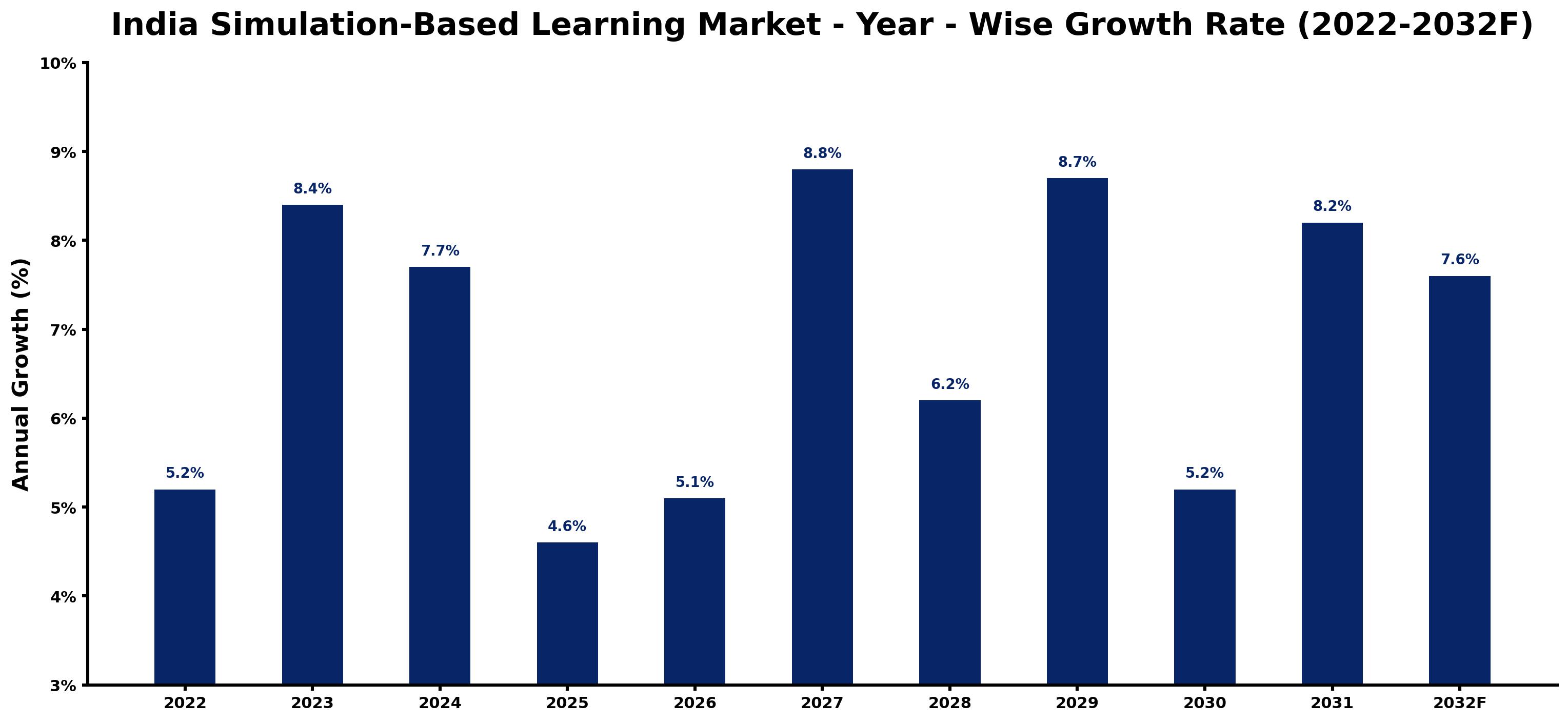
Year by year, the estimates below pair each growth rate with the development that shaped it.
| Year | Estimated Annual Growth (%) | Market Rationale |
| 2022 | 5.2 | The market experienced steady growth due to the increasing adoption of innovative learning methods. |
| 2023 | 8.4 | Demand surged as educational institutions enhanced their training programs with simulation technologies. |
| 2024 | 7.7 | Growth slowed slightly as institutions adjusted to new technologies and methodologies. |
| 2025 | 4.6 | The market continued to expand, albeit at a slower pace, as training centres refined their offerings. |
| 2026 | 5.1 | Growth accelerated again as pilot training centres increased their use of flight simulation. |
| 2027 | 8.8 | The market peaked with significant investments in aviation training and medical simulations. |
| 2028 | 6.2 | A slight slowdown occurred as the market stabilised after rapid growth in previous years. |
| 2029 | 8.7 | Demand rebounded strongly, driven by educational institutes seeking advanced training solutions. |
| 2030 | 5.2 | Growth decelerated as the market matured and competition intensified among providers. |
| 2031 | 8.2 | The market saw renewed interest as educational institutes embraced new simulation technologies. |
| 2032 | 7.6 | A further slowdown occurred as the market reached a more stable growth phase. |
Note: Market size estimations and growth projections presented in this report are based on 6Wresearch's proprietary forecasting methodology, utilizing the latest available industry data, government publications, and primary research inputs.
India Simulation-Based Learning Market Synopsis
Simulation-Based Learning in India includes a variety of technologies designed to create engaging educational experiences. By leveraging software platforms, it replicates real-world scenarios for training in sectors such as aviation and healthcare. The India Simulation-Based Learning Market is expanding, driven by the increasing demand from educational institutions and training centres. Initiatives like the Skill India Mission and the National Educational Technology Forum have further accelerated this growth, supporting vocational training and skill development efforts.
Market Dynamics Impact Analysis (2026–2032)
| Factor | Type | Impact | Primary Segment Affected |
| Growing adoption of simulation technologies in educational institutions | Driver | High | Educational Institutes |
| Increased investment in aviation training facilities | Driver | High | Pilot Training Centers |
| Rising demand for medical simulation in healthcare education | Opportunity | High | Medical Colleges |
| Expansion of virtual lab simulations in science education | Opportunity | Medium | Science/Engineering |
| Limited awareness of simulation benefits among some educational institutions | Restraint | Medium | Educational Institutes |
| High initial costs associated with implementing simulation technologies | Restraint | High | Pilot Training Centers |
| Simulation-Based Learning in India faces challenges in technology integration | Challenge | High | Medical Colleges |
| Competition among training providers is intensifying | Challenge | Medium | Educational Institutes |
Evaluation of Drivers in India Simulation-Based Learning Market (2026–2032)
The main growth drivers and the segments they affect most are set out below.
| Drivers | Primary Segment Affected | Why It Matters (Evidence) |
| Increased funding for technical education | Educational Institutes | The Indian government's Skill India Mission allocated 10 billion INR to support vocational training, driving demand for simulation tools. |
| Expansion of pilot training centres | Pilot Training Centers | Over 50 pilot training centres are employing flight simulation, significantly increasing the demand for advanced training technologies. |
| Growing adoption of medical simulation in colleges | Medical Colleges | Medical colleges are increasingly adopting simulation tools for surgical training, leading to a rise in demand for these technologies. |
| Rising student population in higher education | Educational Institutes | The student population in higher education reached 38 million in 2023, boosting the need for innovative learning methods. |
| Integration of technology in engineering curricula | Science/Engineering | The All India Council for Technical Education approved guidelines for simulation-based learning, enhancing educational offerings in engineering. |
Market growth for Simulation-Based Learning in India is underpinned by increased funding for technical education, expansion of pilot training centres, and growing adoption of simulation technologies in medical colleges. The Skill India Mission allocated 10 billion INR to support vocational training, which drives demand for simulation tools. More than 50 pilot training centres are employing flight simulation, significantly increasing the need for advanced training technologies. The student population in higher education reached 38 million in 2023, pushing institutions to seek innovative learning methods. Additionally, the All India Council for Technical Education's guidelines for integrating simulation in engineering curricula are enhancing educational offerings.
Evaluation of Restraints in India Simulation-Based Learning Market
The following restraints limit how fast demand can grow.
| Market Restraint | Primary Segment Affected | Why It Matters (Evidence) |
| Limited awareness of simulation benefits among some educational institutions | Educational Institutes | Some educational institutions lack understanding of the advantages of simulation technologies, hindering adoption rates. |
| High initial costs associated with implementing simulation technologies | Pilot Training Centers | The substantial investment required for simulation technologies can deter pilot training centres from upgrading their facilities. |
| Insufficient training for educators on new technologies | Medical Colleges | Medical colleges face challenges in training faculty to effectively use simulation tools, impacting their integration. |
| Competition among training providers is intensifying | Educational Institutes | As more providers enter the market, existing institutions may struggle to differentiate their offerings. |
| Regulatory hurdles in adopting new technologies | Pilot Training Centers | Pilot training centres encounter delays in regulatory approvals for implementing advanced simulation systems. |
India Simulation-Based Learning Market Challenges
The India Simulation-Based Learning market encounters high cost barriers for educational institutions, as initial investments in simulation technologies can consume over 20% of their annual budgets, limiting access for many buyers. Producers face challenges with outdated technology, with more than 60% of existing systems failing to meet current educational standards, which hinders effective training. A shortage of qualified trainers impacts skill development, with 70% of educators reporting recruitment difficulties, restricting the implementation of advanced simulations. Regulatory compliance adds complexity, as institutions must adhere to ISO 9001 standards, extending the certification process by up to six months and delaying program launches for buyers.
Trends in the India Simulation-Based Learning Market
The trends below show where the India Simulation-Based Learning Market is heading.
- Shift from Traditional to Simulation-Based Learning: In 2022, educational institutions began transitioning from traditional teaching methods to simulation-based learning. This change is reflected in over 1,000 institutes adopting simulation tools, improving practical skills across various fields.
- Increase in Medical Simulation Adoption: Medical colleges are increasingly incorporating simulation technologies for surgical training, with a notable rise in adoption rates. In 2023, 30% of medical colleges reported using simulation tools, improving training outcomes.
- Growth of Virtual Lab Simulations: The Science/Engineering field has seen a significant uptake of virtual lab simulations in universities. In 2023, over 500 universities implemented these tools to improve practical learning experiences.
- Expansion of Aviation Training Facilities: Aviation training centres are rapidly expanding their use of flight simulation technologies. In 2023, VR cockpit systems were implemented in numerous facilities, improving pilot training efficiency.
Investment Opportunities in the India Simulation-Based Learning Market
Investors looking at the India Simulation-Based Learning Market should consider the following areas.
- Educational Institutes Seeking Advanced Training Solutions: With 38 million students in higher education, educational institutes are actively searching for advanced training solutions. Investing in simulation technologies can enhance their offerings and attract more students.
- Pilot Training Centres Upgrading to Advanced Simulations: As the aviation sector expands, pilot training centres are transitioning to advanced simulation technologies. Collaborating with local partners can facilitate this upgrade and improve training outcomes.
- Medical Colleges Expanding Surgical Training Programs: Medical colleges are increasingly utilising simulation tools for surgical training, responding to a growing demand for improved training experiences. Investing in these technologies can address this rising need.
- Science/Engineering Institutions Adopting Virtual Labs: The demand for virtual lab simulations in science education is on the rise, with universities eager to enhance practical learning. Entering this market through local partnerships can present significant opportunities.
Government Initiatives in the India Simulation-Based Learning Market
In 2022, the Ministry of Education launched the National Educational Technology Forum to promote the use of technology, including simulation-based learning, in educational institutions. This initiative complements the Skill India Mission, which supports training programs that incorporate simulation technologies for vocational skills development, allocating significant resources to enhance the overall educational framework. Additionally, the All India Council for Technical Education approved guidelines for integrating simulation-based learning in engineering curricula in 2021, ensuring that educational institutions align with modern training standards.
The National Educational Technology Forum provides funding for educational institutions to adopt simulation technologies. The Ministry of Education also oversees the Skill India Mission, which funds training programs that integrate simulation technologies. These initiatives enable educational institutions to improve their training offerings and enhance student outcomes, ensuring that they remain competitive in the evolving educational environment.
Future Insight of the India Simulation-Based Learning Market
Several forward-looking factors are likely to support the India Simulation-Based Learning market in the coming years. The government's new skill development programme will increase funding for simulation technologies in educational institutions, enhancing training capabilities. The integration of advanced simulation methods in medical colleges will improve surgical education. The rise of VR cockpit systems in aviation training facilities will offer immersive experiences, while corporate training programmes will increasingly incorporate simulations for strategic planning, driving demand for innovative learning solutions.
Market Segmentation Analysis
Each segment group is reviewed below, with the leader by share and the fastest grower by CAGR.
By Learning Type – Medical Simulation Dominated, Virtual Lab Simulation Expected to Grow Fastest
According to Dhaval Chaurasia, Assistant Manager at 6Wresearch, with a 44% revenue share in 2025, Medical Simulation was the largest learning type category. Medical simulation commands the largest share in the India Simulation-Based Learning Market because it is essential for training healthcare professionals, particularly in surgical procedures. The growing number of medical colleges adopting these tools reflects a strong demand for effective training solutions. The quickest growth will come from Virtual Lab Simulation, forecast to expand at a CAGR of 8.5% between 2026 and 2032. Virtual lab simulation is rapidly gaining traction as educational institutions seek to provide practical experiences without the constraints of physical labs. This trend is illustrated by its extensive use in science education, catering to a vast student population. Suppliers must prioritise the development of advanced virtual lab solutions to satisfy the increasing demand from educational institutions.
By Training Field – Aviation Training Dominated, Surgical/Diagnostic Skills Expected to Grow Fastest
Aviation Training took a 45% share of training field in 2025, more than any other category. Aviation training captures the largest market share due to its essential role in pilot training programmes throughout India, with over 50 pilot training centres dedicated to this purpose. This established infrastructure and the high demand for skilled pilots solidify its position as the leader in simulation-based learning. Over 2026–2032, Surgical/Diagnostic Skills are expected to post the fastest growth, at a CAGR of 8.5%. Surgical and diagnostic skills training is experiencing rapid growth, primarily due to the increasing focus on practical training methods in medical colleges. The urgent need for effective training solutions in healthcare is reflected in the expanding enrolment numbers in medical programmes. This trend indicates that suppliers should prioritise the development of advanced simulation tools tailored for the medical sector.
By Technology Used – Browser/3D Models Dominated, Haptics + AI Expected to Grow Fastest
Browser/3D Models accounted for a 34% market share by technology used in 2025. Browser and 3D models dominate the market as they provide interactive learning experiences that educational institutes widely utilise. Their accessibility and effectiveness in engaging students contribute to their leading market share in simulation-based learning. Haptics + AI is projected to grow fastest, at a CAGR of 8.7% during 2026–2032. Haptics technology is the fastest-growing segment, as it offers immersive training experiences that can significantly enhance learning outcomes. Its potential applications in various fields are beginning to attract attention and investment, signalling a shift towards more advanced training methods. Suppliers should explore collaborations to enhance haptic technologies, as they represent a promising future in simulation-based learning.
By End User – Educational Institutes Dominated, Medical Colleges Expected to Grow Fastest
The largest end user category in 2025 was Educational Institutes, with a 41% share of total revenue. Educational institutes hold the largest market share, as they are the primary users of simulation-based learning tools designed to improve student engagement and practical skills. The growing number of institutions adopting these technologies further strengthens their leading position in the market. Medical Colleges are set to record the highest CAGR in this split, 9.1% over 2026–2032. Medical colleges are the fastest-growing end user segment, driven by the urgent need for effective training solutions in healthcare education. The increasing enrolment of students in medical programmes highlights the demand for advanced training methodologies within this sector. This growth suggests that suppliers must tailor their offerings to address the specific needs of medical colleges, which are set for significant expansion.
Key Attractiveness of the Report
- 10 Years of Market Numbers
- Historical Data Starting from 2022 to 2025
- Base Year 2025
- Forecast Data until 2032
- Key Performance Indicators Impacting the Market
- Major Upcoming Developments and Projects
Key Highlights of the Report:
- India Simulation-Based Learning Market Outlook
- Market Size of India Simulation-Based Learning Market, 2025
- Forecast of India Simulation-Based Learning Market, 2032
- Historical Data and Forecast of India Simulation-Based Learning Revenues & Volume for the Period 2022 - 2032F
- India Simulation-Based Learning Market Trend Evolution
- India Simulation-Based Learning Market Drivers and Challenges
- India Simulation-Based Learning Price Trends
- India Simulation-Based Learning Porter's Five Forces
- India Simulation-Based Learning Industry Life Cycle
- Historical Data and Forecast of India Simulation-Based Learning Market Revenues & Volume By Learning Type for the Period 2022 - 2032F
- Historical Data and Forecast of India Simulation-Based Learning Market Revenues & Volume By Virtual Lab Simulation for the Period 2022 - 2032F
- Historical Data and Forecast of India Simulation-Based Learning Market Revenues & Volume By Flight Simulation for the Period 2022 - 2032F
- Historical Data and Forecast of India Simulation-Based Learning Market Revenues & Volume By Medical Simulation for the Period 2022 - 2032F
- Historical Data and Forecast of India Simulation-Based Learning Market Revenues & Volume By Business Simulation for the Period 2022 - 2032F
- Historical Data and Forecast of India Simulation-Based Learning Market Revenues & Volume By Training Field for the Period 2022 - 2032F
- Historical Data and Forecast of India Simulation-Based Learning Market Revenues & Volume By Science/Engineering for the Period 2022 - 2032F
- Historical Data and Forecast of India Simulation-Based Learning Market Revenues & Volume By Aviation Training for the Period 2022 - 2032F
- Historical Data and Forecast of India Simulation-Based Learning Market Revenues & Volume By Surgical/Diagnostic Skills for the Period 2022 - 2032F
- Historical Data and Forecast of India Simulation-Based Learning Market Revenues & Volume By Strategic Planning for the Period 2022 - 2032F
- Historical Data and Forecast of India Simulation-Based Learning Market Revenues & Volume By Technology Used for the Period 2022 - 2032F
- Historical Data and Forecast of India Simulation-Based Learning Market Revenues & Volume By Browser/3D Models for the Period 2022 - 2032F
- Historical Data and Forecast of India Simulation-Based Learning Market Revenues & Volume By VR Cockpit Systems for the Period 2022 - 2032F
- Historical Data and Forecast of India Simulation-Based Learning Market Revenues & Volume By Haptics + AI for the Period 2022 - 2032F
- Historical Data and Forecast of India Simulation-Based Learning Market Revenues & Volume By Scenario Engines for the Period 2022 - 2032F
- Historical Data and Forecast of India Simulation-Based Learning Market Revenues & Volume By End User for the Period 2022 - 2032F
- Historical Data and Forecast of India Simulation-Based Learning Market Revenues & Volume By Educational Institutes for the Period 2022 - 2032F
- Historical Data and Forecast of India Simulation-Based Learning Market Revenues & Volume By Pilot Training Centers for the Period 2022 - 2032F
- Historical Data and Forecast of India Simulation-Based Learning Market Revenues & Volume By Medical Colleges for the Period 2022 - 2032F
- Historical Data and Forecast of India Simulation-Based Learning Market Revenues & Volume By Corporate Trainers for the Period 2022 - 2032F
- India Simulation-Based Learning Import Export Trade Statistics
- Market Opportunity Assessment By Learning Type
- Market Opportunity Assessment By Training Field
- Market Opportunity Assessment By Technology Used
- Market Opportunity Assessment By End User
- India Simulation-Based Learning Top Companies Market Share
- India Simulation-Based Learning Competitive Benchmarking By Technical and Operational Parameters
- India Simulation-Based Learning Company Profiles
- India Simulation-Based Learning Key Strategic Recommendations
Market Covered
This report examines the market across the segments below.
By Learning Type
- Virtual Lab Simulation
- Flight Simulation
- Medical Simulation
- Business Simulation
By Training Field
- Science/Engineering
- Aviation Training
- Surgical/Diagnostic Skills
- Strategic Planning
By Technology Used
- Browser/3D Models
- VR Cockpit Systems
- Haptics + AI
- Scenario Engines
By End User
- Educational Institutes
- Pilot Training Centers
- Medical Colleges
- Corporate Trainers































