China Simulation-Based Learning Market Size & Growth Rate
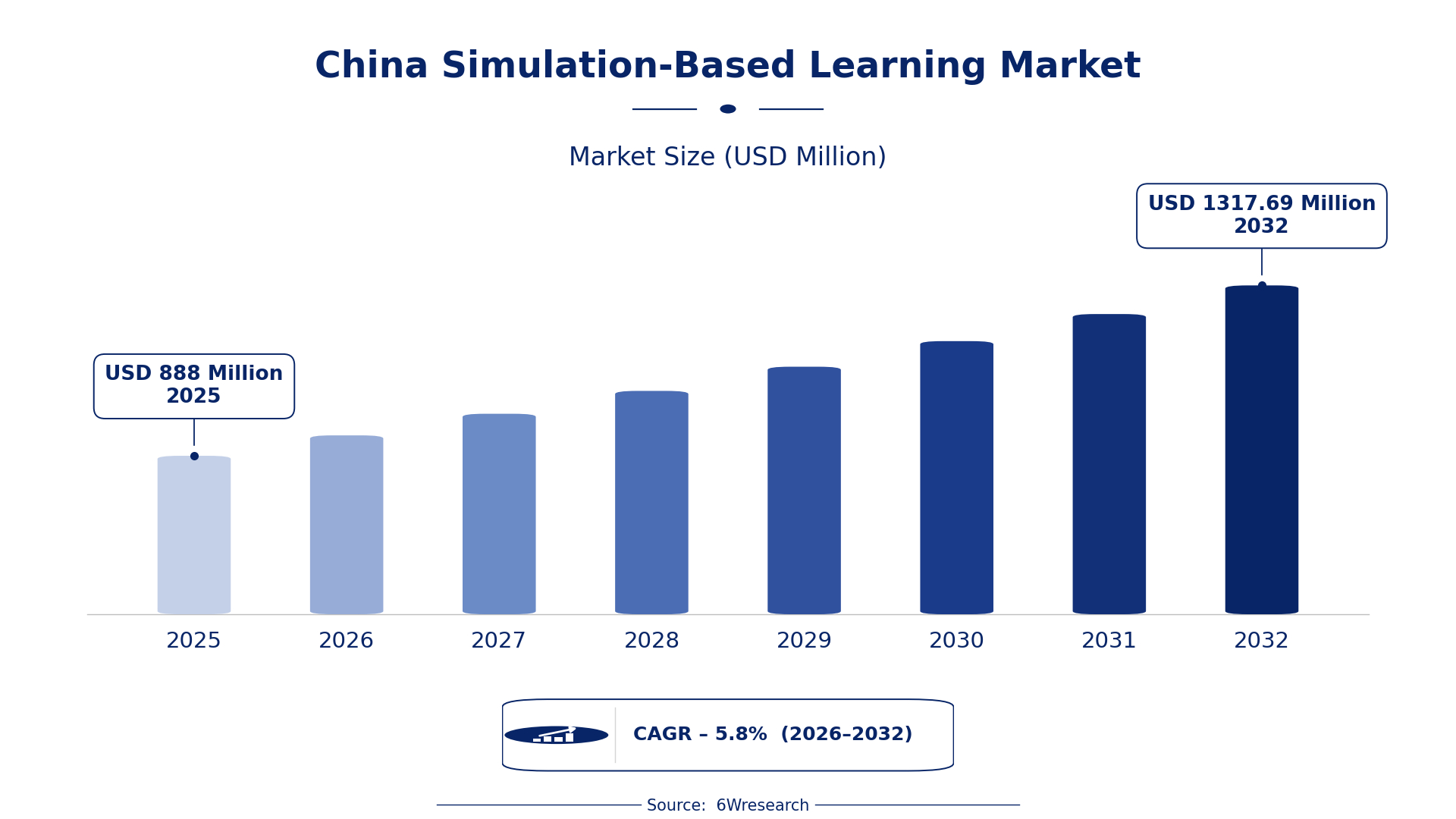
According to 6Wresearch internal database and industry insights, the China Simulation-Based Learning Market was valued at USD 888.0 million in 2025 and is projected to reach USD 1,317.69 million by 2032, growing at a CAGR of approximately 5.8% during 2026–2032.
China Simulation-Based Learning Market Highlights
| Report Metric | Details |
| Report Name | China Simulation-Based Learning Market |
| Market Size 2025 | USD 888.0 million |
| Market Size 2032 | USD 1,317.69 million |
| Absolute Growth 2025–2032 | USD 429.69 million |
| CAGR 2026–2032 | 5.8% |
| Peak Annual Growth | 7.4% in 2030 |
| Forecast Period | 2026–2032 |
| Historical Data | 2022–2025 |
| Base Year | 2025 |
| Leading Learning Type, 2025 | Medical Simulation (43% share) |
| Leading Training Field, 2025 | Aviation Training (50% share) |
| Leading Technology Used, 2025 | VR Cockpit Systems (45% share) |
| Leading End User, 2025 | Educational Institutes (47% share) |
| Fastest-Growing Learning Type | Virtual Lab Simulation (7.7% CAGR) |
| Fastest-Growing Training Field | Surgical/Diagnostic Skills (6.9% CAGR) |
| Fastest-Growing Technology Used | Haptics + AI (7.9% CAGR) |
| Fastest-Growing End User | Medical Colleges (7.0% CAGR) |
| Growing Sector | Educational Institutions |
| Key End Users | Educational Institutes, Pilot Training Centers, Medical Colleges, Corporate Trainers |
China Simulation-Based Learning Market Year-wise Growth Rate and Key Drivers (2022–2032)
This graph illustrates the annual growth rates of the market from 2022 to 2032, highlighting a steady upward trajectory and projected market expansion over the forecast period.
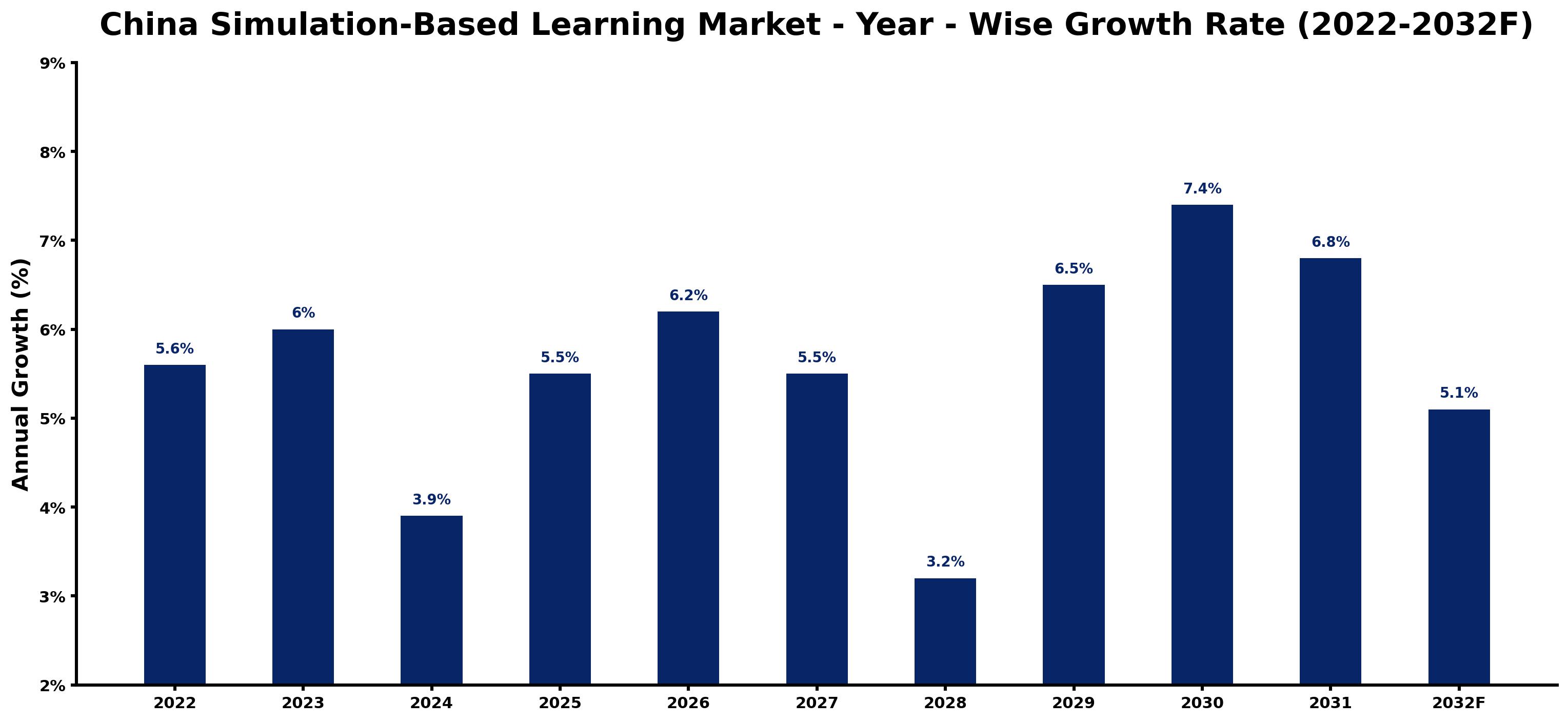
Each row of the following table gives one year's estimated growth and the event or demand shift that explains it.
| Year | Estimated Annual Growth (%) | Market Rationale |
| 2022 | 5.6 | The market showed strong engagement with over 290 million students enrolled in educational institutions. |
| 2023 | 6.0 | Growth accelerated due to increased adoption of VR technologies in over 1,000 universities across China. |
| 2024 | 3.9 | A slowdown occurred as demand stabilised after rapid growth in previous years following the integration of simulation in STEM education. |
| 2025 | 5.5 | Demand increased again as the Ministry of Education supported simulation integration in STEM education. |
| 2026 | 6.2 | Growth is expected to resume with the Civil Aviation Administration promoting flight simulation training programs. |
| 2027 | 5.5 | The market is projected to experience a slowdown as pilot training centres adjust to new regulations regarding flight training. |
| 2028 | 3.2 | A further slowdown is expected due to market adjustments following healthcare reforms affecting medical training. |
| 2029 | 6.5 | Demand is anticipated to rise again as corporate trainers increasingly adopt simulation methods for employee development. |
| 2030 | 7.4 | The market is projected to peak with substantial investments in medical simulation driven by healthcare reforms. |
| 2031 | 6.8 | Growth is expected to slow as the market begins to stabilise after reaching a peak in demand. |
| 2032 | 5.1 | A continued slowdown is anticipated as the market matures and competition increases. |
Note: Market size estimations and growth projections presented in this report are based on 6Wresearch's proprietary forecasting methodology, utilizing the latest available industry data, government publications, and primary research inputs.
China Simulation-Based Learning Market Synopsis
The China Simulation-Based Learning market includes immersive learning environments that utilise technologies such as virtual labs and flight simulators, crucial for training in aviation, healthcare, and educational institutions. With over 290 million students enrolled, the market is expanding due to increasing domestic educational needs and corporate training demands. The anticipated need for 8,700 new pilots by 2038 further propels investment in this sector. The incorporation of simulation technologies in STEM education stimulates growth, improving the quality of training across various fields.
Market Dynamics Impact Analysis (2026–2032)
| Factor | Type | Impact | Primary Segment Affected |
| Growing student enrolment in educational institutions drives demand for immersive learning solutions. | Driver | High | Educational Institutes |
| Increased pilot training centres enhance the need for flight simulation technologies. | Driver | High | Pilot Training Centers |
| Healthcare reforms create a significant demand for medical simulation training. | Opportunity | High | Medical Simulation |
| The rise of corporate training programs necessitates advanced simulation tools. | Opportunity | Medium | Business Simulation |
| Regulatory hurdles in medical simulation device approvals can delay market entry. | Restraint | High | Medical Simulation |
| Limited awareness of simulation benefits among traditional educators restricts adoption. | Restraint | Medium | Educational Institutes |
| Buyers face challenges in integrating advanced technologies into existing curricula. | Challenge | High | Educational Institutes |
| Suppliers struggle with high initial investment costs for simulation technologies. | Challenge | Medium | Corporate Trainers |
Evaluation of Drivers in China Simulation-Based Learning Market (2026–2032)
The factors lifting demand, and the evidence behind each, are summarised below.
| Drivers | Primary Segment Affected | Why It Matters (Evidence) |
| Increased funding for educational technologies drives simulation adoption in schools. | Educational Institutes | The Ministry of Education's support for technology integration drives more institutions to invest in simulation-based learning. |
| Growing aviation sector leads to higher demand for pilot training solutions. | Pilot Training Centers | The projected requirement for 8,700 new pilots by 2038 necessitates advanced flight simulation training. |
| Healthcare reforms boost the need for effective training solutions in medical fields. | Medical Simulation | The expected rise in demand for medical simulation aligns with ongoing healthcare reforms. |
| Corporate trainers are increasingly adopting simulation methods for employee development. | Business Simulation | Over 60% of corporate trainers in China are now using simulation techniques to improve training effectiveness. |
| Integration of VR technologies in universities supports immersive learning experiences. | Virtual Lab Simulation | The adoption of VR technologies in over 1,000 universities supports the growth of simulation-based learning. |
The Simulation-Based Learning market in China is expanding as educational institutions, pilot training centres, and corporate trainers increasingly adopt immersive technologies. With over 290 million students enrolled, the demand for effective training solutions is rising. The aviation sector's requirement for new pilots drives demand for flight simulation training, while healthcare reforms are expected to increase the need for medical simulation, aligning with the growing focus on effective training solutions in educational settings and corporate environments.
Evaluation of Restraints in China Simulation-Based Learning Market
Below mentioned are some major restraints and their influence on market dynamics.
| Market Restraint | Primary Segment Affected | Why It Matters (Evidence) |
| Regulatory hurdles can delay the approval of new medical simulation devices. | Medical Simulation | The National Medical Products Administration's stringent regulations can slow down market entry for new products. |
| Limited awareness of simulation benefits restricts adoption in traditional education settings. | Educational Institutes | Many educators remain unaware of the advantages of simulation-based learning, hindering its implementation. |
| High initial investment costs for simulation technologies can deter buyers. | Corporate Trainers | The financial burden of acquiring advanced simulation tools may limit adoption among smaller companies. |
| Inconsistent training standards across regions can affect market growth. | Aviation Training | Variability in training quality may lead to uneven demand for flight simulation solutions. |
| Resistance to change from traditional training methods can slow adoption rates. | Business Simulation | Some corporate trainers prefer conventional methods over newer simulation techniques, impacting growth. |
China Simulation-Based Learning Market Challenges
Buyers and suppliers in the China Simulation-Based Learning market face intense competition as educational institutions and corporate trainers adopt similar technologies, which can reduce individual market share. Supply chain issues arise from reliance on specific hardware components, delaying the delivery of simulation tools to over 290 million students nationwide. Many smaller educational institutions struggle to obtain the latest immersive learning technologies, limiting their training effectiveness and reducing opportunities for their students. High costs associated with developing and maintaining advanced simulation environments strain budgets for educational institutions and corporate trainers, restricting their ability to invest in new tools and methods.
Trends in the China Simulation-Based Learning Market
Four trends stand out in the China Simulation-Based Learning Market.
- Shift from Traditional to Simulation-Based Training: Educational institutions in China are progressively transitioning towards simulation-based training methods. The Ministry of Education's 'Digital Education Action Plan' in 2021 has resulted in increased funding for technology integration, benefiting over 290 million students.
- Growing Adoption of VR Technologies in Universities: In 2023, more than 1,000 universities in China embraced VR technologies for immersive learning. This transition supports the integration of advanced learning tools, enhancing student engagement and practical skill development.
- Increased Focus on Medical Simulation Training: The demand for medical simulation training has escalated following healthcare reforms. By 2025, the need for medical simulation is projected to rise considerably, driven by the China Association of Simulation Technology in Medicine.
- Expansion of Corporate Training Using Simulations: Corporate trainers in China are increasingly implementing simulation methods for employee development. Over 60% of trainers are now using these techniques to boost training effectiveness and engagement.
Investment Opportunities in the China Simulation-Based Learning Market
Several openings in the China Simulation-Based Learning Market merit attention from investors.
- Investment in Medical Simulation Technologies: Medical colleges are pursuing advanced simulation tools to enhance training quality. With a projected increase in demand for medical simulation by 2025, investing in this sector offers a clear opportunity for suppliers.
- Growth in Aviation Training Facilities: Pilot training centres are broadening their capabilities to meet the demand for new pilots. The projected need for 8,700 new pilots by 2038 underscores the necessity for investment in flight simulation technologies.
- Corporate Training Needs Advanced Solutions: Corporate trainers are increasingly seeking advanced training solutions. With over 60% of trainers adopting simulation methods, there is a clear opportunity for suppliers to provide tailored solutions.
- Enhancing STEM Education with Simulation Tools: Educational institutions are prioritising the integration of simulation-based learning in STEM curricula. The Ministry of Education's support for this integration opens avenues for partnerships with local educational providers.
Government Initiatives in the China Simulation-Based Learning Market
In 2021, the Ministry of Education launched the 'Digital Education Action Plan' to improve simulation-based learning in schools. This initiative focuses on funding for technology integration, aiming to enhance educational outcomes for over 290 million students. Additionally, the 'National Strategy for Vocational Education Reform' approved by the State Council in 2021 highlights the role of simulation in technical training, promoting its adoption across various sectors.
In 2023, the Civil Aviation Administration of China introduced the 'Pilot Training Enhancement Program', which emphasises the use of flight simulators in training. This program aims to elevate training quality and efficiency for aspiring pilots. Furthermore, the National Medical Products Administration updated regulations in 2022 to streamline the approval process for medical simulation devices, ensuring higher training standards.
Future Insight of the China Simulation-Based Learning Market
Several forward-looking factors should support the China Simulation-Based Learning market in the coming years. The Ministry of Education's initiative to integrate simulation-based learning into STEM education will drive demand for advanced training tools. By 2025, healthcare reforms are expected to increase the need for medical training simulations, improving the quality of healthcare education. Government funding for upgrading educational technologies will enhance access to immersive learning environments across various sectors. The aviation industry's projected requirement for 8,700 new pilots by 2038 will further stimulate investments in flight training programs.
Market Segmentation Analysis
Each segment group is reviewed below, with the leader by share and the fastest grower by CAGR.
By Learning Type – Medical Simulation Dominated, Virtual Lab Simulation Expected to Grow Fastest
According to Dhaval Chaurasia, Assistant Manager at 6Wresearch, Medical Simulation took a 43% share of learning type in 2025, more than any other category. Medical simulation commands the largest share in the China Simulation-Based Learning Market, primarily due to its critical role in training healthcare professionals. The regulatory framework established by the National Medical Products Administration reinforces the importance of this segment in medical education. The quickest growth will come from Virtual Lab Simulation, forecast to expand at a CAGR of 7.7% between 2026 and 2032. Virtual lab simulation is rapidly expanding as educational institutions increasingly adopt VR technologies for immersive learning experiences. This growth is further propelled by the Ministry of Education's initiatives promoting simulation-based learning in STEM fields. Suppliers must focus on developing advanced medical simulation tools to meet the growing demand from educational institutions.
By Training Field – Aviation Training Dominated, Surgical/Diagnostic Skills Expected to Grow Fastest
Aviation Training accounted for a 50% market share by training field in 2025. Aviation training holds the largest market share, essential for preparing pilots and crew, with approximately 500 pilot training centres currently operational in China. The anticipated requirement for 8,700 new pilots by 2038 highlights the significance of this training field. Surgical/Diagnostic Skills are projected to grow fastest, at a CAGR of 6.9% during 2026–2032. Surgical and diagnostic skills training is experiencing rapid growth, driven by the increasing emphasis on advanced medical training methods. The expected surge in demand for medical simulation due to healthcare reforms will significantly impact this segment's expansion. Buyers in the medical sector should prioritise acquiring advanced surgical training tools to enhance the quality of medical education.
By Technology Used – VR Cockpit Systems Dominated, Haptics + AI Expected to Grow Fastest
With a 45% revenue share in 2025, VR Cockpit Systems was the largest technology used category. VR cockpit systems lead the market share, crucial for delivering realistic flight training experiences to aspiring pilots. The aviation industry's dependence on these systems ensures their ongoing relevance in simulation-based learning. Over 2026–2032, Haptics + AI is expected to post the fastest growth, at a CAGR of 7.9%. Haptics combined with AI is the fastest-growing technology segment, offering emerging capabilities that elevate the training experience. This technology is gaining traction across various training environments, signalling a shift towards more interactive learning methods. Suppliers should invest in developing haptic and AI technologies to maintain competitiveness in the evolving simulation market.
By End User – Educational Institutes Dominated, Medical Colleges Expected to Grow Fastest
The largest end user category in 2025 was Educational Institutes, with a 47% share of total revenue. Educational institutes account for the largest share of the market, as they are the primary users of simulation-based learning tools. With over 290 million students enrolled, these institutions are key drivers of demand for immersive educational technologies. Medical Colleges are set to record the highest CAGR in this split, 7.0% over 2026–2032. Medical colleges represent the fastest-growing end user segment, reflecting the increasing focus on advanced training for healthcare professionals. As healthcare reforms advance, the need for effective medical training solutions will continue to escalate. Buyers in educational sectors should seek partnerships with simulation technology providers to enhance their training capabilities.
Key Attractiveness of the Report
- 10 Years of Market Numbers
- Historical Data Starting from 2022 to 2025
- Base Year 2025
- Forecast Data until 2032
- Key Performance Indicators Impacting the Market
- Major Upcoming Developments and Projects
Key Highlights of the Report:
- China Simulation-Based Learning Market Outlook
- Market Size of China Simulation-Based Learning Market, 2025
- Forecast of China Simulation-Based Learning Market, 2032
- Historical Data and Forecast of China Simulation-Based Learning Revenues & Volume for the Period 2022 - 2032F
- China Simulation-Based Learning Market Trend Evolution
- China Simulation-Based Learning Market Drivers and Challenges
- China Simulation-Based Learning Price Trends
- China Simulation-Based Learning Porter's Five Forces
- China Simulation-Based Learning Industry Life Cycle
- Historical Data and Forecast of China Simulation-Based Learning Market Revenues & Volume By Learning Type for the Period 2022 - 2032F
- Historical Data and Forecast of China Simulation-Based Learning Market Revenues & Volume By Virtual Lab Simulation for the Period 2022 - 2032F
- Historical Data and Forecast of China Simulation-Based Learning Market Revenues & Volume By Flight Simulation for the Period 2022 - 2032F
- Historical Data and Forecast of China Simulation-Based Learning Market Revenues & Volume By Medical Simulation for the Period 2022 - 2032F
- Historical Data and Forecast of China Simulation-Based Learning Market Revenues & Volume By Business Simulation for the Period 2022 - 2032F
- Historical Data and Forecast of China Simulation-Based Learning Market Revenues & Volume By Training Field for the Period 2022 - 2032F
- Historical Data and Forecast of China Simulation-Based Learning Market Revenues & Volume By Science/Engineering for the Period 2022 - 2032F
- Historical Data and Forecast of China Simulation-Based Learning Market Revenues & Volume By Aviation Training for the Period 2022 - 2032F
- Historical Data and Forecast of China Simulation-Based Learning Market Revenues & Volume By Surgical/Diagnostic Skills for the Period 2022 - 2032F
- Historical Data and Forecast of China Simulation-Based Learning Market Revenues & Volume By Strategic Planning for the Period 2022 - 2032F
- Historical Data and Forecast of China Simulation-Based Learning Market Revenues & Volume By Technology Used for the Period 2022 - 2032F
- Historical Data and Forecast of China Simulation-Based Learning Market Revenues & Volume By Browser/3D Models for the Period 2022 - 2032F
- Historical Data and Forecast of China Simulation-Based Learning Market Revenues & Volume By VR Cockpit Systems for the Period 2022 - 2032F
- Historical Data and Forecast of China Simulation-Based Learning Market Revenues & Volume By Haptics + AI for the Period 2022 - 2032F
- Historical Data and Forecast of China Simulation-Based Learning Market Revenues & Volume By Scenario Engines for the Period 2022 - 2032F
- Historical Data and Forecast of China Simulation-Based Learning Market Revenues & Volume By End User for the Period 2022 - 2032F
- Historical Data and Forecast of China Simulation-Based Learning Market Revenues & Volume By Educational Institutes for the Period 2022 - 2032F
- Historical Data and Forecast of China Simulation-Based Learning Market Revenues & Volume By Pilot Training Centers for the Period 2022 - 2032F
- Historical Data and Forecast of China Simulation-Based Learning Market Revenues & Volume By Medical Colleges for the Period 2022 - 2032F
- Historical Data and Forecast of China Simulation-Based Learning Market Revenues & Volume By Corporate Trainers for the Period 2022 - 2032F
- China Simulation-Based Learning Import Export Trade Statistics
- Market Opportunity Assessment By Learning Type
- Market Opportunity Assessment By Training Field
- Market Opportunity Assessment By Technology Used
- Market Opportunity Assessment By End User
- China Simulation-Based Learning Top Companies Market Share
- China Simulation-Based Learning Competitive Benchmarking By Technical and Operational Parameters
- China Simulation-Based Learning Company Profiles
- China Simulation-Based Learning Key Strategic Recommendations
Market Covered
This report examines the market across the segments below.
By Learning Type
- Virtual Lab Simulation
- Flight Simulation
- Medical Simulation
- Business Simulation
By Training Field
- Science/Engineering
- Aviation Training
- Surgical/Diagnostic Skills
- Strategic Planning
By Technology Used
- Browser/3D Models
- VR Cockpit Systems
- Haptics + AI
- Scenario Engines
By End User
- Educational Institutes
- Pilot Training Centers
- Medical Colleges
- Corporate Trainers































