India Skin Care Oil Market Size & Growth Rate
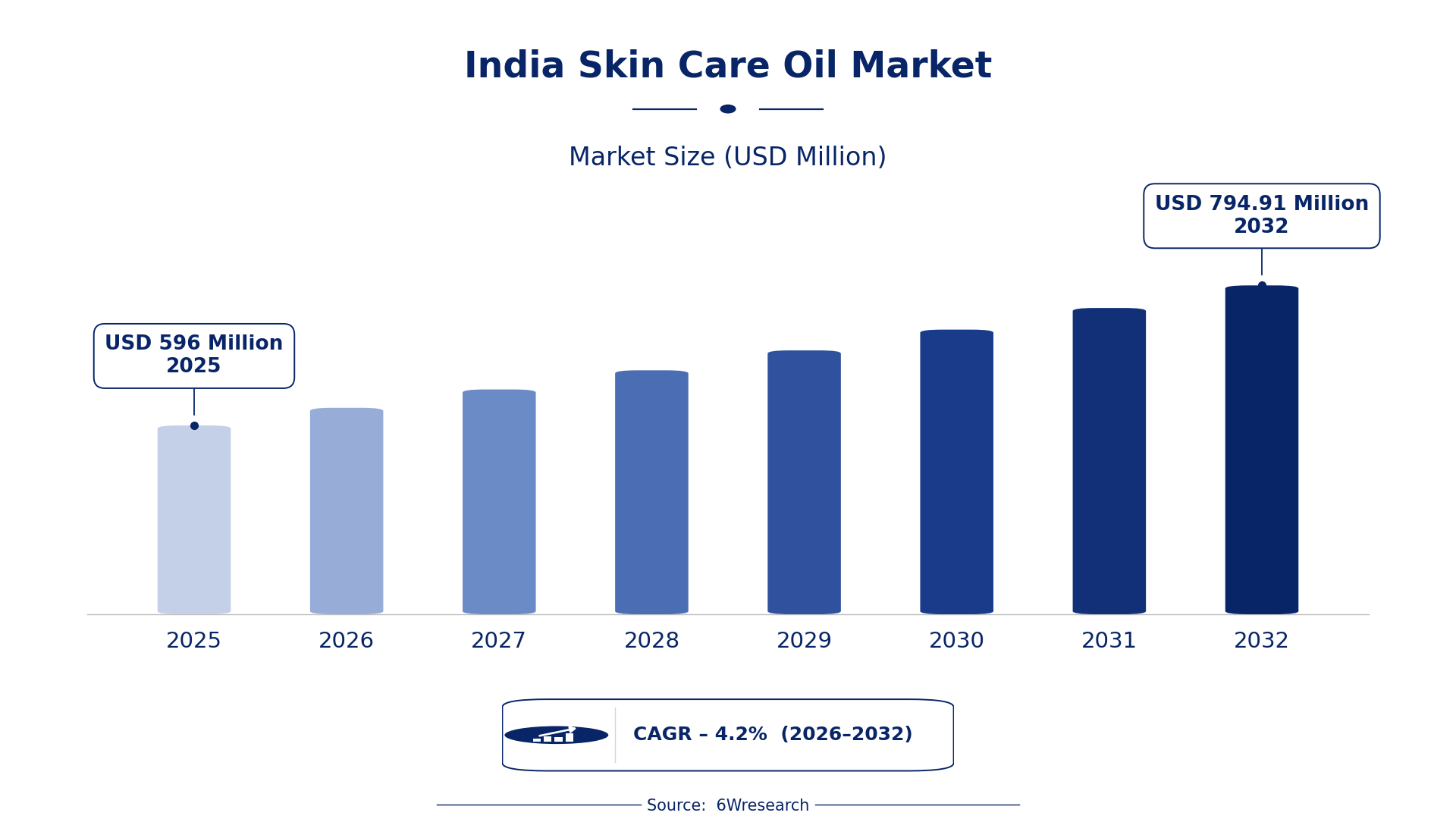
According to 6Wresearch internal database and industry insights, the India Skin Care Oil Market was valued at USD 596.0 million in 2025 and is projected to reach USD 794.91 million by 2032, growing at a CAGR of approximately 4.2% during 2026–2032.
India Skin Care Oil Market Highlights
| Report Metric | Details |
| Report Name | India Skin Care Oil Market |
| Market Size 2025 | USD 596.0 million |
| Market Size 2032 | USD 794.91 million |
| Absolute Growth 2025–2032 | USD 198.91 million |
| CAGR 2026–2032 | 4.2% |
| Peak Annual Growth | 5.9% in 2030 |
| Forecast Period | 2026–2032 |
| Historical Data | 2022–2025 |
| Base Year | 2025 |
| Leading Oil Type, 2025 | Coconut Oil (35% share) |
| Leading Source, 2025 | Plant-Based (44% share) |
| Leading Skin Benefit, 2025 | Hydration & Antibacterial (44% share) |
| Leading End User, 2025 | Natural Beauty Brands (50% share) |
| Fastest-Growing Oil Type | Tea Tree Oil (5.8% CAGR) |
| Fastest-Growing Skin Benefit | Anti-aging & Moisturizing (5.4% CAGR) |
| Fastest-Growing End User | Retail Cosmetic Brands (6.1% CAGR) |
| Growing Sector | Natural Beauty |
| Key End Users | Natural Beauty Brands, Retail Cosmetic Brands, Wellness Product Firms |
India Skin Care Oil Market Year-wise Growth Rate and Key Drivers (2022–2032)
This graph illustrates the annual growth rates of the market from 2022 to 2032, highlighting a steady upward trajectory and projected market expansion over the forecast period.
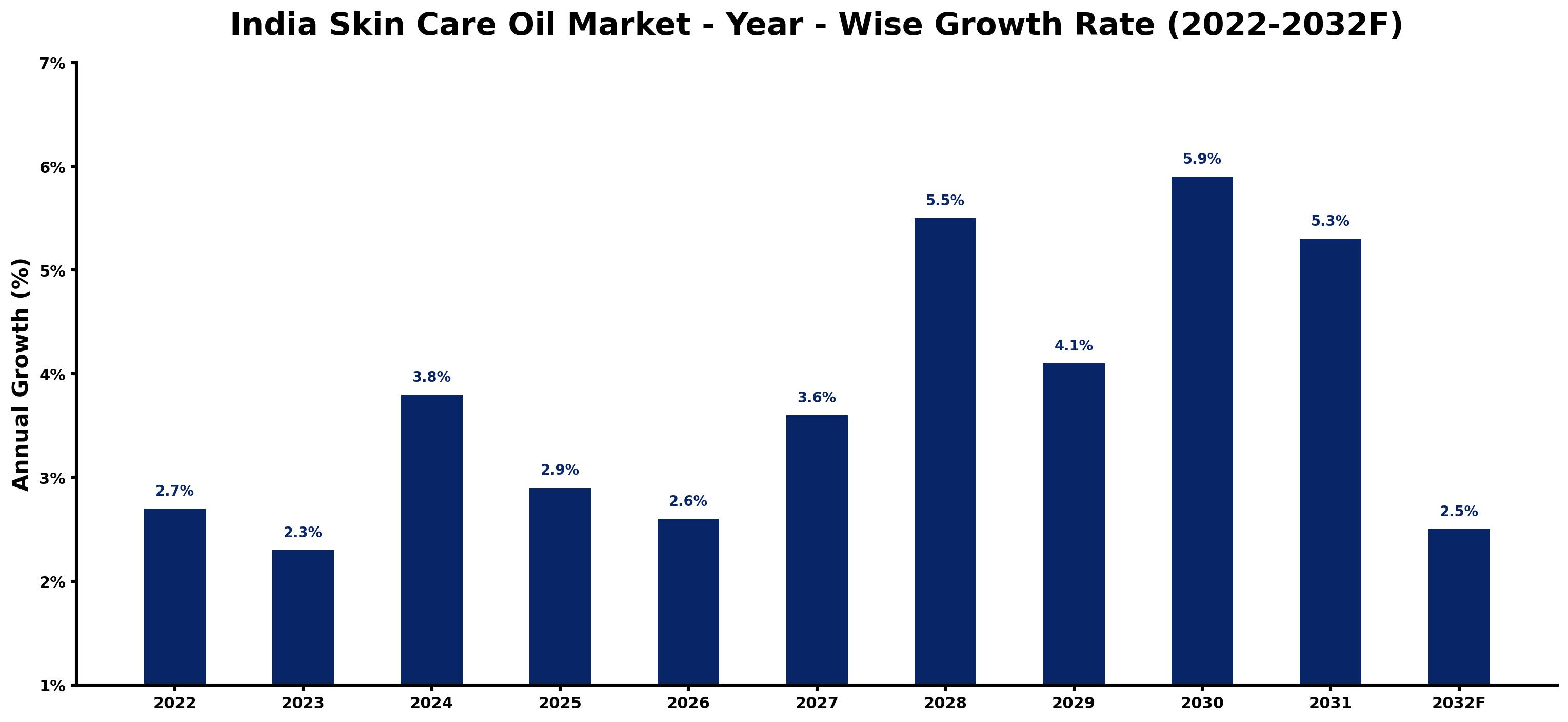
The following table presents the estimated annual growth rate for each year together with the principal factor influencing market performance.
| Year | Estimated Annual Growth (%) | Market Rationale |
| 2022 | 2.7 | The market experienced steady growth, driven by rising disposable incomes and changing lifestyles. |
| 2023 | 2.3 | Growth slowed as demand stabilised amid increased competition in the natural product segment. |
| 2024 | 3.8 | A surge in consumer interest in anti-aging products boosted growth significantly this year. |
| 2025 | 2.9 | Demand for skin care oils continued, though growth slowed due to market adjustments. |
| 2026 | 2.6 | A slight slowdown occurred as consumers became more discerning about product quality. |
| 2027 | 3.6 | Growth accelerated as urban consumers increasingly sought natural and organic skin care solutions. |
| 2028 | 5.5 | The market saw robust growth driven by the expanding wellness industry and e-commerce platforms. |
| 2029 | 4.1 | Growth moderated as consumers became more selective in their purchasing decisions. |
| 2030 | 5.9 | A peak in growth was reached, propelled by heightened demand for anti-aging and moisturizing products. |
| 2031 | 5.3 | Growth decelerated slightly as market saturation began to influence purchasing patterns. |
| 2032 | 2.5 | The market is expected to grow at a slower pace as consumer preferences evolve. |
Note: Market size estimations and growth projections presented in this report are based on 6Wresearch's proprietary forecasting methodology, utilizing the latest available industry data, government publications, and primary research inputs.
India Skin Care Oil Market Synopsis
Skin Care Oil Market in India includes oils sourced from natural plants, aimed at delivering various skin benefits such as moisturising and anti-ageing. These oils are extracted using methods like cold pressing. The market is growing due to a population exceeding 1.4 billion and a rising preference for natural and organic products. The wellness industry is set to reach $50 billion by 2025, further boosting the demand for skin care oils. The emergence of natural beauty brands committed to sustainable practices also supports market expansion.
Market Dynamics Impact Analysis (2026–2032)
| Factor | Type | Impact | Primary Segment Affected |
| Growing consumer preference for natural products | Driver | High | Plant-Based |
| Increased disposable income among urban populations | Driver | High | Natural Beauty Brands |
| Expansion of e-commerce platforms for cosmetic sales | Opportunity | High | Retail Cosmetic Brands |
| Rising demand for anti-aging products among aging consumers | Opportunity | High | Natural Beauty Brands |
| Regulatory challenges in product certification | Restraint | Medium | Essential Oil |
| Competition from synthetic alternatives in the market | Restraint | Medium | Coconut Oil |
| The Skin Care Oil Market in India faces significant obstacles due to regulatory complexities. | Challenge | High | Coconut Oil |
| Limited awareness about the benefits of specific oils hampers growth potential. | Challenge | Medium | Coconut Oil |
Evaluation of Drivers in India Skin Care Oil Market (2026–2032)
Below mentioned are some major drivers and their influence on market dynamics.
| Drivers | Primary Segment Affected | Why It Matters (Evidence) |
| Increased focus on natural ingredients in cosmetics | Plant-Based | This trend drives demand for plant-based skin care oils, with a projected growth of 5.2% in the segment. |
| Urban consumers seeking effective solutions for skin issues | Tea Tree Oil | The popularity of tea tree oil for acne treatment is rising, particularly among urban demographics, leading to increased purchases. |
| Growing interest in anti-aging products among consumers | Hydration & Antibacterial | The demand for anti-aging oils is increasing, particularly in urban areas with aging populations, boosting sales. |
| Investment in sustainable sourcing practices by brands | Natural Beauty Brands | Sustainable practices are becoming essential, with many brands focusing on eco-friendly formulations to attract consumers. |
| Rising disposable incomes leading to increased spending on personal care | Retail Cosmetic Brands | Higher disposable incomes are encouraging consumers to invest in premium skin care oils, driving market growth. |
Growth in the Skin Care Oil market in India stems from a heightened emphasis on natural ingredients, increasing disposable incomes, and urban consumers searching for effective skin solutions. The wellness industry is projected to reach $50 billion by 2025, stimulating demand for skin care oils. The popularity of tea tree oil for acne treatment is on the rise, especially among urban demographics, while anti-ageing products are increasingly sought after by older populations. Investment in sustainable sourcing practices is becoming more common among natural beauty brands, which are broadening their product offerings. This combination of trends is creating a positive market environment for skin care oils, resulting in increased purchases and brand loyalty.
Evaluation of Restraints in India Skin Care Oil Market
Below mentioned are some major restraints and their influence on market dynamics.
| Market Restraint | Primary Segment Affected | Why It Matters (Evidence) |
| Regulatory complexities in product certification | Essential Oil | Compliance with the Drugs and Cosmetics Act creates hurdles for producers, affecting market entry and increasing costs by up to 20%. |
| Competition from synthetic alternatives | Coconut Oil | Synthetic oils are often cheaper, attracting price-sensitive consumers away from natural options, impacting sales. |
| Limited consumer awareness about specific oil benefits | Tea Tree Oil | Lack of information restricts market growth as consumers may opt for familiar brands, hindering new product adoption. |
| High production costs associated with natural oils | Plant-Based | The cost of sourcing and processing natural oils can deter smaller producers from entering the market, limiting supply. |
| Challenges in maintaining consistent quality standards | Hydration & Antibacterial | Quality control issues can lead to product recalls, damaging brand reputation and consumer trust. |
India Skin Care Oil Market Challenges
The India Skin Care Oil Market encounters a critical challenge with outdated extraction technology, limiting production efficiency for suppliers. Many producers rely on traditional methods, leading to yields that are 30% lower than achievable with modern techniques, which delays product availability for buyers. Urban consumers often face difficulties accessing high-quality natural oils due to underdeveloped distribution networks, resulting in potential revenue losses of 15% for suppliers. Navigating the Drugs and Cosmetics Act adds complexity, as compliance can inflate production costs by up to 20%, ultimately raising prices for buyers.
Trends in the India Skin Care Oil Market
Buyers and suppliers in the India Skin Care Oil Market are adjusting to the following trends.
- Natural Beauty Brands Prioritising Sustainable Sourcing: Natural beauty brands in India are increasingly embracing sustainable sourcing practices for skin care oils, with 44% of the market share expected for plant-based oils by 2025. This trend mirrors consumer demand for eco-friendly products.
- Urban Consumers Shifting Towards Organic Skin Care: Urban consumers in India are turning towards organic skin care oils, with a marked increase in the use of tea tree oil for acne treatment. This shift is supported by the wellness industry anticipated to grow to $50 billion by 2025.
- E-commerce Platforms Expanding Access to Skin Care Oils: The growth of e-commerce platforms is enhancing access to skin care oils, with online sales expected to rise significantly. This trend is driven by the expanding urban population seeking convenience in purchasing.
- Increased Focus on Anti-Aging Products: The demand for anti-ageing skin care oils is climbing, particularly among the ageing population in urban areas. This trend is reflected in the projected growth of the anti-ageing segment, expected to increase at a CAGR of 9% from 2023 to 2028.
Investment Opportunities in the India Skin Care Oil Market
Investors looking at the India Skin Care Oil Market should consider the following areas.
- Maharashtra as a Hub for Cosmetic Manufacturing: Maharashtra is emerging as a centre for cosmetic manufacturing, accounting for a considerable share of production. This presents opportunities for local partnerships to strengthen supply chains and improve distribution.
- $50 Billion Wellness Industry Boosting Demand: The wellness industry in India is projected to reach $50 billion by 2025, creating opportunities for suppliers of skin care oils. Natural beauty brands are increasingly in search of high-quality oils for product development.
- Entry Through Joint Ventures in Local Markets: Joint ventures with local firms in Maharashtra can facilitate market entry for new suppliers. The expanding market for skin care oils presents a promising opportunity for investment.
- Retail Cosmetic Brands Seeking Natural Ingredients: Retail cosmetic brands are increasingly pursuing natural ingredients to satisfy consumer demand. This trend presents an opportunity for suppliers to offer high-quality skin care oils.
Government Initiatives in the India Skin Care Oil Market
The 'Make in India' initiative, launched by the Ministry of Commerce in 2020, greatly influences the Skin Care Oil Market by promoting local manufacturing of cosmetics. This initiative aims to improve domestic production capabilities, encouraging suppliers to invest in modern facilities and sustainable practices. Additionally, the 'Atmanirbhar Bharat' programme, initiated in 2020, provides financial assistance and resources to local businesses in the cosmetic sector, facilitating the growth of skin care oil production. These measures are designed to strengthen the supply chain and reduce dependency on imports, benefiting both producers and consumers. The Bureau of Indian Standards also plays a crucial role in maintaining quality through the updated 'IS 11677: 2020' standard for cosmetic products, ensuring safety in skin care oil formulations.
The Ministry of AYUSH oversees the 'National Ayush Mission', launched in 2020, which promotes traditional herbal products, including skin care oils. This initiative broadens market reach and encourages the integration of Ayurvedic practices in skin care. The Bureau of Indian Standards is responsible for approving standards that ensure quality and safety in skin care oil production, which is vital for consumer trust. Furthermore, the government supports research and development in herbal products through various schemes, providing funding to enhance innovation in the sector. These efforts aim to boost local production and improve the overall quality of skin care oils available in the market.
Future Insight of the India Skin Care Oil Market
By 2032, buyers and suppliers in the India Skin Care Oil Market can anticipate a shift towards advanced extraction technologies that will improve efficiency and product quality. The wellness industry is projected to reach $50 billion by 2025, driving demand for skin care oils as consumers increasingly prefer natural solutions. Adoption of ISO 22716 standards will enhance production quality, benefiting all market participants. Government initiatives like 'Atmanirbhar Bharat' will strengthen local manufacturing, resulting in a more streamlined supply chain.
Market Segmentation Analysis
Each segment group is reviewed below, with the leader by share and the fastest grower by CAGR.
By Oil Type – Coconut Oil Dominated, Tea Tree Oil Expected to Grow Fastest
According to Dhaval Chaurasia, Assistant Manager at 6Wresearch, Coconut Oil accounted for a 35% market share by oil type in 2025. Coconut oil holds the largest share in the India skin care oil market due to its widespread use in southern India, where it is valued for its moisturizing and antibacterial properties. This oil is a staple in many households, making it a preferred choice for skin care applications. Tea Tree Oil is set to record the highest CAGR in this split, 5.8% over 2026–2032. Tea tree oil is experiencing rapid growth as urban consumers increasingly seek its antibacterial and anti-inflammatory properties, particularly for acne treatment. The rising awareness of natural remedies among younger demographics is fuelling this trend. Suppliers should focus on expanding their offerings of tea tree oil to capitalise on its growing popularity among consumers.
By Source – Plant-Based Dominated and Is Expected to Record the Fastest Growth
In 2025, Plant-Based led the source split with a 44% share. Plant-based sources dominate the market share as they are essential for creating natural formulations that appeal to health-conscious consumers. The shift towards organic products has solidified plant-based oils as the preferred choice in skin care. The same category is also set to grow fastest, at a CAGR of 5.2% during 2026–2032. The plant-based segment is also the fastest-growing due to the increasing consumer preference for natural ingredients in skin care products. This trend is supported by the rising demand for sustainable and ethically sourced beauty products. Buyers should prioritise plant-based oils to align with consumer preferences for natural and sustainable skin care solutions.
By Skin Benefit – Hydration & Antibacterial Dominated, Anti-aging & Moisturizing Expected to Grow Fastest
Hydration & Antibacterial took a 44% share of skin benefit in 2025, more than any other category. Hydration and antibacterial properties hold the largest market share as they are essential for maintaining skin health and preventing infections. Urban consumers increasingly seek effective skin care solutions, reflecting this trend in their purchasing behaviour. The quickest growth will come from Anti-aging & Moisturizing, forecast to expand at a CAGR of 5.4% between 2026 and 2032. The anti-aging and moisturizing segment is witnessing rapid growth, fuelled by the rising demand among the aging population in urban areas. This demographic shift encourages manufacturers to innovate and expand their product lines to meet these specific needs. Suppliers should prioritise the development of anti-aging and moisturizing products to meet the evolving preferences of consumers in the skin care oil market.
By End User – Natural Beauty Brands Dominated, Retail Cosmetic Brands Expected to Grow Fastest
The largest end user category in 2025 was Natural Beauty Brands, with a 50% share of total revenue. Natural beauty brands capture the largest share of the market as they heavily rely on skin care oils for their product development. This segment's commitment to using high-quality, natural ingredients aligns with consumer expectations for effective and safe beauty products. Retail Cosmetic Brands are projected to grow fastest, at a CAGR of 6.1% during 2026–2032. Retail cosmetic brands are the fastest-growing segment as they increasingly incorporate skin care oils into their diverse product lines. The rise of e-commerce platforms is facilitating their access to a broader range of oils, driving this growth. Suppliers should target retail cosmetic brands to expand their market reach and increase sales opportunities.
Key Attractiveness of the Report
- 10 Years of Market Numbers
- Historical Data Starting from 2022 to 2025
- Base Year 2025
- Forecast Data until 2032
- Key Performance Indicators Impacting the Market
- Major Upcoming Developments and Projects
Key Highlights of the Report:
- India Skin Care Oil Market Outlook
- Market Size of India Skin Care Oil Market, 2025
- Forecast of India Skin Care Oil Market, 2032
- Historical Data and Forecast of India Skin Care Oil Revenues & Volume for the Period 2022 - 2032F
- India Skin Care Oil Market Trend Evolution
- India Skin Care Oil Market Drivers and Challenges
- India Skin Care Oil Price Trends
- India Skin Care Oil Porter's Five Forces
- India Skin Care Oil Industry Life Cycle
- Historical Data and Forecast of India Skin Care Oil Market Revenues & Volume By Oil Type for the Period 2022 - 2032F
- Historical Data and Forecast of India Skin Care Oil Market Revenues & Volume By Argan Oil for the Period 2022 - 2032F
- Historical Data and Forecast of India Skin Care Oil Market Revenues & Volume By Tea Tree Oil for the Period 2022 - 2032F
- Historical Data and Forecast of India Skin Care Oil Market Revenues & Volume By Rosehip Oil for the Period 2022 - 2032F
- Historical Data and Forecast of India Skin Care Oil Market Revenues & Volume By Coconut Oil for the Period 2022 - 2032F
- Historical Data and Forecast of India Skin Care Oil Market Revenues & Volume By Source for the Period 2022 - 2032F
- Historical Data and Forecast of India Skin Care Oil Market Revenues & Volume By Plant-Based for the Period 2022 - 2032F
- Historical Data and Forecast of India Skin Care Oil Market Revenues & Volume By Essential Oil for the Period 2022 - 2032F
- Historical Data and Forecast of India Skin Care Oil Market Revenues & Volume By Seed Oil for the Period 2022 - 2032F
- Historical Data and Forecast of India Skin Care Oil Market Revenues & Volume By Carrier Oil for the Period 2022 - 2032F
- Historical Data and Forecast of India Skin Care Oil Market Revenues & Volume By Skin Benefit for the Period 2022 - 2032F
- Historical Data and Forecast of India Skin Care Oil Market Revenues & Volume By Anti-aging & Moisturizing for the Period 2022 - 2032F
- Historical Data and Forecast of India Skin Care Oil Market Revenues & Volume By Anti-inflammatory for the Period 2022 - 2032F
- Historical Data and Forecast of India Skin Care Oil Market Revenues & Volume By Scar & Stretch Mark Repair for the Period 2022 - 2032F
- Historical Data and Forecast of India Skin Care Oil Market Revenues & Volume By Hydration & Antibacterial for the Period 2022 - 2032F
- Historical Data and Forecast of India Skin Care Oil Market Revenues & Volume By End User for the Period 2022 - 2032F
- Historical Data and Forecast of India Skin Care Oil Market Revenues & Volume By Natural Beauty Brands for the Period 2022 - 2032F
- Historical Data and Forecast of India Skin Care Oil Market Revenues & Volume By Acne Product Lines for the Period 2022 - 2032F
- Historical Data and Forecast of India Skin Care Oil Market Revenues & Volume By Retail Cosmetic Brands for the Period 2022 - 2032F
- Historical Data and Forecast of India Skin Care Oil Market Revenues & Volume By Wellness Product Firms for the Period 2022 - 2032F
- India Skin Care Oil Import Export Trade Statistics
- Market Opportunity Assessment By Oil Type
- Market Opportunity Assessment By Source
- Market Opportunity Assessment By Skin Benefit
- Market Opportunity Assessment By End User
- India Skin Care Oil Top Companies Market Share
- India Skin Care Oil Competitive Benchmarking By Technical and Operational Parameters
- India Skin Care Oil Company Profiles
- India Skin Care Oil Key Strategic Recommendations
Market Covered
The report offers an extensive study of the following market segments.
By Oil Type
- Argan Oil
- Tea Tree Oil
- Rosehip Oil
- Coconut Oil
By Source
- Plant-Based
- Essential Oil
- Seed Oil
- Carrier Oil
By Skin Benefit
- Anti-aging & Moisturizing
- Anti-inflammatory
- Scar & Stretch Mark Repair
- Hydration & Antibacterial
By End User
- Natural Beauty Brands
- Acne Product Lines
- Retail Cosmetic Brands
- Wellness Product Firms































