India Small Cell Deployment Market Size & Growth Rate
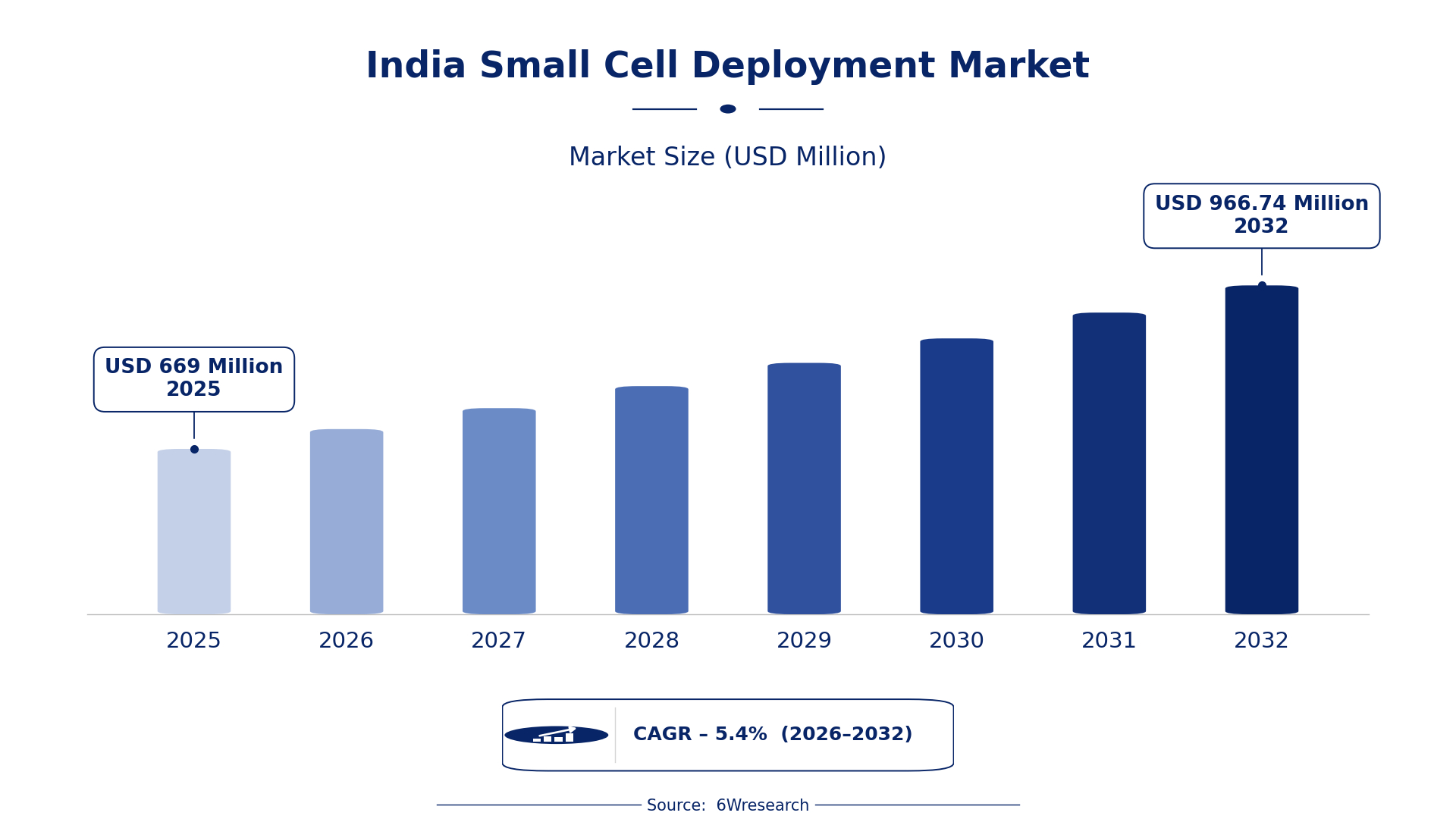
According to 6Wresearch internal database and industry insights, the India Small Cell Deployment Market was valued at USD 669.0 million in 2025 and is projected to reach USD 966.74 million by 2032, growing at a CAGR of approximately 5.4% during 2026–2032.
India Small Cell Deployment Market Highlights
| Report Metric | Details |
| Report Name | India Small Cell Deployment Market |
| Market Size 2025 | USD 669.0 million |
| Market Size 2032 | USD 966.74 million |
| Absolute Growth 2025–2032 | USD 297.74 million |
| CAGR 2026–2032 | 5.4% |
| Peak Annual Growth | 6.9% in 2031 |
| Forecast Period | 2026–2032 |
| Historical Data | 2022–2025 |
| Base Year | 2025 |
| Leading Cell Type, 2025 | Metrocells (39% share) |
| Leading Deployment Environment, 2025 | Dense Urban Area (41% share) |
| Leading Technology Supported, 2025 | 5G mmWave (36% share) |
| Leading End User, 2025 | Telecom Operators (46% share) |
| Fastest-Growing Cell Type | Picocell (8.1% CAGR) |
| Fastest-Growing Deployment Environment | Enterprises (6.9% CAGR) |
| Fastest-Growing End User | Smart City Authorities (6.4% CAGR) |
| Growing Sector | Telecommunications |
| Key End Users | Telecom Operators, Smart City Authorities, Mobile Infrastructure Firms |
India Small Cell Deployment Market Year-wise Growth Rate and Key Drivers (2022–2032)
This graph illustrates the annual growth rates of the market from 2022 to 2032, highlighting a steady upward trajectory and projected market expansion over the forecast period.
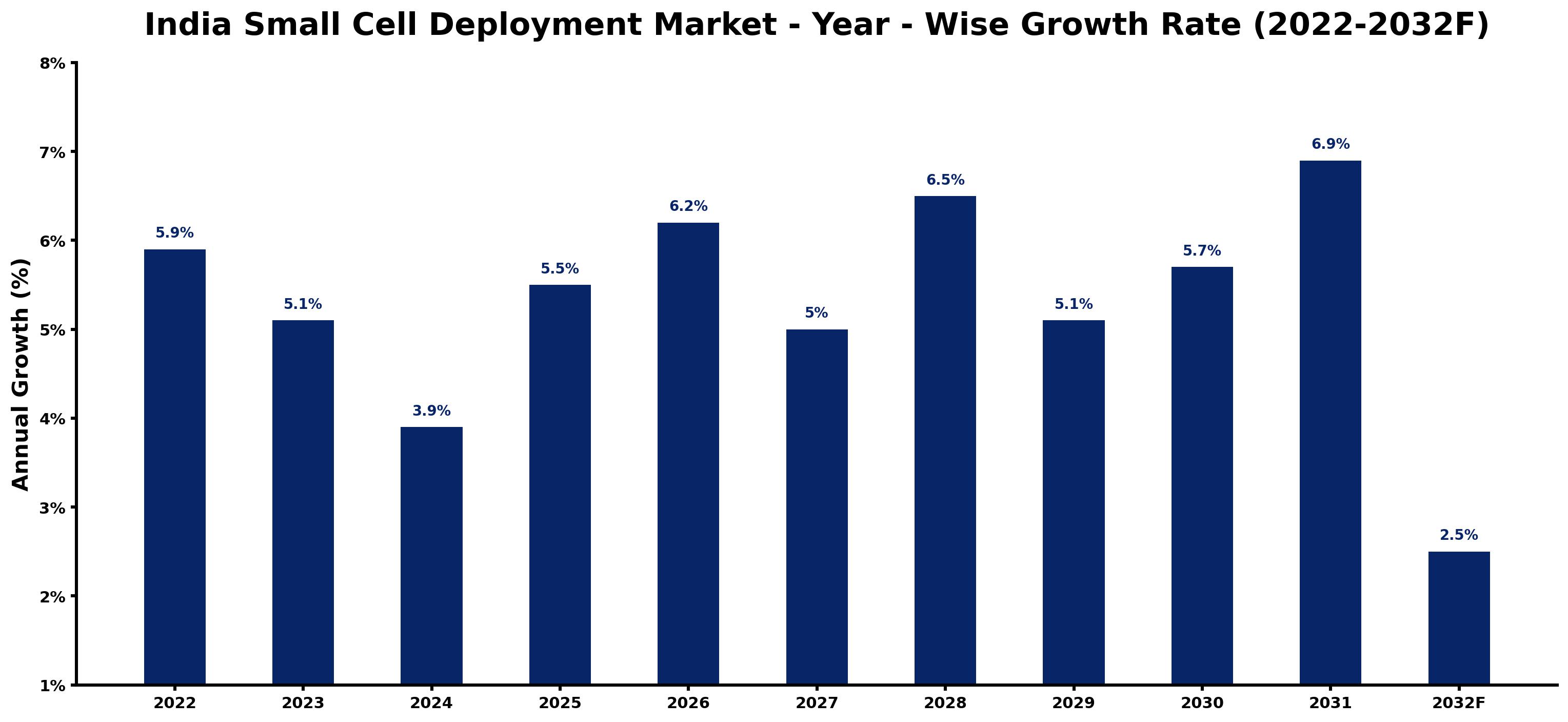
Annual growth estimates for each year appear below with the principal reason behind them, explaining the shifts that set the pace of the market.
| Year | Estimated Annual Growth (%) | Market Rationale |
| 2022 | 5.9 | The market experienced solid growth due to increased mobile data consumption driven by a subscriber base of 1.2 billion. |
| 2023 | 5.1 | Growth slowed as telecom operators adjusted to the regulatory guidelines set by the Telecom Regulatory Authority of India in 2022. |
| 2024 | 3.9 | A further slowdown occurred as demand stabilised amid ongoing urbanisation efforts, particularly in major cities. |
| 2025 | 5.5 | Demand accelerated as telecom operators ramped up small cell installations to meet user needs, aligning with the National Digital Communications Policy. |
| 2026 | 6.2 | Growth is expected to continue rising with increasing investments in 5G infrastructure and urban connectivity initiatives. |
| 2027 | 5.0 | A slight slowdown is projected as market conditions normalise after rapid expansion in urban areas. |
| 2028 | 6.5 | Demand is expected to surge again as urban areas adopt more small cells for improved connectivity and user experience. |
| 2029 | 5.1 | A slight slowdown is projected as market saturation begins to take effect in some urban regions. |
| 2030 | 5.7 | A rebound in growth is expected as new urban projects initiate small cell deployment to support high data consumption. |
| 2031 | 6.9 | The market is projected to peak as telecom operators deploy over 1 million small cells nationwide to meet rising demand. |
| 2032 | 2.5 | Growth is expected to slow as the market stabilises after reaching high deployment levels in urban centres. |
Note: Market size estimations and growth projections presented in this report are based on 6Wresearch's proprietary forecasting methodology, utilizing the latest available industry data, government publications, and primary research inputs.
India Small Cell Deployment Market Synopsis
Small Cell Deployment in India involves the installation of low-powered cellular nodes that enhance network coverage and capacity. These nodes are critical for improving mobile connectivity in densely populated urban areas. The India Small Cell Deployment Market is expanding due to a booming mobile subscriber base of 1.2 billion and rising data consumption, which averaged 14 GB per user in 2023. Initiatives like the National Digital Communications Policy aim for 1 Gbps broadband speeds by 2025, driving further demand for small cells.
Market Dynamics Impact Analysis (2026–2032)
| Factor | Type | Impact | Primary Segment Affected |
| Rising mobile data consumption drives demand for enhanced connectivity solutions. | Driver | High | Telecom Operators |
| Urbanisation creates a need for improved infrastructure in densely populated areas. | Driver | High | Dense Urban Area |
| Significant funding for digital infrastructure development presents investment opportunities. | Opportunity | High | Telecom Operators |
| The Smart Cities Mission promotes small cell deployment for urban infrastructure improvements. | Opportunity | High | Smart City Authorities |
| Regulatory guidelines may slow down deployment processes for telecom operators. | Restraint | Medium | Telecom Operators |
| High installation costs can deter smaller operators from deploying small cells. | Restraint | Medium | Mobile Infrastructure Firms |
| Limited technical expertise in small cell technology can hinder deployment efforts. | Challenge | High | Telecom Operators |
| Competition among telecom operators can lead to price wars, affecting profitability. | Challenge | Medium | Telecom Operators |
Evaluation of Drivers in India Small Cell Deployment Market (2026–2032)
Key forces behind demand, with the segment each one moves most, are listed below.
| Drivers | Primary Segment Affected | Why It Matters (Evidence) |
| Increased mobile data consumption necessitates improved network capacity. | Telecom Operators | India's average data consumption per user reached approximately 14 GB per month in 2023, prompting telecom operators to expand their networks. |
| Urbanisation drives demand for improved connectivity solutions in cities. | Dense Urban Area | As urban areas grow, the need for small cells to support high user density becomes critical. |
| Government initiatives support infrastructure development for small cell deployment. | Smart City Authorities | The Smart Cities Mission, launched in 2015, promotes funding for small cell infrastructure to improve urban connectivity. |
| 5G rollout generates demand for advanced small cell technology. | 5G mmWave | India's 5G rollout began in 2022, making small cells integral to expanding network capabilities. |
| Investment in digital infrastructure is increasing across the country. | Telecom Operators | In 2023, the Indian government allocated ₹10,000 crore for improving digital infrastructure, including small cells. |
Growth in the Small Cell Deployment market in India comes from rising mobile data consumption, urbanisation, and support for infrastructure development. In 2023, the average data consumption per user reached approximately 14 GB per month, prompting telecom operators to expand network capacity. The rollout of 5G technology initiated in 2022 has made small cells essential for improving network capabilities. Urbanisation continues to create a pressing need for enhanced connectivity solutions, particularly in densely populated areas.
Evaluation of Restraints in India Small Cell Deployment Market
The main factors holding the market back are set out below.
| Market Restraint | Primary Segment Affected | Why It Matters (Evidence) |
| Regulatory guidelines may complicate small cell installation processes. | Telecom Operators | The Telecom Regulatory Authority of India issued guidelines in 2022, which can slow down deployment timelines for telecom operators. |
| High initial investment costs deter smaller operators from entering the market. | Mobile Infrastructure Firms | The cost of deploying small cells can be prohibitive, limiting market participation among smaller firms. |
| Limited technical expertise in small cell technology can hinder deployment efforts. | Telecom Operators | A lack of skilled personnel can delay the installation and maintenance of small cell networks, affecting deployment timelines. |
| Competition among telecom operators can lead to price wars, affecting profitability. | Telecom Operators | Intense competition may force operators to lower prices, impacting their profit margins and investment in quality. |
| Market saturation in urban areas may limit growth potential. | Dense Urban Area | As more small cells are deployed, the incremental growth opportunities may diminish in already saturated markets. |
India Small Cell Deployment Market Challenges
The India Small Cell Deployment Market faces a few practical problems, and the first is technology standardisation. The Bureau of Indian Standards is still developing standards for small cell technology, which delays installation timelines for telecom operators. Intense competition among suppliers results in price wars, squeezing profit margins for producers and hindering their ability to invest in quality improvements. Buyers, particularly telecom operators, face high installation costs, which can reach ₹10,000 crore for urban connectivity enhancements. Additionally, inconsistent local policies across states create supply chain complexities, complicating deployment for operators in various regions.
Trends in the India Small Cell Deployment Market
The trends below show where the India Small Cell Deployment Market is heading.
- Shift towards 5G mmWave Technology: India's shift towards 5G mmWave technology began in 2022, with telecom operators increasingly deploying small cells to support this high-speed network. By 2023, 36% of small cell deployments were 5G mmWave, improving urban connectivity.
- Increased Focus on Urban Connectivity: The Smart Cities Mission has emphasised urban connectivity improvements since 2015, resulting in increased small cell deployments in urban areas. By 2023, 50 cities were targeted for improved connectivity through small cell infrastructure.
- Growing Demand for Indoor Coverage Solutions: The demand for indoor coverage solutions has surged, particularly in commercial spaces. In 2023, picocells accounted for a significant portion of deployments, reflecting the need for improved connectivity in offices and retail environments.
- Expansion of Public Wi-Fi Networks: The Indian government launched a scheme in 2023 to promote small cells in public Wi-Fi networks, improving digital access. This initiative aims to enhance connectivity in urban areas, focusing on underserved regions.
Investment Opportunities in the India Small Cell Deployment Market
Some of the investment opportunities in the India Small Cell Deployment Market are mentioned below.
- Investment in Urban Infrastructure: Urban areas are increasingly investing in small cell technology to improve connectivity, with a projected ₹10,000 crore allocated for digital infrastructure improvements. Local governments and smart city authorities are key buyers in this sector.
- Supply of Indoor Connectivity Solutions: With the demand for indoor coverage solutions rising, telecom operators are seeking picocells for better connectivity. The average data consumption per user reached 14 GB per month, indicating a growing need for reliable indoor services.
- Development of 5G Infrastructure: The rollout of 5G technology creates opportunities for suppliers of small cell technology. Telecom operators are expected to deploy over 1 million small cells by 2025 to meet increasing demand for high-speed connectivity.
- Collaboration with Smart City Initiatives: Smart city authorities are actively seeking partnerships for small cell deployment to improve urban infrastructure. The Smart Cities Mission promotes funding for small cell projects, creating opportunities for local firms.
Government Initiatives in the India Small Cell Deployment Market
The National Digital Communications Policy 2020 aims to improve broadband connectivity and includes provisions for small cell deployment, overseen by the Ministry of Communications. This policy sets a target for achieving 1 Gbps broadband speeds by 2025, necessitating the widespread installation of small cells to support this goal. In 2022, the Telecom Regulatory Authority of India issued guidelines for the installation of small cells in urban areas to facilitate 5G rollout, ensuring compliance with safety standards and enhancing network capacity.
The Ministry of Electronics and Information Technology launched a scheme in 2023 to promote the use of small cells in public Wi-Fi networks, improving digital access and connectivity in urban areas. This initiative aims to enhance access to broadband services, particularly in underserved regions. The Smart Cities Mission, managed by the Ministry of Housing and Urban Affairs, promotes funding for small cell infrastructure to improve urban connectivity, allocating significant resources to support small cell projects in various cities.
Future Insight of the India Small Cell Deployment Market
Several forward-looking factors should support the India Small Cell Deployment Market in the coming years. The National Digital Communications Policy aims for 1 Gbps broadband speed, driving the need for advanced small cell technology. A government investment of ₹15,000 crore in digital infrastructure will bolster connectivity initiatives. The Smart Cities Mission will further integrate small cells into urban planning, enhancing infrastructure. By 2025, telecom operators are expected to deploy over 1 million small cells, significantly improving network coverage and capacity.
Market Segmentation Analysis
The report offers a comprehensive study of the following market segments and their leading categories in the market.
By Cell Type – Metrocells Dominated, Picocell Expected to Grow Fastest
According to Dhaval Chaurasia, Assistant Manager at 6Wresearch, in 2025, Metrocells led the cell type split with a 39% share. Metrocells hold the largest share in the India Small Cell Deployment Market due to their critical role in urban areas with high user density. Their deployment is particularly important in cities like Mumbai, where the demand for enhanced mobile connectivity is significant. The quickest growth will come from Picocell, forecast to expand at a CAGR of 8.1% between 2026 and 2032. Picocells are experiencing rapid growth as they are increasingly installed in commercial spaces to improve connectivity. With the average data consumption per user reaching approximately 14 GB per month in 2023, the demand for picocells is expected to surge. Suppliers should focus on developing picocell solutions to cater to the growing demand in commercial environments.
By Deployment Environment – Dense Urban Area Dominated, Enterprises Expected to Grow Fastest
With a 41% revenue share in 2025, Dense Urban Area was the largest deployment environment category. Dense Urban Areas dominate the market share as they are essential for managing high traffic and ensuring seamless connectivity in populous cities. The government's initiative to enhance urban connectivity through small cells in 50 cities underscores the importance of this deployment environment. Enterprises are set to record the highest CAGR in this split, 6.9% over 2026–2032. Enterprises are the fastest-growing segment as businesses increasingly require enhanced communication solutions. The government's commitment to improving digital infrastructure is driving the rapid adoption of small cells within enterprises. Buyers in the enterprise sector should invest in small cell technologies to enhance their communication capabilities.
By Technology Supported – 5G mmWave Dominated and Is Expected to Record the Fastest Growth
5G mmWave accounted for a 36% market share by technology supported in 2025. 5G mmWave technology captures the largest market share as it enables high-speed data transfer essential for urban areas. This technology is vital for the ongoing rollout of 5G networks, which is a priority for the Indian telecom sector. 5G mmWave is also forecast to expand faster than any other category, at a CAGR of 7.4% over 2026–2032. 5G mmWave is also the fastest-growing technology segment, driven by the rapid expansion of 5G networks across India. With the government's commitment to achieving 1 Gbps broadband speed by 2025, the demand for this technology will continue to rise. Suppliers must prioritise the development of 5G mmWave solutions to meet the accelerating demand in the market.
By End User – Telecom Operators Dominated, Smart City Authorities Expected to Grow Fastest
The largest end user category in 2025 was Telecom Operators, with a 46% share of total revenue. Telecom Operators capture the largest market share as they are the primary users for network expansion. Their continuous investments in small cell deployment are crucial for accommodating India's expanding mobile subscriber base of 1.2 billion. Over 2026–2032, Smart City Authorities are expected to post the fastest growth, at a CAGR of 6.4%. Smart City Authorities represent the fastest-growing end user segment as they utilise small cells for urban infrastructure development. The Smart Cities Mission promotes the integration of small cells into urban planning, accelerating this segment's growth. Suppliers should engage with smart city authorities to align their offerings with urban infrastructure projects.
Key Attractiveness of the Report
- 10 Years of Market Numbers
- Historical Data Starting from 2022 to 2025
- Base Year 2025
- Forecast Data until 2032
- Key Performance Indicators Impacting the Market
- Major Upcoming Developments and Projects
Key Highlights of the Report:
- India Small Cell Deployment Market Outlook
- Market Size of India Small Cell Deployment Market, 2025
- Forecast of India Small Cell Deployment Market, 2032
- Historical Data and Forecast of India Small Cell Deployment Revenues & Volume for the Period 2022 - 2032F
- India Small Cell Deployment Market Trend Evolution
- India Small Cell Deployment Market Drivers and Challenges
- India Small Cell Deployment Price Trends
- India Small Cell Deployment Porter's Five Forces
- India Small Cell Deployment Industry Life Cycle
- Historical Data and Forecast of India Small Cell Deployment Market Revenues & Volume By Cell Type for the Period 2022 - 2032F
- Historical Data and Forecast of India Small Cell Deployment Market Revenues & Volume By Femtocell for the Period 2022 - 2032F
- Historical Data and Forecast of India Small Cell Deployment Market Revenues & Volume By Picocell for the Period 2022 - 2032F
- Historical Data and Forecast of India Small Cell Deployment Market Revenues & Volume By Microcell for the Period 2022 - 2032F
- Historical Data and Forecast of India Small Cell Deployment Market Revenues & Volume By Metrocells for the Period 2022 - 2032F
- Historical Data and Forecast of India Small Cell Deployment Market Revenues & Volume By Deployment Environment for the Period 2022 - 2032F
- Historical Data and Forecast of India Small Cell Deployment Market Revenues & Volume By Indoor (Home/Office) for the Period 2022 - 2032F
- Historical Data and Forecast of India Small Cell Deployment Market Revenues & Volume By Enterprises for the Period 2022 - 2032F
- Historical Data and Forecast of India Small Cell Deployment Market Revenues & Volume By Urban Streets for the Period 2022 - 2032F
- Historical Data and Forecast of India Small Cell Deployment Market Revenues & Volume By Dense Urban Area for the Period 2022 - 2032F
- Historical Data and Forecast of India Small Cell Deployment Market Revenues & Volume By Technology Supported for the Period 2022 - 2032F
- Historical Data and Forecast of India Small Cell Deployment Market Revenues & Volume By 4G/5G for the Period 2022 - 2032F
- Historical Data and Forecast of India Small Cell Deployment Market Revenues & Volume By LTE for the Period 2022 - 2032F
- Historical Data and Forecast of India Small Cell Deployment Market Revenues & Volume By 5G mmWave for the Period 2022 - 2032F
- Historical Data and Forecast of India Small Cell Deployment Market Revenues & Volume By Multi-band for the Period 2022 - 2032F
- Historical Data and Forecast of India Small Cell Deployment Market Revenues & Volume By End User for the Period 2022 - 2032F
- Historical Data and Forecast of India Small Cell Deployment Market Revenues & Volume By Telecom Operators for the Period 2022 - 2032F
- Historical Data and Forecast of India Small Cell Deployment Market Revenues & Volume By Commercial Real Estate for the Period 2022 - 2032F
- Historical Data and Forecast of India Small Cell Deployment Market Revenues & Volume By Smart City Authorities for the Period 2022 - 2032F
- Historical Data and Forecast of India Small Cell Deployment Market Revenues & Volume By Mobile Infrastructure Firms for the Period 2022 - 2032F
- India Small Cell Deployment Import Export Trade Statistics
- Market Opportunity Assessment By Cell Type
- Market Opportunity Assessment By Deployment Environment
- Market Opportunity Assessment By Technology Supported
- Market Opportunity Assessment By End User
- India Small Cell Deployment Top Companies Market Share
- India Small Cell Deployment Competitive Benchmarking By Technical and Operational Parameters
- India Small Cell Deployment Company Profiles
- India Small Cell Deployment Key Strategic Recommendations
Market Covered
Segments analysed in this report are listed below.
By Cell Type
- Femtocell
- Picocell
- Microcell
- Metrocells
By Deployment Environment
- Indoor (Home/Office)
- Enterprises
- Urban Streets
- Dense Urban Area
By Technology Supported
- 4G/5G
- LTE
- 5G mmWave
- Multi-band
By End User
- Telecom Operators
- Commercial Real Estate
- Smart City Authorities
- Mobile Infrastructure Firms































