China Small Cell Deployment Market Size & Growth Rate
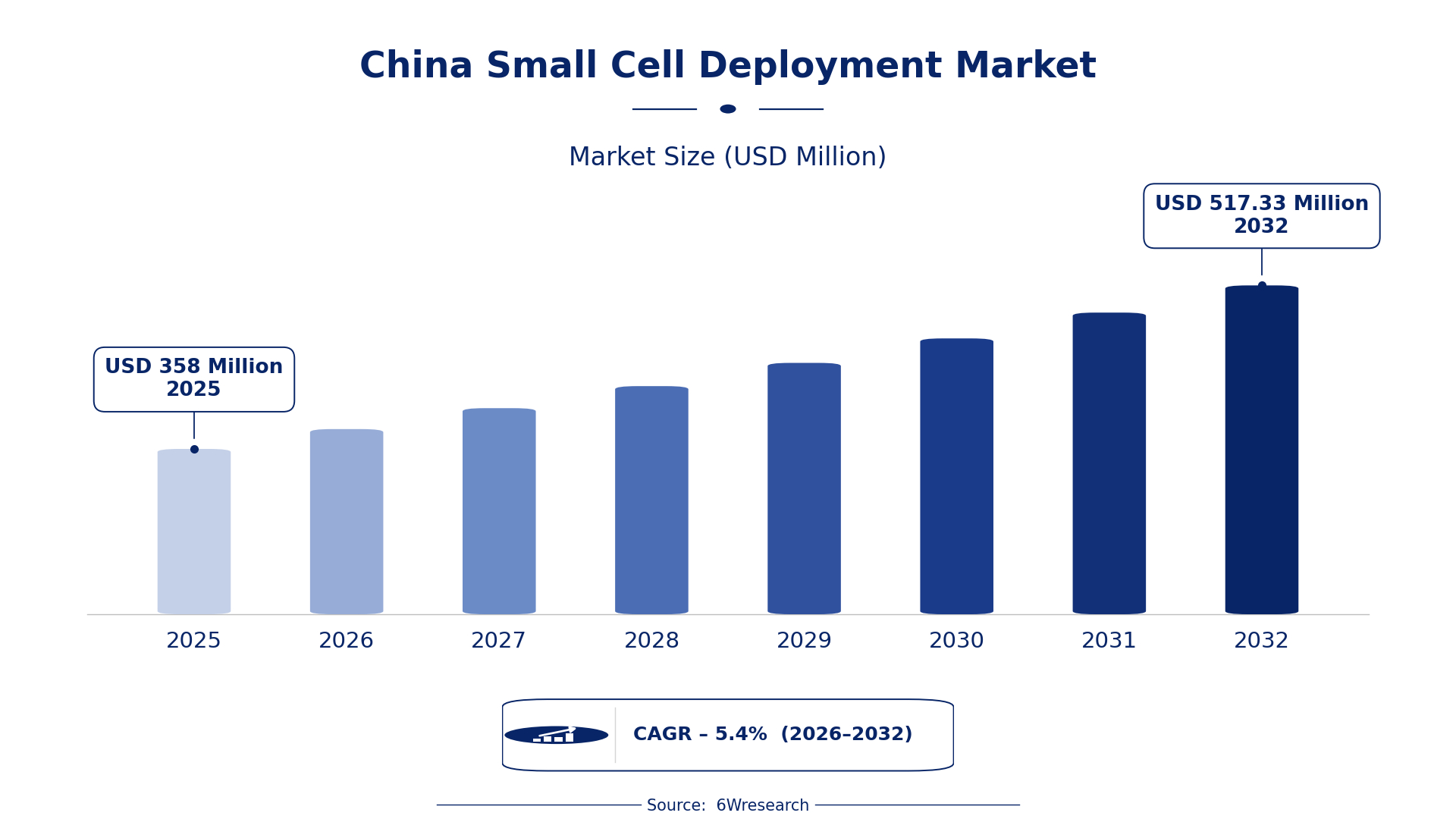
According to 6Wresearch internal database and industry insights, the China Small Cell Deployment Market was valued at USD 358.0 million in 2025 and is projected to reach USD 517.33 million by 2032, growing at a CAGR of approximately 5.4% during 2026–2032.
China Small Cell Deployment Market Highlights
| Report Metric | Details |
| Report Name | China Small Cell Deployment Market |
| Market Size 2025 | USD 358.0 million |
| Market Size 2032 | USD 517.33 million |
| Absolute Growth 2025–2032 | USD 159.33 million |
| CAGR 2026–2032 | 5.4% |
| Peak Annual Growth | 7.7% in 2028 |
| Forecast Period | 2026–2032 |
| Historical Data | 2022–2025 |
| Base Year | 2025 |
| Leading Cell Type, 2025 | Metrocells (47% share) |
| Leading Deployment Environment, 2025 | Dense Urban Area (44% share) |
| Leading Technology Supported, 2025 | 5G mmWave (40% share) |
| Leading End User, 2025 | Telecom Operators (45% share) |
| Fastest-Growing Cell Type | Microcell (7.2% CAGR) |
| Fastest-Growing Deployment Environment | Enterprises (6.9% CAGR) |
| Fastest-Growing End User | Smart City Authorities (6.7% CAGR) |
| Growing Sector | Telecommunications |
| Key End Users | Telecom Operators, Smart City Authorities, Commercial Real Estate |
China Small Cell Deployment Market Year-wise Growth Rate and Key Drivers (2022–2032)
This graph illustrates the annual growth rates of the market from 2022 to 2032, highlighting a steady upward trajectory and projected market expansion over the forecast period.
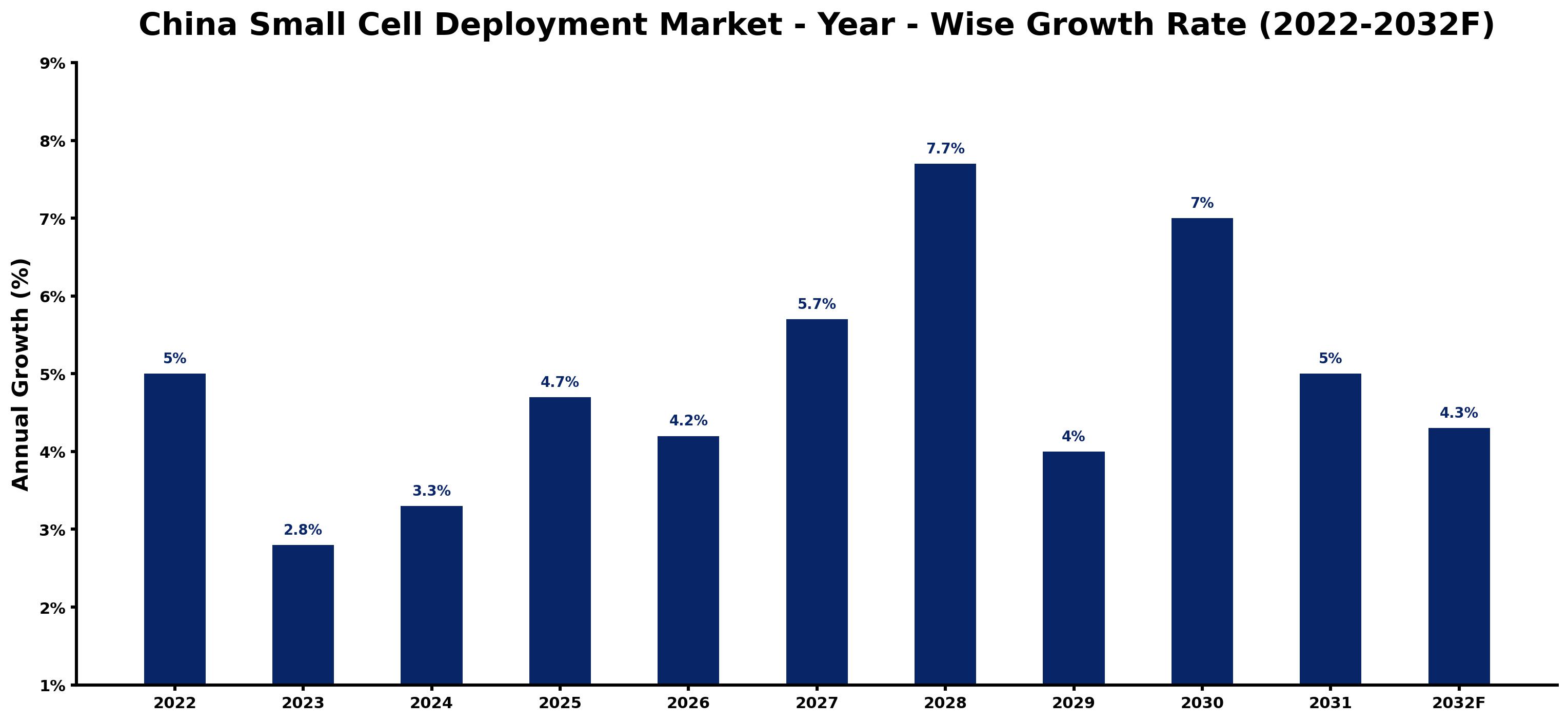
The following table presents the estimated annual growth rate for each year together with the principal factor influencing market performance.
| Year | Estimated Annual Growth (%) | Market Rationale |
| 2022 | 5.0 | The market exhibited strong demand due to urban connectivity needs. |
| 2023 | 2.8 | Growth slowed as deployment faced logistical challenges in urban areas. |
| 2024 | 3.3 | Increased investments in infrastructure led to faster growth than the previous year. |
| 2025 | 4.7 | Expansion in urban areas drove further demand for small cells. |
| 2026 | 4.2 | Growth slowed as market adjustments were observed in deployment strategies. |
| 2027 | 5.7 | Increased urban data consumption spurred demand for small cell installations. |
| 2028 | 7.7 | The market peaked due to heightened investments in 5G infrastructure. |
| 2029 | 4.0 | Growth slowed as the market began to stabilise after rapid expansion. |
| 2030 | 7.0 | Demand surged again as urban areas continued to expand connectivity. |
| 2031 | 5.0 | Growth slowed as the market adjusted to new deployment standards. |
| 2032 | 4.3 | The market stabilised with consistent demand for improved connectivity. |
Note: Market size estimations and growth projections presented in this report are based on 6Wresearch's proprietary forecasting methodology, utilizing the latest available industry data, government publications, and primary research inputs.
China Small Cell Deployment Market Synopsis
Small Cell Deployment in China involves the installation of low-powered cellular radio access nodes to improve network coverage in urban areas. These nodes are crucial for enhancing mobile connectivity, especially in densely populated regions. The Small Cell Deployment Market is expanding due to China's rapid urbanisation, with the urban population reaching 1 billion in 2023. Telecom operators are making substantial investments, exceeding $100 billion by 2025, which fuels this growth alongside initiatives like the Smart City initiative in 50 major cities. The ongoing demand for better connectivity drives further expansion in this sector.
Market Dynamics Impact Analysis (2026–2032)
| Factor | Type | Impact | Primary Segment Affected |
| Urban population growth drives demand for enhanced connectivity solutions. | Driver | High | Dense Urban Area |
| Telecom operators' investments in infrastructure support small cell deployment. | Driver | High | Telecom Operators |
| The Smart City initiative creates opportunities for urban connectivity solutions. | Opportunity | High | Smart City Authorities |
| Increasing data usage per mobile user necessitates more small cells. | Opportunity | High | Telecom Operators |
| Logistical challenges hinder rapid deployment in urban environments. | Restraint | Medium | Dense Urban Area |
| Regulatory hurdles can delay small cell installations in certain regions. | Restraint | Medium | Telecom Operators |
| Competition for spectrum allocation can limit deployment capabilities. | Challenge | High | Telecom Operators |
| Technological integration issues may slow down the adoption of new standards. | Challenge | Medium | Telecom Operators |
Evaluation of Drivers in China Small Cell Deployment Market (2026–2032)
The main growth drivers and the segments they affect most are set out below.
| Drivers | Primary Segment Affected | Why It Matters (Evidence) |
| Rising urban population increases demand for mobile connectivity. | Dense Urban Area | China's urban population reached 1 billion in 2023, necessitating more small cells. |
| Telecom operators are investing heavily in infrastructure upgrades. | Telecom Operators | Over $100 billion is planned for 5G infrastructure by 2025. |
| The Smart City initiative promotes urban connectivity solutions. | Smart City Authorities | The initiative aims to enhance mobile infrastructure in 50 major cities. |
| Increasing mobile data usage drives demand for additional capacity. | Telecom Operators | Average data usage is projected to reach 30GB/month by 2025. |
| 5G mmWave technology adoption supports high-speed data transfer. | 5G mmWave | Widespread adoption is expected in urban centers by 2026. |
In 2023, China's urban population reached 1 billion, creating an urgent need for improved mobile connectivity. Telecom operators are set to invest over $100 billion in 5G infrastructure by 2025, which will boost demand for small cells. Average mobile data usage is expected to reach 30GB per month by 2025, necessitating more small cells to handle the increased traffic.
Evaluation of Restraints in China Small Cell Deployment Market
Below mentioned are some major restraints and their influence on market dynamics.
| Market Restraint | Primary Segment Affected | Why It Matters (Evidence) |
| Logistical challenges hinder rapid deployment in urban environments. | Dense Urban Area | Deployment in densely populated areas faces significant logistical hurdles. |
| Regulatory hurdles can delay small cell installations in certain regions. | Telecom Operators | Local regulations may complicate the installation process for small cells. |
| Limited spectrum availability affects the ability to deploy new small cells. | Telecom Operators | Competition for spectrum allocation can limit deployment capabilities. |
| Compatibility challenges with existing infrastructure can slow down the adoption of new standards. | Telecom Operators | Technological integration issues may delay new deployments. |
| High costs associated with infrastructure upgrades can deter investment. | Telecom Operators | The financial burden of upgrading existing systems may limit expansion. |
China Small Cell Deployment Market Challenges
The China Small Cell Deployment Market still has to solve a few problems, starting with high deployment costs that can reach up to $100,000 per small cell, which burdens telecom operators and delays network expansion. A shortage of skilled technicians in urban areas complicates installation efforts, leading to project timelines extending by several months for producers. Rapid technological advancements require constant upgrades, overwhelming smaller firms that lack resources, resulting in missed opportunities for buyers. Regulatory hurdles from local governments can slow down approvals, causing delays in project timelines for operators aiming to deploy 600,000 5G base stations by 2025.
Trends in the China Small Cell Deployment Market
Several trends are reshaping the China Small Cell Deployment Market; the most important are set out below.
- Shift to Urban Connectivity Solutions: Beijing is increasingly incorporating small cells into urban planning to improve connectivity. The Urban Connectivity Program launched in 2023 aims to enhance mobile infrastructure in 50 cities, supporting this shift.
- Transition to 5G mmWave Technology: Since 2023, the adoption of 5G mmWave technology has accelerated in urban centres. This technology is projected to support high-speed data transfer, with an adoption rate of 40% expected by 2025.
- Telecom Operators Focusing on Smart City Initiatives: Telecom operators are prioritising investments in Smart City initiatives, which improve urban connectivity. The initiative aims to integrate small cells into urban planning across major cities.
- Increased Demand for Indoor Coverage Solutions: The demand for indoor coverage solutions has surged, particularly in commercial real estate. Femtocells and picocells are being deployed to enhance connectivity in office spaces.
Investment Opportunities in the China Small Cell Deployment Market
Several openings in the China Small Cell Deployment Market merit attention from investors.
- Supply Small Cell Technology: With urbanisation driving demand, supplying small cell technology is essential. Telecom operators are actively seeking solutions to improve connectivity in urban areas, with the market projected to reach USD 358 million by 2025.
- Invest in Smart City Projects: Now is the time to invest in Smart City projects that integrate small cells. The Urban Connectivity Program is set to improve mobile infrastructure in 50 cities, creating opportunities for suppliers.
- Focus on Indoor Connectivity Solutions: The demand for indoor connectivity solutions is rising, particularly in commercial spaces. Femtocells and picocells are essential for improving signal strength in offices and residential areas.
- Partner with Telecom Operators: Entering partnerships with telecom operators can facilitate small cell deployments. Collaborating on projects can streamline installations and improve market presence.
Government Initiatives in the China Small Cell Deployment Market
The 'National 5G Development Strategy' was approved in 2023 by the State Council, highlighting the need for small cell deployment in urban areas. This measure builds on the '5G Infrastructure Development Plan' launched in 2021, which targeted the installation of 600,000 small cells by 2025. Together, these initiatives aim to improve network coverage and capacity across China, supporting the growing demand for mobile connectivity and facilitating the expansion of 5G infrastructure.
The Ministry of Industry and Information Technology (MIIT) oversees the approval of small cell projects under the 'Telecommunications Infrastructure Development Fund', established in 2020 with a budget of $1 billion. This fund supports small cell projects, ensuring that urban areas receive the necessary infrastructure to meet connectivity demands. Additionally, the 'Urban Connectivity Program' initiated in 2023 by MIIT focuses on improving mobile infrastructure in 50 cities, further facilitating small cell deployment.
Future Insight of the China Small Cell Deployment Market
The China Small Cell Deployment Market is set for transformation by 2032, driven by the 5G Action Plan and the Urban Connectivity Program. The average data usage per mobile user in urban areas will reach 30GB/month by 2025, prompting further infrastructure investments. The establishment of the National Standard for Small Cell Technology will simplify compliance, allowing producers to deploy more efficiently. The anticipated adoption of advanced technologies will accelerate deployment rates, providing substantial benefits for buyers and suppliers in the market.
Market Segmentation Analysis
Each segment group is reviewed below, with the leader by share and the fastest grower by CAGR.
By Cell Type – Metrocells Dominated, Microcell Expected to Grow Fastest
According to Dhaval Chaurasia, Assistant Manager at 6Wresearch, in 2025, Metrocells led the cell type split with a 47% share. Metrocells capture the largest market share as they are specifically deployed in urban areas characterised by high user density. Their extensive installation, with 1.5 million small cells reported by 2023, effectively meets the demand for enhanced mobile connectivity in major cities like Beijing and Shanghai. Microcell is projected to grow fastest, at a CAGR of 7.2% during 2026–2032. Microcells are experiencing rapid growth due to their targeted application in specific scenarios where Metrocells may not be suitable. This trend is driven by the rising need for customised network solutions in densely populated urban settings. Suppliers should focus on developing Microcell solutions to meet the increasing demand for specialised applications in urban environments.
By Deployment Environment – Dense Urban Area Dominated, Enterprises Expected to Grow Fastest
Dense Urban Area took a 44% share of deployment environment in 2025, more than any other category. Dense Urban Areas dominate market share as they are essential for managing high traffic volumes in metropolitan regions. The ongoing investments in urban infrastructure highlight the critical role of small cells in enhancing mobile connectivity. Enterprises are set to record the highest CAGR in this split, 6.9% over 2026–2032. Enterprises are increasingly integrating small cell technology to ensure reliable connectivity for their operations. This trend reflects a growing necessity for dependable communication solutions in urban settings, particularly for business activities. Buyers in the enterprise sector should evaluate small cell solutions to improve operational efficiency and connectivity.
By Technology Supported – 5G mmWave Dominated and Is Expected to Record the Fastest Growth
The largest technology supported category in 2025 was 5G mmWave, with a 40% share of total revenue. 5G mmWave technology leads the market due to its capability to deliver high-speed data transfer in urban settings. As urban areas expand, the demand for this technology becomes critical for maintaining network performance. The same category is also set to grow fastest, at a CAGR of 8.1% during 2026–2032. 5G mmWave is also the fastest-growing segment, as its adoption is essential for addressing the rising data demands in urban centres. The alignment of its leadership and growth suggests a continued emphasis on improving urban connectivity. Suppliers must prioritise 5G mmWave technology to stay competitive and meet the changing demands of urban mobile networks.
By End User – Telecom Operators Dominated, Smart City Authorities Expected to Grow Fastest
Telecom Operators held a 45% share of the China Small Cell Deployment Market by end user in 2025. Telecom Operators hold the largest market share as they are the primary users of small cell technology for network expansion. Their continuous investments in infrastructure underscore the importance of small cells in enhancing service delivery. The quickest growth will come from Smart City Authorities, forecast to expand at a CAGR of 6.7% between 2026 and 2032. Smart City Authorities are rapidly adopting small cells to improve urban connectivity solutions, signalling a growing trend towards smart city initiatives. This adoption is expected to accelerate as cities strive to enhance their digital infrastructure. Suppliers should engage with Smart City Authorities to align their offerings with the rising demand for urban connectivity solutions.
Key Attractiveness of the Report
- 10 Years of Market Numbers
- Historical Data Starting from 2022 to 2025
- Base Year 2025
- Forecast Data until 2032
- Key Performance Indicators Impacting the Market
- Major Upcoming Developments and Projects
Key Highlights of the Report:
- China Small Cell Deployment Market Outlook
- Market Size of China Small Cell Deployment Market, 2025
- Forecast of China Small Cell Deployment Market, 2032
- Historical Data and Forecast of China Small Cell Deployment Revenues & Volume for the Period 2022 - 2032F
- China Small Cell Deployment Market Trend Evolution
- China Small Cell Deployment Market Drivers and Challenges
- China Small Cell Deployment Price Trends
- China Small Cell Deployment Porter's Five Forces
- China Small Cell Deployment Industry Life Cycle
- Historical Data and Forecast of China Small Cell Deployment Market Revenues & Volume By Cell Type for the Period 2022 - 2032F
- Historical Data and Forecast of China Small Cell Deployment Market Revenues & Volume By Femtocell for the Period 2022 - 2032F
- Historical Data and Forecast of China Small Cell Deployment Market Revenues & Volume By Picocell for the Period 2022 - 2032F
- Historical Data and Forecast of China Small Cell Deployment Market Revenues & Volume By Microcell for the Period 2022 - 2032F
- Historical Data and Forecast of China Small Cell Deployment Market Revenues & Volume By Metrocells for the Period 2022 - 2032F
- Historical Data and Forecast of China Small Cell Deployment Market Revenues & Volume By Deployment Environment for the Period 2022 - 2032F
- Historical Data and Forecast of China Small Cell Deployment Market Revenues & Volume By Indoor (Home/Office) for the Period 2022 - 2032F
- Historical Data and Forecast of China Small Cell Deployment Market Revenues & Volume By Enterprises for the Period 2022 - 2032F
- Historical Data and Forecast of China Small Cell Deployment Market Revenues & Volume By Urban Streets for the Period 2022 - 2032F
- Historical Data and Forecast of China Small Cell Deployment Market Revenues & Volume By Dense Urban Area for the Period 2022 - 2032F
- Historical Data and Forecast of China Small Cell Deployment Market Revenues & Volume By Technology Supported for the Period 2022 - 2032F
- Historical Data and Forecast of China Small Cell Deployment Market Revenues & Volume By 4G/5G for the Period 2022 - 2032F
- Historical Data and Forecast of China Small Cell Deployment Market Revenues & Volume By LTE for the Period 2022 - 2032F
- Historical Data and Forecast of China Small Cell Deployment Market Revenues & Volume By 5G mmWave for the Period 2022 - 2032F
- Historical Data and Forecast of China Small Cell Deployment Market Revenues & Volume By Multi-band for the Period 2022 - 2032F
- Historical Data and Forecast of China Small Cell Deployment Market Revenues & Volume By End User for the Period 2022 - 2032F
- Historical Data and Forecast of China Small Cell Deployment Market Revenues & Volume By Telecom Operators for the Period 2022 - 2032F
- Historical Data and Forecast of China Small Cell Deployment Market Revenues & Volume By Commercial Real Estate for the Period 2022 - 2032F
- Historical Data and Forecast of China Small Cell Deployment Market Revenues & Volume By Smart City Authorities for the Period 2022 - 2032F
- Historical Data and Forecast of China Small Cell Deployment Market Revenues & Volume By Mobile Infrastructure Firms for the Period 2022 - 2032F
- China Small Cell Deployment Import Export Trade Statistics
- Market Opportunity Assessment By Cell Type
- Market Opportunity Assessment By Deployment Environment
- Market Opportunity Assessment By Technology Supported
- Market Opportunity Assessment By End User
- China Small Cell Deployment Top Companies Market Share
- China Small Cell Deployment Competitive Benchmarking By Technical and Operational Parameters
- China Small Cell Deployment Company Profiles
- China Small Cell Deployment Key Strategic Recommendations
Market Covered
The report offers an extensive study of the following market segments.
By Cell Type
- Femtocell
- Picocell
- Microcell
- Metrocells
By Deployment Environment
- Indoor (Home/Office)
- Enterprises
- Urban Streets
- Dense Urban Area
By Technology Supported
- 4G/5G
- LTE
- 5G mmWave
- Multi-band
By End User
- Telecom Operators
- Commercial Real Estate
- Smart City Authorities
- Mobile Infrastructure Firms































