India Smart Agriculture Monitoring Market Size & Growth Rate
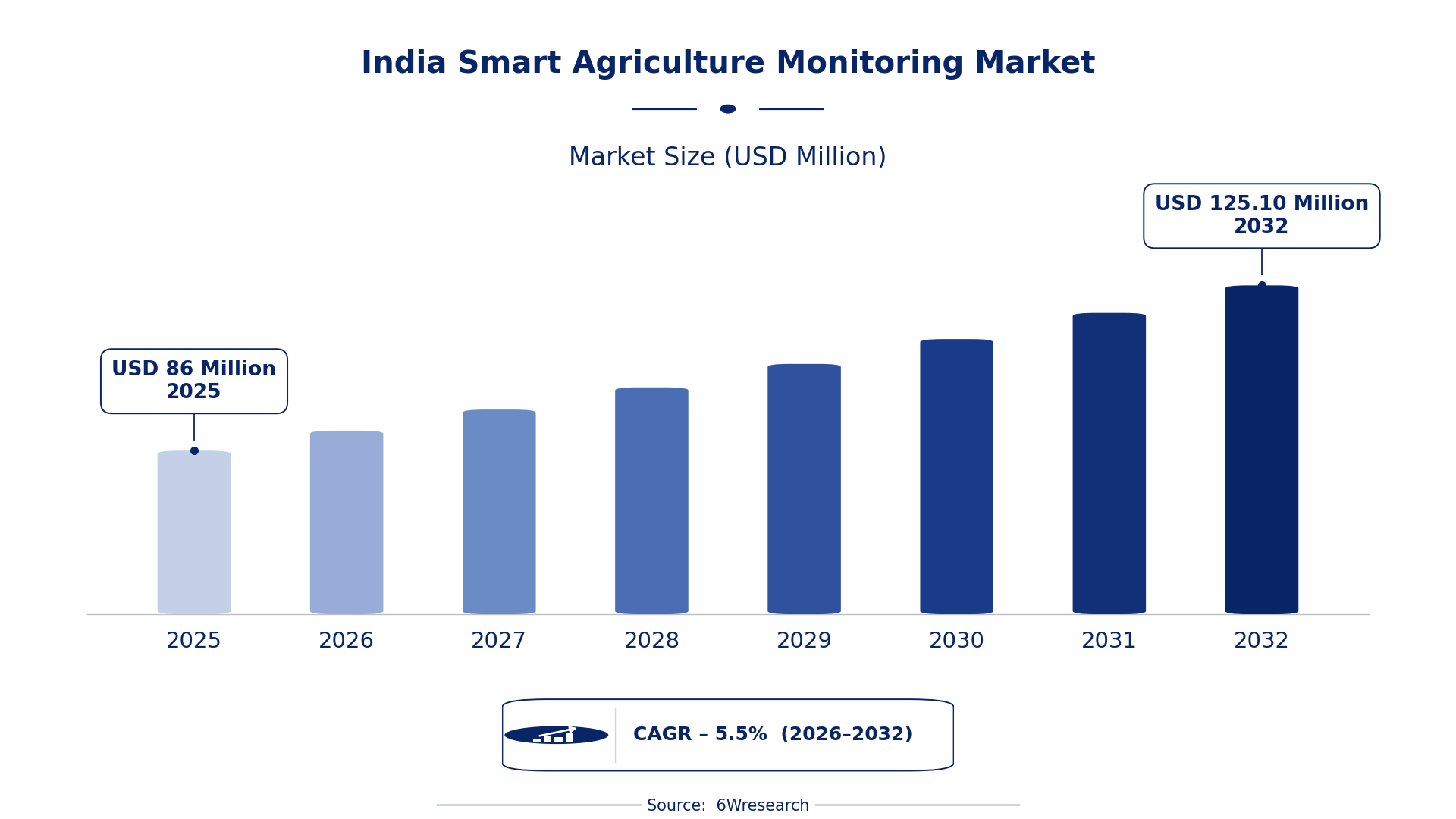
According to 6Wresearch internal database and industry insights, the India Smart Agriculture Monitoring Market was valued at USD 86.0 million in 2025 and is projected to reach USD 125.10 million by 2032, growing at a CAGR of approximately 5.5% during 2026–2032.
India Smart Agriculture Monitoring Market Highlights
| Report Metric | Details |
| Report Name | India Smart Agriculture Monitoring Market |
| Market Size 2025 | USD 86.0 million |
| Market Size 2032 | USD 125.10 million |
| Absolute Growth 2025–2032 | USD 39.10 million |
| CAGR 2026–2032 | 5.5% |
| Peak Annual Growth | 7.6% in 2031 |
| Forecast Period | 2026–2032 |
| Historical Data | 2022–2025 |
| Base Year | 2025 |
| Leading Monitoring Type, 2025 | Crop Growth Monitoring (43% share) |
| Leading Sensing Technology, 2025 | Moisture/PH Sensors (41% share) |
| Leading Coverage Area, 2025 | Large Fields (51% share) |
| Leading End User, 2025 | Smart Farm Operators (54% share) |
| Fastest-Growing Monitoring Type | Soil Health Monitoring (7.1% CAGR) |
| Fastest-Growing Sensing Technology | IoT + Micro Stations (7.7% CAGR) |
| Fastest-Growing Coverage Area | Per-Plot (6.9% CAGR) |
| Fastest-Growing End User | AgTech Companies (7.5% CAGR) |
| Growing Sector | AgTech Companies |
| Key End Users | Smart Farm Operators, AgTech Companies, Precision Agri Suppliers, Dairy & Livestock Farms |
India Smart Agriculture Monitoring Market Year-wise Growth Rate and Key Drivers (2022–2032)
This graph illustrates the annual growth rates of the market from 2022 to 2032, highlighting a steady upward trajectory and projected market expansion over the forecast period.
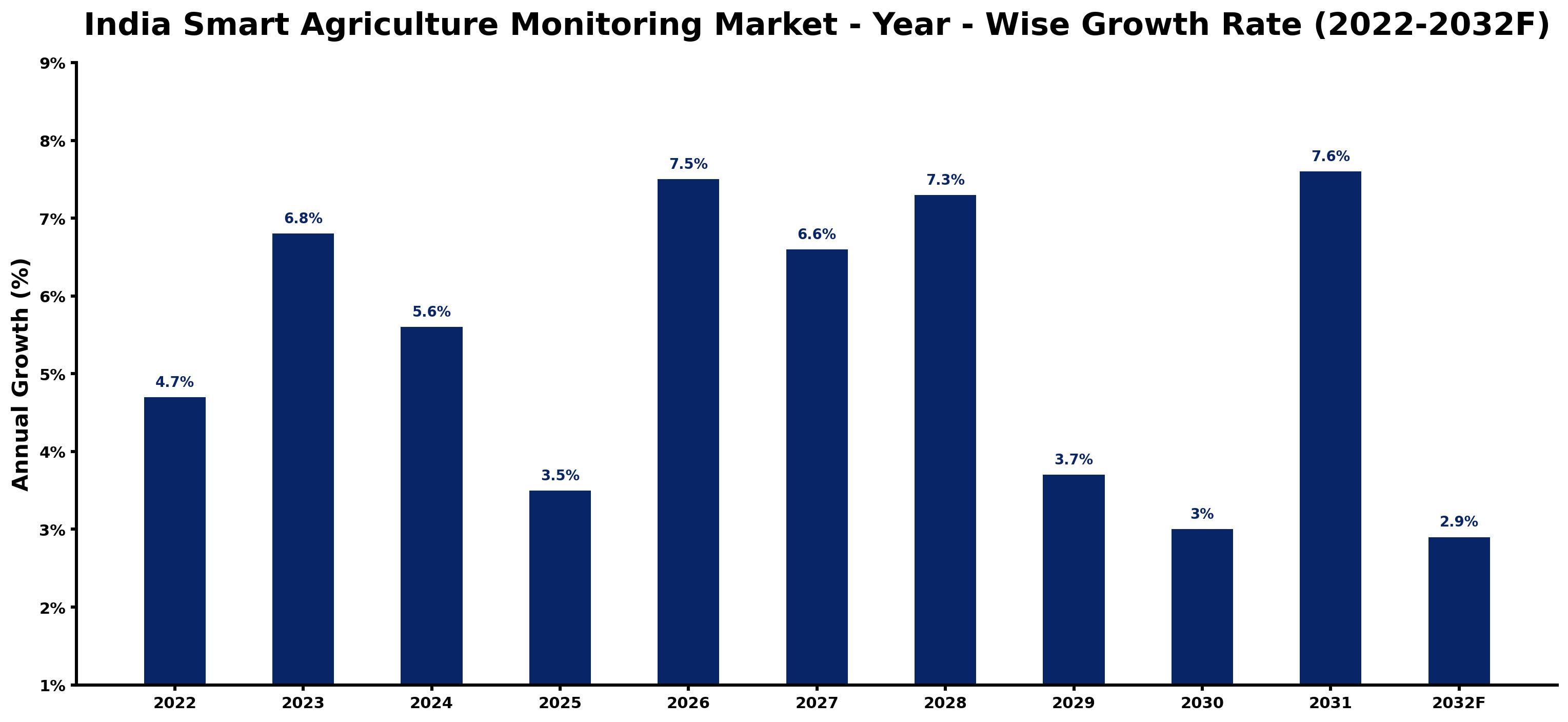
Year by year, the estimates below pair each growth rate with the development that shaped it.
| Year | Estimated Annual Growth (%) | Market Rationale |
| 2022 | 4.7 | The market showed steady growth due to increasing adoption of smart farming technologies. |
| 2023 | 6.8 | Growth accelerated as farmers sought efficient solutions amid rising agricultural demands. |
| 2024 | 5.6 | The market experienced a slowdown as investment levels adjusted to market conditions. |
| 2025 | 3.5 | Growth continued to slow as market saturation began to affect new investments. |
| 2026 | 7.5 | A resurgence in growth occurred as innovative technologies gained traction among farmers. |
| 2027 | 6.6 | Growth slowed again as the market matured and competition intensified. |
| 2028 | 7.3 | The market rebounded with faster growth driven by technological advancements. |
| 2029 | 3.7 | Growth slowed as the market faced challenges in scaling new technologies. |
| 2030 | 3.0 | The market continued to slow as adoption rates stabilised across sectors. |
| 2031 | 7.6 | Growth peaked as demand surged for advanced monitoring solutions in agriculture. |
| 2032 | 2.9 | The market growth rate slowed as it reached a more stable phase. |
Note: Market size estimations and growth projections presented in this report are based on 6Wresearch's proprietary forecasting methodology, utilizing the latest available industry data, government publications, and primary research inputs.
India Smart Agriculture Monitoring Market Synopsis
Smart Agriculture Monitoring in India involves advanced technologies that boost agricultural productivity through real-time data collection and analysis. This includes IoT devices, sensors, and drones that track various agricultural parameters. The India Smart Agriculture Monitoring Market is growing due to increasing demand from domestic users and AgTech companies that support farmers. Substantial investments in technology adoption and initiatives like the Digital India programme are propelling this growth. The agricultural sector, contributing around 17-18% to the GDP, continues to thrive with over 60% of the population engaged in agriculture.
Market Dynamics Impact Analysis (2026–2032)
| Factor | Type | Impact | Primary Segment Affected |
| Increasing investment in IoT technologies for agriculture | Driver | High | IoT + Micro Stations |
| Growing demand for sustainable farming practices | Driver | High | Soil Health Monitoring |
| Expansion of agricultural land and farming areas | Opportunity | High | Large Fields |
| Rising interest in precision agriculture among farmers | Opportunity | High | Smart Farm Operators |
| Limited awareness of smart agriculture solutions | Restraint | Medium | Crop Growth Monitoring |
| High initial investment costs for technology adoption | Restraint | Medium | Moisture/PH Sensors |
| Challenges in integrating new technologies with traditional practices | Challenge | High | Weather Monitoring |
| Insufficient infrastructure for widespread technology deployment | Challenge | High | Livestock Monitoring |
Evaluation of Drivers in India Smart Agriculture Monitoring Market (2026–2032)
The factors lifting demand, and the evidence behind each, are summarised below.
| Drivers | Primary Segment Affected | Why It Matters (Evidence) |
| Rising investment in IoT technologies | Soil Health Monitoring | This investment enhances the capacity for real-time data collection, enabling farmers to monitor soil quality effectively. |
| Increasing demand for sustainable farming practices | Crop Growth Monitoring | Farmers are purchasing more monitoring solutions to track plant health and improve yields sustainably. |
| Expansion of agricultural land | Large Fields | The growth in arable land necessitates advanced monitoring technologies to manage extensive agricultural areas. |
| Growing interest in precision agriculture | Smart Farm Operators | Smart farm operators are adopting advanced solutions to optimise resource use and enhance productivity. |
| Supportive government initiatives | Crop Growth Monitoring | These initiatives encourage technology integration in farming, facilitating the adoption of smart agriculture monitoring solutions. |
Growth in the Smart Agriculture Monitoring market in India is rooted in rising investment in IoT technologies, enhancing the capacity for real-time data collection. The agricultural sector contributes about 17-18% to the GDP, with more than 60% of the population involved in farming. The push for sustainable farming practices drives the demand for soil health monitoring solutions. Expansion of agricultural land increases the need for large field monitoring technologies, while the growing interest in precision agriculture encourages smart farm operators to adopt advanced solutions.
Evaluation of Restraints in India Smart Agriculture Monitoring Market
The following restraints limit how fast demand can grow.
| Market Restraint | Primary Segment Affected | Why It Matters (Evidence) |
| Limited awareness of smart agriculture solutions | Crop Growth Monitoring | Many farmers remain unaware of the benefits of smart agriculture, hindering adoption rates. |
| High initial investment costs for technology adoption | Moisture/PH Sensors | The upfront costs deter smaller farmers from investing in smart agriculture technologies. |
| Challenges in integrating new technologies with traditional practices | Weather Monitoring | Farmers face difficulties adapting to new technologies, resulting in slower adoption rates. |
| Insufficient infrastructure for widespread technology deployment | Livestock Monitoring | Lack of adequate infrastructure limits the effective implementation of monitoring solutions. |
| Regulatory hurdles in technology deployment | Soil Health Monitoring | Complex regulations can delay the introduction of new agricultural technologies. |
India Smart Agriculture Monitoring Market Challenges
The India Smart Agriculture Monitoring market still has to solve a few problems, starting with technology adoption. Many farmers lack access to advanced IoT devices and sensors, which delays productivity improvements and limits their ability to monitor soil health effectively. Regulatory hurdles complicate the implementation of initiatives like the Soil Health Card Scheme, creating confusion for farmers and hindering their ability to optimise resource use. High costs associated with smart agriculture technologies deter smallholder farmers, who represent over 60% of the agricultural workforce, from investing in these solutions. Competition from traditional farming methods makes it difficult for suppliers of smart agriculture technologies to penetrate the market, resulting in slower growth for these solutions.
Trends in the India Smart Agriculture Monitoring Market
The trends below show where the India Smart Agriculture Monitoring Market is heading.
- Start of Increased IoT Adoption: The adoption of IoT devices in agriculture is on the rise, with an expected growth of 7.7% for IoT + Micro Stations by 2032. This trend allows farmers to optimise resource use and improve yields.
- Transition to Precision Agriculture: Farmers are increasingly shifting towards precision agriculture, driven by the need for efficiency. The AgTech Companies segment is expected to grow at a CAGR of 7.5% through 2032, reflecting this trend.
- Emergence of Smart Farm Operators: Smart Farm Operators are becoming the leading end-users in the market, holding a 54% share in 2025. Their demand for advanced monitoring solutions is reshaping agricultural practices.
- Growth in Soil Health Monitoring: Soil Health Monitoring is gaining traction as farmers focus on sustainable practices. The Soil Health Monitoring segment is projected to grow at a CAGR of 7.1% from 2026 to 2032.
Investment Opportunities in the India Smart Agriculture Monitoring Market
Several openings in the India Smart Agriculture Monitoring Market merit attention from investors.
- Investment in Large Fields: With over 140 million hectares of arable land, there is an opportunity to provide monitoring solutions for large fields. This market gap offers a chance for precision agri suppliers to enter the sector.
- Supply of Moisture/PH Sensors: The market for Moisture/PH Sensors is expanding, with a projected share of 41% in 2025. Suppliers can capitalise on this demand by offering advanced sensor technologies.
- Focus on Smart Farm Operators: Smart Farm Operators represent a growing buyer group, with a 54% market share. Suppliers can engage with this segment by providing tailored solutions that boost productivity.
- Alignment with Government Initiatives: The Digital India initiative promotes technology adoption in agriculture, creating a supportive environment for investment. This presents an opportunity for suppliers to align with government programmes.
Government Initiatives in the India Smart Agriculture Monitoring Market
The Ministry of Agriculture oversees various schemes that support agricultural development. The National Livestock Mission, in place since 2014, focuses on livestock development, funding projects that enhance productivity and health management. The Digital India initiative encourages the use of technology in agriculture, allowing farmers to access digital solutions that improve productivity. Additionally, the Ministry of Electronics and Information Technology supports the integration of digital tools in farming, ensuring that farmers can effectively utilise technology.
Farmers benefit from the Soil Health Card Scheme, which provides assessments and recommendations for sustainable farming practices. The National Agriculture Market (eNAM) aims to unify agricultural markets across states, enhancing farmer income. These initiatives collectively promote the adoption of smart agriculture monitoring technologies, enabling farmers to optimise resource use and improve yields.
Future Insight of the India Smart Agriculture Monitoring Market
The India Smart Agriculture Monitoring market will experience notable changes by 2032, driven by several key factors. The Digital India initiative will continue to promote technology adoption, enabling farmers to use data for better decision-making. The National Mission for Sustainable Agriculture will encourage climate-resilient practices, increasing the appeal of smart monitoring solutions. By 2025, the agricultural machinery market is projected to reach significant levels, further integrating smart technologies into farming operations. These advancements will ultimately support farmers in increasing yields and improving sustainability.
Market Segmentation Analysis
The report offers a comprehensive study of the following market segments and their leading categories in the market.
By Monitoring Type – Crop Growth Monitoring Dominated, Soil Health Monitoring Expected to Grow Fastest
According to Dhaval Chaurasia, Assistant Manager at 6Wresearch, the largest monitoring type category in 2025 was Crop Growth Monitoring, with a 43% share of total revenue. Crop Growth Monitoring holds the largest share as it is vital for assessing plant health and growth stages, directly impacting yield. For instance, farmers rely on this monitoring to optimise their crop management practices, especially in regions with extensive agricultural activities. Soil Health Monitoring is set to record the highest CAGR in this split, 7.1% over 2026–2032. Soil Health Monitoring is experiencing rapid growth due to increasing awareness of soil quality's impact on productivity, with initiatives like the Soil Health Card Scheme promoting its importance. This focus on soil health is expected to drive further adoption among farmers seeking sustainable practices. Suppliers should prioritise developing advanced soil health monitoring solutions to meet the growing demand from farmers.
By Sensing Technology – Moisture/PH Sensors Dominated, IoT + Micro Stations Expected to Grow Fastest
In 2025, Moisture/PH Sensors led the sensing technology split with a 41% share. Moisture/PH Sensors command the largest share due to their essential role in measuring soil moisture and pH levels, which are crucial for maintaining crop health. Their widespread use among farmers across various agricultural regions in India underscores their importance in optimising growing conditions. Over 2026–2032, IoT + Micro Stations are expected to post the fastest growth, at a CAGR of 7.7%. IoT + Micro Stations are witnessing the fastest growth as they enable real-time data collection, a necessity for farmers aiming for precision agriculture. This trend will likely accelerate as technology integration in farming practices becomes more prevalent. Suppliers should focus on enhancing IoT + Micro Stations to support farmers in making informed, data-driven decisions.
By Coverage Area – Large Fields Dominated, Per-Plot Expected to Grow Fastest
Large Fields held a 51% share of the India Smart Agriculture Monitoring Market by coverage area in 2025. Large Fields hold a significant market share as they are vital for managing extensive agricultural areas, particularly in a country with abundant arable land like India. Farmers operating large plots benefit from comprehensive monitoring solutions that efficiently oversee their entire fields. The quickest growth will come from Per-Plot, forecast to expand at a CAGR of 6.9% between 2026 and 2032. Per-Plot monitoring is growing rapidly, allowing for customised monitoring that enhances precision, especially for farmers cultivating high-value crops. This trend indicates a shift towards more tailored agricultural practices among producers. Suppliers must develop solutions that cater to the specific needs of per-plot monitoring to capitalise on this expanding market.
By End User – Smart Farm Operators Dominated, AgTech Companies Expected to Grow Fastest
Smart Farm Operators accounted for a 54% market share by end user in 2025. Smart Farm Operators account for the largest share as they are the primary users of smart agriculture technologies, driving demand for advanced monitoring solutions. Their proactive adoption of these technologies positions them as key players in the agricultural sector. AgTech Companies are projected to grow fastest, at a CAGR of 7.5% during 2026–2032. AgTech Companies are the fastest-growing segment as they deliver essential technologies and solutions that empower farmers to optimise their operations. This growth highlights the increasing synergy between technology providers and agricultural stakeholders. Suppliers should seek partnerships with AgTech Companies to expand their market reach and enhance their service offerings.
Key Attractiveness of the Report
- 10 Years of Market Numbers
- Historical Data Starting from 2022 to 2025
- Base Year 2025
- Forecast Data until 2032
- Key Performance Indicators Impacting the Market
- Major Upcoming Developments and Projects
Key Highlights of the Report:
- India Smart Agriculture Monitoring Market Outlook
- Market Size of India Smart Agriculture Monitoring Market, 2025
- Forecast of India Smart Agriculture Monitoring Market, 2032
- Historical Data and Forecast of India Smart Agriculture Monitoring Revenues & Volume for the Period 2022 - 2032F
- India Smart Agriculture Monitoring Market Trend Evolution
- India Smart Agriculture Monitoring Market Drivers and Challenges
- India Smart Agriculture Monitoring Price Trends
- India Smart Agriculture Monitoring Porter's Five Forces
- India Smart Agriculture Monitoring Industry Life Cycle
- Historical Data and Forecast of India Smart Agriculture Monitoring Market Revenues & Volume By Monitoring Type for the Period 2022 - 2032F
- Historical Data and Forecast of India Smart Agriculture Monitoring Market Revenues & Volume By Soil Health Monitoring for the Period 2022 - 2032F
- Historical Data and Forecast of India Smart Agriculture Monitoring Market Revenues & Volume By Crop Growth Monitoring for the Period 2022 - 2032F
- Historical Data and Forecast of India Smart Agriculture Monitoring Market Revenues & Volume By Weather Monitoring for the Period 2022 - 2032F
- Historical Data and Forecast of India Smart Agriculture Monitoring Market Revenues & Volume By Livestock Monitoring for the Period 2022 - 2032F
- Historical Data and Forecast of India Smart Agriculture Monitoring Market Revenues & Volume By Sensing Technology for the Period 2022 - 2032F
- Historical Data and Forecast of India Smart Agriculture Monitoring Market Revenues & Volume By Moisture/PH Sensors for the Period 2022 - 2032F
- Historical Data and Forecast of India Smart Agriculture Monitoring Market Revenues & Volume By Vision + Drones for the Period 2022 - 2032F
- Historical Data and Forecast of India Smart Agriculture Monitoring Market Revenues & Volume By IoT + Micro Stations for the Period 2022 - 2032F
- Historical Data and Forecast of India Smart Agriculture Monitoring Market Revenues & Volume By Wearable Sensors for the Period 2022 - 2032F
- Historical Data and Forecast of India Smart Agriculture Monitoring Market Revenues & Volume By Coverage Area for the Period 2022 - 2032F
- Historical Data and Forecast of India Smart Agriculture Monitoring Market Revenues & Volume By Per-Plot for the Period 2022 - 2032F
- Historical Data and Forecast of India Smart Agriculture Monitoring Market Revenues & Volume By Large Fields for the Period 2022 - 2032F
- Historical Data and Forecast of India Smart Agriculture Monitoring Market Revenues & Volume By Real-Time for the Period 2022 - 2032F
- Historical Data and Forecast of India Smart Agriculture Monitoring Market Revenues & Volume By Per Animal for the Period 2022 - 2032F
- Historical Data and Forecast of India Smart Agriculture Monitoring Market Revenues & Volume By End User for the Period 2022 - 2032F
- Historical Data and Forecast of India Smart Agriculture Monitoring Market Revenues & Volume By Smart Farm Operators for the Period 2022 - 2032F
- Historical Data and Forecast of India Smart Agriculture Monitoring Market Revenues & Volume By AgTech Companies for the Period 2022 - 2032F
- Historical Data and Forecast of India Smart Agriculture Monitoring Market Revenues & Volume By Precision Agri Suppliers for the Period 2022 - 2032F
- Historical Data and Forecast of India Smart Agriculture Monitoring Market Revenues & Volume By Dairy & Livestock Farms for the Period 2022 - 2032F
- India Smart Agriculture Monitoring Import Export Trade Statistics
- Market Opportunity Assessment By Monitoring Type
- Market Opportunity Assessment By Sensing Technology
- Market Opportunity Assessment By Coverage Area
- Market Opportunity Assessment By End User
- India Smart Agriculture Monitoring Top Companies Market Share
- India Smart Agriculture Monitoring Competitive Benchmarking By Technical and Operational Parameters
- India Smart Agriculture Monitoring Company Profiles
- India Smart Agriculture Monitoring Key Strategic Recommendations
Market Covered
This report examines the market across the segments below.
By Monitoring Type
- Soil Health Monitoring
- Crop Growth Monitoring
- Weather Monitoring
- Livestock Monitoring
By Sensing Technology
- Moisture/PH Sensors
- Vision + Drones
- IoT + Micro Stations
- Wearable Sensors
By Coverage Area
- Per-Plot
- Large Fields
- Real-Time
- Per Animal
By End User
- Smart Farm Operators
- AgTech Companies
- Precision Agri Suppliers
- Dairy & Livestock Farms































