China Smart Agriculture Monitoring Market Size & Growth Rate
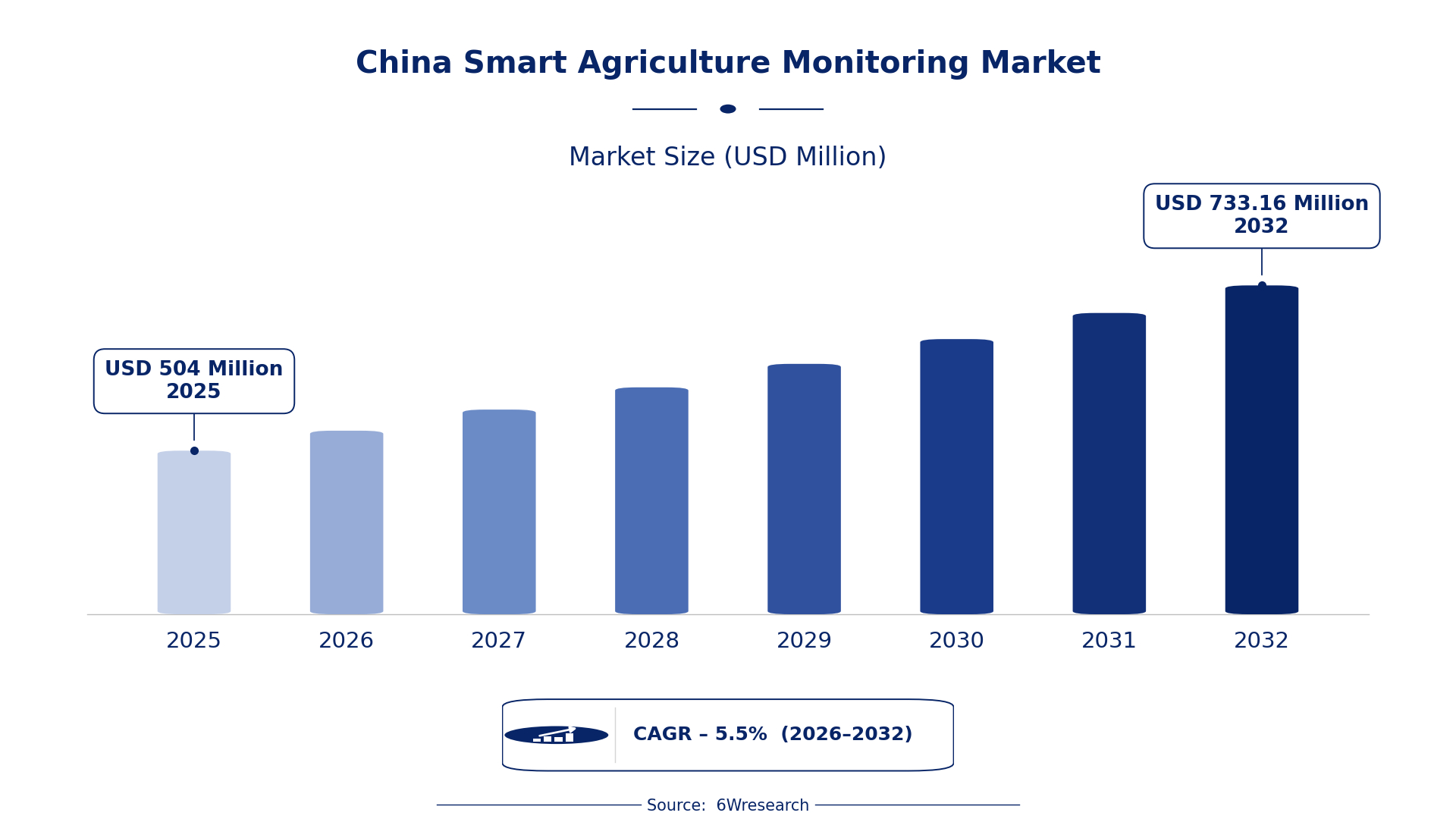
According to 6Wresearch internal database and industry insights, the China Smart Agriculture Monitoring Market was valued at USD 504.0 million in 2025 and is projected to reach USD 733.16 million by 2032, growing at a CAGR of approximately 5.5% during 2026–2032.
China Smart Agriculture Monitoring Market Highlights
| Report Metric | Details |
| Report Name | China Smart Agriculture Monitoring Market |
| Market Size 2025 | USD 504.0 million |
| Market Size 2032 | USD 733.16 million |
| Absolute Growth 2025–2032 | USD 229.16 million |
| CAGR 2026–2032 | 5.5% |
| Peak Annual Growth | 8.0% in 2028 |
| Forecast Period | 2026–2032 |
| Historical Data | 2022–2025 |
| Base Year | 2025 |
| Leading Monitoring Type, 2025 | Crop Growth Monitoring (43% share) |
| Leading Sensing Technology, 2025 | Moisture/PH Sensors (45% share) |
| Leading Coverage Area, 2025 | Large Fields (43% share) |
| Leading End User, 2025 | Smart Farm Operators (41% share) |
| Fastest-Growing Monitoring Type | Soil Health Monitoring (6.7% CAGR) |
| Fastest-Growing Sensing Technology | IoT + Micro Stations (7.4% CAGR) |
| Fastest-Growing Coverage Area | Per-Plot (7.4% CAGR) |
| Fastest-Growing End User | Precision Agri Suppliers (8.2% CAGR) |
| Growing Sector | Agricultural Technology |
| Key End Users | Smart Farm Operators, AgTech Companies, Precision Agri Suppliers, Dairy & Livestock Farms |
China Smart Agriculture Monitoring Market Year-wise Growth Rate and Key Drivers (2022–2032)
This graph illustrates the annual growth rates of the market from 2022 to 2032, highlighting a steady upward trajectory and projected market expansion over the forecast period.
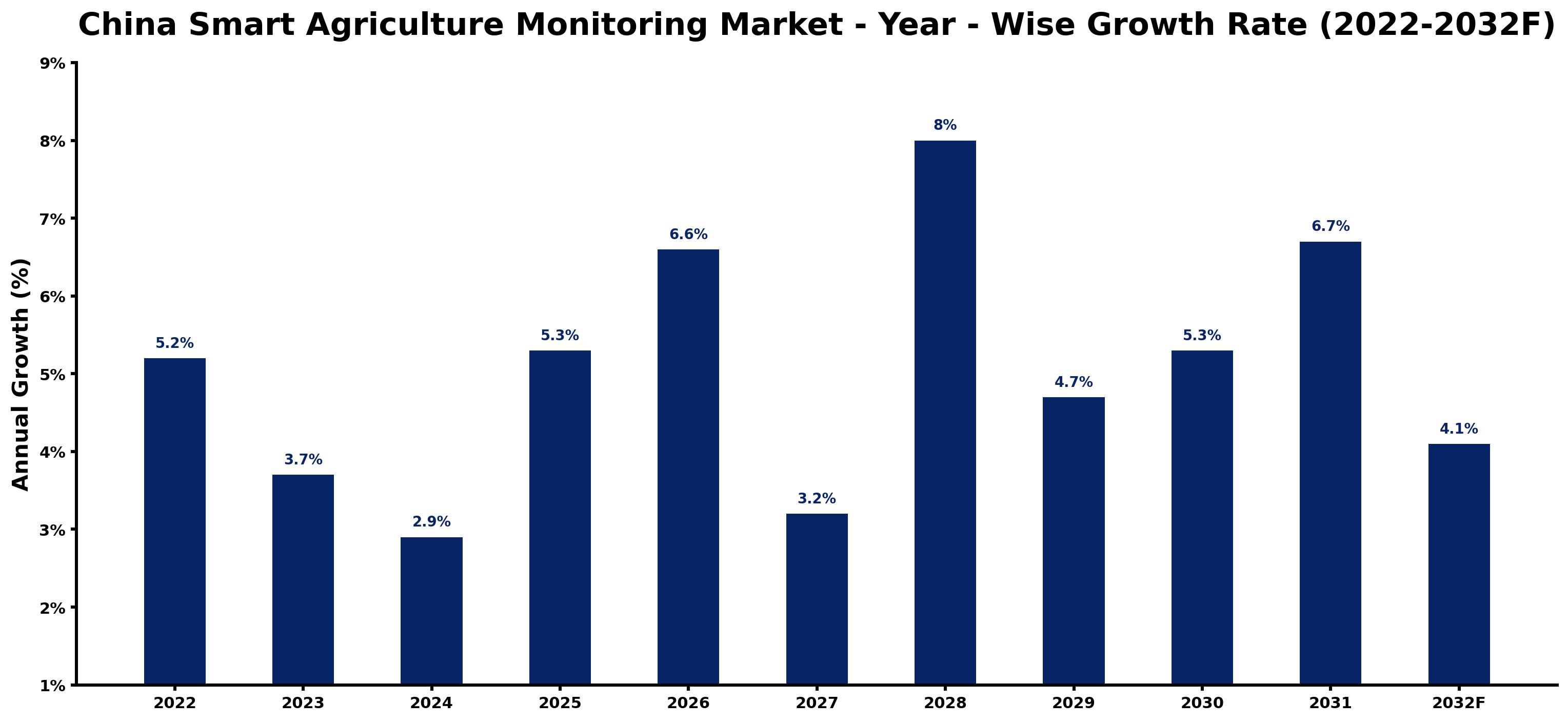
Annual growth estimates for each year appear below with the principal reason behind them, explaining the shifts that set the pace of the market.
| Year | Estimated Annual Growth (%) | Market Rationale |
| 2022 | 5.2 | The market experienced moderate growth as smart agriculture technologies began gaining traction among farmers. |
| 2023 | 3.7 | Growth slowed as the adoption rate of smart technologies faced challenges in rural areas. |
| 2024 | 2.9 | The market continued to slow due to limited access to advanced agricultural technologies. |
| 2025 | 5.3 | Growth accelerated as precision agriculture practices were adopted in provinces like Shandong. |
| 2026 | 6.6 | The market is expected to grow faster as the government increases funding for agricultural technology initiatives. |
| 2027 | 3.2 | Growth is projected to slow as farmers face challenges in integrating new technologies into existing practices. |
| 2028 | 8.0 | The market is expected to peak with high demand for smart agriculture solutions driven by the Smart Agriculture Development Plan. |
| 2029 | 4.7 | Growth is projected to slow as market saturation begins to impact the adoption of new technologies. |
| 2030 | 5.3 | The market is expected to experience renewed growth as investments in smart farming technologies increase. |
| 2031 | 6.7 | Growth is projected to accelerate as more agricultural cooperatives adopt smart technologies for efficiency. |
| 2032 | 4.1 | The market is expected to slow as the focus shifts towards optimising existing technologies rather than new adoptions. |
Note: Market size estimations and growth projections presented in this report are based on 6Wresearch's proprietary forecasting methodology, utilizing the latest available industry data, government publications, and primary research inputs.
China Smart Agriculture Monitoring Market Synopsis
Smart Agriculture Monitoring in China involves advanced technologies that improve agricultural practices. This includes the use of sensors, data analytics, and IoT devices, which enhance crop yield and soil health management. The China Smart Agriculture Monitoring Market is growing due to rising demand from domestic users and increased government backing for smart farming initiatives. In 2022, the adoption rate of these technologies reached approximately 25%, highlighting substantial growth potential. The government's commitment to technology adoption is set to attract further investments in this sector.
Market Dynamics Impact Analysis (2026–2032)
| Factor | Type | Impact | Primary Segment Affected |
| Growing investments in agricultural technology development are driving demand for smart monitoring solutions. | Driver | High | Soil Health Monitoring |
| The increasing need for efficient farming practices presents opportunities for smart agriculture solutions. | Opportunity | High | Crop Growth Monitoring |
| Limited access to advanced technologies in rural areas restrains market growth. | Restraint | High | Weather Monitoring |
| Integration challenges of new technologies into existing farming practices slow down adoption rates. | Challenge | Medium | Livestock Monitoring |
| Government initiatives promoting smart farming technologies are enhancing market growth. | Driver | High | Moisture/PH Sensors |
| The rising awareness of sustainable farming practices opens new avenues for investment. | Opportunity | Medium | IoT + Micro Stations |
| High initial costs of smart agriculture technologies can deter small-scale farmers. | Restraint | Medium | Vision + Drones |
| Competition among technology providers can lead to price wars, affecting profitability. | Challenge | Medium | Large Fields |
Evaluation of Drivers in China Smart Agriculture Monitoring Market (2026–2032)
The table below links each growth driver to the segment it affects and the evidence for it.
| Drivers | Primary Segment Affected | Why It Matters (Evidence) |
| Increased government funding for agricultural technology development supports the adoption of smart monitoring solutions. | Soil Health Monitoring | In 2023, the government allocated $500 million for agricultural technology development, encouraging farmers to invest in smart solutions. |
| The demand for efficient farming practices drives the need for smart agriculture technologies. | Crop Growth Monitoring | With over 300 million people employed in agriculture, the need for solutions that improve productivity is substantial. |
| The introduction of smart farming initiatives by the government promotes technology adoption. | Moisture/PH Sensors | The 'Smart Agriculture Development Plan' launched in 2022 aims to increase technology adoption in farming by 20% by 2025. |
| The rising awareness of sustainable farming practices boosts the demand for smart monitoring solutions. | Weather Monitoring | Farmers are increasingly seeking technologies that provide real-time data for informed decision-making, enhancing their operations. |
| The integration of IoT devices in agriculture is driving demand for smart monitoring technologies. | Livestock Monitoring | The growing use of wearable sensors for livestock health monitoring is gaining traction among dairy farms, improving management. |
Growth in the Smart Agriculture Monitoring market in China comes from increased investment in agricultural technology, rising end-use demand for efficient farming practices, and the need for sustainable solutions. In 2023, significant funding for agricultural technology development encourages farmers to adopt smart solutions. With over 300 million people employed in agriculture, the demand for productivity-enhancing technologies is substantial. The introduction of the 'Smart Agriculture Development Plan' in 2022 has further promoted the adoption of smart monitoring solutions. The increasing use of sensors for livestock health monitoring among dairy farms is driving demand for advanced technologies.
Evaluation of Restraints in China Smart Agriculture Monitoring Market
Below mentioned are some major restraints and their influence on market dynamics.
| Market Restraint | Primary Segment Affected | Why It Matters (Evidence) |
| Limited access to advanced technologies in rural areas hinders market growth. | Weather Monitoring | Farmers in remote areas often lack the resources to invest in smart agriculture technologies, limiting their productivity. |
| High initial costs of smart agriculture technologies can deter small-scale farmers from adopting them. | Livestock Monitoring | The financial burden of implementing these technologies can be prohibitive for smaller operations, preventing adoption. |
| Integration challenges of new technologies into existing farming practices slow down adoption rates. | Moisture/PH Sensors | Many farmers struggle to incorporate new systems into their traditional farming methods, resulting in inefficiencies. |
| The complexity of smart monitoring systems can lead to confusion among users. | Vision + Drones | Farmers may find it difficult to operate and maintain advanced technology without proper training and support. |
| Market saturation in certain regions can limit growth opportunities for new entrants. | Large Fields | As more farmers adopt smart technologies, the potential for new sales decreases, affecting market dynamics. |
China Smart Agriculture Monitoring Market Challenges
China's smart agriculture monitoring market faces intense competition, which drives down prices and reduces profit margins for producers. The current technology adoption rate of 25% means many producers struggle to effectively integrate new systems, leading to inefficiencies that can reduce crop yields by up to 15%. Many importers encounter challenges with outdated technology, resulting in delays that can extend project timelines by six months. Buyers confront high initial investments for smart agriculture solutions, with costs reaching $10,000 per farm, which delays adoption and limits access to improved farming practices.
Trends in the China Smart Agriculture Monitoring Market
The trends below show where the China Smart Agriculture Monitoring Market is heading.
- 30% Increase in Drone Usage: The use of drones in agriculture has increased by 30% in the last two years, particularly in regions like Shandong, improving crop monitoring efficiency.
- Launch of the Smart Agriculture Development Plan: In 2023, the government initiated the 'Smart Agriculture Development Plan' with a budget of $500 million to support technology adoption among farmers.
- Yangtze River Delta Promotes Soil Health Monitoring: Soil health monitoring technologies are actively promoted in the Yangtze River Delta region, aiming to improve crop yields and sustainability.
- Integration of Weather Monitoring Systems: Weather monitoring systems are being integrated into 10,000 farms nationwide, providing farmers with critical data to make informed decisions.
Investment Opportunities in the China Smart Agriculture Monitoring Market
The following opportunities in the China Smart Agriculture Monitoring Market pair current demand with a clear way in.
- Yangtze River Delta as a Growth Hub: The Yangtze River Delta is becoming a key area for smart agriculture investment, with a projected increase of 25% in technology adoption by 2025, driven by local initiatives.
- Partnerships with Agricultural Cooperatives: Forming partnerships with agricultural cooperatives can facilitate the introduction of smart technologies, tapping into their extensive networks and reach to enhance adoption rates.
- Supply of IoT Devices: There is a growing demand for IoT devices in agriculture, with farmers seeking solutions to improve productivity and efficiency in their operations, creating opportunities for suppliers.
- Investment in Precision Agriculture: Investing in the Precision Agriculture sector offers substantial growth potential, as it is projected to grow rapidly, attracting interest from various stakeholders.
Government Initiatives in the China Smart Agriculture Monitoring Market
The 'National Standard for Smart Agriculture' established in 2021 guides technology implementation in agriculture, ensuring that producers adhere to quality and safety standards. The 'Smart Agriculture Development Plan' launched in 2022 aims to promote technology adoption with a budget of $500 million, enhancing innovation and efficiency in farming practices. These measures collectively support the growth of smart agriculture monitoring technologies across the country by setting clear guidelines and providing necessary funding.
The Agricultural Technology Promotion Agency oversees the implementation of various agricultural initiatives, including the 'Agricultural Technology Promotion Initiative' updated in 2023 to include smart farming technologies. This initiative aims to increase adoption rates by 20% by 2025, providing funding and resources to farmers. The National Agricultural Technology Extension and Service Center plays a critical role in disseminating technology and supporting farmers in adopting smart solutions, ensuring that producers can access the latest advancements in smart agriculture.
Future Insight of the China Smart Agriculture Monitoring Market
The smart agriculture monitoring market in China is set to evolve significantly by 2032, driven by increased government support and funding for technology initiatives. The government aims to boost technology use in agriculture by 50% by 2025, which will improve productivity and efficiency across the sector. By 2025, the establishment of smart farming pilot zones will facilitate broader adoption of advanced practices. As agricultural cooperatives adopt smart technologies, buyers will benefit from enhanced crop yields and more efficient farming operations.
Market Segmentation Analysis
The analysis below covers each segmentation, its leading category in 2025 and its fastest-growing category through 2032.
By Monitoring Type – Crop Growth Monitoring Dominated, Soil Health Monitoring Expected to Grow Fastest
According to Dhaval Chaurasia, Assistant Manager at 6Wresearch, Crop Growth Monitoring accounted for a 43% market share by monitoring type in 2025. Crop growth monitoring commands the largest market share because it is vital for providing real-time insights into crop health, which directly impacts yield optimisation. This is especially crucial for expansive agricultural operations that depend on timely data to maximise productivity. The quickest growth will come from Soil Health Monitoring, forecast to expand at a CAGR of 6.7% between 2026 and 2032. Soil health monitoring is experiencing rapid growth as farmers increasingly recognise the importance of evaluating soil conditions for optimal crop performance. Initiatives in regions such as the Yangtze River Delta are significantly driving the uptake of these technologies. Suppliers should focus on enhancing soil health monitoring solutions to cater to the growing demand from farmers prioritising soil optimisation.
By Sensing Technology – Moisture/PH Sensors Dominated, IoT + Micro Stations Expected to Grow Fastest
Moisture/PH Sensors took a 45% share of sensing technology in 2025, more than any other category. Moisture and pH sensors lead the market share due to their essential role in delivering critical data on soil and plant health, which is necessary for effective agricultural practices. Their widespread use across various farming operations highlights their significance in the smart agriculture sector. IoT + Micro Stations are set to record the highest CAGR in this split, 7.4% over 2026–2032. The combination of IoT and micro stations is the fastest-growing segment, fuelled by the rising demand for real-time data collection and analysis in agriculture. This integration allows for more precise farming practices, appealing to contemporary farmers. Buyers should invest in IoT and micro station technologies to enhance their data collection capabilities and improve overall farm management.
By Coverage Area – Large Fields Dominated, Per-Plot Expected to Grow Fastest
Large Fields held a 43% share of the China Smart Agriculture Monitoring Market by coverage area in 2025. Large fields account for the largest market share as they are crucial for monitoring extensive agricultural areas, a common scenario in China's vast farming landscape. This segment's importance is highlighted by the necessity for effective management of large-scale operations. Per-Plot is projected to grow fastest, at a CAGR of 7.4% during 2026–2032. Per-plot monitoring is rapidly gaining traction, enabling targeted management of individual plots and aligning with the increasing trend of precision agriculture. This shift towards more granular monitoring reflects farmers' desire for optimised resource allocation. Suppliers should develop solutions tailored for per-plot monitoring to capitalise on the growing trend of precision agriculture among farmers.
By End User – Smart Farm Operators Dominated, Precision Agri Suppliers Expected to Grow Fastest
With a 41% revenue share in 2025, Smart Farm Operators was the largest end user category. Smart farm operators dominate the market share as they actively employ smart agriculture technologies for efficient farm management, showcasing a strong commitment to modernising their practices. Their adoption of advanced tools is essential for boosting productivity within the agricultural sector. Over 2026–2032, Precision Agri Suppliers are expected to post the fastest growth, at a CAGR of 8.2%. Precision agri suppliers represent the fastest-growing segment, driven by the rising demand for tools and technologies that support precision farming. This growth signifies a shift towards more specialised agricultural practices among suppliers. Buyers should seek partnerships with precision agri suppliers to access advanced tools that enhance their farming efficiency.
Key Attractiveness of the Report
- 10 Years of Market Numbers
- Historical Data Starting from 2022 to 2025
- Base Year 2025
- Forecast Data until 2032
- Key Performance Indicators Impacting the Market
- Major Upcoming Developments and Projects
Key Highlights of the Report:
- China Smart Agriculture Monitoring Market Outlook
- Market Size of China Smart Agriculture Monitoring Market, 2025
- Forecast of China Smart Agriculture Monitoring Market, 2032
- Historical Data and Forecast of China Smart Agriculture Monitoring Revenues & Volume for the Period 2022 - 2032F
- China Smart Agriculture Monitoring Market Trend Evolution
- China Smart Agriculture Monitoring Market Drivers and Challenges
- China Smart Agriculture Monitoring Price Trends
- China Smart Agriculture Monitoring Porter's Five Forces
- China Smart Agriculture Monitoring Industry Life Cycle
- Historical Data and Forecast of China Smart Agriculture Monitoring Market Revenues & Volume By Monitoring Type for the Period 2022 - 2032F
- Historical Data and Forecast of China Smart Agriculture Monitoring Market Revenues & Volume By Soil Health Monitoring for the Period 2022 - 2032F
- Historical Data and Forecast of China Smart Agriculture Monitoring Market Revenues & Volume By Crop Growth Monitoring for the Period 2022 - 2032F
- Historical Data and Forecast of China Smart Agriculture Monitoring Market Revenues & Volume By Weather Monitoring for the Period 2022 - 2032F
- Historical Data and Forecast of China Smart Agriculture Monitoring Market Revenues & Volume By Livestock Monitoring for the Period 2022 - 2032F
- Historical Data and Forecast of China Smart Agriculture Monitoring Market Revenues & Volume By Sensing Technology for the Period 2022 - 2032F
- Historical Data and Forecast of China Smart Agriculture Monitoring Market Revenues & Volume By Moisture/PH Sensors for the Period 2022 - 2032F
- Historical Data and Forecast of China Smart Agriculture Monitoring Market Revenues & Volume By Vision + Drones for the Period 2022 - 2032F
- Historical Data and Forecast of China Smart Agriculture Monitoring Market Revenues & Volume By IoT + Micro Stations for the Period 2022 - 2032F
- Historical Data and Forecast of China Smart Agriculture Monitoring Market Revenues & Volume By Wearable Sensors for the Period 2022 - 2032F
- Historical Data and Forecast of China Smart Agriculture Monitoring Market Revenues & Volume By Coverage Area for the Period 2022 - 2032F
- Historical Data and Forecast of China Smart Agriculture Monitoring Market Revenues & Volume By Per-Plot for the Period 2022 - 2032F
- Historical Data and Forecast of China Smart Agriculture Monitoring Market Revenues & Volume By Large Fields for the Period 2022 - 2032F
- Historical Data and Forecast of China Smart Agriculture Monitoring Market Revenues & Volume By Real-Time for the Period 2022 - 2032F
- Historical Data and Forecast of China Smart Agriculture Monitoring Market Revenues & Volume By Per Animal for the Period 2022 - 2032F
- Historical Data and Forecast of China Smart Agriculture Monitoring Market Revenues & Volume By End User for the Period 2022 - 2032F
- Historical Data and Forecast of China Smart Agriculture Monitoring Market Revenues & Volume By Smart Farm Operators for the Period 2022 - 2032F
- Historical Data and Forecast of China Smart Agriculture Monitoring Market Revenues & Volume By AgTech Companies for the Period 2022 - 2032F
- Historical Data and Forecast of China Smart Agriculture Monitoring Market Revenues & Volume By Precision Agri Suppliers for the Period 2022 - 2032F
- Historical Data and Forecast of China Smart Agriculture Monitoring Market Revenues & Volume By Dairy & Livestock Farms for the Period 2022 - 2032F
- China Smart Agriculture Monitoring Import Export Trade Statistics
- Market Opportunity Assessment By Monitoring Type
- Market Opportunity Assessment By Sensing Technology
- Market Opportunity Assessment By Coverage Area
- Market Opportunity Assessment By End User
- China Smart Agriculture Monitoring Top Companies Market Share
- China Smart Agriculture Monitoring Competitive Benchmarking By Technical and Operational Parameters
- China Smart Agriculture Monitoring Company Profiles
- China Smart Agriculture Monitoring Key Strategic Recommendations
Market Covered
This report examines the market across the segments below.
By Monitoring Type
- Soil Health Monitoring
- Crop Growth Monitoring
- Weather Monitoring
- Livestock Monitoring
By Sensing Technology
- Moisture/PH Sensors
- Vision + Drones
- IoT + Micro Stations
- Wearable Sensors
By Coverage Area
- Per-Plot
- Large Fields
- Real-Time
- Per Animal
By End User
- Smart Farm Operators
- AgTech Companies
- Precision Agri Suppliers
- Dairy & Livestock Farms































