India Smart Automation Sensors Market Size & Growth Rate
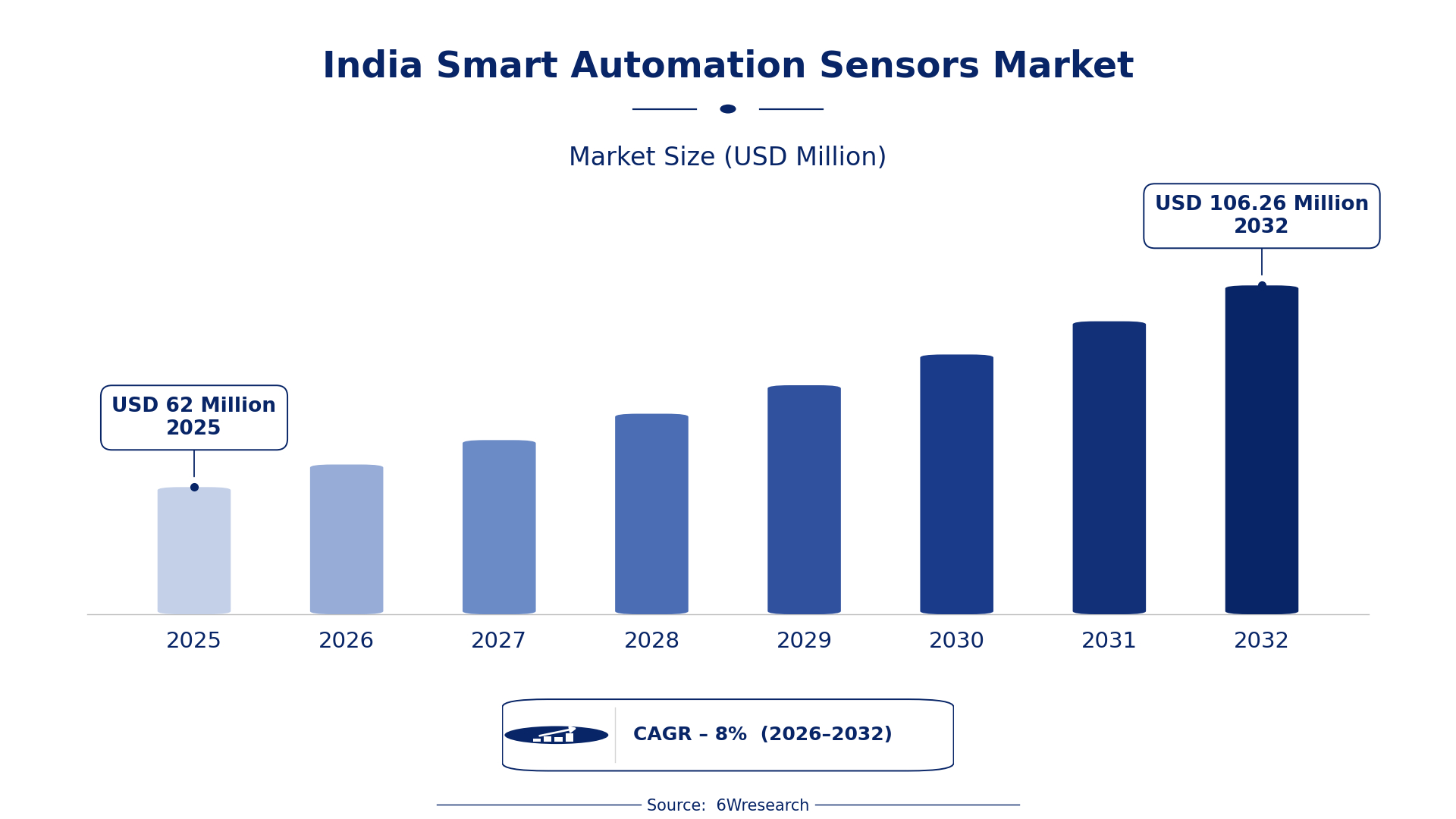
According to 6Wresearch internal database and industry insights, the India Smart Automation Sensors Market was valued at USD 62.0 million in 2025 and is projected to reach USD 106.26 million by 2032, growing at a CAGR of approximately 8% during 2026–2032.
India Smart Automation Sensors Market Highlights
| Report Metric | Details |
| Report Name | India Smart Automation Sensors Market |
| Market Size 2025 | USD 62.0 million |
| Market Size 2032 | USD 106.26 million |
| Absolute Growth 2025–2032 | USD 44.26 million |
| CAGR 2026–2032 | 8% |
| Peak Annual Growth | 10.1% in 2030 |
| Forecast Period | 2026–2032 |
| Historical Data | 2022–2025 |
| Base Year | 2025 |
| Leading Sensor Type, 2025 | Temperature Sensors (51% share) |
| Leading Automation Purpose, 2025 | Process Control (46% share) |
| Leading Industry Application, 2025 | Factory Robotics (45% share) |
| Leading End User, 2025 | Industrial Automation (41% share) |
| Fastest-Growing Sensor Type | Vibration Sensors (10.7% CAGR) |
| Fastest-Growing Automation Purpose | Equipment Health (9.1% CAGR) |
| Fastest-Growing Industry Application | Predictive Maintenance (10.1% CAGR) |
| Fastest-Growing End User | Building Integrators (10.1% CAGR) |
| Growing Sector | Industrial Automation |
| Key End Users | Manufacturers, Building Integrators, Plant Operators, Maintenance Firms |
India Smart Automation Sensors Market Year-wise Growth Rate and Key Drivers (2022–2032)
This graph illustrates the annual growth rates of the market from 2022 to 2032, highlighting a steady upward trajectory and projected market expansion over the forecast period.
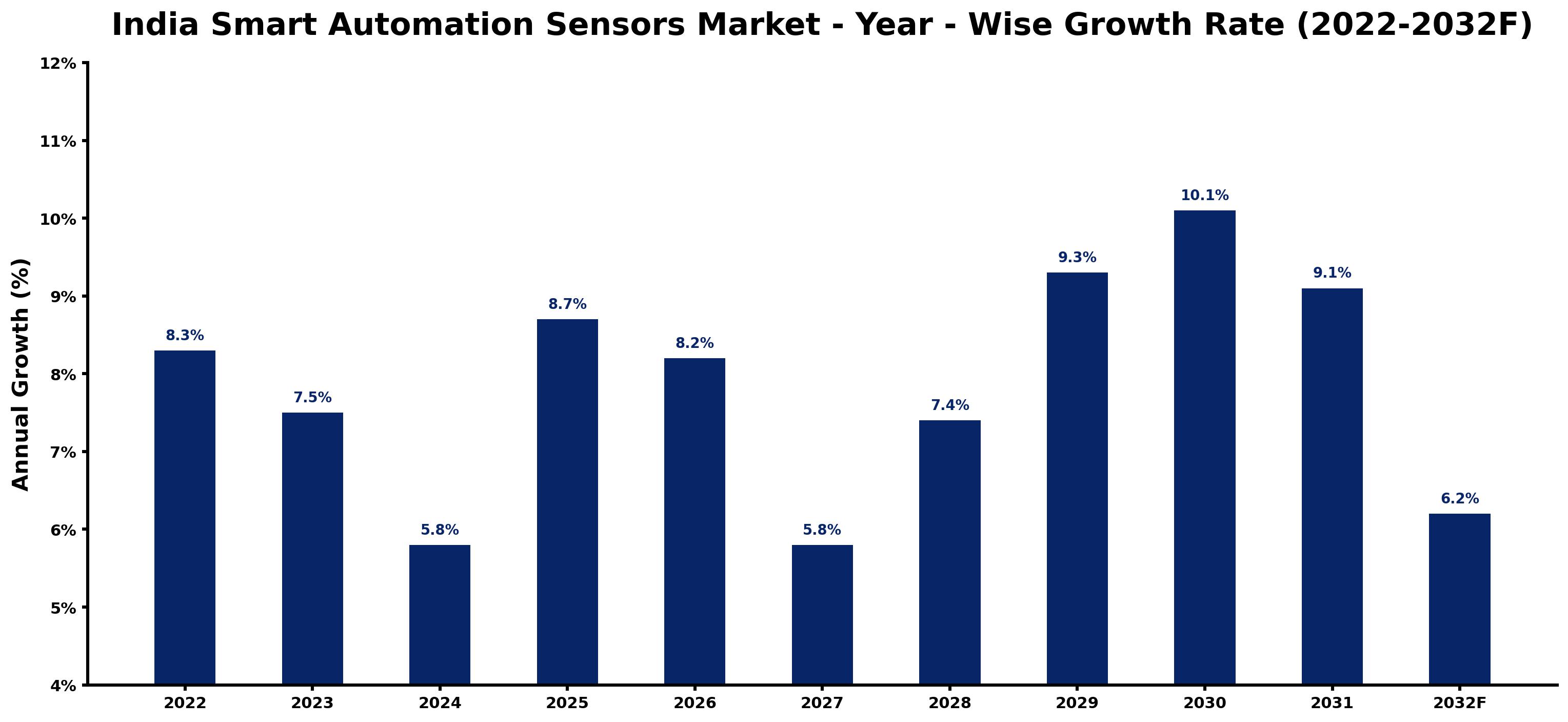
Annual growth estimates for each year appear below with the principal reason behind them, explaining the shifts that set the pace of the market.
| Year | Estimated Annual Growth (%) | Market Rationale |
| 2022 | 8.3 | The market experienced steady growth as industrial automation continued to expand in various sectors. |
| 2023 | 7.5 | Growth slowed due to temporary supply chain disruptions affecting sensor availability. |
| 2024 | 5.8 | The market maintained a slower growth rate as manufacturers adjusted to new standards and technologies. |
| 2025 | 8.7 | Demand surged with increased investments in smart manufacturing and automation technologies. |
| 2026 | 8.2 | The market is expected to slow as it adjusts to the rapid expansion seen in previous years. |
| 2027 | 5.8 | The market will continue to grow, but at a reduced rate as competition increases among manufacturers. |
| 2028 | 7.4 | A faster growth rate is projected as predictive maintenance gains traction in various industries. |
| 2029 | 9.3 | Demand is expected to accelerate with rising adoption of automation technologies in smart buildings and factories. |
| 2030 | 10.1 | The market is projected to peak with the highest growth rate driven by the Smart Cities Mission's initiatives. |
| 2031 | 9.1 | Growth will slow as the market begins to stabilise after reaching its peak in the previous year. |
| 2032 | 6.2 | The market is expected to grow at a slower rate as saturation in certain segments occurs. |
Note: Market size estimations and growth projections presented in this report are based on 6Wresearch's proprietary forecasting methodology, utilizing the latest available industry data, government publications, and primary research inputs.
India Smart Automation Sensors Market Synopsis
The India Smart Automation Sensors Market encompasses electronic devices that detect and respond to physical stimuli, crucial for improving efficiency across multiple sectors. These sensors are integral to manufacturing processes, equipment health monitoring, and smart building management. The market is anticipated to reach 1.5 billion USD by 2025, propelled by the manufacturing sector's demand and the Smart Cities Mission advocating for automation technologies. The Digital India programme is driving the uptake of smart technologies, leading to increased purchases across various industries.
Market Dynamics Impact Analysis (2026–2032)
| Factor | Type | Impact | Primary Segment Affected |
| Rising investments in smart manufacturing technologies | Driver | High | Industrial Automation |
| Growing demand for predictive maintenance solutions | Driver | High | Predictive Maintenance |
| Expansion of smart buildings in urban areas | Opportunity | High | Smart Buildings |
| Increased focus on local manufacturing of sensors | Opportunity | High | Temperature Sensors |
| Challenges in meeting evolving industry standards | Restraint | Medium | Temperature Sensors |
| Supply chain disruptions affecting sensor availability | Restraint | Medium | Proximity Sensors |
| High competition among manufacturers leading to price wars | Challenge | High | Factory Robotics |
| Technological advancements requiring continuous updates | Challenge | Medium | Equipment Health |
Evaluation of Drivers in India Smart Automation Sensors Market (2026–2032)
The table below links each growth driver to the segment it affects and the evidence for it.
| Drivers | Primary Segment Affected | Why It Matters (Evidence) |
| Increased automation in manufacturing processes | Industrial Automation | The manufacturing sector employs over 50 million people, driving sensor demand for efficiency. |
| Rising adoption of predictive maintenance | Predictive Maintenance | Vibration sensors are increasingly used, reducing downtime and improving operational reliability. |
| Growth of smart buildings | Smart Buildings | The Smart Cities Mission aims to develop 100 smart cities, increasing automation sensor needs. |
| Government initiatives promoting local manufacturing | Temperature Sensors | The Atmanirbhar Bharat initiative allocates 1.5 billion USD for boosting local sensor production. |
| Expansion of the food and pharma sectors | Temperature Sensors | Temperature sensors are critical for monitoring conditions in rapidly growing food and pharma industries. |
The Smart Automation Sensors market in India is expanding due to rising investments in smart manufacturing technologies, greater adoption of predictive maintenance, and the growth of smart buildings. The manufacturing sector employs over 50 million people, which fuels sensor demand for improved efficiency. The Smart Cities Mission aims to establish 100 smart cities, thereby increasing the need for automation sensors. Rapid growth in the food and pharma sectors necessitates temperature sensors for monitoring conditions.
Evaluation of Restraints in India Smart Automation Sensors Market
Below mentioned are some major restraints and their influence on market dynamics.
| Market Restraint | Primary Segment Affected | Why It Matters (Evidence) |
| Challenges in meeting evolving industry standards | Temperature Sensors | The Bureau of Indian Standards has set guidelines under IS 9000, requiring compliance from manufacturers. |
| Supply chain disruptions affecting sensor availability | Proximity Sensors | Global supply chain issues have delayed sensor production and delivery timelines for manufacturers. |
| High competition among manufacturers | Factory Robotics | Increased competition has resulted in aggressive pricing strategies, impacting profit margins. |
| Technological advancements requiring continuous updates | Equipment Health | Rapid advancements in sensor technology necessitate regular updates, straining resources for manufacturers. |
| Limited awareness of sensor capabilities among end users | Smart Buildings | Many potential buyers lack knowledge about the benefits of smart automation sensors, hindering adoption. |
India Smart Automation Sensors Market Challenges
India's Smart Automation Sensors market still has to solve a few problems, and the first is high production costs. The manufacturing sector employs over 50 million people, resulting in increased labour expenses that inflate sensor prices for producers. Buyers face challenges as the anticipated cost of smart automation sensors may restrict their adoption in budget-sensitive projects, potentially limiting market growth. Supply chain disruptions also hinder availability; for instance, delays in component sourcing can extend delivery times by up to three months, impacting project timelines for buyers. Skills shortages complicate matters, as training initiatives are still developing, leaving producers struggling to find qualified personnel to meet rising demand.
Trends in the India Smart Automation Sensors Market
The trends below show where the India Smart Automation Sensors Market is heading.
- Shift towards Predictive Maintenance: Predictive maintenance is becoming a priority in Indian industries, driven by the need to minimise downtime. The use of vibration sensors is on the rise, with a projected CAGR of 10.1% from 2026 to 2032.
- Increased Adoption of Smart Building Technologies: Smart buildings are gaining popularity in urban areas, with the Smart Cities Mission encouraging automation. The market for smart building sensors is expected to grow at a CAGR of 20% from 2023 to 2030.
- Focus on Local Manufacturing of Sensors: The Atmanirbhar Bharat initiative is promoting local production of smart automation sensors. The Indian government has allocated 1.5 billion USD to bolster self-reliance in manufacturing.
- Emergence of Advanced Sensor Technologies: New sensor technologies are being developed to meet industry demands, particularly in the food and pharma sectors. Temperature sensors are crucial for maintaining quality, especially as these sectors expand rapidly.
Investment Opportunities in the India Smart Automation Sensors Market
Below are the investment opportunities with the strongest case in the India Smart Automation Sensors Market.
- Supply of Smart Automation Sensors: The demand for smart automation sensors is rising, particularly in smart buildings. The Smart Cities Mission aims to develop 100 smart cities, creating a substantial market opportunity.
- Investment in Predictive Maintenance Solutions: With the growth of predictive maintenance, there is an increasing need for advanced sensors. Industrial automation firms are pursuing innovative solutions to improve operational efficiency.
- Development of Temperature Sensors: The food and pharma sectors are expanding rapidly, generating a demand for temperature sensors. Investing in this area can yield high returns as these industries grow.
- Local Manufacturing of Sensors: The Indian government is encouraging local manufacturing through initiatives like Make in India. This presents an opportunity for partnerships with local firms to boost production capabilities.
Government Initiatives in the India Smart Automation Sensors Market
The National Policy on Electronics 2019, launched by the Ministry of Electronics and Information Technology, aims to achieve a 20% reduction in import dependency for electronic components by 2025. This policy encourages local production of smart automation sensors, benefiting manufacturers and buyers alike. The Digital India programme, initiated in 2015, focuses on increasing the adoption of smart technologies, including automation sensors, across various sectors, promoting innovation and growth in the market.
The Make in India initiative, overseen by the Ministry of Commerce and Industry, has allocated 1.5 billion USD to support local manufacturing of smart automation sensors. This initiative boosts production capabilities. Furthermore, the Smart Cities Mission, launched in 2015 by the Ministry of Housing and Urban Affairs, promotes the use of smart automation technologies in urban development projects across 100 cities, increasing the demand for these sensors.
Future Insight of the India Smart Automation Sensors Market
The Smart Automation Sensors market in India is projected to experience significant transformation by 2032, driven by several key factors. The Digital India initiative will promote the integration of advanced technologies across various sectors, while the Smart Cities Mission will create substantial demand for automation solutions. By 2025, the healthcare sector is set to adopt smart sensors for patient monitoring systems, reflecting a growing trend. The government's commitment to the Atmanirbhar Bharat initiative will strengthen local manufacturing capabilities, ensuring a consistent supply of automation solutions for both buyers and producers.
Market Segmentation Analysis
The report offers a comprehensive study of the following market segments and their leading categories in the market.
By Sensor Type – Temperature Sensors Dominated, Vibration Sensors Expected to Grow Fastest
According to Dhaval Chaurasia, Assistant Manager at 6Wresearch, with a 51% revenue share in 2025, Temperature Sensors was the largest sensor type category. Temperature sensors hold the largest share in the India smart automation sensors market due to their critical function in monitoring temperature across diverse industrial processes. For instance, the food and pharmaceutical sectors heavily depend on these sensors to comply with safety standards and ensure product quality. Vibration Sensors are projected to grow fastest, at a CAGR of 10.7% during 2026–2032. Vibration sensors are experiencing rapid growth as industries increasingly adopt predictive maintenance techniques to minimise equipment downtime. Their rising implementation in manufacturing facilities underscores their role in monitoring machinery health and enhancing operational effectiveness. Suppliers should focus on advancing temperature and vibration sensor technologies to capitalise on the growth potential in these vital market segments.
By Automation Purpose – Process Control Dominated, Equipment Health Expected to Grow Fastest
In 2025, Process Control led the automation purpose split with a 46% share. Process control leads the automation purpose segment, as it is essential for optimising efficiency in industrial operations. The adoption of smart manufacturing practices further solidifies its dominant market share, with businesses striving for enhanced process optimisation. Over 2026–2032, Equipment Health is expected to post the fastest growth, at a CAGR of 9.1%. Equipment health is the fastest-growing segment, propelled by the urgent need for real-time machinery condition monitoring to prevent failures. This trend is particularly significant in sectors prioritising reliability and maintenance efficiency, ensuring seamless operations. Buyers should invest in advanced equipment health monitoring solutions to boost operational reliability and reduce maintenance costs.
By Industry Application – Factory Robotics Dominated, Predictive Maintenance Expected to Grow Fastest
Factory Robotics accounted for a 45% market share by industry application in 2025. Factory robotics is the leading application area, being integral to the functioning of automated systems in manufacturing environments. The growing demand for automation in factories reinforces the significance of these sensors in streamlining operational processes. Predictive Maintenance is set to record the highest CAGR in this split, 10.1% over 2026–2032. Predictive maintenance is the fastest-growing application, indicating a shift towards proactive strategies aimed at minimising equipment downtime. This trend is particularly relevant in industries where maintaining operational continuity is crucial for profitability. Suppliers should concentrate on developing predictive maintenance solutions to meet the increasing demand for reliability and efficiency in industrial operations.
By End User – Industrial Automation Dominated, Building Integrators Expected to Grow Fastest
Industrial Automation held a 41% share of the India Smart Automation Sensors Market by end user in 2025. Industrial automation is the largest end-user segment, serving as the primary sector employing smart automation sensors to enhance operational efficiency. The substantial workforce in manufacturing drives significant demand for these sensors across various processes. The quickest growth will come from Building Integrators, forecast to expand at a CAGR of 10.1% between 2026 and 2032. Building integrators represent the fastest-growing end-user group, as they increasingly incorporate smart technologies into building designs. This trend aligns with government initiatives promoting smart city developments, creating new market opportunities. Suppliers should tailor their products to meet the specific needs of building integrators, taking advantage of the growth in smart building technologies.
Key Attractiveness of the Report
- 10 Years of Market Numbers
- Historical Data Starting from 2022 to 2025
- Base Year 2025
- Forecast Data until 2032
- Key Performance Indicators Impacting the Market
- Major Upcoming Developments and Projects
Key Highlights of the Report:
- India Smart Automation Sensors Market Outlook
- Market Size of India Smart Automation Sensors Market, 2025
- Forecast of India Smart Automation Sensors Market, 2032
- Historical Data and Forecast of India Smart Automation Sensors Revenues & Volume for the Period 2022 - 2032F
- India Smart Automation Sensors Market Trend Evolution
- India Smart Automation Sensors Market Drivers and Challenges
- India Smart Automation Sensors Price Trends
- India Smart Automation Sensors Porter's Five Forces
- India Smart Automation Sensors Industry Life Cycle
- Historical Data and Forecast of India Smart Automation Sensors Market Revenues & Volume By Sensor Type for the Period 2022 - 2032F
- Historical Data and Forecast of India Smart Automation Sensors Market Revenues & Volume By Proximity Sensors for the Period 2022 - 2032F
- Historical Data and Forecast of India Smart Automation Sensors Market Revenues & Volume By Temperature Sensors for the Period 2022 - 2032F
- Historical Data and Forecast of India Smart Automation Sensors Market Revenues & Volume By Vibration Sensors for the Period 2022 - 2032F
- Historical Data and Forecast of India Smart Automation Sensors Market Revenues & Volume By Motion Sensors for the Period 2022 - 2032F
- Historical Data and Forecast of India Smart Automation Sensors Market Revenues & Volume By Automation Purpose for the Period 2022 - 2032F
- Historical Data and Forecast of India Smart Automation Sensors Market Revenues & Volume By Object Detection for the Period 2022 - 2032F
- Historical Data and Forecast of India Smart Automation Sensors Market Revenues & Volume By Process Control for the Period 2022 - 2032F
- Historical Data and Forecast of India Smart Automation Sensors Market Revenues & Volume By Equipment Health for the Period 2022 - 2032F
- Historical Data and Forecast of India Smart Automation Sensors Market Revenues & Volume By Security/Lighting Systems for the Period 2022 - 2032F
- Historical Data and Forecast of India Smart Automation Sensors Market Revenues & Volume By Industry Application for the Period 2022 - 2032F
- Historical Data and Forecast of India Smart Automation Sensors Market Revenues & Volume By Factory Robotics for the Period 2022 - 2032F
- Historical Data and Forecast of India Smart Automation Sensors Market Revenues & Volume By Food/Pharma Manufacturing for the Period 2022 - 2032F
- Historical Data and Forecast of India Smart Automation Sensors Market Revenues & Volume By Predictive Maintenance for the Period 2022 - 2032F
- Historical Data and Forecast of India Smart Automation Sensors Market Revenues & Volume By Smart Buildings for the Period 2022 - 2032F
- Historical Data and Forecast of India Smart Automation Sensors Market Revenues & Volume By End User for the Period 2022 - 2032F
- Historical Data and Forecast of India Smart Automation Sensors Market Revenues & Volume By Industrial Automation for the Period 2022 - 2032F
- Historical Data and Forecast of India Smart Automation Sensors Market Revenues & Volume By Plant Operators for the Period 2022 - 2032F
- Historical Data and Forecast of India Smart Automation Sensors Market Revenues & Volume By Maintenance Firms for the Period 2022 - 2032F
- Historical Data and Forecast of India Smart Automation Sensors Market Revenues & Volume By Building Integrators for the Period 2022 - 2032F
- India Smart Automation Sensors Import Export Trade Statistics
- Market Opportunity Assessment By Sensor Type
- Market Opportunity Assessment By Automation Purpose
- Market Opportunity Assessment By Industry Application
- Market Opportunity Assessment By End User
- India Smart Automation Sensors Top Companies Market Share
- India Smart Automation Sensors Competitive Benchmarking By Technical and Operational Parameters
- India Smart Automation Sensors Company Profiles
- India Smart Automation Sensors Key Strategic Recommendations
Market Covered
The report offers an extensive study of the following market segments.
By Sensor Type
- Proximity Sensors
- Temperature Sensors
- Vibration Sensors
- Motion Sensors
By Automation Purpose
- Object Detection
- Process Control
- Equipment Health
- Security/Lighting Systems
By Industry Application
- Factory Robotics
- Food/Pharma Manufacturing
- Predictive Maintenance
- Smart Buildings
By End User
- Industrial Automation
- Plant Operators
- Maintenance Firms
- Building Integrators































