China Smart Automation Sensors Market Size & Growth Rate
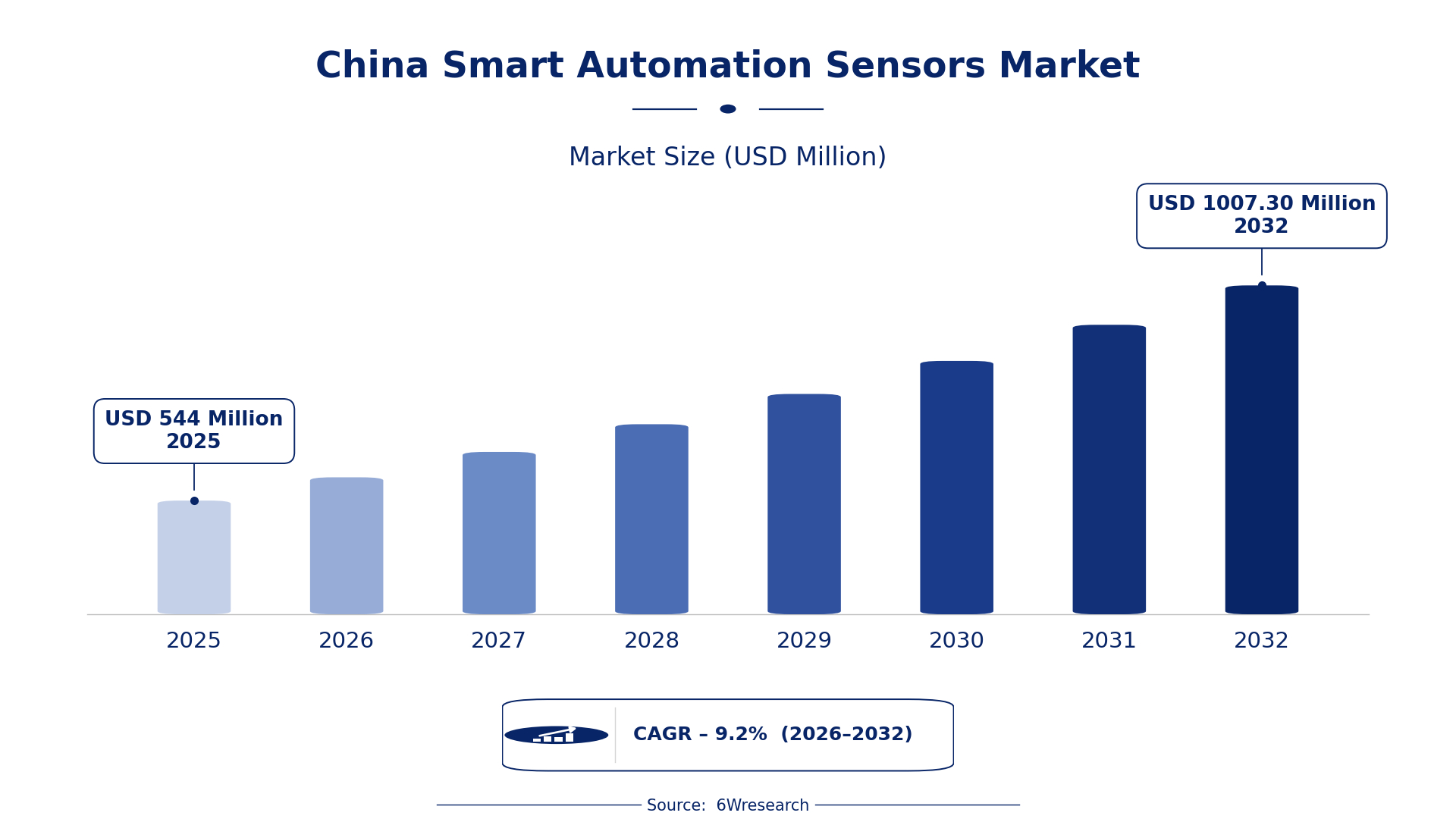
According to 6Wresearch internal database and industry insights, the China Smart Automation Sensors Market was valued at USD 544.0 million in 2025 and is projected to reach USD 1,007.30 million by 2032, growing at a CAGR of approximately 9.2% during 2026–2032.
China Smart Automation Sensors Market Highlights
| Report Metric | Details |
| Report Name | China Smart Automation Sensors Market |
| Market Size 2025 | USD 544.0 million |
| Market Size 2032 | USD 1,007.30 million |
| Absolute Growth 2025–2032 | USD 463.30 million |
| CAGR 2026–2032 | 9.2% |
| Peak Annual Growth | 11.6% in 2031 |
| Forecast Period | 2026–2032 |
| Historical Data | 2022–2025 |
| Base Year | 2025 |
| Leading Sensor Type, 2025 | Proximity Sensors (37% share) |
| Leading Automation Purpose, 2025 | Object Detection (40% share) |
| Leading Industry Application, 2025 | Factory Robotics (43% share) |
| Leading End User, 2025 | Industrial Automation (48% share) |
| Fastest-Growing Sensor Type | Temperature Sensors (10.7% CAGR) |
| Fastest-Growing Automation Purpose | Process Control (10.6% CAGR) |
| Fastest-Growing Industry Application | Predictive Maintenance (12.0% CAGR) |
| Fastest-Growing End User | Building Integrators (10.6% CAGR) |
| Growing Sector | Predictive Maintenance |
| Key End Users | Factory Robotics, Food/Pharma Manufacturing, Predictive Maintenance, Smart Buildings |
China Smart Automation Sensors Market Year-wise Growth Rate and Key Drivers (2022–2032)
This graph illustrates the annual growth rates of the market from 2022 to 2032, highlighting a steady upward trajectory and projected market expansion over the forecast period.
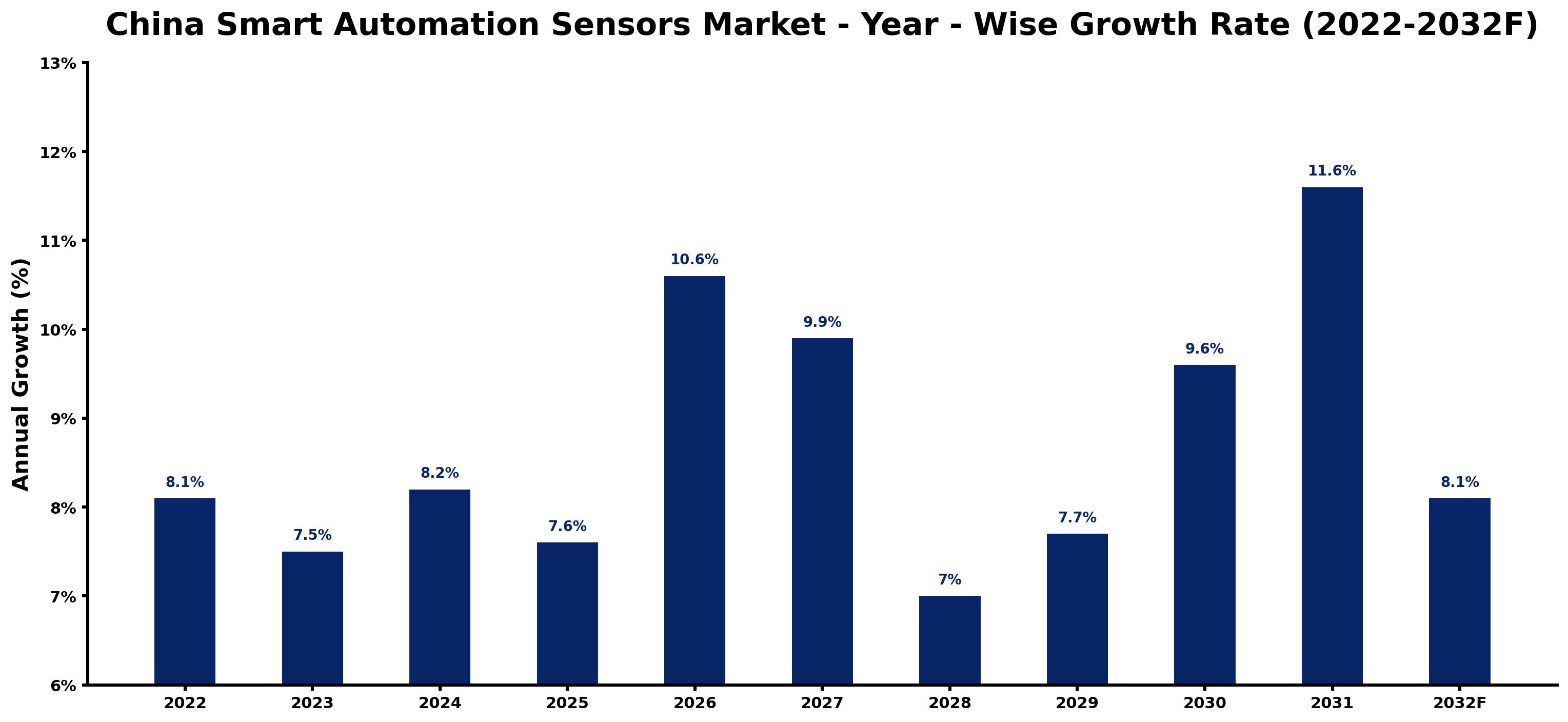
Each row of the following table gives one year's estimated growth and the event or demand shift that explains it.
| Year | Estimated Annual Growth (%) | Market Rationale |
| 2022 | 8.1 | The market experienced steady growth, driven by the 'Smart Manufacturing 2025' initiative, which promotes automation technologies. |
| 2023 | 7.5 | Growth slowed slightly due to the maturation of smart automation solutions in the industrial sector. |
| 2024 | 8.2 | Demand increased as more factories integrated automation sensors to improve operational efficiency and safety. |
| 2025 | 7.6 | Growth decelerated as the market began to stabilise after rapid expansions in previous years. |
| 2026 | 10.6 | A surge in investments in smart technologies is expected to accelerate growth as factories aim for higher automation levels. |
| 2027 | 9.9 | Growth is projected to moderate as the market adjusts to new technologies and their integration into existing systems. |
| 2028 | 7.0 | Demand is anticipated to continue slowing, reflecting the natural maturation of the market and technology adoption in industries. |
| 2029 | 7.7 | The market is expected to rebound slightly as new applications for automation sensors emerge in various sectors. |
| 2030 | 9.6 | Growth will pick up again, driven by increased focus on smart building technologies and energy efficiency initiatives. |
| 2031 | 11.6 | The market is projected to peak as demand surges for advanced automation solutions across multiple industries. |
| 2032 | 8.1 | Growth will slow as the market stabilises after reaching a peak in adoption and integration. |
Note: Market size estimations and growth projections presented in this report are based on 6Wresearch's proprietary forecasting methodology, utilizing the latest available industry data, government publications, and primary research inputs.
China Smart Automation Sensors Market Synopsis
Smart Automation Sensors in China include devices that detect and respond to environmental changes, playing a crucial role in industrial automation and smart buildings. These sensors employ various technologies, such as capacitive and optical sensing, to improve operational efficiency and safety. The China Smart Automation Sensors Market is growing due to substantial investments in smart manufacturing and a strong industrial automation sector. With China's industrial automation market expected to reach 1 trillion yuan by 2025, the demand for these sensors is set to increase steadily, driven by domestic users and ongoing technological advancements.
Market Dynamics Impact Analysis (2026–2032)
| Factor | Type | Impact | Primary Segment Affected |
| Growing investments in smart manufacturing technologies are driving demand for automation sensors. | Driver | High | Industrial Automation |
| The increasing adoption of smart building technologies creates new opportunities for sensor integration. | Opportunity | High | Smart Buildings |
| The need for compliance with safety regulations in food and pharmaceutical manufacturing limits sensor adoption. | Restraint | Medium | Food/Pharma Manufacturing |
| The complexity of integrating new sensor technologies poses challenges for manufacturers. | Challenge | High | Factory Robotics |
| The rising demand for predictive maintenance solutions is boosting sensor sales in manufacturing. | Driver | High | Predictive Maintenance |
| The ongoing urbanization in China presents opportunities for smart building projects. | Opportunity | Medium | Smart Buildings |
| High initial costs of smart automation technologies can deter smaller manufacturers from investing. | Restraint | High | Industrial Automation |
| Supply chain disruptions can delay sensor availability and affect production timelines. | Challenge | Medium | Equipment Health |
Evaluation of Drivers in China Smart Automation Sensors Market (2026–2032)
Key forces behind demand, with the segment each one moves most, are listed below.
| Drivers | Primary Segment Affected | Why It Matters (Evidence) |
| Increased investments in smart manufacturing technologies are driving demand for automation sensors. | Industrial Automation | China's industrial automation market is projected to reach 1 trillion yuan by 2025, leading to higher sensor purchases. |
| Growing adoption of predictive maintenance solutions boosts the need for sensors in manufacturing. | Predictive Maintenance | Predictive maintenance solutions are expected to reduce maintenance costs by up to 30%, prompting sensor integration. |
| The rise of smart building projects creates demand for automation sensors in urban developments. | Smart Buildings | In 2022, over 1,000 smart building projects were in development, increasing sensor requirements. |
| The need for enhanced safety in manufacturing drives the use of automation sensors. | Factory Robotics | Proximity sensors are widely used in over 50% of manufacturing plants in China, ensuring operational safety. |
| The push for energy efficiency in buildings is increasing sensor adoption. | Smart Buildings | The smart building sector is expected to grow at a CAGR of 15% from 2023 to 2030, driving sensor demand. |
Market growth in China for Smart Automation Sensors rests on increased investments in smart manufacturing technologies, projected to reach 1 trillion yuan by 2025. The rising adoption of predictive maintenance solutions reduces operational costs, prompting more manufacturers to integrate sensors. The growth of smart building projects, with over 1,000 developments in 2022, creates new demand for automation sensors. Safety requirements in manufacturing drive the widespread use of proximity sensors, which are found in over 50% of plants. The focus on energy efficiency in buildings is increasing sensor adoption as the smart building sector is anticipated to grow significantly from 2023 to 2030.
Evaluation of Restraints in China Smart Automation Sensors Market
The following restraints limit how fast demand can grow.
| Market Restraint | Primary Segment Affected | Why It Matters (Evidence) |
| High costs of raw materials are impacting sensor production. | Industrial Automation | Rising prices have increased overall expenses for manufacturers, forcing them to pass on costs to buyers. |
| Supply chain disruptions are affecting sensor availability. | Smart Buildings | Delays in semiconductor components are causing production setbacks, impacting delivery schedules. |
| Skills shortage in advanced sensor technologies is hindering market growth. | Predictive Maintenance | Many workers lack training, delaying project timelines for manufacturers. |
| Intense competition among suppliers is leading to price wars. | Factory Robotics | This erodes profit margins and reduces investment in innovation for sensor producers. |
| Regulatory compliance costs are rising for manufacturers. | Food/Pharma Manufacturing | Increased safety regulations require investment in advanced sensor technologies. |
China Smart Automation Sensors Market Challenges
The China Smart Automation Sensors Market encounters a skills shortage, as many workers lack training in advanced sensor technologies, which delays project timelines for manufacturers. Fierce competition among suppliers results in price wars, eroding profit margins and limiting investment in innovation for producers. Frequent supply chain disruptions, particularly for semiconductor components, lead to delays in sensor production, affecting delivery schedules for buyers. Rising raw material costs have escalated overall expenses for manufacturers, compelling them to pass on these costs to buyers, which can slow adoption rates in the market.
Trends in the China Smart Automation Sensors Market
Four trends stand out in the China Smart Automation Sensors Market.
- Shift Towards Smart Building Technologies: Building integrators are increasingly adopting smart automation sensors to improve energy efficiency in urban developments. In 2022, over 1,000 smart building projects were in development, indicating a growing trend towards automation in construction.
- Transition to Predictive Maintenance Solutions: Manufacturers are moving towards predictive maintenance strategies, utilising automation sensors to monitor equipment health. This shift is projected to reduce maintenance costs by up to 30%, driving sensor adoption.
- Emergence of New Safety Regulations: The need for improved safety in manufacturing is leading to increased sensor integration. Proximity sensors are widely used in over 50% of manufacturing plants, ensuring operational safety and compliance with evolving standards.
- Growing Demand for Energy Efficiency: The focus on energy efficiency in buildings is driving sensor adoption. The smart building sector is projected to grow significantly from 2023 to 2030, creating opportunities for automation sensor suppliers.
Investment Opportunities in the China Smart Automation Sensors Market
The following opportunities in the China Smart Automation Sensors Market pair current demand with a clear way in.
- Current Investment in Smart Manufacturing Technologies: Now is an ideal time to invest in smart automation sensors, as the industrial automation market is expected to reach 1 trillion yuan by 2025. Collaborating with industrial automation firms can ease market entry.
- Supply of Predictive Maintenance Solutions: There is a rising demand for predictive maintenance solutions in manufacturing. Suppliers can target plant operators, particularly in the automotive sector, to effectively meet this need.
- Expansion in Smart Building Projects: The increase in smart building projects offers opportunities for automation sensor suppliers. Focusing on urban developments in major cities can yield substantial returns on investment.
- Collaboration with Building Integrators: Building integrators are increasingly adopting smart automation technologies. Suppliers can partner with these firms to provide customised sensor solutions that enhance energy efficiency.
Government Initiatives in the China Smart Automation Sensors Market
The 'Made in China 2025' strategy, launched in 2020, aims to boost the adoption of smart sensors in industrial applications, targeting 30% automation by 2025. This initiative encourages manufacturers to embrace advanced sensor technologies, ensuring compliance with national standards and improving production efficiency.
In 2023, the National Development and Reform Commission allocated 1 billion yuan to support research and development in smart automation technologies. This funding will aid in developing innovative sensor solutions, promoting their integration across various industries.
Future Insight of the China Smart Automation Sensors Market
Several forward-looking factors should support the China Smart Automation Sensors Market in the coming years. The government's 'Smart Manufacturing 2025' initiative will stimulate investment in advanced sensor technologies, enhancing industrial efficiency. By 2025, China's industrial automation market is projected to reach 1 trillion yuan, indicating strong growth potential. The integration of predictive maintenance solutions is likely to significantly reduce maintenance costs, encouraging more manufacturers to adopt smart technologies. Urbanisation will further drive demand for smart building technologies, expanding the market for automation sensors.
Market Segmentation Analysis
The report offers a comprehensive study of the following market segments and their leading categories in the market.
By Sensor Type – Proximity Sensors Dominated, Temperature Sensors Expected to Grow Fastest
According to Dhaval Chaurasia, Assistant Manager at 6Wresearch, with a 37% revenue share in 2025, Proximity Sensors was the largest sensor type category. Proximity sensors hold the largest share in China due to their extensive use in over 50% of manufacturing plants. Their non-contact detection capability is vital for various industrial applications, particularly in automation processes. Temperature Sensors are projected to grow fastest, at a CAGR of 10.7% during 2026–2032. Temperature sensors are experiencing rapid growth as they are essential for monitoring environmental conditions in factories. With an average response time of less than 1 second, they are increasingly crucial for achieving real-time operational efficiency. Suppliers should focus on enhancing temperature sensor features to meet the increasing demand in industrial settings.
By Automation Purpose – Object Detection Dominated, Process Control Expected to Grow Fastest
Object Detection accounted for a 40% market share by automation purpose in 2025. Object detection is the leading segment in automation purpose because it is fundamental for robotics and manufacturing processes. Its critical role in ensuring precise detection capabilities drives its significant market share across various applications. The quickest growth will come from Process Control, forecast to expand at a CAGR of 10.6% between 2026 and 2032. Process control is the fastest-growing purpose, as it is vital for maintaining operational efficiency in factories. The increasing focus on maximising productivity is driving substantial demand for effective process control solutions. Buyers should prioritise investments in process control technologies to optimise their manufacturing processes and improve operational efficiency.
By Industry Application – Factory Robotics Dominated, Predictive Maintenance Expected to Grow Fastest
Factory Robotics held a 43% share of the China Smart Automation Sensors Market by industry application in 2025. Factory robotics is the dominant application in the industry, playing a central role in modern manufacturing and automation practices. The substantial installed base of industrial automation sensors in factories reinforces this segment's leading position. Over 2026–2032, Predictive Maintenance is expected to post the fastest growth, at a CAGR of 12.0%. Predictive maintenance is rapidly gaining traction as it significantly reduces downtime and enhances operational efficiency. With potential maintenance cost reductions of up to 30%, its adoption is accelerating across various industries. Suppliers need to concentrate on developing predictive maintenance solutions to cater to the rising demand for efficiency in manufacturing.
By End User – Industrial Automation Dominated, Building Integrators Expected to Grow Fastest
In 2025, Industrial Automation led the end user split with a 48% share. Industrial automation is the largest end user of smart automation sensors in China, bolstered by significant investments in smart manufacturing technologies. Government initiatives that promote automation further enhance growth in this sector. Building Integrators are set to record the highest CAGR in this split, 10.6% over 2026–2032. Building integrators are the fastest-growing end user group, increasingly integrating smart automation sensors into their projects. This trend reflects the rising demand for smart technologies in building systems and infrastructure. Suppliers should collaborate with building integrators to strengthen their market presence in the expanding smart building sector.
Key Attractiveness of the Report
- 10 Years of Market Numbers
- Historical Data Starting from 2022 to 2025
- Base Year 2025
- Forecast Data until 2032
- Key Performance Indicators Impacting the Market
- Major Upcoming Developments and Projects
Key Highlights of the Report:
- China Smart Automation Sensors Market Outlook
- Market Size of China Smart Automation Sensors Market, 2025
- Forecast of China Smart Automation Sensors Market, 2032
- Historical Data and Forecast of China Smart Automation Sensors Revenues & Volume for the Period 2022 - 2032F
- China Smart Automation Sensors Market Trend Evolution
- China Smart Automation Sensors Market Drivers and Challenges
- China Smart Automation Sensors Price Trends
- China Smart Automation Sensors Porter's Five Forces
- China Smart Automation Sensors Industry Life Cycle
- Historical Data and Forecast of China Smart Automation Sensors Market Revenues & Volume By Sensor Type for the Period 2022 - 2032F
- Historical Data and Forecast of China Smart Automation Sensors Market Revenues & Volume By Proximity Sensors for the Period 2022 - 2032F
- Historical Data and Forecast of China Smart Automation Sensors Market Revenues & Volume By Temperature Sensors for the Period 2022 - 2032F
- Historical Data and Forecast of China Smart Automation Sensors Market Revenues & Volume By Vibration Sensors for the Period 2022 - 2032F
- Historical Data and Forecast of China Smart Automation Sensors Market Revenues & Volume By Motion Sensors for the Period 2022 - 2032F
- Historical Data and Forecast of China Smart Automation Sensors Market Revenues & Volume By Automation Purpose for the Period 2022 - 2032F
- Historical Data and Forecast of China Smart Automation Sensors Market Revenues & Volume By Object Detection for the Period 2022 - 2032F
- Historical Data and Forecast of China Smart Automation Sensors Market Revenues & Volume By Process Control for the Period 2022 - 2032F
- Historical Data and Forecast of China Smart Automation Sensors Market Revenues & Volume By Equipment Health for the Period 2022 - 2032F
- Historical Data and Forecast of China Smart Automation Sensors Market Revenues & Volume By Security/Lighting Systems for the Period 2022 - 2032F
- Historical Data and Forecast of China Smart Automation Sensors Market Revenues & Volume By Industry Application for the Period 2022 - 2032F
- Historical Data and Forecast of China Smart Automation Sensors Market Revenues & Volume By Factory Robotics for the Period 2022 - 2032F
- Historical Data and Forecast of China Smart Automation Sensors Market Revenues & Volume By Food/Pharma Manufacturing for the Period 2022 - 2032F
- Historical Data and Forecast of China Smart Automation Sensors Market Revenues & Volume By Predictive Maintenance for the Period 2022 - 2032F
- Historical Data and Forecast of China Smart Automation Sensors Market Revenues & Volume By Smart Buildings for the Period 2022 - 2032F
- Historical Data and Forecast of China Smart Automation Sensors Market Revenues & Volume By End User for the Period 2022 - 2032F
- Historical Data and Forecast of China Smart Automation Sensors Market Revenues & Volume By Industrial Automation for the Period 2022 - 2032F
- Historical Data and Forecast of China Smart Automation Sensors Market Revenues & Volume By Plant Operators for the Period 2022 - 2032F
- Historical Data and Forecast of China Smart Automation Sensors Market Revenues & Volume By Maintenance Firms for the Period 2022 - 2032F
- Historical Data and Forecast of China Smart Automation Sensors Market Revenues & Volume By Building Integrators for the Period 2022 - 2032F
- China Smart Automation Sensors Import Export Trade Statistics
- Market Opportunity Assessment By Sensor Type
- Market Opportunity Assessment By Automation Purpose
- Market Opportunity Assessment By Industry Application
- Market Opportunity Assessment By End User
- China Smart Automation Sensors Top Companies Market Share
- China Smart Automation Sensors Competitive Benchmarking By Technical and Operational Parameters
- China Smart Automation Sensors Company Profiles
- China Smart Automation Sensors Key Strategic Recommendations
Market Covered
The report offers an extensive study of the following market segments.
By Sensor Type
- Proximity Sensors
- Temperature Sensors
- Vibration Sensors
- Motion Sensors
By Automation Purpose
- Object Detection
- Process Control
- Equipment Health
- Security/Lighting Systems
By Industry Application
- Factory Robotics
- Food/Pharma Manufacturing
- Predictive Maintenance
- Smart Buildings
By End User
- Industrial Automation
- Plant Operators
- Maintenance Firms
- Building Integrators































