India Smart Building Products Market Size & Growth Rate
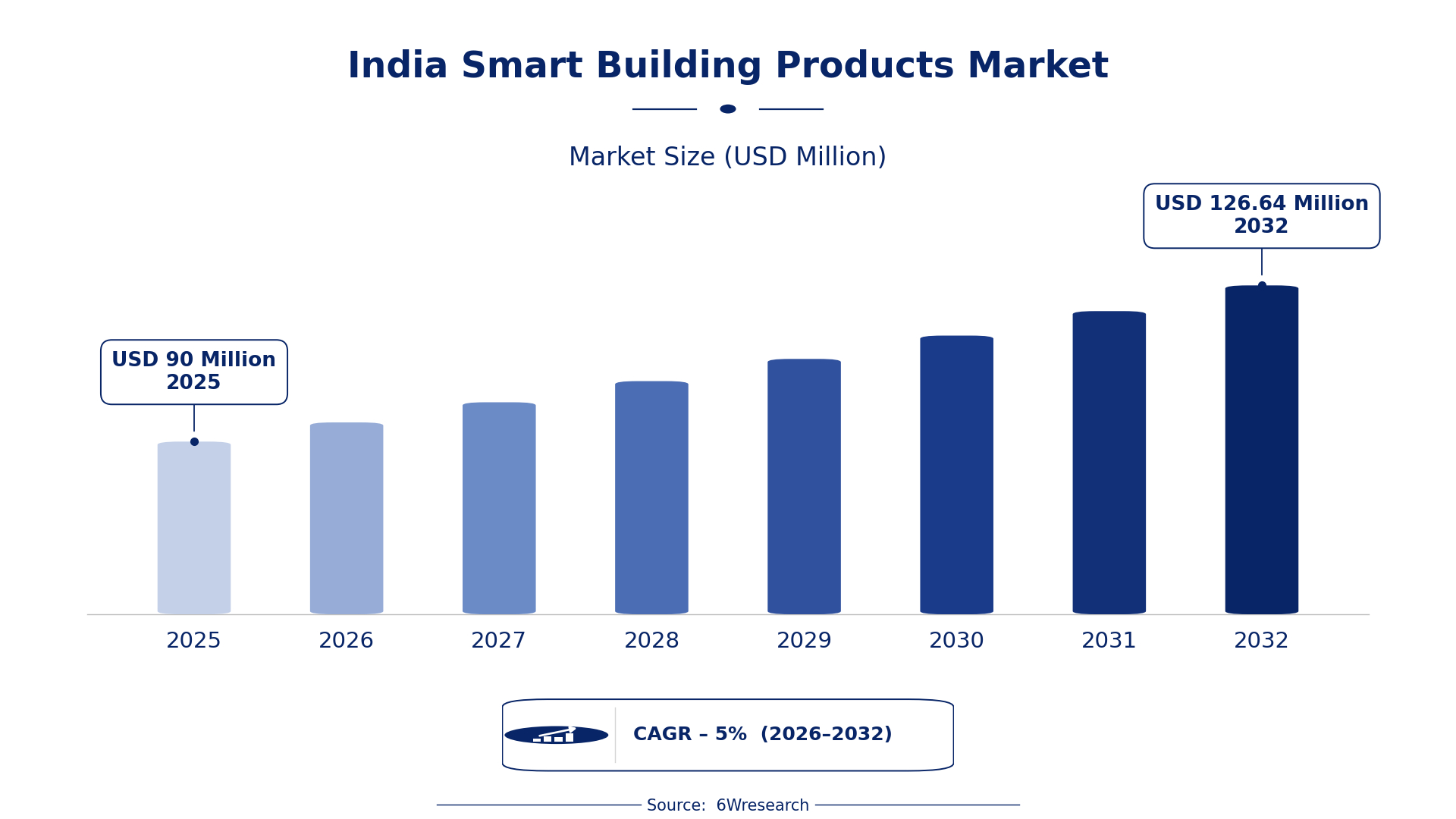
According to 6Wresearch internal database and industry insights, the India Smart Building Products Market was valued at USD 90.0 million in 2025 and is projected to reach USD 126.64 million by 2032, growing at a CAGR of approximately 5% during 2026–2032.
India Smart Building Products Market Highlights
| Report Metric | Details |
| Report Name | India Smart Building Products Market |
| Market Size 2025 | USD 90.0 million |
| Market Size 2032 | USD 126.64 million |
| Absolute Growth 2025–2032 | USD 36.64 million |
| CAGR 2026–2032 | 5% |
| Peak Annual Growth | 7.5% in 2030 |
| Forecast Period | 2026–2032 |
| Historical Data | 2022–2025 |
| Base Year | 2025 |
| Leading Product Type, 2025 | Smart HVAC Systems (37% share) |
| Leading Functionality, 2025 | Energy-Efficient Climate (45% share) |
| Leading Application Area, 2025 | Commercial Complexes (49% share) |
| Leading End User, 2025 | Building Contractors (42% share) |
| Fastest-Growing Product Type | Smart Glass Panels (6.7% CAGR) |
| Fastest-Growing Functionality | Light Control + Tinting (7.5% CAGR) |
| Fastest-Growing Application Area | Green Buildings (7.8% CAGR) |
| Fastest-Growing End User | Architects (6.4% CAGR) |
| Growing Sector | Commercial Complexes |
| Key End Users | Building Contractors, Architects, Electrical Consultants |
India Smart Building Products Market Year-wise Growth Rate and Key Drivers (2022–2032)
This graph illustrates the annual growth rates of the market from 2022 to 2032, highlighting a steady upward trajectory and projected market expansion over the forecast period.
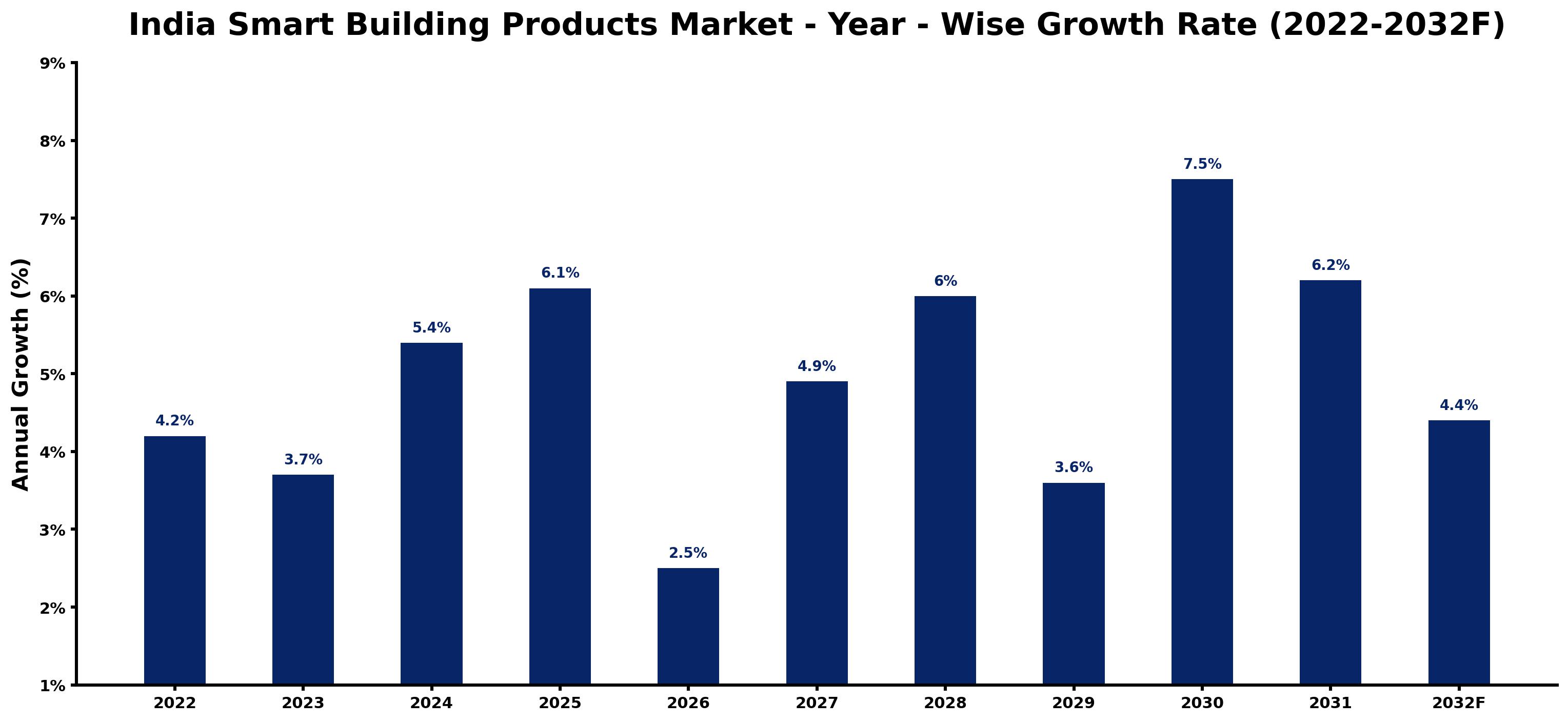
Annual growth estimates for each year appear below with the principal reason behind them, explaining the shifts that set the pace of the market.
| Year | Estimated Annual Growth (%) | Market Rationale |
| 2022 | 4.2 | The market showed steady growth, reflecting ongoing urbanisation and increased adoption of smart technologies. |
| 2023 | 3.7 | Growth slowed as the market adjusted to evolving standards and consumer preferences in smart building technologies. |
| 2024 | 5.4 | Demand increased due to rising investments in energy-efficient solutions and government initiatives promoting smart buildings. |
| 2025 | 6.1 | The market peaked as commercial complexes in major cities adopted smart HVAC systems extensively. |
| 2026 | 2.5 | Growth slowed as the market faced challenges in integrating advanced technologies into existing infrastructure. |
| 2027 | 4.9 | Demand accelerated as building contractors increasingly embraced smart technologies for new projects. |
| 2028 | 6.0 | Growth continued as energy-efficient climate control technologies gained traction in urban developments. |
| 2029 | 3.6 | The market experienced a slowdown due to market saturation in certain urban areas. |
| 2030 | 7.5 | Demand surged as the Smart Cities Mission expanded, driving investments in smart building infrastructure. |
| 2031 | 6.2 | Growth slowed as the market matured and competition intensified among smart technology providers. |
| 2032 | 4.4 | The market continues to grow, driven by ongoing urban development and sustainability initiatives. |
Note: Market size estimations and growth projections presented in this report are based on 6Wresearch's proprietary forecasting methodology, utilizing the latest available industry data, government publications, and primary research inputs.
India Smart Building Products Market Synopsis
Smart Building Products in India include advanced technologies aimed at improving building efficiency and user experience. These products, such as IoT devices, sensors, and automation software, are primarily utilised for energy management and enhanced security. The India Smart Building Products Market is experiencing growth driven by urbanisation, government initiatives, and a heightened focus on sustainable construction practices. As of 2023, more than 30% of new buildings in India are designed as green buildings, showcasing a shift in industry standards. The Smart Cities Mission aims to develop 100 smart cities, which further stimulates demand for these products.
Market Dynamics Impact Analysis (2026–2032)
| Factor | Type | Impact | Primary Segment Affected |
| Increasing adoption of smart HVAC systems in commercial complexes drives demand for energy-efficient solutions. | Driver | High | Smart HVAC Systems |
| Growing focus on energy-efficient climate control technologies creates opportunities for innovative products. | Opportunity | High | Energy-Efficient Climate |
| Regulatory standards mandating energy efficiency in buildings limit the market's growth potential. | Restraint | High | Smart Lighting Systems |
| High installation costs of smart building technologies pose challenges for widespread adoption. | Challenge | High | Smart Elevators |
| Rising demand for smart glass panels in luxury residential projects boosts market growth. | Driver | Medium | Smart Glass Panels |
| The increasing need for energy management solutions in urban areas presents investment opportunities. | Opportunity | Medium | Smart Lighting Systems |
| Limited awareness of smart building technologies among architects restricts market expansion. | Restraint | Medium | Smart HVAC Systems |
| Integration challenges with existing building systems hinder the adoption of smart technologies. | Challenge | Medium | Smart Glass Panels |
Evaluation of Drivers in India Smart Building Products Market (2026–2032)
The table below links each growth driver to the segment it affects and the evidence for it.
| Drivers | Primary Segment Affected | Why It Matters (Evidence) |
| Growing adoption of smart HVAC systems in commercial complexes boosts energy efficiency. | Smart HVAC Systems | As of 2023, over 50% of commercial buildings in India are equipped with smart technologies. |
| Increased investments in energy-efficient climate control technologies drive demand for solutions. | Energy-Efficient Climate | Energy-efficient climate control technologies can reduce energy consumption by up to 40%. |
| The rising popularity of smart glass panels in luxury residential projects supports market growth. | Smart Glass Panels | Smart glass panels are increasingly used in urban luxury residential developments. |
| The demand for smart lighting systems in educational institutions fuels market expansion. | Smart Lighting Systems | Smart lighting systems are increasingly used in urban educational institutions. |
| The Smart Cities Mission drives investments in smart building infrastructure across India. | Smart Elevators | The Smart Cities Mission aims to develop 100 smart cities across India by 2023. |
Growth across the Smart Building Products market in India is anchored in rising investments in energy-efficient solutions and increasing adoption of smart technologies. As of 2023, over 50% of commercial buildings are equipped with smart technologies, indicating a shift in industry practices. The focus on energy-efficient climate control technologies is expected to reduce energy consumption by up to 40%, prompting contractors to invest in these solutions. The demand for smart lighting systems in educational institutions is growing, reflecting changing preferences towards sustainability.
Evaluation of Restraints in India Smart Building Products Market
The following restraints limit how fast demand can grow.
| Market Restraint | Primary Segment Affected | Why It Matters (Evidence) |
| Regulatory standards mandating energy efficiency in buildings limit market growth potential. | Smart Lighting Systems | The Bureau of Energy Efficiency sets standards for energy-efficient technologies in buildings. |
| High installation costs of smart building technologies pose challenges for widespread adoption. | Smart Elevators | Smart elevators are essential in high-rise buildings, especially in metropolitan cities. |
| Limited awareness of smart building technologies among architects restricts market expansion. | Smart HVAC Systems | The Indian Green Building Council promotes the adoption of smart building technologies. |
| Integration challenges with existing building systems hinder the adoption of smart technologies. | Smart Glass Panels | Smart glass panels are increasingly used in educational institutions in urban areas. |
| Market saturation in certain urban areas slows down growth in smart building products. | Energy-Efficient Climate | As of 2023, over 30% of new buildings in India are designed as green buildings. |
India Smart Building Products Market Challenges
Buyers and suppliers in the India Smart Building Products market encounter immediate technology integration challenges, as many existing buildings lack the necessary infrastructure for advanced solutions. This problem stems from rapid urbanisation, which has outpaced the adoption of energy-efficient practices. High initial costs also burden buyers; for instance, integrating smart HVAC systems can increase upfront expenses by 30% compared to traditional systems. Additionally, the supply chain for these products suffers from inconsistent component availability, leading to project delays that can extend timelines by up to six months for construction firms.
Trends in the India Smart Building Products Market
Four trends stand out in the India Smart Building Products Market.
- Shift towards Energy-Efficient Solutions: India is increasingly adopting energy-efficient solutions in building design, driven by government initiatives. The National Building Code of India promotes energy-efficient practices, with over 30% of new buildings incorporating these technologies.
- Growing Popularity of Smart Glass Panels: Smart glass panels are becoming more common in luxury residential projects, reflecting a trend towards modern building aesthetics. As of 2023, over 30% of new buildings incorporate smart glass technology.
- Transition from Traditional to Smart Lighting: Educational institutions are moving from traditional lighting to smart lighting systems to improve energy efficiency. This shift is backed by initiatives promoting sustainable urban infrastructure.
- Emergence of Green Building Practices: Green building practices are gaining traction, with the Indian Green Building Council promoting sustainable technologies. As of 2023, over 30% of new buildings are designed as green buildings.
Investment Opportunities in the India Smart Building Products Market
The following opportunities in the India Smart Building Products Market pair current demand with a clear way in.
- Partnerships with Local Contractors: Building contractors are increasingly pursuing partnerships to implement smart technologies in new projects. With over 50% of commercial buildings equipped with smart technologies, now presents an ideal opportunity for local collaborations.
- Focus on Energy-Efficient Climate Control: The demand for energy-efficient climate control technologies is on the rise, particularly in urban developments. With energy-efficient solutions capable of reducing consumption by up to 40%, suppliers can target commercial complexes for investment.
- Investment in Smart Lighting Solutions: Educational institutions are actively investing in smart lighting solutions to enhance energy efficiency. Suppliers should concentrate on urban areas where smart lighting systems are being increasingly adopted.
- Entry into the Luxury Residential Market: The growing popularity of smart glass panels in luxury residential projects offers a notable opportunity. Suppliers can penetrate this market by collaborating with architects and builders focused on modern aesthetics.
Government Initiatives in the India Smart Building Products Market
The Bureau of Energy Efficiency released the Energy Conservation Building Code in 2020, mandating energy-efficient designs for new buildings. This regulation impacts buyers by ensuring compliance with energy efficiency standards, promoting the adoption of smart technologies. The National Building Code of India also encourages energy-efficient building practices, further supporting the market for smart building products. These measures motivate producers to innovate and comply with sustainability goals, driving market growth.
The Smart Cities Mission allocated ₹48,000 crore for the development of smart infrastructure across 100 cities in India, including smart buildings. The Ministry of Housing and Urban Affairs oversees this initiative, which funds various projects aimed at enhancing urban living through smart technologies. This funding supports the integration of smart building products into urban planning, benefiting both producers and buyers. The mission's focus on sustainability aligns with the increasing demand for energy-efficient solutions.
Future Insight of the India Smart Building Products Market
The India Smart Building Products market is set to evolve significantly by 2032, driven by urban planning initiatives and government backing for sustainable construction. The National Building Code promotes energy-efficient practices, encouraging more buildings to adopt smart technologies. By 2025, the integration of AI routing in elevators will rise by 20%, improving operational efficiency in high-rise buildings. Furthermore, over 50% of commercial buildings are now equipped with smart technologies, indicating a strong shift towards advanced solutions in urban infrastructure.
Market Segmentation Analysis
The report offers a comprehensive study of the following market segments and their leading categories in the market.
By Product Type – Smart HVAC Systems Dominated, Smart Glass Panels Expected to Grow Fastest
According to Dhaval Chaurasia, Assistant Manager at 6Wresearch, the largest product type category in 2025 was Smart HVAC Systems, with a 37% share of total revenue. Smart HVAC systems hold the largest market share due to their essential role in energy-efficient climate control within buildings. Their extensive use in commercial complexes across major urban centres like Delhi and Mumbai underscores their importance in modern infrastructure. The quickest growth will come from Smart Glass Panels, forecast to expand at a CAGR of 6.7% between 2026 and 2032. Smart glass panels are rapidly gaining traction, particularly in luxury residential projects, where they provide effective light control and significant energy savings. This surge reflects the growing preference for energy-efficient and visually appealing solutions in urban settings. Suppliers should prioritise the development of smart glass technologies to capitalise on the increasing market demand.
By Functionality – Energy-Efficient Climate Dominated, Light Control + Tinting Expected to Grow Fastest
Energy-Efficient Climate accounted for a 45% market share by functionality in 2025. Energy-efficient climate control leads the market share as it is crucial for reducing energy consumption in buildings. This functionality aligns with national energy efficiency initiatives and is vital for compliance with standards established by the Bureau of Energy Efficiency. Over 2026–2032, Light Control + Tinting is expected to post the fastest growth, at a CAGR of 7.5%. Light control and tinting technologies are experiencing swift growth, driven by their necessity for managing natural light and heat in urban developments. The rising focus on energy efficiency in architectural designs makes this functionality increasingly important. Buyers should emphasise energy-efficient solutions to meet regulatory requirements and lower operational expenses.
By Application Area – Commercial Complexes Dominated, Green Buildings Expected to Grow Fastest
Commercial Complexes took a 49% share of application area in 2025, more than any other category. Commercial complexes dominate the market share as the primary application area for smart building products, driven by the need for enhanced efficiency and user experience. With over 50% of these buildings in India equipped with smart technologies, their adoption is clearly on the rise. Green Buildings are set to record the highest CAGR in this split, 7.8% over 2026–2032. Green buildings are seeing the fastest growth, aligning with sustainability goals and regulations outlined in the National Building Code of India. The increasing emphasis on environmentally friendly construction practices is making this segment more appealing. Suppliers must tailor their offerings to meet the growing demand for smart technologies in green building initiatives.
By End User – Building Contractors Dominated, Architects Expected to Grow Fastest
Building Contractors held a 42% share of the India Smart Building Products Market by end user in 2025. Building contractors represent the largest share of the market as key users implementing smart technologies in construction projects. Their involvement is essential for ensuring that new buildings adhere to rising standards for energy efficiency and smart solutions. Architects are projected to grow fastest, at a CAGR of 6.4% during 2026–2032. Architects are the fastest-growing end user group, playing a significant role in the design and integration of smart systems in new developments. Their commitment to innovative designs that incorporate smart technologies is propelling this segment's rapid growth. Suppliers should engage with architects to ensure their products align with evolving design and functionality needs.
Key Attractiveness of the Report
- 10 Years of Market Numbers
- Historical Data Starting from 2022 to 2025
- Base Year 2025
- Forecast Data until 2032
- Key Performance Indicators Impacting the Market
- Major Upcoming Developments and Projects
Key Highlights of the Report:
- India Smart Building Products Market Outlook
- Market Size of India Smart Building Products Market, 2025
- Forecast of India Smart Building Products Market, 2032
- Historical Data and Forecast of India Smart Building Products Revenues & Volume for the Period 2022 - 2032F
- India Smart Building Products Market Trend Evolution
- India Smart Building Products Market Drivers and Challenges
- India Smart Building Products Price Trends
- India Smart Building Products Porter's Five Forces
- India Smart Building Products Industry Life Cycle
- Historical Data and Forecast of India Smart Building Products Market Revenues & Volume By Product Type for the Period 2022 - 2032F
- Historical Data and Forecast of India Smart Building Products Market Revenues & Volume By Smart HVAC Systems for the Period 2022 - 2032F
- Historical Data and Forecast of India Smart Building Products Market Revenues & Volume By Smart Glass Panels for the Period 2022 - 2032F
- Historical Data and Forecast of India Smart Building Products Market Revenues & Volume By Smart Lighting Systems for the Period 2022 - 2032F
- Historical Data and Forecast of India Smart Building Products Market Revenues & Volume By Smart Elevators for the Period 2022 - 2032F
- Historical Data and Forecast of India Smart Building Products Market Revenues & Volume By Functionality for the Period 2022 - 2032F
- Historical Data and Forecast of India Smart Building Products Market Revenues & Volume By Energy-Efficient Climate for the Period 2022 - 2032F
- Historical Data and Forecast of India Smart Building Products Market Revenues & Volume By Light Control + Tinting for the Period 2022 - 2032F
- Historical Data and Forecast of India Smart Building Products Market Revenues & Volume By Motion + Ambient Control for the Period 2022 - 2032F
- Historical Data and Forecast of India Smart Building Products Market Revenues & Volume By AI Routing + Touchless for the Period 2022 - 2032F
- Historical Data and Forecast of India Smart Building Products Market Revenues & Volume By Application Area for the Period 2022 - 2032F
- Historical Data and Forecast of India Smart Building Products Market Revenues & Volume By Commercial Complexes for the Period 2022 - 2032F
- Historical Data and Forecast of India Smart Building Products Market Revenues & Volume By Green Buildings for the Period 2022 - 2032F
- Historical Data and Forecast of India Smart Building Products Market Revenues & Volume By Offices/Schools for the Period 2022 - 2032F
- Historical Data and Forecast of India Smart Building Products Market Revenues & Volume By Skyscrapers/Malls for the Period 2022 - 2032F
- Historical Data and Forecast of India Smart Building Products Market Revenues & Volume By End User for the Period 2022 - 2032F
- Historical Data and Forecast of India Smart Building Products Market Revenues & Volume By Building Contractors for the Period 2022 - 2032F
- Historical Data and Forecast of India Smart Building Products Market Revenues & Volume By Architects for the Period 2022 - 2032F
- Historical Data and Forecast of India Smart Building Products Market Revenues & Volume By Electrical Consultants for the Period 2022 - 2032F
- Historical Data and Forecast of India Smart Building Products Market Revenues & Volume By Vertical Transport Firms for the Period 2022 - 2032F
- India Smart Building Products Import Export Trade Statistics
- Market Opportunity Assessment By Product Type
- Market Opportunity Assessment By Functionality
- Market Opportunity Assessment By Application Area
- Market Opportunity Assessment By End User
- India Smart Building Products Top Companies Market Share
- India Smart Building Products Competitive Benchmarking By Technical and Operational Parameters
- India Smart Building Products Company Profiles
- India Smart Building Products Key Strategic Recommendations
Market Covered
Segments analysed in this report are listed below.
By Product Type
- Smart HVAC Systems
- Smart Glass Panels
- Smart Lighting Systems
- Smart Elevators
By Functionality
- Energy-Efficient Climate
- Light Control + Tinting
- Motion + Ambient Control
- AI Routing + Touchless
By Application Area
- Commercial Complexes
- Green Buildings
- Offices/Schools
- Skyscrapers/Malls
By End User
- Building Contractors
- Architects
- Electrical Consultants
- Vertical Transport Firms































