China Smart Building Products Market Size & Growth Rate
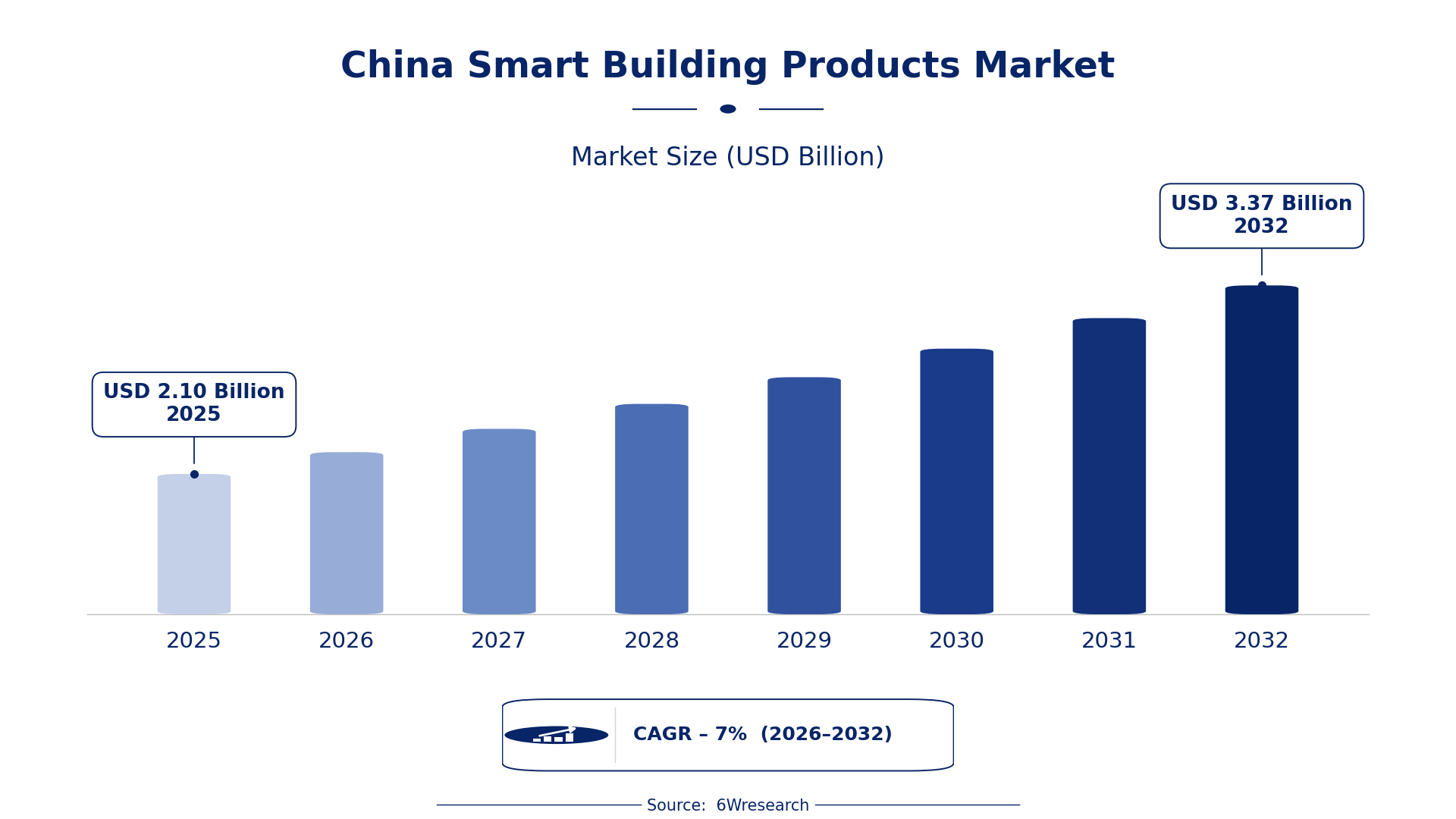
According to 6Wresearch internal database and industry insights, the China Smart Building Products Market was valued at USD 2.10 billion in 2025 and is projected to reach USD 3.37 billion by 2032, growing at a CAGR of approximately 7% during 2026–2032.
China Smart Building Products Market Highlights
| Report Metric | Details |
| Report Name | China Smart Building Products Market |
| Market Size 2025 | USD 2.10 billion |
| Market Size 2032 | USD 3.37 billion |
| Absolute Growth 2025–2032 | USD 1.27 billion |
| CAGR 2026–2032 | 7% |
| Peak Annual Growth | 9.5% in 2026 |
| Forecast Period | 2026–2032 |
| Historical Data | 2022–2025 |
| Base Year | 2025 |
| Leading Product Type, 2025 | Smart HVAC Systems (35% share) |
| Leading Functionality, 2025 | Energy-Efficient Climate (39% share) |
| Leading Application Area, 2025 | Commercial Complexes (39% share) |
| Leading End User, 2025 | Building Contractors (44% share) |
| Fastest-Growing Product Type | Smart Lighting Systems (8.1% CAGR) |
| Fastest-Growing Functionality | Light Control + Tinting (8.7% CAGR) |
| Fastest-Growing Application Area | Green Buildings (8.3% CAGR) |
| Fastest-Growing End User | Architects (9.1% CAGR) |
| Growing Sector | Commercial Complexes |
| Key End Users | Building Contractors, Architects, Electrical Consultants, Vertical Transport Firms |
China Smart Building Products Market Year-wise Growth Rate and Key Drivers (2022–2032)
This graph illustrates the annual growth rates of the market from 2022 to 2032, highlighting a steady upward trajectory and projected market expansion over the forecast period.
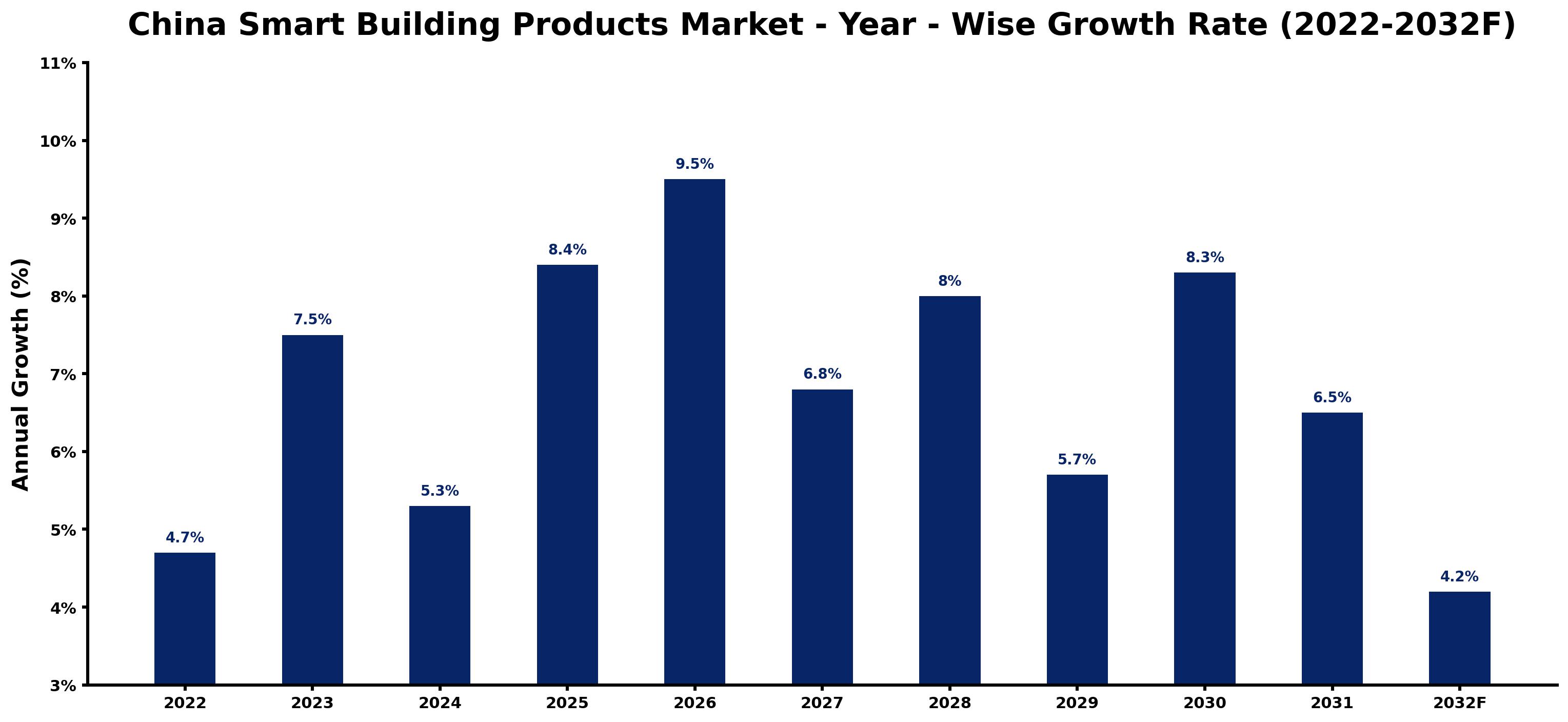
Below, each year's estimated growth is shown next to the factor that most influenced it.
| Year | Estimated Annual Growth (%) | Market Rationale |
| 2022 | 4.7 | The market experienced steady growth, driven by increased urbanisation and demand for energy-efficient solutions. |
| 2023 | 7.5 | Growth accelerated due to the Smart City Development Strategy promoting smart building technologies and urban development. |
| 2024 | 5.3 | The market saw a slowdown as the implementation of the national standard GB/T 50378-2019 began affecting project timelines. |
| 2025 | 8.4 | Demand surged with the completion of major infrastructure projects and increased investment in green technologies under the Green Building Action Plan. |
| 2026 | 9.5 | The market is expected to peak as smart building technologies gain widespread acceptance in urban areas, supported by government initiatives. |
| 2027 | 6.8 | Growth will slow as the market adjusts to the rapid expansion of previous years and the completion of major projects. |
| 2028 | 8.0 | Demand is projected to rebound with a renewed focus on energy efficiency and sustainability in building designs, particularly in commercial complexes. |
| 2029 | 5.7 | The market is expected to experience a slowdown as competition intensifies among technology providers in major cities. |
| 2030 | 8.3 | Growth will accelerate again as urban populations increase and smart technologies become more integrated into new constructions. |
| 2031 | 6.5 | The market is projected to slow as the focus shifts towards maintaining existing smart systems and retrofitting older buildings, impacting demand. |
| 2032 | 4.2 | Growth will continue but at a slower pace as the market stabilises and matures, with ongoing government support for green buildings. |
Note: Market size estimations and growth projections presented in this report are based on 6Wresearch's proprietary forecasting methodology, utilizing the latest available industry data, government publications, and primary research inputs.
China Smart Building Products Market Synopsis
Smart Building Products in China include advanced technologies integrated into structures to improve efficiency, comfort, and security. These products utilise IoT, AI, and automation technologies, primarily for energy management and enhanced occupant comfort. The China Smart Building Products Market is projected to reach 1 trillion yuan by 2025, driven by urbanisation and government initiatives promoting green building practices. The aim for 50% of new buildings to be green by 2025 significantly boosts demand for these technologies.
Market Dynamics Impact Analysis (2026–2032)
| Factor | Type | Impact | Primary Segment Affected |
| Urbanisation and rising population density drive demand for energy-efficient buildings. | Driver | High | Smart HVAC Systems |
| Government initiatives promote green building practices, increasing the adoption of smart technologies. | Driver | High | Smart Lighting Systems |
| Growing urban populations create opportunities for smart building implementations in new developments. | Opportunity | High | Commercial Complexes |
| The increasing focus on sustainability opens avenues for suppliers of energy-efficient products. | Opportunity | High | Green Buildings |
| High initial costs of smart building technologies can deter potential buyers. | Restraint | Medium | Smart Elevators |
| Complex regulatory requirements may slow down project approvals and implementations. | Restraint | Medium | Smart Glass Panels |
| Supply chain disruptions can delay the availability of essential components for smart systems. | Challenge | Medium | Smart Lighting Systems |
| Rapid technological advancements may outpace current market offerings, leading to obsolescence. | Challenge | Medium | Smart HVAC Systems |
Evaluation of Drivers in China Smart Building Products Market (2026–2032)
The factors lifting demand, and the evidence behind each, are summarised below.
| Drivers | Primary Segment Affected | Why It Matters (Evidence) |
| Increased urbanisation leads to higher demand for energy-efficient climate control solutions. | Smart HVAC Systems | Smart HVAC systems can reduce energy consumption by up to 30% in commercial buildings. |
| Government initiatives promote the integration of smart technologies in new constructions. | Smart Lighting Systems | Smart lighting systems are increasingly installed in over 60% of new commercial buildings in urban areas. |
| Growing construction of skyscrapers and malls boosts demand for advanced building technologies. | Smart Elevators | The demand for smart elevators is growing due to the construction of over 100 new skyscrapers in major cities. |
| The push for green buildings drives the adoption of energy-efficient technologies. | Energy-Efficient Climate | The government aims for 50% of new buildings to be green by 2025 under the Green Building Action Plan. |
| The establishment of technology standards enhances market transparency and encourages investment. | Smart Glass Panels | The national standard GB/T 50378-2019 outlines requirements for smart building design. |
The construction of over 100 new skyscrapers in major cities boosts demand for smart elevators, improving vertical transport efficiency. Smart lighting systems are now installed in over 60% of new commercial buildings, reflecting a commitment to modernisation and efficiency. The national standard GB/T 50378-2019 outlines requirements for smart building design, encouraging investment in innovative technologies.
Evaluation of Restraints in China Smart Building Products Market
The key brakes on demand, and where they bite hardest, are shown below.
| Market Restraint | Primary Segment Affected | Why It Matters (Evidence) |
| High initial costs of smart building technologies can deter potential buyers. | Smart Elevators | The upfront investment required for smart elevators may limit adoption among smaller developers. |
| Complex regulatory requirements may slow down project approvals and implementations. | Smart Glass Panels | Navigating the regulatory procedures can delay project timelines and increase costs for developers. |
| Supply chain disruptions can delay the availability of essential components for smart systems. | Smart Lighting Systems | Recent global supply chain issues have affected the timely delivery of smart lighting components, impacting project schedules. |
| Limited awareness of smart technologies among some buyer groups hampers market growth. | Smart HVAC Systems | Many building contractors may not fully understand the benefits of integrating smart HVAC solutions into their projects. |
| Technological obsolescence may deter investment in smart building products. | Smart Glass Panels | Rapid advancements in technology can make existing products seem outdated, discouraging purchases among developers. |
China Smart Building Products Market Challenges
Producers in the China Smart Building Products Market face fierce competition, which compels them to reduce prices and threatens profit margins, potentially undermining financial stability. Buyers encounter inflated costs due to the high expenses associated with advanced technologies; for example, smart HVAC systems may require up to 30% more in initial investments. Importers deal with supply chain disruptions, particularly concerning smart lighting systems, resulting in project delays and additional costs for contractors. Adhering to the national standard GB/T 50378-2019 can extend project timelines, complicating buyers' efforts to achieve green building targets.
Trends in the China Smart Building Products Market
The trends below show where the China Smart Building Products Market is heading.
- Architects Embracing Smart Design: Architects are increasingly incorporating smart technologies into their designs, focusing on energy efficiency. In 2023, over 60% of new projects in Beijing featured smart building elements, reflecting a shift towards modernisation.
- Green Buildings Gaining Popularity: Green buildings are becoming the standard in urban development, supported by government incentives. The Green Building Action Plan aims for 50% of new buildings to be green by 2025, promoting sustainable construction practices.
- Rise of Smart Lighting Systems: Smart lighting systems are increasingly prevalent in commercial complexes, improving energy efficiency and user comfort. In urban areas, over 60% of new commercial buildings now feature these advanced systems.
- Smart Elevators in Skyscrapers: The construction of new skyscrapers in major cities is driving demand for smart elevators. With over 100 new skyscrapers planned, the need for efficient vertical transport solutions is more pressing than ever.
Investment Opportunities in the China Smart Building Products Market
Below are the investment opportunities with the strongest case in the China Smart Building Products Market.
- Commercial Complexes in Major Cities: With urbanisation on the rise, there is a chance to supply smart building technologies in commercial complexes. By 2025, these complexes are projected to represent 39% of the market share, offering a substantial target for suppliers.
- Energy-Efficient Climate Solutions: The demand for energy-efficient climate solutions is rising, supported by government initiatives. Suppliers can focus on building contractors, who are key users of these technologies, to satisfy the growing need for sustainable solutions.
- Green Building Initiatives: As the government aims for 50% of new buildings to be green by 2025, there is an urgent requirement for suppliers of sustainable building technologies. Collaborating with local contractors can ease market entry and improve project success.
- Smart Glass Panels in Luxury Developments: The luxury residential market is increasingly adopting smart glass panels, especially in cities like Shenzhen. This trend presents a valuable opportunity for suppliers to meet the demand for energy-efficient solutions.
Government Initiatives in the China Smart Building Products Market
The Green Building Action Plan, issued by the Ministry of Housing and Urban-Rural Development in 2020, aims to promote sustainable building practices by targeting 50% green buildings by 2025. This measure requires builders to comply with specific standards, encouraging the adoption of smart technologies in new constructions. Additionally, the Energy Efficiency Labeling Program, updated in 2022, mandates energy efficiency ratings for smart building products, improving market transparency and consumer confidence.
The Smart City Development Strategy, launched in 2021 by the National Development and Reform Commission, focuses on integrating smart technologies into urban planning and infrastructure. This initiative funds various smart city projects, enabling building contractors to access resources and support for implementing smart building solutions. The Ministry of Housing and Urban-Rural Development oversees the approval of smart building projects, ensuring compliance with national standards and facilitating market growth.
Future Insight of the China Smart Building Products Market
The China Smart Building Products Market is anticipated to evolve significantly by 2032, driven by urbanisation and supportive government policies. The construction of over 200 new skyscrapers will heighten the demand for energy-efficient solutions and advanced technologies. Urban areas are projected to accommodate 1 billion people, creating a pressing need for improved building efficiency and comfort. The government's commitment to green building practices will further accelerate the adoption of smart technologies, while the allocation of 5 billion yuan for smart city infrastructure will enable substantial progress in this sector.
Market Segmentation Analysis
The analysis below covers each segmentation, its leading category in 2025 and its fastest-growing category through 2032.
By Product Type – Smart HVAC Systems Dominated, Smart Lighting Systems Expected to Grow Fastest
According to Dhaval Chaurasia, Assistant Manager at 6Wresearch, Smart HVAC Systems took a 35% share of product type in 2025, more than any other category. Smart HVAC systems hold the largest market share as they are crucial for energy management and climate control in commercial buildings. Their ability to cut energy consumption by up to 30% makes them particularly sought after in major urban centres like Beijing and Shanghai. Over 2026–2032, Smart Lighting Systems are expected to post the fastest growth, at a CAGR of 8.1%. The rapid growth of smart lighting systems is driven by their significant impact on energy efficiency and occupant comfort, with over 60% of new commercial buildings in urban areas adopting these technologies. This trend is expected to accelerate as urbanisation and energy regulations tighten. Suppliers should focus on enhancing smart lighting solutions to capitalise on the growing demand in the market.
By Functionality – Energy-Efficient Climate Dominated, Light Control + Tinting Expected to Grow Fastest
Energy-Efficient Climate accounted for a 39% market share by functionality in 2025. Energy-efficient climate control leads the functionality segment, as it is essential for reducing energy consumption in buildings. This focus resonates with government initiatives aimed at promoting green building practices, particularly in urban areas. The quickest growth will come from Light Control + Tinting, forecast to expand at a CAGR of 8.7% between 2026 and 2032. Light control and tinting functionalities are experiencing rapid growth due to their importance in managing natural light and optimising energy use, especially in green buildings. As urban populations increase, the need for effective light management solutions will become more critical. Buyers should prioritise investments in technologies that improve energy efficiency and occupant comfort through advanced light control solutions.
By Application Area – Commercial Complexes Dominated, Green Buildings Expected to Grow Fastest
In 2025, Commercial Complexes led the application area split with a 39% share. Commercial complexes dominate the application area for smart building technologies, as they represent a major investment in urban infrastructure. These complexes are increasingly integrating smart solutions to improve operational efficiency and tenant satisfaction. Green Buildings are projected to grow fastest, at a CAGR of 8.3% during 2026–2032. Green buildings are the fastest-growing application area, driven by the government's goal for 50% of new buildings to be green by 2025. This shift reflects a broader commitment to sustainability and energy efficiency in construction practices. Suppliers should align their offerings with the green building trend to meet the rising demand for sustainable construction solutions.
By End User – Building Contractors Dominated, Architects Expected to Grow Fastest
With a 44% revenue share in 2025, Building Contractors was the largest end user category. Building contractors represent the largest end user group for smart building technologies, as they are integral to the implementation of these systems in new constructions. Their expertise is essential for the successful integration of smart solutions into building projects. Architects are set to record the highest CAGR in this split, 9.1% over 2026–2032. Architects are the fastest-growing end user segment, as they are key in designing smart buildings that incorporate advanced technologies. Their influence on building design will further accelerate the adoption of smart solutions in the market. Suppliers must collaborate with architects to ensure their products align with the evolving design needs of smart buildings.
Key Attractiveness of the Report
- 10 Years of Market Numbers
- Historical Data Starting from 2022 to 2025
- Base Year 2025
- Forecast Data until 2032
- Key Performance Indicators Impacting the Market
- Major Upcoming Developments and Projects
Key Highlights of the Report:
- China Smart Building Products Market Outlook
- Market Size of China Smart Building Products Market, 2025
- Forecast of China Smart Building Products Market, 2032
- Historical Data and Forecast of China Smart Building Products Revenues & Volume for the Period 2022 - 2032F
- China Smart Building Products Market Trend Evolution
- China Smart Building Products Market Drivers and Challenges
- China Smart Building Products Price Trends
- China Smart Building Products Porter's Five Forces
- China Smart Building Products Industry Life Cycle
- Historical Data and Forecast of China Smart Building Products Market Revenues & Volume By Product Type for the Period 2022 - 2032F
- Historical Data and Forecast of China Smart Building Products Market Revenues & Volume By Smart HVAC Systems for the Period 2022 - 2032F
- Historical Data and Forecast of China Smart Building Products Market Revenues & Volume By Smart Glass Panels for the Period 2022 - 2032F
- Historical Data and Forecast of China Smart Building Products Market Revenues & Volume By Smart Lighting Systems for the Period 2022 - 2032F
- Historical Data and Forecast of China Smart Building Products Market Revenues & Volume By Smart Elevators for the Period 2022 - 2032F
- Historical Data and Forecast of China Smart Building Products Market Revenues & Volume By Functionality for the Period 2022 - 2032F
- Historical Data and Forecast of China Smart Building Products Market Revenues & Volume By Energy-Efficient Climate for the Period 2022 - 2032F
- Historical Data and Forecast of China Smart Building Products Market Revenues & Volume By Light Control + Tinting for the Period 2022 - 2032F
- Historical Data and Forecast of China Smart Building Products Market Revenues & Volume By Motion + Ambient Control for the Period 2022 - 2032F
- Historical Data and Forecast of China Smart Building Products Market Revenues & Volume By AI Routing + Touchless for the Period 2022 - 2032F
- Historical Data and Forecast of China Smart Building Products Market Revenues & Volume By Application Area for the Period 2022 - 2032F
- Historical Data and Forecast of China Smart Building Products Market Revenues & Volume By Commercial Complexes for the Period 2022 - 2032F
- Historical Data and Forecast of China Smart Building Products Market Revenues & Volume By Green Buildings for the Period 2022 - 2032F
- Historical Data and Forecast of China Smart Building Products Market Revenues & Volume By Offices/Schools for the Period 2022 - 2032F
- Historical Data and Forecast of China Smart Building Products Market Revenues & Volume By Skyscrapers/Malls for the Period 2022 - 2032F
- Historical Data and Forecast of China Smart Building Products Market Revenues & Volume By End User for the Period 2022 - 2032F
- Historical Data and Forecast of China Smart Building Products Market Revenues & Volume By Building Contractors for the Period 2022 - 2032F
- Historical Data and Forecast of China Smart Building Products Market Revenues & Volume By Architects for the Period 2022 - 2032F
- Historical Data and Forecast of China Smart Building Products Market Revenues & Volume By Electrical Consultants for the Period 2022 - 2032F
- Historical Data and Forecast of China Smart Building Products Market Revenues & Volume By Vertical Transport Firms for the Period 2022 - 2032F
- China Smart Building Products Import Export Trade Statistics
- Market Opportunity Assessment By Product Type
- Market Opportunity Assessment By Functionality
- Market Opportunity Assessment By Application Area
- Market Opportunity Assessment By End User
- China Smart Building Products Top Companies Market Share
- China Smart Building Products Competitive Benchmarking By Technical and Operational Parameters
- China Smart Building Products Company Profiles
- China Smart Building Products Key Strategic Recommendations
Market Covered
This report examines the market across the segments below.
By Product Type
- Smart HVAC Systems
- Smart Glass Panels
- Smart Lighting Systems
- Smart Elevators
By Functionality
- Energy-Efficient Climate
- Light Control + Tinting
- Motion + Ambient Control
- AI Routing + Touchless
By Application Area
- Commercial Complexes
- Green Buildings
- Offices/Schools
- Skyscrapers/Malls
By End User
- Building Contractors
- Architects
- Electrical Consultants
- Vertical Transport Firms































