India Smart Building Sensors Market Size & Growth Rate
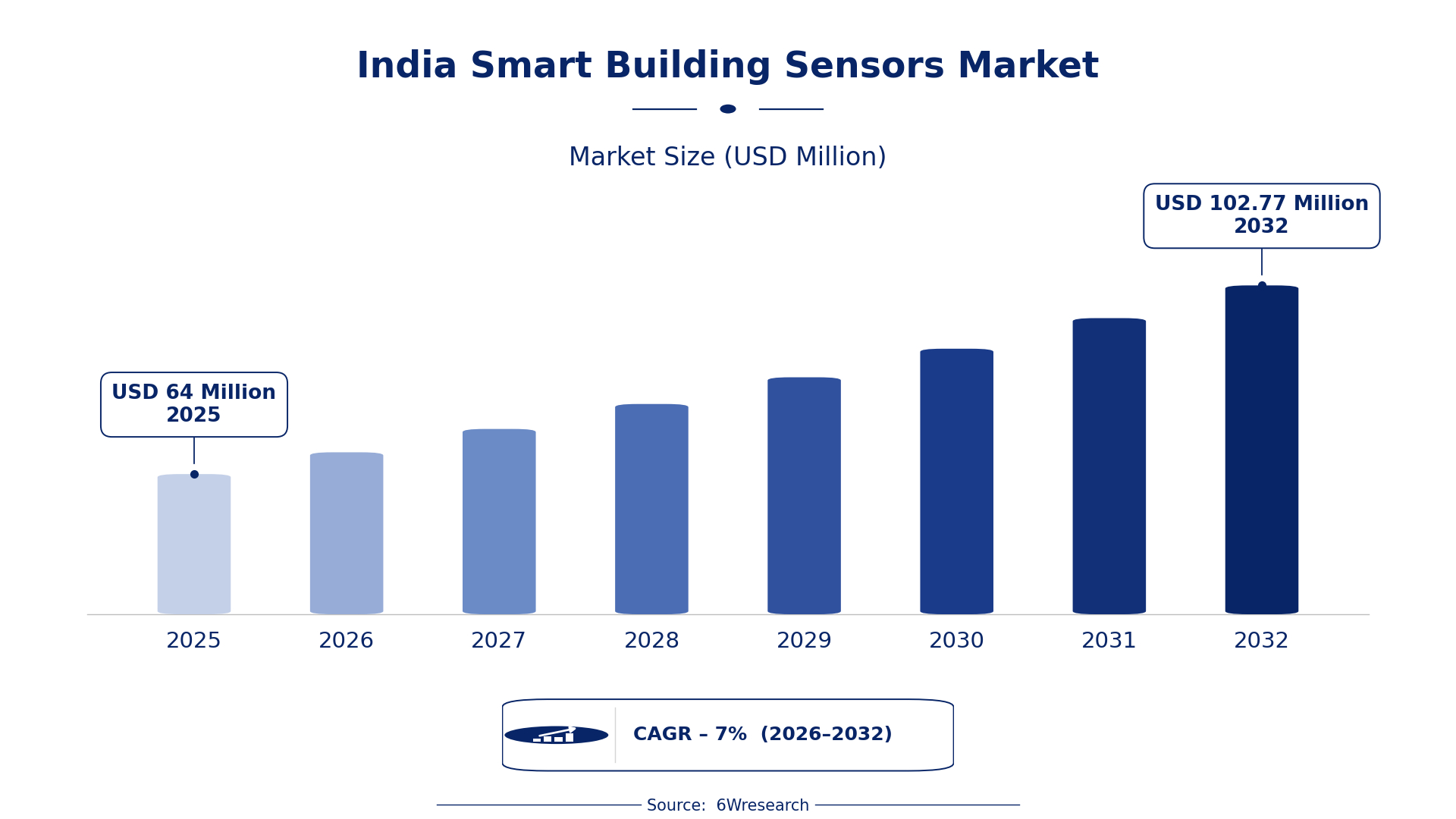
According to 6Wresearch internal database and industry insights, the India Smart Building Sensors Market was valued at USD 64.0 million in 2025 and is projected to reach USD 102.77 million by 2032, growing at a CAGR of approximately 7% during 2026–2032.
India Smart Building Sensors Market Highlights
| Report Metric | Details |
| Report Name | India Smart Building Sensors Market |
| Market Size 2025 | USD 64.0 million |
| Market Size 2032 | USD 102.77 million |
| Absolute Growth 2025–2032 | USD 38.77 million |
| CAGR 2026–2032 | 7% |
| Peak Annual Growth | 9.6% in 2032 |
| Forecast Period | 2026–2032 |
| Historical Data | 2022–2025 |
| Base Year | 2025 |
| Leading Sensor Type, 2025 | Motion Sensors (40% share) |
| Leading Measured Input, 2025 | Occupancy Detection (42% share) |
| Leading Output Platform, 2025 | Building Automation Systems (42% share) |
| Leading End User, 2025 | Security Integrators (41% share) |
| Fastest-Growing Sensor Type | Thermal Sensors (9.7% CAGR) |
| Fastest-Growing Measured Input | Heat Detection (8.9% CAGR) |
| Fastest-Growing Output Platform | Smart Lighting Controls (9.3% CAGR) |
| Fastest-Growing End User | Building Safety Vendors (9.5% CAGR) |
| Growing Sector | Building Safety Vendors |
| Key End Users | Security Integrators, Electrical OEMs, Building Safety Vendors, Facility Maintenance Teams |
India Smart Building Sensors Market Year-wise Growth Rate and Key Drivers (2022–2032)
This graph illustrates the annual growth rates of the market from 2022 to 2032, highlighting a steady upward trajectory and projected market expansion over the forecast period.
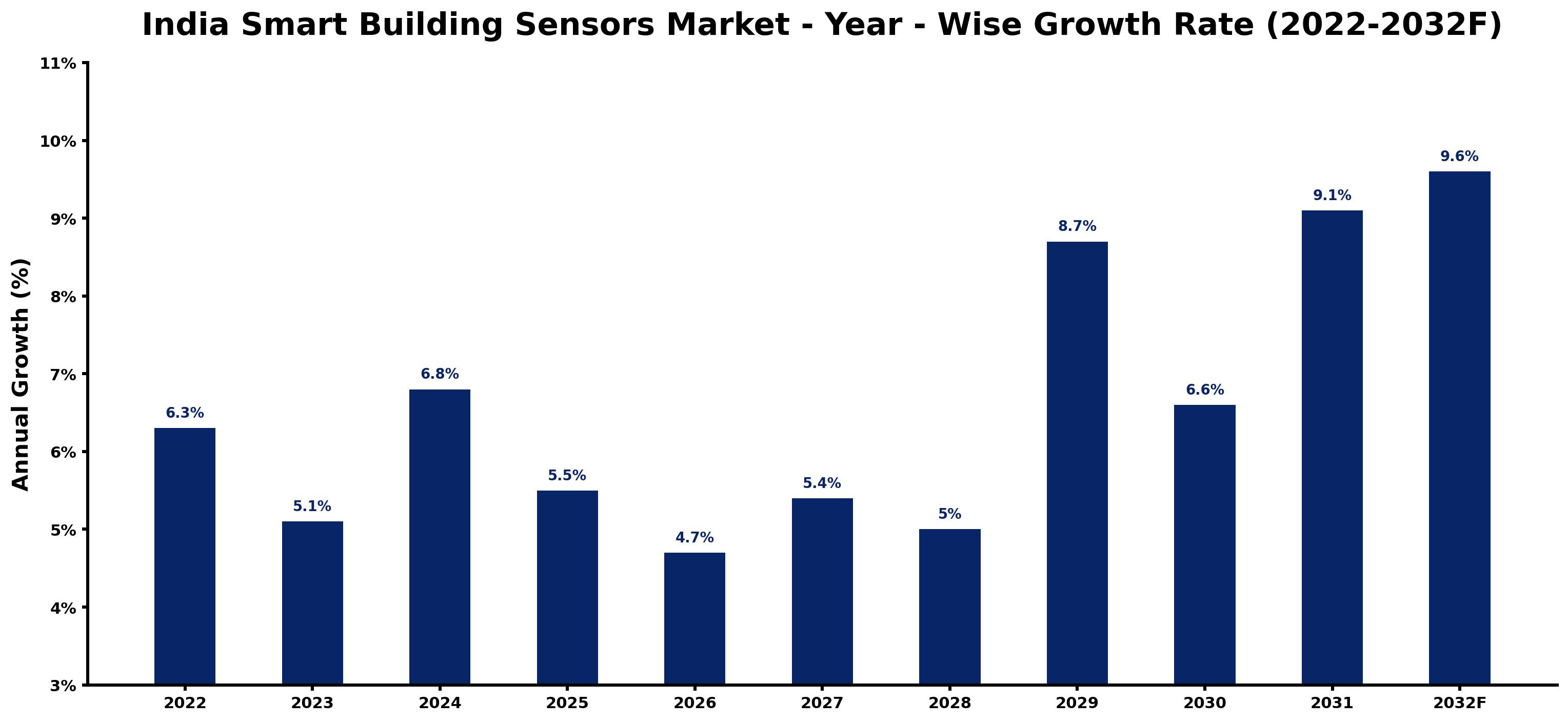
Each row of the following table gives one year's estimated growth and the event or demand shift that explains it.
| Year | Estimated Annual Growth (%) | Market Rationale |
| 2022 | 6.3 | The market experienced steady growth due to increased urbanisation and infrastructure development. |
| 2023 | 5.1 | Growth slowed as the market adjusted to supply chain challenges and economic conditions. |
| 2024 | 6.8 | Demand surged with the implementation of smart city initiatives and urban planning programmes. |
| 2025 | 5.5 | The market continued to grow, driven by investments in energy-efficient building technologies. |
| 2026 | 4.7 | Growth is expected to slow as the market faces regulatory adjustments and project delays. |
| 2027 | 5.4 | Demand is projected to increase as more facilities adopt smart building solutions for energy management. |
| 2028 | 5.0 | Growth is expected to slow slightly due to market saturation in urban regions. |
| 2029 | 8.7 | A rebound in demand is anticipated as urbanisation accelerates and new projects launch. |
| 2030 | 6.6 | Growth is expected to slow as the market stabilises with established technologies. |
| 2031 | 9.1 | Demand is projected to surge again as the urban population increases, driving smart building adoption. |
| 2032 | 9.6 | The market is expected to peak with substantial investments in smart technologies and infrastructure. |
Note: Market size estimations and growth projections presented in this report are based on 6Wresearch's proprietary forecasting methodology, utilizing the latest available industry data, government publications, and primary research inputs.
India Smart Building Sensors Market Synopsis
Smart Building Sensors in India encompass advanced devices for monitoring and controlling building functions. These sensors improve energy efficiency, security, and occupant comfort. The focus on energy management and security further fuels demand across commercial and residential sectors, particularly among security integrators and facility maintenance teams.
Market Dynamics Impact Analysis (2026–2032)
| Factor | Type | Impact | Primary Segment Affected |
| Rising urbanisation leads to increased demand for energy-efficient buildings. | Driver | High | Occupancy Detection |
| Growing investments in smart city projects create opportunities for sensor integration. | Driver | High | Building Automation Systems |
| The push for energy-efficient solutions opens avenues for smart lighting controls. | Opportunity | High | Smart Lighting Controls |
| Increasing focus on building safety drives demand for leak detection sensors. | Opportunity | High | Leak Detection Sensors |
| Regulatory changes may slow down project approvals for smart technologies. | Restraint | Medium | Thermal Sensors |
| High initial costs of smart systems may deter small businesses from adopting them. | Restraint | Medium | Motion Sensors |
| Limited awareness among end-users can hinder market penetration. | Challenge | Medium | Security Integrators |
| Supply chain disruptions may delay project timelines and increase costs. | Challenge | Medium | Facility Maintenance Teams |
Evaluation of Drivers in India Smart Building Sensors Market (2026–2032)
The main growth drivers and the segments they affect most are set out below.
| Drivers | Primary Segment Affected | Why It Matters (Evidence) |
| Increased urbanisation drives demand for smart building technologies. | Building Automation Systems | India's urban population is expected to reach 600 million by 2031, leading to more smart building projects. |
| Government initiatives promote energy-efficient building solutions. | Smart Lighting Controls | The Smart Cities Mission supports urban infrastructure, including smart lighting systems. |
| Growing focus on security boosts demand for occupancy detection sensors. | Occupancy Detection | The rise in urban crime rates has led to increased investments in building security, with a focus on occupancy detection systems. |
| The adoption of IoT technologies boosts smart sensor integration. | Leak Detection Sensors | The increasing use of IoT in buildings supports energy management and security, enhancing the demand for leak detection sensors. |
| Rising energy costs encourage investment in energy-efficient solutions. | Thermal Sensors | The Energy Conservation Building Code promotes energy efficiency in new constructions, driving demand for thermal sensors. |
The urban population is projected to reach 600 million by 2031, increasing the need for smart building solutions. The Smart Cities Mission promotes the integration of smart technologies, improving urban infrastructure. Rising energy costs are driving investments in energy-efficient solutions, particularly thermal sensors. Increased focus on security due to urban crime rates is also boosting demand for occupancy detection sensors, resulting in more purchases across commercial and residential sectors.
Evaluation of Restraints in India Smart Building Sensors Market
The table below lists the restraints and the evidence behind each.
| Market Restraint | Primary Segment Affected | Why It Matters (Evidence) |
| Regulatory changes can delay project approvals for smart technologies. | Motion Sensors | The updated National Building Code may impose stricter guidelines, affecting implementation timelines. |
| High initial costs of smart systems deter small businesses from adopting them. | Thermal Sensors | Many small enterprises struggle to invest in advanced building technologies due to budget constraints. |
| Limited awareness among end-users can hinder market penetration. | Leak Detection Sensors | Many potential buyers are unaware of the benefits of smart sensors for building safety, limiting adoption. |
| Supply chain disruptions may delay project timelines and increase costs. | Building Automation Systems | Global supply chain issues have affected the availability of critical components, impacting project schedules. |
| Market saturation in urban areas can limit growth opportunities. | Occupancy Detection | As more buildings adopt smart technologies, the growth potential in urban areas may decline. |
India Smart Building Sensors Market Challenges
India's smart building sensors market faces a supply chain issue, with semiconductor shortages causing production delays that can extend lead times by 20%. Buyers encounter rising costs due to volatile raw material prices, inflating project budgets by up to 15%, particularly affecting residential developments. Many producers struggle to adapt to rapid technological advancements, leading to outdated products that can reduce sales for suppliers. Increased competition from international firms pressures local manufacturers to lower prices, risking quality and potentially eroding buyer trust over time.
Trends in the India Smart Building Sensors Market
Several trends are reshaping the India Smart Building Sensors Market; the most important are set out below.
- Smart Lighting Initiative Promotes Energy Efficiency: The Smart Lighting Initiative, launched in 2020, aims to improve energy-efficient lighting solutions across urban areas. This initiative has led to a 30% increase in smart lighting installations in commercial buildings.
- Shift Towards Integrated Building Management Systems: Since 2021, there has been a notable shift towards integrated building management systems that centralise control. This trend has resulted in a 25% increase in the adoption of building automation systems.
- Rise of IoT-Enabled Smart Sensors: The adoption of IoT-enabled smart sensors has transformed building management since 2022. This shift has led to a 40% increase in installations across residential and commercial sectors.
- Focus on Energy Management in Urban Planning: The emphasis on energy management in urban planning has grown since 2023, leading to a 20% increase in the integration of smart building technologies.
Investment Opportunities in the India Smart Building Sensors Market
Below are the investment opportunities with the strongest case in the India Smart Building Sensors Market.
- Supply of Smart Building Sensors: The demand for smart building sensors is on the rise due to urbanisation, with the market anticipated to reach USD 64.0 million by 2025. Security integrators are key buyers, and forming partnerships with local firms can aid market entry.
- Investment in Energy-Efficient Solutions: The demand for energy-efficient solutions opens up opportunities for suppliers of thermal sensors. Facility maintenance teams are increasingly on the lookout for these solutions, making this a timely investment area.
- Expansion in Commercial Buildings: The growth of smart technologies in commercial buildings presents opportunities for suppliers of building automation systems. Urban areas are the primary focus, and collaboration with local developers can improve market access.
- Development of Smart City Projects: The ongoing smart city projects offer a substantial opportunity for smart building sensor suppliers. With a projected budget of ₹50,000 crore, engaging with local governments can facilitate entry into this market.
Government Initiatives in the India Smart Building Sensors Market
The Smart Cities Mission, launched by the Ministry of Housing and Urban Affairs in 2015, continues to promote the adoption of smart building technologies across urban areas. This initiative improves urban infrastructure, making it easier for producers to integrate smart sensors into new projects. Additionally, the National Building Code of India, updated in 2021, includes guidelines for integrating smart technologies in building designs, ensuring safety and efficiency in construction practices.
In 2023, the Ministry of Housing and Urban Affairs allocated ₹50,000 crore for smart city projects, focusing on energy-efficient buildings. The Bureau of Indian Standards oversees the implementation of these guidelines, ensuring compliance with safety standards. Furthermore, the Energy Conservation Building Code, revised in 2020, promotes energy efficiency in new constructions, benefiting both producers and buyers of smart building technologies.
Future Insight of the India Smart Building Sensors Market
The smart building sensors market in India is poised for significant evolution by 2032, driven by the Smart Cities Mission and rapid urbanisation. The urban population is expected to reach 600 million by 2031, creating strong demand for advanced building solutions. The integration of IoT technologies will improve energy management and security, enhancing operational efficiency. By 2025, government-funded smart building initiatives will increase the need for energy-efficient solutions, while the Bureau of Indian Standards will ensure safety and efficiency, benefiting both buyers and suppliers.
Market Segmentation Analysis
Each segment group is reviewed below, with the leader by share and the fastest grower by CAGR.
By Sensor Type – Motion Sensors Dominated, Thermal Sensors Expected to Grow Fastest
According to Dhaval Chaurasia, Assistant Manager at 6Wresearch, with a 40% revenue share in 2025, Motion Sensors was the largest sensor type category. Motion sensors dominate the market share due to their extensive application in occupancy detection and security across various building types. Their essential role in enhancing safety is particularly significant in commercial facilities, where effective monitoring is critical. Thermal Sensors are set to record the highest CAGR in this split, 9.7% over 2026–2032. Thermal sensors are witnessing rapid growth as they integrate seamlessly with HVAC systems for precise temperature monitoring. The rising focus on energy management in urban developments is a key factor driving their increased adoption. Suppliers should prioritise the development of thermal sensors to meet the growing demand in smart building applications.
By Measured Input – Occupancy Detection Dominated, Heat Detection Expected to Grow Fastest
Occupancy Detection took a 42% share of measured input in 2025, more than any other category. Occupancy detection leads in market share as it automates lighting and HVAC systems based on real-time presence, significantly improving energy efficiency. This technology is particularly favoured in commercial buildings, where managing energy costs is essential. The quickest growth will come from Heat Detection, forecast to expand at a CAGR of 8.9% between 2026 and 2032. Heat detection is growing the fastest as it becomes increasingly vital for integration with fire safety systems, providing timely alerts and enhancing overall safety. The heightened emphasis on safety measures in urban infrastructure is propelling this trend. Suppliers should focus on advancing heat detection technologies to address the rising safety requirements in smart buildings.
By Output Platform – Building Automation Systems Dominated, Smart Lighting Controls Expected to Grow Fastest
The largest output platform category in 2025 was Building Automation Systems, with a 42% share of total revenue. Building automation systems hold the largest market share as they centralise control of various building functions, making them essential for efficient management. Their widespread application across commercial and residential sectors underscores their importance in smart building technologies. Smart Lighting Controls are projected to grow fastest, at a CAGR of 9.3% during 2026–2032. Smart lighting controls are experiencing the fastest growth due to their ability to optimise energy use in lighting, a key priority for many urban projects. The push for energy-efficient solutions in smart cities is significantly accelerating their adoption. This indicates that suppliers must invest in smart lighting control technologies to align with the increasing demand for energy efficiency in buildings.
By End User – Security Integrators Dominated, Building Safety Vendors Expected to Grow Fastest
Security Integrators accounted for a 41% market share by end user in 2025. Security integrators command the largest share as they are pivotal in implementing sensor systems that enhance building security. Their expertise in integrating various technologies makes them essential partners in smart building projects. Over 2026–2032, Building Safety Vendors are expected to post the fastest growth, at a CAGR of 9.5%. Building safety vendors are seeing the fastest growth as they provide crucial solutions for ensuring building safety, particularly in response to regulatory pressures. The increasing focus on safety in urban developments is driving their rapid adoption. This suggests that suppliers should strengthen partnerships with building safety vendors to meet the rising safety demands in smart buildings.
Key Attractiveness of the Report
- 10 Years of Market Numbers
- Historical Data Starting from 2022 to 2025
- Base Year 2025
- Forecast Data until 2032
- Key Performance Indicators Impacting the Market
- Major Upcoming Developments and Projects
Key Highlights of the Report:
- India Smart Building Sensors Market Outlook
- Market Size of India Smart Building Sensors Market, 2025
- Forecast of India Smart Building Sensors Market, 2032
- Historical Data and Forecast of India Smart Building Sensors Revenues & Volume for the Period 2022 - 2032F
- India Smart Building Sensors Market Trend Evolution
- India Smart Building Sensors Market Drivers and Challenges
- India Smart Building Sensors Price Trends
- India Smart Building Sensors Porter's Five Forces
- India Smart Building Sensors Industry Life Cycle
- Historical Data and Forecast of India Smart Building Sensors Market Revenues & Volume By Sensor Type for the Period 2022 - 2032F
- Historical Data and Forecast of India Smart Building Sensors Market Revenues & Volume By Motion Sensors for the Period 2022 - 2032F
- Historical Data and Forecast of India Smart Building Sensors Market Revenues & Volume By Light Sensors for the Period 2022 - 2032F
- Historical Data and Forecast of India Smart Building Sensors Market Revenues & Volume By Thermal Sensors for the Period 2022 - 2032F
- Historical Data and Forecast of India Smart Building Sensors Market Revenues & Volume By Leak Detection Sensors for the Period 2022 - 2032F
- Historical Data and Forecast of India Smart Building Sensors Market Revenues & Volume By Measured Input for the Period 2022 - 2032F
- Historical Data and Forecast of India Smart Building Sensors Market Revenues & Volume By Occupancy Detection for the Period 2022 - 2032F
- Historical Data and Forecast of India Smart Building Sensors Market Revenues & Volume By Ambient Light for the Period 2022 - 2032F
- Historical Data and Forecast of India Smart Building Sensors Market Revenues & Volume By Heat Detection for the Period 2022 - 2032F
- Historical Data and Forecast of India Smart Building Sensors Market Revenues & Volume By Water Ingress Alert for the Period 2022 - 2032F
- Historical Data and Forecast of India Smart Building Sensors Market Revenues & Volume By Output Platform for the Period 2022 - 2032F
- Historical Data and Forecast of India Smart Building Sensors Market Revenues & Volume By Building Automation Systems for the Period 2022 - 2032F
- Historical Data and Forecast of India Smart Building Sensors Market Revenues & Volume By Smart Lighting Controls for the Period 2022 - 2032F
- Historical Data and Forecast of India Smart Building Sensors Market Revenues & Volume By Fire Safety Systems for the Period 2022 - 2032F
- Historical Data and Forecast of India Smart Building Sensors Market Revenues & Volume By Mobile Notification for the Period 2022 - 2032F
- Historical Data and Forecast of India Smart Building Sensors Market Revenues & Volume By End User for the Period 2022 - 2032F
- Historical Data and Forecast of India Smart Building Sensors Market Revenues & Volume By Security Integrators for the Period 2022 - 2032F
- Historical Data and Forecast of India Smart Building Sensors Market Revenues & Volume By Electrical OEMs for the Period 2022 - 2032F
- Historical Data and Forecast of India Smart Building Sensors Market Revenues & Volume By Building Safety Vendors for the Period 2022 - 2032F
- Historical Data and Forecast of India Smart Building Sensors Market Revenues & Volume By Facility Maintenance Teams for the Period 2022 - 2032F
- India Smart Building Sensors Import Export Trade Statistics
- Market Opportunity Assessment By Sensor Type
- Market Opportunity Assessment By Measured Input
- Market Opportunity Assessment By Output Platform
- Market Opportunity Assessment By End User
- India Smart Building Sensors Top Companies Market Share
- India Smart Building Sensors Competitive Benchmarking By Technical and Operational Parameters
- India Smart Building Sensors Company Profiles
- India Smart Building Sensors Key Strategic Recommendations
Market Covered
Segments analysed in this report are listed below.
By Sensor Type
- Motion Sensors
- Light Sensors
- Thermal Sensors
- Leak Detection Sensors
By Measured Input
- Occupancy Detection
- Ambient Light
- Heat Detection
- Water Ingress Alert
By Output Platform
- Building Automation Systems
- Smart Lighting Controls
- Fire Safety Systems
- Mobile Notification
By End User
- Security Integrators
- Electrical OEMs
- Building Safety Vendors
- Facility Maintenance Teams































