China Smart Building Sensors Market Size & Growth Rate
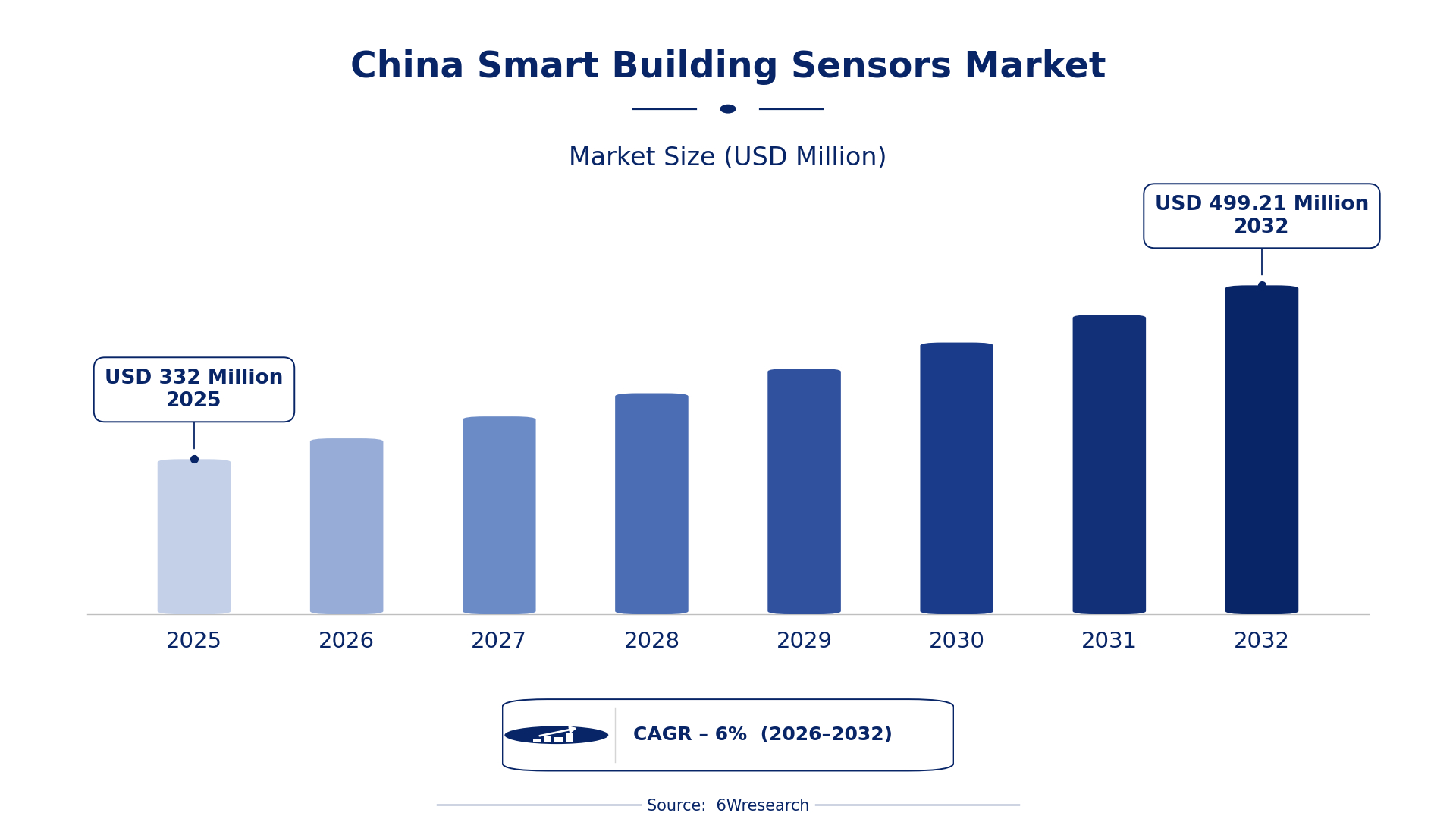
According to 6Wresearch internal database and industry insights, the China Smart Building Sensors Market was valued at USD 332.0 million in 2025 and is projected to reach USD 499.21 million by 2032, growing at a CAGR of approximately 6% during 2026–2032.
China Smart Building Sensors Market Highlights
| Report Metric | Details |
| Report Name | China Smart Building Sensors Market |
| Market Size 2025 | USD 332.0 million |
| Market Size 2032 | USD 499.21 million |
| Absolute Growth 2025–2032 | USD 167.21 million |
| CAGR 2026–2032 | 6% |
| Peak Annual Growth | 7.9% in 2027 |
| Forecast Period | 2026–2032 |
| Historical Data | 2022–2025 |
| Base Year | 2025 |
| Leading Sensor Type, 2025 | Motion Sensors (39% share) |
| Leading Measured Input, 2025 | Occupancy Detection (36% share) |
| Leading Output Platform, 2025 | Building Automation Systems (52% share) |
| Leading End User, 2025 | Security Integrators (36% share) |
| Fastest-Growing Sensor Type | Thermal Sensors (8.4% CAGR) |
| Fastest-Growing Output Platform | Smart Lighting Controls (8.1% CAGR) |
| Fastest-Growing End User | Building Safety Vendors (7.6% CAGR) |
| Growing Sector | Security Integrators |
| Key End Users | Facility Maintenance Teams, Security Integrators, Building Safety Vendors |
China Smart Building Sensors Market Year-wise Growth Rate and Key Drivers (2022–2032)
This graph illustrates the annual growth rates of the market from 2022 to 2032, highlighting a steady upward trajectory and projected market expansion over the forecast period.
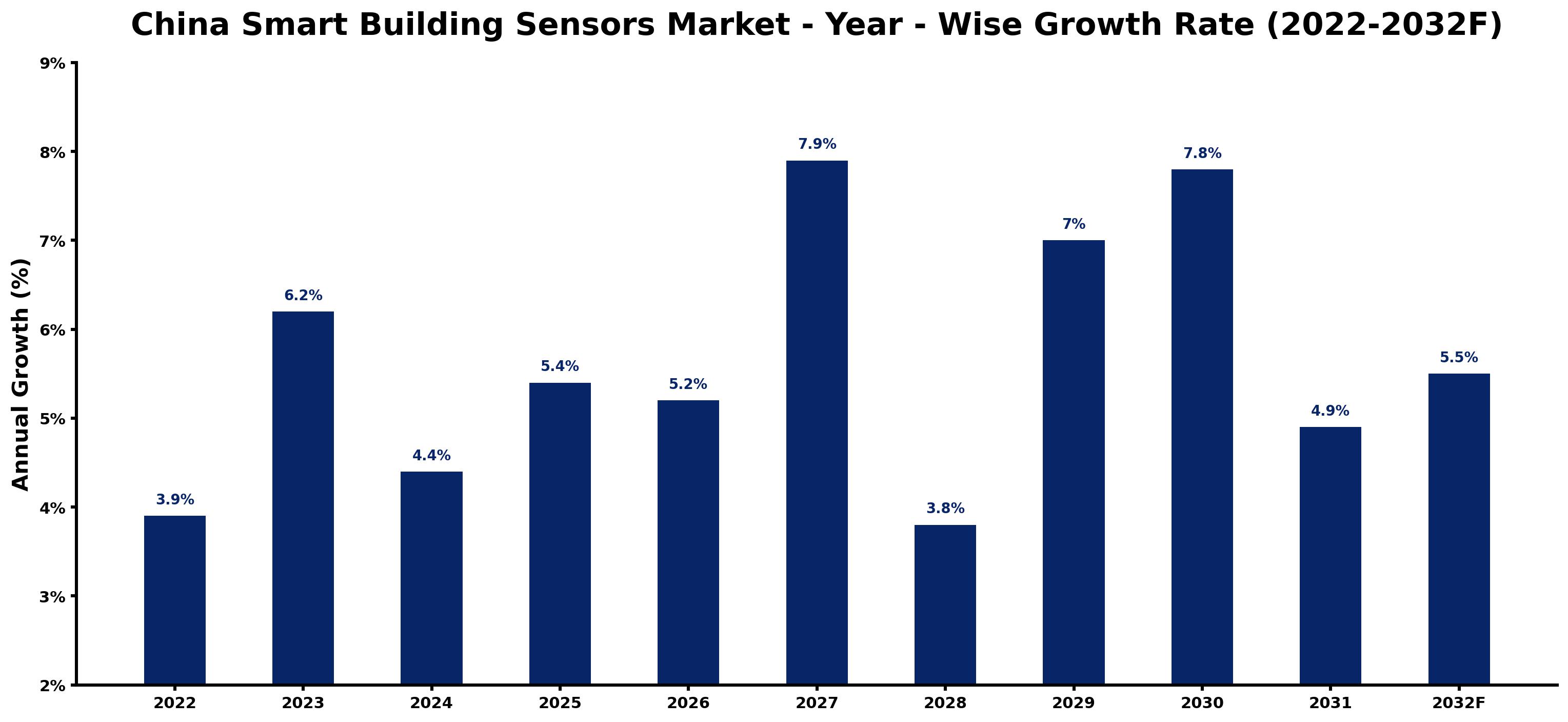
The following table presents the estimated annual growth rate for each year together with the principal factor influencing market performance.
| Year | Estimated Annual Growth (%) | Market Rationale |
| 2022 | 3.9 | The market experienced steady growth due to increased urbanization and smart building initiatives. |
| 2023 | 6.2 | Demand surged as over 70% of new commercial buildings in Shanghai integrated smart sensors. |
| 2024 | 4.4 | Growth slowed as projects faced delays in sensor installations and integration. |
| 2025 | 5.4 | The market rebounded with faster growth from rising energy efficiency initiatives in urban areas. |
| 2026 | 5.2 | A slight slowdown occurred due to heightened competition among sensor manufacturers. |
| 2027 | 7.9 | The market peaked with substantial investments in building automation systems and energy management. |
| 2028 | 3.8 | Growth decelerated as market saturation began to affect new installations. |
| 2029 | 7.0 | Demand accelerated again due to heightened focus on building safety and energy efficiency. |
| 2030 | 7.8 | The market continued to grow as smart lighting controls gained traction in urban residential areas. |
| 2031 | 4.9 | Growth slowed as the market adjusted to the increasing number of installed sensors. |
| 2032 | 5.5 | Demand increased again as government targets for energy reduction spurred further investments. |
Note: Market size estimations and growth projections presented in this report are based on 6Wresearch's proprietary forecasting methodology, utilizing the latest available industry data, government publications, and primary research inputs.
China Smart Building Sensors Market Synopsis
The China Smart Building Sensors Market includes advanced devices that monitor and control various aspects of a building's environment, using microelectromechanical systems technology. These sensors play a crucial role in energy management, security, and occupant comfort. Urbanisation is driving market growth, with over 70% of new commercial buildings in Shanghai incorporating smart sensors. Government initiatives, such as the Smart Building Development Plan, are increasing demand for energy-efficient solutions.
Market Dynamics Impact Analysis (2026–2032)
| Factor | Type | Impact | Primary Segment Affected |
| Urbanisation and smart building initiatives drive demand for energy-efficient solutions. | Driver | High | Occupancy Detection |
| The integration of smart sensors in new constructions enhances building automation capabilities. | Driver | High | Building Automation Systems |
| The Guangdong province is investing in smart building projects, creating opportunities for sensor suppliers. | Opportunity | High | Thermal Sensors |
| Security integrators are increasingly adopting smart sensors for enhanced safety in buildings. | Opportunity | Medium | Security Integrators |
| High competition among manufacturers may lead to pricing pressures affecting profitability. | Restraint | High | Motion Sensors |
| Delays in sensor installation can hinder project timelines and overall market growth. | Restraint | Medium | Leak Detection Sensors |
| The market still has to solve a few problems, such as integration challenges for existing buildings. | Challenge | High | Building Automation Systems |
| Limited awareness among smaller construction firms about smart technology benefits poses a challenge. | Challenge | Medium | Facility Maintenance Teams |
Evaluation of Drivers in China Smart Building Sensors Market (2026–2032)
Key forces behind demand, with the segment each one moves most, are listed below.
| Drivers | Primary Segment Affected | Why It Matters (Evidence) |
| Increased urbanisation leads to more smart buildings requiring advanced sensors. | Occupancy Detection | In 2022, over 70% of new commercial buildings in Shanghai integrated smart sensors. |
| Government initiatives promote energy efficiency, boosting sensor demand. | Building Automation Systems | The Ministry of Housing and Urban-Rural Development supports smart building standards under the 13th Five-Year Plan. |
| Rising energy costs encourage building owners to invest in smart sensors for savings. | Thermal Sensors | The National Energy Administration's 2023 program aims to enhance energy efficiency using smart sensors. |
| Security concerns drive the adoption of sensors for improved building safety. | Security Integrators | The China Association of Building Energy Efficiency advocates for smart sensors in new constructions. |
| Technological advancements in sensor capabilities are expanding market applications. | Smart Lighting Controls | ISO 50001 is a key standard for energy management systems in smart buildings. |
In 2022, over 70% of new commercial buildings in Shanghai integrated smart sensors, significantly improving energy management and security. The ongoing push for energy efficiency is driving demand for thermal sensors, as facility maintenance teams seek to optimise building performance. Security concerns are also leading to higher adoption rates, as security integrators look to enhance building safety and compliance.
Evaluation of Restraints in China Smart Building Sensors Market
The key brakes on demand, and where they bite hardest, are shown below.
| Market Restraint | Primary Segment Affected | Why It Matters (Evidence) |
| High competition among manufacturers may lead to pricing pressures affecting profitability. | Motion Sensors | The installed base of smart sensors in Chinese buildings is estimated at over 5 million units. |
| Delays in sensor installation can hinder project timelines and overall market growth. | Leak Detection Sensors | Projects in the Guangdong province have experienced delays due to integration challenges. |
| Limited awareness among smaller construction firms about smart technology benefits poses a challenge. | Facility Maintenance Teams | Many smaller firms lack the resources to invest in advanced smart technologies. |
| Integration challenges with existing building systems can slow adoption rates. | Building Automation Systems | Older buildings often require retrofitting, complicating sensor integration. |
| Regulatory compliance can be complex and time-consuming for new installations. | Thermal Sensors | The updated National Standard for Building Automation includes advanced sensor technologies. |
China Smart Building Sensors Market Challenges
Buyers in the China Smart Building Sensors market encounter integration challenges, as many existing buildings lack the necessary infrastructure for advanced sensor technology. This issue stems from rapid urbanisation, creating a disparity between older structures and modern requirements, which can delay project completions by up to six months for buyers. Regulatory hurdles complicate the situation, as compliance with ISO 50001 often necessitates costly upgrades, raising expenses for suppliers by approximately 15%. Competition from low-cost alternatives also pressures buyers, as these cheaper products may compromise quality, risking reliability issues in their systems.
Trends in the China Smart Building Sensors Market
Buyers and suppliers in the China Smart Building Sensors Market are adjusting to the following trends.
- Rise in Smart Lighting Controls Adoption: In urban residential areas, smart lighting controls are increasingly adopted, focusing on energy savings. In 2023, the National Energy Administration reported a 40% increase in installations.
- Accelerated Integration of Energy Efficiency Standards: The Ministry of Housing and Urban-Rural Development's 13th Five-Year Plan has spurred the integration of energy efficiency standards in buildings. This has led to a notable increase in smart sensor installations, improving energy management capabilities.
- Growing Integration of IoT in Building Management: The integration of IoT platforms with smart sensors is transforming building management practices. In 2023, over 5 million smart sensors were reported in use across Chinese buildings, enhancing operational efficiency.
- Expansion of Smart City Initiatives: The Smart City Pilot Program initiated by the Ministry of Ecology and Environment encourages urban areas to adopt smart technologies. By 2025, the government aims for a 20% reduction in energy consumption, driving demand for smart solutions.
Investment Opportunities in the China Smart Building Sensors Market
Some of the investment opportunities in the China Smart Building Sensors Market are mentioned below.
- Timing for Smart Sensor Investments: With the government aiming to reduce energy consumption in buildings by 20% by 2025, now is an opportune time for investment in smart sensors. Security integrators are particularly in need of advanced solutions to meet these targets.
- Entry through Partnerships in Smart Building Projects: Partnering with local firms in the Guangdong province can facilitate entry into the smart building market, where 40% of projects utilise advanced sensor technology. This presents an opportunity for suppliers to expand their reach.
- Focus on Energy Management Solutions: The ongoing push for energy efficiency creates a demand for thermal sensors and other energy management solutions. Facility maintenance teams are increasingly seeking these technologies to optimise building performance and reduce costs.
- Growing Demand from Urban Residential Areas: Urban residential areas are rapidly adopting smart lighting controls, creating opportunities for suppliers. With a focus on energy savings, local partnerships can enhance market entry and drive growth.
Government Initiatives in the China Smart Building Sensors Market
In 2023, the State Administration for Market Regulation updated the 'National Standard for Building Automation' to include advanced sensor technologies for improved safety and efficiency. This measure builds on the 'Smart Building Development Plan' launched by the Ministry of Housing and Urban-Rural Development in 2021, which aims to improve energy efficiency in buildings nationwide. These regulations ensure that new constructions meet modern safety and energy standards, promoting the integration of smart sensors in building projects.
The 'Green Building Action Plan' approved by the National Development and Reform Commission in 2022 encourages the integration of smart sensors in new constructions to reduce energy consumption. This initiative supports building safety vendors who rely on sensors for compliance with energy efficiency standards. The plan facilitates funding for projects that incorporate smart technologies, ensuring that buyers can access the latest advancements in building automation.
Future Insight of the China Smart Building Sensors Market
Several forward-looking factors should support the China Smart Building Sensors market over the coming years. The government’s target to reduce energy consumption in buildings by 20% by 2025 will drive demand for energy-efficient solutions. The National Energy Administration's initiatives will encourage the adoption of smart technology in construction projects, improving operational efficiency. By 2032, the installed base of smart sensors is expected to exceed 10 million units, reflecting a substantial shift towards advanced building management across various sectors.
Market Segmentation Analysis
Each segment group is reviewed below, with the leader by share and the fastest grower by CAGR.
By Sensor Type – Motion Sensors Dominated, Thermal Sensors Expected to Grow Fastest
According to Dhaval Chaurasia, Assistant Manager at 6Wresearch, the largest sensor type category in 2025 was Motion Sensors, with a 39% share of total revenue. Motion sensors are essential in the smart building sensors market due to their widespread use in detecting occupancy, which optimises energy consumption. Their integration in over 70% of new commercial buildings in Shanghai exemplifies their crucial role in enhancing energy efficiency. Over 2026–2032, Thermal Sensors are expected to post the fastest growth, at a CAGR of 8.4%. Thermal sensors are rapidly gaining traction as they monitor temperature for HVAC efficiency, a necessity driven by government energy-saving initiatives. The 2023 programme launched by the National Energy Administration to improve energy efficiency in buildings significantly propels this growth. Suppliers should focus on developing advanced thermal sensor technologies to meet the rising demand for energy-efficient solutions in smart buildings.
By Measured Input – Occupancy Detection Dominated and Is Expected to Record the Fastest Growth
Occupancy Detection accounted for a 36% market share by measured input in 2025. Occupancy detection leads the market as it is vital for automating lighting and HVAC systems, thereby significantly improving energy efficiency. Its adoption is aligned with government standards promoting smart building technologies, making it essential in new constructions. Occupancy Detection is also forecast to expand faster than any other category, at a CAGR of 7.7% over 2026–2032. The continuous adoption of occupancy detection ensures its rapid growth, remaining integral to energy management strategies in smart buildings. With an installed base exceeding 5 million units, its importance in energy efficiency will keep increasing. Buyers will benefit greatly by investing in occupancy detection solutions to optimise energy management and comply with emerging regulations.
By Output Platform – Building Automation Systems Dominated, Smart Lighting Controls Expected to Grow Fastest
With a 52% revenue share in 2025, Building Automation Systems was the largest output platform category. Building automation systems command the largest market share as they provide centralised control by integrating various sensors, which is crucial for effective smart building management. Their widespread use is bolstered by the Ministry of Housing and Urban-Rural Development's promotion of smart building standards. Smart Lighting Controls are projected to grow fastest, at a CAGR of 8.1% during 2026–2032. Smart lighting controls are quickly gaining popularity, enabling automated lighting adjustments that significantly enhance energy savings. This growth is fuelled by increasing adoption in urban residential areas prioritising energy efficiency. Suppliers should enhance their smart lighting control offerings to address the growing demand for energy-efficient solutions in residential buildings.
By End User – Security Integrators Dominated, Building Safety Vendors Expected to Grow Fastest
In 2025, Security Integrators led the end user split with a 36% share. Security integrators hold the largest market share as they utilise sensors to strengthen building security, a primary concern in new constructions. Their role is vital for meeting the safety requirements of modern urban developments. The quickest growth will come from Building Safety Vendors, forecast to expand at a CAGR of 7.6% between 2026 and 2032. Building safety vendors are witnessing the fastest growth as they rely on sensors to ensure compliance with stringent safety regulations. As safety standards become more rigorous, the demand for their solutions will continue to rise. Buyers should consider partnerships with building safety vendors to improve compliance and security measures in their projects.
Key Attractiveness of the Report
- 10 Years of Market Numbers
- Historical Data Starting from 2022 to 2025
- Base Year 2025
- Forecast Data until 2032
- Key Performance Indicators Impacting the Market
- Major Upcoming Developments and Projects
Key Highlights of the Report:
- China Smart Building Sensors Market Outlook
- Market Size of China Smart Building Sensors Market, 2025
- Forecast of China Smart Building Sensors Market, 2032
- Historical Data and Forecast of China Smart Building Sensors Revenues & Volume for the Period 2022 - 2032F
- China Smart Building Sensors Market Trend Evolution
- China Smart Building Sensors Market Drivers and Challenges
- China Smart Building Sensors Price Trends
- China Smart Building Sensors Porter's Five Forces
- China Smart Building Sensors Industry Life Cycle
- Historical Data and Forecast of China Smart Building Sensors Market Revenues & Volume By Sensor Type for the Period 2022 - 2032F
- Historical Data and Forecast of China Smart Building Sensors Market Revenues & Volume By Motion Sensors for the Period 2022 - 2032F
- Historical Data and Forecast of China Smart Building Sensors Market Revenues & Volume By Light Sensors for the Period 2022 - 2032F
- Historical Data and Forecast of China Smart Building Sensors Market Revenues & Volume By Thermal Sensors for the Period 2022 - 2032F
- Historical Data and Forecast of China Smart Building Sensors Market Revenues & Volume By Leak Detection Sensors for the Period 2022 - 2032F
- Historical Data and Forecast of China Smart Building Sensors Market Revenues & Volume By Measured Input for the Period 2022 - 2032F
- Historical Data and Forecast of China Smart Building Sensors Market Revenues & Volume By Occupancy Detection for the Period 2022 - 2032F
- Historical Data and Forecast of China Smart Building Sensors Market Revenues & Volume By Ambient Light for the Period 2022 - 2032F
- Historical Data and Forecast of China Smart Building Sensors Market Revenues & Volume By Heat Detection for the Period 2022 - 2032F
- Historical Data and Forecast of China Smart Building Sensors Market Revenues & Volume By Water Ingress Alert for the Period 2022 - 2032F
- Historical Data and Forecast of China Smart Building Sensors Market Revenues & Volume By Output Platform for the Period 2022 - 2032F
- Historical Data and Forecast of China Smart Building Sensors Market Revenues & Volume By Building Automation Systems for the Period 2022 - 2032F
- Historical Data and Forecast of China Smart Building Sensors Market Revenues & Volume By Smart Lighting Controls for the Period 2022 - 2032F
- Historical Data and Forecast of China Smart Building Sensors Market Revenues & Volume By Fire Safety Systems for the Period 2022 - 2032F
- Historical Data and Forecast of China Smart Building Sensors Market Revenues & Volume By Mobile Notification for the Period 2022 - 2032F
- Historical Data and Forecast of China Smart Building Sensors Market Revenues & Volume By End User for the Period 2022 - 2032F
- Historical Data and Forecast of China Smart Building Sensors Market Revenues & Volume By Security Integrators for the Period 2022 - 2032F
- Historical Data and Forecast of China Smart Building Sensors Market Revenues & Volume By Electrical OEMs for the Period 2022 - 2032F
- Historical Data and Forecast of China Smart Building Sensors Market Revenues & Volume By Building Safety Vendors for the Period 2022 - 2032F
- Historical Data and Forecast of China Smart Building Sensors Market Revenues & Volume By Facility Maintenance Teams for the Period 2022 - 2032F
- China Smart Building Sensors Import Export Trade Statistics
- Market Opportunity Assessment By Sensor Type
- Market Opportunity Assessment By Measured Input
- Market Opportunity Assessment By Output Platform
- Market Opportunity Assessment By End User
- China Smart Building Sensors Top Companies Market Share
- China Smart Building Sensors Competitive Benchmarking By Technical and Operational Parameters
- China Smart Building Sensors Company Profiles
- China Smart Building Sensors Key Strategic Recommendations
Market Covered
The report offers an extensive study of the following market segments.
By Sensor Type
- Motion Sensors
- Light Sensors
- Thermal Sensors
- Leak Detection Sensors
By Measured Input
- Occupancy Detection
- Ambient Light
- Heat Detection
- Water Ingress Alert
By Output Platform
- Building Automation Systems
- Smart Lighting Controls
- Fire Safety Systems
- Mobile Notification
By End User
- Security Integrators
- Electrical OEMs
- Building Safety Vendors
- Facility Maintenance Teams































