India Smart Building Technology Market Size & Growth Rate
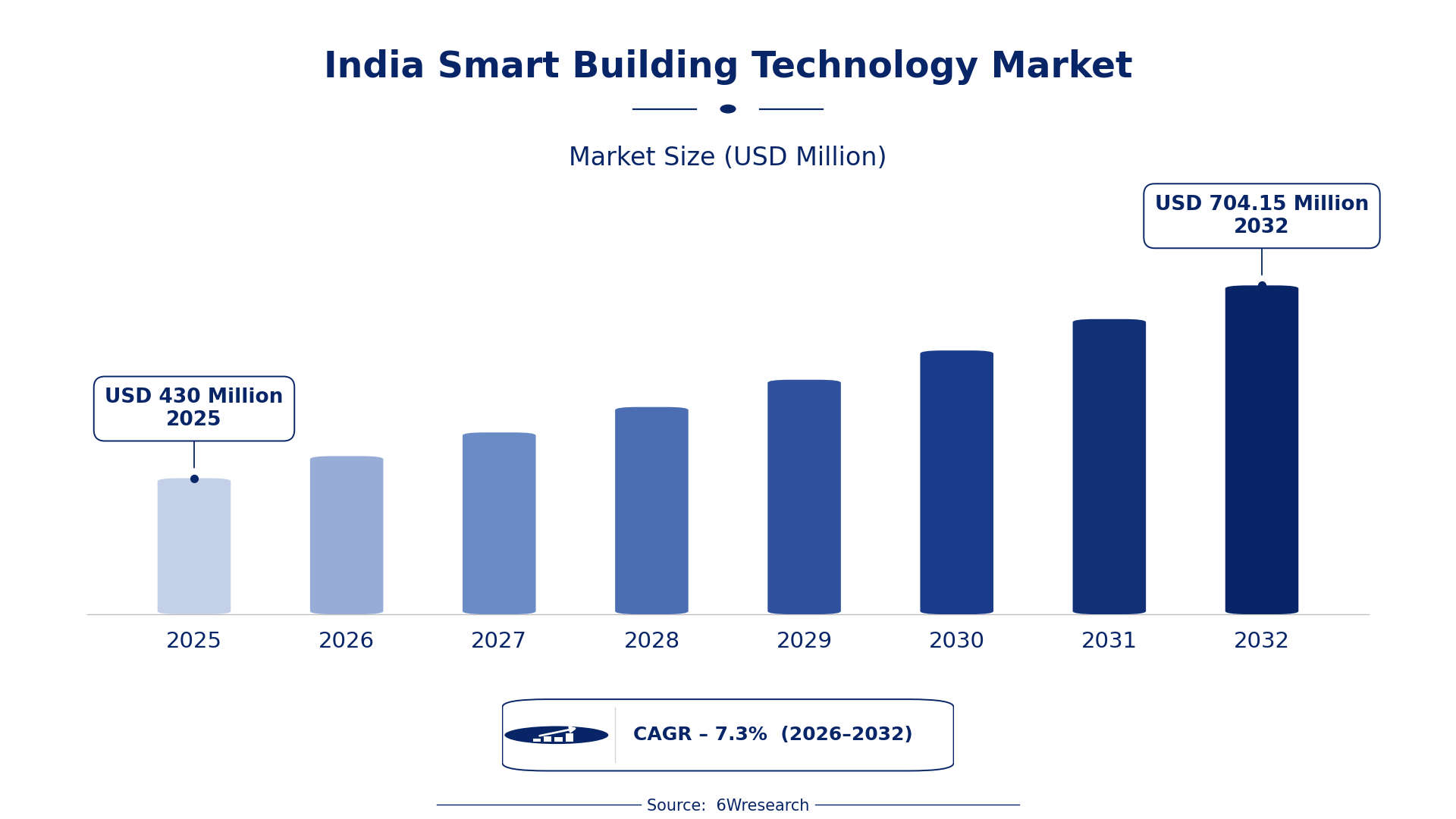
According to 6Wresearch internal database and industry insights, the India Smart Building Technology Market was valued at USD 430.0 million in 2025 and is projected to reach USD 704.15 million by 2032, growing at a CAGR of approximately 7.3% during 2026–2032.
India Smart Building Technology Market Highlights
| Report Metric | Details |
| Report Name | India Smart Building Technology Market |
| Market Size 2025 | USD 430.0 million |
| Market Size 2032 | USD 704.15 million |
| Absolute Growth 2025–2032 | USD 274.15 million |
| CAGR 2026–2032 | 7.3% |
| Peak Annual Growth | 9.6% in 2027 |
| Forecast Period | 2026–2032 |
| Historical Data | 2022–2025 |
| Base Year | 2025 |
| Leading Technology Type, 2025 | Cloud-Based Platforms (38% share) |
| Leading Smart Function, 2025 | Centralized Automation (51% share) |
| Leading Deployment Mode, 2025 | SaaS Deployment (45% share) |
| Leading End User, 2025 | Building Automation Firms (44% share) |
| Fastest-Growing Technology Type | Smart Edge Gateways (9.0% CAGR) |
| Fastest-Growing Smart Function | Remote Monitoring + AI (9.7% CAGR) |
| Fastest-Growing End User | Energy Efficiency Experts (10.0% CAGR) |
| Growing Sector | Building Automation |
| Key End Users | Building Automation Firms, Property Managers, Energy Efficiency Experts, Facility Operators |
India Smart Building Technology Market Year-wise Growth Rate and Key Drivers (2022–2032)
This graph illustrates the annual growth rates of the market from 2022 to 2032, highlighting a steady upward trajectory and projected market expansion over the forecast period.
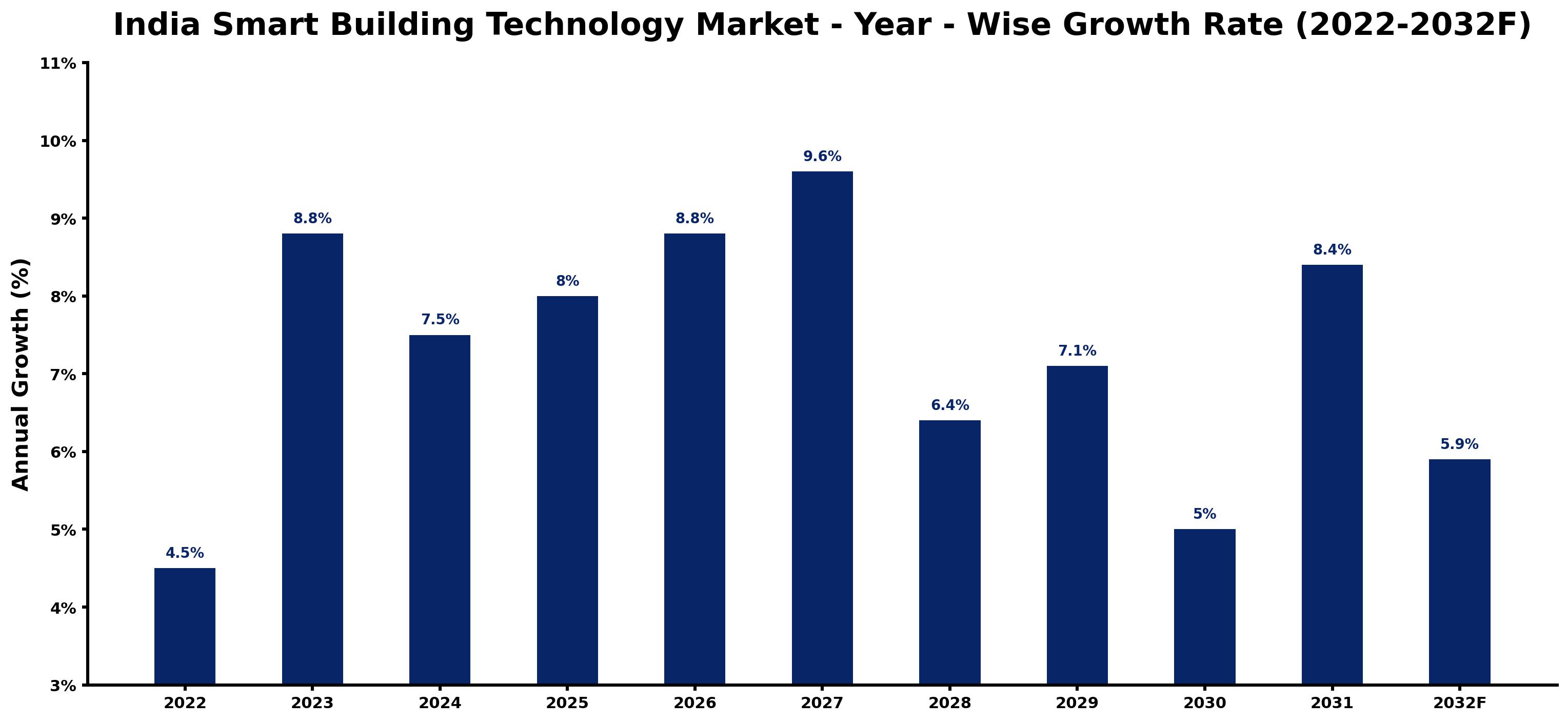
Year by year, the estimates below pair each growth rate with the development that shaped it.
| Year | Estimated Annual Growth (%) | Market Rationale |
| 2022 | 4.5 | The market exhibited moderate growth as urbanization began to accelerate in major cities. |
| 2023 | 8.8 | Demand surged due to increased investment in smart infrastructure and urban development projects. |
| 2024 | 7.5 | Growth slowed slightly as the market adjusted to previous rapid expansions and project completions. |
| 2025 | 8.0 | A renewed interest in energy efficiency drove faster growth as more buildings adopted smart technologies. |
| 2026 | 8.8 | The market experienced a boost as cloud-based platforms gained traction among building managers. |
| 2027 | 9.6 | Peak growth was achieved as the Smart Cities Mission spurred widespread adoption of smart technologies. |
| 2028 | 6.4 | Growth decelerated as the market matured and competition intensified among service providers. |
| 2029 | 7.1 | Demand increased again as property managers sought advanced solutions for tenant satisfaction. |
| 2030 | 5.0 | A slowdown occurred as the market stabilised after several years of rapid adoption. |
| 2031 | 8.4 | Growth accelerated again as new standards for energy efficiency were implemented across the sector. |
| 2032 | 5.9 | The market continued to grow, albeit at a slower rate, as energy efficiency remained a priority. |
Note: Market size estimations and growth projections presented in this report are based on 6Wresearch's proprietary forecasting methodology, utilizing the latest available industry data, government publications, and primary research inputs.
India Smart Building Technology Market Synopsis
Smart Building Technology in India includes systems that integrate IoT, cloud computing, and automation to improve building management. These technologies enhance energy efficiency, security, and user comfort in both commercial and residential properties. The India Smart Building Technology Market is growing rapidly, driven by urbanisation and a rising demand for energy-efficient solutions. The Smart Cities Mission is advancing sustainable urban development, which is increasing the need for smart technologies. Consequently, more than 50% of new commercial buildings are incorporating these innovations, indicating a strong investment trend in this sector.
Market Dynamics Impact Analysis (2026–2032)
| Factor | Type | Impact | Primary Segment Affected |
| Rapid urbanization is increasing the demand for energy-efficient building solutions. | Driver | High | Building Automation Firms |
| The adoption of cloud-based platforms is enhancing operational efficiency in smart buildings. | Driver | High | Cloud-Based Platforms |
| Investment in smart infrastructure is expected to rise, creating opportunities for technology providers. | Opportunity | High | Smart Edge Gateways |
| The growing focus on energy efficiency presents a chance for new technologies and services. | Opportunity | High | Energy Efficiency Experts |
| High installation costs can deter smaller firms from adopting smart technologies. | Restraint | Medium | Property Managers |
| Limited awareness of smart technologies among stakeholders can slow market penetration. | Restraint | Medium | Facility Operators |
| The Smart Building Technology market in India faces challenges from high installation costs. | Challenge | High | Building Automation Firms |
| Competition among technology providers can lead to price wars, affecting profitability. | Challenge | Medium | Cloud-Based Platforms |
Evaluation of Drivers in India Smart Building Technology Market (2026–2032)
The main growth drivers and the segments they affect most are set out below.
| Drivers | Primary Segment Affected | Why It Matters (Evidence) |
| Urbanization is driving demand for smart building technologies in metropolitan areas. | Building Automation Firms | Over 50% of new commercial buildings are adopting smart technologies, increasing purchases. |
| Cloud-based platforms enable centralized control, boosting operational efficiency. | Cloud-Based Platforms | The adoption of cloud solutions is increasing, resulting in higher demand for smart systems. |
| Government initiatives like the Smart Cities Mission promote sustainable urban development. | Smart Edge Gateways | This initiative is driving investment in smart technologies across urban areas. |
| Energy efficiency regulations are pushing firms to adopt smart technologies. | Energy Efficiency Experts | ISO 50001 standards are motivating firms to improve energy management practices. |
| Remote monitoring solutions are becoming essential for property management. | Property Managers | These solutions improve tenant services, resulting in increased demand for smart technologies. |
The Smart Cities Mission has led to substantial investments in smart infrastructure, with over 50% of new commercial buildings adopting smart technologies. The adoption of cloud-based platforms is increasing, enabling centralized control and boosting operational efficiency. Property managers are increasingly seeking remote monitoring solutions to improve tenant satisfaction, further driving demand for smart technologies.
Evaluation of Restraints in India Smart Building Technology Market
The main factors holding the market back are set out below.
| Market Restraint | Primary Segment Affected | Why It Matters (Evidence) |
| High installation costs can deter smaller firms from adopting smart technologies. | Building Automation Firms | The average installation cost of smart building systems remains a barrier despite decreasing prices. |
| Limited awareness of smart technologies among stakeholders can slow market penetration. | Facility Operators | The need for education and training on smart systems is critical for wider adoption. |
| Regulatory compliance can be complex and costly for new entrants in the market. | Cloud-Based Platforms | Navigating multiple standards and codes can delay implementation and increase costs. |
| Competition among technology providers can lead to price wars, affecting profitability. | Energy Efficiency Experts | Price pressures can limit investment in innovation and quality improvements. |
| Market saturation in certain urban areas may limit growth opportunities. | Property Managers | As more buildings adopt smart technologies, the potential for new installations diminishes. |
India Smart Building Technology Market Challenges
The India Smart Building Technology Market grapples with a critical skills shortage, as many professionals lack expertise in IoT integration and automation. This gap stems from the industry's nascent stage, causing project delays for producers that can extend timelines by up to six months. Buyers face high initial costs, with installation expenses for smart systems often exceeding 20% of total project budgets. Regulatory compliance adds another layer of complexity, as adherence to the National Building Code requires additional investments, which can deter potential buyers from adopting these technologies.
Trends in the India Smart Building Technology Market
Buyers and suppliers in the India Smart Building Technology Market are adjusting to the following trends.
- Shift in Focus from Energy Management to Building Automation: Property managers in India are increasingly prioritising building automation solutions. The Smart Building Technology Conference 2023 highlighted this trend, with over 70% of attendees expressing interest in integrated systems.
- Transition to Cloud-Based Solutions for Scalability: The adoption of cloud-based platforms is rising among building automation firms, with 45% of new installations using SaaS deployment. This shift began in 2022, allowing for greater flexibility and cost-effectiveness.
- Emergence of AI in Remote Monitoring Solutions: Since 2023, the integration of AI in remote monitoring solutions has gained traction among property managers. This trend is expected to enhance tenant services and operational efficiency significantly.
- Increased Demand for IoT Controllers in Urban Areas: The market for IoT controllers is expanding rapidly, with a projected CAGR of 9.0% from 2026 to 2032. This growth is driven by the need for effective management of smart devices in urban buildings.
Investment Opportunities in the India Smart Building Technology Market
Below are the investment opportunities with the strongest case in the India Smart Building Technology Market.
- Investment in Energy Management Systems: With energy efficiency becoming a priority, there is a growing opportunity to supply advanced energy management systems. Building automation firms are increasingly seeking solutions that can reduce energy consumption by up to 30%.
- Supply of Cloud-Based Platforms for Scalability: The demand for cloud-based platforms is rising, with a projected increase in adoption. Property managers are looking for scalable solutions that can enhance operational efficiency and reduce costs.
- Partnerships for Smart Infrastructure Development: Investing in smart infrastructure development is essential, especially in urban areas. Collaborating with local governments can facilitate entry into the market and align with initiatives like the Smart Cities Mission.
- Provision of Remote Monitoring Solutions: The increasing need for tenant satisfaction presents an opportunity to supply remote monitoring solutions. Property managers are actively seeking these technologies to improve service delivery and operational efficiency.
Government Initiatives in the India Smart Building Technology Market
The Atal Mission for Rejuvenation and Urban Transformation (AMRUT), launched in 2020, allocates significant resources for smart city projects, promoting the adoption of smart building technologies. This initiative complements the Smart Cities Mission, enhancing urban infrastructure funding and encouraging the integration of smart solutions in new developments. The revised Energy Conservation Building Code (ECBC) in 2020 mandates energy efficiency standards, pushing new buildings to integrate smart solutions, thus benefiting producers and buyers alike.
The Bureau of Energy Efficiency oversees the implementation of various schemes, including the Perform, Achieve and Trade (PAT) scheme, which encourages energy efficiency in large industries. This scheme impacts smart building technology adoption by incentivising firms to invest in energy-efficient solutions, ultimately benefiting both producers and buyers in the market. The Ministry of Housing and Urban Affairs also supports various initiatives to enhance urban infrastructure, approving funding for projects that align with smart city objectives.
Future Insight of the India Smart Building Technology Market
The India Smart Building Technology Market will experience significant transformations by 2032, driven by the Smart Cities Mission that seeks to modernise urban infrastructure. The adoption of ISO 50001 standards will promote energy-efficient practices, leading to average energy savings of 20-30% in new constructions. Increased deployment of cloud-based platforms will provide scalable solutions for property managers, improving operational efficiency. Advancements in remote monitoring technologies will enhance tenant services, making smart buildings more attractive to buyers and stimulating market growth.
Market Segmentation Analysis
Each segment group is reviewed below, with the leader by share and the fastest grower by CAGR.
By Technology Type – Cloud-Based Platforms Dominated, Smart Edge Gateways Expected to Grow Fastest
According to Dhaval Chaurasia, Assistant Manager at 6Wresearch, in 2025, Cloud-Based Platforms led the technology type split with a 38% share. Cloud-based platforms dominate the Indian smart building technology market due to their ability to provide centralised control and efficient data management, crucial for energy optimisation. With over 50% of new commercial buildings adopting these platforms, they have become essential for enhancing operational efficiency. The quickest growth will come from Smart Edge Gateways, forecast to expand at a CAGR of 9.0% between 2026 and 2032. Smart edge gateways are rapidly gaining traction as they meet the growing demand for local data processing and connectivity in urban settings. This growth is particularly significant as building managers increasingly seek immediate data insights to improve their operations. Suppliers should prioritise the development of scalable smart edge gateway solutions to cater to the rising urban demand.
By Smart Function – Centralized Automation Dominated, Remote Monitoring + AI Expected to Grow Fastest
Centralized Automation took a 51% share of smart function in 2025, more than any other category. Centralised automation commands the largest market share by integrating various systems, which streamlines operations and enhances efficiency across building functions. This method is critical for achieving energy savings of up to 30% in commercial buildings, making it a preferred choice among stakeholders. Remote Monitoring + AI is set to record the highest CAGR in this split, 9.7% over 2026–2032. Remote monitoring combined with advanced analytics is experiencing rapid growth due to its capability for real-time oversight and predictive maintenance, which significantly enhances tenant services. The increasing adoption of smart technologies in new commercial buildings underscores this trend. Buyers should focus on solutions that integrate remote monitoring and advanced analytics to optimise operational efficiency and improve tenant satisfaction.
By Deployment Mode – SaaS Deployment Dominated and Is Expected to Record the Fastest Growth
With a 45% revenue share in 2025, SaaS Deployment was the largest deployment mode category. SaaS deployment leads the market because it offers flexibility and scalability, allowing businesses to adjust their smart building solutions in response to evolving needs. This model is particularly attractive in rapidly urbanising India, where infrastructure demands are constantly changing. Its lead should widen, with a projected CAGR of 9.3% during 2026–2032, the highest in this split. SaaS deployment is also the fastest-growing segment, driven by its cost-effectiveness and ease of implementation. The decreasing installation costs of smart building systems further enhance its appeal, making SaaS a preferred choice for many. Suppliers must ensure their SaaS offerings are robust and adaptable to meet the increasing demand for smart building technologies.
By End User – Building Automation Firms Dominated, Energy Efficiency Experts Expected to Grow Fastest
Building Automation Firms accounted for a 44% market share by end user in 2025. Building automation firms hold the largest market share as they are the primary users of smart building technologies, leveraging these solutions for improved management and efficiency. Their established presence in the sector drives the widespread adoption of advanced systems across various building types. Over 2026–2032, Energy Efficiency Experts are expected to post the fastest growth, at a CAGR of 10.0%. Energy efficiency experts are the fastest-growing user group, focusing on optimising energy use through technology. Their expertise is increasingly sought as businesses strive to meet energy conservation standards and lower operational costs. Suppliers should tailor their offerings to align with the specific needs of energy efficiency experts, ensuring they remain competitive in the market.
Key Attractiveness of the Report
- 10 Years of Market Numbers
- Historical Data Starting from 2022 to 2025
- Base Year 2025
- Forecast Data until 2032
- Key Performance Indicators Impacting the Market
- Major Upcoming Developments and Projects
Key Highlights of the Report:
- India Smart Building Technology Market Outlook
- Market Size of India Smart Building Technology Market, 2025
- Forecast of India Smart Building Technology Market, 2032
- Historical Data and Forecast of India Smart Building Technology Revenues & Volume for the Period 2022 - 2032F
- India Smart Building Technology Market Trend Evolution
- India Smart Building Technology Market Drivers and Challenges
- India Smart Building Technology Price Trends
- India Smart Building Technology Porter's Five Forces
- India Smart Building Technology Industry Life Cycle
- Historical Data and Forecast of India Smart Building Technology Market Revenues & Volume By Technology Type for the Period 2022 - 2032F
- Historical Data and Forecast of India Smart Building Technology Market Revenues & Volume By IoT Controllers for the Period 2022 - 2032F
- Historical Data and Forecast of India Smart Building Technology Market Revenues & Volume By Cloud-Based Platforms for the Period 2022 - 2032F
- Historical Data and Forecast of India Smart Building Technology Market Revenues & Volume By Smart Edge Gateways for the Period 2022 - 2032F
- Historical Data and Forecast of India Smart Building Technology Market Revenues & Volume By Blockchain in BMS for the Period 2022 - 2032F
- Historical Data and Forecast of India Smart Building Technology Market Revenues & Volume By Smart Function for the Period 2022 - 2032F
- Historical Data and Forecast of India Smart Building Technology Market Revenues & Volume By Centralized Automation for the Period 2022 - 2032F
- Historical Data and Forecast of India Smart Building Technology Market Revenues & Volume By Remote Monitoring + AI for the Period 2022 - 2032F
- Historical Data and Forecast of India Smart Building Technology Market Revenues & Volume By Localized Processing for the Period 2022 - 2032F
- Historical Data and Forecast of India Smart Building Technology Market Revenues & Volume By Data Integrity & Security for the Period 2022 - 2032F
- Historical Data and Forecast of India Smart Building Technology Market Revenues & Volume By Deployment Mode for the Period 2022 - 2032F
- Historical Data and Forecast of India Smart Building Technology Market Revenues & Volume By Wired/Wireless for the Period 2022 - 2032F
- Historical Data and Forecast of India Smart Building Technology Market Revenues & Volume By SaaS Deployment for the Period 2022 - 2032F
- Historical Data and Forecast of India Smart Building Technology Market Revenues & Volume By Multi-Protocol Integration for the Period 2022 - 2032F
- Historical Data and Forecast of India Smart Building Technology Market Revenues & Volume By Distributed Ledger for the Period 2022 - 2032F
- Historical Data and Forecast of India Smart Building Technology Market Revenues & Volume By End User for the Period 2022 - 2032F
- Historical Data and Forecast of India Smart Building Technology Market Revenues & Volume By Building Automation Firms for the Period 2022 - 2032F
- Historical Data and Forecast of India Smart Building Technology Market Revenues & Volume By Property Managers for the Period 2022 - 2032F
- Historical Data and Forecast of India Smart Building Technology Market Revenues & Volume By Energy Efficiency Experts for the Period 2022 - 2032F
- Historical Data and Forecast of India Smart Building Technology Market Revenues & Volume By Facility Operators for the Period 2022 - 2032F
- India Smart Building Technology Import Export Trade Statistics
- Market Opportunity Assessment By Technology Type
- Market Opportunity Assessment By Smart Function
- Market Opportunity Assessment By Deployment Mode
- Market Opportunity Assessment By End User
- India Smart Building Technology Top Companies Market Share
- India Smart Building Technology Competitive Benchmarking By Technical and Operational Parameters
- India Smart Building Technology Company Profiles
- India Smart Building Technology Key Strategic Recommendations
Market Covered
The report offers an extensive study of the following market segments.
By Technology Type
- IoT Controllers
- Cloud-Based Platforms
- Smart Edge Gateways
- Blockchain in BMS
By Smart Function
- Centralized Automation
- Remote Monitoring + AI
- Localized Processing
- Data Integrity & Security
By Deployment Mode
- Wired/Wireless
- SaaS Deployment
- Multi-Protocol Integration
- Distributed Ledger
By End User
- Building Automation Firms
- Property Managers
- Energy Efficiency Experts
- Facility Operators































