China Smart Building Technology Market Size & Growth Rate
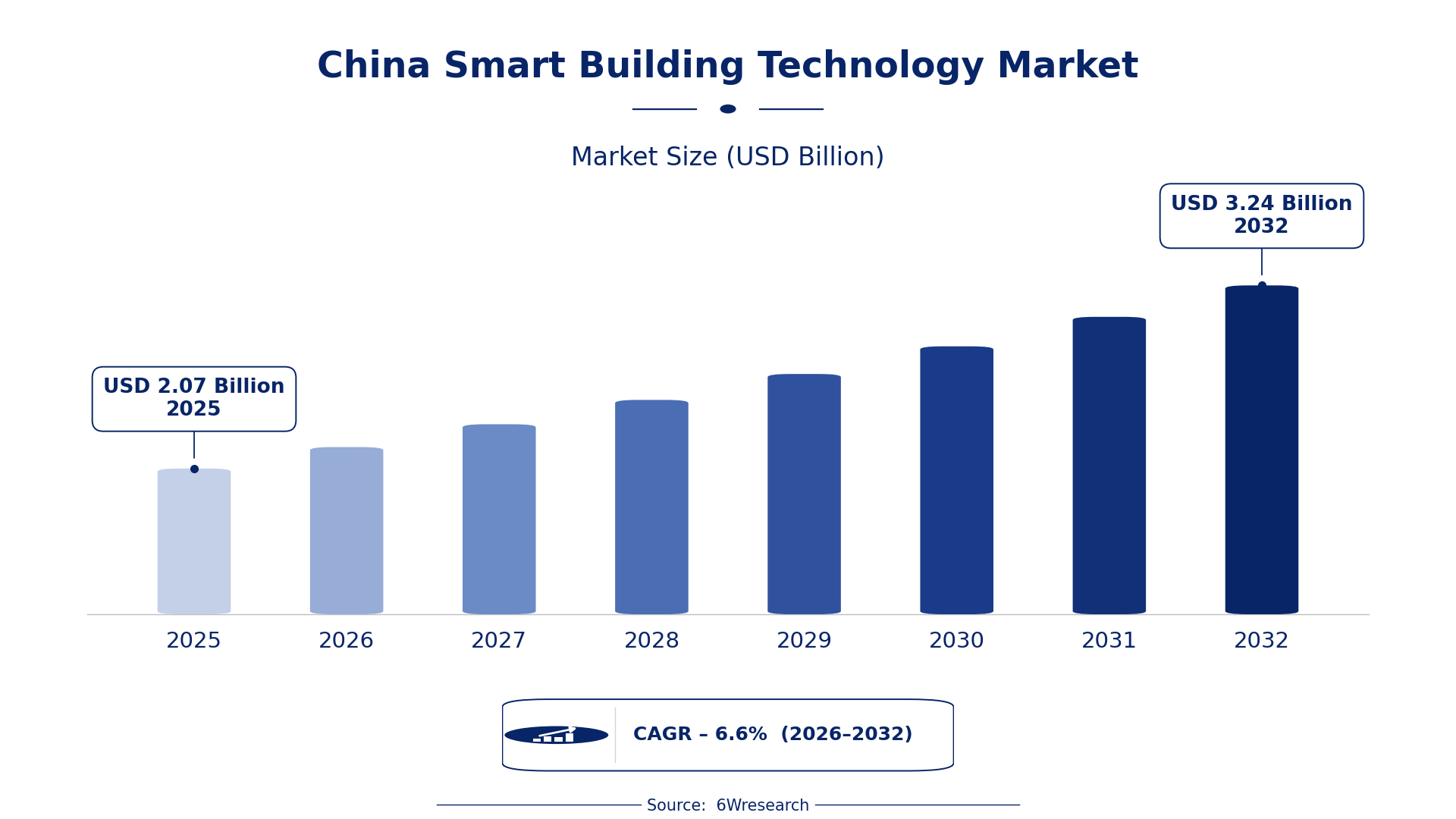
According to 6Wresearch internal database and industry insights, the China Smart Building Technology Market was valued at USD 2.07 billion in 2025 and is projected to reach USD 3.24 billion by 2032, growing at a CAGR of approximately 6.6% during 2026–2032.
China Smart Building Technology Market Highlights
| Report Metric | Details |
| Report Name | China Smart Building Technology Market |
| Market Size 2025 | USD 2.07 billion |
| Market Size 2032 | USD 3.24 billion |
| Absolute Growth 2025–2032 | USD 1.17 billion |
| CAGR 2026–2032 | 6.6% |
| Peak Annual Growth | 8.8% in 2030 |
| Forecast Period | 2026–2032 |
| Historical Data | 2022–2025 |
| Base Year | 2025 |
| Leading Technology Type, 2025 | IoT Controllers (53% share) |
| Leading Smart Function, 2025 | Centralized Automation (48% share) |
| Leading Deployment Mode, 2025 | Wired/Wireless (48% share) |
| Leading End User, 2025 | Building Automation Firms (40% share) |
| Fastest-Growing Technology Type | Cloud-Based Platforms (9.1% CAGR) |
| Fastest-Growing Smart Function | Remote Monitoring + AI (8.5% CAGR) |
| Fastest-Growing Deployment Mode | SaaS Deployment (7.9% CAGR) |
| Fastest-Growing End User | Property Managers (7.6% CAGR) |
| Growing Sector | Building Automation |
| Key End Users | Building Automation Firms, Property Managers, Energy Efficiency Experts, Facility Operators |
China Smart Building Technology Market Year-wise Growth Rate and Key Drivers (2022–2032)
This graph illustrates the annual growth rates of the market from 2022 to 2032, highlighting a steady upward trajectory and projected market expansion over the forecast period.
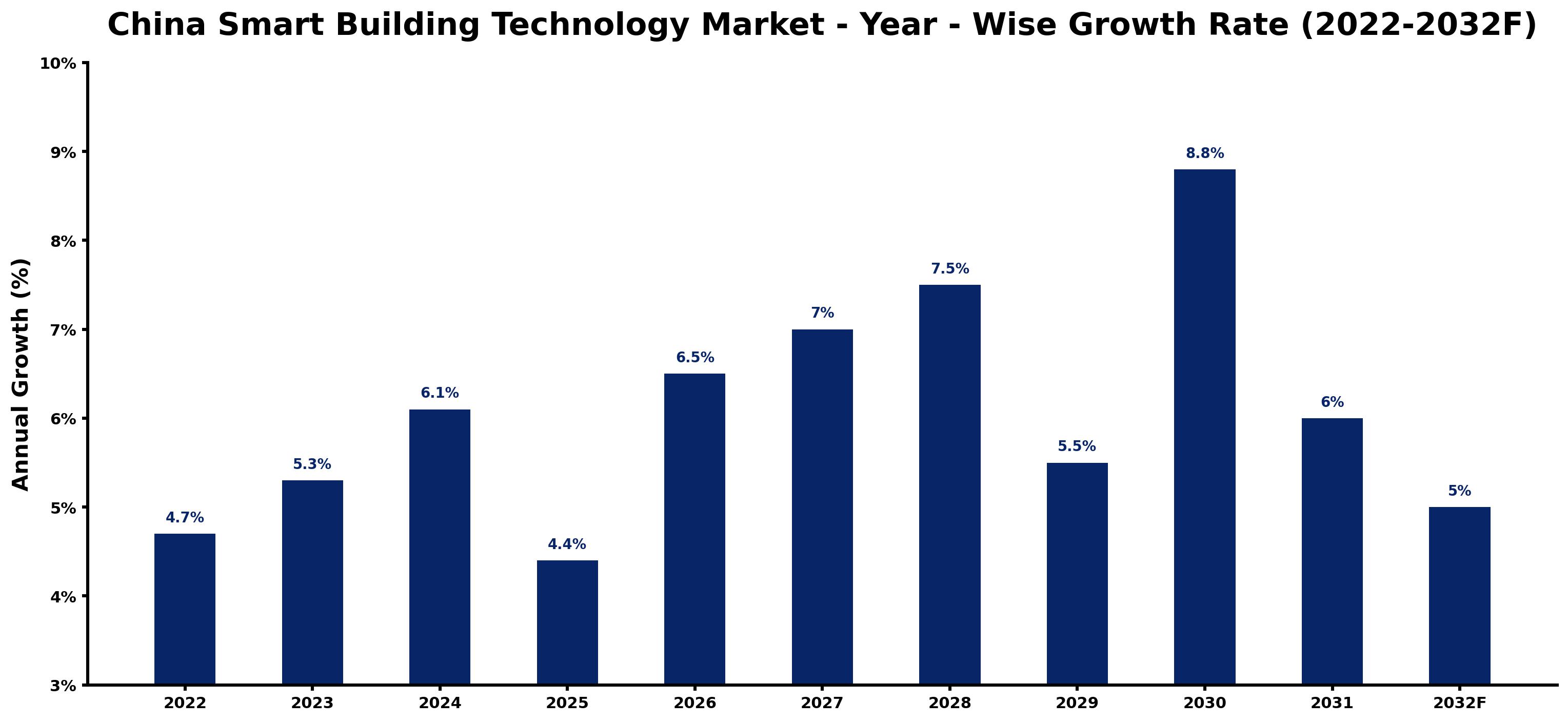
The following table presents the estimated annual growth rate for each year together with the principal factor influencing market performance.
| Year | Estimated Annual Growth (%) | Market Rationale |
| 2022 | 4.7 | The market experienced steady growth, driven by urbanization and energy efficiency needs. |
| 2023 | 5.3 | Demand increased as more commercial buildings adopted smart technologies for operational efficiency. |
| 2024 | 6.1 | Growth continued with the integration of IoT and AI in building management systems. |
| 2025 | 4.4 | A slowdown occurred as the market adjusted to previous rapid expansions in technology adoption. |
| 2026 | 6.5 | The market is expected to recover with renewed investments in smart infrastructure. |
| 2027 | 7.0 | Demand rises as more property managers seek energy-efficient solutions for operational savings. |
| 2028 | 7.5 | Growth accelerates as urban areas expand their smart building initiatives. |
| 2029 | 5.5 | Competition among technology providers is expected to increase, affecting pricing strategies. |
| 2030 | 8.8 | Peak growth is anticipated as smart technologies become standard in new constructions. |
| 2031 | 6.0 | A slowdown is expected as the market matures and adoption levels off. |
| 2032 | 5.0 | The market continues to grow as energy efficiency remains a priority for new developments. |
Note: Market size estimations and growth projections presented in this report are based on 6Wresearch's proprietary forecasting methodology, utilizing the latest available industry data, government publications, and primary research inputs.
China Smart Building Technology Market Synopsis
Smart Building Technology in China integrates various building functions through advanced technologies such as IoT and AI, focusing on energy management, security, and automation. The China Smart Building Technology Market is projected to reach 1 trillion yuan by 2025, driven by urbanisation and the demand for energy-efficient solutions. Contributions from domestic users and ongoing industrial activities highlight the growing importance of smart technologies in urban infrastructure.
Market Dynamics Impact Analysis (2026–2032)
| Factor | Type | Impact | Primary Segment Affected |
| Urbanization drives the need for smart technologies in new buildings. | Driver | High | Centralized Automation |
| The rise in energy efficiency initiatives boosts demand for smart building solutions. | Driver | High | IoT Controllers |
| Investment in smart infrastructure presents opportunities for technology providers. | Opportunity | High | Cloud-Based Platforms |
| Growing urban areas require advanced building management solutions to handle increased complexity. | Opportunity | Medium | Smart Edge Gateways |
| High installation costs deter some potential buyers from adopting smart technologies. | Restraint | High | Wired/Wireless |
| Limited awareness of smart technologies among smaller firms restricts market growth. | Restraint | Medium | Building Automation Firms |
| Competition among technology providers can lead to price wars, affecting profitability. | Challenge | High | Facility Operators |
| Technological integration challenges may delay project implementations. | Challenge | Medium | Property Managers |
Evaluation of Drivers in China Smart Building Technology Market (2026–2032)
The factors lifting demand, and the evidence behind each, are summarised below.
| Drivers | Primary Segment Affected | Why It Matters (Evidence) |
| Urbanization increases the demand for smart building technologies in new constructions. | Centralized Automation | In major cities like Beijing and Shanghai, over 70% of new buildings are expected to incorporate smart technologies by 2025. |
| The push for energy efficiency drives investments in smart solutions. | IoT Controllers | The average energy savings from smart building technologies is estimated at 30%, attracting energy efficiency experts. |
| Government initiatives promote the adoption of smart technologies in buildings. | Cloud-Based Platforms | The Energy Efficiency Program aims to retrofit 100,000 buildings with smart technologies by 2025. |
| Increased reliance on data management solutions improves operational efficiency. | Smart Edge Gateways | Urban areas are implementing smart edge gateways for efficient data processing and communication. |
| The integration of AI in building management systems boosts demand for advanced solutions. | Remote Monitoring + AI | Over 50% of new commercial developments are implementing remote monitoring and AI solutions. |
By 2025, the market is projected to reach 1 trillion yuan, propelled by the integration of smart technologies in new constructions. The average energy savings from smart building technologies is estimated at 30%, encouraging property managers to adopt these solutions. In major cities, over 70% of new buildings are expected to incorporate smart technologies, reflecting the rising demand for efficient building management.
Evaluation of Restraints in China Smart Building Technology Market
The following restraints limit how fast demand can grow.
| Market Restraint | Primary Segment Affected | Why It Matters (Evidence) |
| High installation costs limit the adoption of smart building technologies. | Wired/Wireless | The average installation cost for smart building technologies is around 500 yuan per square meter, which can deter budget-conscious buyers. |
| Limited awareness of smart technologies among smaller firms restricts market growth. | Building Automation Firms | Many smaller firms lack knowledge about the benefits of smart technologies, resulting in lower adoption rates. |
| Technological integration challenges may delay project implementations. | Property Managers | Complexities in integrating various systems can lead to project delays, affecting operational efficiency. |
| Competition among technology providers can lead to price wars, affecting profitability. | Facility Operators | Price competition can reduce margins for facility operators, impacting their ability to invest in new technologies. |
| Regulatory compliance can be burdensome for smaller firms entering the market. | Cloud-Based Platforms | Adhering to standards like ISO 50001 requires significant investment in training and systems. |
China Smart Building Technology Market Challenges
The China Smart Building Technology Market faces practical challenges, with intense competition among suppliers driving down prices and squeezing profit margins for producers. This pressure can lead to compromises in technology quality, affecting operational efficiency for buyers. Installation costs for smart building technologies average around 500 yuan per square meter, creating a financial hurdle for buyers looking to retrofit existing buildings. Additionally, regulatory compliance with standards like ISO 50001 complicates project execution, causing delays and increased costs for developers until 2032.
Trends in the China Smart Building Technology Market
Four trends stand out in the China Smart Building Technology Market.
- Shift from Traditional to Smart Building Technologies: In 2021, the Smart Building Initiative was launched, promoting smart technologies in new constructions across China. By 2025, over 70% of new buildings are expected to incorporate these technologies, reflecting a shift in construction practices.
- Transition from Manual to Automated Building Management: The adoption of Centralized Automation is increasing, particularly in commercial buildings in urban areas. By 2025, this segment is expected to hold a 48% market share, indicating a move towards more efficient management systems.
- Emergence of AI-Driven Solutions in Building Operations: Remote Monitoring + AI solutions are being implemented in over 50% of new commercial developments, showcasing a trend towards AI for predictive maintenance and operational efficiency.
- Growing Adoption of Cloud-Based Platforms: The market for Cloud-Based Platforms is rapidly expanding, driven by increased demand for remote management solutions. This segment is expected to grow significantly as more firms seek centralized data management.
Investment Opportunities in the China Smart Building Technology Market
Investors looking at the China Smart Building Technology Market should consider the following areas.
- Urban Areas as Key Markets for Smart Technologies: China's urban centres are rapidly expanding, with over 70% of new buildings expected to incorporate smart technologies by 2025. This presents an opportunity for technology providers to engage with property managers.
- Partnerships for Technology Integration: Now is the time for technology firms to form joint ventures with local construction companies to promote smart building technology adoption. The Energy Efficiency Program aims to retrofit 100,000 buildings by 2025, creating demand for innovative solutions.
- Investment in Smart Infrastructure: With the government's commitment to reducing energy consumption by 20% by 2025, there is a clear opportunity for investments in smart building technologies. Collaborating with building automation firms can facilitate entry into this growing market.
- Gap in Knowledge Among Smaller Firms: There is a gap in awareness of smart technologies among smaller firms, presenting an opportunity for educational initiatives. By 2025, targeted programs can help increase adoption rates.
Government Initiatives in the China Smart Building Technology Market
The Standardization Administration of China published the National Standard for Smart Building Systems in 2023, establishing guidelines for technology integration. This new measure builds on the 14th Five-Year Plan, which emphasises smart building technology adoption to improve urban infrastructure efficiency. The updated standards will help streamline compliance for producers and buyers, ensuring a cohesive approach to smart building implementation.
The Ministry of Housing and Urban-Rural Development oversees the Smart Building Initiative, which promotes the integration of smart technologies in new constructions. This initiative targets 100,000 buildings by 2025, providing funding and support for projects that align with energy efficiency goals. Additionally, the National Development and Reform Commission approves investments in smart infrastructure, facilitating the growth of the smart building sector.
Future Insight of the China Smart Building Technology Market
Several forward-looking factors should support the growth of the China Smart Building Technology Market in the coming years. The government’s Energy Efficiency Program aims to retrofit 100,000 buildings with smart technologies, which will stimulate demand for these systems. Urbanisation will drive the adoption of smart technologies in over 70% of new buildings, enhancing operational efficiency for users. Initiatives from the Ministry of Housing and Urban-Rural Development will further encourage investments in advanced building management systems, fostering a more efficient built environment.
Market Segmentation Analysis
The report offers a comprehensive study of the following market segments and their leading categories in the market.
By Technology Type – IoT Controllers Dominated, Cloud-Based Platforms Expected to Grow Fastest
According to Dhaval Chaurasia, Assistant Manager at 6Wresearch, IoT Controllers accounted for a 53% market share by technology type in 2025. The IoT Controllers segment leads the market due to its critical function in managing connected devices within smart buildings, which is essential for energy management and automation. This technology is particularly important as over 70% of new buildings are projected to incorporate smart solutions by 2025. Cloud-Based Platforms are set to record the highest CAGR in this split, 9.1% over 2026–2032. Cloud-Based Platforms are rapidly gaining traction as they facilitate centralized data management and remote access, which are vital for contemporary building operations. The surge in demand for effective remote management solutions is driving this segment's swift growth. Suppliers should enhance their cloud capabilities to align with the increasing demands of smart building operators.
By Smart Function – Centralized Automation Dominated, Remote Monitoring + AI Expected to Grow Fastest
Centralized Automation took a 48% share of smart function in 2025, more than any other category. Centralized Automation commands the largest share as it streamlines control over various building systems, significantly enhancing operational efficiency in commercial structures. This technology is extensively adopted in major urban centres like Beijing and Shanghai, demonstrating its importance in modern building management. Over 2026–2032, Remote Monitoring + AI is expected to post the fastest growth, at a CAGR of 8.5%. Remote Monitoring + AI is the fastest-growing segment, propelled by the necessity for real-time monitoring and predictive maintenance in new commercial developments. The fact that these solutions are being implemented in over 50% of new projects highlights their rising significance. Buyers should invest in advanced monitoring technologies to boost operational efficiency and lower maintenance costs.
By Deployment Mode – Wired/Wireless Dominated, SaaS Deployment Expected to Grow Fastest
With a 48% revenue share in 2025, Wired/Wireless was the largest deployment mode category. Wired/Wireless deployment mode dominates the market as it is crucial for ensuring connectivity among various smart building systems. This connectivity is essential for the seamless integration of smart technologies in urban settings. SaaS Deployment is projected to grow fastest, at a CAGR of 7.9% during 2026–2032. SaaS Deployment is expanding quickly due to its capacity to provide scalable solutions for building management, which aligns with the growing demand for flexible operational frameworks. This trend indicates a broader shift towards cloud-based management in the industry. Suppliers must adjust their offerings to include flexible SaaS solutions to meet the changing preferences of building managers.
By End User – Building Automation Firms Dominated, Property Managers Expected to Grow Fastest
In 2025, Building Automation Firms led the end user split with a 40% share. Building Automation Firms lead the market as the primary users of smart building technology, focusing on system integration to enhance building performance. Their expertise in deploying smart solutions positions them as key players in this sector. The quickest growth will come from Property Managers, forecast to expand at a CAGR of 7.6% between 2026 and 2032. Property Managers represent the fastest-growing segment, leveraging smart technologies to efficiently manage building operations. As urbanisation progresses, their dependence on these technologies for operational efficiency is set to increase significantly. Suppliers should customise their products to address the specific needs of property managers to capitalise on this expanding segment.
Key Attractiveness of the Report
- 10 Years of Market Numbers
- Historical Data Starting from 2022 to 2025
- Base Year 2025
- Forecast Data until 2032
- Key Performance Indicators Impacting the Market
- Major Upcoming Developments and Projects
Key Highlights of the Report:
- China Smart Building Technology Market Outlook
- Market Size of China Smart Building Technology Market, 2025
- Forecast of China Smart Building Technology Market, 2032
- Historical Data and Forecast of China Smart Building Technology Revenues & Volume for the Period 2022 - 2032F
- China Smart Building Technology Market Trend Evolution
- China Smart Building Technology Market Drivers and Challenges
- China Smart Building Technology Price Trends
- China Smart Building Technology Porter's Five Forces
- China Smart Building Technology Industry Life Cycle
- Historical Data and Forecast of China Smart Building Technology Market Revenues & Volume By Technology Type for the Period 2022 - 2032F
- Historical Data and Forecast of China Smart Building Technology Market Revenues & Volume By IoT Controllers for the Period 2022 - 2032F
- Historical Data and Forecast of China Smart Building Technology Market Revenues & Volume By Cloud-Based Platforms for the Period 2022 - 2032F
- Historical Data and Forecast of China Smart Building Technology Market Revenues & Volume By Smart Edge Gateways for the Period 2022 - 2032F
- Historical Data and Forecast of China Smart Building Technology Market Revenues & Volume By Blockchain in BMS for the Period 2022 - 2032F
- Historical Data and Forecast of China Smart Building Technology Market Revenues & Volume By Smart Function for the Period 2022 - 2032F
- Historical Data and Forecast of China Smart Building Technology Market Revenues & Volume By Centralized Automation for the Period 2022 - 2032F
- Historical Data and Forecast of China Smart Building Technology Market Revenues & Volume By Remote Monitoring + AI for the Period 2022 - 2032F
- Historical Data and Forecast of China Smart Building Technology Market Revenues & Volume By Localized Processing for the Period 2022 - 2032F
- Historical Data and Forecast of China Smart Building Technology Market Revenues & Volume By Data Integrity & Security for the Period 2022 - 2032F
- Historical Data and Forecast of China Smart Building Technology Market Revenues & Volume By Deployment Mode for the Period 2022 - 2032F
- Historical Data and Forecast of China Smart Building Technology Market Revenues & Volume By Wired/Wireless for the Period 2022 - 2032F
- Historical Data and Forecast of China Smart Building Technology Market Revenues & Volume By SaaS Deployment for the Period 2022 - 2032F
- Historical Data and Forecast of China Smart Building Technology Market Revenues & Volume By Multi-Protocol Integration for the Period 2022 - 2032F
- Historical Data and Forecast of China Smart Building Technology Market Revenues & Volume By Distributed Ledger for the Period 2022 - 2032F
- Historical Data and Forecast of China Smart Building Technology Market Revenues & Volume By End User for the Period 2022 - 2032F
- Historical Data and Forecast of China Smart Building Technology Market Revenues & Volume By Building Automation Firms for the Period 2022 - 2032F
- Historical Data and Forecast of China Smart Building Technology Market Revenues & Volume By Property Managers for the Period 2022 - 2032F
- Historical Data and Forecast of China Smart Building Technology Market Revenues & Volume By Energy Efficiency Experts for the Period 2022 - 2032F
- Historical Data and Forecast of China Smart Building Technology Market Revenues & Volume By Facility Operators for the Period 2022 - 2032F
- China Smart Building Technology Import Export Trade Statistics
- Market Opportunity Assessment By Technology Type
- Market Opportunity Assessment By Smart Function
- Market Opportunity Assessment By Deployment Mode
- Market Opportunity Assessment By End User
- China Smart Building Technology Top Companies Market Share
- China Smart Building Technology Competitive Benchmarking By Technical and Operational Parameters
- China Smart Building Technology Company Profiles
- China Smart Building Technology Key Strategic Recommendations
Market Covered
Segments analysed in this report are listed below.
By Technology Type
- IoT Controllers
- Cloud-Based Platforms
- Smart Edge Gateways
- Blockchain in BMS
By Smart Function
- Centralized Automation
- Remote Monitoring + AI
- Localized Processing
- Data Integrity & Security
By Deployment Mode
- Wired/Wireless
- SaaS Deployment
- Multi-Protocol Integration
- Distributed Ledger
By End User
- Building Automation Firms
- Property Managers
- Energy Efficiency Experts
- Facility Operators































