India Smart City Connectivity Market Size & Growth Rate
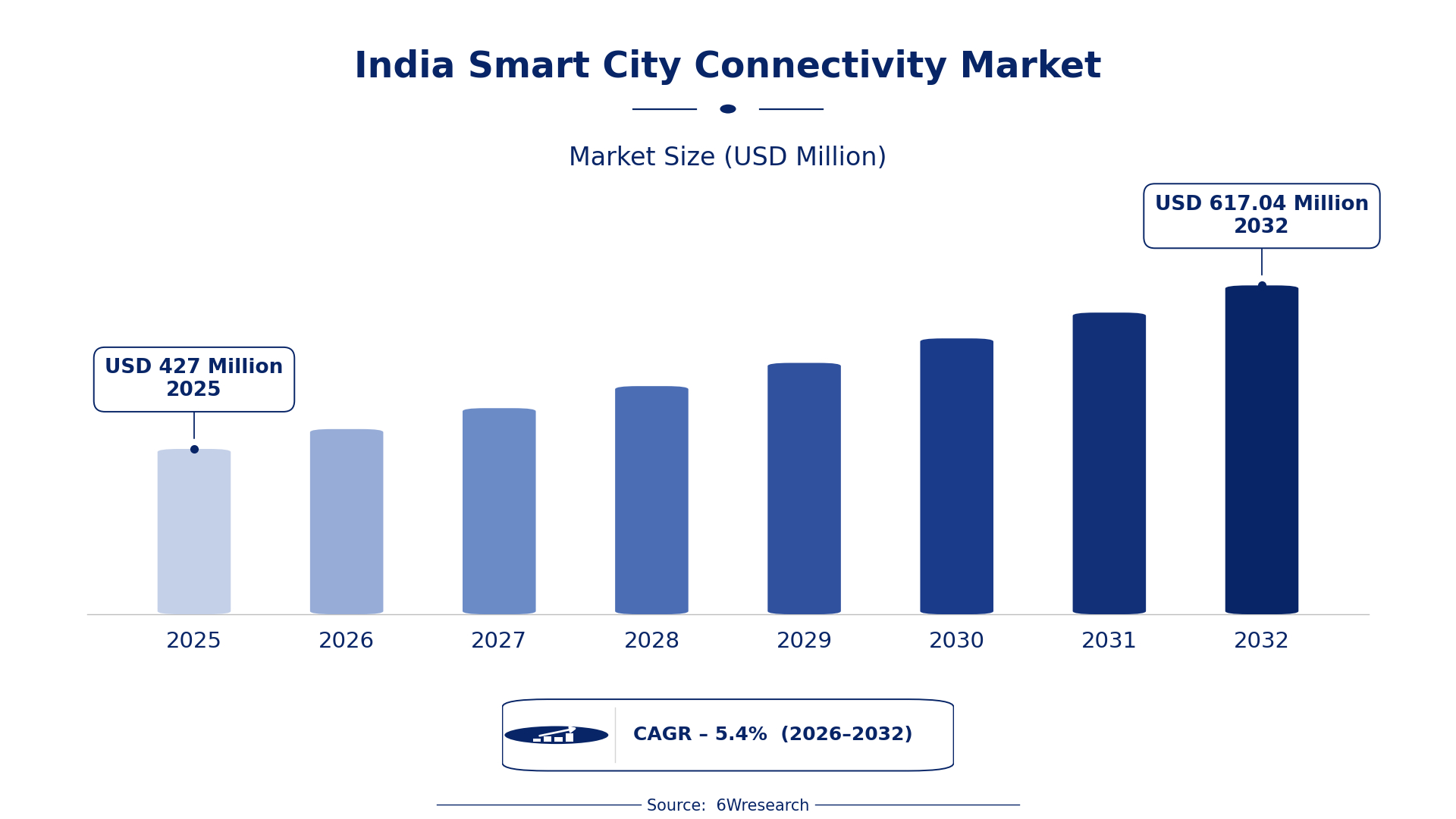
According to 6Wresearch internal database and industry insights, the India Smart City Connectivity Market was valued at USD 427.0 million in 2025 and is projected to reach USD 617.04 million by 2032, growing at a CAGR of approximately 5.4% during 2026–2032.
India Smart City Connectivity Market Highlights
| Report Metric | Details |
| Report Name | India Smart City Connectivity Market |
| Market Size 2025 | USD 427.0 million |
| Market Size 2032 | USD 617.04 million |
| Absolute Growth 2025–2032 | USD 190.04 million |
| CAGR 2026–2032 | 5.4% |
| Peak Annual Growth | 7.7% in 2031 |
| Forecast Period | 2026–2032 |
| Historical Data | 2022–2025 |
| Base Year | 2025 |
| Leading Connectivity Mode, 2025 | 5G-Enabled IoT (43% share) |
| Leading Network Type, 2025 | Cellular Network (39% share) |
| Leading Application Area, 2025 | Public Services Automation (46% share) |
| Leading End User, 2025 | Telecom Providers (51% share) |
| Fastest-Growing Connectivity Mode | LPWAN (8.1% CAGR) |
| Fastest-Growing Network Type | LoRaWAN/NB-IoT (8.1% CAGR) |
| Fastest-Growing Application Area | Utility Metering (7.1% CAGR) |
| Fastest-Growing End User | Smart City Developers (7.5% CAGR) |
| Growing Sector | Smart Transport Solutions |
| Key End Users | Telecom Providers, Smart City Developers, Urban Planners, Infrastructure Builders |
India Smart City Connectivity Market Year-wise Growth Rate and Key Drivers (2022–2032)
This graph illustrates the annual growth rates of the market from 2022 to 2032, highlighting a steady upward trajectory and projected market expansion over the forecast period.
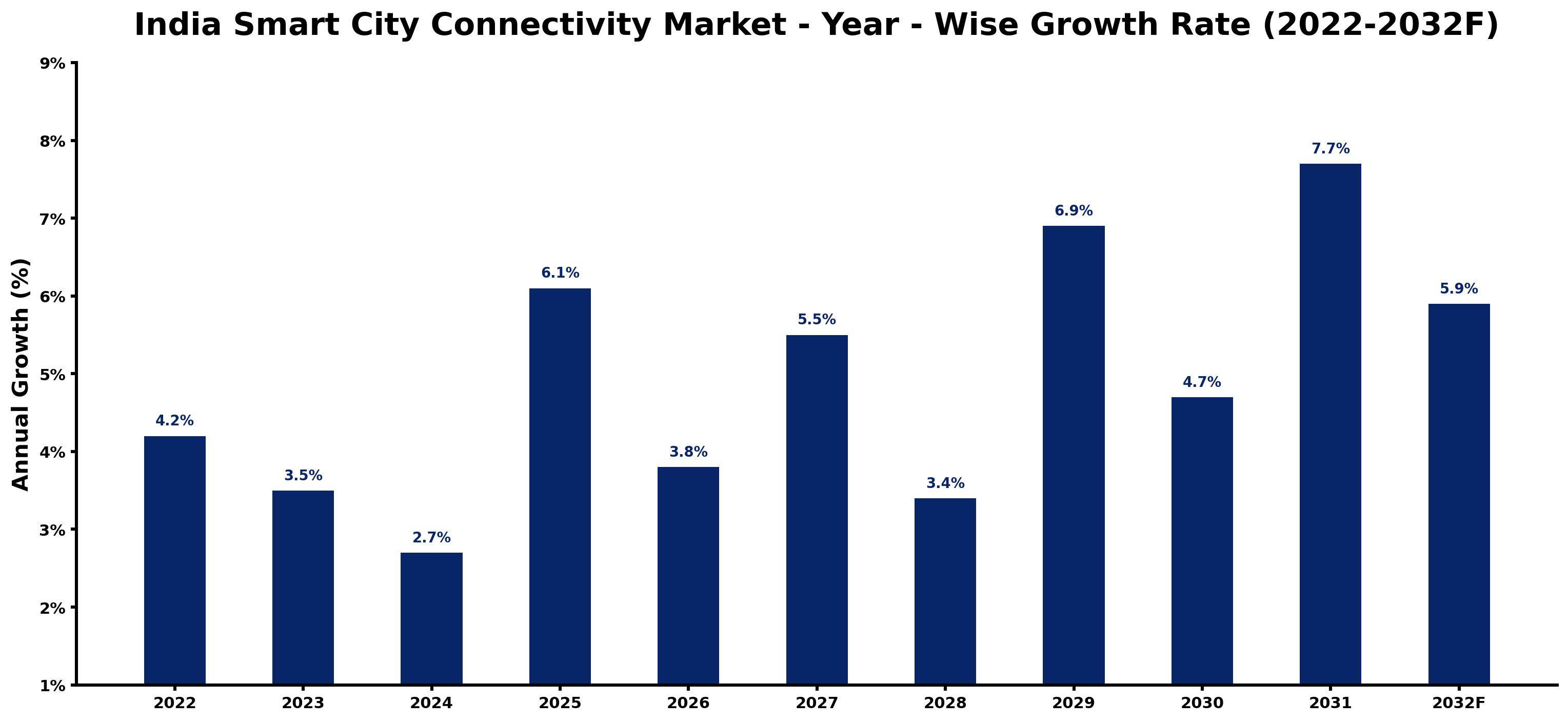
The following table presents the estimated annual growth rate for each year together with the principal factor influencing market performance.
| Year | Estimated Annual Growth (%) | Market Rationale |
| 2022 | 4.2 | The market experienced steady growth as urban development initiatives gained momentum. |
| 2023 | 3.5 | Growth slowed as the National Digital Communications Policy was implemented, impacting connectivity expansion. |
| 2024 | 2.7 | Demand continued to slow due to challenges in project execution across various smart city initiatives. |
| 2025 | 6.1 | Growth accelerated as significant investments were made in smart transport initiatives in cities like Pune. |
| 2026 | 3.8 | The market saw a slowdown as the implementation of 5G technology faced delays in major cities. |
| 2027 | 5.5 | Growth picked up again with increased funding for smart city projects from the government. |
| 2028 | 3.4 | Demand slowed as urban planners faced challenges in integrating new technologies effectively. |
| 2029 | 6.9 | Growth surged as public-private partnerships expanded in the smart city sector. |
| 2030 | 4.7 | The market experienced a slowdown as infrastructure projects faced regulatory hurdles. |
| 2031 | 7.7 | Growth peaked as urban population pressures drove demand for enhanced connectivity solutions. |
| 2032 | 5.9 | The market growth slowed as the focus shifted towards sustainable urban development. |
Note: Market size estimations and growth projections presented in this report are based on 6Wresearch's proprietary forecasting methodology, utilizing the latest available industry data, government publications, and primary research inputs.
India Smart City Connectivity Market Synopsis
Smart City Connectivity in India includes technologies that streamline urban management and services. It integrates advanced communication networks and IoT devices to improve public services and utility management. The India Smart City Connectivity Market is expanding due to rising urban populations and government initiatives. With the urban population projected to hit 600 million by 2031, the demand for connectivity solutions is escalating. Substantial investments from both public and private sectors are propelling this growth, particularly through the Smart Cities Mission and associated projects.
Market Dynamics Impact Analysis (2026–2032)
| Factor | Type | Impact | Primary Segment Affected |
| Increased urbanisation drives the need for efficient connectivity solutions. | Driver | High | Telecom Providers |
| Government funding for smart city projects has increased by 30% since 2020. | Driver | High | Smart City Developers |
| Growing demand for smart transport solutions creates opportunities for connectivity providers. | Opportunity | High | Smart Transport/Surveillance |
| The need for real-time data transmission in smart cities opens avenues for IoT solutions. | Opportunity | High | 5G-Enabled IoT |
| Challenges in project execution can delay smart city initiatives. | Restraint | High | Public Services Automation |
| Regulatory hurdles can slow down the deployment of advanced connectivity solutions. | Restraint | Medium | Utility Metering |
| The Smart City Connectivity market in India faces significant delays in infrastructure development. | Challenge | High | Infrastructure Builders |
| Competition among connectivity providers can lead to pricing pressures. | Challenge | Medium | Telecom Providers |
Evaluation of Drivers in India Smart City Connectivity Market (2026–2032)
Below mentioned are some major drivers and their influence on market dynamics.
| Drivers | Primary Segment Affected | Why It Matters (Evidence) |
| Increased urbanisation necessitates connectivity solutions for efficient management. | Telecom Providers | As urban populations grow, telecom providers are expanding their infrastructure to meet rising connectivity demands. |
| Government funding for smart city projects has surged, boosting investment in connectivity. | Smart City Developers | With a budget of INR 50,000 crore, smart city developers are investing heavily in connectivity solutions. |
| The rollout of 5G technology is transforming urban connectivity capabilities. | 5G-Enabled IoT | As 5G is deployed in 13 major cities, demand for IoT applications is increasing as cities modernise. |
| Public-private partnerships are fostering innovation in smart city projects. | Smart Transport/Surveillance | These partnerships are driving investments in smart transport solutions, improving urban mobility and efficiency. |
| The National Digital Communications Policy aims for broadband access for all, boosting connectivity. | Utility Metering | This policy encourages utility metering advancements, facilitating better resource management in urban areas. |
The urban population is projected to reach 600 million by 2031, necessitating connectivity solutions. The deployment of 5G technology in 13 major cities is transforming urban connectivity capabilities, driving demand for IoT applications. Public-private partnerships are fostering innovation in smart transport solutions, improving urban mobility and efficiency.
Evaluation of Restraints in India Smart City Connectivity Market
The main factors holding the market back are set out below.
| Market Restraint | Primary Segment Affected | Why It Matters (Evidence) |
| Delays in project execution hinder the timely implementation of smart city initiatives. | Public Services Automation | As projects face execution challenges, the rollout of essential services is slowed, impacting urban efficiency. |
| Regulatory hurdles complicate the deployment of advanced connectivity solutions. | Utility Metering | These hurdles can lead to increased costs and delays for utility providers trying to implement smart metering. |
| Limited infrastructure investment can restrict the growth of smart city connectivity. | Infrastructure Builders | Insufficient funding for infrastructure projects can delay the development of necessary connectivity frameworks. |
| Market competition can lead to pricing pressures, affecting profitability. | Telecom Providers | Intense competition among providers may force them to lower prices, impacting their financial sustainability. |
| Technical challenges in integrating new technologies can slow down implementation. | Smart City Developers | These challenges can result in increased project timelines and costs, affecting overall market growth. |
India Smart City Connectivity Market Challenges
The India Smart City Connectivity Market faces a critical skills shortage, as urban planners find it challenging to locate qualified professionals in a rapidly evolving sector. This expertise gap can delay project timelines, affecting the efficiency of public services for urban residents. Rising costs present another hurdle; the smart city mission's budget of INR 48,000 crore has only increased by 30% since 2020, limiting local governments' development capabilities. Supply chain disruptions complicate technology deployment, resulting in delays for essential infrastructure projects that affect utility management for municipalities.
Trends in the India Smart City Connectivity Market
The trends below show where the India Smart City Connectivity Market is heading.
- Shift from Traditional to Smart Transport Solutions: As of 2023, cities like Pune are implementing smart transport initiatives, driving demand for advanced connectivity solutions. With a budget of INR 50,000 crore for urban development, this shift is reshaping urban mobility.
- Transition from Legacy Systems to IoT-Enabled Infrastructure: Since the launch of the Digital India Programme in 2020, there has been a move towards IoT-enabled urban infrastructure. This change is supported by the government's investment of INR 50,000 crore in urban development.
- Emergence of 5G as a Key Connectivity Driver: The rollout of 5G technology began in 2023 across 13 major cities, providing faster and more reliable connectivity. This advancement is essential for the implementation of smart city applications and services.
- Public-Private Partnerships Gaining Importance: The Smart Cities Mission encourages public-private partnerships, fostering innovation in urban solutions. With over 50 projects in various stages, this collaboration is vital for improving urban infrastructure.
Investment Opportunities in the India Smart City Connectivity Market
Investors looking at the India Smart City Connectivity Market should consider the following areas.
- Telecom Providers Seeking Advanced Connectivity Solutions: With the urban population projected to reach 600 million by 2031, telecom providers are actively pursuing advanced connectivity solutions. Investing in 5G infrastructure will be crucial for meeting future demands.
- Smart City Developers Focusing on Sustainable Solutions: As government funding for smart city projects rises, smart city developers are concentrating on sustainable solutions. Investing in utility metering technologies will be vital for efficient resource management.
- Infrastructure Builders Targeting Smart City Projects: With the government's commitment to develop 100 smart cities, infrastructure builders have a growing opportunity. Collaborating with local partners will ease entry into this expanding market.
- Utility Providers Expanding Smart Metering Initiatives: The Indian government's aim for 100% smart metering by 2025 presents a promising opportunity for utility providers. Investing in IoT-enabled metering solutions will be crucial for compliance.
Government Initiatives in the India Smart City Connectivity Market
The National Digital Communications Policy 2020 aims to provide broadband access to all citizens by 2022, improving connectivity for smart cities. This policy complements the Smart Cities Mission, which focuses on developing urban infrastructure and services. By setting clear targets for broadband expansion, the policy supports the integration of advanced connectivity solutions in urban areas. The government's commitment to improving digital infrastructure is vital for the successful implementation of smart city projects.
The Ministry of Housing and Urban Affairs oversees the Smart Cities Mission, which funds urban development projects. The mission has allocated INR 48,000 crore to develop 100 smart cities by 2023. Additionally, the Ministry of Electronics and Information Technology promotes the Digital India Programme, which supports digital infrastructure initiatives. This programme aims to improve connectivity and promote the use of IoT technologies in urban areas.
Future Insight of the India Smart City Connectivity Market
The India Smart City Connectivity Market will experience substantial changes by 2032, primarily driven by the completion of 5G technology rollout across major urban centres. This advancement will support the National Digital Communications Policy's goal of universal broadband access, facilitating improved connectivity. Urban population growth, expected to reach 600 million by 2031, will further heighten demand for smart infrastructure. The government's initiative for 100% smart metering in urban areas by 2025 will enable better utility management, benefiting both residents and service providers.
Market Segmentation Analysis
The report offers a comprehensive study of the following market segments and their leading categories in the market.
By Connectivity Mode – 5G-Enabled IoT Dominated, LPWAN Expected to Grow Fastest
According to Dhaval Chaurasia, Assistant Manager at 6Wresearch, with a 43% revenue share in 2025, 5G-Enabled IoT was the largest connectivity mode category. The 5G-Enabled IoT segment commands the largest share due to its essential role in facilitating real-time data transmission for urban management. Its deployment in 13 major cities underscores its critical function in enhancing smart city connectivity. The quickest growth will come from LPWAN, forecast to expand at a CAGR of 8.1% between 2026 and 2032. LPWAN is rapidly growing as it effectively supports low-power, wide-area network applications, which are increasingly vital as urban populations rise. The escalating need for efficient connectivity solutions in smart cities is propelling this segment's growth. Suppliers should focus on developing solutions that leverage 5G capabilities while also exploring opportunities within the LPWAN segment to meet urban connectivity needs.
By Network Type – Cellular Network Dominated, LoRaWAN/NB-IoT Expected to Grow Fastest
Cellular Network took a 39% share of network type in 2025, more than any other category. Cellular Network leads the market share as it provides essential mobile connectivity that is critical for urban environments. Its ability to support a diverse range of applications makes it indispensable for smart city infrastructure. LoRaWAN/NB-IoT is set to record the highest CAGR in this split, 8.1% over 2026–2032. LoRaWAN/NB-IoT is the fastest-growing segment, largely due to its capacity to support IoT applications that require low power, which is increasingly vital as cities modernise. The demand for energy-efficient connectivity solutions drives this segment's rapid expansion. Buyers should invest in LoRaWAN/NB-IoT technologies to ensure their smart city projects remain sustainable and future-ready.
By Application Area – Public Services Automation Dominated, Utility Metering Expected to Grow Fastest
Public Services Automation held a 46% share of the India Smart City Connectivity Market by application area in 2025. Public Services Automation leads the market share as it significantly improves the efficiency of city services, making it a priority for urban management. This automation is crucial for enhancing the quality of life for residents in smart cities. Over 2026–2032, Utility Metering is expected to post the fastest growth, at a CAGR of 7.1%. Utility Metering is witnessing rapid growth, driven by the government's target of achieving 100% smart metering in urban areas by 2025. This focus on utility efficiency is a key factor propelling the segment's expansion. Suppliers must align their offerings with the increasing demand for utility metering solutions to capitalise on the expanding smart city initiatives.
By End User – Telecom Providers Dominated, Smart City Developers Expected to Grow Fastest
Telecom Providers accounted for a 51% market share by end user in 2025. Telecom Providers hold the largest market share as they are directly involved in delivering essential connectivity solutions for smart cities. Their established infrastructure and expertise position them as pivotal players in the smart city ecosystem. Smart City Developers are projected to grow fastest, at a CAGR of 7.5% during 2026–2032. Smart City Developers represent the fastest-growing segment, reflecting the surge in urban development and modernisation projects. Their crucial role in implementing smart city initiatives places them at the forefront of market growth. Suppliers should collaborate with Smart City Developers to create tailored solutions that address the specific requirements of urban development projects.
Key Attractiveness of the Report
- 10 Years of Market Numbers
- Historical Data Starting from 2022 to 2025
- Base Year 2025
- Forecast Data until 2032
- Key Performance Indicators Impacting the Market
- Major Upcoming Developments and Projects
Key Highlights of the Report:
- India Smart City Connectivity Market Outlook
- Market Size of India Smart City Connectivity Market, 2025
- Forecast of India Smart City Connectivity Market, 2032
- Historical Data and Forecast of India Smart City Connectivity Revenues & Volume for the Period 2022 - 2032F
- India Smart City Connectivity Market Trend Evolution
- India Smart City Connectivity Market Drivers and Challenges
- India Smart City Connectivity Price Trends
- India Smart City Connectivity Porter's Five Forces
- India Smart City Connectivity Industry Life Cycle
- Historical Data and Forecast of India Smart City Connectivity Market Revenues & Volume By Connectivity Mode for the Period 2022 - 2032F
- Historical Data and Forecast of India Smart City Connectivity Market Revenues & Volume By 5G-Enabled IoT for the Period 2022 - 2032F
- Historical Data and Forecast of India Smart City Connectivity Market Revenues & Volume By LPWAN for the Period 2022 - 2032F
- Historical Data and Forecast of India Smart City Connectivity Market Revenues & Volume By Wi-Fi Mesh for the Period 2022 - 2032F
- Historical Data and Forecast of India Smart City Connectivity Market Revenues & Volume By Fiber Backhaul for the Period 2022 - 2032F
- Historical Data and Forecast of India Smart City Connectivity Market Revenues & Volume By Network Type for the Period 2022 - 2032F
- Historical Data and Forecast of India Smart City Connectivity Market Revenues & Volume By Cellular Network for the Period 2022 - 2032F
- Historical Data and Forecast of India Smart City Connectivity Market Revenues & Volume By LoRaWAN/NB-IoT for the Period 2022 - 2032F
- Historical Data and Forecast of India Smart City Connectivity Market Revenues & Volume By Public Internet for the Period 2022 - 2032F
- Historical Data and Forecast of India Smart City Connectivity Market Revenues & Volume By Gigabit Internet for the Period 2022 - 2032F
- Historical Data and Forecast of India Smart City Connectivity Market Revenues & Volume By Application Area for the Period 2022 - 2032F
- Historical Data and Forecast of India Smart City Connectivity Market Revenues & Volume By Public Services Automation for the Period 2022 - 2032F
- Historical Data and Forecast of India Smart City Connectivity Market Revenues & Volume By Utility Metering for the Period 2022 - 2032F
- Historical Data and Forecast of India Smart City Connectivity Market Revenues & Volume By Smart Transport/Surveillance for the Period 2022 - 2032F
- Historical Data and Forecast of India Smart City Connectivity Market Revenues & Volume By Government Networks for the Period 2022 - 2032F
- Historical Data and Forecast of India Smart City Connectivity Market Revenues & Volume By End User for the Period 2022 - 2032F
- Historical Data and Forecast of India Smart City Connectivity Market Revenues & Volume By Telecom Providers for the Period 2022 - 2032F
- Historical Data and Forecast of India Smart City Connectivity Market Revenues & Volume By Smart City Developers for the Period 2022 - 2032F
- Historical Data and Forecast of India Smart City Connectivity Market Revenues & Volume By Urban Planners for the Period 2022 - 2032F
- Historical Data and Forecast of India Smart City Connectivity Market Revenues & Volume By Infrastructure Builders for the Period 2022 - 2032F
- India Smart City Connectivity Import Export Trade Statistics
- Market Opportunity Assessment By Connectivity Mode
- Market Opportunity Assessment By Network Type
- Market Opportunity Assessment By Application Area
- Market Opportunity Assessment By End User
- India Smart City Connectivity Top Companies Market Share
- India Smart City Connectivity Competitive Benchmarking By Technical and Operational Parameters
- India Smart City Connectivity Company Profiles
- India Smart City Connectivity Key Strategic Recommendations
Market Covered
The report offers an extensive study of the following market segments.
By Connectivity Mode
- 5G-Enabled IoT
- LPWAN
- Wi-Fi Mesh
- Fiber Backhaul
By Network Type
- Cellular Network
- LoRaWAN/NB-IoT
- Public Internet
- Gigabit Internet
By Application Area
- Public Services Automation
- Utility Metering
- Smart Transport/Surveillance
- Government Networks
By End User
- Telecom Providers
- Smart City Developers
- Urban Planners
- Infrastructure Builders































