China Smart City Connectivity Market Size & Growth Rate
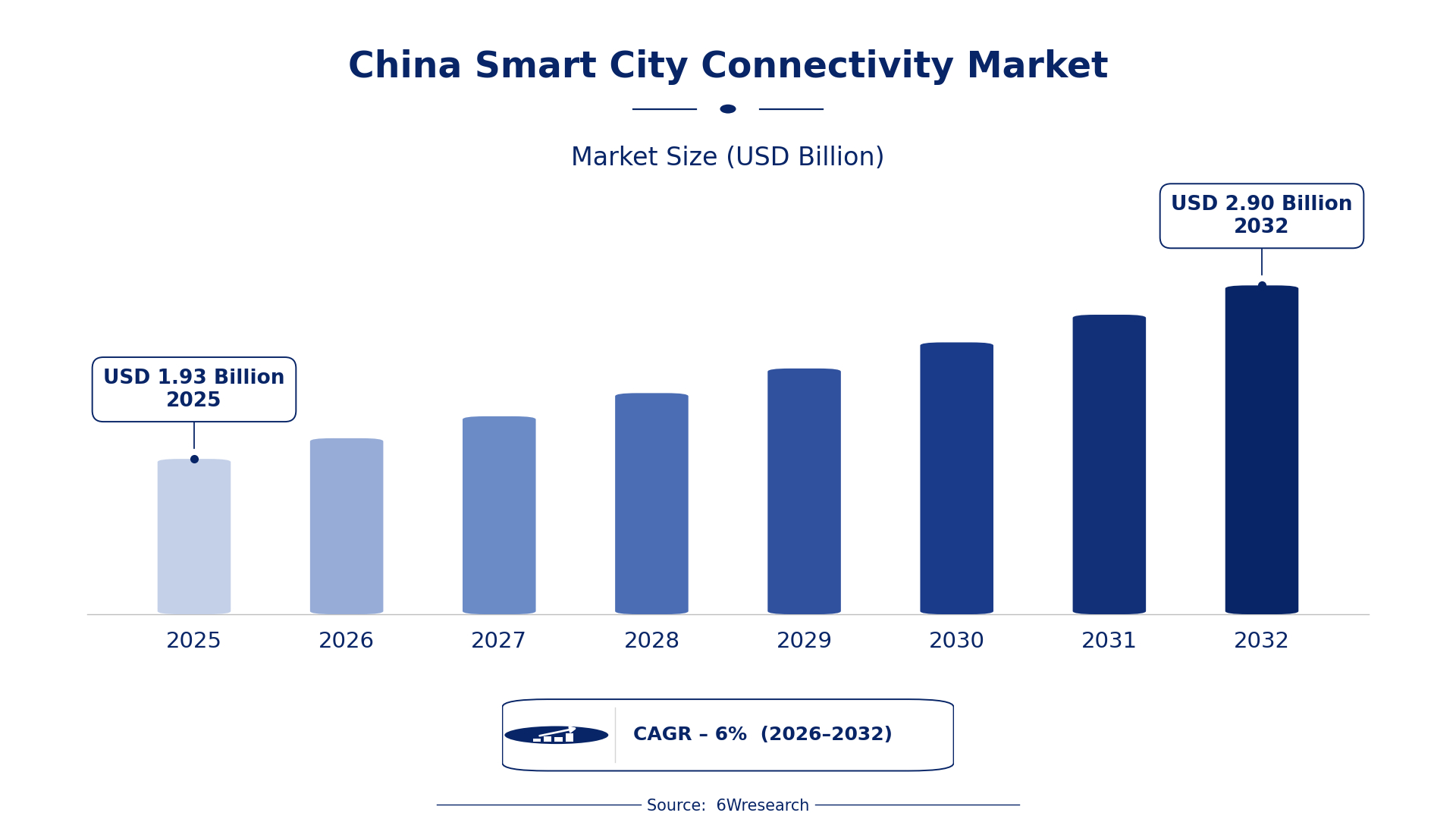
According to 6Wresearch internal database and industry insights, the China Smart City Connectivity Market was valued at USD 1.93 billion in 2025 and is projected to reach USD 2.90 billion by 2032, growing at a CAGR of approximately 6% during 2026–2032.
China Smart City Connectivity Market Highlights
| Report Metric | Details |
| Report Name | China Smart City Connectivity Market |
| Market Size 2025 | USD 1.93 billion |
| Market Size 2032 | USD 2.90 billion |
| Absolute Growth 2025–2032 | USD 0.97 billion |
| CAGR 2026–2032 | 6% |
| Peak Annual Growth | 7.7% in 2026 |
| Forecast Period | 2026–2032 |
| Historical Data | 2022–2025 |
| Base Year | 2025 |
| Leading Connectivity Mode, 2025 | 5G-Enabled IoT (35% share) |
| Leading Network Type, 2025 | Cellular Network (44% share) |
| Leading Application Area, 2025 | Public Services Automation (39% share) |
| Leading End User, 2025 | Telecom Providers (52% share) |
| Fastest-Growing Connectivity Mode | LPWAN (7.9% CAGR) |
| Fastest-Growing Network Type | LoRaWAN/NB-IoT (8.7% CAGR) |
| Fastest-Growing Application Area | Smart Transport/Surveillance (7.6% CAGR) |
| Fastest-Growing End User | Smart City Developers (8.3% CAGR) |
| Growing Sector | Public Services Automation |
| Key End Users | Telecom Providers, Smart City Developers, Urban Planners, Infrastructure Builders |
China Smart City Connectivity Market Year-wise Growth Rate and Key Drivers (2022–2032)
This graph illustrates the annual growth rates of the market from 2022 to 2032, highlighting a steady upward trajectory and projected market expansion over the forecast period.
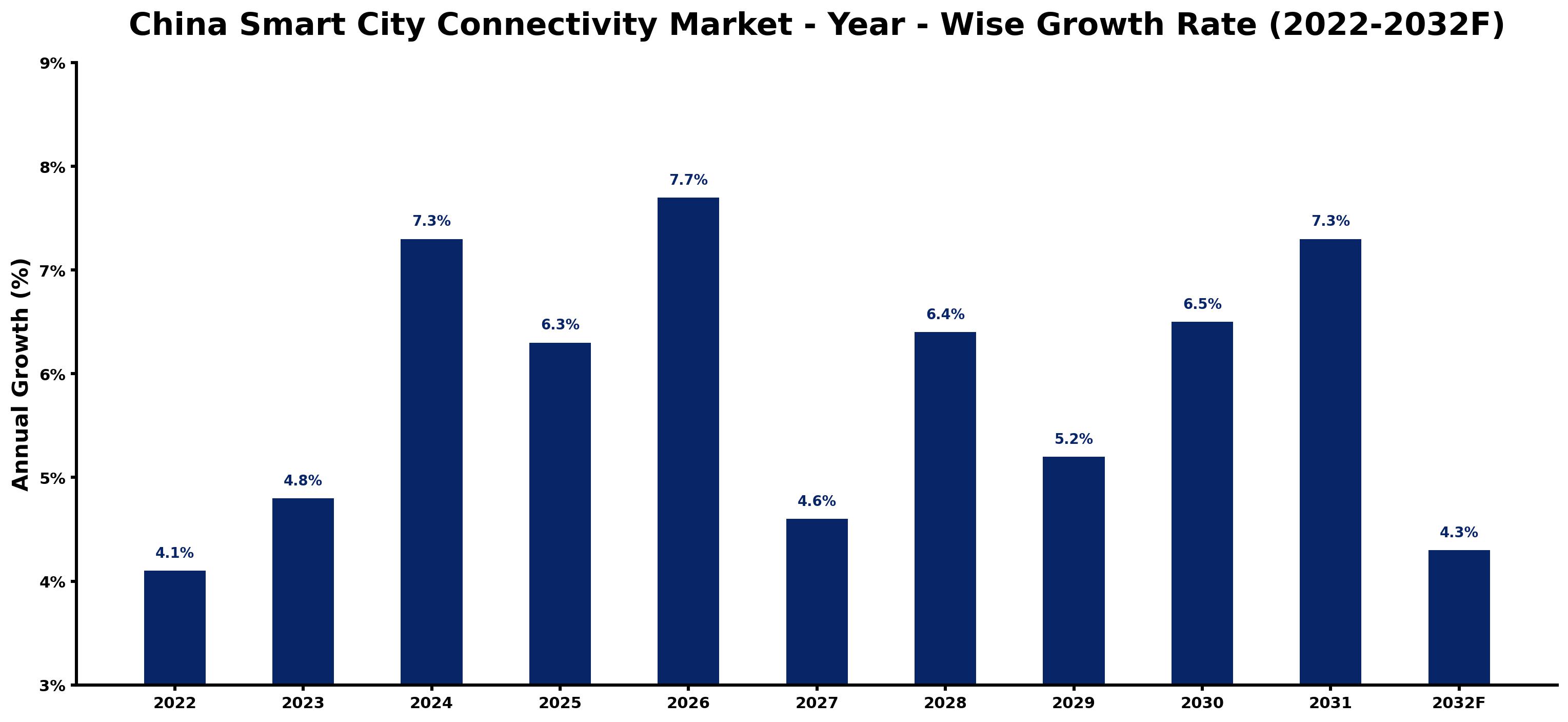
Below, each year's estimated growth is shown next to the factor that most influenced it.
| Year | Estimated Annual Growth (%) | Market Rationale |
| 2022 | 4.1 | Urbanisation continued to drive demand for smart city solutions across China. |
| 2023 | 4.8 | The implementation of the 'Smart City Pilot Program' accelerated urban management improvements. |
| 2024 | 7.3 | Growing investments in infrastructure led to increased adoption of smart city technologies. |
| 2025 | 6.3 | 5G coverage expansion contributed to improved connectivity for smart city applications. |
| 2026 | 7.7 | The 'New Infrastructure' initiative is expected to boost smart city development. |
| 2027 | 4.6 | Public services automation projects are projected to improve efficiency in urban areas. |
| 2028 | 6.4 | The rise of smart transport systems is expected to enhance urban mobility. |
| 2029 | 5.2 | Investment in utility metering solutions is set to improve resource management. |
| 2030 | 6.5 | The 'Digital China' initiative aims to integrate more digital technologies into urban planning. |
| 2031 | 7.3 | The establishment of the 'Smart City Development Standard' supports quality urban technology implementation. |
| 2032 | 4.3 | Ongoing investments in smart city projects will continue to drive market growth. |
Note: Market size estimations and growth projections presented in this report are based on 6Wresearch's proprietary forecasting methodology, utilizing the latest available industry data, government publications, and primary research inputs.
China Smart City Connectivity Market Synopsis
Smart City Connectivity in China encompasses advanced technologies that enable communication and data exchange within urban environments. This integration of IoT devices, high-speed networks, and data analytics platforms enhances public services, transportation systems, and utility management. The China Smart City Connectivity Market is expanding due to rapid urbanisation, with the urban population reaching 900 million in 2023. Government initiatives like the 'New Infrastructure' plan and the 'Smart City Pilot Program' are driving investments, with forecasts suggesting that spending on smart city projects will surpass $200 billion by 2025.
Market Dynamics Impact Analysis (2026–2032)
| Factor | Type | Impact | Primary Segment Affected |
| Urbanisation drives demand for smart city solutions. | Driver | High | 5G-Enabled IoT |
| 5G network expansion supports connectivity for smart city applications. | Driver | High | 5G-Enabled IoT |
| Investment in smart transport systems presents new opportunities. | Opportunity | High | Smart Transport/Surveillance |
| Utility metering solutions are in demand for resource management. | Opportunity | Medium | Utility Metering |
| High costs of infrastructure development can limit project rollout. | Restraint | High | 5G-Enabled IoT |
| Complex regulatory requirements may hinder implementation timelines. | Restraint | Medium | 5G-Enabled IoT |
| Supply chain disruptions affect timely project delivery for developers. | Challenge | High | Smart City Developers |
| Talent shortages in urban planning can delay project execution. | Challenge | Medium | Urban Planners |
Evaluation of Drivers in China Smart City Connectivity Market (2026–2032)
Key forces behind demand, with the segment each one moves most, are listed below.
| Drivers | Primary Segment Affected | Why It Matters (Evidence) |
| Growing urban population increases demand for smart city solutions. | Public Services Automation | China's urban population reached 900 million in 2023, driving demand for efficient public services. |
| Expansion of 5G networks improves connectivity for smart city applications. | Cellular Network | 5G networks are expected to cover 80% of urban areas in China by 2025. |
| Government initiatives boost investment in smart city projects. | Smart City Developers | Investment in smart city projects is projected to exceed $200 billion by 2025. |
| Increased focus on sustainability drives utility metering adoption. | Utility Metering | Utility metering solutions are being deployed in 300 cities to enhance resource management. |
| Smart transport systems improve urban mobility and efficiency. | Smart Transport/Surveillance | Over 200 cities are implementing smart transport systems as part of urban modernization efforts. |
The urban population reached 900 million in 2023, increasing demand for smart city solutions. The expansion of 5G networks, expected to cover 80% of urban areas by 2025, improves connectivity for smart city applications. The deployment of utility metering solutions in numerous cities improves resource management and sustainability.
Evaluation of Restraints in China Smart City Connectivity Market
Below mentioned are some major restraints and their influence on market dynamics.
| Market Restraint | Primary Segment Affected | Why It Matters (Evidence) |
| High costs of infrastructure development limit project rollout. | 5G-Enabled IoT | Infrastructure development costs can be substantial, affecting project feasibility for developers. |
| Complex regulatory requirements hinder implementation timelines. | 5G-Enabled IoT | Navigating regulatory frameworks can delay project approvals and execution. |
| Supply chain disruptions affect timely project delivery. | Smart City Developers | Global supply chain issues can lead to delays in acquiring necessary materials. |
| Talent shortages in urban planning delay project execution. | Urban Planners | A lack of skilled professionals can slow down the planning and implementation processes. |
| Limited public funding for smart city initiatives restricts growth. | 5G-Enabled IoT | Budget constraints can limit the scope and scale of smart city projects. |
China Smart City Connectivity Market Challenges
Buyers in the China Smart City Connectivity market face rising costs as urban demand for advanced solutions increases, with urban populations projected to exceed 1 billion by 2030. Producers encounter technological challenges since the integration of IoT devices and data analytics requires substantial infrastructure investments, delaying project completions for suppliers. A lack of skilled professionals hampers the management of smart city technologies, affecting over 200 cities implementing smart transport systems and reducing service efficiency. Compliance with the 'Smart City Development Standard' established in 2022 adds financial burdens on producers, complicating their pricing strategies and market positioning.
Trends in the China Smart City Connectivity Market
Below mentioned are some of the trends shaping the China Smart City Connectivity Market growth.
- Expansion of 5G Networks: The rollout of 5G networks is accelerating across urban areas in China, with coverage expected to reach 80% by 2025. This expansion facilitates improved connectivity for smart city applications, enabling real-time data exchange.
- Shift Towards Public Services Automation: Public services automation is gaining traction, with over 50 cities piloting projects to improve service delivery. This trend reflects a growing emphasis on efficiency and responsiveness in urban management.
- Rise of Smart Transport Systems: Smart transport systems are being implemented in over 200 cities, improving urban mobility and safety. This trend is important for modernising transportation infrastructure and enhancing city efficiency.
- Increased Focus on Utility Metering Solutions: Utility metering solutions are being deployed in 300 cities, enhancing resource management and sustainability. This shift supports the efficient use of urban resources and aligns with sustainability goals.
Investment Opportunities in the China Smart City Connectivity Market
Below are the investment opportunities with the strongest case in the China Smart City Connectivity Market.
- Investment in Smart Transport Solutions: With over 200 cities implementing smart transport systems, there is an opportunity for investment in this area. The expected growth in urban mobility solutions presents a chance for developers to enter the market.
- Supply of Utility Metering Technologies: As utility metering solutions are being deployed in numerous cities, there is a demand for advanced technologies. Suppliers can target urban planners and utility providers to meet this need effectively.
- Development of 5G-Enabled IoT Solutions: The expansion of 5G networks creates a demand for IoT solutions tailored for smart cities. Companies can partner with telecom providers to develop applications that improve urban connectivity.
- Provision of Public Services Automation Tools: With public services automation projects being piloted in over 50 cities, there is a growing need for technology solutions. Suppliers can engage with local governments to provide necessary tools and platforms.
Government Initiatives in the China Smart City Connectivity Market
The 'New Infrastructure' initiative by the National Development and Reform Commission, introduced in 2020, focuses on developing smart cities across China with a budget of $1 trillion by 2030. This initiative aims to improve urban infrastructure and technology integration, impacting smart city connectivity. Another key measure is the 'Smart City Pilot Program' launched in 2021 by the Ministry of Housing and Urban-Rural Development, which aims to improve urban management through technology integration. This program supports various smart city projects, facilitating better service delivery and urban planning.
The '5G Promotion Plan' initiated by the Ministry of Industry and Information Technology aims to expand 5G coverage in urban areas by 2025. This plan supports the deployment of advanced connectivity solutions necessary for smart city applications. Additionally, the Standardization Administration of China's 'Smart City Development Standard' released in 2022 guides urban technology implementation, ensuring quality and consistency across projects. These measures provide a framework for urban planners and developers to follow, improving the effectiveness of smart city initiatives.
Future Insight of the China Smart City Connectivity Market
The China Smart City Connectivity market is set to evolve significantly by 2032, driven by the expansion of 5G networks expected to cover 90% of urban areas. The 'New Infrastructure' plan will accelerate smart city developments, fostering innovation in urban management. Investment in smart city projects is projected to exceed $200 billion by 2025, indicating robust government backing. The implementation of utility metering solutions in 400 cities will enhance resource management and sustainability efforts.
Market Segmentation Analysis
The report offers a comprehensive study of the following market segments and their leading categories in the market.
By Connectivity Mode – 5G-Enabled IoT Dominated, LPWAN Expected to Grow Fastest
According to Dhaval Chaurasia, Assistant Manager at 6Wresearch, the largest connectivity mode category in 2025 was 5G-Enabled IoT, with a 35% share of total revenue. The 5G-Enabled IoT segment holds the largest share due to its critical role in facilitating real-time data exchange across urban environments. With cities targeting comprehensive 5G coverage by 2025, this technology is indispensable for enhancing urban services. LPWAN is projected to grow fastest, at a CAGR of 7.9% during 2026–2032. LPWAN is experiencing rapid growth as it caters to the increasing demand for low-power, long-range communication necessary for various IoT applications in urban settings. The expansion of IoT networks in urban areas is expected to drive the demand for LPWAN solutions significantly. Suppliers should focus on developing LPWAN technologies to meet the rising demand in urban environments.
By Network Type – Cellular Network Dominated, LoRaWAN/NB-IoT Expected to Grow Fastest
Cellular Network held a 44% share of the China Smart City Connectivity Market by network type in 2025. Cellular Network commands the largest share as it is fundamental for mobile connectivity within smart city infrastructure, enabling seamless communication among various urban systems. Its extensive adoption ensures reliable connectivity for a wide range of smart applications. Over 2026–2032, LoRaWAN/NB-IoT is expected to post the fastest growth, at a CAGR of 8.7%. LoRaWAN/NB-IoT is the fastest-growing network type because it effectively supports efficient communication for IoT devices in urban settings. As cities increasingly implement IoT solutions, the demand for these network types is projected to rise sharply. Buyers should explore partnerships with LoRaWAN/NB-IoT providers to enhance their smart city project capabilities.
By Application Area – Public Services Automation Dominated, Smart Transport/Surveillance Expected to Grow Fastest
Public Services Automation took a 39% share of application area in 2025, more than any other category. Public Services Automation leads the market by significantly improving the efficiency and responsiveness of city services, which is crucial for a rapidly growing urban population. The implementation of automation projects in over 50 cities highlights its essential role in enhancing public service delivery. The quickest growth will come from Smart Transport/Surveillance, forecast to expand at a CAGR of 7.6% between 2026 and 2032. Smart Transport/Surveillance is the fastest-growing application area, as it plays a vital role in enhancing safety and efficiency in urban transport systems, which are increasingly important with urban population growth. Ongoing initiatives in numerous cities underscore the rising emphasis on smart transport solutions. Suppliers should invest in technologies that enable smart transport and surveillance to capitalise on emerging market opportunities.
By End User – Telecom Providers Dominated, Smart City Developers Expected to Grow Fastest
With a 52% revenue share in 2025, Telecom Providers was the largest end user category. Telecom Providers dominate the market as they are essential in delivering connectivity solutions crucial for smart cities. Their established infrastructure and expertise in mobile networks position them as key enablers of smart city initiatives. Smart City Developers are set to record the highest CAGR in this split, 8.3% over 2026–2032. Smart City Developers represent the fastest-growing end user group, as they are integral in planning and executing smart city projects that require advanced connectivity solutions. The surge in smart city initiatives is propelling their rapid growth. Suppliers must engage with Smart City Developers to align their offerings with the evolving demands of urban development.
Key Attractiveness of the Report
- 10 Years of Market Numbers
- Historical Data Starting from 2022 to 2025
- Base Year 2025
- Forecast Data until 2032
- Key Performance Indicators Impacting the Market
- Major Upcoming Developments and Projects
Key Highlights of the Report:
- China Smart City Connectivity Market Outlook
- Market Size of China Smart City Connectivity Market, 2025
- Forecast of China Smart City Connectivity Market, 2032
- Historical Data and Forecast of China Smart City Connectivity Revenues & Volume for the Period 2022 - 2032F
- China Smart City Connectivity Market Trend Evolution
- China Smart City Connectivity Market Drivers and Challenges
- China Smart City Connectivity Price Trends
- China Smart City Connectivity Porter's Five Forces
- China Smart City Connectivity Industry Life Cycle
- Historical Data and Forecast of China Smart City Connectivity Market Revenues & Volume By Connectivity Mode for the Period 2022 - 2032F
- Historical Data and Forecast of China Smart City Connectivity Market Revenues & Volume By 5G-Enabled IoT for the Period 2022 - 2032F
- Historical Data and Forecast of China Smart City Connectivity Market Revenues & Volume By LPWAN for the Period 2022 - 2032F
- Historical Data and Forecast of China Smart City Connectivity Market Revenues & Volume By Wi-Fi Mesh for the Period 2022 - 2032F
- Historical Data and Forecast of China Smart City Connectivity Market Revenues & Volume By Fiber Backhaul for the Period 2022 - 2032F
- Historical Data and Forecast of China Smart City Connectivity Market Revenues & Volume By Network Type for the Period 2022 - 2032F
- Historical Data and Forecast of China Smart City Connectivity Market Revenues & Volume By Cellular Network for the Period 2022 - 2032F
- Historical Data and Forecast of China Smart City Connectivity Market Revenues & Volume By LoRaWAN/NB-IoT for the Period 2022 - 2032F
- Historical Data and Forecast of China Smart City Connectivity Market Revenues & Volume By Public Internet for the Period 2022 - 2032F
- Historical Data and Forecast of China Smart City Connectivity Market Revenues & Volume By Gigabit Internet for the Period 2022 - 2032F
- Historical Data and Forecast of China Smart City Connectivity Market Revenues & Volume By Application Area for the Period 2022 - 2032F
- Historical Data and Forecast of China Smart City Connectivity Market Revenues & Volume By Public Services Automation for the Period 2022 - 2032F
- Historical Data and Forecast of China Smart City Connectivity Market Revenues & Volume By Utility Metering for the Period 2022 - 2032F
- Historical Data and Forecast of China Smart City Connectivity Market Revenues & Volume By Smart Transport/Surveillance for the Period 2022 - 2032F
- Historical Data and Forecast of China Smart City Connectivity Market Revenues & Volume By Government Networks for the Period 2022 - 2032F
- Historical Data and Forecast of China Smart City Connectivity Market Revenues & Volume By End User for the Period 2022 - 2032F
- Historical Data and Forecast of China Smart City Connectivity Market Revenues & Volume By Telecom Providers for the Period 2022 - 2032F
- Historical Data and Forecast of China Smart City Connectivity Market Revenues & Volume By Smart City Developers for the Period 2022 - 2032F
- Historical Data and Forecast of China Smart City Connectivity Market Revenues & Volume By Urban Planners for the Period 2022 - 2032F
- Historical Data and Forecast of China Smart City Connectivity Market Revenues & Volume By Infrastructure Builders for the Period 2022 - 2032F
- China Smart City Connectivity Import Export Trade Statistics
- Market Opportunity Assessment By Connectivity Mode
- Market Opportunity Assessment By Network Type
- Market Opportunity Assessment By Application Area
- Market Opportunity Assessment By End User
- China Smart City Connectivity Top Companies Market Share
- China Smart City Connectivity Competitive Benchmarking By Technical and Operational Parameters
- China Smart City Connectivity Company Profiles
- China Smart City Connectivity Key Strategic Recommendations
Market Covered
The report offers an extensive study of the following market segments.
By Connectivity Mode
- 5G-Enabled IoT
- LPWAN
- Wi-Fi Mesh
- Fiber Backhaul
By Network Type
- Cellular Network
- LoRaWAN/NB-IoT
- Public Internet
- Gigabit Internet
By Application Area
- Public Services Automation
- Utility Metering
- Smart Transport/Surveillance
- Government Networks
By End User
- Telecom Providers
- Smart City Developers
- Urban Planners
- Infrastructure Builders































