India Smart City Infrastructure Market Size & Growth Rate
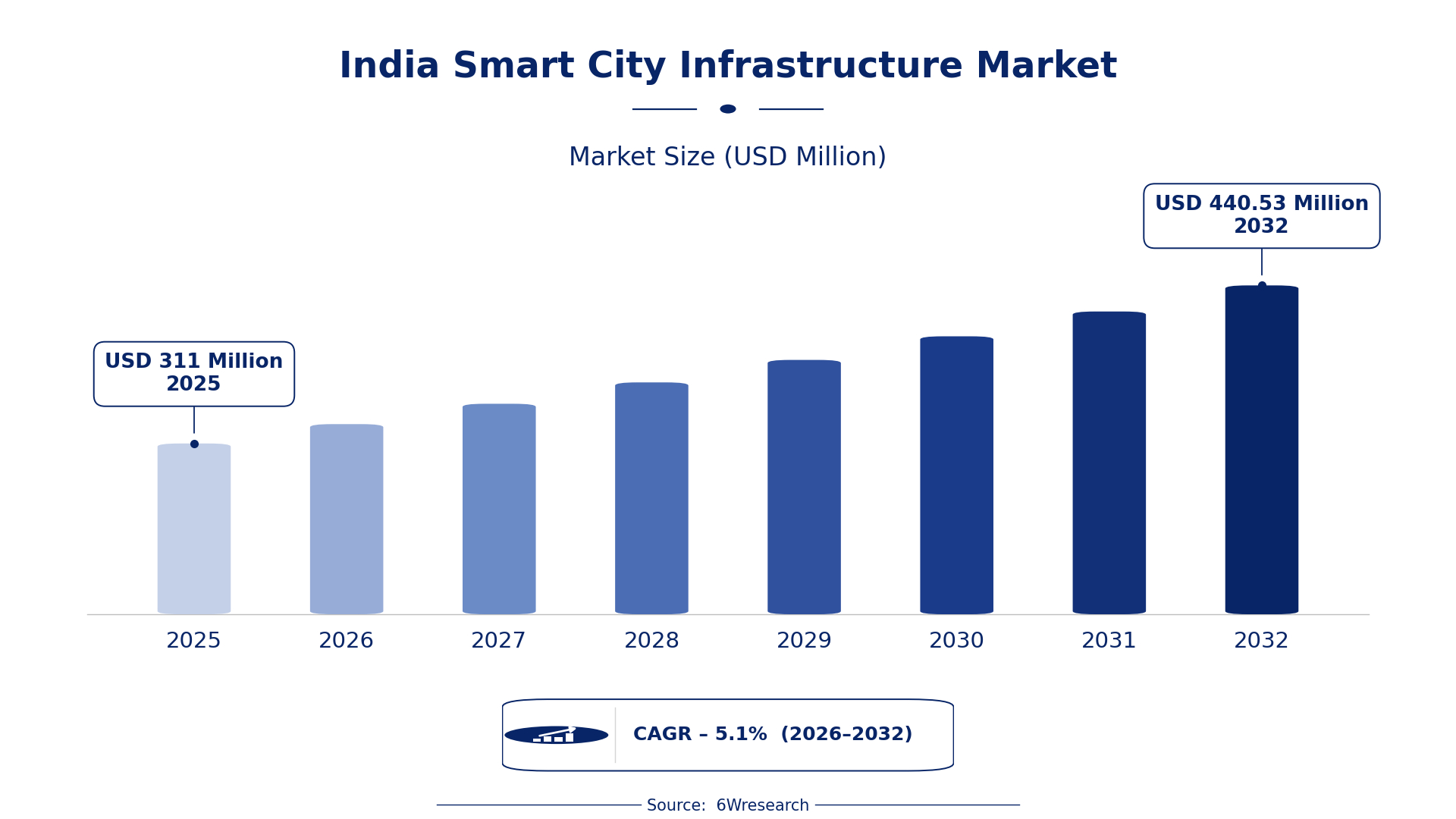
According to 6Wresearch internal database and industry insights, the India Smart City Infrastructure Market was valued at USD 311.0 million in 2025 and is projected to reach USD 440.53 million by 2032, growing at a CAGR of approximately 5.1% during 2026–2032.
India Smart City Infrastructure Market Highlights
| Report Metric | Details |
| Report Name | India Smart City Infrastructure Market |
| Market Size 2025 | USD 311.0 million |
| Market Size 2032 | USD 440.53 million |
| Absolute Growth 2025–2032 | USD 129.53 million |
| CAGR 2026–2032 | 5.1% |
| Peak Annual Growth | 7.6% in 2031 |
| Forecast Period | 2026–2032 |
| Historical Data | 2022–2025 |
| Base Year | 2025 |
| Leading Infrastructure Type, 2025 | Smart Roads (34% share) |
| Leading Smart Feature, 2025 | Sensor-Embedded Lanes (46% share) |
| Leading Technology Embedded, 2025 | Traffic & Vibration Data (36% share) |
| Leading End User, 2025 | Municipal Corporations (46% share) |
| Fastest-Growing Infrastructure Type | Smart Lighting (7.3% CAGR) |
| Fastest-Growing Technology Embedded | EV Charging (7.4% CAGR) |
| Fastest-Growing End User | Utility Integrators (6.1% CAGR) |
| Growing Sector | Urban Infrastructure Development |
| Key End Users | Municipal Corporations, Urban Planners, Utility Integrators, Transport Departments |
India Smart City Infrastructure Market Year-wise Growth Rate and Key Drivers (2022–2032)
This graph illustrates the annual growth rates of the market from 2022 to 2032, highlighting a steady upward trajectory and projected market expansion over the forecast period.

Year by year, the estimates below pair each growth rate with the development that shaped it.
| Year | Estimated Annual Growth (%) | Market Rationale |
| 2022 | 6.4 | The market experienced growth due to the initiation of major smart city projects under the Smart Cities Mission. |
| 2023 | 3.5 | Growth slowed as some projects faced delays in implementation and funding from municipal corporations. |
| 2024 | 3.9 | Demand increased as urban planners focused on improving infrastructure efficiency through new technologies. |
| 2025 | 5.9 | Expansion was driven by increased government funding for smart city initiatives, particularly in Maharashtra. |
| 2026 | 4.5 | Growth is expected to slow as competition among technology providers intensifies in the market. |
| 2027 | 5.9 | Demand will rise as urban populations continue to expand, necessitating better infrastructure solutions. |
| 2028 | 5.4 | Growth is projected to slow due to challenges in project execution and resource allocation. |
| 2029 | 4.3 | Demand will decrease slightly as budget constraints affect project timelines for municipal corporations. |
| 2030 | 2.6 | Growth is expected to slow as priorities shift towards other urban development areas, impacting funding. |
| 2031 | 7.6 | The market will peak as new smart city initiatives are launched ahead of deadlines set by the government. |
| 2032 | 5.5 | Growth will slow as the Bureau of Indian Standards implements new regulations for smart city infrastructure. |
Note: Market size estimations and growth projections presented in this report are based on 6Wresearch's proprietary forecasting methodology, utilizing the latest available industry data, government publications, and primary research inputs.
India Smart City Infrastructure Market Synopsis
Smart City Infrastructure in India includes advanced urban development technologies designed to enhance urban living conditions. Key components encompass smart roads, lighting, and digital signage, all integrated through IoT and AI technologies. The India Smart City Infrastructure Market is expanding due to rapid urbanisation, with the urban population expected to reach 600 million by 2031. Municipal corporations and urban planners are driving the demand for efficient urban services. Government initiatives and public-private partnerships are encouraging investments in this sector, improving overall urban infrastructure.
Market Dynamics Impact Analysis (2026–2032)
| Factor | Type | Impact | Primary Segment Affected |
| Growing urban population driving infrastructure needs | Driver | High | Smart Roads |
| Increased government funding for smart city projects | Driver | High | Smart Lighting |
| Rising demand for energy-efficient solutions | Opportunity | High | Smart Lighting |
| Need for improved traffic management systems | Opportunity | High | Smart Roads |
| Delays in project implementation due to bureaucratic hurdles | Restraint | High | Smart Roads |
| Budget constraints limiting project scope and scale | Restraint | High | Smart Lighting |
| Competition among technology providers leading to price wars | Challenge | Medium | Smart Roads |
| Technological integration challenges affecting project timelines | Challenge | Medium | Smart Lighting |
Evaluation of Drivers in India Smart City Infrastructure Market (2026–2032)
Key forces behind demand, with the segment each one moves most, are listed below.
| Drivers | Primary Segment Affected | Why It Matters (Evidence) |
| Increased urbanisation necessitating better infrastructure | Smart Roads | The urban population in India is projected to reach 600 million by 2031, increasing demand for efficient traffic management. |
| Government funding for smart city initiatives | Smart Lighting | In 2021, INR 1,000 crore was allocated for smart city projects, improving energy efficiency. |
| Adoption of IoT technologies in urban planning | Sensor-Embedded Lanes | The integration of IoT in traffic management systems boosts real-time monitoring capabilities. |
| Focus on sustainable urban development | EV Charging | The National Electric Mobility Mission aims to install 1 million EV charging stations by 2030. |
| Public-private partnerships driving investment | Digital Signage | Smart signage systems are being implemented in public transport across major cities, improving communication. |
The urban population is projected to reach 600 million by 2031, driving demand for efficient traffic management systems. In 2021, INR 1,000 crore was allocated for smart city projects, improving energy efficiency through smart lighting. The integration of IoT technologies in urban planning is boosting real-time monitoring capabilities, particularly in sensor-embedded lanes. The focus on sustainable urban development will lead to the installation of 1 million EV charging stations by 2030, promoting cleaner transport solutions.
Evaluation of Restraints in India Smart City Infrastructure Market
The main factors holding the market back are set out below.
| Market Restraint | Primary Segment Affected | Why It Matters (Evidence) |
| Bureaucratic hurdles delaying project timelines | Smart Roads | Delays in approvals can extend project timelines, affecting timely infrastructure deployment. |
| Budget constraints limiting project scope | Smart Lighting | Limited funding restricts the implementation of effective smart lighting solutions. |
| Technological integration challenges | Sensor-Embedded Lanes | Integration of IoT technologies can face technical difficulties, delaying project completion. |
| Competition leading to price wars | Digital Signage | Intense competition among providers can result in reduced profit margins for suppliers. |
| Resource allocation issues affecting project execution | EV Charging | Insufficient resources can hinder the establishment of necessary charging infrastructure. |
India Smart City Infrastructure Market Challenges
Buyers and suppliers in the India Smart City Infrastructure market face considerable technological challenges, as many urban areas lack adequate IoT and AI integration for effective solutions. This issue stems from a shortage of skilled professionals, causing delays for municipal corporations that can extend up to 18 months. Budget constraints are another pressing concern; in 2021, the Government of India allocated INR 1,000 crore for smart city projects, which falls short given the anticipated urban population growth. Supply chain inefficiencies also affect the market, as reliance on local vendors can postpone the delivery of essential components by up to six months, complicating project timelines for urban planners. Additionally, intense competition among states like Maharashtra and Gujarat for funding resources hampers collaborative efforts, making it difficult for cities to implement cohesive smart initiatives.
Trends in the India Smart City Infrastructure Market
Buyers and suppliers in the India Smart City Infrastructure Market are adjusting to the following trends.
- Shift towards Sustainable Urban Mobility Solutions: Cities like Pune and Surat are implementing smart street lighting systems, improving energy efficiency. The government aims to promote sustainable urban transport with a target of 1 million EV charging stations by 2030.
- Increased Adoption of IoT in Urban Planning: Municipal corporations are increasingly integrating IoT technologies in projects, with smart traffic management systems deployed in Bengaluru and Hyderabad. This trend is expected to improve urban services and efficiency.
- Growth of Public-Private Partnerships in Smart City Projects: Public-private partnerships are becoming more prevalent, with over 100 smart city projects initiated under the Smart Cities Mission since 2015. This collaboration is essential for funding and expertise.
- Expansion of Smart Infrastructure in Urban Areas: Urban planners are focusing on developing smart infrastructure, with major projects in Maharashtra and Gujarat leading the way. This trend supports the growing urban population and infrastructure needs.
Investment Opportunities in the India Smart City Infrastructure Market
Some of the investment opportunities in the India Smart City Infrastructure Market are mentioned below.
- Partnerships with Local Governments: Now is an ideal time to collaborate with municipal corporations, which hold a significant share in smart city projects, to improve infrastructure development and service delivery.
- Investment in EV Charging Infrastructure: With the government's target of 1 million EV charging stations by 2030, investing in this infrastructure presents a valuable opportunity for suppliers and developers.
- Focus on Energy-Efficient Solutions: The rising demand for energy-efficient smart lighting systems offers opportunities for manufacturers to supply innovative technologies to urban planners and municipalities.
- Development of Smart Traffic Management Systems: Investing in smart traffic solutions is timely as cities like Bengaluru and Hyderabad implement advanced systems to enhance urban mobility and reduce congestion.
Government Initiatives in the India Smart City Infrastructure Market
The Smart Cities Mission, launched by the Ministry of Housing and Urban Affairs in 2015, aims to promote sustainable and inclusive cities through smart solutions. The Bureau of Indian Standards released standards for smart city infrastructure in 2022, ensuring quality and safety in implementation. Furthermore, the Atal Mission for Rejuvenation and Urban Transformation (AMRUT) focuses on urban infrastructure development, with a budget of INR 50,000 crore allocated to improve urban services.
The National Institute of Urban Affairs is a key agency that promotes smart city development by providing research and guidance. It supports urban planners and municipal corporations in implementing smart solutions. The Ministry of Electronics and Information Technology announced a budget of INR 500 crore for developing smart city technologies, enhancing the overall infrastructure framework.
Future Insight of the India Smart City Infrastructure Market
The India Smart City Infrastructure market is set for substantial evolution by 2032, driven by the adoption of new digital standards from the Bureau of Indian Standards. Urbanisation will accelerate demand for integrated solutions, particularly in traffic management and energy efficiency. The government plans to boost urban services through increased public-private partnerships, facilitating innovative projects across multiple regions. By 2023, the Smart Cities Mission's objective to develop 100 cities with smart solutions will significantly influence the infrastructure landscape, ultimately shaping a more connected urban environment.
Market Segmentation Analysis
Each segment group is reviewed below, with the leader by share and the fastest grower by CAGR.
By Infrastructure Type – Smart Roads Dominated, Smart Lighting Expected to Grow Fastest
According to Dhaval Chaurasia, Assistant Manager at 6Wresearch, Smart Roads accounted for a 34% market share by infrastructure type in 2025. Smart Roads hold the largest share in the India Smart City Infrastructure Market due to their critical function in traffic management and urban mobility. For instance, cities like Bengaluru are implementing smart roads to reduce congestion and enhance transportation efficiency. Over 2026–2032, Smart Lighting is expected to post the fastest growth, at a CAGR of 7.3%. Smart Lighting is experiencing rapid growth as urban areas increasingly focus on energy efficiency and public safety. The substantial allocation of INR 1,000 crore by the Government of India for smart city projects is expected to significantly elevate the demand for smart lighting solutions. This trend indicates that suppliers should prioritise the advancement of smart lighting technologies to meet urban demands.
By Smart Feature – Sensor-Embedded Lanes Dominated and Is Expected to Record the Fastest Growth
The largest smart feature category in 2025 was Sensor-Embedded Lanes, with a 46% share of total revenue. Sensor-Embedded Lanes dominate the market share as they are essential for real-time traffic monitoring, crucial for effective urban management. Their deployment in major cities enhances traffic flow and safety, making them indispensable for smart city initiatives. Its lead should widen, with a projected CAGR of 7.2% during 2026–2032, the highest in this split. The growth of Sensor-Embedded Lanes will continue to accelerate as urban areas increasingly adopt these technologies for traffic management. Their integration into smart city frameworks ensures sustained relevance and rising demand. Suppliers must focus on developing advanced sensor technologies to capitalise on this expanding market segment.
By Technology Embedded – Traffic & Vibration Data Dominated, EV Charging Expected to Grow Fastest
With a 36% revenue share in 2025, Traffic & Vibration Data was the largest technology embedded category. Traffic & Vibration Data technology leads the market share as it is vital for infrastructure planning and maintenance in smart cities. This technology allows municipalities to effectively monitor road conditions and optimise maintenance schedules. EV Charging is projected to grow fastest, at a CAGR of 7.4% during 2026–2032. EV Charging technology is rapidly gaining traction, driven by the government's ambitious target to install 1 million EV charging stations by 2030. This initiative reflects a growing commitment to sustainable urban transport solutions. For suppliers, investing in EV charging infrastructure presents a lucrative opportunity aligned with government sustainability objectives.
By End User – Municipal Corporations Dominated, Utility Integrators Expected to Grow Fastest
In 2025, Municipal Corporations led the end user split with a 46% share. Municipal Corporations represent the largest share in the market as they are the primary implementers of smart city initiatives across India. Their active involvement is essential for the successful deployment of smart infrastructure projects. The quickest growth will come from Utility Integrators, forecast to expand at a CAGR of 6.1% between 2026 and 2032. Utility Integrators are experiencing the fastest growth as they play a crucial role in integrating various smart technologies into existing urban frameworks. Their demand is increasing as cities seek comprehensive solutions for infrastructure management. This suggests that suppliers should tailor their offerings to meet the specific needs of utility integrators involved in smart city projects.
Key Attractiveness of the Report
- 10 Years of Market Numbers
- Historical Data Starting from 2022 to 2025
- Base Year 2025
- Forecast Data until 2032
- Key Performance Indicators Impacting the Market
- Major Upcoming Developments and Projects
Key Highlights of the Report:
- India Smart City Infrastructure Market Outlook
- Market Size of India Smart City Infrastructure Market, 2025
- Forecast of India Smart City Infrastructure Market, 2032
- Historical Data and Forecast of India Smart City Infrastructure Revenues & Volume for the Period 2022 - 2032F
- India Smart City Infrastructure Market Trend Evolution
- India Smart City Infrastructure Market Drivers and Challenges
- India Smart City Infrastructure Price Trends
- India Smart City Infrastructure Porter's Five Forces
- India Smart City Infrastructure Industry Life Cycle
- Historical Data and Forecast of India Smart City Infrastructure Market Revenues & Volume By Infrastructure Type for the Period 2022 - 2032F
- Historical Data and Forecast of India Smart City Infrastructure Market Revenues & Volume By Smart Roads for the Period 2022 - 2032F
- Historical Data and Forecast of India Smart City Infrastructure Market Revenues & Volume By Smart Lighting for the Period 2022 - 2032F
- Historical Data and Forecast of India Smart City Infrastructure Market Revenues & Volume By Smart Poles for the Period 2022 - 2032F
- Historical Data and Forecast of India Smart City Infrastructure Market Revenues & Volume By Digital Signage for the Period 2022 - 2032F
- Historical Data and Forecast of India Smart City Infrastructure Market Revenues & Volume By Smart Feature for the Period 2022 - 2032F
- Historical Data and Forecast of India Smart City Infrastructure Market Revenues & Volume By Sensor-Embedded Lanes for the Period 2022 - 2032F
- Historical Data and Forecast of India Smart City Infrastructure Market Revenues & Volume By Adaptive Brightness for the Period 2022 - 2032F
- Historical Data and Forecast of India Smart City Infrastructure Market Revenues & Volume By Multi-Utility for the Period 2022 - 2032F
- Historical Data and Forecast of India Smart City Infrastructure Market Revenues & Volume By Info Display for the Period 2022 - 2032F
- Historical Data and Forecast of India Smart City Infrastructure Market Revenues & Volume By Technology Embedded for the Period 2022 - 2032F
- Historical Data and Forecast of India Smart City Infrastructure Market Revenues & Volume By Traffic & Vibration Data for the Period 2022 - 2032F
- Historical Data and Forecast of India Smart City Infrastructure Market Revenues & Volume By Motion + AI for the Period 2022 - 2032F
- Historical Data and Forecast of India Smart City Infrastructure Market Revenues & Volume By Wi-Fi, EV Charging, CCTV for the Period 2022 - 2032F
- Historical Data and Forecast of India Smart City Infrastructure Market Revenues & Volume By Cloud Content Control for the Period 2022 - 2032F
- Historical Data and Forecast of India Smart City Infrastructure Market Revenues & Volume By End User for the Period 2022 - 2032F
- Historical Data and Forecast of India Smart City Infrastructure Market Revenues & Volume By Municipal Corporations for the Period 2022 - 2032F
- Historical Data and Forecast of India Smart City Infrastructure Market Revenues & Volume By Urban Planners for the Period 2022 - 2032F
- Historical Data and Forecast of India Smart City Infrastructure Market Revenues & Volume By Utility Integrators for the Period 2022 - 2032F
- Historical Data and Forecast of India Smart City Infrastructure Market Revenues & Volume By Transport Departments for the Period 2022 - 2032F
- India Smart City Infrastructure Import Export Trade Statistics
- Market Opportunity Assessment By Infrastructure Type
- Market Opportunity Assessment By Smart Feature
- Market Opportunity Assessment By Technology Embedded
- Market Opportunity Assessment By End User
- India Smart City Infrastructure Top Companies Market Share
- India Smart City Infrastructure Competitive Benchmarking By Technical and Operational Parameters
- India Smart City Infrastructure Company Profiles
- India Smart City Infrastructure Key Strategic Recommendations
Market Covered
This report examines the market across the segments below.
By Infrastructure Type
- Smart Roads
- Smart Lighting
- Smart Poles
- Digital Signage
By Smart Feature
- Sensor-Embedded Lanes
- Adaptive Brightness
- Multi-Utility
- Info Display
By Technology Embedded
- Traffic & Vibration Data
- Motion + AI
- Wi-Fi
- EV Charging
- CCTV
- Cloud Content Control
By End User
- Municipal Corporations
- Urban Planners
- Utility Integrators
- Transport Departments































