China Smart City Infrastructure Market Size & Growth Rate
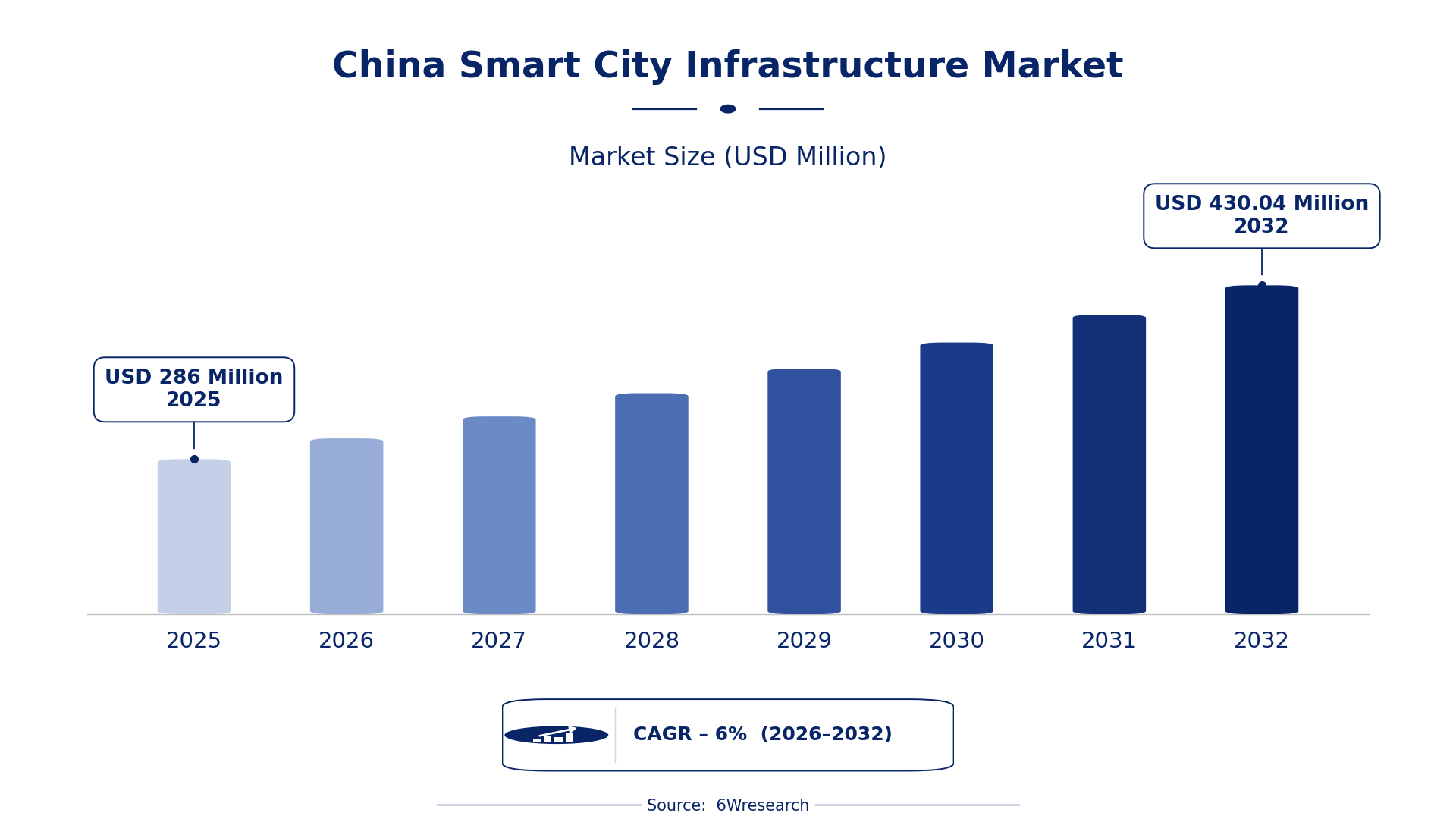
According to 6Wresearch internal database and industry insights, the China Smart City Infrastructure Market was valued at USD 286.0 million in 2025 and is projected to reach USD 430.04 million by 2032, growing at a CAGR of approximately 6% during 2026–2032.
China Smart City Infrastructure Market Highlights
| Report Metric | Details |
| Report Name | China Smart City Infrastructure Market |
| Market Size 2025 | USD 286.0 million |
| Market Size 2032 | USD 430.04 million |
| Absolute Growth 2025–2032 | USD 144.04 million |
| CAGR 2026–2032 | 6% |
| Peak Annual Growth | 7.6% in 2027 |
| Forecast Period | 2026–2032 |
| Historical Data | 2022–2025 |
| Base Year | 2025 |
| Leading Infrastructure Type, 2025 | Smart Roads (40% share) |
| Leading Smart Feature, 2025 | Sensor-Embedded Lanes (50% share) |
| Leading Technology Embedded, 2025 | Traffic & Vibration Data (33% share) |
| Leading End User, 2025 | Municipal Corporations (42% share) |
| Fastest-Growing Infrastructure Type | Smart Poles (7.8% CAGR) |
| Fastest-Growing Technology Embedded | Motion + AI (8.1% CAGR) |
| Fastest-Growing End User | Utility Integrators (7.6% CAGR) |
| Growing Sector | Utility Integrators |
| Key End Users | Municipal Corporations, Urban Planners, Utility Integrators, Transport Departments |
China Smart City Infrastructure Market Year-wise Growth Rate and Key Drivers (2022–2032)
This graph illustrates the annual growth rates of the market from 2022 to 2032, highlighting a steady upward trajectory and projected market expansion over the forecast period.
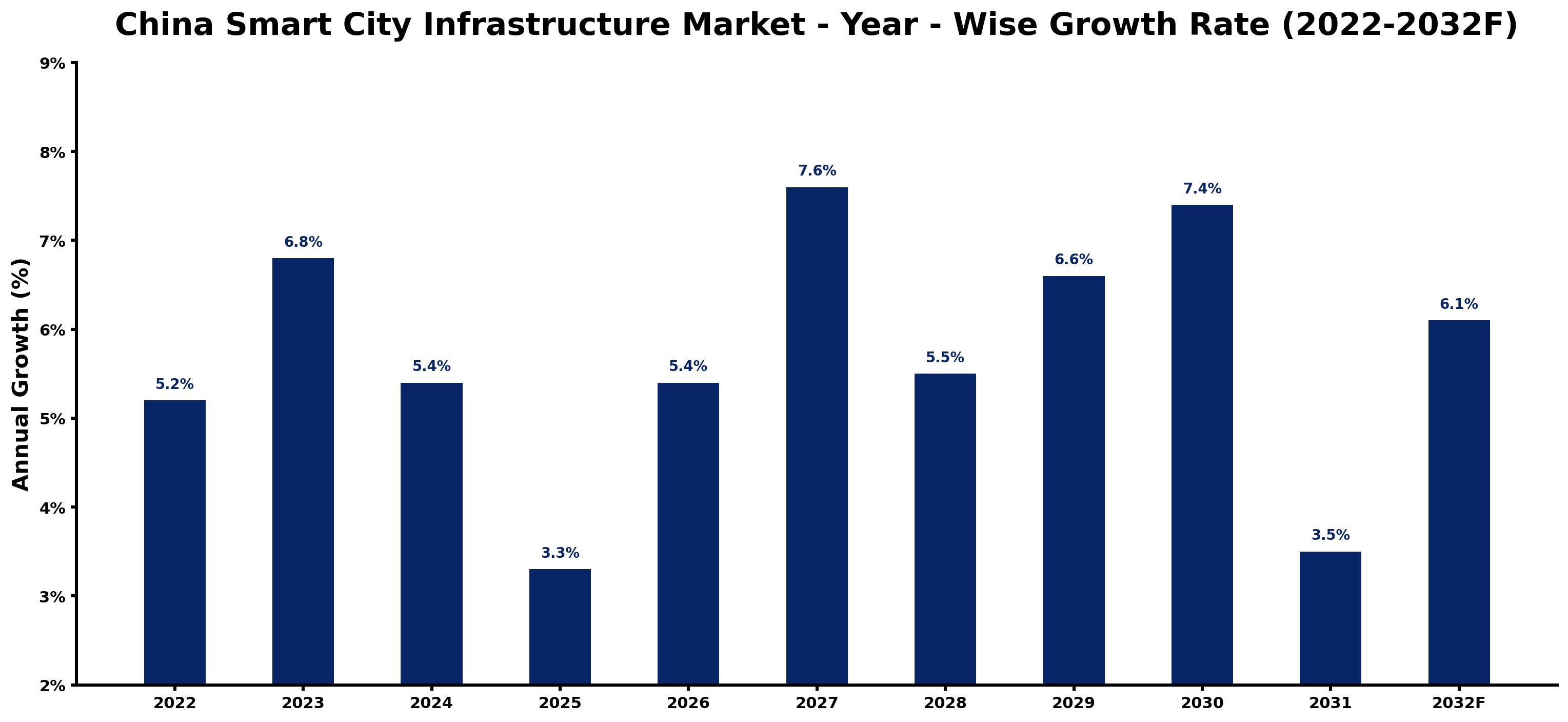
Annual growth estimates for each year appear below with the principal reason behind them, explaining the shifts that set the pace of the market.
| Year | Estimated Annual Growth (%) | Market Rationale |
| 2022 | 5.2 | Urbanisation continued to drive demand for smart city solutions across major cities. |
| 2023 | 6.8 | The National Smart City Development Plan spurred increased investment in urban infrastructure. |
| 2024 | 5.4 | Growth slowed as some cities completed initial smart city projects and focused on optimisation. |
| 2025 | 3.3 | Cities prioritised smart traffic management systems to enhance operational efficiency. |
| 2026 | 5.4 | Investment in smart technologies is expected to rise as cities adopt new solutions. |
| 2027 | 7.6 | The smart roads initiative in Beijing is projected to significantly improve traffic flow. |
| 2028 | 5.5 | Growth is anticipated to slow as cities focus on integrating existing systems. |
| 2029 | 6.6 | Demand is expected to rise as urban planners increasingly utilise data for development. |
| 2030 | 7.4 | The government’s energy savings target will drive investments in smart infrastructure. |
| 2031 | 3.5 | Growth is projected to slow as cities reassess their smart city strategies. |
| 2032 | 6.1 | Increased funding for smart city projects is expected to improve urban living. |
Note: Market size estimations and growth projections presented in this report are based on 6Wresearch's proprietary forecasting methodology, utilizing the latest available industry data, government publications, and primary research inputs.
China Smart City Infrastructure Market Synopsis
Smart City Infrastructure in China includes technologies aimed at improving urban living through enhanced connectivity and efficiency. This encompasses systems for traffic management, energy efficiency, and public safety improvements. The China Smart City Infrastructure Market is expanding due to rapid urbanisation and government initiatives that support integrated urban management. The National Smart City Development Plan, launched in 2021, has been a key driver, with over 200 cities designated as pilot smart cities by 2023. Investment in smart city projects is expected to exceed $300 billion by 2025, indicating strong demand from municipal corporations and urban planners.
Market Dynamics Impact Analysis (2026–2032)
| Factor | Type | Impact | Primary Segment Affected |
| Rapid urbanisation is increasing the need for efficient urban management systems. | Driver | High | Smart Roads |
| Government initiatives are promoting investment in smart technologies for cities. | Driver | High | Smart Lighting |
| The total investment in smart city projects is projected to exceed $300 billion by 2025. | Opportunity | High | Smart Poles |
| Growing demand for integrated urban solutions presents opportunities for suppliers. | Opportunity | High | Digital Signage |
| High costs of implementation can limit project initiation in smaller cities. | Restraint | High | Smart Roads |
| Limited funding for ongoing maintenance can hinder system effectiveness. | Restraint | High | Smart Lighting |
| The Smart City Infrastructure market in China faces regulatory complexities that can delay projects. | Challenge | High | Smart Poles |
| Competition among cities for funding can lead to project prioritisation issues. | Challenge | High | Digital Signage |
Evaluation of Drivers in China Smart City Infrastructure Market (2026–2032)
Below mentioned are some major drivers and their influence on market dynamics.
| Drivers | Primary Segment Affected | Why It Matters (Evidence) |
| Increased urban population drives demand for smart traffic management solutions. | Smart Roads | In 2022, China's urban population reached 64%, necessitating improved traffic systems. |
| Government funding supports the development of smart lighting systems in urban areas. | Smart Lighting | Shanghai has implemented smart lighting in over 50% of its urban areas as of 2023. |
| Smart poles equipped with 5G technology improve connectivity and data collection. | Smart Poles | Smart poles in Shenzhen are essential for integrating various urban services. |
| Digital signage facilitates real-time information dissemination to the public. | Digital Signage | Increased urbanisation has raised the need for effective communication in cities. |
| The smart city initiative aims to improve energy efficiency across urban infrastructure. | Sensor-Embedded Lanes | The Chinese government targets 30% energy savings in urban infrastructure by 2030. |
Urbanisation reached 64% of the total population in 2022, creating a pressing need for efficient infrastructure. The National Smart City Development Plan, launched in 2021, has catalysed funding for urban projects. Smart poles in Shenzhen equipped with 5G technology are improving connectivity and data collection, driving further demand.
Evaluation of Restraints in China Smart City Infrastructure Market
The following restraints limit how fast demand can grow.
| Market Restraint | Primary Segment Affected | Why It Matters (Evidence) |
| High implementation costs can deter smaller municipalities from adopting smart solutions. | Smart Roads | The total investment required for smart city projects can exceed budgets for smaller cities. |
| Ongoing maintenance costs can limit the effectiveness of smart infrastructure. | Smart Lighting | Cities may struggle to allocate sufficient funds for maintaining advanced systems. |
| Regulatory complexities can delay project approvals and implementation. | Smart Poles | Compliance with various standards can slow down the deployment of smart technologies. |
| Limited public awareness can hinder the adoption of smart city technologies. | Digital Signage | Without understanding the benefits, residents may resist changes to their urban environment. |
| Competition for funding among cities can lead to prioritisation issues. | Sensor-Embedded Lanes | Cities may delay projects if they are not seen as immediate priorities for funding. |
China Smart City Infrastructure Market Challenges
The China Smart City Infrastructure market faces notable supply chain disruptions, with over 30% of key components sourced from abroad, leading to delays for producers and extended project timelines. Rising material costs present another challenge; a 15% increase in raw material prices in 2022 has strained budgets for buyers, potentially delaying project completions by several months. A shortage of skilled professionals is apparent, as 40% of urban planners report difficulties in finding qualified talent, which directly affects project execution. Additionally, slow technology adoption is problematic; only 25% of cities have fully implemented the updated National Standard for Smart City Construction, limiting the effectiveness of new initiatives for municipalities.
Trends in the China Smart City Infrastructure Market
Four trends stand out in the China Smart City Infrastructure Market.
- National Smart City Development Plan Drives Innovation: The National Smart City Development Plan, launched in 2021, has accelerated the integration of technology in urban planning. By 2023, over 200 cities are recognised as pilot smart cities, showcasing advancements in urban technology.
- Shift Towards Sustainable Urban Solutions: In 2023, cities like Shanghai are implementing smart lighting systems in over 50% of urban areas. This shift towards energy-efficient solutions aligns with the government's target of 30% energy savings by 2030.
- Emergence of Smart Poles as Multifunctional Infrastructure: Smart poles in Shenzhen are equipped with 5G technology, improving connectivity and data collection. This trend reflects a growing preference for integrated urban solutions that serve multiple purposes.
- Increased Focus on Real-Time Information Dissemination: Digital signage is becoming essential for urban communication, with cities recognising its importance in information dissemination. The demand for effective communication systems is rising as urbanisation increases.
Investment Opportunities in the China Smart City Infrastructure Market
Investors looking at the China Smart City Infrastructure Market should consider the following areas.
- Timing for Investment: With total investment in smart city projects projected to exceed $300 billion by 2025, there is an opportunity for suppliers to engage with municipal corporations.
- Growing Demand for Smart Solutions: As urban populations rise, cities require more smart infrastructure. Urban planners are eager to implement solutions that improve efficiency and sustainability.
- Integration of Services: Smart poles are gaining traction, particularly in urban areas like Shenzhen, where multifunctional infrastructure is needed. Suppliers can invest in this growing segment.
- Focus on Energy Efficiency: The government's target of 30% energy savings by 2030 creates a demand for energy-efficient technologies. Utility integrators are key buyers in this market.
Government Initiatives in the China Smart City Infrastructure Market
The Urban Traffic Management Regulation, updated in 2023 by the Ministry of Transport, includes provisions for implementing smart traffic systems in major cities. This regulation strengthens the framework for integrating technology into urban traffic management, ensuring cities meet modern standards. The 14th Five-Year Plan for Economic and Social Development emphasises smart city infrastructure as a key area for investment and growth, focusing on sustainability and innovation. This plan encourages local governments to adopt advanced technologies for urban management.
The Smart City Pilot Program, initiated by the Ministry of Science and Technology in 2022, supports 100 cities in developing smart technologies with a budget of 1 billion yuan. This funding allows cities to experiment with innovative solutions and improve their urban infrastructure. The National Development and Reform Commission also plays a role in funding smart city projects, ensuring that cities have the resources needed to implement these technologies effectively.
Future Insight of the China Smart City Infrastructure Market
The China Smart City Infrastructure market is poised for transformation by 2032, driven by urbanisation and strong government support. Total investment in smart city projects is anticipated to surpass $300 billion by 2025, reflecting a firm commitment to enhancing urban efficiency. The introduction of smart lighting systems in over 50% of urban areas will improve energy management and public safety. The National Smart City Development Plan will further encourage integrated urban management, ensuring cities are equipped to tackle future challenges.
Market Segmentation Analysis
The report offers a comprehensive study of the following market segments and their leading categories in the market.
By Infrastructure Type – Smart Roads Dominated, Smart Poles Expected to Grow Fastest
According to Dhaval Chaurasia, Assistant Manager at 6Wresearch, Smart Roads held a 40% share of the China Smart City Infrastructure Market by infrastructure type in 2025. Smart Roads command the largest share in China's smart city infrastructure market due to their critical role in traffic management and safety enhancements. The initiative in Beijing aims to improve traffic flow by 30% by 2025, showcasing their importance in urban planning. Smart Poles are projected to grow fastest, at a CAGR of 7.8% during 2026–2032. Smart Poles are experiencing rapid growth because of their multifunctionality, including the integration of 5G technology for enhanced connectivity. As urban areas expand, the need for these poles is expected to rise significantly, further widening their market share. Suppliers should focus on developing multifunctional smart infrastructure solutions to meet the increasing demand in urban environments.
By Smart Feature – Sensor-Embedded Lanes Dominated and Is Expected to Record the Fastest Growth
Sensor-Embedded Lanes took a 50% share of smart feature in 2025, more than any other category. Sensor-Embedded Lanes lead the market as they significantly enhance traffic monitoring and management capabilities. Their effectiveness in optimising traffic flow makes them a preferred choice among urban planners, securing their dominant position. Sensor-Embedded Lanes are also forecast to expand faster than any other category, at a CAGR of 7.4% over 2026–2032. The growth of Sensor-Embedded Lanes is propelled by rising urbanisation and the urgent need for efficient traffic management solutions. As cities increasingly adopt these technologies, their market share is poised for rapid expansion. Buyers should invest in advanced sensor technologies to improve traffic efficiency and urban mobility.
By Technology Embedded – Traffic & Vibration Data Dominated, Motion + AI Expected to Grow Fastest
Traffic & Vibration Data accounted for a 33% market share by technology embedded in 2025. Traffic & Vibration Data technology holds the largest share in the market as it provides essential analytics for urban planning and infrastructure management. This technology is crucial for municipal corporations, enabling effective management of urban environments. Motion + AI is set to record the highest CAGR in this split, 8.1% over 2026–2032. The Motion + AI segment is witnessing rapid growth due to its significant role in enhancing traffic management systems. As cities seek smarter solutions, the integration of this technology into existing frameworks is anticipated to increase substantially. Suppliers should concentrate on developing solutions that improve traffic management capabilities for urban settings.
By End User – Municipal Corporations Dominated, Utility Integrators Expected to Grow Fastest
The largest end user category in 2025 was Municipal Corporations, with a 42% share of total revenue. Municipal Corporations are the primary users of smart city technologies, contributing the largest share to the market. Their direct involvement in implementing smart solutions is vital for effective management of urban resources and infrastructure. The quickest growth will come from Utility Integrators, forecast to expand at a CAGR of 7.6% between 2026 and 2032. Utility Integrators are experiencing the fastest growth as they play a crucial role in implementing and managing smart infrastructure solutions. Their collaboration with municipal corporations is likely to accelerate the adoption of smart technologies. Buyers should partner with utility integrators to ensure the effective implementation of smart city solutions.
Key Attractiveness of the Report
- 10 Years of Market Numbers
- Historical Data Starting from 2022 to 2025
- Base Year 2025
- Forecast Data until 2032
- Key Performance Indicators Impacting the Market
- Major Upcoming Developments and Projects
Key Highlights of the Report:
- China Smart City Infrastructure Market Outlook
- Market Size of China Smart City Infrastructure Market, 2025
- Forecast of China Smart City Infrastructure Market, 2032
- Historical Data and Forecast of China Smart City Infrastructure Revenues & Volume for the Period 2022 - 2032F
- China Smart City Infrastructure Market Trend Evolution
- China Smart City Infrastructure Market Drivers and Challenges
- China Smart City Infrastructure Price Trends
- China Smart City Infrastructure Porter's Five Forces
- China Smart City Infrastructure Industry Life Cycle
- Historical Data and Forecast of China Smart City Infrastructure Market Revenues & Volume By Infrastructure Type for the Period 2022 - 2032F
- Historical Data and Forecast of China Smart City Infrastructure Market Revenues & Volume By Smart Roads for the Period 2022 - 2032F
- Historical Data and Forecast of China Smart City Infrastructure Market Revenues & Volume By Smart Lighting for the Period 2022 - 2032F
- Historical Data and Forecast of China Smart City Infrastructure Market Revenues & Volume By Smart Poles for the Period 2022 - 2032F
- Historical Data and Forecast of China Smart City Infrastructure Market Revenues & Volume By Digital Signage for the Period 2022 - 2032F
- Historical Data and Forecast of China Smart City Infrastructure Market Revenues & Volume By Smart Feature for the Period 2022 - 2032F
- Historical Data and Forecast of China Smart City Infrastructure Market Revenues & Volume By Sensor-Embedded Lanes for the Period 2022 - 2032F
- Historical Data and Forecast of China Smart City Infrastructure Market Revenues & Volume By Adaptive Brightness for the Period 2022 - 2032F
- Historical Data and Forecast of China Smart City Infrastructure Market Revenues & Volume By Multi-Utility for the Period 2022 - 2032F
- Historical Data and Forecast of China Smart City Infrastructure Market Revenues & Volume By Info Display for the Period 2022 - 2032F
- Historical Data and Forecast of China Smart City Infrastructure Market Revenues & Volume By Technology Embedded for the Period 2022 - 2032F
- Historical Data and Forecast of China Smart City Infrastructure Market Revenues & Volume By Traffic & Vibration Data for the Period 2022 - 2032F
- Historical Data and Forecast of China Smart City Infrastructure Market Revenues & Volume By Motion + AI for the Period 2022 - 2032F
- Historical Data and Forecast of China Smart City Infrastructure Market Revenues & Volume By Wi-Fi, EV Charging, CCTV for the Period 2022 - 2032F
- Historical Data and Forecast of China Smart City Infrastructure Market Revenues & Volume By Cloud Content Control for the Period 2022 - 2032F
- Historical Data and Forecast of China Smart City Infrastructure Market Revenues & Volume By End User for the Period 2022 - 2032F
- Historical Data and Forecast of China Smart City Infrastructure Market Revenues & Volume By Municipal Corporations for the Period 2022 - 2032F
- Historical Data and Forecast of China Smart City Infrastructure Market Revenues & Volume By Urban Planners for the Period 2022 - 2032F
- Historical Data and Forecast of China Smart City Infrastructure Market Revenues & Volume By Utility Integrators for the Period 2022 - 2032F
- Historical Data and Forecast of China Smart City Infrastructure Market Revenues & Volume By Transport Departments for the Period 2022 - 2032F
- China Smart City Infrastructure Import Export Trade Statistics
- Market Opportunity Assessment By Infrastructure Type
- Market Opportunity Assessment By Smart Feature
- Market Opportunity Assessment By Technology Embedded
- Market Opportunity Assessment By End User
- China Smart City Infrastructure Top Companies Market Share
- China Smart City Infrastructure Competitive Benchmarking By Technical and Operational Parameters
- China Smart City Infrastructure Company Profiles
- China Smart City Infrastructure Key Strategic Recommendations
Market Covered
The report offers an extensive study of the following market segments.
By Infrastructure Type
- Smart Roads
- Smart Lighting
- Smart Poles
- Digital Signage
By Smart Feature
- Sensor-Embedded Lanes
- Adaptive Brightness
- Multi-Utility
- Info Display
By Technology Embedded
- Traffic & Vibration Data
- Motion + AI
- Wi-Fi
- EV Charging
- CCTV
- Cloud Content Control
By End User
- Municipal Corporations
- Urban Planners
- Utility Integrators
- Transport Departments































