India Smart Energy Forecasting Market Size & Growth Rate
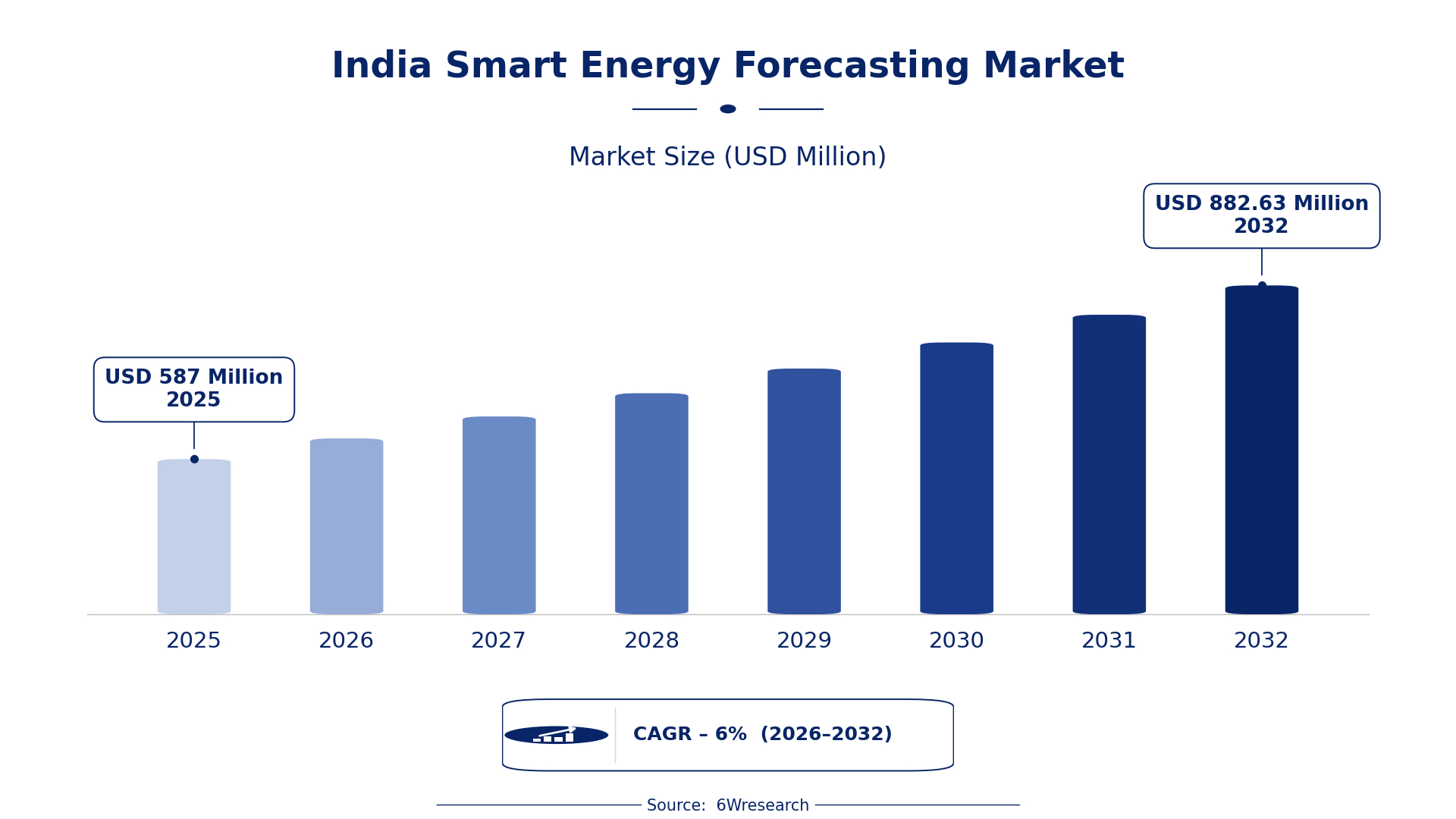
According to 6Wresearch internal database and industry insights, the India Smart Energy Forecasting Market was valued at USD 587.0 million in 2025 and is projected to reach USD 882.63 million by 2032, growing at a CAGR of approximately 6% during 2026–2032.
India Smart Energy Forecasting Market Highlights
| Report Metric | Details |
| Report Name | India Smart Energy Forecasting Market |
| Market Size 2025 | USD 587.0 million |
| Market Size 2032 | USD 882.63 million |
| Absolute Growth 2025–2032 | USD 295.63 million |
| CAGR 2026–2032 | 6% |
| Peak Annual Growth | 6.8% in 2032 |
| Forecast Period | 2026–2032 |
| Historical Data | 2022–2025 |
| Base Year | 2025 |
| Leading Forecast Type, 2025 | Load Forecasting (53% share) |
| Leading Data Source, 2025 | Grid Demand Data (49% share) |
| Leading AI Model Used, 2025 | Machine Learning (46% share) |
| Leading End User, 2025 | Utility Providers (51% share) |
| Fastest-Growing Forecast Type | Wind Power Prediction (7.0% CAGR) |
| Fastest-Growing Data Source | Smart Metering Data (8.5% CAGR) |
| Fastest-Growing AI Model Used | Predictive Analytics (8.6% CAGR) |
| Fastest-Growing End User | Renewable Energy Firms (8.1% CAGR) |
| Growing Sector | Renewable Energy |
| Key End Users | Utility Providers, Renewable Energy Firms, Solar Plant Operators, Smart Grid Developers |
India Smart Energy Forecasting Market Year-wise Growth Rate and Key Drivers (2022–2032)
This graph illustrates the annual growth rates of the market from 2022 to 2032, highlighting a steady upward trajectory and projected market expansion over the forecast period.
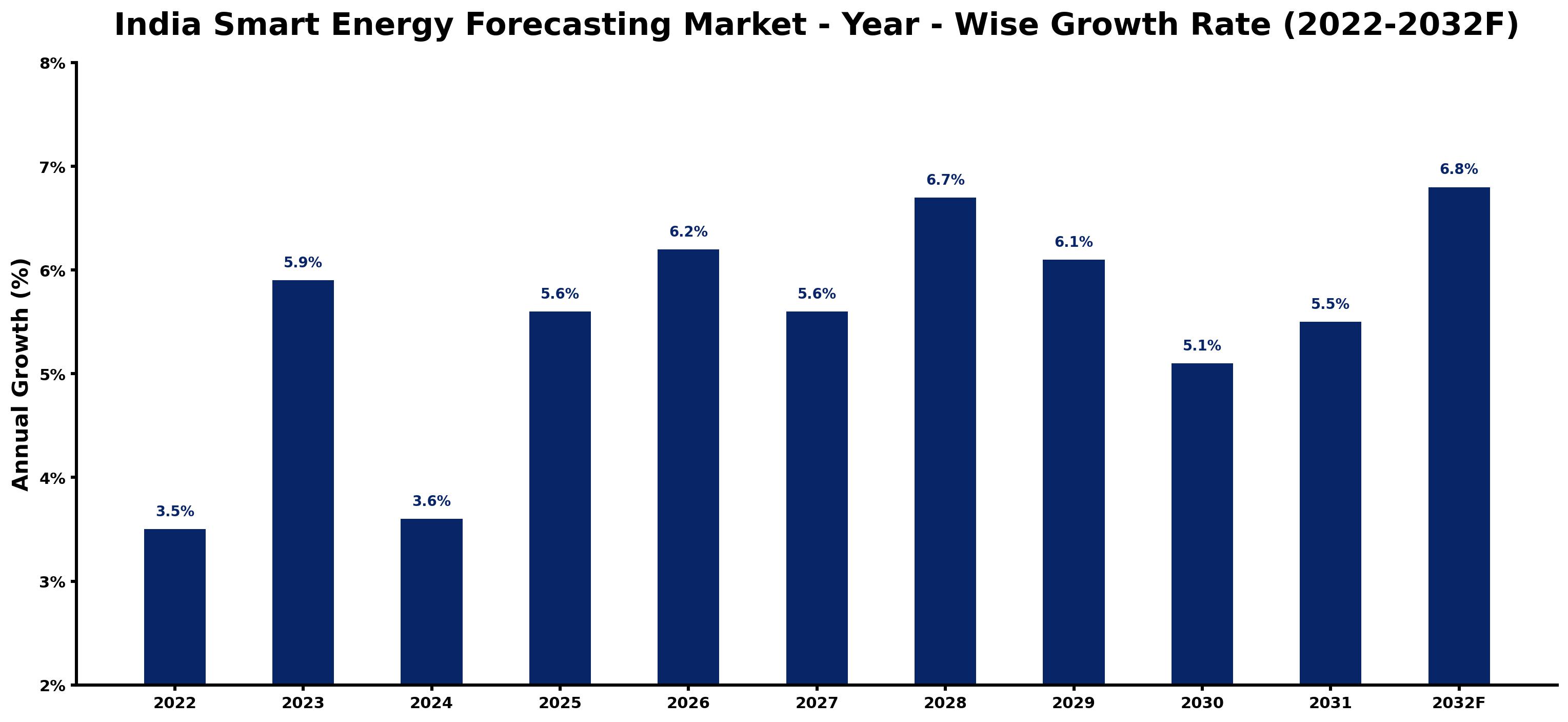
The table below sets out the estimated growth rate for each year and the main factor behind it.
| Year | Estimated Annual Growth (%) | Market Rationale |
| 2022 | 3.5 | The market experienced steady growth due to the National Smart Grid Mission promoting advanced forecasting technologies. |
| 2023 | 5.9 | Demand surged as India's renewable energy capacity reached 175 GW, driving the need for accurate forecasting. |
| 2024 | 3.6 | Growth slowed as utilities adjusted to new forecasting methodologies mandated by the Central Electricity Authority. |
| 2025 | 5.6 | The market rebounded with initiatives under the National Smart Grid Mission boosting demand for forecasting solutions. |
| 2026 | 6.2 | Increased investments in smart metering technology are expected to support higher growth rates in forecasting. |
| 2027 | 5.6 | A slight slowdown is expected as the market adapts to evolving consumer energy needs and preferences. |
| 2028 | 6.7 | Growth is projected to accelerate again as renewable energy firms seek advanced forecasting solutions. |
| 2029 | 6.1 | The market is expected to experience a slowdown as competition intensifies among service providers. |
| 2030 | 5.1 | Demand growth is projected to slow as utilities focus on optimizing existing forecasting tools and technologies. |
| 2031 | 5.5 | A rebound in growth is expected as new projects are initiated under the Smart Cities Mission. |
| 2032 | 6.8 | The market is projected to peak as demand for smart energy solutions surges with new regulations. |
Note: Market size estimations and growth projections presented in this report are based on 6Wresearch's proprietary forecasting methodology, utilizing the latest available industry data, government publications, and primary research inputs.
India Smart Energy Forecasting Market Synopsis
The Smart Energy Forecasting Market in India involves using advanced data analytics and AI technologies to predict energy generation and consumption patterns. This process integrates various data sources to optimise distribution and support renewable energy integration. The Smart Energy Forecasting Market is expanding due to rising investments in smart grid technologies and increasing demand from utility providers and renewable energy firms. With India's renewable energy capacity targeting 450 GW by 2030, the need for effective forecasting solutions becomes critical. The National Smart Grid Mission propels this growth by modernising the electricity grid with smart technologies.
Market Dynamics Impact Analysis (2026–2032)
| Factor | Type | Impact | Primary Segment Affected |
| Increased investment in smart grid technologies | Driver | High | Load Forecasting |
| Growing number of smart meters installed across states | Driver | High | Smart Metering Data |
| Rising demand for solar forecasting solutions | Opportunity | High | Solar Generation Forecast |
| Expansion of renewable energy firms seeking advanced analytics | Opportunity | High | Wind Power Prediction |
| High initial costs of implementing forecasting technologies | Restraint | High | Consumption Forecasting |
| Limited awareness among smaller utility providers | Restraint | Medium | Grid Demand Data |
| Competition among service providers leading to price wars | Challenge | Medium | Utility Providers |
| Technological integration issues between legacy systems and new forecasting tools | Challenge | High | Smart Metering Data |
Evaluation of Drivers in India Smart Energy Forecasting Market (2026–2032)
The main growth drivers and the segments they affect most are set out below.
| Drivers | Primary Segment Affected | Why It Matters (Evidence) |
| Increased investment in smart grid technologies | Load Forecasting | India's renewable energy capacity reached 175 GW in 2022, prompting utilities to invest in forecasting solutions. |
| Growing number of smart meters installed across states | Smart Metering Data | Over 40 million smart meters installed provide essential data for accurate forecasting. |
| Rising demand for solar forecasting solutions | Solar Generation Forecast | India's installed solar capacity is expected to exceed 100 GW by 2025, increasing the need for solar forecasting. |
| Expansion of renewable energy firms seeking advanced analytics | Wind Power Prediction | The Renewable Energy Development Agency supports projects utilizing advanced forecasting methods, driving demand. |
| Increased trading volumes due to better forecasting | Consumption Forecasting | The Indian Energy Exchange reported a 20% increase in trading volumes in 2023, driven by improved forecasting capabilities. |
Expansion of the Smart Energy Forecasting market in India is backed by increased investment in smart grid technologies, a growing number of smart meters, and heightened interest in solar forecasting solutions. India's renewable energy capacity reached 175 GW in 2022, prompting utilities to invest in load forecasting to manage supply and demand effectively. Over 40 million smart meters installed provide critical data for accurate consumption forecasting. The Indian Energy Exchange reported a 20% increase in trading volumes in 2023, further stimulating market growth.
Evaluation of Restraints in India Smart Energy Forecasting Market
The key brakes on demand, and where they bite hardest, are shown below.
| Market Restraint | Primary Segment Affected | Why It Matters (Evidence) |
| High initial costs of implementing forecasting technologies | Consumption Forecasting | Utilities face substantial upfront investment costs, delaying the adoption of advanced forecasting solutions. |
| Limited awareness among smaller utility providers | Grid Demand Data | Many smaller utilities lack knowledge about the benefits of smart energy forecasting, hindering market growth. |
| Regulatory hurdles in adopting new technologies | Load Forecasting | Utilities must navigate complex regulations which can slow down the implementation of forecasting technologies. |
| Data privacy concerns regarding smart meter data | Smart Metering Data | Concerns over consumer data privacy may limit the adoption of smart metering solutions. |
| Dependence on accurate weather data for forecasting | Solar Generation Forecast | Inaccurate weather data can lead to unreliable forecasting, affecting energy management decisions. |
India Smart Energy Forecasting Market Challenges
In the India Smart Energy Forecasting market, intense competition arises as new players enter, reducing prices and squeezing margins for established energy providers. Many utilities rely on outdated forecasting methods, which can inflate operational costs by up to 15% for energy suppliers and hinder efficiency. Buyers encounter integration issues with smart meters, as over 40 million units installed are not fully operational, leading to delays in energy distribution and decreased service reliability. The lack of accurate wind data from the National Institute of Wind Energy results in unreliable forecasts, threatening grid stability for utility companies.
Trends in the India Smart Energy Forecasting Market
The trends below show where the India Smart Energy Forecasting Market is heading.
- Shift from Traditional to Smart Metering: Utility providers are increasingly adopting smart metering technologies to improve data accuracy and efficiency. As of 2023, over 40 million smart meters have been installed, enabling better forecasting capabilities.
- Integration of AI in Energy Forecasting: The use of AI and machine learning in energy forecasting is becoming prevalent, with predictive analytics gaining traction. This shift is supported by an expected 8.6% CAGR in the predictive analytics segment from 2026 to 2032.
- Increased Focus on Renewable Energy Integration: There is a growing emphasis on integrating renewable energy sources into the grid, necessitating advanced forecasting solutions. The National Smart Grid Mission aims to modernise the grid by 2025, improving forecasting capabilities.
- Rising Demand for Real-Time Data Analytics: Utility providers are prioritising real-time data analytics for effective energy management. The Indian Energy Exchange reported a 20% increase in trading volumes in 2023, driven by improved forecasting.
Investment Opportunities in the India Smart Energy Forecasting Market
Below are the investment opportunities with the strongest case in the India Smart Energy Forecasting Market.
- Growing Need for Solar Forecasting Solutions: With India's solar capacity expected to exceed 100 GW by 2025, there is a pressing need for advanced solar forecasting solutions. Renewable energy firms are actively seeking these technologies to optimise generation.
- Investment in Smart Metering Technologies: The Smart Meter National Programme aims to install smart meters in 250 million households by 2025, creating opportunities for suppliers of smart metering solutions. Collaborating with local partners can facilitate market entry.
- Expansion of Wind Power Forecasting: The wind power sector is projected to grow, with a 7.0% CAGR for wind power prediction from 2026 to 2032. Renewable energy firms are looking for advanced analytics to manage wind energy effectively.
- Increased Demand from Utility Providers: Utility providers are increasingly investing in forecasting technologies to improve grid reliability. The Central Electricity Authority mandates load forecasting, creating opportunities for service providers.
Government Initiatives in the India Smart Energy Forecasting Market
The National Smart Grid Mission, established by the Ministry of Power in 2020, aims to implement smart grid technologies across India, improving energy efficiency and reliability. This initiative complements existing regulations by providing a framework for integrating advanced forecasting technologies into the grid. The Renewable Energy Sector Scheme, introduced in 2022 by the Ministry of New and Renewable Energy, allocates funds specifically for developing forecasting technologies for solar and wind energy, further supporting the growth of this market.
The Smart Meter National Programme aims to install smart meters in 250 million households by 2025, enhancing data collection for accurate forecasting. The Central Electricity Authority supports load forecasting mandates, ensuring that utilities adhere to standards that promote grid stability and reliability. These measures collectively empower utility providers to make informed decisions based on real-time data.
Future Insight of the India Smart Energy Forecasting Market
The India Smart Energy Forecasting market is set to transform by 2032, driven by advancements in data analytics and smart grid technologies. The National Smart Grid Mission aims to modernise the electricity grid by 2025, enhancing forecasting capabilities for energy management. With India's renewable energy capacity expected to reach 450 GW by 2030, the demand for accurate solar forecasting will surge, especially as solar capacity is projected to exceed 100 GW. The Central Electricity Authority's mandate for load forecasting will compel utilities to adopt more precise forecasting methods, improving grid reliability.
Market Segmentation Analysis
The report offers a comprehensive study of the following market segments and their leading categories in the market.
By Forecast Type – Load Forecasting Dominated, Wind Power Prediction Expected to Grow Fastest
According to Dhaval Chaurasia, Assistant Manager at 6Wresearch, Load Forecasting held a 53% share of the India Smart Energy Forecasting Market by forecast type in 2025. Load forecasting holds the largest share because it is essential for balancing energy supply and demand, particularly for utilities. The Central Electricity Authority mandates this forecasting, ensuring that energy distribution remains stable across the country. Wind Power Prediction is set to record the highest CAGR in this split, 7.0% over 2026–2032. Wind power prediction is growing rapidly due to India's renewable energy capacity projected to reach 450 GW by 2030, which amplifies the need for effective wind energy management. This growth will further solidify load forecasting's lead as it continues to expand. Suppliers should enhance load forecasting capabilities to meet the rising demand from utility providers.
By Data Source – Grid Demand Data Dominated, Smart Metering Data Expected to Grow Fastest
Grid Demand Data took a 49% share of data source in 2025, more than any other category. Grid demand data commands the largest share as it is crucial for real-time energy management, enabling utilities to respond swiftly to demand fluctuations. This data is vital for optimising energy distribution across India's diverse regions. The quickest growth will come from Smart Metering Data, forecast to expand at a CAGR of 8.5% between 2026 and 2032. Smart metering data is experiencing rapid growth, with over 40 million smart meters installed by 2023, providing essential insights into consumption patterns. This increase in smart metering will likely enhance the relevance of grid demand data. Buyers should invest in smart metering technologies to leverage insights for improved energy management.
By AI Model Used – Machine Learning Dominated, Predictive Analytics Expected to Grow Fastest
The largest ai model used category in 2025 was Machine Learning, with a 46% share of total revenue. Machine learning leads the market due to its effectiveness in predictive analytics, which is vital for accurate energy forecasting. This technology facilitates the integration of diverse data sources, improving forecasting precision significantly. Over 2026–2032, Predictive Analytics is expected to post the fastest growth, at a CAGR of 8.6%. Predictive analytics is gaining traction as it becomes essential for decision-making in energy management, especially with the increasing complexity of energy systems. As machine learning advances, its applications in predictive analytics will expand, further solidifying its lead. Suppliers must prioritise machine learning solutions to remain competitive in the smart energy forecasting market.
By End User – Utility Providers Dominated, Renewable Energy Firms Expected to Grow Fastest
Utility Providers accounted for a 51% market share by end user in 2025. Utility providers dominate the market share as they rely heavily on accurate forecasts for efficient grid management. Their dependence on forecasting technologies ensures stability and reliability in energy supply across the country. Renewable Energy Firms are projected to grow fastest, at a CAGR of 8.1% during 2026–2032. Renewable energy firms are the fastest-growing segment, driven by the increasing need to optimise energy generation from renewable sources. As the renewable sector expands, utility providers will also benefit from enhanced forecasting capabilities. Buyers in the renewable sector should focus on integrating advanced forecasting solutions to maximise energy generation efficiency.
Key Attractiveness of the Report
- 10 Years of Market Numbers
- Historical Data Starting from 2022 to 2025
- Base Year 2025
- Forecast Data until 2032
- Key Performance Indicators Impacting the Market
- Major Upcoming Developments and Projects
Key Highlights of the Report:
- India Smart Energy Forecasting Market Outlook
- Market Size of India Smart Energy Forecasting Market, 2025
- Forecast of India Smart Energy Forecasting Market, 2032
- Historical Data and Forecast of India Smart Energy Forecasting Revenues & Volume for the Period 2022 - 2032F
- India Smart Energy Forecasting Market Trend Evolution
- India Smart Energy Forecasting Market Drivers and Challenges
- India Smart Energy Forecasting Price Trends
- India Smart Energy Forecasting Porter's Five Forces
- India Smart Energy Forecasting Industry Life Cycle
- Historical Data and Forecast of India Smart Energy Forecasting Market Revenues & Volume By Forecast Type for the Period 2022 - 2032F
- Historical Data and Forecast of India Smart Energy Forecasting Market Revenues & Volume By Solar Generation Forecast for the Period 2022 - 2032F
- Historical Data and Forecast of India Smart Energy Forecasting Market Revenues & Volume By Load Forecasting for the Period 2022 - 2032F
- Historical Data and Forecast of India Smart Energy Forecasting Market Revenues & Volume By Wind Power Prediction for the Period 2022 - 2032F
- Historical Data and Forecast of India Smart Energy Forecasting Market Revenues & Volume By Consumption Forecasting for the Period 2022 - 2032F
- Historical Data and Forecast of India Smart Energy Forecasting Market Revenues & Volume By Data Source for the Period 2022 - 2032F
- Historical Data and Forecast of India Smart Energy Forecasting Market Revenues & Volume By Weather + Radiation Data for the Period 2022 - 2032F
- Historical Data and Forecast of India Smart Energy Forecasting Market Revenues & Volume By Grid Demand Data for the Period 2022 - 2032F
- Historical Data and Forecast of India Smart Energy Forecasting Market Revenues & Volume By Turbine + Wind Sensor Data for the Period 2022 - 2032F
- Historical Data and Forecast of India Smart Energy Forecasting Market Revenues & Volume By Smart Metering Data for the Period 2022 - 2032F
- Historical Data and Forecast of India Smart Energy Forecasting Market Revenues & Volume By AI Model Used for the Period 2022 - 2032F
- Historical Data and Forecast of India Smart Energy Forecasting Market Revenues & Volume By Machine Learning for the Period 2022 - 2032F
- Historical Data and Forecast of India Smart Energy Forecasting Market Revenues & Volume By Predictive Analytics for the Period 2022 - 2032F
- Historical Data and Forecast of India Smart Energy Forecasting Market Revenues & Volume By AI/ML Regression Models for the Period 2022 - 2032F
- Historical Data and Forecast of India Smart Energy Forecasting Market Revenues & Volume By Time Series Models for the Period 2022 - 2032F
- Historical Data and Forecast of India Smart Energy Forecasting Market Revenues & Volume By End User for the Period 2022 - 2032F
- Historical Data and Forecast of India Smart Energy Forecasting Market Revenues & Volume By Solar Plant Operators for the Period 2022 - 2032F
- Historical Data and Forecast of India Smart Energy Forecasting Market Revenues & Volume By Utility Providers for the Period 2022 - 2032F
- Historical Data and Forecast of India Smart Energy Forecasting Market Revenues & Volume By Renewable Energy Firms for the Period 2022 - 2032F
- Historical Data and Forecast of India Smart Energy Forecasting Market Revenues & Volume By Smart Grid Developers for the Period 2022 - 2032F
- India Smart Energy Forecasting Import Export Trade Statistics
- Market Opportunity Assessment By Forecast Type
- Market Opportunity Assessment By Data Source
- Market Opportunity Assessment By AI Model Used
- Market Opportunity Assessment By End User
- India Smart Energy Forecasting Top Companies Market Share
- India Smart Energy Forecasting Competitive Benchmarking By Technical and Operational Parameters
- India Smart Energy Forecasting Company Profiles
- India Smart Energy Forecasting Key Strategic Recommendations
Market Covered
The report offers an extensive study of the following market segments.
By Forecast Type
- Solar Generation Forecast
- Load Forecasting
- Wind Power Prediction
- Consumption Forecasting
By Data Source
- Weather + Radiation Data
- Grid Demand Data
- Turbine + Wind Sensor Data
- Smart Metering Data
By AI Model Used
- Machine Learning
- Predictive Analytics
- AI/ML Regression Models
- Time Series Models
By End User
- Solar Plant Operators
- Utility Providers
- Renewable Energy Firms
- Smart Grid Developers































