China Smart Energy Forecasting Market Size & Growth Rate
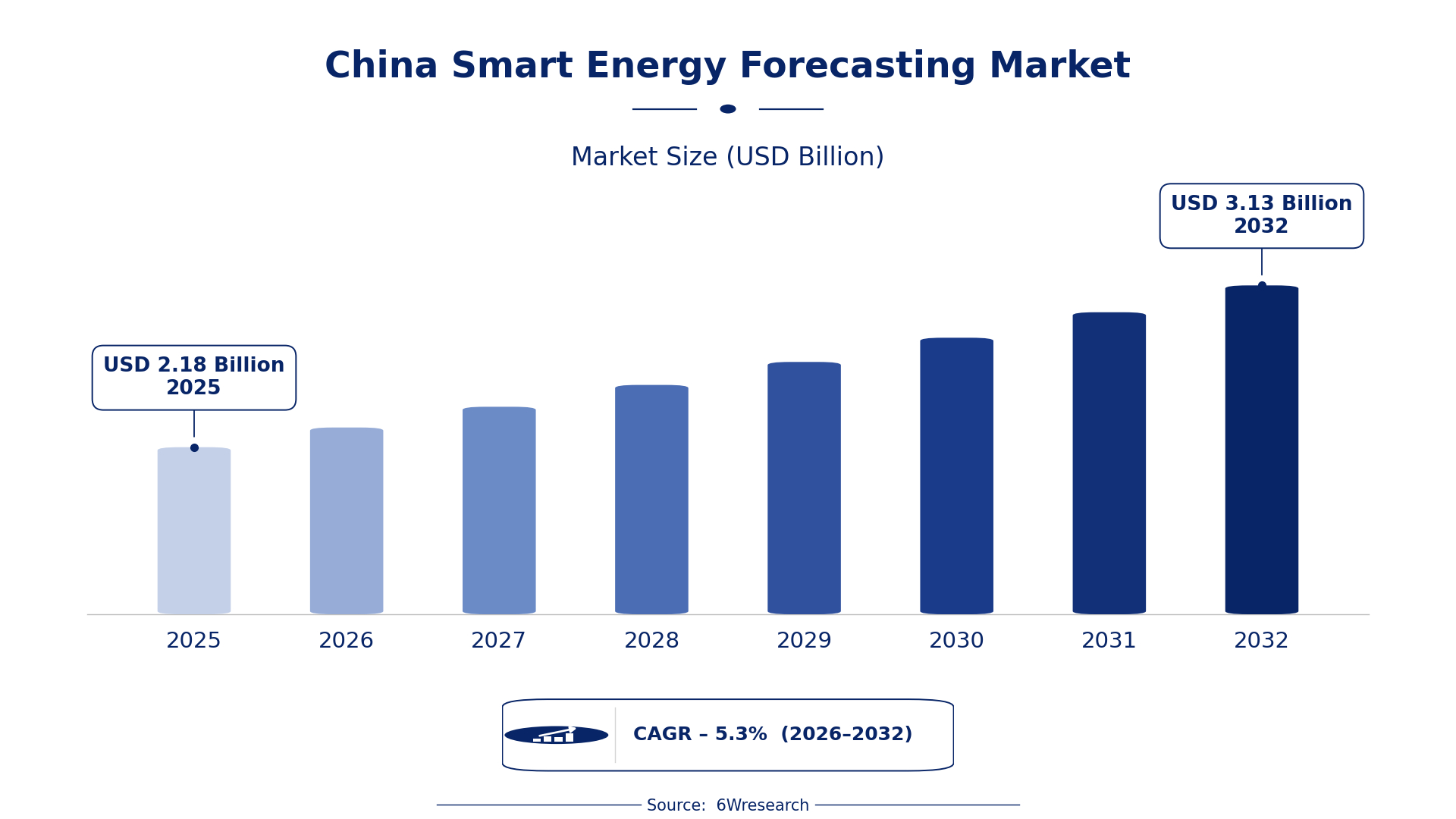
According to 6Wresearch internal database and industry insights, the China Smart Energy Forecasting Market was valued at USD 2.18 billion in 2025 and is projected to reach USD 3.13 billion by 2032, growing at a CAGR of approximately 5.3% during 2026–2032.
China Smart Energy Forecasting Market Highlights
| Report Metric | Details |
| Report Name | China Smart Energy Forecasting Market |
| Market Size 2025 | USD 2.18 billion |
| Market Size 2032 | USD 3.13 billion |
| Absolute Growth 2025–2032 | USD 0.95 billion |
| CAGR 2026–2032 | 5.3% |
| Peak Annual Growth | 7.7% in 2030 |
| Forecast Period | 2026–2032 |
| Historical Data | 2022–2025 |
| Base Year | 2025 |
| Leading Forecast Type, 2025 | Load Forecasting (37% share) |
| Leading Data Source, 2025 | Grid Demand Data (47% share) |
| Leading AI Model Used, 2025 | Machine Learning (38% share) |
| Leading End User, 2025 | Utility Providers (39% share) |
| Fastest-Growing Forecast Type | Wind Power Prediction (6.7% CAGR) |
| Fastest-Growing Data Source | Smart Metering Data (6.8% CAGR) |
| Fastest-Growing AI Model Used | Predictive Analytics (8.0% CAGR) |
| Fastest-Growing End User | Renewable Energy Firms (7.0% CAGR) |
| Growing Sector | Renewable Energy |
| Key End Users | Utility Providers, Renewable Energy Firms, Smart Grid Developers |
China Smart Energy Forecasting Market Year-wise Growth Rate and Key Drivers (2022–2032)
This graph illustrates the annual growth rates of the market from 2022 to 2032, highlighting a steady upward trajectory and projected market expansion over the forecast period.
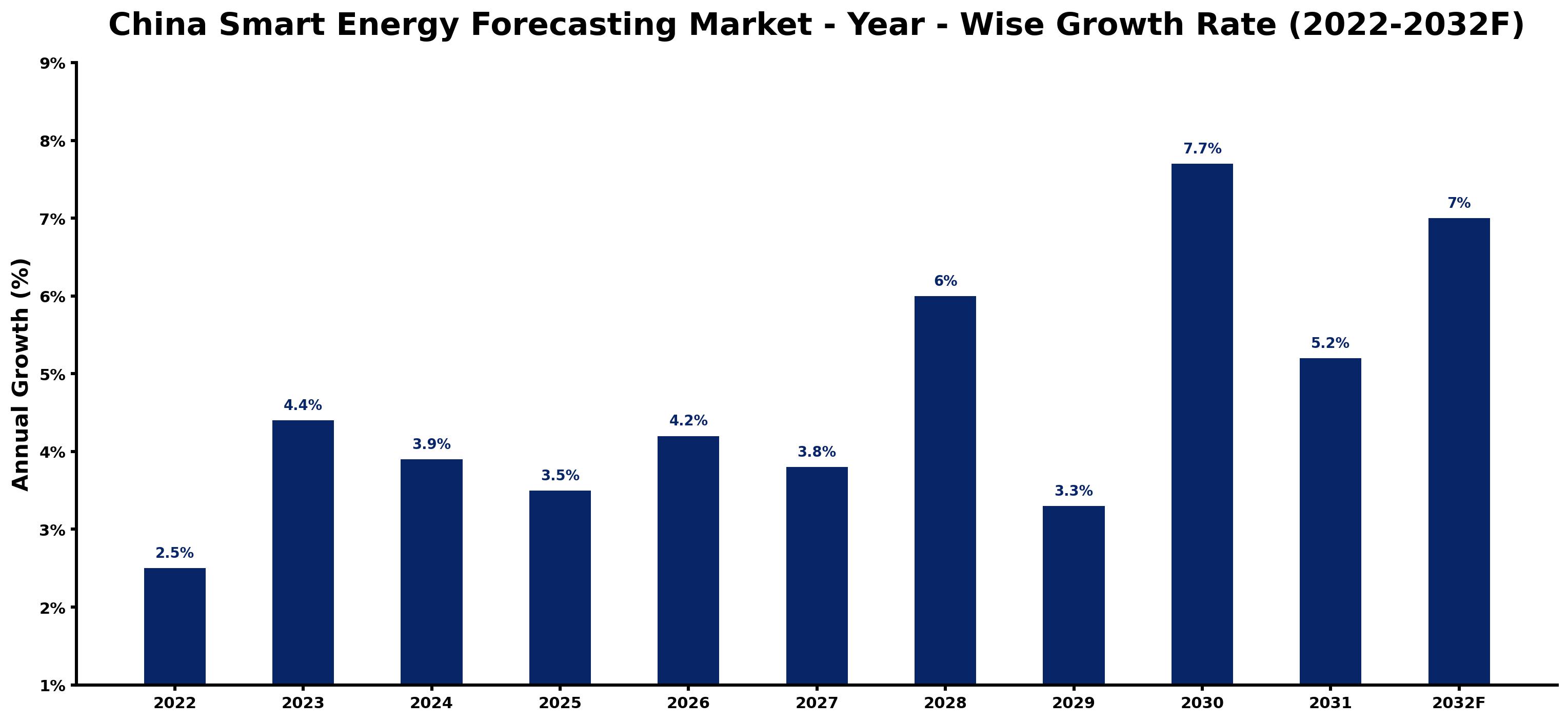
Below, each year's estimated growth is shown next to the factor that most influenced it.
| Year | Estimated Annual Growth (%) | Market Rationale |
| 2022 | 2.5 | The market experienced steady growth due to the '14th Five-Year Plan for Renewable Energy Development' promoting advanced forecasting technologies. |
| 2023 | 4.4 | Demand for advanced forecasting technologies rose sharply as utility providers adopted new systems to enhance efficiency. |
| 2024 | 3.9 | Growth slowed as the market adjusted to the rapid integration of smart metering systems and their operational challenges. |
| 2025 | 3.5 | A further slowdown occurred as the market stabilised following the previous surge in demand for forecasting technologies. |
| 2026 | 4.2 | Renewed interest in improving load forecasting capabilities among utility providers is expected to drive growth again. |
| 2027 | 3.8 | The market is projected to see a slowdown as competition intensifies among various forecasting technology providers. |
| 2028 | 6.0 | Rising demand for wind power predictions from renewable energy firms is anticipated to boost growth once more. |
| 2029 | 3.3 | A slowdown is expected as the market adjusts to the increasing integration of AI technologies in forecasting. |
| 2030 | 7.7 | Adoption of predictive analytics among utility providers will surge, significantly driving growth in the market. |
| 2031 | 5.2 | The market is projected to experience a slowdown as focus shifts towards enhancing forecasting accuracy. |
| 2032 | 7.0 | Growth is expected to rise again as more renewable energy firms adopt advanced forecasting solutions. |
Note: Market size estimations and growth projections presented in this report are based on 6Wresearch's proprietary forecasting methodology, utilizing the latest available industry data, government publications, and primary research inputs.
China Smart Energy Forecasting Market Synopsis
Smart Energy Forecasting in China utilises advanced analytics and AI technologies to predict energy generation and consumption patterns. This technology optimises energy distribution, improves grid reliability, and integrates renewable energy sources. The China Smart Energy Forecasting Market is expanding due to the growing renewable energy sector and investments in smart grid technologies. The National Energy Administration's '14th Five-Year Plan for Renewable Energy Development' and the installation of over 30 million smart meters in 2023 are key factors supporting this trend.
Market Dynamics Impact Analysis (2026–2032)
| Factor | Type | Impact | Primary Segment Affected |
| Growing renewable energy capacity drives demand for accurate forecasting solutions. | Driver | High | Load Forecasting |
| Increasing installation of smart meters enhances real-time consumption analysis capabilities. | Driver | High | Smart Metering Data |
| Utility providers are seeking advanced forecasting systems to improve grid management. | Opportunity | High | Load Forecasting |
| Renewable energy firms require accurate predictions to optimize energy output. | Opportunity | High | Wind Power Prediction |
| Limited integration of AI technologies hampers forecasting accuracy. | Restraint | Medium | Predictive Analytics |
| High initial costs of implementing advanced forecasting systems deter smaller firms. | Restraint | Medium | Machine Learning |
| The Smart Energy Forecasting market in China faces challenges in technology adoption. | Challenge | High | Smart Metering Data |
| Competition among forecasting technology providers can lead to pricing pressures. | Challenge | Medium | Load Forecasting |
Evaluation of Drivers in China Smart Energy Forecasting Market (2026–2032)
The main growth drivers and the segments they affect most are set out below.
| Drivers | Primary Segment Affected | Why It Matters (Evidence) |
| Increased renewable energy capacity necessitates accurate load forecasting. | Load Forecasting | China's renewable energy capacity reached 1,000 GW in 2022, prompting utility providers to adopt advanced forecasting systems. |
| The installation of smart meters improves energy consumption forecasting. | Smart Metering Data | In 2023, over 30 million smart meters were installed, enhancing real-time data analysis for energy providers. |
| Government initiatives support the adoption of advanced forecasting technologies. | Wind Power Prediction | The '14th Five-Year Plan for Renewable Energy Development' promotes advanced forecasting technologies to optimise energy management. |
| Growing urban populations increase demand for accurate consumption forecasting. | Consumption Forecasting | China's urban population reached 900 million in 2022, driving the need for precise energy consumption predictions. |
| Integration of AI technologies improves predictive analytics capabilities. | Predictive Analytics | Over 50% of renewable energy firms in China utilise machine learning for energy forecasting, enhancing accuracy. |
Growth across the Smart Energy Forecasting market in China is anchored in rising end-use demand for precise energy predictions and the supply response from advanced technology adoption. The renewable energy capacity reached 1,000 GW in 2022, prompting utility providers to seek improved forecasting systems. In 2023, over 30 million smart meters were installed, enhancing real-time consumption analysis for energy providers. The urban population of 900 million increases the need for accurate consumption forecasting, encouraging investments in predictive analytics.
Evaluation of Restraints in China Smart Energy Forecasting Market
Below mentioned are some major restraints and their influence on market dynamics.
| Market Restraint | Primary Segment Affected | Why It Matters (Evidence) |
| Limited integration of AI technologies hampers forecasting accuracy. | Predictive Analytics | Despite advancements, many firms lack the infrastructure to fully integrate AI, affecting their forecasting capabilities. |
| High initial costs deter smaller firms from adopting advanced forecasting systems. | Machine Learning | The financial burden of implementing sophisticated forecasting technologies limits access for smaller energy companies. |
| Regulatory compliance can slow down the adoption of new forecasting technologies. | Smart Metering Data | Firms must navigate complex regulations, which can delay the implementation of smart metering systems. |
| Data privacy concerns limit the sharing of essential forecasting data. | Load Forecasting | Regulations surrounding data privacy restrict access to critical information needed for accurate load forecasting. |
| Competition among providers can lead to price wars, affecting service quality. | Wind Power Prediction | As more companies enter the market, aggressive pricing strategies may compromise the quality of forecasting solutions. |
China Smart Energy Forecasting Market Challenges
The China Smart Energy Forecasting Market faces a few practical problems, starting with supply chain disruptions that can delay project timelines for producers. These disruptions stem from the rapid increase in renewable energy capacity, which reached 1,000 GW in 2022, complicating the acquisition of essential forecasting technologies. Skills shortages in advanced analytics hinder firms' ability to deploy effective forecasting systems, limiting buyers' capacity to optimise energy distribution. Additionally, the growing urban population, which surpassed 900 million in 2022, intensifies the demand for accurate consumption forecasting, straining existing forecasting resources. Rising operational costs associated with advanced forecasting technologies can restrict budgets for buyers, limiting their investment in essential solutions.
Trends in the China Smart Energy Forecasting Market
Four trends stand out in the China Smart Energy Forecasting Market.
- Shift to AI-Driven Forecasting Solutions: Since 2021, utility providers in China have increasingly adopted AI-driven forecasting solutions, improving accuracy. In 2023, over 50% of renewable energy firms utilised machine learning for energy forecasting, indicating a trend towards AI integration.
- Transition from Traditional to Smart Metering: In 2023, the installation of over 30 million smart meters marked a shift towards smart metering in China. This transition improves real-time consumption analysis, allowing utility providers to optimise energy distribution.
- Emergence of Predictive Analytics in Energy Management: The emphasis on predictive analytics began in 2021, driven by government initiatives. By 2023, more than 50% of renewable energy firms adopted these technologies, improving forecasting accuracy and efficiency.
- Focus on Renewable Energy Forecasting: The need for accurate renewable energy forecasting has intensified since 2021, driven by increasing capacity. China's solar energy capacity surpassed 300 GW by 2022, necessitating improved forecasting solutions.
Investment Opportunities in the China Smart Energy Forecasting Market
Below are the investment opportunities with the strongest case in the China Smart Energy Forecasting Market.
- Utility Providers Seeking Advanced Forecasting Systems: Utility providers in China are increasingly looking for advanced forecasting systems to improve grid management. With over 200 providers adopting new technologies in 2023, there is a notable opportunity for suppliers to meet this demand.
- Partnerships with Renewable Energy Firms: Renewable energy firms require accurate forecasting to optimise energy output. With 328 GW of wind power capacity in 2022, partnerships can be formed to develop tailored forecasting solutions.
- Investment in Smart Metering Technologies: The installation of over 30 million smart meters in 2023 highlights the need for advanced metering technologies. Suppliers can enter the market through partnerships with utility providers to improve forecasting capabilities.
- Gap in Predictive Analytics Adoption: With over 50% of renewable energy firms utilising machine learning, there remains a gap for further adoption. Suppliers can target this gap by offering tailored predictive analytics solutions.
Government Initiatives in the China Smart Energy Forecasting Market
The 'Smart Energy Development Strategy' by the Ministry of Industry and Information Technology, updated in 2023, aims to improve AI integration in energy forecasting. This measure builds on the '14th Five-Year Plan for Renewable Energy Development' initiated in 2021, which promotes advanced forecasting technologies. Together, these policies create a framework for improving forecasting accuracy and efficiency in the energy sector, benefiting producers and buyers alike.
The 'National Action Plan for Carbon Peaking and Carbon Neutrality' introduced by the Ministry of Ecology and Environment in 2021 encourages the adoption of smart energy forecasting to optimise energy efficiency. Utility providers are increasingly investing in advanced forecasting systems to align with national sustainability goals, with funding allocated to support these initiatives.
Future Insight of the China Smart Energy Forecasting Market
By 2032, buyers and suppliers in the China Smart Energy Forecasting Market can expect transformative changes driven by several key factors. The '14th Five-Year Plan for Renewable Energy Development' will encourage the widespread adoption of advanced forecasting technologies, enhancing accuracy across the sector. The installation of over 30 million smart meters in 2023 will facilitate improved energy consumption forecasting, benefiting both consumers and producers. The integration of AI, as emphasised in the 'Green Energy Action Plan', will streamline forecasting processes, paving the way for a more reliable and efficient energy system.
Market Segmentation Analysis
The analysis below covers each segmentation, its leading category in 2025 and its fastest-growing category through 2032.
By Forecast Type – Load Forecasting Dominated, Wind Power Prediction Expected to Grow Fastest
According to Dhaval Chaurasia, Assistant Manager at 6Wresearch, in 2025, Load Forecasting led the forecast type split with a 37% share. Load forecasting commands the largest share due to its essential role in balancing supply and demand in energy systems. The critical importance of this forecasting method is evidenced by its adoption among over 200 utility providers in China. Wind Power Prediction is set to record the highest CAGR in this split, 6.7% over 2026–2032. Wind power prediction is rapidly growing as it is necessary for maximising wind energy utilisation. The installed capacity of approximately 328 GW in 2022 highlights the increasing demand for precise wind power forecasts, ensuring its continued expansion. This suggests that suppliers should enhance load forecasting solutions to align with the needs of utility providers.
By Data Source – Grid Demand Data Dominated, Smart Metering Data Expected to Grow Fastest
With a 47% revenue share in 2025, Grid Demand Data was the largest data source category. Grid demand data holds the largest market share as it is vital for understanding real-time energy needs. This data empowers utility providers to make informed decisions regarding energy distribution and management, reinforcing its market position. The quickest growth will come from Smart Metering Data, forecast to expand at a CAGR of 6.8% between 2026 and 2032. Smart metering data is the fastest-growing segment, propelled by the installation of over 30 million smart meters in 2023, which improves energy consumption forecasting. This surge in smart metering technology is crucial for accurate real-time consumption analysis, driving its rapid growth. Suppliers should focus on smart metering solutions to leverage the rising demand for real-time consumption data.
By AI Model Used – Machine Learning Dominated, Predictive Analytics Expected to Grow Fastest
Machine Learning accounted for a 38% market share by ai model used in 2025. Machine learning leads the market share as it is integral for developing predictive models that enhance forecasting accuracy. Its widespread use among over 50% of renewable energy firms in China underscores its significance in energy forecasting. Predictive Analytics is projected to grow fastest, at a CAGR of 8.0% during 2026–2032. Predictive analytics is the fastest-growing AI model, essential for forecasting energy trends and adapting to changing consumption patterns. As the need for accurate forecasting increases, this model will likely see greater implementation across the sector, widening its lead. This trend indicates that suppliers should invest in predictive analytics capabilities to remain competitive in the smart energy forecasting market.
By End User – Utility Providers Dominated, Renewable Energy Firms Expected to Grow Fastest
Utility Providers took a 39% share of end user in 2025, more than any other category. Utility providers dominate the market share as they are the primary stakeholders in energy distribution, heavily relying on forecasting technologies. Their extensive role in grid management ensures a consistent demand for load forecasting solutions. Over 2026–2032, Renewable Energy Firms are expected to post the fastest growth, at a CAGR of 7.0%. Renewable energy firms represent the fastest-growing end user segment, driven by the need to optimise renewable energy sources. Their emphasis on integrating advanced forecasting technologies is vital for maximising energy generation efficiency. This growth highlights that suppliers should tailor their offerings to address the specific requirements of renewable energy firms.
Key Attractiveness of the Report
- 10 Years of Market Numbers
- Historical Data Starting from 2022 to 2025
- Base Year 2025
- Forecast Data until 2032
- Key Performance Indicators Impacting the Market
- Major Upcoming Developments and Projects
Key Highlights of the Report:
- China Smart Energy Forecasting Market Outlook
- Market Size of China Smart Energy Forecasting Market, 2025
- Forecast of China Smart Energy Forecasting Market, 2032
- Historical Data and Forecast of China Smart Energy Forecasting Revenues & Volume for the Period 2022 - 2032F
- China Smart Energy Forecasting Market Trend Evolution
- China Smart Energy Forecasting Market Drivers and Challenges
- China Smart Energy Forecasting Price Trends
- China Smart Energy Forecasting Porter's Five Forces
- China Smart Energy Forecasting Industry Life Cycle
- Historical Data and Forecast of China Smart Energy Forecasting Market Revenues & Volume By Forecast Type for the Period 2022 - 2032F
- Historical Data and Forecast of China Smart Energy Forecasting Market Revenues & Volume By Solar Generation Forecast for the Period 2022 - 2032F
- Historical Data and Forecast of China Smart Energy Forecasting Market Revenues & Volume By Load Forecasting for the Period 2022 - 2032F
- Historical Data and Forecast of China Smart Energy Forecasting Market Revenues & Volume By Wind Power Prediction for the Period 2022 - 2032F
- Historical Data and Forecast of China Smart Energy Forecasting Market Revenues & Volume By Consumption Forecasting for the Period 2022 - 2032F
- Historical Data and Forecast of China Smart Energy Forecasting Market Revenues & Volume By Data Source for the Period 2022 - 2032F
- Historical Data and Forecast of China Smart Energy Forecasting Market Revenues & Volume By Weather + Radiation Data for the Period 2022 - 2032F
- Historical Data and Forecast of China Smart Energy Forecasting Market Revenues & Volume By Grid Demand Data for the Period 2022 - 2032F
- Historical Data and Forecast of China Smart Energy Forecasting Market Revenues & Volume By Turbine + Wind Sensor Data for the Period 2022 - 2032F
- Historical Data and Forecast of China Smart Energy Forecasting Market Revenues & Volume By Smart Metering Data for the Period 2022 - 2032F
- Historical Data and Forecast of China Smart Energy Forecasting Market Revenues & Volume By AI Model Used for the Period 2022 - 2032F
- Historical Data and Forecast of China Smart Energy Forecasting Market Revenues & Volume By Machine Learning for the Period 2022 - 2032F
- Historical Data and Forecast of China Smart Energy Forecasting Market Revenues & Volume By Predictive Analytics for the Period 2022 - 2032F
- Historical Data and Forecast of China Smart Energy Forecasting Market Revenues & Volume By AI/ML Regression Models for the Period 2022 - 2032F
- Historical Data and Forecast of China Smart Energy Forecasting Market Revenues & Volume By Time Series Models for the Period 2022 - 2032F
- Historical Data and Forecast of China Smart Energy Forecasting Market Revenues & Volume By End User for the Period 2022 - 2032F
- Historical Data and Forecast of China Smart Energy Forecasting Market Revenues & Volume By Solar Plant Operators for the Period 2022 - 2032F
- Historical Data and Forecast of China Smart Energy Forecasting Market Revenues & Volume By Utility Providers for the Period 2022 - 2032F
- Historical Data and Forecast of China Smart Energy Forecasting Market Revenues & Volume By Renewable Energy Firms for the Period 2022 - 2032F
- Historical Data and Forecast of China Smart Energy Forecasting Market Revenues & Volume By Smart Grid Developers for the Period 2022 - 2032F
- China Smart Energy Forecasting Import Export Trade Statistics
- Market Opportunity Assessment By Forecast Type
- Market Opportunity Assessment By Data Source
- Market Opportunity Assessment By AI Model Used
- Market Opportunity Assessment By End User
- China Smart Energy Forecasting Top Companies Market Share
- China Smart Energy Forecasting Competitive Benchmarking By Technical and Operational Parameters
- China Smart Energy Forecasting Company Profiles
- China Smart Energy Forecasting Key Strategic Recommendations
Market Covered
Segments analysed in this report are listed below.
By Forecast Type
- Solar Generation Forecast
- Load Forecasting
- Wind Power Prediction
- Consumption Forecasting
By Data Source
- Weather + Radiation Data
- Grid Demand Data
- Turbine + Wind Sensor Data
- Smart Metering Data
By AI Model Used
- Machine Learning
- Predictive Analytics
- AI/ML Regression Models
- Time Series Models
By End User
- Solar Plant Operators
- Utility Providers
- Renewable Energy Firms
- Smart Grid Developers































