India Smart Factory 3D Printing Market Size & Growth Rate
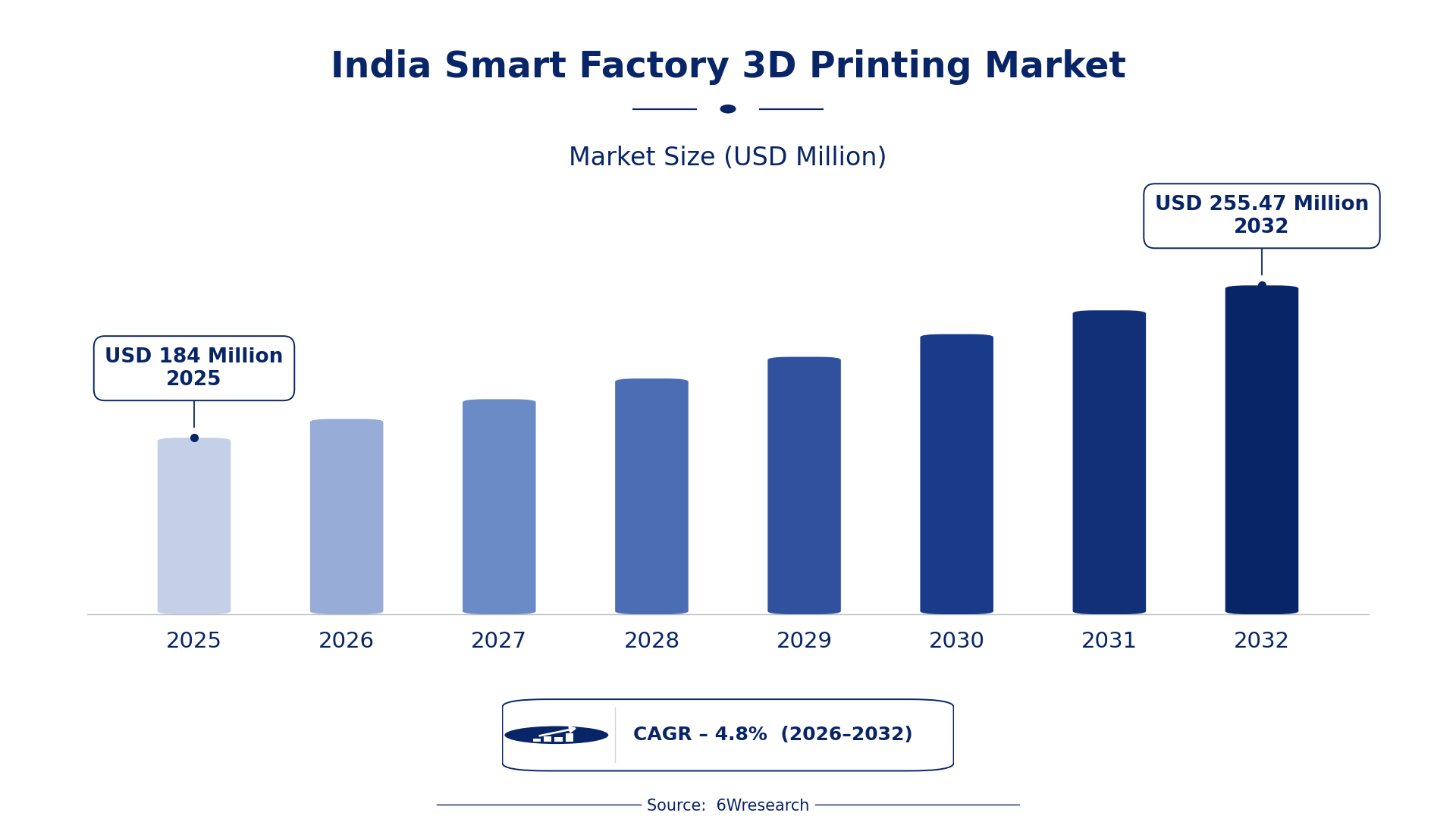
According to 6Wresearch internal database and industry insights, the India Smart Factory 3D Printing Market was valued at USD 184.0 million in 2025 and is projected to reach USD 255.47 million by 2032, growing at a CAGR of approximately 4.8% during 2026–2032.
India Smart Factory 3D Printing Market Highlights
| Report Metric | Details |
| Report Name | India Smart Factory 3D Printing Market |
| Market Size 2025 | USD 184.0 million |
| Market Size 2032 | USD 255.47 million |
| Absolute Growth 2025–2032 | USD 71.47 million |
| CAGR 2026–2032 | 4.8% |
| Peak Annual Growth | 6.1% in 2026 |
| Forecast Period | 2026–2032 |
| Historical Data | 2022–2025 |
| Base Year | 2025 |
| Leading Printing Type, 2025 | FDM Smart Printers (37% share) |
| Leading Smart Feature, 2025 | Predictive Maintenance (40% share) |
| Leading Integration System, 2025 | IoT Cloud Platforms (49% share) |
| Leading End User, 2025 | Automotive Plants (40% share) |
| Fastest-Growing Printing Type | Metal AM Systems (7.6% CAGR) |
| Fastest-Growing Integration System | Edge AI (6.6% CAGR) |
| Fastest-Growing End User | Aerospace Factories (7.4% CAGR) |
| Growing Sector | Aerospace |
| Key End Users | Automotive Plants, Aerospace Factories, Electronics Manufacturers |
India Smart Factory 3D Printing Market Year-wise Growth Rate and Key Drivers (2022–2032)
This graph illustrates the annual growth rates of the market from 2022 to 2032, highlighting a steady upward trajectory and projected market expansion over the forecast period.
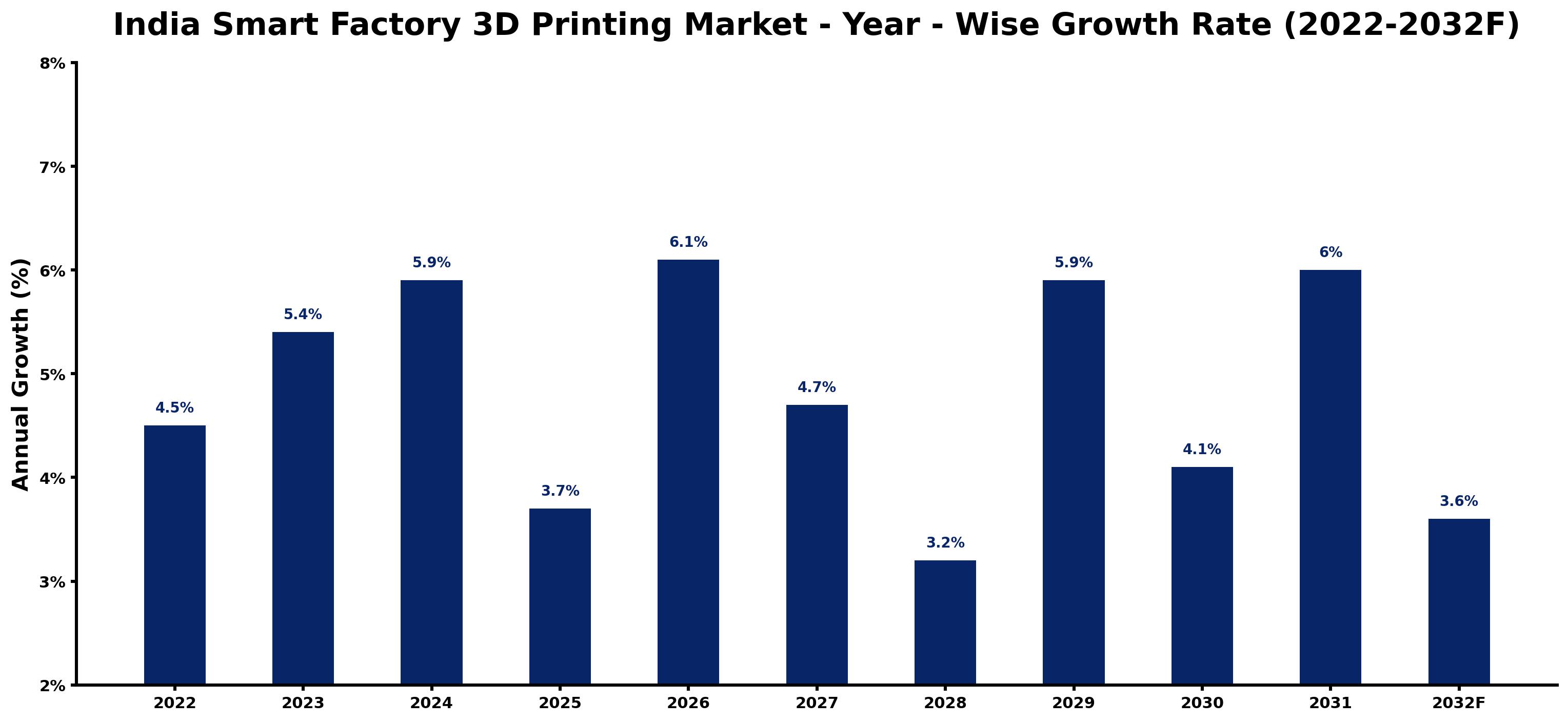
Year by year, the estimates below pair each growth rate with the development that shaped it.
| Year | Estimated Annual Growth (%) | Market Rationale |
| 2022 | 4.5 | The market experienced solid growth driven by increasing adoption of 3D printing technologies. |
| 2023 | 5.4 | Growth accelerated as more sectors began integrating 3D printing into their operations. |
| 2024 | 5.9 | Higher growth rates were supported by the automotive sector's demand for rapid prototyping. |
| 2025 | 3.7 | Growth slowed as the market adjusted to the previous year's rapid expansion. |
| 2026 | 6.1 | A peak in growth is expected due to heightened investments in advanced manufacturing technologies. |
| 2027 | 4.7 | A slight slowdown will follow as the market begins to stabilise after the peak. |
| 2028 | 3.2 | Continued growth is projected, albeit at a slower pace as the market matures. |
| 2029 | 5.9 | Demand will surge again, particularly from aerospace manufacturers adopting new technologies. |
| 2030 | 4.1 | Growth is anticipated to decelerate as the market faces challenges in scaling production capabilities. |
| 2031 | 6.0 | An increase in demand from automotive plants will boost growth rates once more. |
| 2032 | 3.6 | The market is expected to grow at a slower rate as it approaches maturity. |
Note: Market size estimations and growth projections presented in this report are based on 6Wresearch's proprietary forecasting methodology, utilizing the latest available industry data, government publications, and primary research inputs.
India Smart Factory 3D Printing Market Synopsis
Smart Factory 3D Printing in India encompasses advanced additive manufacturing technologies that employ methods like FDM and SLA. These printers facilitate rapid prototyping, complex component production, and customisation across various sectors, including automotive and aerospace. The India Smart Factory 3D Printing Market is growing due to increased investments in advanced manufacturing and a rising uptake by industries such as aerospace, where over 50% of firms are adopting 3D printing technologies. The Make in India initiative further propels this growth, aiming to boost the contribution of advanced manufacturing to GDP by 25% by 2025.
Market Dynamics Impact Analysis (2026–2032)
| Factor | Type | Impact | Primary Segment Affected |
| Rising investments in advanced manufacturing technologies drive demand for Smart Factory 3D Printing. | Driver | High | FDM Smart Printers |
| The automotive sector's demand for rapid prototyping fuels the growth of Smart Factory 3D Printing. | Driver | High | Automotive Plants |
| The increasing need for customised production presents opportunities for Smart Factory 3D Printing. | Opportunity | High | Multi-Material Printers |
| The focus on integrating smart features into manufacturing processes opens avenues for growth. | Opportunity | High | Predictive Maintenance |
| Limited availability of skilled workforce hampers the adoption of Smart Factory 3D Printing. | Restraint | High | SLA Printers with AI |
| High initial investment costs deter small manufacturers from adopting 3D printing technologies. | Restraint | Medium | Metal AM Systems |
| Buyers face challenges in sourcing high-quality materials for 3D printing applications. | Challenge | High | FDM Smart Printers |
| Suppliers encounter difficulties in meeting the evolving standards for additive manufacturing. | Challenge | Medium | FDM Smart Printers |
Evaluation of Drivers in India Smart Factory 3D Printing Market (2026–2032)
Below mentioned are some major drivers and their influence on market dynamics.
| Drivers | Primary Segment Affected | Why It Matters (Evidence) |
| Increased funding for advanced manufacturing initiatives supports the growth of Smart Factory 3D Printing. | FDM Smart Printers | The Ministry of Electronics and Information Technology announced a $100 million fund for 3D printing innovations in 2023. |
| The automotive sector's growing demand for rapid prototyping drives the adoption of Smart Factory 3D Printing. | Automotive Plants | Approximately 40% of 3D printing applications in India are attributed to the automotive sector. |
| The rising focus on customisation in production processes boosts demand for Multi-Material Printers. | Multi-Material Printers | Over 200 advanced manufacturing hubs in India are enhancing production capabilities. |
| The integration of smart features into manufacturing processes fuels demand for Predictive Maintenance. | Predictive Maintenance | The fastest-growing segment is projected to expand at a CAGR of 7.2% through 2032. |
| The aerospace industry's adoption of 3D printing technologies is increasing. | SLA Printers with AI | More than 50% of Indian aerospace manufacturers are implementing 3D printing technologies. |
The automotive sector's growing need for rapid prototyping drives adoption, accounting for approximately 40% of applications. The rising focus on customisation in production processes boosts demand for Multi-Material Printers, supported by over 200 advanced manufacturing hubs in the country. The integration of smart features into manufacturing processes fuels demand for Predictive Maintenance, which is expected to expand significantly through 2032. The aerospace industry's commitment to adopting 3D printing technologies is evident, with more than 50% of manufacturers implementing these solutions.
Evaluation of Restraints in India Smart Factory 3D Printing Market
Below mentioned are some major restraints and their influence on market dynamics.
| Market Restraint | Primary Segment Affected | Why It Matters (Evidence) |
| Limited availability of skilled workforce hampers the adoption of Smart Factory 3D Printing. | SLA Printers with AI | The Electronics Sector Skill Council of India launched a program in 2021 to promote 3D printing skills. |
| High initial investment costs deter small manufacturers from adopting 3D printing technologies. | Metal AM Systems | Investment in advanced manufacturing technology is often beyond the reach of smaller firms. |
| Sourcing high-quality materials for 3D printing applications remains a challenge for buyers. | FDM Smart Printers | The Bureau of Indian Standards is developing ISO-compliant standards for materials, expected by 2024. |
| Evolving standards for additive manufacturing create uncertainty for suppliers. | Advanced Manufacturing | The National Institute of Advanced Manufacturing is conducting research on 3D printing applications. |
| Competition from traditional manufacturing methods limits market penetration of 3D printing. | Multi-Material Printers | Traditional methods are often perceived as more reliable and cost-effective. |
India Smart Factory 3D Printing Market Challenges
Buyers in the India Smart Factory 3D Printing market face high material costs, which can inflate production expenses by up to 20%, limiting their ability to compete effectively. Local suppliers encounter intense competition from international manufacturers offering lower prices, which forces them to reduce profit margins and potentially exit the market. Frequent supply chain disruptions, particularly in sourcing high-quality components, can delay production timelines by as much as three months for manufacturers, impacting their delivery schedules. A skills gap in 3D printing technologies restricts workforce development, with only 30% adoption in manufacturing, hindering firms' capacity to innovate and grow.
Trends in the India Smart Factory 3D Printing Market
Four trends stand out in the India Smart Factory 3D Printing Market.
- Shift from Traditional to Additive Manufacturing: In 2021, the Ministry of Electronics and Information Technology launched the National Strategy for Additive Manufacturing to promote 3D printing across sectors. This initiative aims to increase the adoption of modern manufacturing processes, reflecting a notable shift in production methods.
- Transition to Smart Manufacturing Solutions: The growing integration of IoT Cloud Platforms in 3D printing is evident, with 49% market share anticipated in 2025. This transition enhances operational efficiency and remote management capabilities, crucial for contemporary manufacturing environments.
- Emergence of Predictive Maintenance: Predictive Maintenance is becoming a central focus in manufacturing, with a projected CAGR of 7.2%. This trend is driven by the need for operational efficiency and minimised downtime in production processes.
- Growth of Aerospace Applications: Aerospace Factories are increasingly adopting 3D printing technologies, with a CAGR of 7.4% expected through 2032. This growth stems from the demand for lightweight and complex components in aerospace manufacturing.
Investment Opportunities in the India Smart Factory 3D Printing Market
Some of the investment opportunities in the India Smart Factory 3D Printing Market are mentioned below.
- Joint Ventures with Local Firms: Partnering with local manufacturers presents a strong opportunity, particularly as the market seeks to expand capabilities. The automotive sector, accounting for 40% of applications, is a prime area for investment.
- Investment in Skill Development Programs: With a budget of $50 million approved in 2023 for 3D printing skills, there is a clear gap in skilled workforce availability. Investing in training programs can help fill this need effectively.
- Focus on Aerospace Manufacturing: As the aerospace sector adopts 3D printing technologies, there is a growing demand for advanced manufacturing solutions. This presents an opportunity for suppliers to cater to this expanding market segment.
- Exploration of New Materials: The development of new materials for 3D printing is essential, particularly as standards are finalised by 2024. Suppliers can enter the market by aligning with the Bureau of Indian Standards.
Government Initiatives in the India Smart Factory 3D Printing Market
The National Strategy for Additive Manufacturing, launched by the Ministry of Electronics and Information Technology in 2021, significantly impacts buyers by promoting the adoption of 3D printing technologies across various sectors. This strategy aims to improve the capabilities of manufacturers and enhance the overall environment for additive manufacturing. Additionally, the Advanced Manufacturing Technology Development Programme initiated by the Department of Heavy Industry in 2022 supports research and development in 3D printing, ensuring that manufacturers have access to the latest technologies and innovations. This programme encourages collaboration between industry and academia to drive advancements in the field.
Buyers in the aerospace sector benefit from funding provided by the National Aerospace Laboratories, which received support in 2022 to enhance 3D printing capabilities. This funding under the Make in India initiative allows manufacturers to invest in advanced technologies, improving their production processes. Furthermore, the Ministry of Skill Development and Entrepreneurship's approval of a new skill development program for 3D printing technologies in 2023, with a budget of $50 million, ensures that the workforce is equipped with the necessary skills to thrive in this evolving market. This program directly addresses the skill gap in the industry, enabling buyers to implement advanced manufacturing solutions effectively.
Future Insight of the India Smart Factory 3D Printing Market
Several forward-looking factors are expected to support the India Smart Factory 3D Printing market over the coming years. The Ministry of Electronics and Information Technology's $100 million fund for 3D printing innovations will encourage technological advancements. The Bureau of Indian Standards is developing essential quality benchmarks, enhancing production reliability. The Make in India initiative will strengthen local manufacturing capabilities, while the Electronics Sector Skill Council's programme will develop a skilled workforce, ensuring alignment with industry needs.
Market Segmentation Analysis
The report offers a comprehensive study of the following market segments and their leading categories in the market.
By Printing Type – FDM Smart Printers Dominated, Metal AM Systems Expected to Grow Fastest
According to Dhaval Chaurasia, Assistant Manager at 6Wresearch, FDM Smart Printers took a 37% share of printing type in 2025, more than any other category. FDM Smart Printers dominate the market due to their widespread use in prototyping and manufacturing plastic parts, particularly in the automotive sector, which represents around 40% of 3D printing applications in India. Their cost-effectiveness and reliability make them a preferred choice among manufacturers, ensuring a robust installed base. Over 2026–2032, Metal AM Systems are expected to post the fastest growth, at a CAGR of 7.6%. Metal AM Systems are experiencing rapid growth as they become increasingly vital for producing precision metal components in the aerospace and automotive industries. The rising adoption of these systems by aerospace manufacturers is expected to significantly boost demand in the near future. Suppliers should focus on enhancing the capabilities of FDM Smart Printers while also exploring opportunities in Metal AM Systems to align with evolving market needs.
By Smart Feature – Predictive Maintenance Dominated and Is Expected to Record the Fastest Growth
In 2025, Predictive Maintenance led the smart feature split with a 40% share. Predictive Maintenance leads the market by significantly improving operational efficiency through its ability to foresee equipment failures, which is crucial for maintaining productivity in smart factories. Its integration across various manufacturing processes underscores its growing significance in enhancing operational workflows. Its lead should widen, with a projected CAGR of 7.2% during 2026–2032, the highest in this split. The rapid growth of Predictive Maintenance is driven by its effectiveness in reducing downtime and maintenance costs, making it essential for manufacturers aiming for operational excellence. As the shift towards smart technologies continues, the demand for this feature is projected to increase further. Buyers should invest in Predictive Maintenance solutions to optimise their manufacturing processes and reduce operational disruptions.
By Integration System – IoT Cloud Platforms Dominated, Edge AI Expected to Grow Fastest
The largest integration system category in 2025 was IoT Cloud Platforms, with a 49% share of total revenue. IoT Cloud Platforms hold the largest market share as they facilitate remote monitoring and management of 3D printing processes, thereby enhancing operational efficiency for manufacturers. Their seamless integration into existing systems is crucial for improving productivity and ensuring smooth operational workflows. The quickest growth will come from Edge AI, forecast to expand at a CAGR of 6.6% between 2026 and 2032. Edge AI is the fastest-growing segment as it allows for real-time data processing, which is essential for informed decision-making in today's dynamic manufacturing environments. The increasing need for immediate insights is propelling its swift adoption across various sectors. Suppliers must prioritise the development of IoT Cloud Platforms and Edge AI solutions to meet the rising demand for integrated smart manufacturing systems.
By End User – Automotive Plants Dominated, Aerospace Factories Expected to Grow Fastest
With a 40% revenue share in 2025, Automotive Plants was the largest end user category. Automotive Plants account for the largest share in the market due to their extensive use of 3D printing for parts manufacturing, which is vital for meeting the high demands of the automotive industry. This sector's focus on rapid prototyping and customisation leads to significant investments in 3D printing technologies. Aerospace Factories are set to record the highest CAGR in this split, 7.4% over 2026–2032. Aerospace Factories are the fastest-growing end user segment as they leverage advanced printing techniques for producing lightweight and complex components, which are critical for improving fuel efficiency and overall performance. The aerospace industry's commitment to innovation is a key factor driving this growth. Manufacturers should tailor their 3D printing solutions to meet the specific requirements of the automotive and aerospace sectors to effectively capture market share.
Key Attractiveness of the Report
- 10 Years of Market Numbers
- Historical Data Starting from 2022 to 2025
- Base Year 2025
- Forecast Data until 2032
- Key Performance Indicators Impacting the Market
- Major Upcoming Developments and Projects
Key Highlights of the Report:
- India Smart Factory 3D Printing Market Outlook
- Market Size of India Smart Factory 3D Printing Market, 2025
- Forecast of India Smart Factory 3D Printing Market, 2032
- Historical Data and Forecast of India Smart Factory 3D Printing Revenues & Volume for the Period 2022 - 2032F
- India Smart Factory 3D Printing Market Trend Evolution
- India Smart Factory 3D Printing Market Drivers and Challenges
- India Smart Factory 3D Printing Price Trends
- India Smart Factory 3D Printing Porter's Five Forces
- India Smart Factory 3D Printing Industry Life Cycle
- Historical Data and Forecast of India Smart Factory 3D Printing Market Revenues & Volume By Printing Type for the Period 2022 - 2032F
- Historical Data and Forecast of India Smart Factory 3D Printing Market Revenues & Volume By FDM Smart Printers for the Period 2022 - 2032F
- Historical Data and Forecast of India Smart Factory 3D Printing Market Revenues & Volume By SLA Printers with AI for the Period 2022 - 2032F
- Historical Data and Forecast of India Smart Factory 3D Printing Market Revenues & Volume By Metal AM Systems for the Period 2022 - 2032F
- Historical Data and Forecast of India Smart Factory 3D Printing Market Revenues & Volume By Multi-Material Printers for the Period 2022 - 2032F
- Historical Data and Forecast of India Smart Factory 3D Printing Market Revenues & Volume By Smart Feature for the Period 2022 - 2032F
- Historical Data and Forecast of India Smart Factory 3D Printing Market Revenues & Volume By Predictive Maintenance for the Period 2022 - 2032F
- Historical Data and Forecast of India Smart Factory 3D Printing Market Revenues & Volume By Quality Analysis for the Period 2022 - 2032F
- Historical Data and Forecast of India Smart Factory 3D Printing Market Revenues & Volume By Real-Time Layer Monitoring for the Period 2022 - 2032F
- Historical Data and Forecast of India Smart Factory 3D Printing Market Revenues & Volume By Adaptive Feed Controls for the Period 2022 - 2032F
- Historical Data and Forecast of India Smart Factory 3D Printing Market Revenues & Volume By Integration System for the Period 2022 - 2032F
- Historical Data and Forecast of India Smart Factory 3D Printing Market Revenues & Volume By IoT Cloud Platforms for the Period 2022 - 2032F
- Historical Data and Forecast of India Smart Factory 3D Printing Market Revenues & Volume By Edge AI for the Period 2022 - 2032F
- Historical Data and Forecast of India Smart Factory 3D Printing Market Revenues & Volume By Digital Twin Integration for the Period 2022 - 2032F
- Historical Data and Forecast of India Smart Factory 3D Printing Market Revenues & Volume By MES-Integrated for the Period 2022 - 2032F
- Historical Data and Forecast of India Smart Factory 3D Printing Market Revenues & Volume By End User for the Period 2022 - 2032F
- Historical Data and Forecast of India Smart Factory 3D Printing Market Revenues & Volume By Automotive Plants for the Period 2022 - 2032F
- Historical Data and Forecast of India Smart Factory 3D Printing Market Revenues & Volume By Electronics Manufacturers for the Period 2022 - 2032F
- Historical Data and Forecast of India Smart Factory 3D Printing Market Revenues & Volume By Aerospace Factories for the Period 2022 - 2032F
- Historical Data and Forecast of India Smart Factory 3D Printing Market Revenues & Volume By Advanced Manufacturing for the Period 2022 - 2032F
- India Smart Factory 3D Printing Import Export Trade Statistics
- Market Opportunity Assessment By Printing Type
- Market Opportunity Assessment By Smart Feature
- Market Opportunity Assessment By Integration System
- Market Opportunity Assessment By End User
- India Smart Factory 3D Printing Top Companies Market Share
- India Smart Factory 3D Printing Competitive Benchmarking By Technical and Operational Parameters
- India Smart Factory 3D Printing Company Profiles
- India Smart Factory 3D Printing Key Strategic Recommendations
Market Covered
This report examines the market across the segments below.
By Printing Type
- FDM Smart Printers
- SLA Printers with AI
- Metal AM Systems
- Multi-Material Printers
By Smart Feature
- Predictive Maintenance
- Quality Analysis
- Real-Time Layer Monitoring
- Adaptive Feed Controls
By Integration System
- IoT Cloud Platforms
- Edge AI
- Digital Twin Integration
- MES-Integrated
By End User
- Automotive Plants
- Electronics Manufacturers
- Aerospace Factories
- Advanced Manufacturing































