China Smart Factory 3D Printing Market Size & Growth Rate
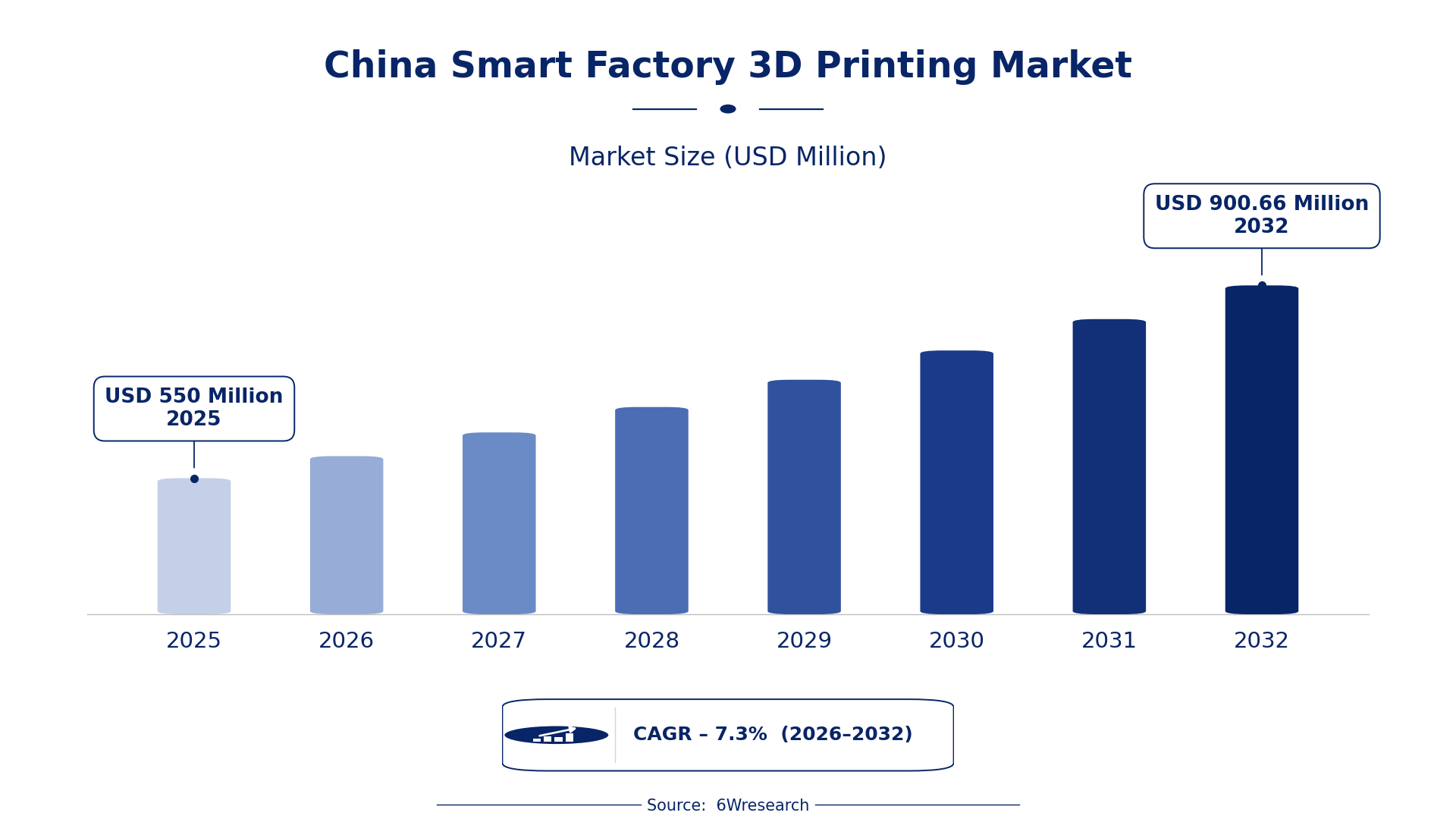
According to 6Wresearch internal database and industry insights, the China Smart Factory 3D Printing Market was valued at USD 550.0 million in 2025 and is projected to reach USD 900.66 million by 2032, growing at a CAGR of approximately 7.3% during 2026–2032.
China Smart Factory 3D Printing Market Highlights
| Report Metric | Details |
| Report Name | China Smart Factory 3D Printing Market |
| Market Size 2025 | USD 550.0 million |
| Market Size 2032 | USD 900.66 million |
| Absolute Growth 2025–2032 | USD 350.66 million |
| CAGR 2026–2032 | 7.3% |
| Peak Annual Growth | 9.7% in 2030 |
| Forecast Period | 2026–2032 |
| Historical Data | 2022–2025 |
| Base Year | 2025 |
| Leading Printing Type, 2025 | FDM Smart Printers (36% share) |
| Leading Smart Feature, 2025 | Predictive Maintenance (46% share) |
| Leading Integration System, 2025 | IoT Cloud Platforms (54% share) |
| Leading End User, 2025 | Automotive Plants (48% share) |
| Fastest-Growing Printing Type | Metal AM Systems (8.9% CAGR) |
| Fastest-Growing Integration System | Digital Twin Integration (10.0% CAGR) |
| Fastest-Growing End User | Aerospace Factories (9.1% CAGR) |
| Growing Sector | Aerospace Factories |
| Key End Users | Automotive Plants, Electronics Manufacturers, Aerospace Factories, Advanced Manufacturing |
China Smart Factory 3D Printing Market Year-wise Growth Rate and Key Drivers (2022–2032)
This graph illustrates the annual growth rates of the market from 2022 to 2032, highlighting a steady upward trajectory and projected market expansion over the forecast period.
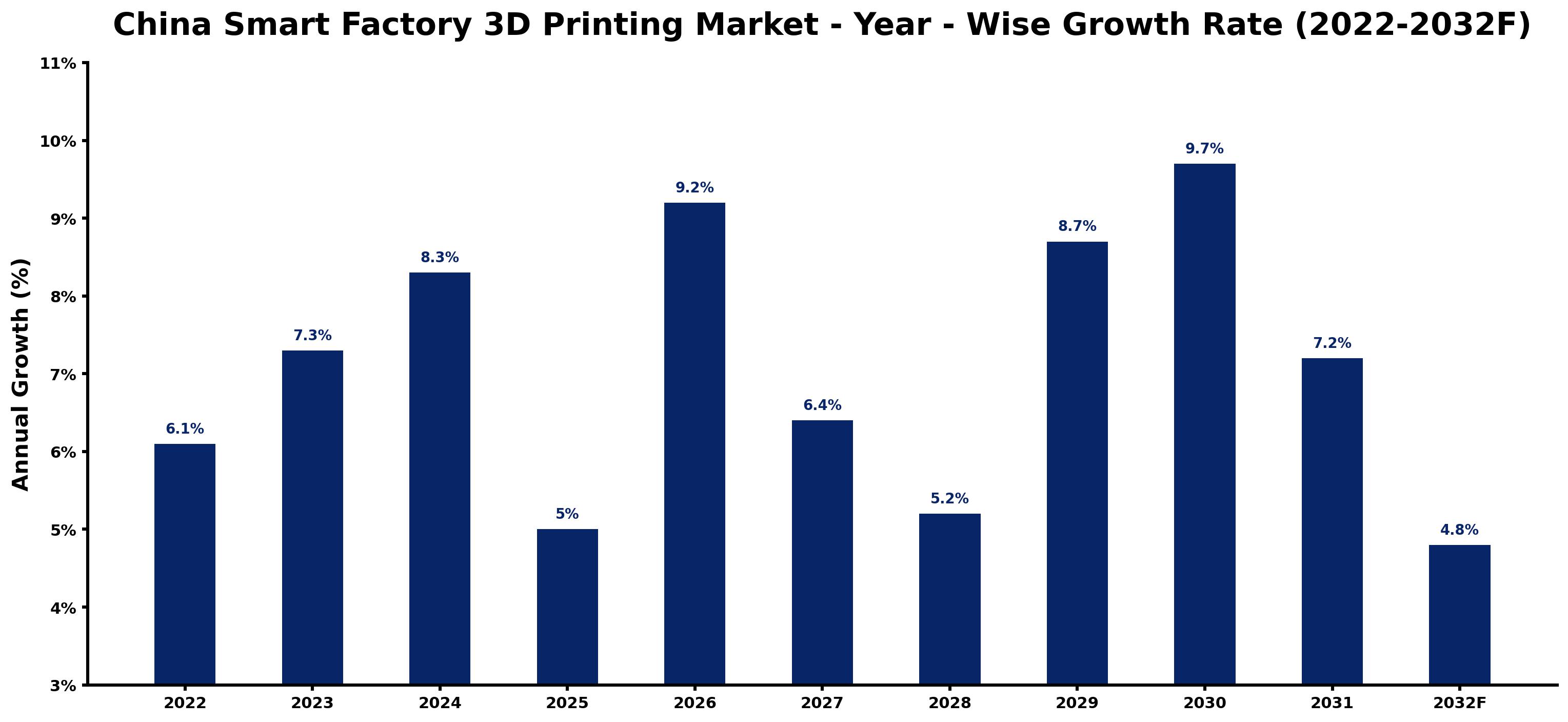
The table below sets out the estimated growth rate for each year and the main factor behind it.
| Year | Estimated Annual Growth (%) | Market Rationale |
| 2022 | 6.1 | The market showed steady activity with substantial investments in advanced manufacturing technologies. |
| 2023 | 7.3 | Growth accelerated due to the launch of the 'Smart Manufacturing 2025' initiative, boosting industry interest. |
| 2024 | 8.3 | Demand increased as the automotive sector continued to adopt 3D printing for production and tooling. |
| 2025 | 5.0 | Growth slowed as companies adjusted to new technologies while still expanding. |
| 2026 | 9.2 | The market is expected to rebound with increased investments in Metal AM Systems, enhancing production capabilities. |
| 2027 | 6.4 | A slowdown is anticipated as the market stabilises after rapid growth in previous years. |
| 2028 | 5.2 | Investment in predictive maintenance technologies will contribute to further demand, although growth is projected to slow. |
| 2029 | 8.7 | The market is expected to gain momentum again as aerospace factories increase their adoption of 3D printing technologies. |
| 2030 | 9.7 | Peak growth will be driven by rising demand for complex components in various industries, especially aerospace. |
| 2031 | 7.2 | Growth is projected to slow as the market begins to stabilise after reaching its peak, but demand will remain strong. |
| 2032 | 4.8 | The market is expected to continue growing, albeit at a slower pace, as technology adoption matures. |
Note: Market size estimations and growth projections presented in this report are based on 6Wresearch's proprietary forecasting methodology, utilizing the latest available industry data, government publications, and primary research inputs.
China Smart Factory 3D Printing Market Synopsis
Smart Factory 3D Printing in China includes advanced manufacturing technologies that build components layer by layer through additive techniques. This technology is extensively used for rapid prototyping and custom part production in industries like automotive and aerospace. The China Smart Factory 3D Printing Market is growing due to significant investments in advanced manufacturing capabilities alongside increasing demand from domestic manufacturers. The automotive sector represented over 30% of the market share in 2022, underscoring the industry's dependence on modern production solutions. Initiatives such as 'Smart Manufacturing 2025' further drive this growth, creating a dynamic environment for 3D printing technologies.
Market Dynamics Impact Analysis (2026–2032)
| Factor | Type | Impact | Primary Segment Affected |
| Increased adoption of advanced manufacturing technologies | Driver | High | Metal AM Systems |
| Growing demand for rapid prototyping in automotive and aerospace sectors | Driver | High | FDM Smart Printers |
| Investment in predictive maintenance systems | Opportunity | Medium | Predictive Maintenance |
| Expansion of 3D printing applications in aerospace manufacturing | Opportunity | High | Aerospace Factories |
| High initial investment costs for advanced 3D printing systems | Restraint | High | SLA Printers with AI |
| Limited awareness of 3D printing capabilities among traditional manufacturers | Restraint | Medium | Multi-Material Printers |
| The market still has to solve a few problems, including high costs and limited awareness. | Challenge | High | FDM Smart Printers |
| Technological integration challenges with existing manufacturing systems | Challenge | Medium | FDM Smart Printers |
Evaluation of Drivers in China Smart Factory 3D Printing Market (2026–2032)
The table below links each growth driver to the segment it affects and the evidence for it.
| Drivers | Primary Segment Affected | Why It Matters (Evidence) |
| Growing demand for custom part production in automotive plants | FDM Smart Printers | This demand arises from the need for rapid prototyping and tooling, with over 30% market share in 2022. |
| Increased investment in Metal AM Systems for aerospace applications | Metal AM Systems | The aerospace industry is projected to adopt 3D printing technologies at a rate of 20% annually, boosting production capabilities. |
| Rising interest in predictive maintenance technologies | Predictive Maintenance | This technology improves equipment reliability and reduces downtime, leading to higher productivity in manufacturing environments. |
| Expansion of 3D printing applications in electronics manufacturing | Multi-Material Printers | Electronics manufacturers are utilising 3D printing for rapid prototyping, increasing the need for diverse material applications. |
| Government initiatives supporting advanced manufacturing technologies | SLA Printers with AI | The 'National 3D Printing Development Plan' aims to boost R&D and application of 3D printing technologies. |
The Smart Factory 3D Printing market in China is expanding as end-use demand rises in sectors such as automotive and aerospace. The automotive sector accounted for over 30% of the market share in 2022, driving investment in custom part production. The aerospace industry is set to adopt 3D printing technologies at a rate of 20% annually, boosting production capabilities. Investments in predictive maintenance technologies are also increasing, which improves equipment reliability and reduces downtime.
Evaluation of Restraints in China Smart Factory 3D Printing Market
The main factors holding the market back are set out below.
| Market Restraint | Primary Segment Affected | Why It Matters (Evidence) |
| High initial investment costs for advanced 3D printing systems | Metal AM Systems | These costs can deter small and medium-sized enterprises from adopting new technologies, limiting market growth. |
| Limited awareness of 3D printing capabilities among traditional manufacturers | FDM Smart Printers | Many manufacturers are unaware of the benefits of 3D printing, hindering broader adoption in various sectors. |
| Challenges in integrating 3D printing with existing manufacturing systems | FDM Smart Printers | Integration issues can lead to delays and increased costs for manufacturers, affecting overall efficiency. |
| Regulatory hurdles in the adoption of new technologies | SLA Printers with AI | Compliance with national standards can slow down the implementation of advanced manufacturing techniques. |
| Shortage of skilled workforce in advanced manufacturing | Multi-Material Printers | The lack of trained personnel can limit the effective use of 3D printing technologies in production. |
China Smart Factory 3D Printing Market Challenges
China's Smart Factory 3D Printing market still has to solve a few problems, and the first is technology limitations. Many producers rely on outdated 3D printing technologies, which can raise production costs by up to 15% for manufacturers. Regulatory challenges arise from compliance with national standards set by the National Standardization Administration, delaying product launches and impacting buyers who depend on timely innovations. Intense competition among local firms drives prices down, forcing suppliers to cut margins, which can compromise quality. Supply chain disruptions occur due to reliance on specific materials, causing production delays for both producers and buyers.
Trends in the China Smart Factory 3D Printing Market
Buyers and suppliers in the China Smart Factory 3D Printing Market are adjusting to the following trends.
- Guangdong Province Leading 3D Printing Development: A major hub for 3D printing technology development is emerging in Guangdong Province, with investments in advanced manufacturing. In 2022, the installed base of industrial 3D printers in China reached 100,000 units, showcasing the region's growth.
- Shift Towards Aerospace Applications: The aerospace industry is increasingly adopting 3D printing technologies for producing lightweight, complex components. This trend is evidenced by a projected adoption rate of 20% annually, reflecting the industry's push for innovation.
- Increase in Predictive Maintenance Adoption: The demand for predictive maintenance technologies is growing, with a CAGR of 9.9% expected in the coming years. This shift is driven by the need for improved equipment reliability and reduced downtime in manufacturing.
- Expansion of IoT Cloud Platforms in Manufacturing: Manufacturers are integrating IoT Cloud Platforms to enable remote monitoring and management of printers. This trend is supported by the growing need for real-time data analysis in production processes.
Investment Opportunities in the China Smart Factory 3D Printing Market
Below are the investment opportunities with the strongest case in the China Smart Factory 3D Printing Market.
- Partnerships for Technology Integration: Now is an opportune time to invest in advanced 3D printing technologies, especially in regions like Guangdong, which is leading development. Collaborating with local manufacturers can facilitate market entry and enhance product offerings.
- Investment in Aerospace Applications: With the aerospace sector projected to adopt 3D printing technologies at a rate of 20% annually, suppliers should focus on providing tailored solutions for this industry. Engaging with aerospace manufacturers can create lucrative opportunities.
- Focus on Predictive Maintenance Solutions: The increasing demand for predictive maintenance technologies presents an opportunity for suppliers to develop innovative solutions. Targeting automotive plants, which heavily rely on these technologies, can drive growth.
- Expansion of IoT Solutions: Investing in IoT Cloud Platforms is crucial as manufacturers seek to enhance operational efficiency. Collaborating with technology providers can help in delivering integrated solutions that meet market needs.
Government Initiatives in the China Smart Factory 3D Printing Market
The 'National 3D Printing Development Plan' launched in 2022 by the Ministry of Industry and Information Technology aims to enhance research and application of 3D printing technologies. This measure builds on the '14th Five-Year Plan for Advanced Manufacturing' approved in 2021, which focuses on integrating 3D printing in key industries. These policies aim to stimulate innovation and drive the adoption of advanced manufacturing technologies, benefiting producers and buyers alike.
The 'Smart Manufacturing Innovation Project' initiated by the National Development and Reform Commission in 2023 allocates 1 billion CNY to support the development and application of 3D printing technologies. Agencies like the Ministry of Science and Technology fund research and development projects that enhance the capabilities of 3D printing in manufacturing, enabling buyers to access advanced solutions more efficiently.
Future Insight of the China Smart Factory 3D Printing Market
Buyers and suppliers in the China Smart Factory 3D Printing market can expect significant changes by 2032, driven by key factors. The 'Smart Manufacturing 2025' initiative will enhance the integration of advanced manufacturing techniques, improving production efficiency. The aerospace sector is projected to adopt 3D printing technologies at a rate of 20% annually, creating new opportunities for suppliers. Government investment of 500 million CNY in advanced manufacturing technologies will stimulate innovation and growth. With a population exceeding 1.4 billion, demand for customised manufacturing solutions will continue to surge.
Market Segmentation Analysis
Each segment group is reviewed below, with the leader by share and the fastest grower by CAGR.
By Printing Type – FDM Smart Printers Dominated, Metal AM Systems Expected to Grow Fastest
According to Dhaval Chaurasia, Assistant Manager at 6Wresearch, FDM Smart Printers held a 36% share of the China Smart Factory 3D Printing Market by printing type in 2025. FDM Smart Printers dominate the market due to their widespread application in prototyping and producing plastic parts, particularly in the automotive sector which holds over 30% of the market share. The large installed base of 100,000 industrial 3D printers in China supports their extensive use and accessibility. Metal AM Systems are set to record the highest CAGR in this split, 8.9% over 2026–2032. Metal AM Systems are experiencing rapid growth as they are essential for creating complex metal components, particularly in the aerospace industry projected to adopt these technologies at a rate of 20% annually. While FDM Smart Printers maintain their lead, the increasing demand for advanced manufacturing will likely widen this gap. Suppliers should focus on enhancing FDM Smart Printers to cater to the automotive sector's growing demands.
By Smart Feature – Predictive Maintenance Dominated and Is Expected to Record the Fastest Growth
Predictive Maintenance accounted for a 46% market share by smart feature in 2025. Predictive Maintenance leads the market as it significantly enhances equipment reliability and reduces downtime, making it crucial for manufacturers aiming to optimise operations. This feature aligns with initiatives like 'Smart Manufacturing 2025' that advocate for advanced manufacturing technologies. The same category is also set to grow fastest, at a CAGR of 9.9% during 2026–2032. Predictive Maintenance also shows the fastest growth as manufacturers increasingly value its role in minimising operational interruptions and maximising productivity. This ongoing trend will further reinforce its market dominance and growth potential. Buyers should invest in predictive maintenance solutions to ensure operational efficiency and minimise costs associated with equipment failures.
By Integration System – IoT Cloud Platforms Dominated, Digital Twin Integration Expected to Grow Fastest
IoT Cloud Platforms took a 54% share of integration system in 2025, more than any other category. IoT Cloud Platforms are the leading integration system, enabling remote monitoring and management of printers, which is essential for manufacturers looking to improve operational efficiency. Their significance is highlighted by ongoing investments in advanced manufacturing technologies, including a substantial government allocation of 500 million CNY. The quickest growth will come from Digital Twin Integration, forecast to expand at a CAGR of 10.0% between 2026 and 2032. Digital Twin Integration is the fastest-growing segment as it allows for simulation and optimisation of manufacturing processes, enabling manufacturers to test and refine operations virtually. This growth indicates a shift towards more sophisticated manufacturing strategies that leverage real-time data. Suppliers should prioritise the development of IoT Cloud Platforms to meet the rising demand for remote management capabilities in smart factories.
By End User – Automotive Plants Dominated, Aerospace Factories Expected to Grow Fastest
With a 48% revenue share in 2025, Automotive Plants was the largest end user category. Automotive Plants are the largest end-user of 3D printing, extensively utilising this technology for parts and tooling, which is vital in the competitive automotive industry. Their substantial market share underscores the critical role of 3D printing in fulfilling the rapid production demands of this sector. Over 2026–2032, Aerospace Factories are expected to post the fastest growth, at a CAGR of 9.1%. Aerospace Factories represent the fastest-growing end-user segment, driven by the need for lightweight, complex components that 3D printing can efficiently produce. As the aerospace industry continues to expand, the demand for advanced manufacturing solutions will further increase. Manufacturers should tailor their 3D printing offerings to meet the specific needs of aerospace factories to capitalise on this growth opportunity.
Key Attractiveness of the Report
- 10 Years of Market Numbers
- Historical Data Starting from 2022 to 2025
- Base Year 2025
- Forecast Data until 2032
- Key Performance Indicators Impacting the Market
- Major Upcoming Developments and Projects
Key Highlights of the Report:
- China Smart Factory 3D Printing Market Outlook
- Market Size of China Smart Factory 3D Printing Market, 2025
- Forecast of China Smart Factory 3D Printing Market, 2032
- Historical Data and Forecast of China Smart Factory 3D Printing Revenues & Volume for the Period 2022 - 2032F
- China Smart Factory 3D Printing Market Trend Evolution
- China Smart Factory 3D Printing Market Drivers and Challenges
- China Smart Factory 3D Printing Price Trends
- China Smart Factory 3D Printing Porter's Five Forces
- China Smart Factory 3D Printing Industry Life Cycle
- Historical Data and Forecast of China Smart Factory 3D Printing Market Revenues & Volume By Printing Type for the Period 2022 - 2032F
- Historical Data and Forecast of China Smart Factory 3D Printing Market Revenues & Volume By FDM Smart Printers for the Period 2022 - 2032F
- Historical Data and Forecast of China Smart Factory 3D Printing Market Revenues & Volume By SLA Printers with AI for the Period 2022 - 2032F
- Historical Data and Forecast of China Smart Factory 3D Printing Market Revenues & Volume By Metal AM Systems for the Period 2022 - 2032F
- Historical Data and Forecast of China Smart Factory 3D Printing Market Revenues & Volume By Multi-Material Printers for the Period 2022 - 2032F
- Historical Data and Forecast of China Smart Factory 3D Printing Market Revenues & Volume By Smart Feature for the Period 2022 - 2032F
- Historical Data and Forecast of China Smart Factory 3D Printing Market Revenues & Volume By Predictive Maintenance for the Period 2022 - 2032F
- Historical Data and Forecast of China Smart Factory 3D Printing Market Revenues & Volume By Quality Analysis for the Period 2022 - 2032F
- Historical Data and Forecast of China Smart Factory 3D Printing Market Revenues & Volume By Real-Time Layer Monitoring for the Period 2022 - 2032F
- Historical Data and Forecast of China Smart Factory 3D Printing Market Revenues & Volume By Adaptive Feed Controls for the Period 2022 - 2032F
- Historical Data and Forecast of China Smart Factory 3D Printing Market Revenues & Volume By Integration System for the Period 2022 - 2032F
- Historical Data and Forecast of China Smart Factory 3D Printing Market Revenues & Volume By IoT Cloud Platforms for the Period 2022 - 2032F
- Historical Data and Forecast of China Smart Factory 3D Printing Market Revenues & Volume By Edge AI for the Period 2022 - 2032F
- Historical Data and Forecast of China Smart Factory 3D Printing Market Revenues & Volume By Digital Twin Integration for the Period 2022 - 2032F
- Historical Data and Forecast of China Smart Factory 3D Printing Market Revenues & Volume By MES-Integrated for the Period 2022 - 2032F
- Historical Data and Forecast of China Smart Factory 3D Printing Market Revenues & Volume By End User for the Period 2022 - 2032F
- Historical Data and Forecast of China Smart Factory 3D Printing Market Revenues & Volume By Automotive Plants for the Period 2022 - 2032F
- Historical Data and Forecast of China Smart Factory 3D Printing Market Revenues & Volume By Electronics Manufacturers for the Period 2022 - 2032F
- Historical Data and Forecast of China Smart Factory 3D Printing Market Revenues & Volume By Aerospace Factories for the Period 2022 - 2032F
- Historical Data and Forecast of China Smart Factory 3D Printing Market Revenues & Volume By Advanced Manufacturing for the Period 2022 - 2032F
- China Smart Factory 3D Printing Import Export Trade Statistics
- Market Opportunity Assessment By Printing Type
- Market Opportunity Assessment By Smart Feature
- Market Opportunity Assessment By Integration System
- Market Opportunity Assessment By End User
- China Smart Factory 3D Printing Top Companies Market Share
- China Smart Factory 3D Printing Competitive Benchmarking By Technical and Operational Parameters
- China Smart Factory 3D Printing Company Profiles
- China Smart Factory 3D Printing Key Strategic Recommendations
Market Covered
Segments analysed in this report are listed below.
By Printing Type
- FDM Smart Printers
- SLA Printers with AI
- Metal AM Systems
- Multi-Material Printers
By Smart Feature
- Predictive Maintenance
- Quality Analysis
- Real-Time Layer Monitoring
- Adaptive Feed Controls
By Integration System
- IoT Cloud Platforms
- Edge AI
- Digital Twin Integration
- MES-Integrated
By End User
- Automotive Plants
- Electronics Manufacturers
- Aerospace Factories
- Advanced Manufacturing































