India Smart Factory Equipment Market Size & Growth Rate
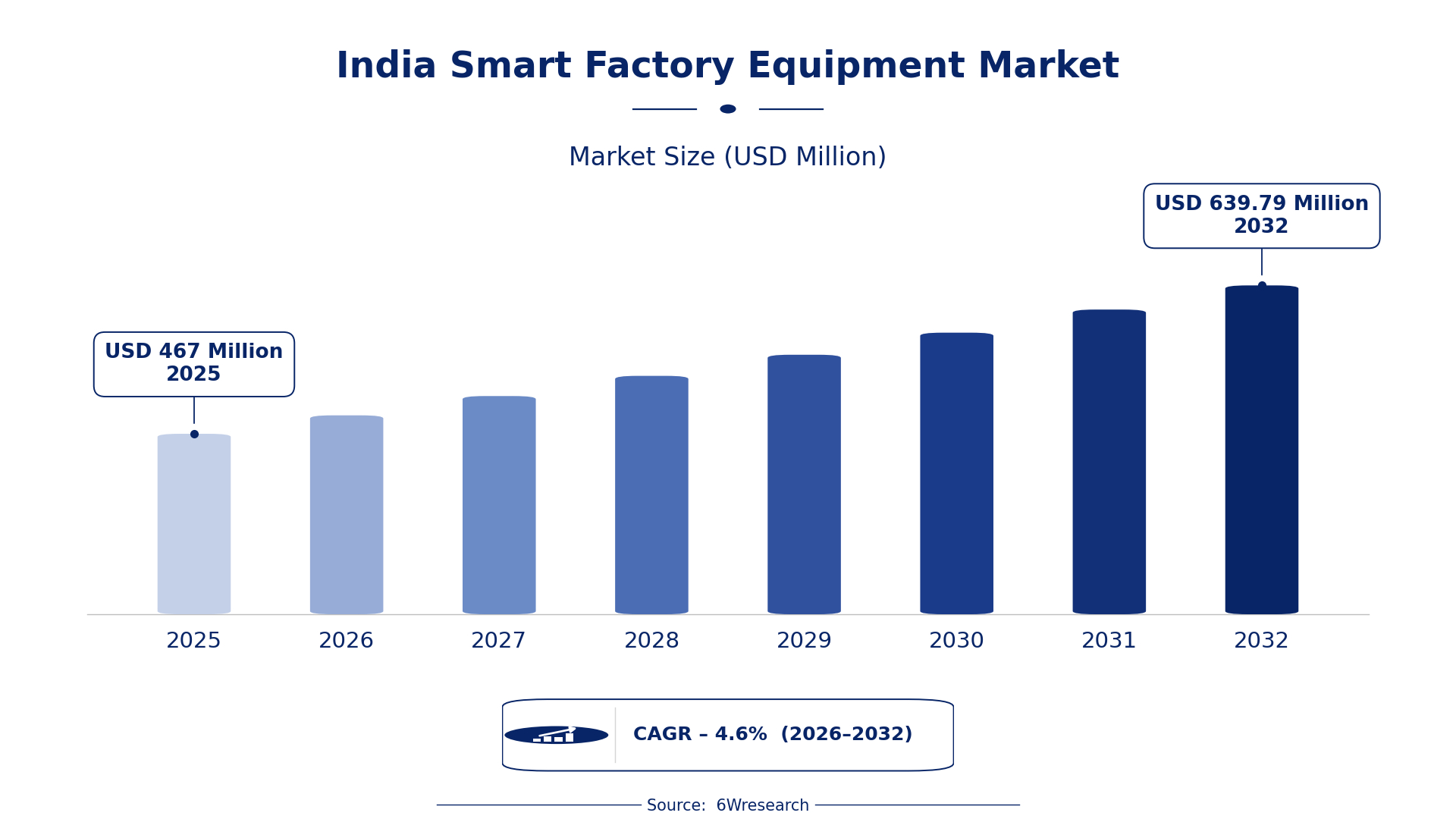
According to 6Wresearch internal database and industry insights, the India Smart Factory Equipment Market was valued at USD 467.0 million in 2025 and is projected to reach USD 639.79 million by 2032, growing at a CAGR of approximately 4.6% during 2026–2032.
India Smart Factory Equipment Market Highlights
| Report Metric | Details |
| Report Name | India Smart Factory Equipment Market |
| Market Size 2025 | USD 467.0 million |
| Market Size 2032 | USD 639.79 million |
| Absolute Growth 2025–2032 | USD 172.79 million |
| CAGR 2026–2032 | 4.6% |
| Peak Annual Growth | 7.0% in 2032 |
| Forecast Period | 2026–2032 |
| Historical Data | 2022–2025 |
| Base Year | 2025 |
| Leading Equipment Type, 2025 | CNC Machines (39% share) |
| Leading Smart Feature, 2025 | AI-Based Optimization (38% share) |
| Leading Integration Type, 2025 | PLC + Sensors (38% share) |
| Leading End User, 2025 | Automotive Production Lines (46% share) |
| Fastest-Growing Equipment Type | Robotic Arms (6.9% CAGR) |
| Fastest-Growing Integration Type | Cloud Manufacturing (6.4% CAGR) |
| Fastest-Growing End User | Assembly Line Operators (7.2% CAGR) |
| Growing Sector | Assembly Line Operators |
| Key End Users | Automotive Production Lines, Industrial OEMs, Assembly Line Operators, Metal Forming Companies |
India Smart Factory Equipment Market Year-wise Growth Rate and Key Drivers (2022–2032)
This graph illustrates the annual growth rates of the market from 2022 to 2032, highlighting a steady upward trajectory and projected market expansion over the forecast period.
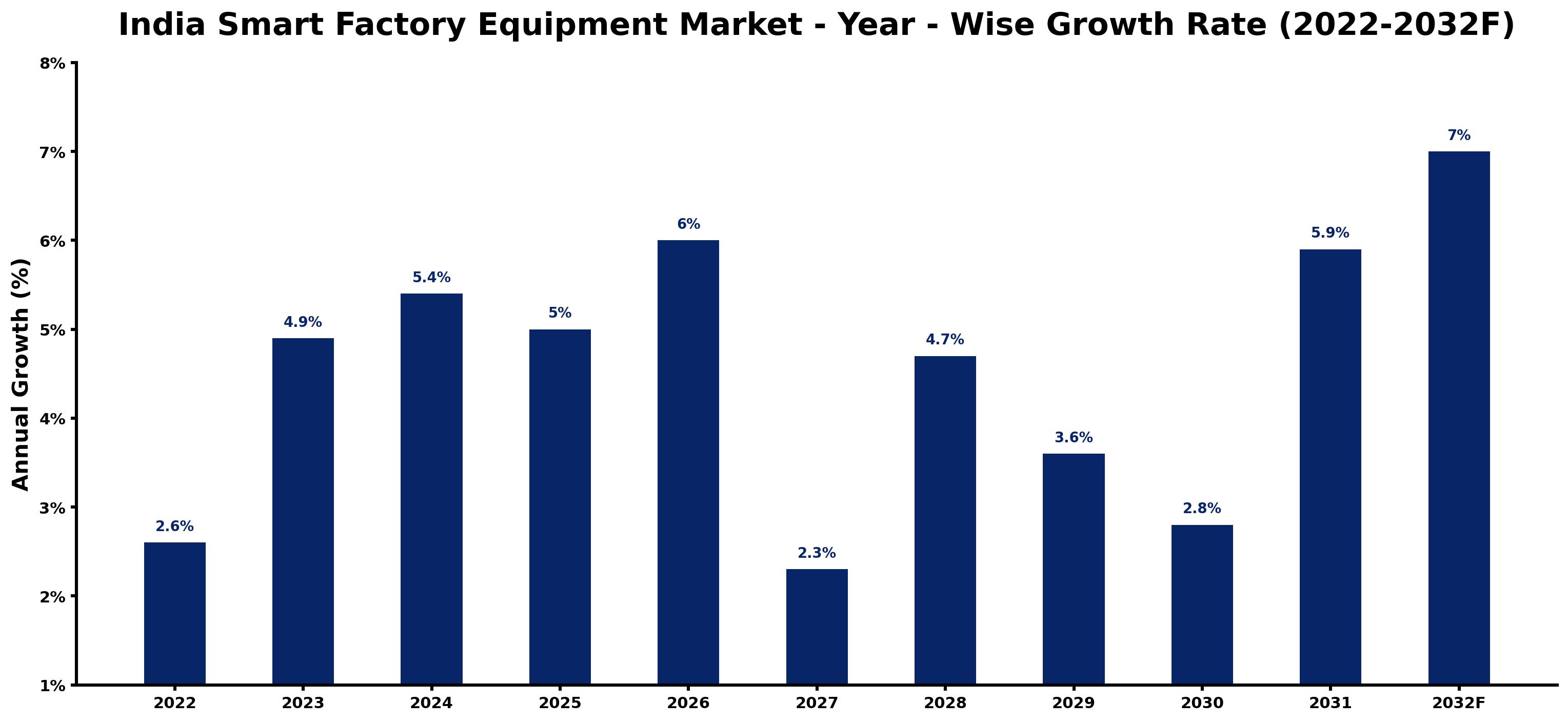
Year by year, the estimates below pair each growth rate with the development that shaped it.
| Year | Estimated Annual Growth (%) | Market Rationale |
| 2022 | 2.6 | The market experienced steady growth due to increasing automation in automotive production, supported by the Make in India initiative. |
| 2023 | 4.9 | Demand surged as automotive production ramped up, reflecting a recovery in the sector driven by over 1,500 automotive companies. |
| 2024 | 5.4 | Growth continued as manufacturers adopted advanced technologies to improve efficiency, supported by the National Manufacturing Policy. |
| 2025 | 5.0 | The market growth slowed slightly as companies adjusted to previous expansions, reflecting the impact of the Production Linked Incentive scheme. |
| 2026 | 6.0 | A renewed focus on smart manufacturing will drive faster growth as investments in automation technologies increase. |
| 2027 | 2.3 | Growth is expected to slow again as manufacturers face challenges in supply chain management and skilled labour shortages. |
| 2028 | 4.7 | Demand is projected to pick up as companies embrace new automation technologies to improve productivity and reduce costs. |
| 2029 | 3.6 | The market will see a slowdown as economic conditions prompt cautious investment in smart solutions. |
| 2030 | 2.8 | Growth is anticipated to slow further as manufacturers deal with rising costs and operational challenges, impacting purchasing decisions. |
| 2031 | 5.9 | A resurgence in demand is expected as companies seek to modernise their operations through smart technologies. |
| 2032 | 7.0 | The market is projected to peak with strong growth driven by advancements in smart technologies and increased automation. |
Note: Market size estimations and growth projections presented in this report are based on 6Wresearch's proprietary forecasting methodology, utilizing the latest available industry data, government publications, and primary research inputs.
India Smart Factory Equipment Market Synopsis
Smart Factory Equipment in India encompasses advanced machinery and systems that optimise manufacturing through automation and data exchange. These products improve production efficiency and product quality. The India Smart Factory Equipment Market is projected to grow significantly, driven by the automotive sector's expansion, which is expected to reach $300 billion by 2026. Over 1,500 automotive companies are operating in India, creating substantial demand for smart solutions. Initiatives like the National Manufacturing Policy aim to elevate the manufacturing sector's GDP contribution to 25% by 2025.
Market Dynamics Impact Analysis (2026–2032)
| Factor | Type | Impact | Primary Segment Affected |
| Increasing demand for automation in manufacturing processes | Driver | High | CNC Machines |
| Growth in automotive production necessitating advanced manufacturing solutions | Driver | High | Robotic Arms |
| Rising investments in smart manufacturing technologies | Opportunity | High | Smart Conveyors |
| Expansion of industrial parks and clusters promoting manufacturing | Opportunity | Medium | IoT-Integrated Presses |
| Challenges in supply chain management affecting production timelines | Restraint | High | PLC + Sensors |
| High initial investment costs for smart factory technologies | Restraint | Medium | AI-Based Optimization |
| Skilled labour shortages impacting technology adoption | Challenge | High | Industrial OEMs |
| Regulatory hurdles delaying equipment approvals | Challenge | Medium | Automotive Production Lines |
Evaluation of Drivers in India Smart Factory Equipment Market (2026–2032)
Below mentioned are some major drivers and their influence on market dynamics.
| Drivers | Primary Segment Affected | Why It Matters (Evidence) |
| Rising demand for automation solutions | CNC Machines | The automotive sector's projected growth to $300 billion by 2026 increases demand for precision CNC machinery, essential for efficient manufacturing processes. |
| Supportive government initiatives | Smart Conveyors | The Make in India initiative promotes local production of smart technologies, enhancing the market for smart conveyors that automate material handling. |
| Increased adoption of Industry 4.0 practices | IoT-Integrated Presses | As manufacturers adopt Industry 4.0, the demand for IoT-integrated presses rises, enabling real-time monitoring and efficiency improvements. |
| Expansion of industrial parks | Robotic Arms | The establishment of over 1,000 industrial parks fosters demand for robotic arms, crucial for automating repetitive tasks in assembly lines. |
| Growing automotive production lines | PLC + Sensors | The automotive production lines' growth drives the need for PLC and sensors, fundamental for automation and control in manufacturing. |
The automotive sector's anticipated growth to $300 billion by 2026 drives the need for precision machinery, crucial for efficient manufacturing. The growing adoption of Industry 4.0 practices leads to increased purchases of real-time monitoring solutions, as manufacturers strive to optimise operations. The expansion of industrial parks also stimulates demand for essential automation equipment, creating a favourable environment for sector growth.
Evaluation of Restraints in India Smart Factory Equipment Market
The table below lists the restraints and the evidence behind each.
| Market Restraint | Primary Segment Affected | Why It Matters (Evidence) |
| Intense competition in the market | CNC Machines | This competitive landscape forces producers to lower prices, impacting profit margins and limiting investment in innovation. |
| Technology adoption challenges | Smart Conveyors | Many producers struggle to integrate advanced automation systems, delaying their ability to optimise production efficiency and increasing operational costs by approximately 20%. |
| Skills shortages in the workforce | Robotic Arms | A lack of trained personnel hampers the implementation of smart solutions, leading to inefficiencies and increased costs for manufacturers. |
| Regulatory complexities in approvals | IoT-Integrated Presses | Delays in the approval processes for new equipment can impact supply chains, affecting buyers' access to the latest technologies. |
| Economic uncertainty affecting investment | PLC + Sensors | Cautious investment due to economic conditions can slow down the growth of the market and limit purchasing decisions. |
India Smart Factory Equipment Market Challenges
The India Smart Factory Equipment Market contends with fierce competition, which compresses profit margins for producers. This challenge arises from numerous domestic and international players, compelling local manufacturers to lower prices to retain market share. Technology integration presents another obstacle, as many producers face difficulties with advanced automation systems, resulting in a 20% rise in operational costs. Skills shortages hinder the rollout of smart solutions, costing producers valuable time and resources due to inefficiencies. Regulatory complexities further delay approval processes for new equipment, impacting supply chains and restricting buyers' access to cutting-edge technologies.
Trends in the India Smart Factory Equipment Market
Buyers and suppliers in the India Smart Factory Equipment Market are adjusting to the following trends.
- Shift from Traditional to Smart Manufacturing: Since 2021, automotive production lines have increasingly embraced smart technologies, driven by the need for efficiency. The market for smart factory equipment is projected to reach $300 billion by 2026.
- Transition to Automation in Assembly Lines: Automotive production lines are swiftly incorporating robotic arms to boost productivity. This trend is clear as assembly line operators seek more efficient solutions, with a projected growth rate of 7.2% by 2032.
- Emergence of AI-Based Optimization: The uptake of AI-Based Optimization technologies is rising among manufacturers, improving overall equipment effectiveness. This trend is bolstered by the growing demand for smart solutions across various sectors, with a 6.6% CAGR anticipated.
- Prioritisation of Industry 4.0 Practices: Manufacturers are increasingly focusing on Industry 4.0 practices to maintain competitiveness. The Digital India programme continues to support this transition, promoting smart technologies throughout the manufacturing sector.
Investment Opportunities in the India Smart Factory Equipment Market
Some of the investment opportunities in the India Smart Factory Equipment Market are mentioned below.
- Investment in Smart Automation Technologies: With the automotive sector projected to reach $300 billion by 2026, there is a significant opportunity for investment in smart automation technologies. Industrial OEMs are key buyers, and local partnerships can facilitate market entry.
- Expansion of Industrial Parks: The establishment of over 1,000 industrial parks presents opportunities for suppliers of smart factory equipment. Collaborating with local partners can enhance market penetration and support regional manufacturing growth.
- Growing Demand for Real-Time Monitoring Solutions: The increasing adoption of IoT technologies creates a gap for suppliers of IoT-Integrated Presses. Targeting assembly line operators can lead to successful market entry and growth.
- Focus on Skill Development Initiatives: The National Skill Development Mission aims to train over 400 million people, creating opportunities for suppliers of training solutions in smart manufacturing. Engaging with educational institutions can facilitate partnerships.
Government Initiatives in the India Smart Factory Equipment Market
The Production Linked Incentive (PLI) scheme for the automotive sector, launched by the Ministry of Heavy Industries in 2021, aims to improve manufacturing capabilities and attract investments in smart factory technologies. This initiative supports local manufacturers by providing financial incentives for adopting advanced equipment, thereby boosting production efficiency.
The Digital India programme, initiated in 2015, continues to encourage the adoption of smart technologies in manufacturing through various funding and policy measures. The Ministry of Electronics and Information Technology oversees this programme, which has allocated significant resources to promote the integration of smart factory solutions across industries.
Future Insight of the India Smart Factory Equipment Market
The India Smart Factory Equipment Market is poised for substantial changes by 2032, driven by key initiatives. The National Manufacturing Policy aims to increase the manufacturing sector's GDP contribution from 16% to 25% by 2025, stimulating investment in advanced technologies. The Production Linked Incentive scheme is expected to motivate manufacturers to adopt modern equipment, improving operational efficiency. With the automotive industry projected to reach $300 billion by 2026, the market will experience a surge in demand for smart solutions and technological advancements.
Market Segmentation Analysis
Each segment group is reviewed below, with the leader by share and the fastest grower by CAGR.
By Equipment Type – CNC Machines Dominated, Robotic Arms Expected to Grow Fastest
According to Dhaval Chaurasia, Assistant Manager at 6Wresearch, with a 39% revenue share in 2025, CNC Machines was the largest equipment type category. CNC Machines command the largest market share because they are indispensable for precision manufacturing across various industries, especially in automotive. The reliance on these machines is underscored by the presence of over 1,500 automotive companies in India that utilise them for high-quality production. Robotic Arms are set to record the highest CAGR in this split, 6.9% over 2026–2032. Robotic Arms are experiencing the fastest growth due to their increasing deployment in assembly lines for repetitive tasks, which enhances operational efficiency. The automotive sector's projected expansion to $300 billion by 2026 is a significant factor driving this demand. Suppliers should focus on expanding their robotic arm product lines to capitalise on this burgeoning market opportunity.
By Smart Feature – AI-Based Optimization Dominated and Is Expected to Record the Fastest Growth
In 2025, AI-Based Optimization led the smart feature split with a 38% share. AI-Based Optimization leads the market as it significantly enhances overall equipment effectiveness, making it a crucial component in smart factory settings. Its importance is further highlighted by initiatives like the Make in India programme that promotes advanced manufacturing technologies. Its lead should widen, with a projected CAGR of 6.6% during 2026–2032, the highest in this split. AI-Based Optimization is also the fastest-growing feature, propelled by the increasing shift towards smart manufacturing practices that emphasise efficiency. This growth is supported by a heightened focus on quality in production processes across various sectors. Buyers should prioritise investment in AI-based solutions to boost operational efficiency and stay competitive in the market.
By Integration Type – PLC + Sensors Dominated, Cloud Manufacturing Expected to Grow Fastest
PLC + Sensors took a 38% share of integration type in 2025, more than any other category. PLC + Sensors hold the largest market share as they are vital for automation and control in manufacturing, ensuring seamless operations. Their essential role is evident in the numerous industrial parks and clusters in India that depend on these technologies for effective manufacturing. Over 2026–2032, Cloud Manufacturing is expected to post the fastest growth, at a CAGR of 6.4%. Cloud Manufacturing is the fastest-growing integration type, as manufacturers increasingly seek its potential for enhanced connectivity and data management. Although still emerging, its adoption is expected to accelerate as digital transformation becomes more widespread. Suppliers must prepare for the rising demand for cloud-based solutions to align with future market developments.
By End User – Automotive Production Lines Dominated, Assembly Line Operators Expected to Grow Fastest
Automotive Production Lines held a 46% share of the India Smart Factory Equipment Market by end user in 2025. Automotive Production Lines are the leading end user segment, significantly driving the demand for smart factory equipment due to the industry's robust growth and dependence on advanced manufacturing technologies. This sector is pivotal in India's manufacturing landscape, making it a primary focus for suppliers. The quickest growth will come from Assembly Line Operators, forecast to expand at a CAGR of 7.2% between 2026 and 2032. Assembly Line Operators represent the fastest-growing user group as they increasingly adopt automation technologies to improve their operations. The push for efficiency in production lines is a key factor driving this segment's rapid expansion. Suppliers should customise their offerings to meet the specific needs of assembly line operators to seize this growing market.
Key Attractiveness of the Report
- 10 Years of Market Numbers
- Historical Data Starting from 2022 to 2025
- Base Year 2025
- Forecast Data until 2032
- Key Performance Indicators Impacting the Market
- Major Upcoming Developments and Projects
Key Highlights of the Report:
- India Smart Factory Equipment Market Outlook
- Market Size of India Smart Factory Equipment Market, 2025
- Forecast of India Smart Factory Equipment Market, 2032
- Historical Data and Forecast of India Smart Factory Equipment Revenues & Volume for the Period 2022 - 2032F
- India Smart Factory Equipment Market Trend Evolution
- India Smart Factory Equipment Market Drivers and Challenges
- India Smart Factory Equipment Price Trends
- India Smart Factory Equipment Porter's Five Forces
- India Smart Factory Equipment Industry Life Cycle
- Historical Data and Forecast of India Smart Factory Equipment Market Revenues & Volume By Equipment Type for the Period 2022 - 2032F
- Historical Data and Forecast of India Smart Factory Equipment Market Revenues & Volume By CNC Machines for the Period 2022 - 2032F
- Historical Data and Forecast of India Smart Factory Equipment Market Revenues & Volume By Smart Conveyors for the Period 2022 - 2032F
- Historical Data and Forecast of India Smart Factory Equipment Market Revenues & Volume By Robotic Arms for the Period 2022 - 2032F
- Historical Data and Forecast of India Smart Factory Equipment Market Revenues & Volume By IoT-Integrated Presses for the Period 2022 - 2032F
- Historical Data and Forecast of India Smart Factory Equipment Market Revenues & Volume By Smart Feature for the Period 2022 - 2032F
- Historical Data and Forecast of India Smart Factory Equipment Market Revenues & Volume By AI-Based Optimization for the Period 2022 - 2032F
- Historical Data and Forecast of India Smart Factory Equipment Market Revenues & Volume By Load + Motion Tracking for the Period 2022 - 2032F
- Historical Data and Forecast of India Smart Factory Equipment Market Revenues & Volume By Vision + AI Navigation for the Period 2022 - 2032F
- Historical Data and Forecast of India Smart Factory Equipment Market Revenues & Volume By Predictive Diagnostics for the Period 2022 - 2032F
- Historical Data and Forecast of India Smart Factory Equipment Market Revenues & Volume By Integration Type for the Period 2022 - 2032F
- Historical Data and Forecast of India Smart Factory Equipment Market Revenues & Volume By Cloud Manufacturing for the Period 2022 - 2032F
- Historical Data and Forecast of India Smart Factory Equipment Market Revenues & Volume By PLC + Sensors for the Period 2022 - 2032F
- Historical Data and Forecast of India Smart Factory Equipment Market Revenues & Volume By MES-Connected for the Period 2022 - 2032F
- Historical Data and Forecast of India Smart Factory Equipment Market Revenues & Volume By Sensor Mesh for the Period 2022 - 2032F
- Historical Data and Forecast of India Smart Factory Equipment Market Revenues & Volume By End User for the Period 2022 - 2032F
- Historical Data and Forecast of India Smart Factory Equipment Market Revenues & Volume By Industrial OEMs for the Period 2022 - 2032F
- Historical Data and Forecast of India Smart Factory Equipment Market Revenues & Volume By Assembly Line Operators for the Period 2022 - 2032F
- Historical Data and Forecast of India Smart Factory Equipment Market Revenues & Volume By Automotive Production Lines for the Period 2022 - 2032F
- Historical Data and Forecast of India Smart Factory Equipment Market Revenues & Volume By Metal Forming Companies for the Period 2022 - 2032F
- India Smart Factory Equipment Import Export Trade Statistics
- Market Opportunity Assessment By Equipment Type
- Market Opportunity Assessment By Smart Feature
- Market Opportunity Assessment By Integration Type
- Market Opportunity Assessment By End User
- India Smart Factory Equipment Top Companies Market Share
- India Smart Factory Equipment Competitive Benchmarking By Technical and Operational Parameters
- India Smart Factory Equipment Company Profiles
- India Smart Factory Equipment Key Strategic Recommendations
Market Covered
Segments analysed in this report are listed below.
By Equipment Type
- CNC Machines
- Smart Conveyors
- Robotic Arms
- IoT-Integrated Presses
By Smart Feature
- AI-Based Optimization
- Load + Motion Tracking
- Vision + AI Navigation
- Predictive Diagnostics
By Integration Type
- Cloud Manufacturing
- PLC + Sensors
- MES-Connected
- Sensor Mesh
By End User
- Industrial OEMs
- Assembly Line Operators
- Automotive Production Lines
- Metal Forming Companies































