China Smart Factory Equipment Market Size & Growth Rate
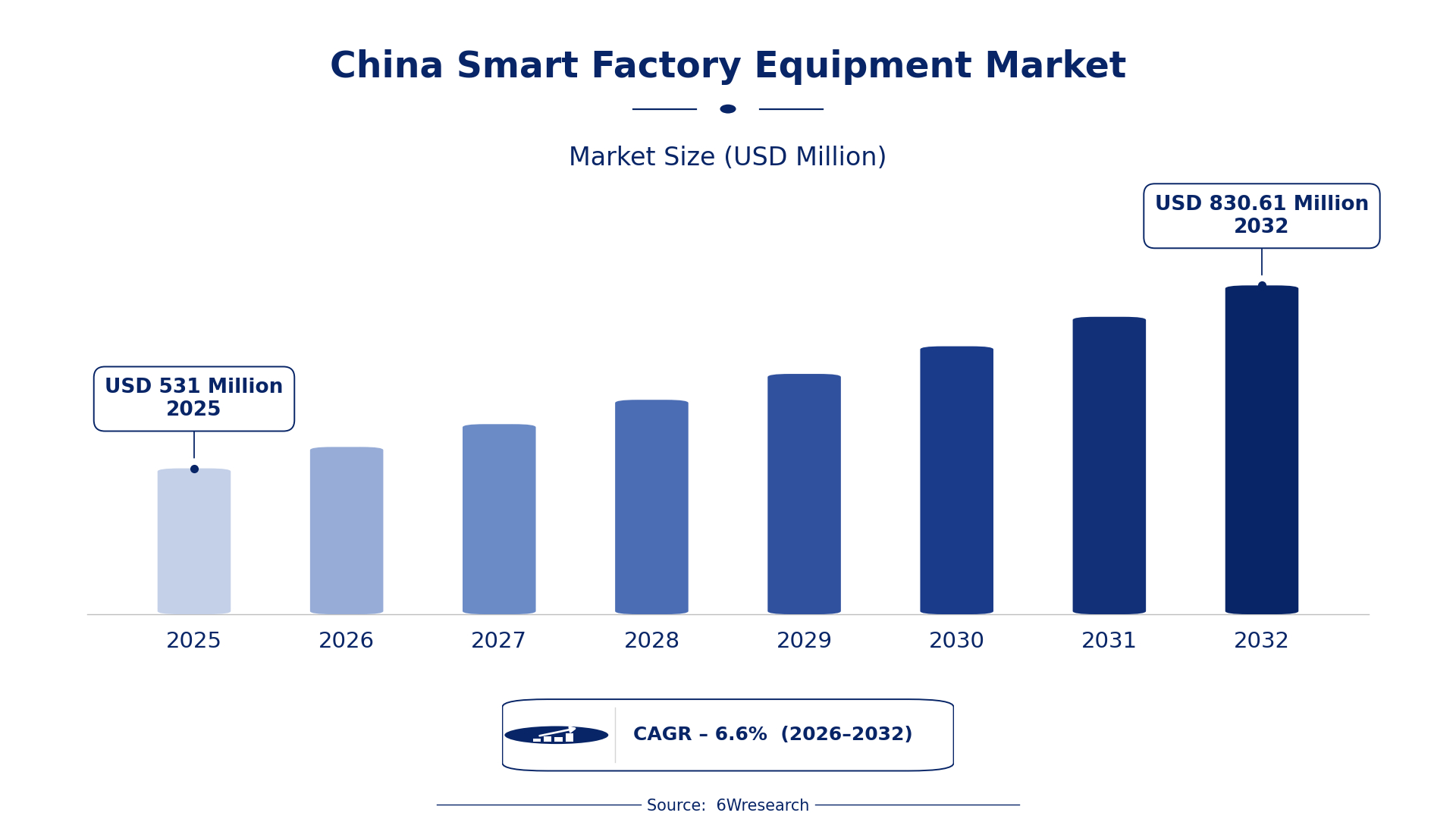
According to 6Wresearch internal database and industry insights, the China Smart Factory Equipment Market was valued at USD 531.0 million in 2025 and is projected to reach USD 830.61 million by 2032, growing at a CAGR of approximately 6.6% during 2026–2032.
China Smart Factory Equipment Market Highlights
| Report Metric | Details |
| Report Name | China Smart Factory Equipment Market |
| Market Size 2025 | USD 531.0 million |
| Market Size 2032 | USD 830.61 million |
| Absolute Growth 2025–2032 | USD 299.61 million |
| CAGR 2026–2032 | 6.6% |
| Peak Annual Growth | 8.5% in 2031 |
| Forecast Period | 2026–2032 |
| Historical Data | 2022–2025 |
| Base Year | 2025 |
| Leading Equipment Type, 2025 | CNC Machines (39% share) |
| Leading Smart Feature, 2025 | AI-Based Optimization (54% share) |
| Leading Integration Type, 2025 | Cloud Manufacturing (43% share) |
| Leading End User, 2025 | Automotive Production Lines (43% share) |
| Fastest-Growing Equipment Type | Robotic Arms (8.3% CAGR) |
| Fastest-Growing Integration Type | MES-Connected (8.4% CAGR) |
| Fastest-Growing End User | Assembly Line Operators (8.5% CAGR) |
| Growing Sector | Automotive Production |
| Key End Users | Industrial OEMs, Assembly Line Operators, Automotive Production Lines |
China Smart Factory Equipment Market Year-wise Growth Rate and Key Drivers (2022–2032)
This graph illustrates the annual growth rates of the market from 2022 to 2032, highlighting a steady upward trajectory and projected market expansion over the forecast period.
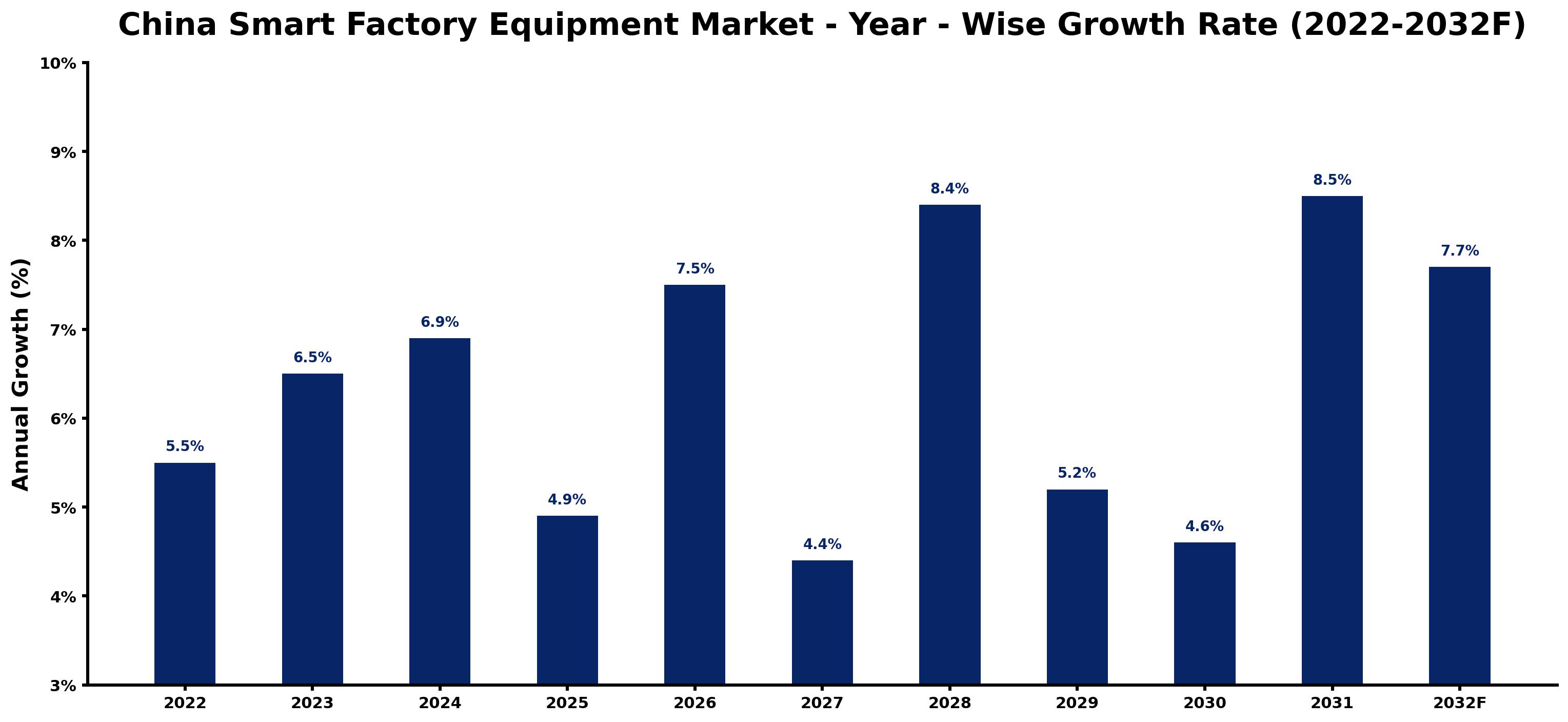
Below, each year's estimated growth is shown next to the factor that most influenced it.
| Year | Estimated Annual Growth (%) | Market Rationale |
| 2022 | 5.5 | The market experienced steady growth due to increased automation trends in manufacturing. |
| 2023 | 6.5 | Demand surged as manufacturers sought to adopt advanced smart technologies for operational efficiency. |
| 2024 | 6.9 | Growth continued as the automotive sector increasingly integrated smart factory solutions into operations. |
| 2025 | 4.9 | A slight slowdown occurred as some manufacturers adjusted to new technologies and standards. |
| 2026 | 7.5 | Investment in smart manufacturing technologies is expected to rise, boosting market demand significantly. |
| 2027 | 4.4 | Growth is projected to slow as the market stabilises after rapid expansion in previous years. |
| 2028 | 8.4 | A resurgence in demand will be driven by advancements in automation and IoT integration. |
| 2029 | 5.2 | The market is expected to experience a slowdown as companies reassess their technology investments. |
| 2030 | 4.6 | Continued growth is anticipated as manufacturers focus on efficiency and cost reduction. |
| 2031 | 8.5 | Peak growth is expected as the automotive sector heavily invests in smart factory innovations. |
| 2032 | 7.7 | The market will maintain strong growth as digital transformation initiatives continue to expand. |
Note: Market size estimations and growth projections presented in this report are based on 6Wresearch's proprietary forecasting methodology, utilizing the latest available industry data, government publications, and primary research inputs.
China Smart Factory Equipment Market Synopsis
Smart Factory Equipment in China encompasses advanced manufacturing technologies that integrate automation, data exchange, and IoT. These systems improve production efficiency, reduce operational costs, and enable real-time monitoring of manufacturing processes. The China Smart Factory Equipment Market is growing due to rising demand from the automotive sector, which accounts for over 30% of usage. Initiatives like the 'Smart Manufacturing Development Plan' are driving investments in digital transformation, further boosting market growth.
Market Dynamics Impact Analysis (2026–2032)
| Factor | Type | Impact | Primary Segment Affected |
| Increasing automation in manufacturing processes | Driver | High | CNC Machines |
| Rising demand for real-time monitoring and control | Driver | High | IoT-Integrated Presses |
| Growing investment in smart manufacturing technologies | Opportunity | High | Robotic Arms |
| Expansion of industrial parks focused on smart technologies | Opportunity | Medium | Smart Conveyors |
| High initial investment costs for small manufacturers | Restraint | High | PLC + Sensors |
| Limited awareness of smart technologies among SMEs | Restraint | Medium | MES-Connected |
| Challenges in integrating legacy systems with new technologies | Challenge | High | Cloud Manufacturing |
| Shortage of skilled workforce in advanced manufacturing | Challenge | Medium | CNC Machines |
Evaluation of Drivers in China Smart Factory Equipment Market (2026–2032)
Key forces behind demand, with the segment each one moves most, are listed below.
| Drivers | Primary Segment Affected | Why It Matters (Evidence) |
| Investment in automation technologies | CNC Machines | Investment in CNC machines is rising due to the need for precision manufacturing, with over 170 million people employed in the manufacturing sector. |
| Demand for production efficiency | Robotic Arms | The automotive sector's demand for robotic arms is increasing, accounting for over 30% of smart factory equipment usage. |
| Integration of IoT in manufacturing | IoT-Integrated Presses | The IoT market in China is projected to grow significantly, driving demand for IoT-integrated solutions. |
| Government initiatives supporting smart manufacturing | Cloud Manufacturing | The 'Smart Manufacturing Development Plan' aims to improve manufacturing capabilities, encouraging investment in cloud solutions. |
| Focus on real-time data analytics | MES-Connected | The adoption of AI in manufacturing is expected to increase significantly, boosting demand for MES solutions. |
The Smart Factory Equipment market in China is growing on the back of rising investments in automation technologies, particularly in CNC machines and robotic arms. In 2022, over 170 million people were employed in the manufacturing sector, driving demand for precision solutions. The automotive sector, which accounts for over 30% of smart factory equipment usage, is increasingly adopting IoT-integrated presses. The IoT market is projected to grow significantly, further driving demand for smart manufacturing solutions.
Evaluation of Restraints in China Smart Factory Equipment Market
The key brakes on demand, and where they bite hardest, are shown below.
| Market Restraint | Primary Segment Affected | Why It Matters (Evidence) |
| High initial investment costs for adopting smart technologies | CNC Machines | Many small manufacturers face high costs, limiting their ability to invest in CNC machines, which can exceed $100,000. |
| Limited awareness of smart factory technologies among SMEs | Robotic Arms | Small and medium enterprises often lack knowledge about the benefits of robotic arms, hindering adoption rates. |
| Challenges in integrating legacy systems with new technologies | Cloud Manufacturing | Manufacturers struggle to integrate existing systems with cloud solutions, delaying upgrades and increasing costs. |
| Regulatory compliance issues for new technologies | MES-Connected | Manufacturers must navigate complex regulations, which can slow down the implementation of MES solutions. |
| Shortage of skilled workforce in advanced manufacturing | IoT-Integrated Presses | The demand for skilled workers in IoT technologies is high, but training programs are not keeping pace with industry needs. |
China Smart Factory Equipment Market Challenges
The China Smart Factory Equipment Market faces a few practical problems, beginning with skills shortages among workers. Many employees lack adequate training in advanced manufacturing technologies, which delays production for manufacturers and affects their output. Buyers also contend with high initial costs of smart factory equipment, often exceeding $1 million for integrated systems, limiting access for smaller firms and reducing their competitiveness. Rising raw material costs burden suppliers, forcing price increases that can deter potential buyers and shrink their market base. Rapid technological advancements create a knowledge gap, leaving many producers unable to keep pace with the latest innovations, which undermines their operational efficiency.
Trends in the China Smart Factory Equipment Market
Below mentioned are some of the trends shaping the China Smart Factory Equipment Market growth.
- Shift towards IoT-Integrated Manufacturing: Guangdong province is at the forefront with over 1,000 smart factory projects, reflecting a shift towards IoT integration in manufacturing. This trend drives operational efficiency and productivity.
- Transition from Traditional to Smart Manufacturing: The 'Made in China 2025' initiative is facilitating a transition from traditional manufacturing methods to smart technologies, targeting a 20% productivity increase by 2025. This shift reshapes production processes.
- Emergence of AI-Based Optimization: AI-Based Optimization is gaining traction in manufacturing processes, with a projected growth rate of 8.0% from 2026 to 2032, improving operational efficiency across various sectors. This trend is crucial for maintaining competitive advantage.
- Increased Adoption of Cloud Manufacturing: Industrial OEMs are increasingly embracing Cloud Manufacturing solutions, with a market share of 43% expected by 2025, enabling remote monitoring and management. This adoption improves operational flexibility.
Investment Opportunities in the China Smart Factory Equipment Market
The following opportunities in the China Smart Factory Equipment Market pair current demand with a clear way in.
- Investment in Smart Manufacturing Facilities: Guangdong province is expanding its smart manufacturing facilities, with a projected investment of $1 billion in 2023, creating opportunities for suppliers to enter the market through partnerships and collaborations.
- Growing Demand for Automation Solutions: The automotive sector's demand for automation solutions is anticipated to rise, with over 30% of smart factory equipment usage, presenting investment opportunities for technology providers to address this growing need.
- Expansion of Industrial Parks: China hosts over 500 industrial parks focused on smart manufacturing, providing a solid foundation for new entrants to collaborate with local manufacturers and leverage existing infrastructure for growth.
- Development of Skilled Workforce: The shortage of skilled workers in advanced manufacturing presents opportunities for training providers to develop programmes that align with industry needs, particularly in IoT and AI technologies.
Government Initiatives in the China Smart Factory Equipment Market
The 'Smart Manufacturing Development Plan' launched by the Ministry of Industry and Information Technology in 2021 aims to enhance manufacturing capabilities through digital transformation. This plan complements the '13th Five-Year Plan for Economic and Social Development', which targeted a 20% increase in productivity by 2025. Together, these measures encourage investment in smart technologies, ensuring manufacturers can adapt to evolving market demands and improve their operational efficiencies.
The automotive sector benefits from the $500 million subsidy programme announced by the Ministry of Industry and Information Technology in 2022, which supports small and medium-sized enterprises in adopting smart technologies. Additionally, the 'Digital Economy Development Plan' aims to increase the share of digital technologies in manufacturing to 30% by 2025, facilitating greater access to funding and resources for manufacturers seeking to upgrade their operations.
Future Insight of the China Smart Factory Equipment Market
Several forward-looking factors should support the China Smart Factory Equipment Market in the coming years. Government investment in smart manufacturing initiatives is expected to exceed $1 billion, driving innovation and infrastructure development. The automotive sector's demand for smart factory equipment will continue to rise, supported by the 'Made in China 2025' initiative promoting advanced technologies. A projected 40% increase in AI adoption will further improve operational efficiencies, while the IoT market's growth to $200 billion by 2025 will create new opportunities for manufacturers.
Market Segmentation Analysis
The analysis below covers each segmentation, its leading category in 2025 and its fastest-growing category through 2032.
By Equipment Type – CNC Machines Dominated, Robotic Arms Expected to Grow Fastest
According to Dhaval Chaurasia, Assistant Manager at 6Wresearch, CNC Machines accounted for a 39% market share by equipment type in 2025. CNC Machines dominate the market due to their essential role in precision manufacturing, particularly in the automotive sector where high accuracy is critical. The automotive industry's substantial investment in smart factory equipment reinforces the strong demand for CNC Machines, establishing their leading position. Robotic Arms are projected to grow fastest, at a CAGR of 8.3% during 2026–2032. Robotic Arms are rapidly gaining popularity as they are increasingly adopted for automation in production lines, reflecting the rising demand for enhanced operational efficiency. The government's significant funding for smart manufacturing initiatives is further propelling the adoption of Robotic Arms across various sectors. Suppliers should concentrate on developing CNC Machines and Robotic Arms to meet the growing demand in China's smart factory equipment market.
By Smart Feature – AI-Based Optimization Dominated and Is Expected to Record the Fastest Growth
The largest smart feature category in 2025 was AI-Based Optimization, with a 54% share of total revenue. AI-Based Optimization leads the market by significantly enhancing operational efficiency in manufacturing processes, making it an indispensable element of smart factories. Its extensive adoption aligns with national standards promoting the integration of advanced technologies in manufacturing. Its lead should widen, with a projected CAGR of 8.0% during 2026–2032, the highest in this split. The growth of AI-Based Optimization is propelled by the anticipated increase in AI adoption within the manufacturing sector, ensuring its continued relevance in future advancements. As both the leader and fastest segment, it is likely to attract further investments and innovations. Buyers should focus on solutions that utilise AI-Based Optimization to improve efficiency and maintain a competitive edge in the smart manufacturing industry.
By Integration Type – Cloud Manufacturing Dominated, MES-Connected Expected to Grow Fastest
Cloud Manufacturing held a 43% share of the China Smart Factory Equipment Market by integration type in 2025. Cloud Manufacturing holds the largest market share as it enables remote monitoring and management of factories, which is crucial for modern smart manufacturing. The presence of numerous industrial parks dedicated to smart technologies accelerates the adoption of cloud-based solutions. Over 2026–2032, MES-Connected is expected to post the fastest growth, at a CAGR of 8.4%. The MES-Connected segment is witnessing rapid growth due to its ability to seamlessly integrate manufacturing processes with management systems, thereby streamlining operations. As manufacturers seek to optimise efficiency, this segment is set for increased investment and development. Suppliers must enhance their offerings in Cloud Manufacturing and MES-Connected solutions to align with the industry's shift towards integrated smart manufacturing.
By End User – Automotive Production Lines Dominated, Assembly Line Operators Expected to Grow Fastest
In 2025, Automotive Production Lines led the end user split with a 43% share. Automotive Production Lines represent the largest market share, heavily investing in smart manufacturing technologies to improve efficiency and reduce costs. The significant workforce in this sector highlights its critical role in driving demand for smart factory equipment. Assembly Line Operators are set to record the highest CAGR in this split, 8.5% over 2026–2032. Assembly Line Operators are experiencing the fastest growth as they increasingly adopt smart factory equipment to optimise production processes. This trend is expected to continue as manufacturers aim to enhance operational efficiency and minimise downtime. Suppliers should tailor their products to meet the specific needs of Automotive Production Lines and Assembly Line Operators, ensuring competitiveness in the smart factory equipment market.
Key Attractiveness of the Report
- 10 Years of Market Numbers
- Historical Data Starting from 2022 to 2025
- Base Year 2025
- Forecast Data until 2032
- Key Performance Indicators Impacting the Market
- Major Upcoming Developments and Projects
Key Highlights of the Report:
- China Smart Factory Equipment Market Outlook
- Market Size of China Smart Factory Equipment Market, 2025
- Forecast of China Smart Factory Equipment Market, 2032
- Historical Data and Forecast of China Smart Factory Equipment Revenues & Volume for the Period 2022 - 2032F
- China Smart Factory Equipment Market Trend Evolution
- China Smart Factory Equipment Market Drivers and Challenges
- China Smart Factory Equipment Price Trends
- China Smart Factory Equipment Porter's Five Forces
- China Smart Factory Equipment Industry Life Cycle
- Historical Data and Forecast of China Smart Factory Equipment Market Revenues & Volume By Equipment Type for the Period 2022 - 2032F
- Historical Data and Forecast of China Smart Factory Equipment Market Revenues & Volume By CNC Machines for the Period 2022 - 2032F
- Historical Data and Forecast of China Smart Factory Equipment Market Revenues & Volume By Smart Conveyors for the Period 2022 - 2032F
- Historical Data and Forecast of China Smart Factory Equipment Market Revenues & Volume By Robotic Arms for the Period 2022 - 2032F
- Historical Data and Forecast of China Smart Factory Equipment Market Revenues & Volume By IoT-Integrated Presses for the Period 2022 - 2032F
- Historical Data and Forecast of China Smart Factory Equipment Market Revenues & Volume By Smart Feature for the Period 2022 - 2032F
- Historical Data and Forecast of China Smart Factory Equipment Market Revenues & Volume By AI-Based Optimization for the Period 2022 - 2032F
- Historical Data and Forecast of China Smart Factory Equipment Market Revenues & Volume By Load + Motion Tracking for the Period 2022 - 2032F
- Historical Data and Forecast of China Smart Factory Equipment Market Revenues & Volume By Vision + AI Navigation for the Period 2022 - 2032F
- Historical Data and Forecast of China Smart Factory Equipment Market Revenues & Volume By Predictive Diagnostics for the Period 2022 - 2032F
- Historical Data and Forecast of China Smart Factory Equipment Market Revenues & Volume By Integration Type for the Period 2022 - 2032F
- Historical Data and Forecast of China Smart Factory Equipment Market Revenues & Volume By Cloud Manufacturing for the Period 2022 - 2032F
- Historical Data and Forecast of China Smart Factory Equipment Market Revenues & Volume By PLC + Sensors for the Period 2022 - 2032F
- Historical Data and Forecast of China Smart Factory Equipment Market Revenues & Volume By MES-Connected for the Period 2022 - 2032F
- Historical Data and Forecast of China Smart Factory Equipment Market Revenues & Volume By Sensor Mesh for the Period 2022 - 2032F
- Historical Data and Forecast of China Smart Factory Equipment Market Revenues & Volume By End User for the Period 2022 - 2032F
- Historical Data and Forecast of China Smart Factory Equipment Market Revenues & Volume By Industrial OEMs for the Period 2022 - 2032F
- Historical Data and Forecast of China Smart Factory Equipment Market Revenues & Volume By Assembly Line Operators for the Period 2022 - 2032F
- Historical Data and Forecast of China Smart Factory Equipment Market Revenues & Volume By Automotive Production Lines for the Period 2022 - 2032F
- Historical Data and Forecast of China Smart Factory Equipment Market Revenues & Volume By Metal Forming Companies for the Period 2022 - 2032F
- China Smart Factory Equipment Import Export Trade Statistics
- Market Opportunity Assessment By Equipment Type
- Market Opportunity Assessment By Smart Feature
- Market Opportunity Assessment By Integration Type
- Market Opportunity Assessment By End User
- China Smart Factory Equipment Top Companies Market Share
- China Smart Factory Equipment Competitive Benchmarking By Technical and Operational Parameters
- China Smart Factory Equipment Company Profiles
- China Smart Factory Equipment Key Strategic Recommendations
Market Covered
The report offers an extensive study of the following market segments.
By Equipment Type
- CNC Machines
- Smart Conveyors
- Robotic Arms
- IoT-Integrated Presses
By Smart Feature
- AI-Based Optimization
- Load + Motion Tracking
- Vision + AI Navigation
- Predictive Diagnostics
By Integration Type
- Cloud Manufacturing
- PLC + Sensors
- MES-Connected
- Sensor Mesh
By End User
- Industrial OEMs
- Assembly Line Operators
- Automotive Production Lines
- Metal Forming Companies































