India Smart Factory Network Market Size & Growth Rate
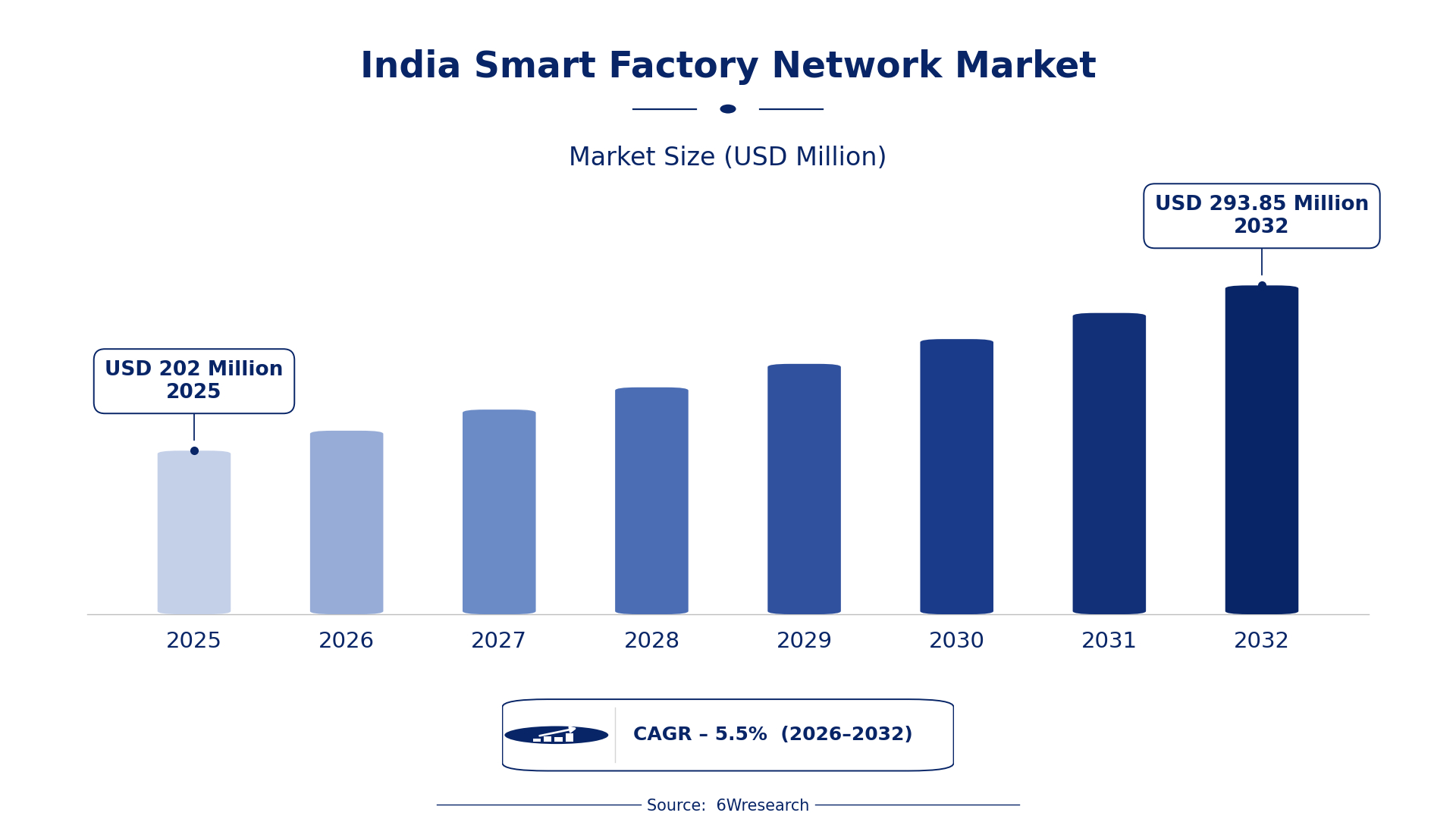
According to 6Wresearch internal database and industry insights, the India Smart Factory Network Market was valued at USD 202.0 million in 2025 and is projected to reach USD 293.85 million by 2032, growing at a CAGR of approximately 5.5% during 2026–2032.
India Smart Factory Network Market Highlights
| Report Metric | Details |
| Report Name | India Smart Factory Network Market |
| Market Size 2025 | USD 202.0 million |
| Market Size 2032 | USD 293.85 million |
| Absolute Growth 2025–2032 | USD 91.85 million |
| CAGR 2026–2032 | 5.5% |
| Peak Annual Growth | 7.4% in 2026 |
| Forecast Period | 2026–2032 |
| Historical Data | 2022–2025 |
| Base Year | 2025 |
| Leading Network Type, 2025 | 5G Private Network (39% share) |
| Leading Key Features, 2025 | Ultra-Reliable Low Latency (42% share) |
| Leading Supported Tech, 2025 | Industrial IoT (37% share) |
| Leading End User, 2025 | Smart Factory Operators (43% share) |
| Fastest-Growing Network Type | Edge Computing Mesh (8.2% CAGR) |
| Fastest-Growing Key Features | Real-Time Local Analysis (6.8% CAGR) |
| Fastest-Growing End User | Manufacturing Hubs (6.5% CAGR) |
| Growing Sector | manufacturing |
| Key End Users | Smart Factory Operators, Manufacturing Hubs, Factory Automation Experts |
India Smart Factory Network Market Year-wise Growth Rate and Key Drivers (2022–2032)
This graph illustrates the annual growth rates of the market from 2022 to 2032, highlighting a steady upward trajectory and projected market expansion over the forecast period.
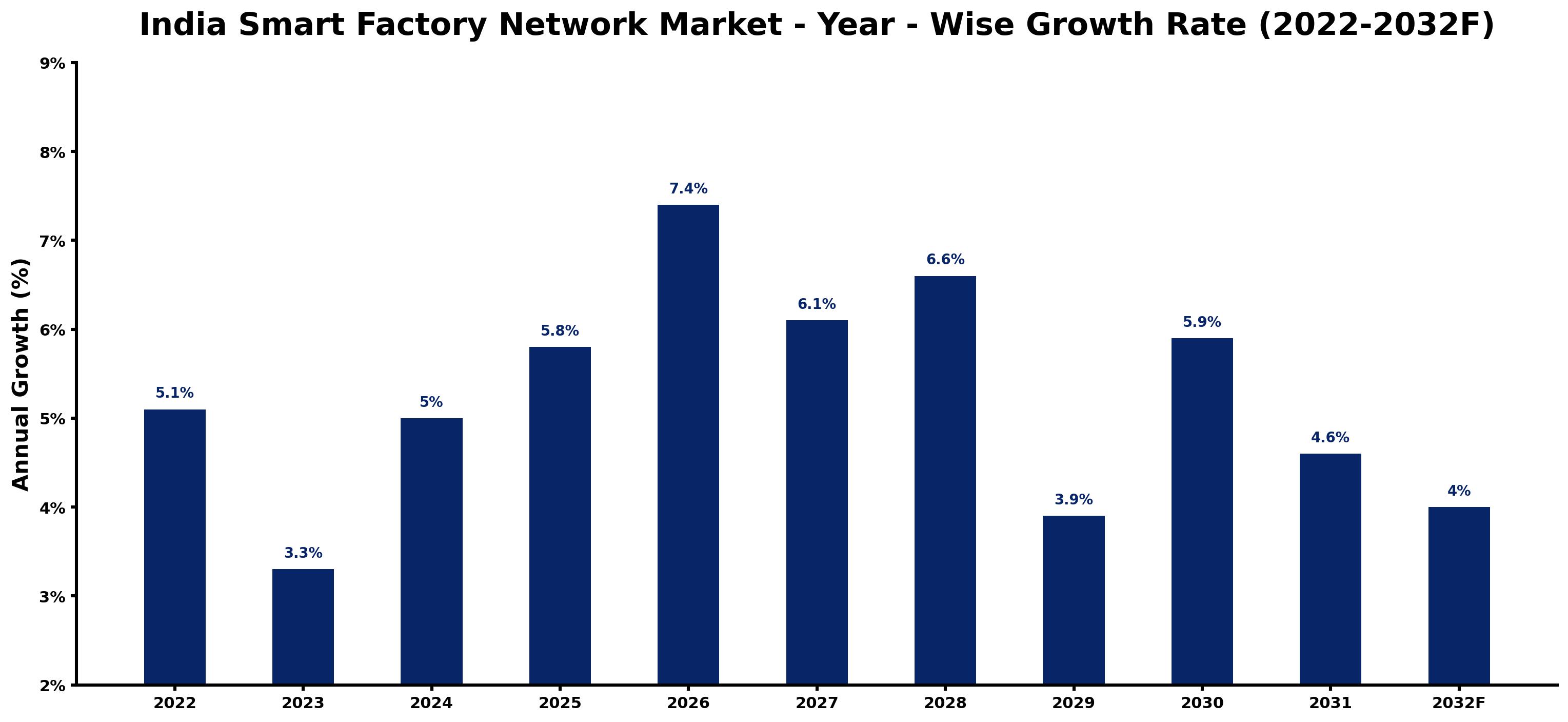
The following table presents the estimated annual growth rate for each year together with the principal factor influencing market performance.
| Year | Estimated Annual Growth (%) | Market Rationale |
| 2022 | 5.1 | The market experienced steady growth, driven by increasing investments in smart manufacturing technologies under the 'Make in India' initiative. |
| 2023 | 3.3 | Growth slowed as manufacturers adjusted to new technologies and the impact of the 'Digital India' initiative on operations. |
| 2024 | 5.0 | Demand rose as more factories adopted Industry 4.0 technologies for efficiency improvements, supported by government programs. |
| 2025 | 5.8 | Growth accelerated due to the successful implementation of smart factory networks and government support for smart manufacturing. |
| 2026 | 7.4 | The peak growth year saw substantial investments in 5G and IoT technologies, boosting adoption across manufacturing hubs. |
| 2027 | 6.1 | Growth slowed as the market began to stabilise after rapid expansion and increased competition in smart technologies. |
| 2028 | 6.6 | Demand increased as more manufacturing hubs adopted smart technologies under the 'Make in India' initiative, enhancing productivity. |
| 2029 | 3.9 | Growth slowed due to market maturity and the challenges of integrating new technologies into existing systems. |
| 2030 | 5.9 | Demand rose again as factories upgraded their existing smart systems to improve efficiency and meet evolving standards. |
| 2031 | 4.6 | Growth slowed as the market adjusted to technological advancements and evolving standards in smart manufacturing. |
| 2032 | 4.0 | The market continues to grow, driven by ongoing investments in smart manufacturing technologies and government initiatives. |
Note: Market size estimations and growth projections presented in this report are based on 6Wresearch's proprietary forecasting methodology, utilizing the latest available industry data, government publications, and primary research inputs.
India Smart Factory Network Market Synopsis
The Smart Factory Network in India integrates advanced communication networks, IoT devices, and data analytics to optimise manufacturing processes. This framework is deployed through various network types, such as 5G and Wi-Fi 6, enabling real-time monitoring and automation. The India Smart Factory Network Market is expanding due to rising investments in smart manufacturing technologies and government initiatives like 'Make in India'. With over 1,000 smart factories operational as of 2023, the market is projected to improve operational efficiency by 30% by 2025.
Market Dynamics Impact Analysis (2026–2032)
| Factor | Type | Impact | Primary Segment Affected |
| Increasing investments in Industry 4.0 technologies | Driver | High | 5G Private Network |
| Growing demand for real-time data processing | Driver | High | Edge Computing Mesh |
| Rising adoption of smart manufacturing technologies | Opportunity | High | Smart Factory Operators |
| Expansion of manufacturing hubs in India | Opportunity | High | Manufacturing Hubs |
| High costs associated with implementing new technologies | Restraint | High | Wi-Fi 6 Enterprise LAN |
| Limited awareness of smart factory benefits among smaller manufacturers | Restraint | Medium | LPWAN Industrial Mesh |
| Challenges in integrating legacy systems with new technologies | Challenge | High | Connected Equipment |
| Regulatory hurdles in technology adoption and compliance | Challenge | Medium | Industrial IoT |
Evaluation of Drivers in India Smart Factory Network Market (2026–2032)
The factors lifting demand, and the evidence behind each, are summarised below.
| Drivers | Primary Segment Affected | Why It Matters (Evidence) |
| Increased funding for smart manufacturing initiatives | 5G Private Network | The government aims to improve operational efficiency by 30% by 2025, boosting investments in 5G networks. |
| Growing need for automation in production processes | Edge Computing Mesh | With over 1,000 smart factories operational, demand for edge computing solutions is rising to meet efficiency needs. |
| Support from government initiatives like 'Make in India' | Smart Factory Operators | This initiative encourages local production and foreign investments, driving demand for smart technologies in factories. |
| Rising adoption of IoT devices in manufacturing | Industrial IoT | The average factory in India has 50 connected devices, increasing the need for smart factory networks to manage them. |
| Focus on improving productivity and competitiveness | Manufacturing Hubs | The National Industrial Policy 2020 promotes smart factories to enhance performance in the manufacturing sector. |
Market growth for Smart Factory Network in India is driven by increased funding for smart manufacturing initiatives, which aims to improve operational efficiency by 30% by 2025. Government support through the 'Make in India' initiative encourages local production and foreign investments, creating demand for smart technologies. With over 1,000 smart factories operational, the need for edge computing solutions is growing as manufacturers seek to automate production processes. The average factory in India has 50 connected devices, which boosts the demand for smart factory networks. The National Industrial Policy 2020 promotes smart factories, improving productivity and competitiveness in the manufacturing sector.
Evaluation of Restraints in India Smart Factory Network Market
The table below lists the restraints and the evidence behind each.
| Market Restraint | Primary Segment Affected | Why It Matters (Evidence) |
| High costs associated with technology implementation | Wi-Fi 6 Enterprise LAN | The initial investment for smart factory technologies can be prohibitive for smaller manufacturers, limiting adoption. |
| Limited awareness of smart factory benefits | LPWAN Industrial Mesh | Many smaller manufacturers are unaware of the advantages of adopting smart technologies, hindering growth. |
| Integration challenges with legacy systems | Connected Equipment | Existing systems may not easily integrate with new smart technologies, delaying upgrades and increasing costs. |
| Regulatory hurdles in technology adoption | Industrial IoT | Compliance with standards can slow down the implementation of IoT solutions, affecting manufacturers' competitiveness. |
| Dependence on skilled workforce for technology operation | Edge Computing Mesh | A shortage of trained personnel can hinder the effective use of advanced technologies, impacting productivity. |
India Smart Factory Network Market Challenges
India's Smart Factory Network market faces challenges with outdated technology, as many factories still rely on legacy systems that lack integration capabilities, causing delays in operational upgrades and costing manufacturers up to 20% in inefficiencies. Supply chain disruptions present another challenge; for example, reliance on imported components can lead to delays of over three months for critical parts, impacting production schedules for manufacturers. A skills gap exists, with only 30% of the workforce trained in advanced manufacturing technologies, limiting the implementation of modern solutions. Competition intensifies as new entrants adopt agile strategies, forcing established players to invest heavily in innovation to maintain market share.
Trends in the India Smart Factory Network Market
Several trends are reshaping the India Smart Factory Network Market; the most important are set out below.
- Shift from Traditional to Smart Manufacturing: Smart Factory Operators are increasingly adopting advanced technologies to improve efficiency. In 2023, the government launched a program to support smart manufacturing, aiming for a 30% increase in operational smart factories by 2025.
- Transition to 5G Networks: In 2023, the adoption of 5G Private Networks began to rise among manufacturing hubs. This shift improves real-time data transmission capabilities, with the government targeting a 30% operational efficiency increase by 2025.
- Emergence of Edge Computing Solutions: The demand for Edge Computing Mesh has surged as manufacturers seek to reduce latency in operations. By 2026, this segment is expected to grow at a CAGR of 8.2%, driven by the need for real-time local analysis.
- Prioritisation of IoT Integration: Manufacturing Hubs are increasingly integrating Industrial IoT technologies into their operations. The industrial IoT market is expected to grow at a CAGR of 25% from 2023 to 2028, reflecting the rising importance of connectivity.
Investment Opportunities in the India Smart Factory Network Market
Investors looking at the India Smart Factory Network Market should consider the following areas.
- Manufacturing Hubs seeking smart solutions: Manufacturing Hubs in India are looking to invest in smart factory technologies to improve productivity. With the government targeting a 30% efficiency boost by 2025, there is a significant opportunity for suppliers to meet this demand.
- Supply of Edge Computing technologies: Edge Computing Mesh is in high demand as manufacturers aim to improve operational efficiency. The government's support for smart manufacturing initiatives provides a pathway for local partnerships to supply these technologies.
- Investment in IoT devices for factories: Smart Factory Operators are increasingly adopting IoT devices to improve connectivity. With over 1,000 smart factories operational, suppliers can enter the market through local collaborations to meet this demand.
- Entry into the smart manufacturing sector: Approval pathways for smart factory technologies are opening up, providing opportunities for new entrants. The 'Make in India' initiative encourages local partnerships to boost production in this sector.
Government Initiatives in the India Smart Factory Network Market
In 2021, the Ministry of Electronics and Information Technology launched the 'Digital India 2.0' initiative, which aims to promote smart manufacturing technologies with a budget of ₹10,000 crores. This initiative builds on previous efforts to improve the manufacturing sector's competitiveness and productivity through technology adoption.
The 'Skill India' program has been updated to include training for smart factory technologies, aiming to train 1 million workers by 2025. The Department for Promotion of Industry and Internal Trade oversees this initiative, which supports the workforce needed for the growing smart manufacturing sector.
Future Insight of the India Smart Factory Network Market
Several forward-looking factors should support the Smart Factory Network market in India over the coming years. The government's 'Make in India' initiative will drive the adoption of Industry 4.0 technologies, while the 'Production Linked Incentive' scheme is expected to attract substantial investments in smart manufacturing. By 2025, operational efficiency is projected to improve by 30% through better integration of IoT devices. The National Policy on Electronics aims to establish India as a global hub for electronics manufacturing, further increasing demand for advanced factory solutions.
Market Segmentation Analysis
Each segment group is reviewed below, with the leader by share and the fastest grower by CAGR.
By Network Type – 5G Private Network Dominated, Edge Computing Mesh Expected to Grow Fastest
According to Dhaval Chaurasia, Assistant Manager at 6Wresearch, in 2025, 5G Private Network led the network type split with a 39% share. The 5G Private Network holds the largest share due to its vital role in enabling real-time data transmission, essential for the effective functioning of smart factories. With over 1,000 operational smart factories in India, the demand for high-speed connectivity continues to grow. Over 2026–2032, Edge Computing Mesh is expected to post the fastest growth, at a CAGR of 8.2%. Edge Computing Mesh is experiencing rapid growth as it allows for local data processing, which significantly reduces latency in operations. This capability is crucial as manufacturers strive to enhance productivity through immediate data analysis. Suppliers should focus on developing 5G Private Networks to meet the increasing demand from smart factory operators.
By Key Features – Ultra-Reliable Low Latency Dominated, Real-Time Local Analysis Expected to Grow Fastest
Ultra-Reliable Low Latency took a 42% share of key features in 2025, more than any other category. Ultra-Reliable Low Latency is the leading feature, essential for applications requiring immediate response times, making it critical for smart manufacturing processes. As factories strive for improved operational efficiency, this feature becomes a key focus for technology adoption. Real-Time Local Analysis is projected to grow fastest, at a CAGR of 6.8% during 2026–2032. Real-Time Local Analysis is growing quickly as it supports immediate decision-making, vital for maintaining a competitive edge in manufacturing. The increasing necessity for swift data-driven decisions is propelling this feature to prominence. Buyers should seek solutions that provide Ultra-Reliable Low Latency to ensure their smart factories achieve optimal operational efficiency.
By Supported Tech – Industrial IoT Dominated and Is Expected to Record the Fastest Growth
Industrial IoT accounted for a 37% market share by supported tech in 2025. Industrial IoT dominates the market as it serves as the core technology connecting devices within smart factories, facilitating seamless communication and data exchange. Its widespread adoption underscores its importance in the smart manufacturing ecosystem. Industrial IoT is also forecast to expand faster than any other category, at a CAGR of 6.9% over 2026–2032. Industrial IoT is also the fastest-growing segment, driven by rising investments in smart technologies and the need for improved connectivity in manufacturing. This growth will further solidify its market position as the backbone of smart factories. Suppliers must prioritise Industrial IoT solutions to cater to the growing needs of manufacturers aiming to modernise their operations.
By End User – Smart Factory Operators Dominated, Manufacturing Hubs Expected to Grow Fastest
Smart Factory Operators held a 43% share of the India Smart Factory Network Market by end user in 2025. Smart Factory Operators command the largest share as they are the primary users of smart factory technologies, benefiting directly from enhanced operational efficiencies. Their pivotal role in implementing smart solutions drives considerable market demand. Manufacturing Hubs are set to record the highest CAGR in this split, 6.5% over 2026–2032. Manufacturing Hubs represent the fastest-growing segment, leveraging smart factory networks to improve operational efficiency and productivity. As these hubs expand, their reliance on smart technologies will continue to increase, further driving growth. Suppliers should tailor their offerings to meet the specific needs of Smart Factory Operators while also targeting Manufacturing Hubs for future growth opportunities.
Key Attractiveness of the Report
- 10 Years of Market Numbers
- Historical Data Starting from 2022 to 2025
- Base Year 2025
- Forecast Data until 2032
- Key Performance Indicators Impacting the Market
- Major Upcoming Developments and Projects
Key Highlights of the Report:
- India Smart Factory Network Market Outlook
- Market Size of India Smart Factory Network Market, 2025
- Forecast of India Smart Factory Network Market, 2032
- Historical Data and Forecast of India Smart Factory Network Revenues & Volume for the Period 2022 - 2032F
- India Smart Factory Network Market Trend Evolution
- India Smart Factory Network Market Drivers and Challenges
- India Smart Factory Network Price Trends
- India Smart Factory Network Porter's Five Forces
- India Smart Factory Network Industry Life Cycle
- Historical Data and Forecast of India Smart Factory Network Market Revenues & Volume By Network Type for the Period 2022 - 2032F
- Historical Data and Forecast of India Smart Factory Network Market Revenues & Volume By 5G Private Network for the Period 2022 - 2032F
- Historical Data and Forecast of India Smart Factory Network Market Revenues & Volume By Wi-Fi 6 Enterprise LAN for the Period 2022 - 2032F
- Historical Data and Forecast of India Smart Factory Network Market Revenues & Volume By Edge Computing Mesh for the Period 2022 - 2032F
- Historical Data and Forecast of India Smart Factory Network Market Revenues & Volume By LPWAN Industrial Mesh for the Period 2022 - 2032F
- Historical Data and Forecast of India Smart Factory Network Market Revenues & Volume By Key Features for the Period 2022 - 2032F
- Historical Data and Forecast of India Smart Factory Network Market Revenues & Volume By Ultra-Reliable Low Latency for the Period 2022 - 2032F
- Historical Data and Forecast of India Smart Factory Network Market Revenues & Volume By High-Speed Local Coverage for the Period 2022 - 2032F
- Historical Data and Forecast of India Smart Factory Network Market Revenues & Volume By Real-Time Local Analysis for the Period 2022 - 2032F
- Historical Data and Forecast of India Smart Factory Network Market Revenues & Volume By Low Power Sensors Support for the Period 2022 - 2032F
- Historical Data and Forecast of India Smart Factory Network Market Revenues & Volume By Supported Tech for the Period 2022 - 2032F
- Historical Data and Forecast of India Smart Factory Network Market Revenues & Volume By Industrial IoT for the Period 2022 - 2032F
- Historical Data and Forecast of India Smart Factory Network Market Revenues & Volume By Connected Equipment for the Period 2022 - 2032F
- Historical Data and Forecast of India Smart Factory Network Market Revenues & Volume By Robotics, AI for the Period 2022 - 2032F
- Historical Data and Forecast of India Smart Factory Network Market Revenues & Volume By Asset Tracking for the Period 2022 - 2032F
- Historical Data and Forecast of India Smart Factory Network Market Revenues & Volume By End User for the Period 2022 - 2032F
- Historical Data and Forecast of India Smart Factory Network Market Revenues & Volume By Smart Factory Operators for the Period 2022 - 2032F
- Historical Data and Forecast of India Smart Factory Network Market Revenues & Volume By Manufacturing Hubs for the Period 2022 - 2032F
- Historical Data and Forecast of India Smart Factory Network Market Revenues & Volume By Factory Automation Experts for the Period 2022 - 2032F
- Historical Data and Forecast of India Smart Factory Network Market Revenues & Volume By Logistics & Inventory Heads for the Period 2022 - 2032F
- India Smart Factory Network Import Export Trade Statistics
- Market Opportunity Assessment By Network Type
- Market Opportunity Assessment By Key Features
- Market Opportunity Assessment By Supported Tech
- Market Opportunity Assessment By End User
- India Smart Factory Network Top Companies Market Share
- India Smart Factory Network Competitive Benchmarking By Technical and Operational Parameters
- India Smart Factory Network Company Profiles
- India Smart Factory Network Key Strategic Recommendations
Market Covered
Segments analysed in this report are listed below.
By Network Type
- 5G Private Network
- Wi-Fi 6 Enterprise LAN
- Edge Computing Mesh
- LPWAN Industrial Mesh
By Key Features
- Ultra-Reliable Low Latency
- High-Speed Local Coverage
- Real-Time Local Analysis
- Low Power Sensors Support
By Supported Tech
- Industrial IoT
- Connected Equipment
- Robotics
- AI
- Asset Tracking
By End User
- Smart Factory Operators
- Manufacturing Hubs
- Factory Automation Experts
- Logistics & Inventory Heads































