China Smart Factory Network Market Size & Growth Rate
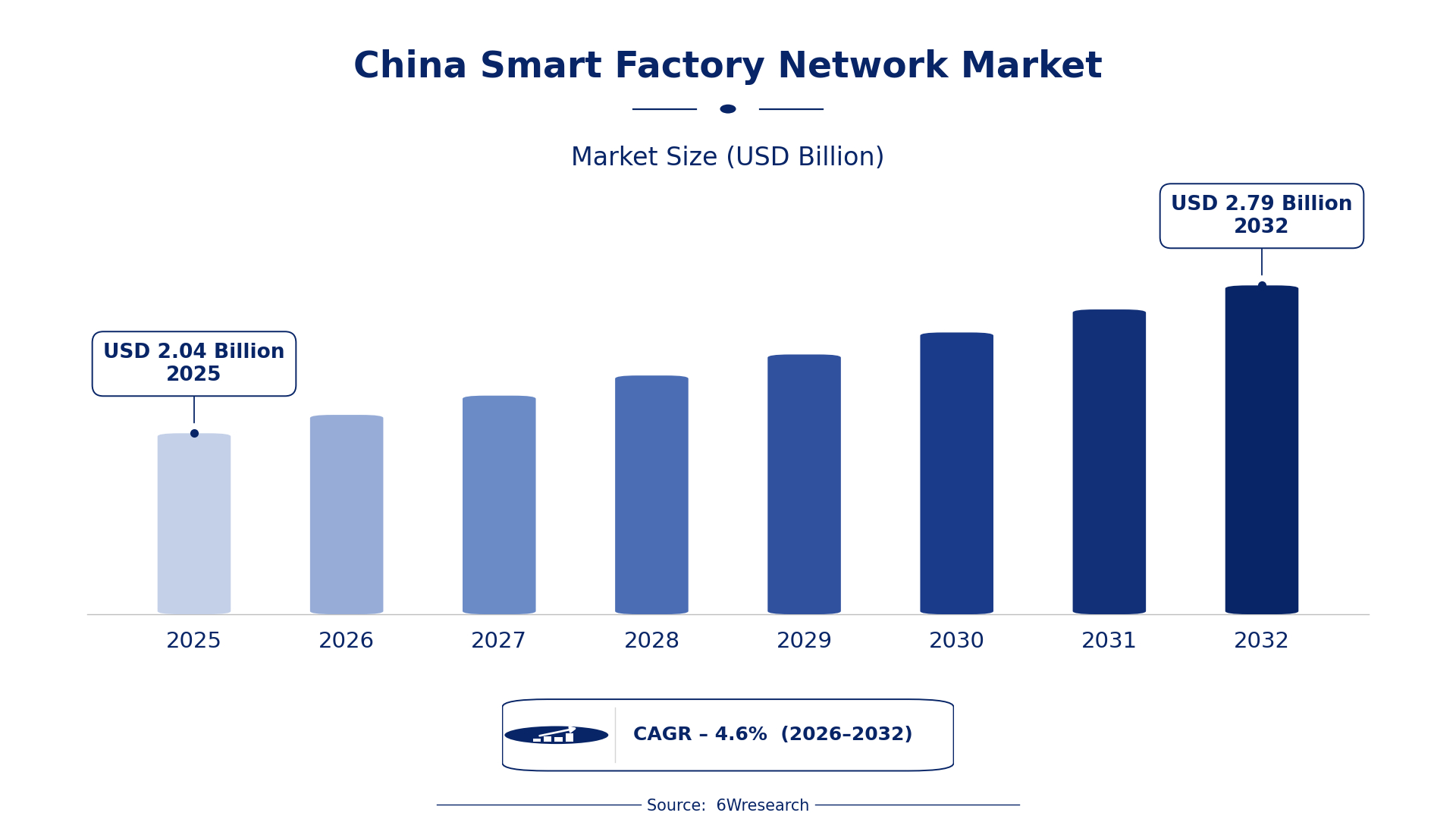
According to 6Wresearch internal database and industry insights, the China Smart Factory Network Market was valued at USD 2.04 billion in 2025 and is projected to reach USD 2.79 billion by 2032, growing at a CAGR of approximately 4.6% during 2026–2032.
China Smart Factory Network Market Highlights
| Report Metric | Details |
| Report Name | China Smart Factory Network Market |
| Market Size 2025 | USD 2.04 billion |
| Market Size 2032 | USD 2.79 billion |
| Absolute Growth 2025–2032 | USD 0.75 billion |
| CAGR 2026–2032 | 4.6% |
| Peak Annual Growth | 6.9% in 2029 |
| Forecast Period | 2026–2032 |
| Historical Data | 2022–2025 |
| Base Year | 2025 |
| Leading Network Type, 2025 | 5G Private Network (44% share) |
| Leading Key Features, 2025 | Ultra-Reliable Low Latency (43% share) |
| Leading Supported Tech, 2025 | Industrial IoT (41% share) |
| Leading End User, 2025 | Smart Factory Operators (48% share) |
| Fastest-Growing Network Type | Edge Computing Mesh (7.3% CAGR) |
| Fastest-Growing Key Features | Real-Time Local Analysis (7.2% CAGR) |
| Fastest-Growing Supported Tech | AI (7.0% CAGR) |
| Fastest-Growing End User | Manufacturing Hubs (5.9% CAGR) |
| Growing Sector | Manufacturing Hubs |
| Key End Users | Smart Factory Operators, Manufacturing Hubs, Factory Automation Experts, Logistics & Inventory Heads |
China Smart Factory Network Market Year-wise Growth Rate and Key Drivers (2022–2032)
This graph illustrates the annual growth rates of the market from 2022 to 2032, highlighting a steady upward trajectory and projected market expansion over the forecast period.
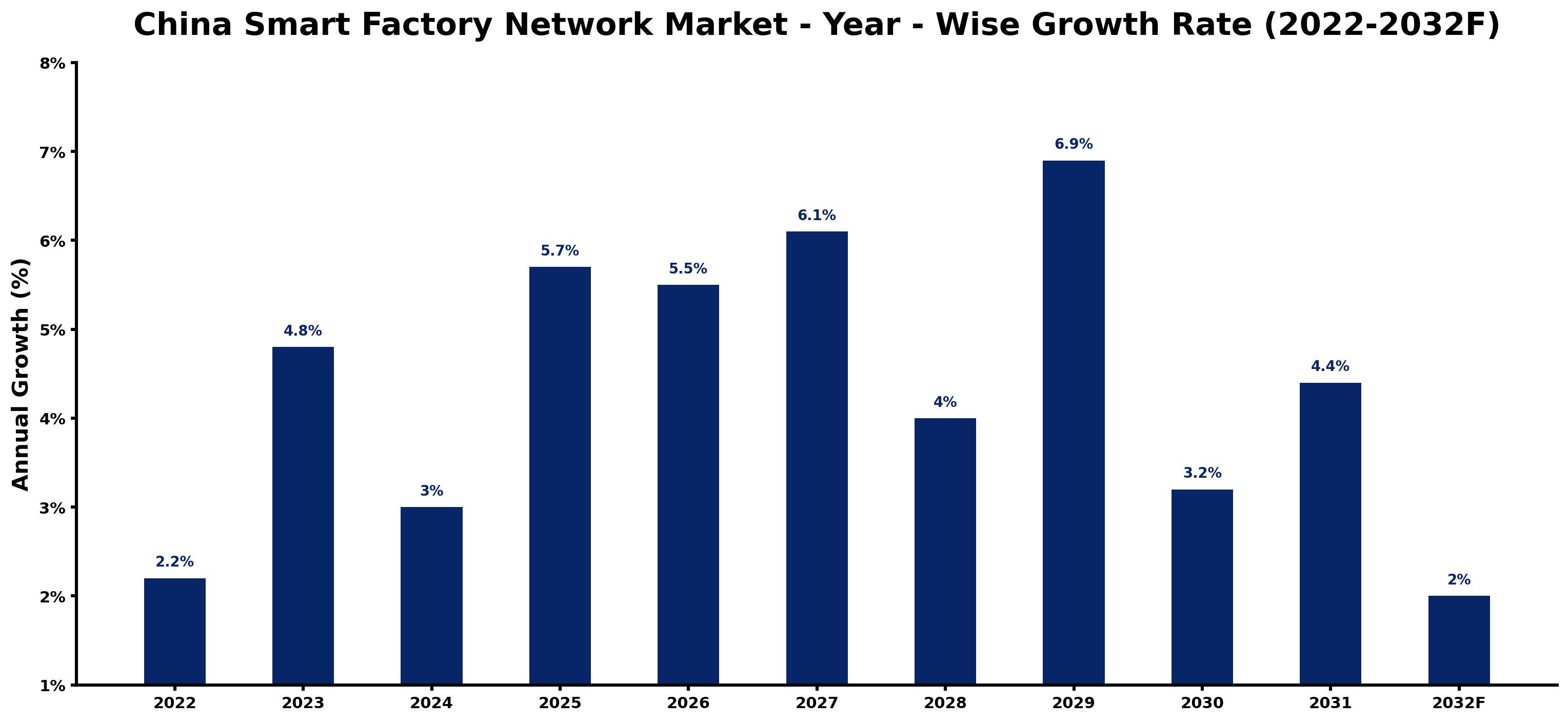
Year by year, the estimates below pair each growth rate with the development that shaped it.
| Year | Estimated Annual Growth (%) | Market Rationale |
| 2022 | 2.2 | The market showed steady growth as manufacturers began adopting automation technologies. |
| 2023 | 4.8 | Increased investment in smart manufacturing initiatives spurred faster growth than the previous year. |
| 2024 | 3.0 | Growth slowed slightly as companies adjusted to new technologies and processes. |
| 2025 | 5.7 | A surge in smart factory implementations drove growth faster than in 2024. |
| 2026 | 5.5 | The market is projected to continue growing as companies invest in automation technologies. |
| 2027 | 6.1 | Demand will rise as more manufacturers integrate advanced technologies into their operations. |
| 2028 | 4.0 | Growth is expected to slow as the market matures and competition intensifies. |
| 2029 | 6.9 | The market is projected to peak with substantial investments in automation and smart technologies. |
| 2030 | 3.2 | A slight slowdown is anticipated as companies focus on optimising existing systems. |
| 2031 | 4.4 | Growth is expected to pick up again as new technologies enter the market and demand increases. |
| 2032 | 2.0 | The market is projected to grow at a slower pace as it stabilises. |
Note: Market size estimations and growth projections presented in this report are based on 6Wresearch's proprietary forecasting methodology, utilizing the latest available industry data, government publications, and primary research inputs.
China Smart Factory Network Market Synopsis
Smart Factory Network in China integrates advanced technologies like IoT, AI, and robotics to improve manufacturing efficiency. These networks streamline operations and enable real-time monitoring in manufacturing facilities. The China Smart Factory Network Market is projected to reach 1.5 trillion yuan by 2025, driven by substantial investments in smart manufacturing initiatives and the Digital Economy Development Plan. Key buyers include smart factory operators and manufacturing hubs, who are increasingly adopting these technologies for improved productivity and operational efficiency.
Market Dynamics Impact Analysis (2026–2032)
| Factor | Type | Impact | Primary Segment Affected |
| Rising investments in smart manufacturing technologies | Driver | High | 5G Private Network |
| Growing demand for real-time data processing | Driver | High | Ultra-Reliable Low Latency |
| Expansion of smart factory implementations in key regions | Opportunity | High | Manufacturing Hubs |
| Increasing need for automation solutions among manufacturers | Opportunity | High | Smart Factory Operators |
| High initial costs of implementing smart factory technologies | Restraint | High | Edge Computing Mesh |
| Limited availability of skilled workforce for advanced technologies | Restraint | Medium | Robotics |
| Integration challenges with existing systems | Challenge | High | Connected Equipment |
| Rapid technological advancements outpacing market readiness | Challenge | Medium | AI |
Evaluation of Drivers in China Smart Factory Network Market (2026–2032)
The table below links each growth driver to the segment it affects and the evidence for it.
| Drivers | Primary Segment Affected | Why It Matters (Evidence) |
| Increased government funding for smart manufacturing initiatives | 5G Private Network | The government allocated 500 million yuan for smart factory initiatives in Jiangsu province, encouraging adoption. |
| Growing adoption of IoT devices in factories | Industrial IoT | The number of IoT devices is expected to exceed 1 billion by 2025, improving connectivity and operational efficiency. |
| Rising demand for automation in manufacturing processes | Robotics | The 'Made in China 2025' initiative drives investments in automation technologies, enhancing production capabilities. |
| Expansion of 5G networks in industrial parks | Ultra-Reliable Low Latency | The State Council's 'New Infrastructure Plan' aims to cover 80% of industrial parks by 2025, facilitating faster data transmission. |
| Increased focus on data analytics for operational efficiency | Real-Time Local Analysis | The updated National Standard for Smart Manufacturing Systems promotes advanced data analytics, improving decision-making. |
Market growth in China for Smart Factory Network rests on rising investments in smart manufacturing technologies, increasing demand for real-time data processing, and expanding IoT device adoption. The number of IoT devices in factories is projected to exceed 1 billion by 2025, improving connectivity and operational efficiency. Expansion of 5G networks in industrial parks will facilitate faster data transmission, improving operational capabilities. Additionally, the updated National Standard for Smart Manufacturing Systems is promoting advanced data analytics, further driving demand.
Evaluation of Restraints in China Smart Factory Network Market
The key brakes on demand, and where they bite hardest, are shown below.
| Market Restraint | Primary Segment Affected | Why It Matters (Evidence) |
| A leading supplier on imported components | Smart Factory Operators | This reliance can delay production timelines for manufacturers by up to three months. |
| High initial investment costs | Smart Factory Operators | The initial investment in smart technologies can reach up to 1 million yuan per factory. |
| Skills gap in workforce | Smart Factory Operators | Many workers lack the necessary training to operate advanced systems, raising operational costs by 15%. |
| Intense market competition | Smart Factory Operators | Local firms struggle to differentiate themselves, leading to price wars that can cut margins by 20%. |
| Supply chain disruptions | Manufacturing Hubs | Disruptions from reliance on imports can hinder timely production and delivery. |
China Smart Factory Network Market Challenges
China's smart factory network market still has to solve a few problems, and the first is supply chain disruptions. These disruptions arise from reliance on imported components, which can delay production timelines for manufacturers by up to three months. Competition presents another challenge, as local firms struggle to differentiate themselves in a crowded market, leading to price wars that can cut margins for producers by 20%. Buyers face high costs due to the initial investment in smart technologies, which can reach up to 1 million yuan per factory. Technology adoption suffers from a skills gap, as many workers lack the necessary training to operate advanced systems, raising operational costs by 15%.
Trends in the China Smart Factory Network Market
Four trends stand out in the China Smart Factory Network Market.
- Shift Towards 5G Integration in Manufacturing: Jiangsu province is increasingly adopting 5G technology in smart factories, improving operational efficiency. By 2025, 80% of industrial parks are expected to be covered by 5G networks, facilitating real-time data transmission.
- Rise of AI in Smart Manufacturing: The 'AI in Manufacturing Program' initiated in 2023 supports the integration of AI technologies in factories. This program aims for 1,000 pilot projects by 2025, driving demand for automation and efficiency.
- Increased Focus on Data Analytics: Manufacturing hubs are prioritising data analytics for operational efficiency, supported by the updated National Standard for Smart Manufacturing Systems. This trend is expected to improve decision-making processes across the sector.
- Emergence of Edge Computing: Edge Computing Mesh is gaining traction as manufacturers seek faster decision-making capabilities. This trend is expected to grow at a CAGR of 7.3% from 2026 to 2032.
Investment Opportunities in the China Smart Factory Network Market
Some of the investment opportunities in the China Smart Factory Network Market are mentioned below.
- Growing Demand for Smart Factory Solutions: With China's smart factory market projected to reach 1.5 trillion yuan by 2025, there is an opportunity for suppliers to provide advanced technologies. Smart factory operators are increasingly seeking solutions to improve productivity and efficiency.
- Investment in AI Technologies: The ongoing 'AI in Manufacturing Program' presents an opportunity for technology providers to supply AI solutions. The program aims for 1,000 pilot projects by 2025, indicating strong demand for advanced technologies.
- Expansion of 5G Infrastructure: The State Council's 'New Infrastructure Plan' aims to cover 80% of industrial parks with 5G networks by 2025. This creates opportunities for companies supplying 5G technology and infrastructure solutions.
- Focus on Data Analytics Solutions: As manufacturers increasingly adopt data analytics for operational efficiency, there is an opportunity for suppliers to provide advanced analytics solutions. The updated National Standard for Smart Manufacturing Systems supports this trend.
Government Initiatives in the China Smart Factory Network Market
The 'Smart Manufacturing Development Plan' launched by the Ministry of Industry and Information Technology in 2021 aims to promote digital transformation in manufacturing. This plan targets a 20% increase in smart factory adoption by 2025, encouraging investments in automation technologies. Additionally, the 'Digital Economy Development Strategy' approved in 2022 focuses on enhancing smart manufacturing capabilities with a budget of 1 billion yuan, further supporting industry growth and innovation.
The Ministry of Science and Technology initiated the 'AI in Manufacturing Program' in 2023 to support the integration of AI technologies in smart factories. This program aims to implement 1,000 pilot projects by 2025, providing funding for technology adoption. Furthermore, the National Development and Reform Commission oversees various initiatives to enhance smart manufacturing, ensuring that manufacturers receive the necessary support for digital transformation and growth.
Future Insight of the China Smart Factory Network Market
The smart factory network market in China is poised for substantial change by 2032, driven by several key factors. The 'Smart Manufacturing Development Plan' will continue to promote automation across industries, improving productivity. By 2025, the number of IoT devices in factories is expected to exceed 1 billion, enabling better data analytics and real-time monitoring. The ongoing 'Made in China 2025' initiative will stimulate investments in advanced manufacturing technologies, ensuring that suppliers and buyers benefit from improved efficiency and reduced operational costs.
Market Segmentation Analysis
The report offers a comprehensive study of the following market segments and their leading categories in the market.
By Network Type – 5G Private Network Dominated, Edge Computing Mesh Expected to Grow Fastest
According to Dhaval Chaurasia, Assistant Manager at 6Wresearch, 5G Private Network accounted for a 44% market share by network type in 2025. The 5G Private Network holds the largest market share due to its critical role in enabling real-time data transmission essential for smart factory operations. This is particularly important in the automotive sector, where seamless communication is vital for maintaining production efficiency. The quickest growth will come from Edge Computing Mesh, forecast to expand at a CAGR of 7.3% between 2026 and 2032. The Edge Computing Mesh is experiencing rapid growth as it allows for data processing near the source, leading to quicker decision-making. With the anticipated increase of IoT devices in factories to over 1 billion by 2025, this capability will become increasingly necessary. Suppliers should focus on enhancing their 5G solutions, while buyers must invest in edge computing technologies to stay competitive.
By Key Features – Ultra-Reliable Low Latency Dominated, Real-Time Local Analysis Expected to Grow Fastest
With a 43% revenue share in 2025, Ultra-Reliable Low Latency was the largest key features category. Ultra-Reliable Low Latency is the leading feature because it is essential for applications that require immediate response times in manufacturing environments. This feature is particularly crucial in sectors like automotive production, where precision and speed are paramount. Over 2026–2032, Real-Time Local Analysis is expected to post the fastest growth, at a CAGR of 7.2%. Real-Time Local Analysis is rapidly gaining traction as it provides immediate insights for operational adjustments, which are vital for maintaining efficiency in smart factories. As manufacturers seek to enhance agility, this feature is becoming increasingly important. Buyers should prioritise features that improve responsiveness, while suppliers can benefit from the growing demand for real-time analytics capabilities.
By Supported Tech – Industrial IoT Dominated, AI Expected to Grow Fastest
Industrial IoT took a 41% share of supported tech in 2025, more than any other category. Industrial IoT dominates the market as it serves as the foundational technology for connecting devices in smart factories, facilitating seamless communication and data exchange. Its widespread adoption is evident with over 10,000 smart factories established across China. AI is projected to grow fastest, at a CAGR of 7.0% during 2026–2032. AI is quickly becoming a key player as it is crucial for predictive analytics and process optimisation, both of which are essential for improving manufacturing efficiency. The push for AI integration is expected to accelerate as factories strive to enhance their operational capabilities. Suppliers need to concentrate on IoT solutions, while buyers should explore AI applications to optimise their manufacturing processes.
By End User – Smart Factory Operators Dominated, Manufacturing Hubs Expected to Grow Fastest
In 2025, Smart Factory Operators led the end user split with a 48% share. Smart Factory Operators represent the largest segment as they are the primary users of smart factory networks, directly benefiting from improved automation and efficiency. Their pivotal role drives the adoption of smart manufacturing technologies across various industries. Manufacturing Hubs are set to record the highest CAGR in this split, 5.9% over 2026–2032. Manufacturing Hubs are the fastest-growing segment, acting as key centres for implementing smart factory technologies that significantly influence the overall market. Their strategic importance within regional economies accelerates the expansion of smart factory initiatives. Suppliers should target smart factory operators, while buyers in manufacturing hubs must adopt advanced technologies to maintain competitiveness.
Key Attractiveness of the Report
- 10 Years of Market Numbers
- Historical Data Starting from 2022 to 2025
- Base Year 2025
- Forecast Data until 2032
- Key Performance Indicators Impacting the Market
- Major Upcoming Developments and Projects
Key Highlights of the Report:
- China Smart Factory Network Market Outlook
- Market Size of China Smart Factory Network Market, 2025
- Forecast of China Smart Factory Network Market, 2032
- Historical Data and Forecast of China Smart Factory Network Revenues & Volume for the Period 2022 - 2032F
- China Smart Factory Network Market Trend Evolution
- China Smart Factory Network Market Drivers and Challenges
- China Smart Factory Network Price Trends
- China Smart Factory Network Porter's Five Forces
- China Smart Factory Network Industry Life Cycle
- Historical Data and Forecast of China Smart Factory Network Market Revenues & Volume By Network Type for the Period 2022 - 2032F
- Historical Data and Forecast of China Smart Factory Network Market Revenues & Volume By 5G Private Network for the Period 2022 - 2032F
- Historical Data and Forecast of China Smart Factory Network Market Revenues & Volume By Wi-Fi 6 Enterprise LAN for the Period 2022 - 2032F
- Historical Data and Forecast of China Smart Factory Network Market Revenues & Volume By Edge Computing Mesh for the Period 2022 - 2032F
- Historical Data and Forecast of China Smart Factory Network Market Revenues & Volume By LPWAN Industrial Mesh for the Period 2022 - 2032F
- Historical Data and Forecast of China Smart Factory Network Market Revenues & Volume By Key Features for the Period 2022 - 2032F
- Historical Data and Forecast of China Smart Factory Network Market Revenues & Volume By Ultra-Reliable Low Latency for the Period 2022 - 2032F
- Historical Data and Forecast of China Smart Factory Network Market Revenues & Volume By High-Speed Local Coverage for the Period 2022 - 2032F
- Historical Data and Forecast of China Smart Factory Network Market Revenues & Volume By Real-Time Local Analysis for the Period 2022 - 2032F
- Historical Data and Forecast of China Smart Factory Network Market Revenues & Volume By Low Power Sensors Support for the Period 2022 - 2032F
- Historical Data and Forecast of China Smart Factory Network Market Revenues & Volume By Supported Tech for the Period 2022 - 2032F
- Historical Data and Forecast of China Smart Factory Network Market Revenues & Volume By Industrial IoT for the Period 2022 - 2032F
- Historical Data and Forecast of China Smart Factory Network Market Revenues & Volume By Connected Equipment for the Period 2022 - 2032F
- Historical Data and Forecast of China Smart Factory Network Market Revenues & Volume By Robotics, AI for the Period 2022 - 2032F
- Historical Data and Forecast of China Smart Factory Network Market Revenues & Volume By Asset Tracking for the Period 2022 - 2032F
- Historical Data and Forecast of China Smart Factory Network Market Revenues & Volume By End User for the Period 2022 - 2032F
- Historical Data and Forecast of China Smart Factory Network Market Revenues & Volume By Smart Factory Operators for the Period 2022 - 2032F
- Historical Data and Forecast of China Smart Factory Network Market Revenues & Volume By Manufacturing Hubs for the Period 2022 - 2032F
- Historical Data and Forecast of China Smart Factory Network Market Revenues & Volume By Factory Automation Experts for the Period 2022 - 2032F
- Historical Data and Forecast of China Smart Factory Network Market Revenues & Volume By Logistics & Inventory Heads for the Period 2022 - 2032F
- China Smart Factory Network Import Export Trade Statistics
- Market Opportunity Assessment By Network Type
- Market Opportunity Assessment By Key Features
- Market Opportunity Assessment By Supported Tech
- Market Opportunity Assessment By End User
- China Smart Factory Network Top Companies Market Share
- China Smart Factory Network Competitive Benchmarking By Technical and Operational Parameters
- China Smart Factory Network Company Profiles
- China Smart Factory Network Key Strategic Recommendations
Market Covered
The report offers an extensive study of the following market segments.
By Network Type
- 5G Private Network
- Wi-Fi 6 Enterprise LAN
- Edge Computing Mesh
- LPWAN Industrial Mesh
By Key Features
- Ultra-Reliable Low Latency
- High-Speed Local Coverage
- Real-Time Local Analysis
- Low Power Sensors Support
By Supported Tech
- Industrial IoT
- Connected Equipment
- Robotics
- AI
- Asset Tracking
By End User
- Smart Factory Operators
- Manufacturing Hubs
- Factory Automation Experts
- Logistics & Inventory Heads































