India Smart Factory Technology Market Size & Growth Rate
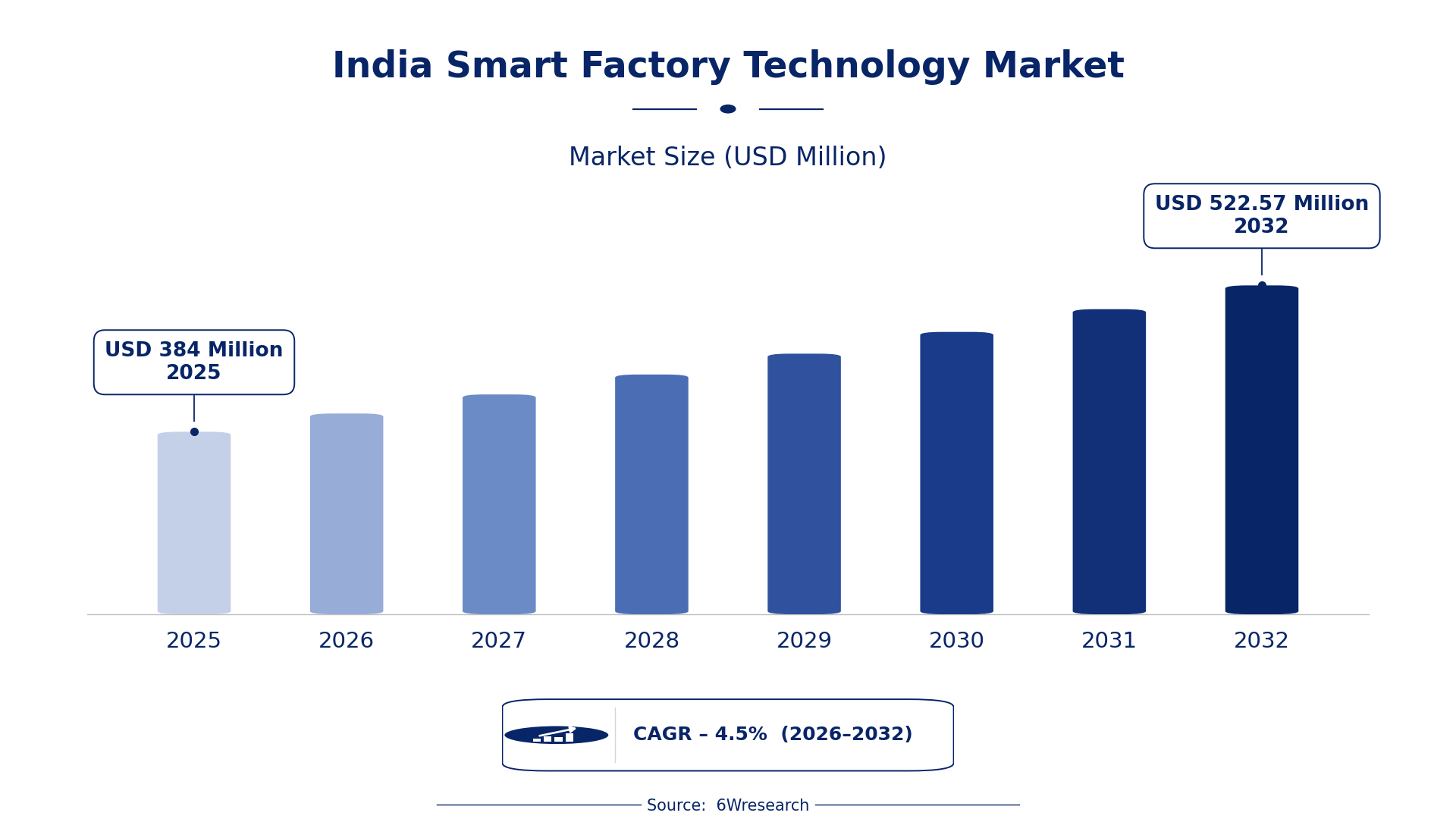
According to 6Wresearch internal database and industry insights, the India Smart Factory Technology Market was valued at USD 384.0 million in 2025 and is projected to reach USD 522.57 million by 2032, growing at a CAGR of approximately 4.5% during 2026–2032.
India Smart Factory Technology Market Highlights
| Report Metric | Details |
| Report Name | India Smart Factory Technology Market |
| Market Size 2025 | USD 384.0 million |
| Market Size 2032 | USD 522.57 million |
| Absolute Growth 2025–2032 | USD 138.57 million |
| CAGR 2026–2032 | 4.5% |
| Peak Annual Growth | 7.4% in 2032 |
| Forecast Period | 2026–2032 |
| Historical Data | 2022–2025 |
| Base Year | 2025 |
| Leading Technology Type, 2025 | Smart MES Systems (43% share) |
| Leading Functionality, 2025 | Production Optimization (40% share) |
| Leading Integration Platform, 2025 | IoT + AI (43% share) |
| Leading End User, 2025 | Manufacturing Plants (43% share) |
| Fastest-Growing Technology Type | Predictive Maintenance AI (6.0% CAGR) |
| Fastest-Growing Functionality | Equipment Health Insights (5.8% CAGR) |
| Fastest-Growing End User | Automotive OEMs (5.8% CAGR) |
| Growing Sector | Manufacturing |
| Key End Users | Manufacturing Plants, Automotive OEMs, Factory Automation Firms, Industrial Engineers |
India Smart Factory Technology Market Year-wise Growth Rate and Key Drivers (2022–2032)
This graph illustrates the annual growth rates of the market from 2022 to 2032, highlighting a steady upward trajectory and projected market expansion over the forecast period.
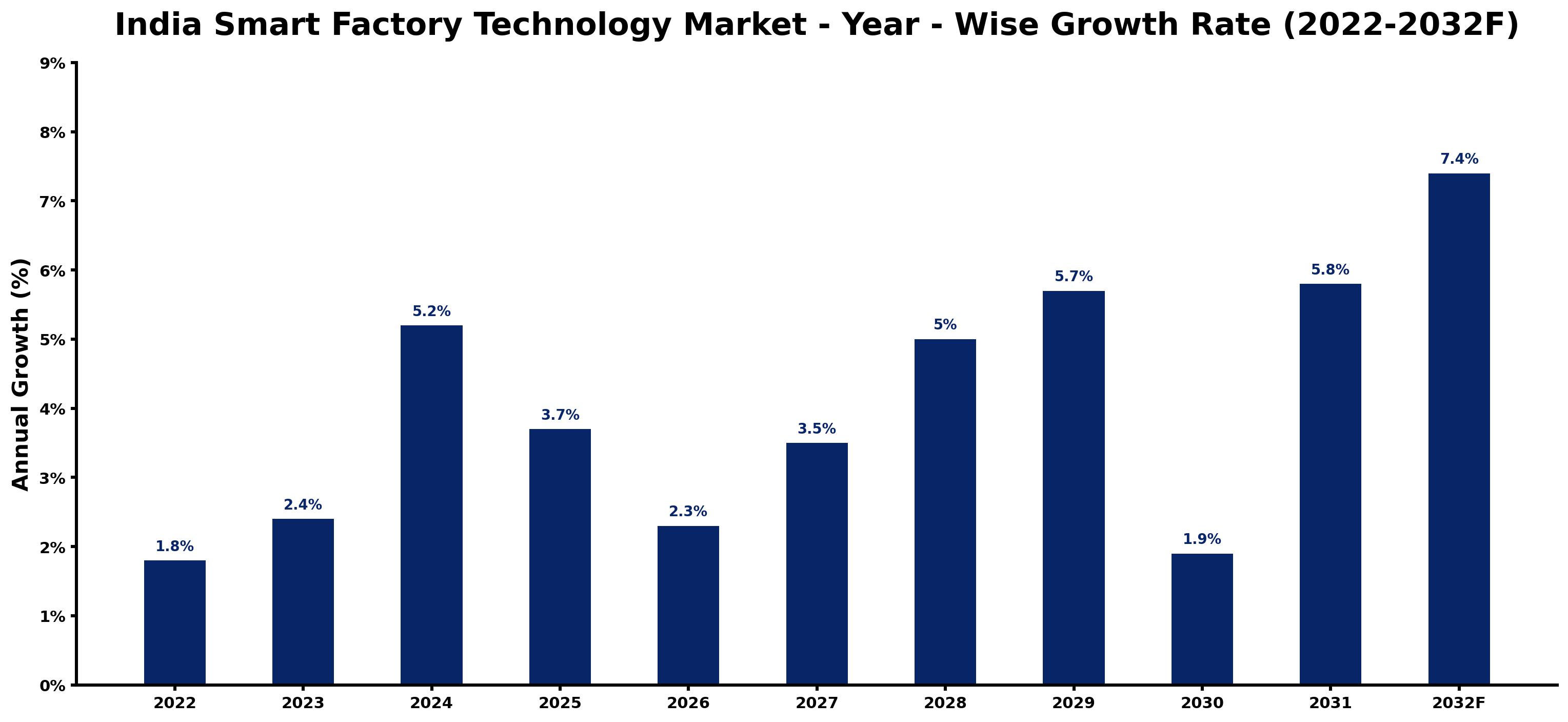
Each row of the following table gives one year's estimated growth and the event or demand shift that explains it.
| Year | Estimated Annual Growth (%) | Market Rationale |
| 2022 | 1.8 | The market experienced steady growth as manufacturers began investing in digital technologies, driven by the 'Digital India' initiative. |
| 2023 | 2.4 | Growth accelerated as more manufacturers adopted smart technologies for efficiency, particularly in manufacturing plants. |
| 2024 | 5.2 | A surge in investment led to advancements in smart factory capabilities, supported by the National Manufacturing Policy. |
| 2025 | 3.7 | Growth slowed as some manufacturers faced challenges in implementing new technologies, particularly due to integration issues. |
| 2026 | 2.3 | The market is expected to continue growing, but at a slower pace due to complexities in integrating smart technologies with existing systems. |
| 2027 | 3.5 | Increased demand for predictive maintenance technologies is expected to boost market performance, especially among automotive OEMs. |
| 2028 | 5.0 | The market is projected to see renewed growth as manufacturers focus on operational efficiency and smart technology adoption. |
| 2029 | 5.7 | A rise in automotive OEMs adopting smart technologies is expected to enhance market dynamics and drive growth. |
| 2030 | 1.9 | Growth is projected to slow again as manufacturers adjust to new standards and technologies, impacting their operational strategies. |
| 2031 | 5.8 | The market is expected to rebound with faster growth driven by enhanced automation solutions in manufacturing processes. |
| 2032 | 7.4 | The peak growth is projected to be achieved as manufacturers fully embrace smart technologies, particularly in production optimization. |
Note: Market size estimations and growth projections presented in this report are based on 6Wresearch's proprietary forecasting methodology, utilizing the latest available industry data, government publications, and primary research inputs.
India Smart Factory Technology Market Synopsis
Smart Factory Technology in India includes advanced automation and data exchange within manufacturing environments. It integrates IoT, AI, and machine learning to enhance operational efficiency through real-time monitoring and predictive maintenance. The Smart Factory Technology Market is expected to expand rapidly, driven by more than 50% of manufacturers investing in digital transformation initiatives and the government's 'Make in India' initiative that supports manufacturing capabilities. Manufacturing plants are the main buyers, aiming for efficiency gains through these technologies. This blend of demand and government backing is propelling the market forward.
Market Dynamics Impact Analysis (2026–2032)
| Factor | Type | Impact | Primary Segment Affected |
| Increased investment in digital transformation | Driver | High | Production Optimization |
| Growing adoption of IoT and AI technologies | Driver | High | IoT + AI |
| Rising demand for predictive maintenance solutions | Opportunity | High | Predictive Maintenance AI |
| Expansion of manufacturing plants adopting smart technologies | Opportunity | Medium | Manufacturing Plants |
| Integration challenges with existing systems | Restraint | High | Smart MES Systems |
| High initial investment costs for smart technologies | Restraint | Medium | Digital Twin Systems |
| The Smart Factory Technology market in India faces integration complexities | Challenge | High | Adaptive Control |
| Limited skilled workforce in smart manufacturing technologies | Challenge | Medium | Equipment Health Insights |
Evaluation of Drivers in India Smart Factory Technology Market (2026–2032)
The main growth drivers and the segments they affect most are set out below.
| Drivers | Primary Segment Affected | Why It Matters (Evidence) |
| Investment in digital transformation initiatives | Production Optimization | Over 50% of manufacturers are investing in digital technologies, improving production efficiency. |
| Adoption of IoT and AI technologies | Predictive Maintenance AI | Manufacturers are increasingly seeking solutions to reduce downtime, leading to higher adoption rates. |
| Expansion of manufacturing plants | Smart MES Systems | India has over 1,500 manufacturing plants utilizing smart technologies, boosting market growth. |
| Government initiatives supporting manufacturing | Smart PLC Controllers | The 'Make in India' initiative aims to enhance manufacturing capabilities, promoting technology adoption. |
| Focus on operational efficiency | Manufacturing Plants | The National Manufacturing Policy aims to increase the sector's GDP contribution to 25%, driving further investments in smart technologies. |
Over 50% of manufacturers are investing in digital technologies, improving production efficiency. The IoT market is projected to grow to $15 billion by 2025, stimulating smart factory implementations. Manufacturers are increasingly seeking predictive maintenance solutions to reduce downtime, which drives higher adoption rates.
Evaluation of Restraints in India Smart Factory Technology Market
The following restraints limit how fast demand can grow.
| Market Restraint | Primary Segment Affected | Why It Matters (Evidence) |
| Integration challenges with existing systems | Smart MES Systems | Many manufacturers struggle to integrate new technologies with legacy systems, hindering adoption rates and causing delays. |
| High initial investment costs for smart technologies | Digital Twin Systems | The cost of implementing smart technologies can be prohibitive for smaller manufacturers, limiting access to advanced solutions. |
| Limited skilled workforce in smart manufacturing technologies | Equipment Health Insights | A shortage of skilled workers affects the implementation and maintenance of smart technologies, delaying progress and increasing costs. |
| Regulatory compliance issues | Predictive Maintenance AI | Manufacturers face challenges in meeting regulatory standards for new technologies, complicating implementation and causing delays. |
| Resistance to change within organizations | Adaptive Control | Cultural resistance to adopting new technologies can slow down implementation efforts, affecting productivity and operational efficiency. |
India Smart Factory Technology Market Challenges
The Smart Factory Technology market in India encounters high initial investment costs, which can consume up to 30% of a producer's budget, deterring many from adopting advanced solutions. This financial burden restricts smaller manufacturers' access to necessary technologies, causing delays in achieving operational efficiency. Supply chain disruptions impact over 50% of producers, complicating the sourcing of critical components and leading to production delays of up to three months. Furthermore, the rapid pace of technological advancements creates a knowledge gap, leaving buyers struggling to adapt, which results in inefficient processes and wasted resources.
Trends in the India Smart Factory Technology Market
Buyers and suppliers in the India Smart Factory Technology Market are adjusting to the following trends.
- Shift from Traditional to Smart Manufacturing: Manufacturing plants in India are increasingly adopting smart technologies, with a projected growth rate of 5.5% for IoT + AI integration. This shift is driving operational efficiency and productivity improvements.
- Increase in Predictive Maintenance Adoption: Automotive OEMs are leading the way in adopting predictive maintenance technologies, with a projected growth rate of 6.0% from 2026 to 2032. This trend is reshaping maintenance strategies across the sector.
- Emphasis on Real-Time Data Analytics: The Digital India programme is promoting the use of real-time data analytics in manufacturing, aiming for a 5.8% growth in Equipment Health Insights. This initiative is driving further investments in smart technologies.
- Growth of IoT and AI Integration: Manufacturing plants are increasingly integrating IoT and AI technologies, with the IoT + AI segment expected to maintain a 5.5% growth rate. This integration is essential for improving automation and efficiency.
Investment Opportunities in the India Smart Factory Technology Market
Below are the investment opportunities with the strongest case in the India Smart Factory Technology Market.
- Manufacturing Plants Seeking Efficiency Gains: Manufacturing plants are investing heavily in smart technologies, with significant growth projected by 2025. Collaborating with local partners can facilitate market entry and enhance operational efficiency.
- Automotive OEMs Adopting Smart Technologies: Automotive OEMs are rapidly adopting smart factory solutions to improve production efficiency. This presents an opportunity for suppliers to provide tailored solutions that meet their needs.
- Entry into the Growing IoT Market: With the Indian IoT market projected to grow to $15 billion by 2025, there is a significant opportunity for investment in IoT solutions for smart factories. Local partnerships can ease market entry.
- Investment in Predictive Maintenance Solutions: The demand for predictive maintenance solutions is rising, with manufacturers looking to reduce downtime. Suppliers can enter this market by offering innovative technologies that address these needs.
Government Initiatives in the India Smart Factory Technology Market
The 'Make in India' initiative, launched in 2014, aims to boost manufacturing capabilities and attract foreign investment in smart technologies. This initiative has led to increased funding for smart factory projects and encouraged manufacturers to adopt advanced technologies. The National Policy on Electronics 2019 promotes the manufacturing of electronics components and smart technologies, further supporting the growth of the smart factory market. This policy aims to boost local manufacturing and reduce dependency on imports, strengthening the overall industry.
The Production Linked Incentive (PLI) scheme, launched in 2020, incentivizes manufacturers to boost production and attract investments in smart factory technologies. This scheme has resulted in substantial financial support for manufacturers adopting smart technologies. The Bureau of Indian Standards sets quality standards for manufacturing technologies, ensuring that products meet specific requirements. This regulatory framework helps buyers ensure the quality and reliability of smart factory solutions.
Future Insight of the India Smart Factory Technology Market
The Smart Factory Technology market in India will undergo considerable changes by 2032, driven by initiatives like 'Make in India' and 'Digital India' that will strengthen manufacturing capabilities and promote digital adoption. By 2025, the Indian manufacturing sector aims to contribute 25% to GDP, encouraging increased investments in smart technologies. The Automotive Mission Plan 2026 will further stimulate growth in the automotive sector, promoting the integration of smart factory solutions. These advancements will empower producers to optimise operations and improve their competitive edge in the global market.
Market Segmentation Analysis
Each segment group is reviewed below, with the leader by share and the fastest grower by CAGR.
By Technology Type – Smart MES Systems Dominated, Predictive Maintenance AI Expected to Grow Fastest
According to Dhaval Chaurasia, Assistant Manager at 6Wresearch, with a 43% revenue share in 2025, Smart MES Systems was the largest technology type category. Smart MES Systems dominate the Indian Smart Factory Technology market due to their capability to integrate various manufacturing processes, which is crucial for enhancing operational efficiency. With over 1,500 manufacturing plants implementing these systems, they play a vital role in modernising production environments. Over 2026–2032, Predictive Maintenance AI is expected to post the fastest growth, at a CAGR of 6.0%. Predictive Maintenance is witnessing rapid growth as it facilitates proactive maintenance, significantly minimising downtime in manufacturing. This technology is increasingly embraced by manufacturers aiming to optimise their operations and reduce disruptions, further solidifying its importance. Suppliers should prioritise advancements in predictive maintenance solutions to cater to the rising demand from manufacturers.
By Functionality – Production Optimization Dominated, Equipment Health Insights Expected to Grow Fastest
Production Optimization accounted for a 40% market share by functionality in 2025. Production Optimization leads the market as it directly enhances overall manufacturing efficiency and output, making it essential for manufacturers. The Indian manufacturing sector's pursuit of higher productivity drives the demand for this functionality. Equipment Health Insights are set to record the highest CAGR in this split, 5.8% over 2026–2032. Equipment Health Insights is rapidly expanding because it delivers critical data on machinery performance, enabling manufacturers to address maintenance needs proactively. As manufacturers increasingly rely on data-driven decisions, this functionality is becoming indispensable. Buyers will gain from investing in equipment health insights to ensure optimal machinery performance and minimise unexpected downtimes.
By Integration Platform – IoT + AI Dominated and Is Expected to Record the Fastest Growth
The largest integration platform category in 2025 was IoT + AI, with a 43% share of total revenue. IoT + AI holds the largest market share as it integrates data from various devices, facilitating smarter decision-making in factories. This integration is essential for manufacturers aiming to leverage data for operational enhancements. IoT + AI is also forecast to expand faster than any other category, at a CAGR of 5.5% over 2026–2032. IoT + AI is also the fastest-growing segment, as its capabilities in real-time data processing and analytics are increasingly acknowledged by manufacturers. The synergy of these technologies will continue to propel their adoption and market share. Suppliers must enhance their IoT and AI capabilities to stay competitive in this swiftly expanding segment.
By End User – Manufacturing Plants Dominated, Automotive OEMs Expected to Grow Fastest
Manufacturing Plants took a 43% share of end user in 2025, more than any other category. Manufacturing Plants represent the largest share as they are the primary users of smart factory technologies, seeking efficiency gains. Given the manufacturing sector's substantial contribution to India's GDP, this user group is crucial for market growth. The quickest growth will come from Automotive OEMs, forecast to expand at a CAGR of 5.8% between 2026 and 2032. Automotive OEMs are the fastest-growing end user, adopting smart technologies to streamline production and enhance quality. The ambition for a $300 billion automotive industry by 2026 is driving this swift adoption. Suppliers should customise their solutions to address the specific needs of automotive OEMs, leveraging the growth in this sector.
Key Attractiveness of the Report
- 10 Years of Market Numbers
- Historical Data Starting from 2022 to 2025
- Base Year 2025
- Forecast Data until 2032
- Key Performance Indicators Impacting the Market
- Major Upcoming Developments and Projects
Key Highlights of the Report:
- India Smart Factory Technology Market Outlook
- Market Size of India Smart Factory Technology Market, 2025
- Forecast of India Smart Factory Technology Market, 2032
- Historical Data and Forecast of India Smart Factory Technology Revenues & Volume for the Period 2022 - 2032F
- India Smart Factory Technology Market Trend Evolution
- India Smart Factory Technology Market Drivers and Challenges
- India Smart Factory Technology Price Trends
- India Smart Factory Technology Porter's Five Forces
- India Smart Factory Technology Industry Life Cycle
- Historical Data and Forecast of India Smart Factory Technology Market Revenues & Volume By Technology Type for the Period 2022 - 2032F
- Historical Data and Forecast of India Smart Factory Technology Market Revenues & Volume By Digital Twin Systems for the Period 2022 - 2032F
- Historical Data and Forecast of India Smart Factory Technology Market Revenues & Volume By Smart PLC Controllers for the Period 2022 - 2032F
- Historical Data and Forecast of India Smart Factory Technology Market Revenues & Volume By Predictive Maintenance AI for the Period 2022 - 2032F
- Historical Data and Forecast of India Smart Factory Technology Market Revenues & Volume By Smart MES Systems for the Period 2022 - 2032F
- Historical Data and Forecast of India Smart Factory Technology Market Revenues & Volume By Functionality for the Period 2022 - 2032F
- Historical Data and Forecast of India Smart Factory Technology Market Revenues & Volume By Real-Time Simulation for the Period 2022 - 2032F
- Historical Data and Forecast of India Smart Factory Technology Market Revenues & Volume By Adaptive Control for the Period 2022 - 2032F
- Historical Data and Forecast of India Smart Factory Technology Market Revenues & Volume By Equipment Health Insights for the Period 2022 - 2032F
- Historical Data and Forecast of India Smart Factory Technology Market Revenues & Volume By Production Optimization for the Period 2022 - 2032F
- Historical Data and Forecast of India Smart Factory Technology Market Revenues & Volume By Integration Platform for the Period 2022 - 2032F
- Historical Data and Forecast of India Smart Factory Technology Market Revenues & Volume By IoT + AI for the Period 2022 - 2032F
- Historical Data and Forecast of India Smart Factory Technology Market Revenues & Volume By Cloud + Edge for the Period 2022 - 2032F
- Historical Data and Forecast of India Smart Factory Technology Market Revenues & Volume By Machine Learning Models for the Period 2022 - 2032F
- Historical Data and Forecast of India Smart Factory Technology Market Revenues & Volume By Data Analytics Dashboards for the Period 2022 - 2032F
- Historical Data and Forecast of India Smart Factory Technology Market Revenues & Volume By End User for the Period 2022 - 2032F
- Historical Data and Forecast of India Smart Factory Technology Market Revenues & Volume By Manufacturing Plants for the Period 2022 - 2032F
- Historical Data and Forecast of India Smart Factory Technology Market Revenues & Volume By Factory Automation Firms for the Period 2022 - 2032F
- Historical Data and Forecast of India Smart Factory Technology Market Revenues & Volume By Industrial Engineers for the Period 2022 - 2032F
- Historical Data and Forecast of India Smart Factory Technology Market Revenues & Volume By Automotive OEMs for the Period 2022 - 2032F
- India Smart Factory Technology Import Export Trade Statistics
- Market Opportunity Assessment By Technology Type
- Market Opportunity Assessment By Functionality
- Market Opportunity Assessment By Integration Platform
- Market Opportunity Assessment By End User
- India Smart Factory Technology Top Companies Market Share
- India Smart Factory Technology Competitive Benchmarking By Technical and Operational Parameters
- India Smart Factory Technology Company Profiles
- India Smart Factory Technology Key Strategic Recommendations
Market Covered
This report examines the market across the segments below.
By Technology Type
- Digital Twin Systems
- Smart PLC Controllers
- Predictive Maintenance AI
- Smart MES Systems
By Functionality
- Real-Time Simulation
- Adaptive Control
- Equipment Health Insights
- Production Optimization
By Integration Platform
- IoT + AI
- Cloud + Edge
- Machine Learning Models
- Data Analytics Dashboards
By End User
- Manufacturing Plants
- Factory Automation Firms
- Industrial Engineers
- Automotive OEMs































