China Smart Factory Technology Market Size & Growth Rate
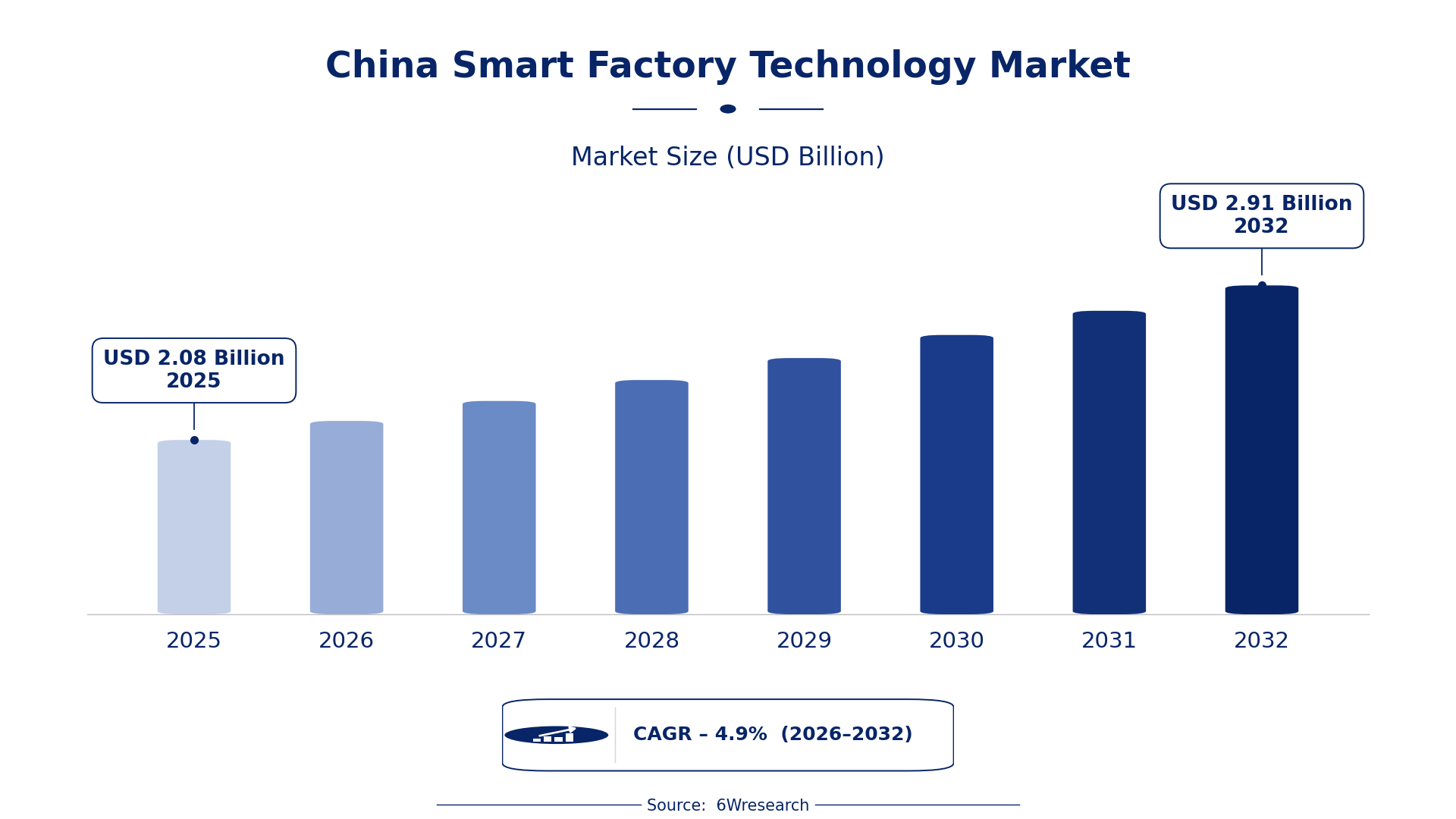
According to 6Wresearch internal database and industry insights, the China Smart Factory Technology Market was valued at USD 2.08 billion in 2025 and is projected to reach USD 2.91 billion by 2032, growing at a CAGR of approximately 4.9% during 2026–2032.
China Smart Factory Technology Market Highlights
| Report Metric | Details |
| Report Name | China Smart Factory Technology Market |
| Market Size 2025 | USD 2.08 billion |
| Market Size 2032 | USD 2.91 billion |
| Absolute Growth 2025–2032 | USD 0.83 billion |
| CAGR 2026–2032 | 4.9% |
| Peak Annual Growth | 6.7% in 2027 |
| Forecast Period | 2026–2032 |
| Historical Data | 2022–2025 |
| Base Year | 2025 |
| Leading Technology Type, 2025 | Smart MES Systems (51% share) |
| Leading Functionality, 2025 | Production Optimization (38% share) |
| Leading Integration Platform, 2025 | IoT + AI (50% share) |
| Leading End User, 2025 | Manufacturing Plants (40% share) |
| Fastest-Growing Technology Type | Predictive Maintenance AI (6.7% CAGR) |
| Fastest-Growing Functionality | Adaptive Control (6.8% CAGR) |
| Fastest-Growing End User | Automotive OEMs (6.4% CAGR) |
| Growing Sector | Automotive Manufacturing |
| Key End Users | Manufacturing Plants, Automotive OEMs, Factory Automation Firms, Industrial Engineers |
China Smart Factory Technology Market Year-wise Growth Rate and Key Drivers (2022–2032)
This graph illustrates the annual growth rates of the market from 2022 to 2032, highlighting a steady upward trajectory and projected market expansion over the forecast period.

Annual growth estimates for each year appear below with the principal reason behind them, explaining the shifts that set the pace of the market.
| Year | Estimated Annual Growth (%) | Market Rationale |
| 2022 | 4.9 | The market experienced steady growth due to ongoing digital transformation efforts in manufacturing. |
| 2023 | 6.1 | Increased adoption of smart technologies by large manufacturers accelerated market expansion. |
| 2024 | 4.2 | A slowdown in growth occurred as firms adjusted to new technologies and processes. |
| 2025 | 6.0 | The market rebounded with renewed investment in smart factory initiatives and automation. |
| 2026 | 2.4 | Growth slowed as firms faced challenges in integrating advanced technologies effectively. |
| 2027 | 6.7 | A surge in demand for predictive maintenance solutions drove significant market growth. |
| 2028 | 3.7 | Growth slowed again as firms focused on optimising existing smart technologies. |
| 2029 | 6.3 | Increased production in the automotive sector boosted demand for smart factory solutions. |
| 2030 | 5.3 | A slowdown occurred as market players consolidated their technology investments. |
| 2031 | 6.6 | Renewed interest in AI applications led to faster growth in smart factory technologies. |
| 2032 | 3.5 | Growth slowed as the market matured and firms focused on efficiency gains. |
Note: Market size estimations and growth projections presented in this report are based on 6Wresearch's proprietary forecasting methodology, utilizing the latest available industry data, government publications, and primary research inputs.
China Smart Factory Technology Market Synopsis
Smart Factory Technology in China involves advanced automation and data exchange in manufacturing settings, primarily utilising IoT, AI, and machine learning. This technology improves operational efficiency and minimises downtime, making it crucial for contemporary manufacturing. The China Smart Factory Technology Market is expanding due to strong demand from the automotive and electronics industries, propelled by initiatives like 'Smart Manufacturing 2025' and rising adoption rates among large manufacturers. With over 70% of large firms embracing smart technologies by 2022, the market is poised for ongoing growth.
Market Dynamics Impact Analysis (2026–2032)
| Factor | Type | Impact | Primary Segment Affected |
| Investment in AI for manufacturing reached $15 billion in 2022, enhancing smart factory capabilities. | Driver | High | Predictive Maintenance AI |
| The automotive industry in China, producing over 25 million vehicles annually, drives demand for smart technologies. | Driver | High | Manufacturing Plants |
| The Guangdong province leads with over 500 smart factories established, creating opportunities for suppliers. | Opportunity | High | Smart MES Systems |
| The average factory has implemented IoT solutions in 40% of processes, indicating a growing need for integration. | Opportunity | Medium | IoT + AI |
| Challenges in integrating advanced technologies can delay adoption rates for manufacturers. | Restraint | High | Smart PLC Controllers |
| The complexity of smart factory systems may deter smaller firms from investing in necessary upgrades. | Restraint | Medium | Digital Twin Systems |
| High implementation costs can restrict access to smart technologies for many manufacturers. | Challenge | High | Manufacturing Plants |
| Supply chain disruptions impact the availability of essential components for smart factories. | Challenge | Medium | Predictive Maintenance AI |
Evaluation of Drivers in China Smart Factory Technology Market (2026–2032)
The table below links each growth driver to the segment it affects and the evidence for it.
| Drivers | Primary Segment Affected | Why It Matters (Evidence) |
| Investment in AI for manufacturing enhances capabilities and efficiency, leading to increased demand for smart factory solutions. | Predictive Maintenance AI | Investment in AI for manufacturing reached $15 billion in 2022. |
| The automotive sector's growth drives demand for smart factory technologies, particularly in production optimization. | Manufacturing Plants | The automotive industry in China produces over 25 million vehicles annually. |
| The establishment of smart factories in the Guangdong province boosts local demand for smart technologies. | Smart MES Systems | Guangdong province has over 500 smart factories established. |
| The integration of IoT solutions in factories enhances operational efficiency, leading to increased adoption rates. | IoT + AI | The average factory has implemented IoT solutions in 40% of its processes. |
| The push for digital transformation in manufacturing creates a strong demand for smart factory technologies. | Digital Twin Systems | The 'Smart Manufacturing 2025' initiative promotes digital transformation. |
The Smart Factory Technology market in China is growing on the back of substantial investments in AI for manufacturing, which reached $15 billion in 2022. The automotive sector, producing over 25 million vehicles annually, drives demand for smart factory technologies, particularly in predictive maintenance. The average factory has integrated IoT solutions into 40% of its processes, indicating a shift towards operational efficiency. As more manufacturers embrace these innovations, demand for predictive maintenance solutions is expected to rise.
Evaluation of Restraints in China Smart Factory Technology Market
The main factors holding the market back are set out below.
| Market Restraint | Primary Segment Affected | Why It Matters (Evidence) |
| High implementation costs can deter manufacturers from adopting smart technologies. | Manufacturing Plants | Implementation costs for smart factory technologies can be substantial, limiting access for many manufacturers. |
| Complexity in integrating advanced technologies may slow down adoption rates. | Digital Twin Systems | Many manufacturers struggle with the technical challenges of integration, causing delays in implementation. |
| Supply chain disruptions affect the availability of components needed for smart factories. | Predictive Maintenance AI | Ongoing global supply chain issues impact component delivery timelines, hindering project progress. |
| Smaller firms may lack the resources to invest in necessary technology upgrades. | Smart MES Systems | High costs associated with smart technologies can be prohibitive for smaller manufacturers, limiting their competitiveness. |
| Regulatory hurdles can delay the implementation of smart factory technologies. | IoT + AI | Compliance with evolving standards can slow down project timelines, affecting overall market growth. |
China Smart Factory Technology Market Challenges
The China Smart Factory Technology market encounters notable supply chain challenges that impede the implementation of advanced automation. These issues stem from dependence on specific components sourced from limited regions, leading to delays that can prolong project timelines for manufacturers by up to six months. A shortage of skilled workers compounds the problem, as many employees lack training in IoT and AI technologies, resulting in increased training costs that can reach 20% of operational budgets for companies. The high initial investment for smart factory technology, averaging around $1 million per facility, discourages smaller manufacturers from upgrading their systems, restricting overall market growth. Intense competition among local firms compels suppliers to lower prices, which diminishes profit margins while maintaining quality standards.
Trends in the China Smart Factory Technology Market
The trends below show where the China Smart Factory Technology Market is heading.
- Shift towards Predictive Maintenance Solutions: Manufacturers are increasingly adopting predictive maintenance solutions to minimise downtime and enhance efficiency. The automotive sector, producing over 25 million vehicles annually, illustrates this trend with a focus on smart technologies.
- Integration of IoT and AI: The integration of IoT and AI technologies is transforming manufacturing processes. The 'Smart Manufacturing 2025' initiative promotes this integration, with over 70% of large firms adopting smart technologies by 2022.
- Focus on Operational Efficiency: Manufacturing plants are prioritising operational efficiency through smart factory technologies. The average factory has implemented IoT solutions in 40% of its processes, showcasing a commitment to improving productivity.
- Regional Growth in Guangdong: Guangdong province is emerging as a leader in smart factory implementation, with over 1,000 smart factories established. This regional focus is driving substantial investment and innovation in smart technologies.
Investment Opportunities in the China Smart Factory Technology Market
Several openings in the China Smart Factory Technology Market merit attention from investors.
- Timing for Smart Factory Investments: With over 70% of large firms adopting smart technologies, now is an opportune moment to invest in smart factory solutions. Manufacturing plants in China are actively seeking advanced technologies to boost efficiency.
- Growing Demand from Automotive OEMs: Automotive OEMs are increasingly pursuing smart factory technologies to enhance production efficiency. Investing in predictive maintenance AI can effectively meet this rising demand.
- Expansion in Guangdong Province: The establishment of over 1,000 smart factories in Guangdong presents a considerable opportunity for suppliers. Collaborating with local partners can facilitate entry into this rapidly growing market.
- Gap in Technology Adoption: As the average factory implements IoT solutions in 40% of processes, there remains an opportunity for further adoption. Targeting manufacturing plants with tailored solutions can capture this potential.
Government Initiatives in the China Smart Factory Technology Market
The 'Smart Manufacturing 2025' initiative, launched by the Ministry of Industry and Information Technology in 2020, aims to promote the digital transformation of manufacturing with a focus on smart technologies. This initiative encourages manufacturers to adopt advanced technologies, driving the growth of the smart factory market. Additionally, the 'Made in China 2025' policy, updated in 2022, emphasises the importance of smart manufacturing in achieving self-sufficiency in advanced technologies. These measures collectively support the growth of smart factory technology in China.
In 2021, the National Development and Reform Commission approved the 'Digital Economy Development Plan', aiming for 50% adoption of smart factory technologies by 2025. This plan provides a framework for manufacturers to enhance their digital capabilities. The Ministry of Science and Technology's 'Artificial Intelligence Innovation Action Plan', initiated in 2020, allocates significant funding to improve AI applications in manufacturing. These initiatives are essential for advancing smart factory technology across the sector.
Future Insight of the China Smart Factory Technology Market
The China Smart Factory Technology market is expected to evolve significantly by 2032, driven by initiatives like 'Smart Manufacturing 2025' and 'Digital China'. These programs will accelerate the adoption of smart technologies, with operational efficiency projected to increase by 30% across various sectors. Investment in AI for manufacturing is set to reach $30 billion by 2025, providing suppliers with enhanced resources to innovate. The establishment of over 1,000 smart manufacturing pilot projects will create frameworks for best practices, ultimately benefiting both buyers and suppliers.
Market Segmentation Analysis
The analysis below covers each segmentation, its leading category in 2025 and its fastest-growing category through 2032.
By Technology Type – Smart MES Systems Dominated, Predictive Maintenance AI Expected to Grow Fastest
According to Dhaval Chaurasia, Assistant Manager at 6Wresearch, Smart MES Systems accounted for a 51% market share by technology type in 2025. Smart MES Systems hold the largest share as they are vital for managing workflows and operations within manufacturing environments. Their adoption by over 70% of large firms underscores their importance in driving operational efficiency in China's manufacturing sector. Over 2026–2032, Predictive Maintenance AI is expected to post the fastest growth, at a CAGR of 6.7%. Predictive Maintenance is rapidly growing because manufacturers are increasingly utilising data to forecast equipment failures and optimise maintenance schedules. The $15 billion investment in manufacturing technologies indicates a strong push towards predictive capabilities. Suppliers should focus on developing predictive maintenance solutions to align with the increasing demand in the smart factory technology market.
By Functionality – Production Optimization Dominated, Adaptive Control Expected to Grow Fastest
With a 38% revenue share in 2025, Production Optimization was the largest functionality category. Production Optimization holds the largest share as it directly addresses the critical need for improving throughput and minimising waste in manufacturing environments. This focus is particularly vital for manufacturers aiming to enhance operational efficiency and remain competitive in the market. The quickest growth will come from Adaptive Control, forecast to expand at a CAGR of 6.8% between 2026 and 2032. Adaptive Control is experiencing rapid growth as manufacturers increasingly seek to adjust processes dynamically based on real-time data insights. This trend signifies a shift towards more responsive manufacturing solutions that can adapt to changing conditions. Buyers should prioritise investments in adaptive control technologies to maintain a competitive edge in the smart factory sector.
By Integration Platform – IoT + AI Dominated and Is Expected to Record the Fastest Growth
IoT + AI took a 50% share of integration platform in 2025, more than any other category. IoT + AI leads the market due to its ability to seamlessly integrate devices, creating smarter manufacturing solutions that significantly enhance operational efficiency. This integration is essential for manufacturers looking to utilise real-time data effectively across their production processes. Its lead should widen, with a projected CAGR of 6.6% during 2026–2032, the highest in this split. As IoT + AI is also the fastest-growing segment, its ongoing adoption will likely further solidify its market dominance. This combination allows manufacturers to optimise their processes and make informed decisions in real-time. Suppliers must focus on enhancing IoT and AI integration capabilities to capture the expanding market share.
By End User – Manufacturing Plants Dominated, Automotive OEMs Expected to Grow Fastest
The largest end user category in 2025 was Manufacturing Plants, with a 40% share of total revenue. Manufacturing Plants account for the largest share as they are the primary users of smart factory technologies aimed at boosting operational efficiency. The substantial production output in sectors such as automotive drives significant demand from these plants. Automotive OEMs are projected to grow fastest, at a CAGR of 6.4% during 2026–2032. Automotive OEMs represent the fastest-growing segment, increasingly adopting smart technologies to improve production efficiency and meet rising consumer demands. This trend reflects the broader digital transformation occurring within the manufacturing industry. Suppliers should tailor their products to address the specific needs of automotive OEMs to seize this growth opportunity.
Key Attractiveness of the Report
- 10 Years of Market Numbers
- Historical Data Starting from 2022 to 2025
- Base Year 2025
- Forecast Data until 2032
- Key Performance Indicators Impacting the Market
- Major Upcoming Developments and Projects
Key Highlights of the Report:
- China Smart Factory Technology Market Outlook
- Market Size of China Smart Factory Technology Market, 2025
- Forecast of China Smart Factory Technology Market, 2032
- Historical Data and Forecast of China Smart Factory Technology Revenues & Volume for the Period 2022 - 2032F
- China Smart Factory Technology Market Trend Evolution
- China Smart Factory Technology Market Drivers and Challenges
- China Smart Factory Technology Price Trends
- China Smart Factory Technology Porter's Five Forces
- China Smart Factory Technology Industry Life Cycle
- Historical Data and Forecast of China Smart Factory Technology Market Revenues & Volume By Technology Type for the Period 2022 - 2032F
- Historical Data and Forecast of China Smart Factory Technology Market Revenues & Volume By Digital Twin Systems for the Period 2022 - 2032F
- Historical Data and Forecast of China Smart Factory Technology Market Revenues & Volume By Smart PLC Controllers for the Period 2022 - 2032F
- Historical Data and Forecast of China Smart Factory Technology Market Revenues & Volume By Predictive Maintenance AI for the Period 2022 - 2032F
- Historical Data and Forecast of China Smart Factory Technology Market Revenues & Volume By Smart MES Systems for the Period 2022 - 2032F
- Historical Data and Forecast of China Smart Factory Technology Market Revenues & Volume By Functionality for the Period 2022 - 2032F
- Historical Data and Forecast of China Smart Factory Technology Market Revenues & Volume By Real-Time Simulation for the Period 2022 - 2032F
- Historical Data and Forecast of China Smart Factory Technology Market Revenues & Volume By Adaptive Control for the Period 2022 - 2032F
- Historical Data and Forecast of China Smart Factory Technology Market Revenues & Volume By Equipment Health Insights for the Period 2022 - 2032F
- Historical Data and Forecast of China Smart Factory Technology Market Revenues & Volume By Production Optimization for the Period 2022 - 2032F
- Historical Data and Forecast of China Smart Factory Technology Market Revenues & Volume By Integration Platform for the Period 2022 - 2032F
- Historical Data and Forecast of China Smart Factory Technology Market Revenues & Volume By IoT + AI for the Period 2022 - 2032F
- Historical Data and Forecast of China Smart Factory Technology Market Revenues & Volume By Cloud + Edge for the Period 2022 - 2032F
- Historical Data and Forecast of China Smart Factory Technology Market Revenues & Volume By Machine Learning Models for the Period 2022 - 2032F
- Historical Data and Forecast of China Smart Factory Technology Market Revenues & Volume By Data Analytics Dashboards for the Period 2022 - 2032F
- Historical Data and Forecast of China Smart Factory Technology Market Revenues & Volume By End User for the Period 2022 - 2032F
- Historical Data and Forecast of China Smart Factory Technology Market Revenues & Volume By Manufacturing Plants for the Period 2022 - 2032F
- Historical Data and Forecast of China Smart Factory Technology Market Revenues & Volume By Factory Automation Firms for the Period 2022 - 2032F
- Historical Data and Forecast of China Smart Factory Technology Market Revenues & Volume By Industrial Engineers for the Period 2022 - 2032F
- Historical Data and Forecast of China Smart Factory Technology Market Revenues & Volume By Automotive OEMs for the Period 2022 - 2032F
- China Smart Factory Technology Import Export Trade Statistics
- Market Opportunity Assessment By Technology Type
- Market Opportunity Assessment By Functionality
- Market Opportunity Assessment By Integration Platform
- Market Opportunity Assessment By End User
- China Smart Factory Technology Top Companies Market Share
- China Smart Factory Technology Competitive Benchmarking By Technical and Operational Parameters
- China Smart Factory Technology Company Profiles
- China Smart Factory Technology Key Strategic Recommendations
Market Covered
Segments analysed in this report are listed below.
By Technology Type
- Digital Twin Systems
- Smart PLC Controllers
- Predictive Maintenance AI
- Smart MES Systems
By Functionality
- Real-Time Simulation
- Adaptive Control
- Equipment Health Insights
- Production Optimization
By Integration Platform
- IoT + AI
- Cloud + Edge
- Machine Learning Models
- Data Analytics Dashboards
By End User
- Manufacturing Plants
- Factory Automation Firms
- Industrial Engineers
- Automotive OEMs































