India Smart Grid Instrumentation Market Size & Growth Rate
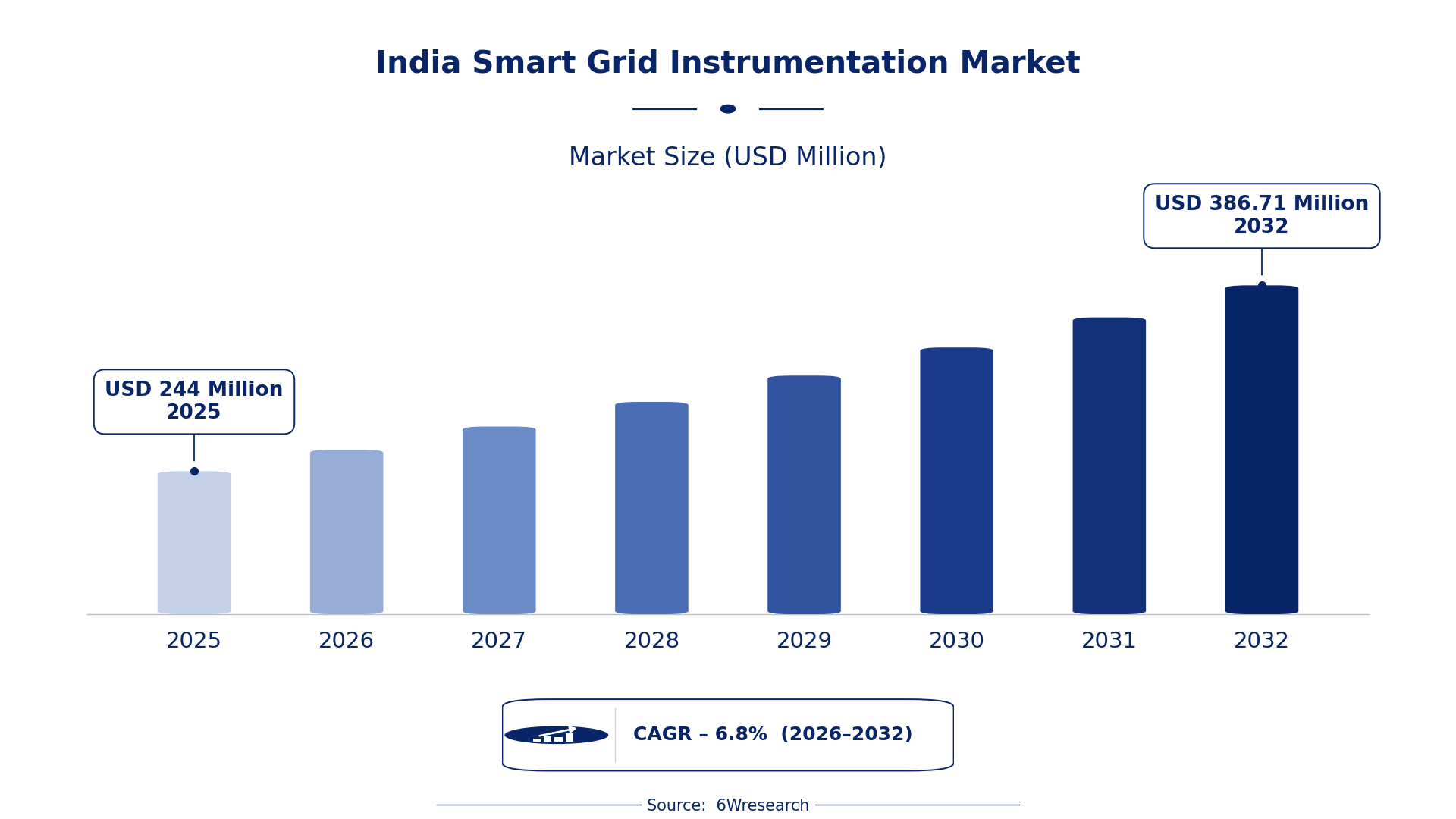
According to 6Wresearch internal database and industry insights, the India Smart Grid Instrumentation Market was valued at USD 244.0 million in 2025 and is projected to reach USD 386.71 million by 2032, growing at a CAGR of approximately 6.8% during 2026–2032.
India Smart Grid Instrumentation Market Highlights
| Report Metric | Details |
| Report Name | India Smart Grid Instrumentation Market |
| Market Size 2025 | USD 244.0 million |
| Market Size 2032 | USD 386.71 million |
| Absolute Growth 2025–2032 | USD 142.71 million |
| CAGR 2026–2032 | 6.8% |
| Peak Annual Growth | 8.6% in 2029 |
| Forecast Period | 2026–2032 |
| Historical Data | 2022–2025 |
| Base Year | 2025 |
| Leading Instrument Type, 2025 | Smart Energy Meters (36% share) |
| Leading Functionality, 2025 | Real-Time Grid Control (45% share) |
| Leading Deployment Zone, 2025 | Residential/Commercial (38% share) |
| Leading End User, 2025 | Grid Operators (33% share) |
| Fastest-Growing Instrument Type | Remote Terminal Units (8.6% CAGR) |
| Fastest-Growing Functionality | Load Balancing (9.2% CAGR) |
| Fastest-Growing Deployment Zone | Substations (9.0% CAGR) |
| Fastest-Growing End User | Energy Reliability Firms (9.6% CAGR) |
| Growing Sector | Energy Reliability Firms |
| Key End Users | Grid Operators, Power Distribution Firms, Transmission Companies, Energy Reliability Firms |
India Smart Grid Instrumentation Market Year-wise Growth Rate and Key Drivers (2022–2032)
This graph illustrates the annual growth rates of the market from 2022 to 2032, highlighting a steady upward trajectory and projected market expansion over the forecast period.
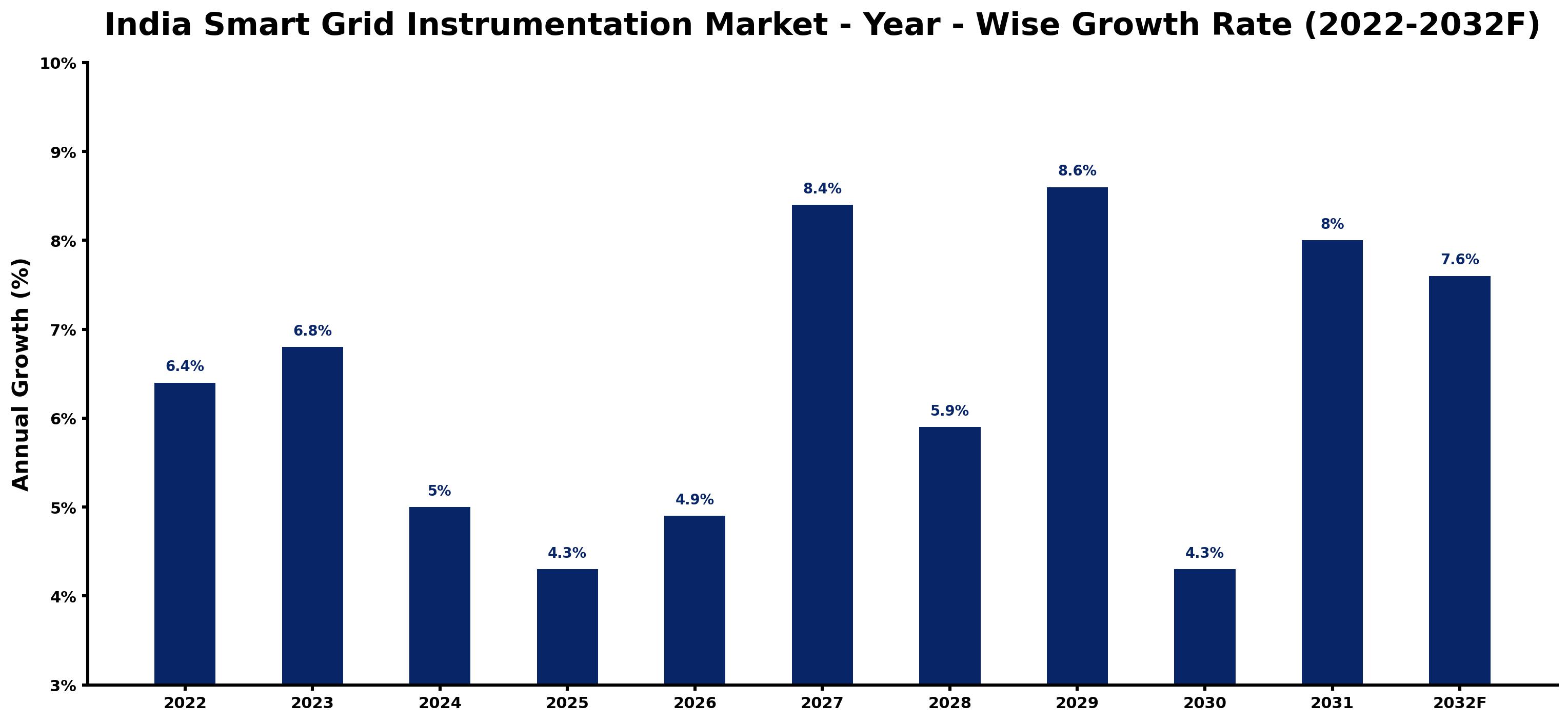
Annual growth estimates for each year appear below with the principal reason behind them, explaining the shifts that set the pace of the market.
| Year | Estimated Annual Growth (%) | Market Rationale |
| 2022 | 6.4 | The market experienced steady growth due to ongoing urbanisation and the implementation of the Smart Cities Mission. |
| 2023 | 6.8 | Demand increased as the National Smart Grid Mission gained momentum in modernising the power sector. |
| 2024 | 5.0 | Growth slowed as some projects faced delays in funding and implementation timelines. |
| 2025 | 4.3 | Expansion continued but at a slower pace as urban areas completed initial smart meter installations under the Smart Cities Mission. |
| 2026 | 4.9 | Investment in smart grid technologies is expected to rise, spurred by the government's commitment to infrastructure development. |
| 2027 | 8.4 | Demand is projected to surge as more substations adopt real-time grid control technologies mandated by the Central Electricity Authority. |
| 2028 | 5.9 | Growth is expected to decelerate as the market adjusts to initial installation saturation in urban areas. |
| 2029 | 8.6 | A peak in growth is anticipated, driven by heightened investments in smart grid infrastructure across major cities. |
| 2030 | 4.3 | The market is projected to slow as new project approvals face bureaucratic hurdles in various states. |
| 2031 | 8.0 | Growth is expected to accelerate again as energy reliability firms increase their investments in smart grid solutions. |
| 2032 | 7.6 | Market growth is projected to moderate as the focus shifts to optimising existing installations and technologies. |
Note: Market size estimations and growth projections presented in this report are based on 6Wresearch's proprietary forecasting methodology, utilizing the latest available industry data, government publications, and primary research inputs.
India Smart Grid Instrumentation Market Synopsis
Smart Grid Instrumentation in India encompasses advanced technologies that enhance the efficiency and reliability of electric grids. This includes devices like smart meters and communication systems that enable real-time data exchange. The India Smart Grid Instrumentation Market is experiencing rapid growth, driven by the need for improved energy management and the integration of renewable energy sources. More than 10 million smart meters have been installed in urban areas, showcasing substantial investment in modernising the power sector. Key initiatives such as the National Smart Grid Mission and Smart Cities Mission are propelling this growth and strengthening the overall infrastructure.
Market Dynamics Impact Analysis (2026–2032)
| Factor | Type | Impact | Primary Segment Affected |
| Investment in smart grid infrastructure is increasing, driven by government initiatives. | Driver | High | Smart Energy Meters |
| Growing demand for energy efficiency and renewable integration is propelling market expansion. | Driver | High | Real-Time Grid Control |
| The need for modernising urban power systems presents significant opportunities. | Opportunity | High | Residential/Commercial |
| Investment in renewable energy projects is creating demand for smart grid solutions. | Opportunity | High | Substations |
| Bureaucratic hurdles can delay project approvals and implementation timelines. | Restraint | High | Remote Terminal Units |
| High costs associated with advanced technologies can limit adoption rates. | Restraint | Medium | Phasor Measurement Units |
| Supply chain disruptions can hinder timely delivery of smart grid components. | Challenge | High | Voltage Regulators |
| The need for skilled personnel to implement smart grid technologies is a challenge. | Challenge | Medium | Two-Way Communication |
Evaluation of Drivers in India Smart Grid Instrumentation Market (2026–2032)
Key forces behind demand, with the segment each one moves most, are listed below.
| Drivers | Primary Segment Affected | Why It Matters (Evidence) |
| Government investment in smart grid infrastructure is increasing, with a target of ₹1,000 crores for development. | Smart Energy Meters | This funding supports the installation of smart meters in urban areas, improving energy management capabilities. |
| The National Smart Grid Mission aims to modernise power systems across India, boosting demand for smart grid technologies. | Real-Time Grid Control | This initiative drives utilities to adopt real-time monitoring solutions for better management of electricity flow. |
| The Smart Cities Mission is integrating smart grid technologies into urban planning, expanding market opportunities. | Residential/Commercial | This integration leads to increased installations of smart meters and related technologies in urban areas. |
| The Central Electricity Authority mandates Phasor Measurement Units in critical transmission networks, enhancing grid stability. | Phasor Measurement Units | This regulation ensures real-time monitoring, increasing demand for these units across utilities. |
| Growing urbanisation is pushing utilities to invest in smart grid solutions for efficient energy distribution. | Remote Terminal Units | Utilities are increasingly adopting these units to manage and control operations remotely, improving efficiency. |
Growth in the Smart Grid Instrumentation market in India is supported by increasing investments in infrastructure, rising end-use demand for energy efficiency, and the integration of renewable energy sources. Over 10 million smart meters have been installed in urban areas, improving energy management capabilities. The adoption of real-time grid control technology in more than 50% of new substations reflects the demand for advanced solutions. As urban areas modernise their energy grids, utilities are increasingly adopting these technologies to boost operational efficiency and reliability.
Evaluation of Restraints in India Smart Grid Instrumentation Market
Below mentioned are some major restraints and their influence on market dynamics.
| Market Restraint | Primary Segment Affected | Why It Matters (Evidence) |
| Bureaucratic delays in project approvals can slow down implementation timelines. | Remote Terminal Units | This can lead to missed deadlines and increased costs for utilities, impacting project viability. |
| High initial costs of smart grid technologies can deter smaller utilities from investing. | Phasor Measurement Units | Smaller firms may struggle to afford the necessary upgrades, limiting market growth opportunities. |
| Supply chain disruptions can affect the availability of critical components for smart grids. | Voltage Regulators | Such disruptions can lead to delays in project timelines and increased costs for utilities, affecting budgets. |
| Limited skilled workforce for implementing smart grid technologies can hinder adoption. | Two-Way Communication | Utilities may face challenges in finding qualified personnel to manage these systems, delaying projects. |
| Regulatory compliance requirements can complicate the installation process for new technologies. | Smart Energy Meters | Utilities must navigate complex regulations, which can delay project timelines and increase costs. |
India Smart Grid Instrumentation Market Challenges
The India Smart Grid Instrumentation Market faces strong competition from global players, which pressures local suppliers to lower prices and diminishes their profit margins. Supply chain challenges arise as many components are imported, leading to delays that can increase costs for utilities by up to 20%. A shortage of skilled workers in advanced technologies hampers the effective implementation of smart grid solutions, resulting in project delays and higher training costs for companies. Inconsistent technological standards across states complicate the seamless integration of smart grid systems, causing inefficiencies that impact utilities' operational performance.
Trends in the India Smart Grid Instrumentation Market
The trends below show where the India Smart Grid Instrumentation Market is heading.
- Shift towards Real-Time Monitoring Solutions: India is increasingly adopting real-time monitoring solutions for its electric grid, as reflected in the National Smart Grid Mission. As of 2023, over 50% of new substations are implementing real-time grid control technology, improving operational efficiency.
- Integration of Renewable Energy Sources: The integration of renewable energy sources into the grid is gaining momentum, supported by the National Renewable Energy Policy. The government plans to invest $5 billion in smart grid infrastructure by 2025 to facilitate this transition.
- Expansion of Smart Meter Installations: The installation of smart meters is rapidly expanding across urban areas, with over 10 million units installed as of 2023. This trend is driven by the Smart Cities Mission, which aims to incorporate smart grid technologies in 100 cities by 2025.
- Focus on Energy Efficiency: There is a growing emphasis on energy efficiency in urban planning, as seen in the Smart Cities Mission. This initiative is leading to increased investments in smart grid technologies to optimise energy management.
Investment Opportunities in the India Smart Grid Instrumentation Market
The following opportunities in the India Smart Grid Instrumentation Market pair current demand with a clear way in.
- Partnerships for Smart Grid Projects: Now is an opportune time for partnerships in smart grid projects, with the government investing ₹1,000 crores. Collaborating with local utilities in Maharashtra can facilitate entry into this growing market.
- Investment in Substation Upgrades: With a projected growth of 9.0% in substations, there is a gap in upgrading existing facilities. Engaging with grid operators in Gujarat can provide opportunities for investment in modernisation.
- Expansion in Residential Areas: The residential sector is expanding rapidly, with a 38% market share expected in 2025. Focusing on smart energy meters in urban areas can yield substantial returns for suppliers.
- Certification for Smart Grid Technologies: The demand for certified smart grid technologies is rising, particularly under IS 16444 guidelines. Suppliers can enter the market by obtaining necessary certifications and collaborating with energy reliability firms.
Government Initiatives in the India Smart Grid Instrumentation Market
The National Smart Grid Mission, launched in 2020, aims to promote smart grid technologies with a budget of ₹1,000 crores for infrastructure development. This initiative encourages utilities to adopt modern technologies for better energy management and improves the existing framework established by the Electricity Act. The Smart Cities Mission, initiated in 2021, focuses on integrating smart grid solutions in urban planning, targeting 100 cities by 2025, thus enhancing the infrastructure for smart grid instrumentation.
The Ministry of Power oversees the implementation of the National Smart Grid Mission, approving projects that enhance grid efficiency. Additionally, the Smart Cities Mission, managed by the Ministry of Housing and Urban Affairs, funds urban planning initiatives that incorporate smart grid solutions, targeting 100 cities by 2025. This funding allows producers to implement advanced technologies and improve energy management systems.
Future Insight of the India Smart Grid Instrumentation Market
The outlook for the India Smart Grid Instrumentation Market to 2032 is promising due to several key developments. The Indian government plans to invest $5 billion in smart grid infrastructure by 2025, which will enhance capabilities and expand access. The adoption of ISO 50001 standards by utilities will streamline energy management processes. The Smart Cities Mission aims to integrate smart grid technologies in 100 cities by 2025, fostering urban energy efficiency. Additionally, the establishment of the National Institute of Smart Grid will provide essential training and research, ensuring a skilled workforce for future advancements.
Market Segmentation Analysis
Each segment group is reviewed below, with the leader by share and the fastest grower by CAGR.
By Instrument Type – Smart Energy Meters Dominated, Remote Terminal Units Expected to Grow Fastest
According to Dhaval Chaurasia, Assistant Manager at 6Wresearch, in 2025, Smart Energy Meters led the instrument type split with a 36% share. Smart Energy Meters command the largest share in the India Smart Grid Instrumentation Market due to their critical role in accurately measuring energy consumption. With over 10 million smart meters installed in urban areas, they are essential for effective energy management and grid efficiency. Over 2026–2032, Remote Terminal Units are expected to post the fastest growth, at a CAGR of 8.6%. Remote Terminal Units are rapidly gaining traction as they facilitate remote monitoring and control of grid operations, which is increasingly vital for modern power systems. Their growth is propelled by the urgent need for efficient management in substations, where real-time data is indispensable. This trend suggests that suppliers should enhance the capabilities of Remote Terminal Units to align with the rising demand.
By Functionality – Real-Time Grid Control Dominated, Load Balancing Expected to Grow Fastest
Real-Time Grid Control took a 45% share of functionality in 2025, more than any other category. Real-Time Grid Control holds the largest market share as it is vital for the dynamic management of electricity flow, particularly in urban areas undergoing modernization. This functionality is crucial for ensuring that energy supply can meet fluctuating demand effectively. Load Balancing is projected to grow fastest, at a CAGR of 9.2% during 2026–2032. Load Balancing is the fastest-growing functionality, driven by the need to evenly distribute electricity demand across the grid. The increasing implementation of smart grid technologies highlights the importance of load balancing in maintaining grid stability. Suppliers should focus on developing advanced load balancing solutions to take advantage of this growth opportunity.
By Deployment Zone – Residential/Commercial Dominated, Substations Expected to Grow Fastest
With a 38% revenue share in 2025, Residential/Commercial was the largest deployment zone category. The Residential/Commercial sector leads in market share as it encompasses the primary users of smart energy meters, essential for energy management in homes and businesses. The ongoing urbanisation in India further fuels the demand for smart grid technologies in these sectors. The quickest growth will come from Substations, forecast to expand at a CAGR of 9.0% between 2026 and 2032. Substations are the fastest-growing deployment zone, as they are crucial for monitoring and controlling grid operations. The rising adoption of real-time grid control technologies in substations reflects the pressing need for enhanced efficiency in energy distribution. This growth indicates that suppliers should tailor solutions specifically for substations to address their operational needs.
By End User – Grid Operators Dominated, Energy Reliability Firms Expected to Grow Fastest
The largest end user category in 2025 was Grid Operators, with a 33% share of total revenue. Grid Operators dominate the market share as the primary users of smart grid technologies, which are essential for efficient grid management and operation. Their role in integrating renewable energy sources further strengthens their position in the market. Energy Reliability Firms are set to record the highest CAGR in this split, 9.6% over 2026–2032. Energy Reliability Firms are the fastest-growing end user group, concentrating on ensuring a consistent energy supply amidst rising demand. Their focus on reliability aligns with broader trends in smart grid adoption and energy management. This highlights the opportunity for suppliers to form partnerships with Energy Reliability Firms to enhance service offerings and meet their evolving needs.
Key Attractiveness of the Report
- 10 Years of Market Numbers
- Historical Data Starting from 2022 to 2025
- Base Year 2025
- Forecast Data until 2032
- Key Performance Indicators Impacting the Market
- Major Upcoming Developments and Projects
Key Highlights of the Report:
- India Smart Grid Instrumentation Market Outlook
- Market Size of India Smart Grid Instrumentation Market, 2025
- Forecast of India Smart Grid Instrumentation Market, 2032
- Historical Data and Forecast of India Smart Grid Instrumentation Revenues & Volume for the Period 2022 - 2032F
- India Smart Grid Instrumentation Market Trend Evolution
- India Smart Grid Instrumentation Market Drivers and Challenges
- India Smart Grid Instrumentation Price Trends
- India Smart Grid Instrumentation Porter's Five Forces
- India Smart Grid Instrumentation Industry Life Cycle
- Historical Data and Forecast of India Smart Grid Instrumentation Market Revenues & Volume By Instrument Type for the Period 2022 - 2032F
- Historical Data and Forecast of India Smart Grid Instrumentation Market Revenues & Volume By Smart Energy Meters for the Period 2022 - 2032F
- Historical Data and Forecast of India Smart Grid Instrumentation Market Revenues & Volume By Remote Terminal Units for the Period 2022 - 2032F
- Historical Data and Forecast of India Smart Grid Instrumentation Market Revenues & Volume By Phasor Measurement Units for the Period 2022 - 2032F
- Historical Data and Forecast of India Smart Grid Instrumentation Market Revenues & Volume By Voltage Regulators for the Period 2022 - 2032F
- Historical Data and Forecast of India Smart Grid Instrumentation Market Revenues & Volume By Functionality for the Period 2022 - 2032F
- Historical Data and Forecast of India Smart Grid Instrumentation Market Revenues & Volume By Two-Way Communication for the Period 2022 - 2032F
- Historical Data and Forecast of India Smart Grid Instrumentation Market Revenues & Volume By Real-Time Grid Control for the Period 2022 - 2032F
- Historical Data and Forecast of India Smart Grid Instrumentation Market Revenues & Volume By Grid Stability Monitoring for the Period 2022 - 2032F
- Historical Data and Forecast of India Smart Grid Instrumentation Market Revenues & Volume By Load Balancing for the Period 2022 - 2032F
- Historical Data and Forecast of India Smart Grid Instrumentation Market Revenues & Volume By Deployment Zone for the Period 2022 - 2032F
- Historical Data and Forecast of India Smart Grid Instrumentation Market Revenues & Volume By Residential/Commercial for the Period 2022 - 2032F
- Historical Data and Forecast of India Smart Grid Instrumentation Market Revenues & Volume By Substations for the Period 2022 - 2032F
- Historical Data and Forecast of India Smart Grid Instrumentation Market Revenues & Volume By Transmission Networks for the Period 2022 - 2032F
- Historical Data and Forecast of India Smart Grid Instrumentation Market Revenues & Volume By Transformer Stations for the Period 2022 - 2032F
- Historical Data and Forecast of India Smart Grid Instrumentation Market Revenues & Volume By End User for the Period 2022 - 2032F
- Historical Data and Forecast of India Smart Grid Instrumentation Market Revenues & Volume By Grid Operators for the Period 2022 - 2032F
- Historical Data and Forecast of India Smart Grid Instrumentation Market Revenues & Volume By Transmission Companies for the Period 2022 - 2032F
- Historical Data and Forecast of India Smart Grid Instrumentation Market Revenues & Volume By Energy Reliability Firms for the Period 2022 - 2032F
- Historical Data and Forecast of India Smart Grid Instrumentation Market Revenues & Volume By Power Distribution Firms for the Period 2022 - 2032F
- India Smart Grid Instrumentation Import Export Trade Statistics
- Market Opportunity Assessment By Instrument Type
- Market Opportunity Assessment By Functionality
- Market Opportunity Assessment By Deployment Zone
- Market Opportunity Assessment By End User
- India Smart Grid Instrumentation Top Companies Market Share
- India Smart Grid Instrumentation Competitive Benchmarking By Technical and Operational Parameters
- India Smart Grid Instrumentation Company Profiles
- India Smart Grid Instrumentation Key Strategic Recommendations
Market Covered
The report offers an extensive study of the following market segments.
By Instrument Type
- Smart Energy Meters
- Remote Terminal Units
- Phasor Measurement Units
- Voltage Regulators
By Functionality
- Two-Way Communication
- Real-Time Grid Control
- Grid Stability Monitoring
- Load Balancing
By Deployment Zone
- Residential/Commercial
- Substations
- Transmission Networks
- Transformer Stations
By End User
- Grid Operators
- Transmission Companies
- Energy Reliability Firms
- Power Distribution Firms































