India Smart Home Connectivity Market Size & Growth Rate
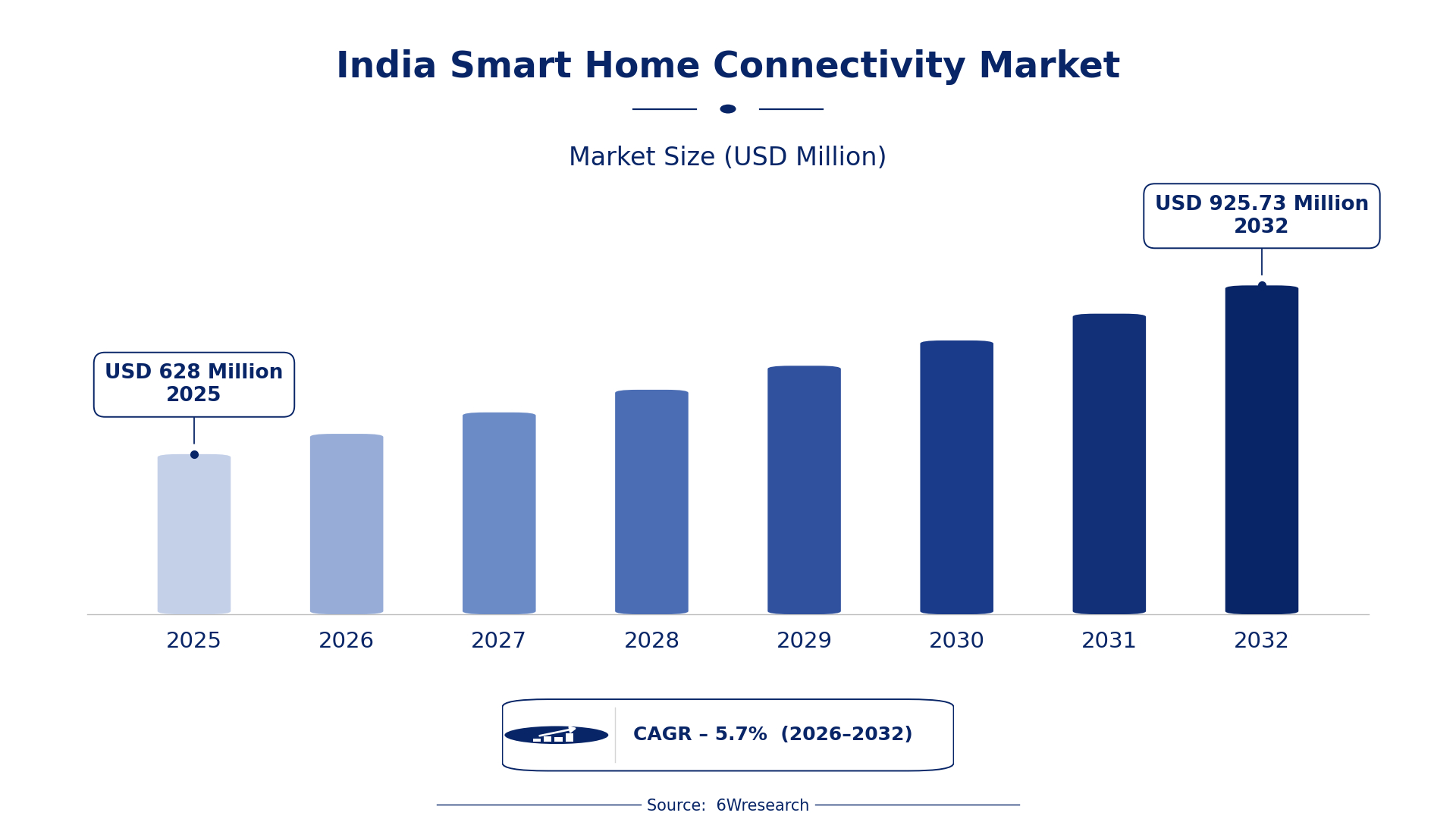
According to 6Wresearch internal database and industry insights, the India Smart Home Connectivity Market was valued at USD 628.0 million in 2025 and is projected to reach USD 925.73 million by 2032, growing at a CAGR of approximately 5.7% during 2026–2032.
India Smart Home Connectivity Market Highlights
| Report Metric | Details |
| Report Name | India Smart Home Connectivity Market |
| Market Size 2025 | USD 628.0 million |
| Market Size 2032 | USD 925.73 million |
| Absolute Growth 2025–2032 | USD 297.73 million |
| CAGR 2026–2032 | 5.7% |
| Peak Annual Growth | 7.6% in 2032 |
| Forecast Period | 2026–2032 |
| Historical Data | 2022–2025 |
| Base Year | 2025 |
| Leading Connectivity Type, 2025 | Wi-Fi Mesh Networks (54% share) |
| Leading Supported Devices, 2025 | Smart TVs (28% share) |
| Leading Protocol Type, 2025 | IEEE 802.11ax (42% share) |
| Leading End User, 2025 | Homeowners (39% share) |
| Fastest-Growing Connectivity Type | Zigbee/Z-Wave Hubs (8.0% CAGR) |
| Fastest-Growing Supported Devices | Thermostats (7.8% CAGR) |
| Fastest-Growing Protocol Type | Zigbee (7.8% CAGR) |
| Fastest-Growing End User | IoT Ecosystem Providers (8.4% CAGR) |
| Growing Sector | Home automation |
| Key End Users | Homeowners, IoT Ecosystem Providers, Smart Home Builders |
India Smart Home Connectivity Market Year-wise Growth Rate and Key Drivers (2022–2032)
This graph illustrates the annual growth rates of the market from 2022 to 2032, highlighting a steady upward trajectory and projected market expansion over the forecast period.
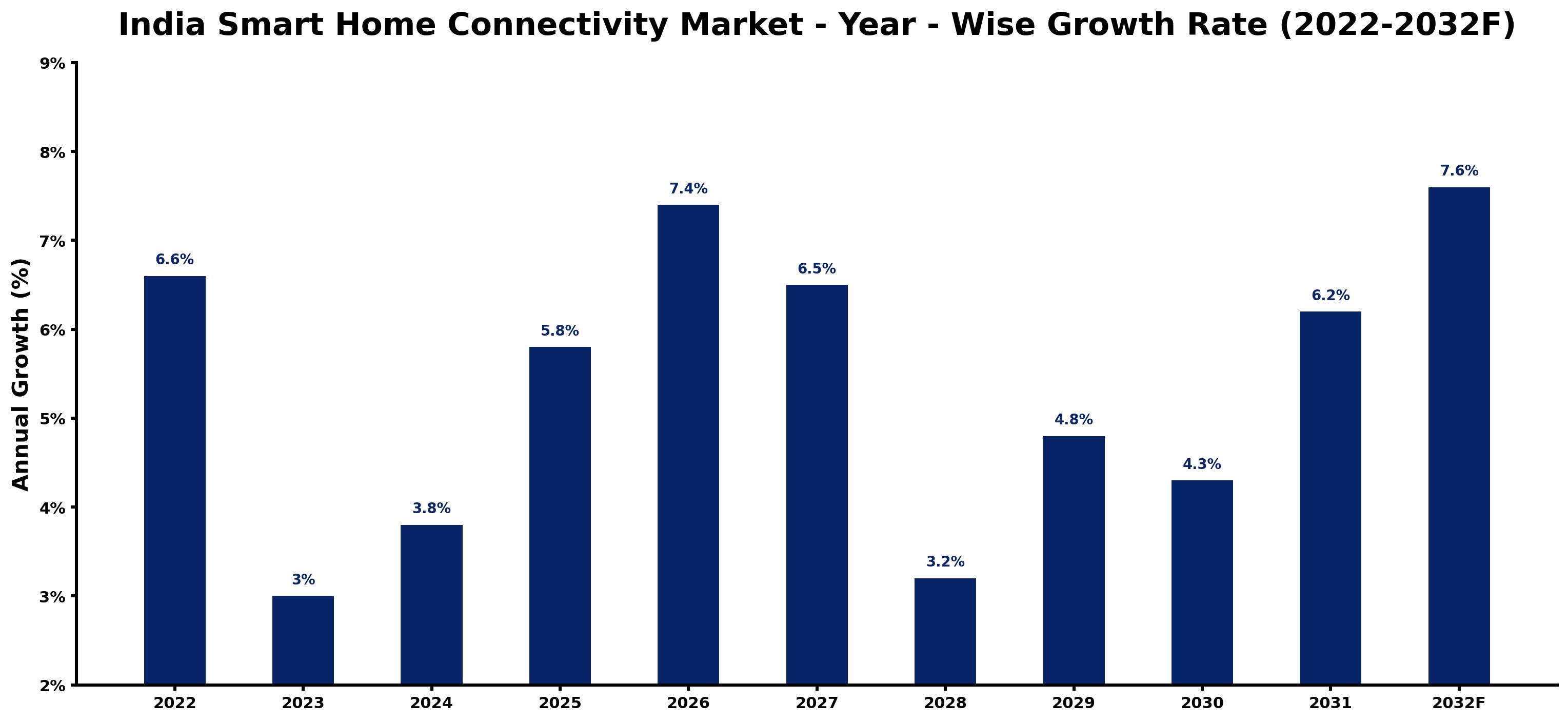
The table below sets out the estimated growth rate for each year and the main factor behind it.
| Year | Estimated Annual Growth (%) | Market Rationale |
| 2022 | 6.6 | The market exhibited strong interest from homeowners, reflecting growing awareness of smart technologies. |
| 2023 | 3.0 | Interest in smart home technologies slowed, influenced by economic uncertainties and budget constraints. |
| 2024 | 3.8 | Consumer interest in energy management devices increased, driving demand for smart home solutions. |
| 2025 | 5.8 | The market saw a resurgence as urban homeowners adopted smart technologies for convenience. |
| 2026 | 7.4 | Investment in smart home infrastructure is expected to surge, leading to increased consumer adoption of smart devices. |
| 2027 | 6.5 | Growth is projected to slow due to market saturation in urban areas, affecting new purchases of smart devices. |
| 2028 | 3.2 | The market is expected to experience a slowdown as economic factors restrain consumer spending on smart home technologies. |
| 2029 | 4.8 | Demand for smart home connectivity will rise as homeowners seek improved security and automation features. |
| 2030 | 4.3 | Growth is projected to slow slightly as competition intensifies among smart home technology providers. |
| 2031 | 6.2 | Increased urbanisation will drive demand for smart home solutions, particularly in metropolitan areas. |
| 2032 | 7.6 | The market is projected to peak as investments in smart cities boost connectivity solutions. |
Note: Market size estimations and growth projections presented in this report are based on 6Wresearch's proprietary forecasting methodology, utilizing the latest available industry data, government publications, and primary research inputs.
India Smart Home Connectivity Market Synopsis
The India Smart Home Connectivity Market includes technologies that enable devices to communicate over a network using wireless protocols. These technologies encompass Wi-Fi, Zigbee, and Bluetooth, which facilitate home automation, energy management, and security improvements. The market is growing as homeowners show increasing interest and urban areas push for smart technologies. More than 60% of Indian homeowners express interest in these solutions, supported by initiatives like the Digital India programme. As urbanisation accelerates, the demand for smart home connectivity is projected to increase further.
Market Dynamics Impact Analysis (2026–2032)
| Factor | Type | Impact | Primary Segment Affected |
| Growing interest in home automation and energy management solutions drives demand for smart home connectivity. | Driver | High | Homeowners |
| The rise of IoT ecosystem providers integrating smart technologies creates new market opportunities. | Driver | High | IoT Ecosystem Providers |
| The increasing urban population necessitates smart home solutions for enhanced living standards. | Opportunity | High | Homeowners |
| Investment in smart city initiatives opens avenues for smart home technology providers to enter new markets. | Opportunity | High | Smart Home Builders |
| Economic uncertainties may limit consumer spending on smart home technologies, affecting market growth. | Restraint | Medium | Homeowners |
| Regulatory challenges in standardisation may hinder the adoption of smart home devices. | Restraint | Medium | IoT Ecosystem Providers |
| The market faces challenges in educating consumers about the benefits of smart home technologies. | Challenge | Medium | Homeowners |
| Competition among technology providers may lead to pricing pressures, impacting profitability. | Challenge | Medium | Smart Home Builders |
Evaluation of Drivers in India Smart Home Connectivity Market (2026–2032)
Key forces behind demand, with the segment each one moves most, are listed below.
| Drivers | Primary Segment Affected | Why It Matters (Evidence) |
| Increased investment in smart home infrastructure boosts connectivity options for consumers. | Wi-Fi Mesh Networks | The average household in urban India has 3-5 smart devices connected to their home network. |
| Growing interest in energy management solutions drives the adoption of smart thermostats. | Thermostats | The Energy Conservation Building Code encourages smart energy management systems. |
| The popularity of smart TVs fuels the demand for integrated smart home systems. | Smart TVs | Over 60% of Indian homeowners are interested in smart home technologies. |
| The rise of IoT technology providers supports the integration of various smart home technologies. | IoT Ecosystem Providers | The Smart Cities Mission promotes advanced connectivity solutions in urban areas. |
| Consumer interest in enhanced security features drives demand for smart locks and alarms. | Locks | The state of Maharashtra is a leading region for smart home adoption in India. |
Expansion of the Smart Home Connectivity market in India is backed by increased investment in infrastructure, which enhances connectivity options for consumers. The average household in urban India has 3-5 smart devices connected to their home network, encouraging further adoption. The Energy Conservation Building Code promotes smart energy management systems, leading to higher sales of energy-efficient devices. Over 60% of Indian homeowners express interest in smart home technologies, driving demand for integrated systems. The rise of IoT technology providers supports the integration of various smart home technologies, boosting the market's growth potential.
Evaluation of Restraints in India Smart Home Connectivity Market
The table below lists the restraints and the evidence behind each.
| Market Restraint | Primary Segment Affected | Why It Matters (Evidence) |
| Economic uncertainties may limit consumer spending on smart home technologies. | Homeowners | Recent surveys indicate that budget constraints are affecting consumer decisions on smart home investments. |
| Regulatory challenges in standardisation may hinder the adoption of smart home devices. | IoT Ecosystem Providers | The Bureau of Indian Standards has set guidelines that may complicate compliance for manufacturers. |
| Consumer awareness about smart home technologies remains low, affecting adoption rates. | Homeowners | Many potential buyers lack understanding of the benefits and functionalities of smart home devices. |
| High initial costs of smart home systems deter some homeowners from making purchases. | Smart Home Builders | The average investment required for a complete smart home setup can be substantial. |
| Competition among technology providers may lead to pricing pressures, impacting profitability. | IoT Ecosystem Providers | As more players enter the market, pricing strategies may become aggressive, affecting margins. |
India Smart Home Connectivity Market Challenges
The India Smart Home Connectivity Market encounters several practical problems, starting with high installation costs that can reach ₹20,000 for a basic setup, making it unaffordable for many potential buyers. This financial barrier arises from a lack of local manufacturing, which forces producers to depend on imported components, increasing overall expenses. Additionally, outdated technology standards create integration issues, frustrating users and limiting market growth. Regulatory challenges exist due to unclear guidelines, leading to inconsistent product quality that undermines consumer trust and slows adoption rates among buyers.
Trends in the India Smart Home Connectivity Market
Below mentioned are some of the trends shaping the India Smart Home Connectivity Market growth.
- Homeowners Prioritising Energy Efficiency: Homeowners are increasingly focusing on energy-efficient solutions, driven by rising energy costs. The Energy Conservation Building Code encourages smart energy management systems, resulting in a 20% increase in smart thermostat installations in urban areas.
- Smart Cities Mission Advancing Connectivity: The Smart Cities Mission is improving connectivity solutions across urban India. In 2023, the government allocated ₹1,000 crores for smart technology initiatives, increasing the demand for smart home connectivity.
- Shift Towards Integrated Smart Home Systems: There is a growing trend towards integrated smart home systems that enhance user experience. In 2023, over 60% of Indian homeowners expressed interest in these solutions, reflecting a shift in consumer preferences.
- Rise of IoT Technology Providers: IoT technology providers are becoming crucial in integrating smart home technologies. The establishment of the FICCI Smart Home Committee in 2023 aims to promote industry standards and practices.
Investment Opportunities in the India Smart Home Connectivity Market
Investors looking at the India Smart Home Connectivity Market should consider the following areas.
- Homeowners Seeking Improved Security Features: With over 60% of homeowners interested in smart technologies, there is a strong opportunity to supply smart locks and alarms. Partnering with local installers can facilitate market entry and build consumer trust.
- Investment in Smart City Initiatives: The Indian government's allocation of ₹1,000 crores for the Smart Cities Mission presents an opportunity for technology providers. Focusing on partnerships with local governments can create new avenues for smart home solutions.
- Growing Demand for Energy Management Devices: As energy efficiency becomes a priority, there is a rising need for smart energy management devices. Targeting urban homeowners can yield substantial returns, especially in regions like Maharashtra.
- Expansion of Smart Home Builders: The increase in smart home builders integrating technology into new constructions presents a promising opportunity. Establishing joint ventures with construction firms can ease entry into this expanding market.
Government Initiatives in the India Smart Home Connectivity Market
The National Policy on Electronics, launched by the Ministry of Electronics and Information Technology in 2021, aims to support smart technology manufacturing in India, improving the availability of smart home devices. Additionally, the Smart Cities Mission, initiated in 2015, focuses on developing 100 smart cities with advanced connectivity solutions, directly benefiting smart home connectivity projects. In 2022, the Bureau of Indian Standards introduced IS 16444, ensuring safety and interoperability for smart home devices, which is crucial for consumer trust. These measures support manufacturers in meeting quality standards, thereby facilitating market growth.
The Ministry of Housing and Urban Affairs implements the Pradhan Mantri Awas Yojana, promoting affordable housing with smart home features, which benefits homeowners seeking modern living solutions. The Smart Cities Mission allocates funding for infrastructure projects that incorporate smart technologies, directly impacting urban development. The National Smart Grid Mission supports initiatives that modernise electricity distribution, improving energy efficiency for smart homes. These schemes enable IoT ecosystem providers to integrate advanced technologies, creating a favourable environment for smart home connectivity adoption.
Future Insight of the India Smart Home Connectivity Market
The India Smart Home Connectivity Market is set to evolve by 2032, driven by several key factors. The National Smart Grid Mission will improve energy efficiency, encouraging more households to adopt smart technologies. The Digital India initiative will support the growth of smart home innovations, with urban populations expected to reach 600 million by 2031, significantly expanding the customer base. The Bureau of Indian Standards will establish industry standards, improving product quality and consumer confidence, which will facilitate broader adoption across the country.
Market Segmentation Analysis
Each segment group is reviewed below, with the leader by share and the fastest grower by CAGR.
By Connectivity Type – Wi-Fi Mesh Networks Dominated, Zigbee/Z-Wave Hubs Expected to Grow Fastest
According to Dhaval Chaurasia, Assistant Manager at 6Wresearch, Wi-Fi Mesh Networks took a 54% share of connectivity type in 2025, more than any other category. Wi-Fi Mesh Networks hold the largest market share due to their ability to provide robust internet coverage for multiple devices, which is crucial for the increasing number of smart devices in homes. Their effectiveness in meeting the connectivity needs of over 60% of Indian homeowners interested in smart home technologies solidifies their leading position. Zigbee/Z-Wave Hubs are projected to grow fastest, at a CAGR of 8.0% during 2026–2032. Zigbee/Z-Wave Hubs are experiencing rapid growth as they enable communication between smart devices using low-power protocols, essential for energy-efficient homes. The projected increase in urban households, expected to reach 600 million by 2031, is a significant factor driving the demand for these hubs. This indicates that suppliers should focus on enhancing their Wi-Fi Mesh Networks while also investing in Zigbee/Z-Wave technology to seize emerging market opportunities.
By Supported Devices – Smart TVs Dominated, Thermostats Expected to Grow Fastest
The largest supported devices category in 2025 was Smart TVs, with a 28% share of total revenue. Smart TVs dominate the market as they integrate seamlessly with smart home systems, providing an enhanced user experience that appeals to tech-savvy homeowners. The growing adoption of smart devices in urban households further reinforces the demand for Smart TVs, establishing them as a staple in smart homes. The quickest growth will come from Thermostats, forecast to expand at a CAGR of 7.8% between 2026 and 2032. Thermostats are the fastest-growing segment due to their critical role in energy management and comfort, aligning with government initiatives that promote smart technologies. The heightened emphasis on energy efficiency is likely to accelerate their adoption among consumers, driving growth in this category. This suggests that suppliers should prioritise the development of Smart TVs while also expanding their product lines to include smart thermostats to meet evolving consumer preferences.
By Protocol Type – IEEE 802.11ax Dominated, Zigbee Expected to Grow Fastest
IEEE 802.11ax held a 42% share of the India Smart Home Connectivity Market by protocol type in 2025. IEEE 802.11ax leads the market by providing high-speed connectivity for smart devices, which is vital as the number of connected devices in homes continues to rise. Its widespread adoption is largely driven by the increasing demand for seamless connectivity solutions among urban populations. Over 2026–2032, Zigbee is expected to post the fastest growth, at a CAGR of 7.8%. Zigbee is the fastest-growing protocol type as it facilitates low-power, reliable communication between devices, which is increasingly important for energy-efficient smart homes. The growing focus on smart energy management systems further accelerates this growth, highlighting its relevance in the market. This means that suppliers should enhance their offerings in IEEE 802.11ax while also investing in Zigbee technology to maintain a competitive edge.
By End User – Homeowners Dominated, IoT Ecosystem Providers Expected to Grow Fastest
In 2025, Homeowners led the end user split with a 39% share. Homeowners represent the largest market share as they are the primary end-users of smart home connectivity solutions, eager to enhance their living spaces with technology. The rising interest in smart home technologies among homeowners significantly drives this segment's dominance in the market. IoT Ecosystem Providers are set to record the highest CAGR in this split, 8.4% over 2026–2032. IoT Ecosystem Providers are the fastest-growing end-user group as they integrate various smart home technologies for consumers, aligning with the government's initiatives for smart solutions. Their increasing role in facilitating the adoption of smart technologies is becoming essential for market growth. This highlights the need for suppliers to strengthen partnerships with IoT Ecosystem Providers while continuing to cater to the needs of homeowners.
Key Attractiveness of the Report
- 10 Years of Market Numbers
- Historical Data Starting from 2022 to 2025
- Base Year 2025
- Forecast Data until 2032
- Key Performance Indicators Impacting the Market
- Major Upcoming Developments and Projects
Key Highlights of the Report:
- India Smart Home Connectivity Market Outlook
- Market Size of India Smart Home Connectivity Market, 2025
- Forecast of India Smart Home Connectivity Market, 2032
- Historical Data and Forecast of India Smart Home Connectivity Revenues & Volume for the Period 2022 - 2032F
- India Smart Home Connectivity Market Trend Evolution
- India Smart Home Connectivity Market Drivers and Challenges
- India Smart Home Connectivity Price Trends
- India Smart Home Connectivity Porter's Five Forces
- India Smart Home Connectivity Industry Life Cycle
- Historical Data and Forecast of India Smart Home Connectivity Market Revenues & Volume By Connectivity Type for the Period 2022 - 2032F
- Historical Data and Forecast of India Smart Home Connectivity Market Revenues & Volume By Wi-Fi Mesh Networks for the Period 2022 - 2032F
- Historical Data and Forecast of India Smart Home Connectivity Market Revenues & Volume By Zigbee/Z-Wave Hubs for the Period 2022 - 2032F
- Historical Data and Forecast of India Smart Home Connectivity Market Revenues & Volume By Thread Networks for the Period 2022 - 2032F
- Historical Data and Forecast of India Smart Home Connectivity Market Revenues & Volume By Bluetooth Low Energy for the Period 2022 - 2032F
- Historical Data and Forecast of India Smart Home Connectivity Market Revenues & Volume By Supported Devices for the Period 2022 - 2032F
- Historical Data and Forecast of India Smart Home Connectivity Market Revenues & Volume By Smart TVs, Thermostats for the Period 2022 - 2032F
- Historical Data and Forecast of India Smart Home Connectivity Market Revenues & Volume By Lights, Locks, Alarms for the Period 2022 - 2032F
- Historical Data and Forecast of India Smart Home Connectivity Market Revenues & Volume By Energy Management Devices for the Period 2022 - 2032F
- Historical Data and Forecast of India Smart Home Connectivity Market Revenues & Volume By Wearables, Sensors for the Period 2022 - 2032F
- Historical Data and Forecast of India Smart Home Connectivity Market Revenues & Volume By Protocol Type for the Period 2022 - 2032F
- Historical Data and Forecast of India Smart Home Connectivity Market Revenues & Volume By IEEE 802.11ax for the Period 2022 - 2032F
- Historical Data and Forecast of India Smart Home Connectivity Market Revenues & Volume By Zigbee, Z-Wave for the Period 2022 - 2032F
- Historical Data and Forecast of India Smart Home Connectivity Market Revenues & Volume By IP-Based Protocol for the Period 2022 - 2032F
- Historical Data and Forecast of India Smart Home Connectivity Market Revenues & Volume By BLE 5.0 for the Period 2022 - 2032F
- Historical Data and Forecast of India Smart Home Connectivity Market Revenues & Volume By End User for the Period 2022 - 2032F
- Historical Data and Forecast of India Smart Home Connectivity Market Revenues & Volume By Homeowners for the Period 2022 - 2032F
- Historical Data and Forecast of India Smart Home Connectivity Market Revenues & Volume By IoT Ecosystem Providers for the Period 2022 - 2032F
- Historical Data and Forecast of India Smart Home Connectivity Market Revenues & Volume By Smart Home Builders for the Period 2022 - 2032F
- Historical Data and Forecast of India Smart Home Connectivity Market Revenues & Volume By Consumer Electronics for the Period 2022 - 2032F
- India Smart Home Connectivity Import Export Trade Statistics
- Market Opportunity Assessment By Connectivity Type
- Market Opportunity Assessment By Supported Devices
- Market Opportunity Assessment By Protocol Type
- Market Opportunity Assessment By End User
- India Smart Home Connectivity Top Companies Market Share
- India Smart Home Connectivity Competitive Benchmarking By Technical and Operational Parameters
- India Smart Home Connectivity Company Profiles
- India Smart Home Connectivity Key Strategic Recommendations
Market Covered
This report examines the market across the segments below.
By Connectivity Type
- Wi-Fi Mesh Networks
- Zigbee/Z-Wave Hubs
- Thread Networks
- Bluetooth Low Energy
By Supported Devices
- Smart TVs
- Thermostats
- Lights
- Locks
- Alarms
- Energy Management Devices
- Wearables
- Sensors
By Protocol Type
- IEEE 802.11ax
- Zigbee
- Z-Wave
- IP-Based Protocol
- BLE 5.0
By End User
- Homeowners
- IoT Ecosystem Providers
- Smart Home Builders
- Consumer Electronics































