China Smart Home Connectivity Market Size & Growth Rate
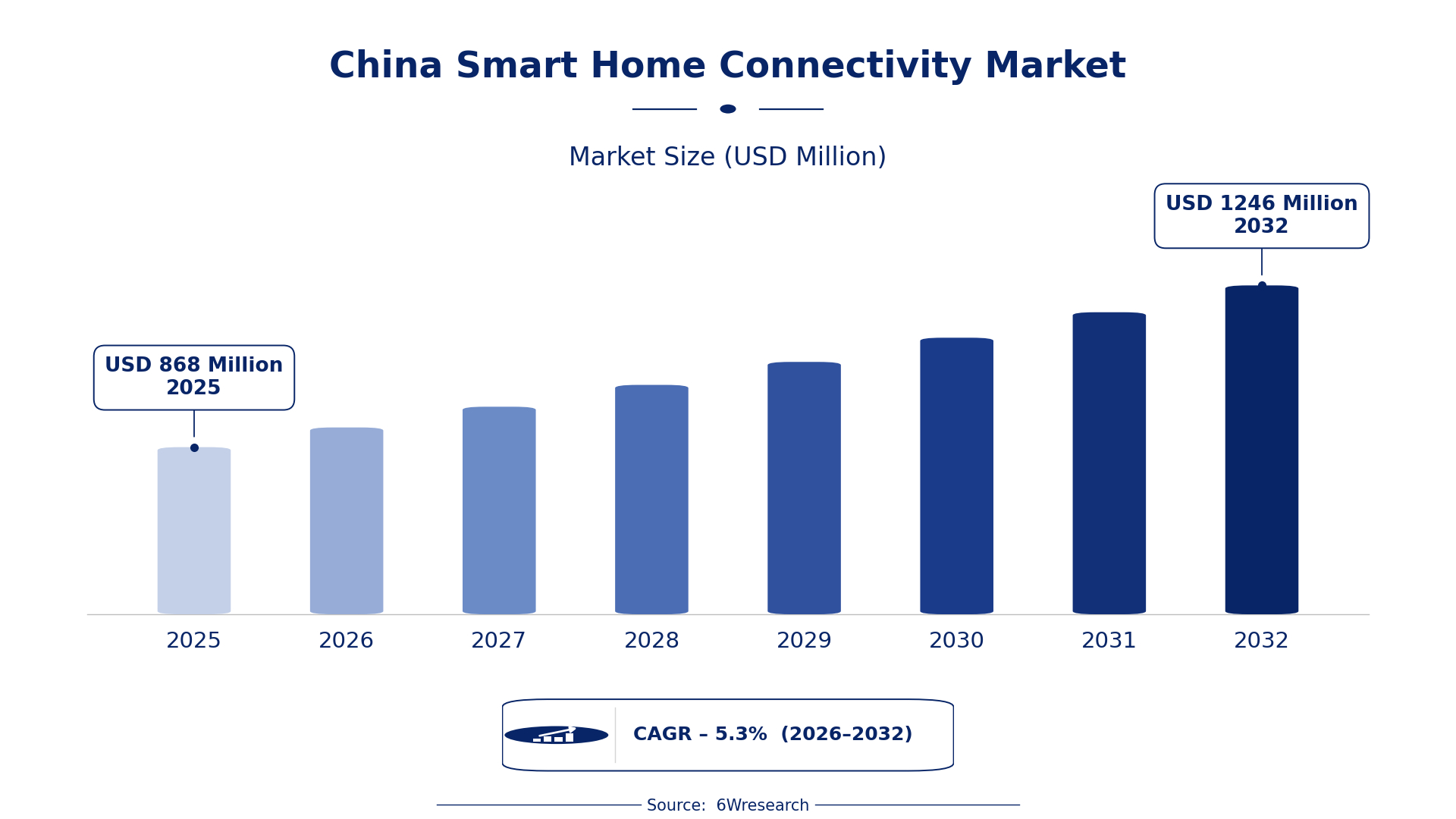
According to 6Wresearch internal database and industry insights, the China Smart Home Connectivity Market was valued at USD 868.0 million in 2025 and is projected to reach USD 1,246 million by 2032, growing at a CAGR of approximately 5.3% during 2026–2032.
China Smart Home Connectivity Market Highlights
| Report Metric | Details |
| Report Name | China Smart Home Connectivity Market |
| Market Size 2025 | USD 868.0 million |
| Market Size 2032 | USD 1,246 million |
| Absolute Growth 2025–2032 | USD 378 million |
| CAGR 2026–2032 | 5.3% |
| Peak Annual Growth | 7.6% in 2029 |
| Forecast Period | 2026–2032 |
| Historical Data | 2022–2025 |
| Base Year | 2025 |
| Leading Connectivity Type, 2025 | Wi-Fi Mesh Networks (45% share) |
| Leading Supported Devices, 2025 | Smart TVs (30% share) |
| Leading Protocol Type, 2025 | IEEE 802.11ax (41% share) |
| Leading End User, 2025 | Homeowners (40% share) |
| Fastest-Growing Connectivity Type | Zigbee/Z-Wave Hubs (7.4% CAGR) |
| Fastest-Growing Supported Devices | Thermostats (6.9% CAGR) |
| Fastest-Growing Protocol Type | Zigbee (6.7% CAGR) |
| Fastest-Growing End User | IoT Ecosystem Providers (7.6% CAGR) |
| Growing Sector | Home Automation |
| Key End Users | Homeowners, IoT Ecosystem Providers, Smart Home Builders, Consumer Electronics |
China Smart Home Connectivity Market Year-wise Growth Rate and Key Drivers (2022–2032)
This graph illustrates the annual growth rates of the market from 2022 to 2032, highlighting a steady upward trajectory and projected market expansion over the forecast period.
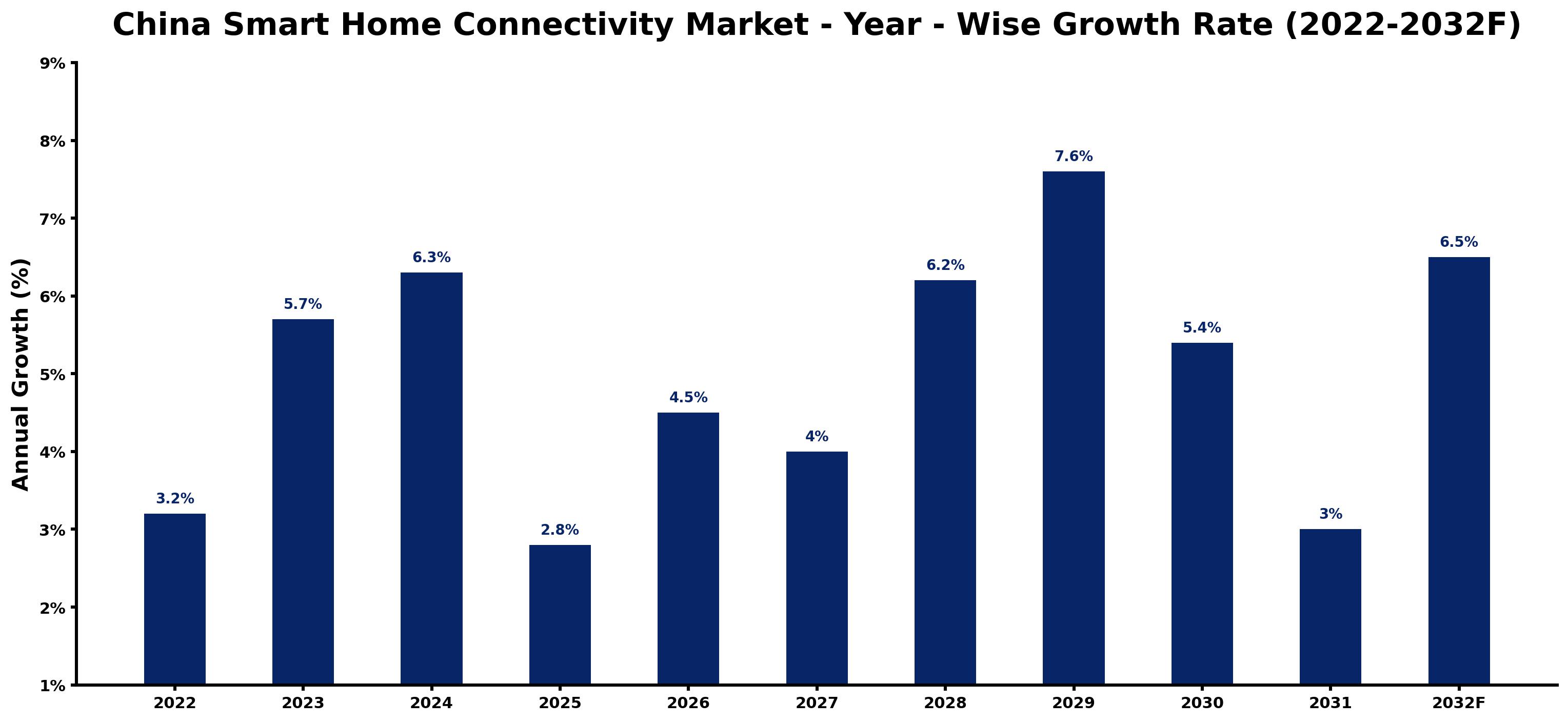
The table below sets out the estimated growth rate for each year and the main factor behind it.
| Year | Estimated Annual Growth (%) | Market Rationale |
| 2022 | 3.2 | The smart home market was well-established, with substantial adoption in urban areas. |
| 2023 | 5.7 | Demand accelerated as more homeowners integrated smart technologies into their daily lives, supported by the growing IoT sector. |
| 2024 | 6.3 | The market experienced strong growth due to rising consumer interest in home automation, particularly in urban settings. |
| 2025 | 2.8 | Growth slowed as market saturation began to affect new device sales, particularly in Wi-Fi Mesh Networks. |
| 2026 | 4.5 | A renewed focus on energy management devices is expected to spur increased investment in smart home solutions, driven by consumer demand. |
| 2027 | 4.0 | The market will continue to grow, driven by innovations in connectivity and device integration, particularly Zigbee and Z-Wave protocols. |
| 2028 | 6.2 | Consumer interest is projected to surge as smart home technologies become more affordable and accessible, particularly in urban areas. |
| 2029 | 7.6 | Peak growth will be driven by the widespread adoption of advanced protocols like Zigbee, enhancing device compatibility. |
| 2030 | 5.4 | Growth is expected to slow as competition intensifies and market maturity sets in, impacting new device sales. |
| 2031 | 3.0 | The market will continue to grow, supported by ongoing technological advancements and the integration of smart devices. |
| 2032 | 6.5 | Demand is projected to rise again as smart home solutions become integral to new home designs, particularly in urban developments. |
Note: Market size estimations and growth projections presented in this report are based on 6Wresearch's proprietary forecasting methodology, utilizing the latest available industry data, government publications, and primary research inputs.
China Smart Home Connectivity Market Synopsis
Smart Home Connectivity refers to the integration of various devices and systems within homes in China to improve automation and control. This technology is created through protocols like Wi-Fi and Zigbee, facilitating applications in home automation, security, and energy management. The China Smart Home Connectivity Market is experiencing rapid growth, driven by increasing urbanisation and the adoption of smart technologies in over 70% of new homes. Projections indicate that the number of smart home devices will exceed 1 billion by 2025, reflecting a significant shift in consumer preferences towards integrated solutions.
Market Dynamics Impact Analysis (2026–2032)
| Factor | Type | Impact | Primary Segment Affected |
| Increasing urbanisation and smart home adoption rates. | Driver | High | Zigbee/Z-Wave Hubs |
| Growing demand for energy management solutions. | Driver | High | Thermostats |
| Rising consumer interest in home automation technologies. | Opportunity | High | Smart TVs |
| Expansion of the IoT ecosystem with over 1,000 companies involved. | Opportunity | High | IoT Ecosystem Providers |
| Market saturation affecting new device sales. | Restraint | Medium | Wi-Fi Mesh Networks |
| Intense competition among various connectivity protocols limiting growth. | Restraint | Medium | Wi-Fi Mesh Networks |
| High initial costs of smart home installations can limit consumer uptake. | Challenge | Medium | Homeowners |
| Limited interoperability between devices from different manufacturers can frustrate users. | Challenge | Medium | Zigbee/Z-Wave Hubs |
Evaluation of Drivers in China Smart Home Connectivity Market (2026–2032)
Below mentioned are some major drivers and their influence on market dynamics.
| Drivers | Primary Segment Affected | Why It Matters (Evidence) |
| Urbanisation is driving demand for smart home solutions as more homes are built with integrated technology. | Smart TVs | Over 70% of new homes in urban areas are equipped with smart home technologies. |
| Energy management devices are increasingly sought after for their ability to optimise energy consumption. | Energy Management Devices | Smart thermostats are among the top-selling smart home devices, with millions sold annually. |
| The integration of Zigbee and Z-Wave protocols improves device compatibility and user experience. | Zigbee/Z-Wave Hubs | These protocols are the most common in smart home devices, facilitating connectivity. |
| The growing number of IoT providers is expanding the market for smart home technologies. | IoT Ecosystem Providers | The IoT sector in China includes over 1,000 companies focusing on smart home solutions. |
| Technological advancements in connectivity are improving the functionality of smart home devices. | Wi-Fi Mesh Networks | Wi-Fi Mesh Networks are essential for providing internet coverage in smart homes. |
Growth in the Smart Home Connectivity market in China is anchored in rising urbanisation, heightened demand for energy management, and the proliferation of smart technologies. In 2022, the market achieved a valuation of approximately 150 billion CNY, driven by the integration of smart technologies in over 70% of new homes. The number of smart home devices is expected to exceed 1 billion by 2025, signalling the growing consumer interest in home automation. The increasing number of IoT providers further propels market growth, with over 1,000 companies engaged in smart home technologies. Developments in connectivity are improving the functionality of smart home devices, leading to greater consumer adoption.
Evaluation of Restraints in China Smart Home Connectivity Market
The table below lists the restraints and the evidence behind each.
| Market Restraint | Primary Segment Affected | Why It Matters (Evidence) |
| Market saturation is limiting the growth of new smart home device sales. | Wi-Fi Mesh Networks | As the market matures, fewer new devices are being adopted in existing homes. |
| Intense competition among various connectivity protocols is constraining market expansion. | Wi-Fi Mesh Networks | Different protocols compete for market share, causing fragmentation in consumer choices. |
| Consumer hesitance towards technology adoption due to privacy concerns. | Homeowners | Privacy issues surrounding data security deter some homeowners from investing in smart devices. |
| High initial costs of smart home installations can limit consumer uptake. | Homeowners | The expense associated with setting up smart home systems can be a barrier for many homeowners. |
| Limited interoperability between devices from different manufacturers can frustrate users. | Zigbee/Z-Wave Hubs | Consumers often face challenges in integrating devices from various brands, affecting satisfaction. |
China Smart Home Connectivity Market Challenges
The China Smart Home Connectivity Market encounters several practical issues, starting with a lack of skilled professionals. This shortage stems from the rapid industry growth outpacing educational initiatives, causing project delays for suppliers who cannot find qualified workers. Supply chain issues also plague the market, as dependence on specific components results in product availability delays, frustrating buyers needing timely installations. High integration costs for smart devices hinder consumer adoption, while intense competition among suppliers drives down prices, leading some to compromise on quality, which ultimately impacts product reliability for buyers.
Trends in the China Smart Home Connectivity Market
Buyers and suppliers in the China Smart Home Connectivity Market are adjusting to the following trends.
- Shift Towards Energy-Efficient Smart Home Solutions: In 2023, the 'Green Building Action Plan' initiated provisions for smart home technologies to improve energy efficiency. This has led to increased sales of energy management devices, with millions sold annually.
- Homeowners Embracing Smart Home Technologies: Homeowners in urban areas are increasingly adopting smart technologies, with over 70% of new homes equipped. This trend is projected to drive further demand for smart home connectivity solutions.
- Rise of Zigbee Protocol Adoption: Zigbee is becoming the preferred protocol for smart home devices, with a projected growth rate of 6.7% from 2026 to 2032. This shift improves compatibility and user experience across devices.
- Integration of Smart Home Devices into New Constructions: In 2023, smart home builders are increasingly incorporating smart technologies into new constructions. This trend is expected to drive demand for smart home connectivity solutions.
Investment Opportunities in the China Smart Home Connectivity Market
Below are the investment opportunities with the strongest case in the China Smart Home Connectivity Market.
- Growing Demand for Smart Home Devices: With the smart home market projected to reach a valuation of 150 billion CNY by 2025, there exists a substantial gap for suppliers to meet rising consumer demand for smart devices. Homeowners are increasingly seeking integrated solutions.
- Investment in Energy Management Technologies: The demand for energy management devices is on the rise, with millions sold annually. IoT providers can capitalise on this trend by developing energy-efficient solutions that appeal to environmentally conscious consumers.
- Partnerships with Smart Home Builders: Collaborating with smart home builders can provide opportunities to supply integrated smart home solutions. This is particularly relevant in regions like Beijing, where adoption rates are high.
- Expansion into Urban Markets: Urban homeowners are increasingly adopting smart technologies, creating opportunities for suppliers. Engaging in joint ventures with local partners can facilitate market entry.
Government Initiatives in the China Smart Home Connectivity Market
The 'Smart Home Development Plan' launched by the Ministry of Industry and Information Technology in 2021 promotes the integration of smart home technologies. This plan builds on previous initiatives by setting clear guidelines for innovation and development in the sector, improving the overall framework for smart home connectivity. The plan aims to increase the adoption of smart home solutions in urban areas, targeting a 30% increase in smart home installations by 2025.
The National Development and Reform Commission is responsible for approving the 'IoT Industry Development Strategy', which aims to improve smart home connectivity across the country. This strategy supports infrastructure development and innovation, facilitating the integration of smart technologies in residential buildings. The State Administration for Market Regulation also updates standards for smart home devices, enhancing safety and interoperability, benefiting both producers and consumers.
Future Insight of the China Smart Home Connectivity Market
The outlook for the China Smart Home Connectivity Market through 2032 indicates substantial changes driven by technological advancements and new regulations. The National Standard for Smart Home Systems will improve compatibility and reliability, encouraging wider consumer adoption. By 2025, the number of smart home devices is expected to exceed 1 billion, enabling more seamless integration for buyers. Urban areas like Beijing will continue to lead in technology adoption, fostering innovation and collaboration among suppliers and developers.
Market Segmentation Analysis
Each segment group is reviewed below, with the leader by share and the fastest grower by CAGR.
By Connectivity Type – Wi-Fi Mesh Networks Dominated, Zigbee/Z-Wave Hubs Expected to Grow Fastest
According to Dhaval Chaurasia, Assistant Manager at 6Wresearch, Wi-Fi Mesh Networks held a 45% share of the China Smart Home Connectivity Market by connectivity type in 2025. Wi-Fi Mesh Networks dominate the market due to their crucial role in ensuring seamless internet coverage, vital for the operation of smart home devices. This type of connectivity is particularly important as over 70% of new homes in urban areas are now equipped with smart technologies. The quickest growth will come from Zigbee/Z-Wave Hubs, forecast to expand at a CAGR of 7.4% between 2026 and 2032. Zigbee/Z-Wave Hubs are experiencing rapid growth as they efficiently connect a variety of smart devices using low-power wireless protocols, making them ideal for energy-conscious homeowners. The anticipated increase of smart home devices in China, projected to surpass 1 billion by 2025, significantly fuels this demand. Suppliers should focus on enhancing compatibility with Zigbee/Z-Wave to meet the rising expectations of homeowners.
By Supported Devices – Smart TVs Dominated, Thermostats Expected to Grow Fastest
Smart TVs accounted for a 30% market share by supported devices in 2025. Smart TVs hold the largest market share as they are frequently integrated into smart home systems, providing entertainment and control for users. Their extensive adoption is reflected in high sales figures, which greatly contribute to the overall smart home connectivity market. Thermostats are projected to grow fastest, at a CAGR of 6.9% during 2026–2032. Thermostats are the fastest-growing segment, driven by the increasing demand for energy management and climate control solutions within smart homes. The introduction of the National Standard for Smart Home Systems in 2023 highlights the significance of these devices in modern households. Buyers are increasingly prioritising energy-efficient solutions, prompting suppliers to innovate in smart thermostat technologies.
By Protocol Type – IEEE 802.11ax Dominated, Zigbee Expected to Grow Fastest
In 2025, IEEE 802.11ax led the protocol type split with a 41% share. The IEEE 802.11ax standard leads the market by significantly improving connectivity for a range of smart devices in homes. Its broad adoption is essential as the smart home ecosystem expands with a growing number of connected devices. Over 2026–2032, Zigbee is expected to post the fastest growth, at a CAGR of 6.7%. Zigbee is the fastest-growing protocol, widely adopted for low-power smart home devices, making it crucial for efficient home automation. The 'Smart Home Development Plan' launched by the Ministry of Industry and Information Technology supports the expansion of this protocol in the market. Suppliers must ensure their devices are compatible with Zigbee to leverage its swift adoption among consumers.
By End User – Homeowners Dominated, IoT Ecosystem Providers Expected to Grow Fastest
With a 40% revenue share in 2025, Homeowners was the largest end user category. Homeowners represent the largest market share as they are the primary users of smart home connectivity solutions. Their increasing investment in smart technologies reflects a broader trend towards home automation and enhanced convenience. IoT Ecosystem Providers are set to record the highest CAGR in this split, 7.6% over 2026–2032. IoT Ecosystem Providers are the fastest-growing segment, playing a vital role in the development and implementation of smart home technologies. The robust IoT ecosystem in China, featuring over 1,000 companies, underscores their importance in driving market growth. Suppliers should collaborate with IoT Ecosystem Providers to enhance their offerings and better cater to the needs of homeowners.
Key Attractiveness of the Report
- 10 Years of Market Numbers
- Historical Data Starting from 2022 to 2025
- Base Year 2025
- Forecast Data until 2032
- Key Performance Indicators Impacting the Market
- Major Upcoming Developments and Projects
Key Highlights of the Report:
- China Smart Home Connectivity Market Outlook
- Market Size of China Smart Home Connectivity Market, 2025
- Forecast of China Smart Home Connectivity Market, 2032
- Historical Data and Forecast of China Smart Home Connectivity Revenues & Volume for the Period 2022 - 2032F
- China Smart Home Connectivity Market Trend Evolution
- China Smart Home Connectivity Market Drivers and Challenges
- China Smart Home Connectivity Price Trends
- China Smart Home Connectivity Porter's Five Forces
- China Smart Home Connectivity Industry Life Cycle
- Historical Data and Forecast of China Smart Home Connectivity Market Revenues & Volume By Connectivity Type for the Period 2022 - 2032F
- Historical Data and Forecast of China Smart Home Connectivity Market Revenues & Volume By Wi-Fi Mesh Networks for the Period 2022 - 2032F
- Historical Data and Forecast of China Smart Home Connectivity Market Revenues & Volume By Zigbee/Z-Wave Hubs for the Period 2022 - 2032F
- Historical Data and Forecast of China Smart Home Connectivity Market Revenues & Volume By Thread Networks for the Period 2022 - 2032F
- Historical Data and Forecast of China Smart Home Connectivity Market Revenues & Volume By Bluetooth Low Energy for the Period 2022 - 2032F
- Historical Data and Forecast of China Smart Home Connectivity Market Revenues & Volume By Supported Devices for the Period 2022 - 2032F
- Historical Data and Forecast of China Smart Home Connectivity Market Revenues & Volume By Smart TVs, Thermostats for the Period 2022 - 2032F
- Historical Data and Forecast of China Smart Home Connectivity Market Revenues & Volume By Lights, Locks, Alarms for the Period 2022 - 2032F
- Historical Data and Forecast of China Smart Home Connectivity Market Revenues & Volume By Energy Management Devices for the Period 2022 - 2032F
- Historical Data and Forecast of China Smart Home Connectivity Market Revenues & Volume By Wearables, Sensors for the Period 2022 - 2032F
- Historical Data and Forecast of China Smart Home Connectivity Market Revenues & Volume By Protocol Type for the Period 2022 - 2032F
- Historical Data and Forecast of China Smart Home Connectivity Market Revenues & Volume By IEEE 802.11ax for the Period 2022 - 2032F
- Historical Data and Forecast of China Smart Home Connectivity Market Revenues & Volume By Zigbee, Z-Wave for the Period 2022 - 2032F
- Historical Data and Forecast of China Smart Home Connectivity Market Revenues & Volume By IP-Based Protocol for the Period 2022 - 2032F
- Historical Data and Forecast of China Smart Home Connectivity Market Revenues & Volume By BLE 5.0 for the Period 2022 - 2032F
- Historical Data and Forecast of China Smart Home Connectivity Market Revenues & Volume By End User for the Period 2022 - 2032F
- Historical Data and Forecast of China Smart Home Connectivity Market Revenues & Volume By Homeowners for the Period 2022 - 2032F
- Historical Data and Forecast of China Smart Home Connectivity Market Revenues & Volume By IoT Ecosystem Providers for the Period 2022 - 2032F
- Historical Data and Forecast of China Smart Home Connectivity Market Revenues & Volume By Smart Home Builders for the Period 2022 - 2032F
- Historical Data and Forecast of China Smart Home Connectivity Market Revenues & Volume By Consumer Electronics for the Period 2022 - 2032F
- China Smart Home Connectivity Import Export Trade Statistics
- Market Opportunity Assessment By Connectivity Type
- Market Opportunity Assessment By Supported Devices
- Market Opportunity Assessment By Protocol Type
- Market Opportunity Assessment By End User
- China Smart Home Connectivity Top Companies Market Share
- China Smart Home Connectivity Competitive Benchmarking By Technical and Operational Parameters
- China Smart Home Connectivity Company Profiles
- China Smart Home Connectivity Key Strategic Recommendations
Market Covered
This report examines the market across the segments below.
By Connectivity Type
- Wi-Fi Mesh Networks
- Zigbee/Z-Wave Hubs
- Thread Networks
- Bluetooth Low Energy
By Supported Devices
- Smart TVs
- Thermostats
- Lights
- Locks
- Alarms
- Energy Management Devices
- Wearables
- Sensors
By Protocol Type
- IEEE 802.11ax
- Zigbee
- Z-Wave
- IP-Based Protocol
- BLE 5.0
By End User
- Homeowners
- IoT Ecosystem Providers
- Smart Home Builders
- Consumer Electronics































