India Smart Home Sensor AI Market Size & Growth Rate
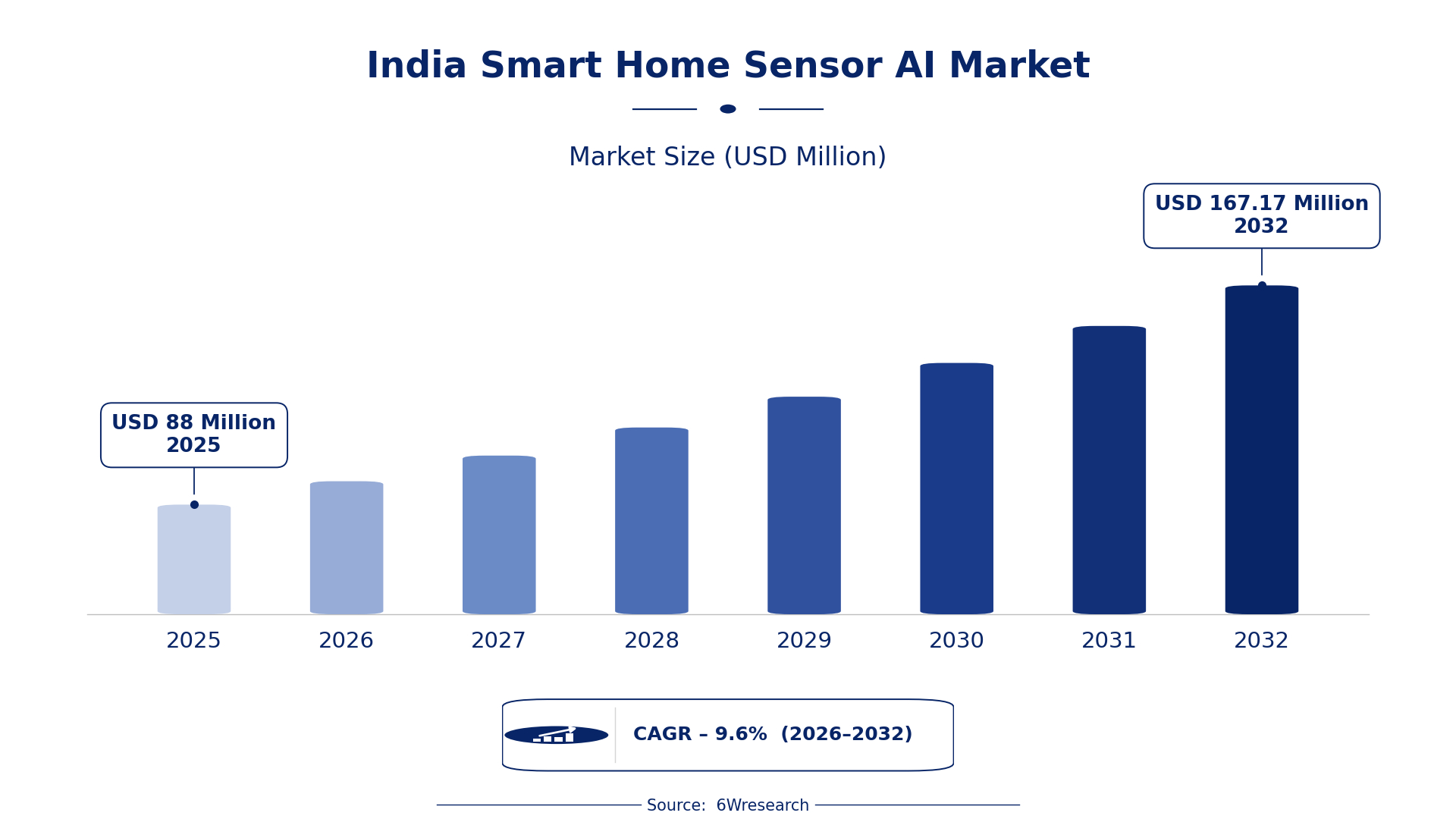
According to 6Wresearch internal database and industry insights, the India Smart Home Sensor AI Market was valued at USD 88.0 million in 2025 and is projected to reach USD 167.17 million by 2032, growing at a CAGR of approximately 9.6% during 2026–2032.
India Smart Home Sensor AI Market Highlights
| Report Metric | Details |
| Report Name | India Smart Home Sensor AI Market |
| Market Size 2025 | USD 88.0 million |
| Market Size 2032 | USD 167.17 million |
| Absolute Growth 2025–2032 | USD 79.17 million |
| CAGR 2026–2032 | 9.6% |
| Peak Annual Growth | 11.6% in 2030 |
| Forecast Period | 2026–2032 |
| Historical Data | 2022–2025 |
| Base Year | 2025 |
| Leading Sensor Type, 2025 | Motion Sensors (44% share) |
| Leading AI Feature, 2025 | Occupant Behavior Prediction (43% share) |
| Leading Area of Application, 2025 | Lighting (43% share) |
| Leading End User, 2025 | Homeowners (45% share) |
| Fastest-Growing Sensor Type | Air Quality Sensors (12.0% CAGR) |
| Fastest-Growing AI Feature | Pollution/CO2 Monitoring (11.9% CAGR) |
| Fastest-Growing Area of Application | HVAC Systems (11.3% CAGR) |
| Fastest-Growing End User | Smart HVAC Providers (12.0% CAGR) |
| Growing Sector | Home Automation |
| Key End Users | Homeowners, Smart HVAC Providers, Home Automation Firms |
India Smart Home Sensor AI Market Year-wise Growth Rate and Key Drivers (2022–2032)
This graph illustrates the annual growth rates of the market from 2022 to 2032, highlighting a steady upward trajectory and projected market expansion over the forecast period.
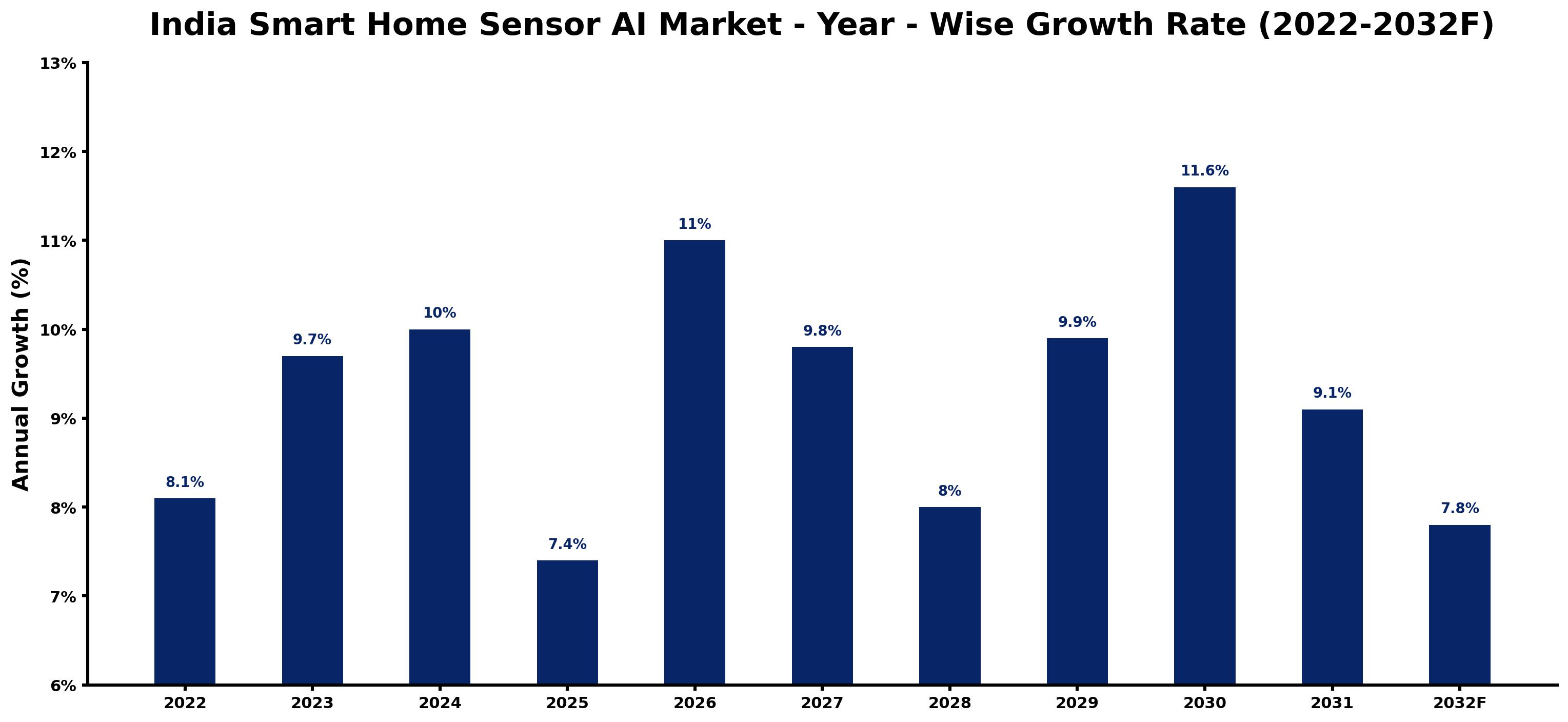
The table below sets out the estimated growth rate for each year and the main factor behind it.
| Year | Estimated Annual Growth (%) | Market Rationale |
| 2022 | 8.1 | The market showed steady growth due to increasing urbanisation and technology adoption. |
| 2023 | 9.7 | Demand rose as more homeowners sought energy-efficient solutions and automation. |
| 2024 | 10.0 | The growth continued with the introduction of new smart home products in urban areas. |
| 2025 | 7.4 | A slight slowdown occurred as market saturation began in some regions. |
| 2026 | 11.0 | Demand surged again with increased investments in smart home technologies. |
| 2027 | 9.8 | Growth slowed slightly due to intensified competition among local providers. |
| 2028 | 8.0 | The market continued to grow as awareness of smart home benefits increased. |
| 2029 | 9.9 | Demand picked up with more urban households adopting smart technologies. |
| 2030 | 11.6 | The peak growth year saw advancements in AI integration in homes. |
| 2031 | 9.1 | Growth decelerated as the market matured and competition heightened. |
| 2032 | 7.8 | A further slowdown is expected as the market stabilises with established players. |
Note: Market size estimations and growth projections presented in this report are based on 6Wresearch's proprietary forecasting methodology, utilizing the latest available industry data, government publications, and primary research inputs.
India Smart Home Sensor AI Market Synopsis
The India Smart Home Sensor AI Market encompasses advanced devices that improve home automation through various sensors. These sensors, made from semiconductor materials, contribute to energy efficiency, security, and air quality monitoring. The market is expanding due to rising urbanisation and growing interest in smart technologies. With approximately 15% penetration of smart home devices in urban areas as of 2023, homeowners are increasingly investing in these solutions. The Smart Cities Mission and the Digital India initiative are driving this growth.
Market Dynamics Impact Analysis (2026–2032)
| Factor | Type | Impact | Primary Segment Affected |
| Increased urbanisation drives demand for smart home solutions. | Driver | High | Motion Sensors |
| Growing environmental concerns boost air quality sensor adoption. | Driver | High | Air Quality Sensors |
| Investment in smart home technologies is rising, providing opportunities for suppliers. | Opportunity | High | Motion Sensors |
| Urban homeowners are increasingly seeking energy-efficient solutions. | Opportunity | High | Homeowners |
| High initial costs deter some homeowners from adopting smart technologies. | Restraint | Medium | Homeowners |
| Limited awareness of smart home benefits restricts broader adoption. | Restraint | Medium | Motion Sensors |
| Technological integration challenges can delay product deployment. | Challenge | High | Motion Sensors |
| Regulatory compliance can be complex and time-consuming for manufacturers. | Challenge | Medium | Motion Sensors |
Evaluation of Drivers in India Smart Home Sensor AI Market (2026–2032)
Key forces behind demand, with the segment each one moves most, are listed below.
| Drivers | Primary Segment Affected | Why It Matters (Evidence) |
| Rising urbanisation increases the need for smart home solutions. | Motion Sensors | As of 2023, 15% of urban households have adopted smart home devices. |
| Environmental concerns drive demand for air quality sensors. | Air Quality Sensors | Increased use of these sensors is due to pollution levels in urban areas. |
| Investment in smart city projects boosts smart home technology adoption. | Motion Sensors | The Indian government allocated ₹500 crore for smart city projects in 2023. |
| Homeowners are increasingly interested in energy management solutions. | Homeowners | The average household invests ₹20,000 on smart home devices, indicating strong demand. |
| Technological advancements in AI improve sensor capabilities. | Motion Sensors | The integration of AI features is projected to improve user experience. |
Expansion of the Smart Home Sensor AI market in India is backed by rising urbanisation, environmental concerns, and increased investments in smart city projects. As of 2023, 15% of urban households have adopted smart home devices, driving demand for energy-efficient solutions. Urban areas are increasingly using air quality sensors due to pollution, creating further demand. Homeowners are willing to invest an average of ₹20,000 on smart home devices, reflecting a strong market interest in energy management solutions.
Evaluation of Restraints in India Smart Home Sensor AI Market
The following restraints limit how fast demand can grow.
| Market Restraint | Primary Segment Affected | Why It Matters (Evidence) |
| High initial costs deter some homeowners from adopting smart technologies. | Homeowners | The average household spends ₹20,000 on smart home devices, which can be prohibitive. |
| Limited awareness of smart home benefits restricts broader adoption. | Motion Sensors | Many potential users remain unaware of the advantages of smart home technologies. |
| Technological integration challenges can delay product deployment. | Motion Sensors | Complexities in integrating various technologies can slow down implementation. |
| Regulatory compliance can be complex and time-consuming for manufacturers. | Motion Sensors | Manufacturers face challenges in meeting various standards and regulations. |
| Market saturation in urban areas may limit growth potential. | Motion Sensors | As penetration reaches 15%, new customer acquisition becomes more challenging. |
India Smart Home Sensor AI Market Challenges
The India Smart Home Sensor AI market still has to overcome several key challenges, starting with low adoption rates among consumers. Currently, only about 15% of urban households utilise smart home devices, which restricts revenue opportunities for producers. Supply chain difficulties, particularly in sourcing semiconductor materials, delay product availability and limit options for consumers. Installation costs, averaging ₹20,000 per household, discourage many potential buyers from investing in smart technologies. Additionally, a shortage of skilled technicians complicates installation processes, resulting in longer service times and dissatisfaction for consumers.
Trends in the India Smart Home Sensor AI Market
Four trends stand out in the India Smart Home Sensor AI Market.
- Shift towards Energy Management Solutions: Homeowners are increasingly prioritising energy efficiency in their smart home setups. In 2023, over 100,000 homes in Delhi were equipped with smart sensors for energy management, reflecting this trend.
- Growing Adoption of Air Quality Sensors: Air quality sensors are becoming essential in urban areas due to rising pollution levels. Their adoption is expected to increase by 12% annually, addressing health concerns.
- Integration of AI in Smart Home Devices: The integration of AI features in smart home devices is on the rise, with Pollution/CO2 Monitoring expected to grow at 11.9% from 2026 to 2032, improving user experience.
- Expansion of Smart Cities Initiative: The Smart Cities Mission is driving the adoption of smart home technologies across urban areas. With a budget of ₹100,000 crore, it aims to integrate these solutions into urban planning.
Investment Opportunities in the India Smart Home Sensor AI Market
Below are the investment opportunities with the strongest case in the India Smart Home Sensor AI Market.
- Partnerships with Local Installers: Local partnerships can ease market entry for smart home technologies. Home automation firms in Maharashtra are exploring solutions to meet rising demand.
- Investment in Energy Management Solutions: Investing in energy-efficient smart home devices is crucial now, particularly in urban areas. Homeowners are increasingly seeking ways to lower energy costs.
- Supply of Air Quality Monitoring Devices: There is a growing demand for air quality sensors in cities grappling with pollution issues. Urban areas like Delhi offer substantial opportunities for suppliers.
- Approval for Smart Home Innovations: Securing certifications for smart home devices can unlock new market avenues. The Bureau of Indian Standards is actively promoting compliance with smart home product guidelines.
Government Initiatives in the India Smart Home Sensor AI Market
The Smart Cities Mission, launched by the Ministry of Housing and Urban Affairs in 2020, aims to promote smart home technologies in urban areas with a budget of ₹100,000 crore. This initiative encourages the integration of smart solutions into urban planning, enhancing living standards for residents. The National Policy on Electronics 2019 supports the development of smart home technologies, targeting a $400 billion electronics manufacturing industry by 2025. This policy encourages innovation and investment in smart home solutions, benefiting both manufacturers and consumers.
The Bureau of Energy Efficiency oversees the creation of guidelines for energy-efficient smart home devices, improving market standards for manufacturers. These guidelines ensure that products meet specific efficiency criteria, benefiting consumers through reduced energy costs. The Digital India programme supports the adoption of smart home technology across India, facilitating various projects aimed at enhancing digital infrastructure and accessibility.
Future Insight of the India Smart Home Sensor AI Market
Several forward-looking factors are set to drive the India Smart Home Sensor AI market towards growth by 2032. The Smart Cities Mission will incorporate smart home technologies into urban planning, boosting adoption rates. The Indian government’s allocation of ₹500 crore for smart city initiatives will enhance funding for innovative solutions. The Digital India initiative will promote advancements in smart home products, further encouraging consumer interest. By 2025, installations of smart HVAC systems are projected to increase by 25%, reflecting rising demand for energy-efficient solutions.
Market Segmentation Analysis
Each segment group is reviewed below, with the leader by share and the fastest grower by CAGR.
By Sensor Type – Motion Sensors Dominated, Air Quality Sensors Expected to Grow Fastest
According to Dhaval Chaurasia, Assistant Manager at 6Wresearch, the largest sensor type category in 2025 was Motion Sensors, with a 44% share of total revenue. Motion sensors hold the largest market share as they are crucial for security and home automation. For instance, over 100,000 homes in Delhi utilise these sensors to enhance safety and streamline daily activities. Air Quality Sensors are set to record the highest CAGR in this split, 12.0% over 2026–2032. Air quality sensors are witnessing rapid growth due to rising pollution levels, especially in cities like Delhi and Mumbai. This heightened concern for environmental health is significantly driving the demand for effective monitoring solutions. Suppliers should prioritise the development of advanced air quality sensors to leverage this expanding market segment.
By AI Feature – Occupant Behavior Prediction Dominated, Pollution/CO2 Monitoring Expected to Grow Fastest
In 2025, Occupant Behavior Prediction led the ai feature split with a 43% share. Occupant behaviour prediction features dominate the market as they are essential for creating personalised experiences in smart home systems. This technology optimises energy usage and improves comfort levels in residential environments, making it highly sought after. Pollution/CO2 Monitoring is projected to grow fastest, at a CAGR of 11.9% during 2026–2032. Pollution and CO2 monitoring capabilities are gaining popularity as consumers increasingly prioritise health and environmental awareness. The integration of these features in smart home systems reflects a shift towards enhancing air quality. Buyers will benefit from investing in smart home systems that include pollution monitoring to promote healthier living conditions.
By Area of Application – Lighting Dominated, HVAC Systems Expected to Grow Fastest
Lighting held a 43% share of the India Smart Home Sensor AI Market by area of application in 2025. Lighting applications lead the market due to their significant role in enhancing convenience and energy efficiency in homes. The rise of automated lighting systems in urban areas is improving user experiences while reducing energy consumption. Over 2026–2032, HVAC Systems are expected to post the fastest growth, at a CAGR of 11.3%. HVAC systems are projected to experience rapid growth as they become integrated into smart home solutions for better climate management. The anticipated 25% increase in installations by 2025 highlights the demand for efficient climate control. Suppliers should focus on HVAC innovations to meet the increasing demand for integrated climate management solutions in smart homes.
By End User – Homeowners Dominated, Smart HVAC Providers Expected to Grow Fastest
Homeowners accounted for a 45% market share by end user in 2025. Homeowners account for the largest market share as they are the primary users of smart home technology, seeking improved convenience and security. The average household in India spends approximately ₹20,000 on these devices, reflecting strong consumer interest. The quickest growth will come from Smart HVAC Providers, forecast to expand at a CAGR of 12.0% between 2026 and 2032. Smart HVAC providers are experiencing the fastest growth as they are integral to the integration of smart climate solutions in homes. The rising emphasis on energy efficiency positions this segment for substantial expansion. Suppliers should collaborate with smart HVAC providers to align their products with the preferences of homeowners pursuing efficient climate solutions.
Key Attractiveness of the Report
- 10 Years of Market Numbers
- Historical Data Starting from 2022 to 2025
- Base Year 2025
- Forecast Data until 2032
- Key Performance Indicators Impacting the Market
- Major Upcoming Developments and Projects
Key Highlights of the Report:
- India Smart Home Sensor AI Market Outlook
- Market Size of India Smart Home Sensor AI Market, 2025
- Forecast of India Smart Home Sensor AI Market, 2032
- Historical Data and Forecast of India Smart Home Sensor AI Revenues & Volume for the Period 2022 - 2032F
- India Smart Home Sensor AI Market Trend Evolution
- India Smart Home Sensor AI Market Drivers and Challenges
- India Smart Home Sensor AI Price Trends
- India Smart Home Sensor AI Porter's Five Forces
- India Smart Home Sensor AI Industry Life Cycle
- Historical Data and Forecast of India Smart Home Sensor AI Market Revenues & Volume By Sensor Type for the Period 2022 - 2032F
- Historical Data and Forecast of India Smart Home Sensor AI Market Revenues & Volume By Motion Sensors for the Period 2022 - 2032F
- Historical Data and Forecast of India Smart Home Sensor AI Market Revenues & Volume By Temperature Sensors for the Period 2022 - 2032F
- Historical Data and Forecast of India Smart Home Sensor AI Market Revenues & Volume By Air Quality Sensors for the Period 2022 - 2032F
- Historical Data and Forecast of India Smart Home Sensor AI Market Revenues & Volume By Leakage Sensors for the Period 2022 - 2032F
- Historical Data and Forecast of India Smart Home Sensor AI Market Revenues & Volume By AI Feature for the Period 2022 - 2032F
- Historical Data and Forecast of India Smart Home Sensor AI Market Revenues & Volume By Occupant Behavior Prediction for the Period 2022 - 2032F
- Historical Data and Forecast of India Smart Home Sensor AI Market Revenues & Volume By Adaptive Climate Control for the Period 2022 - 2032F
- Historical Data and Forecast of India Smart Home Sensor AI Market Revenues & Volume By Pollution/CO2 Monitoring for the Period 2022 - 2032F
- Historical Data and Forecast of India Smart Home Sensor AI Market Revenues & Volume By Predictive Water Risk for the Period 2022 - 2032F
- Historical Data and Forecast of India Smart Home Sensor AI Market Revenues & Volume By Area of Application for the Period 2022 - 2032F
- Historical Data and Forecast of India Smart Home Sensor AI Market Revenues & Volume By Lighting, Security for the Period 2022 - 2032F
- Historical Data and Forecast of India Smart Home Sensor AI Market Revenues & Volume By HVAC Systems for the Period 2022 - 2032F
- Historical Data and Forecast of India Smart Home Sensor AI Market Revenues & Volume By Environment Monitoring for the Period 2022 - 2032F
- Historical Data and Forecast of India Smart Home Sensor AI Market Revenues & Volume By Bathrooms/Kitchens for the Period 2022 - 2032F
- Historical Data and Forecast of India Smart Home Sensor AI Market Revenues & Volume By End User for the Period 2022 - 2032F
- Historical Data and Forecast of India Smart Home Sensor AI Market Revenues & Volume By Homeowners for the Period 2022 - 2032F
- Historical Data and Forecast of India Smart Home Sensor AI Market Revenues & Volume By Smart HVAC Providers for the Period 2022 - 2032F
- Historical Data and Forecast of India Smart Home Sensor AI Market Revenues & Volume By Home Automation Firms for the Period 2022 - 2032F
- Historical Data and Forecast of India Smart Home Sensor AI Market Revenues & Volume By Plumbers & Contractors for the Period 2022 - 2032F
- India Smart Home Sensor AI Import Export Trade Statistics
- Market Opportunity Assessment By Sensor Type
- Market Opportunity Assessment By AI Feature
- Market Opportunity Assessment By Area of Application
- Market Opportunity Assessment By End User
- India Smart Home Sensor AI Top Companies Market Share
- India Smart Home Sensor AI Competitive Benchmarking By Technical and Operational Parameters
- India Smart Home Sensor AI Company Profiles
- India Smart Home Sensor AI Key Strategic Recommendations
Market Covered
This report examines the market across the segments below.
By Sensor Type
- Motion Sensors
- Temperature Sensors
- Air Quality Sensors
- Leakage Sensors
By AI Feature
- Occupant Behavior Prediction
- Adaptive Climate Control
- Pollution/CO2 Monitoring
- Predictive Water Risk
By Area of Application
- Lighting
- Security
- HVAC Systems
- Environment Monitoring
- Bathrooms/Kitchens
By End User
- Homeowners
- Smart HVAC Providers
- Home Automation Firms
- Plumbers & Contractors































