China Smart Home Sensor AI Market Size & Growth Rate
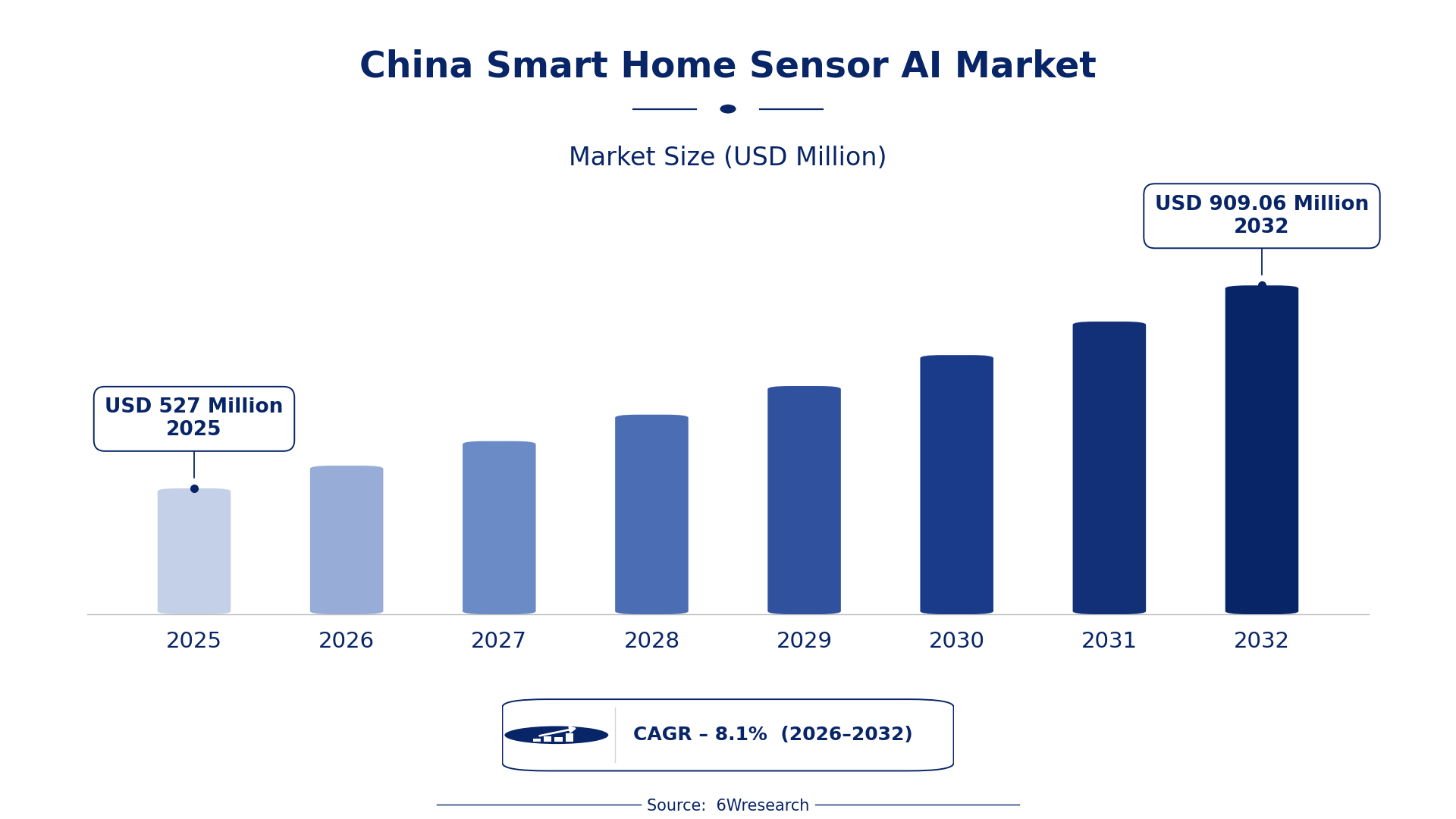
According to 6Wresearch internal database and industry insights, the China Smart Home Sensor AI Market was valued at USD 527.0 million in 2025 and is projected to reach USD 909.06 million by 2032, growing at a CAGR of approximately 8.1% during 2026–2032.
China Smart Home Sensor AI Market Highlights
| Report Metric | Details |
| Report Name | China Smart Home Sensor AI Market |
| Market Size 2025 | USD 527.0 million |
| Market Size 2032 | USD 909.06 million |
| Absolute Growth 2025–2032 | USD 382.06 million |
| CAGR 2026–2032 | 8.1% |
| Peak Annual Growth | 9.9% in 2032 |
| Forecast Period | 2026–2032 |
| Historical Data | 2022–2025 |
| Base Year | 2025 |
| Leading Sensor Type, 2025 | Motion Sensors (45% share) |
| Leading AI Feature, 2025 | Occupant Behavior Prediction (48% share) |
| Leading Area of Application, 2025 | Lighting (37% share) |
| Leading End User, 2025 | Homeowners (50% share) |
| Fastest-Growing Sensor Type | Temperature Sensors (10.5% CAGR) |
| Fastest-Growing AI Feature | Adaptive Climate Control (9.9% CAGR) |
| Fastest-Growing Area of Application | Security (10.3% CAGR) |
| Fastest-Growing End User | Smart HVAC Providers (10.0% CAGR) |
| Growing Sector | Home Automation |
| Key End Users | Homeowners, Smart HVAC Providers, Home Automation Firms |
China Smart Home Sensor AI Market Year-wise Growth Rate and Key Drivers (2022–2032)
This graph illustrates the annual growth rates of the market from 2022 to 2032, highlighting a steady upward trajectory and projected market expansion over the forecast period.
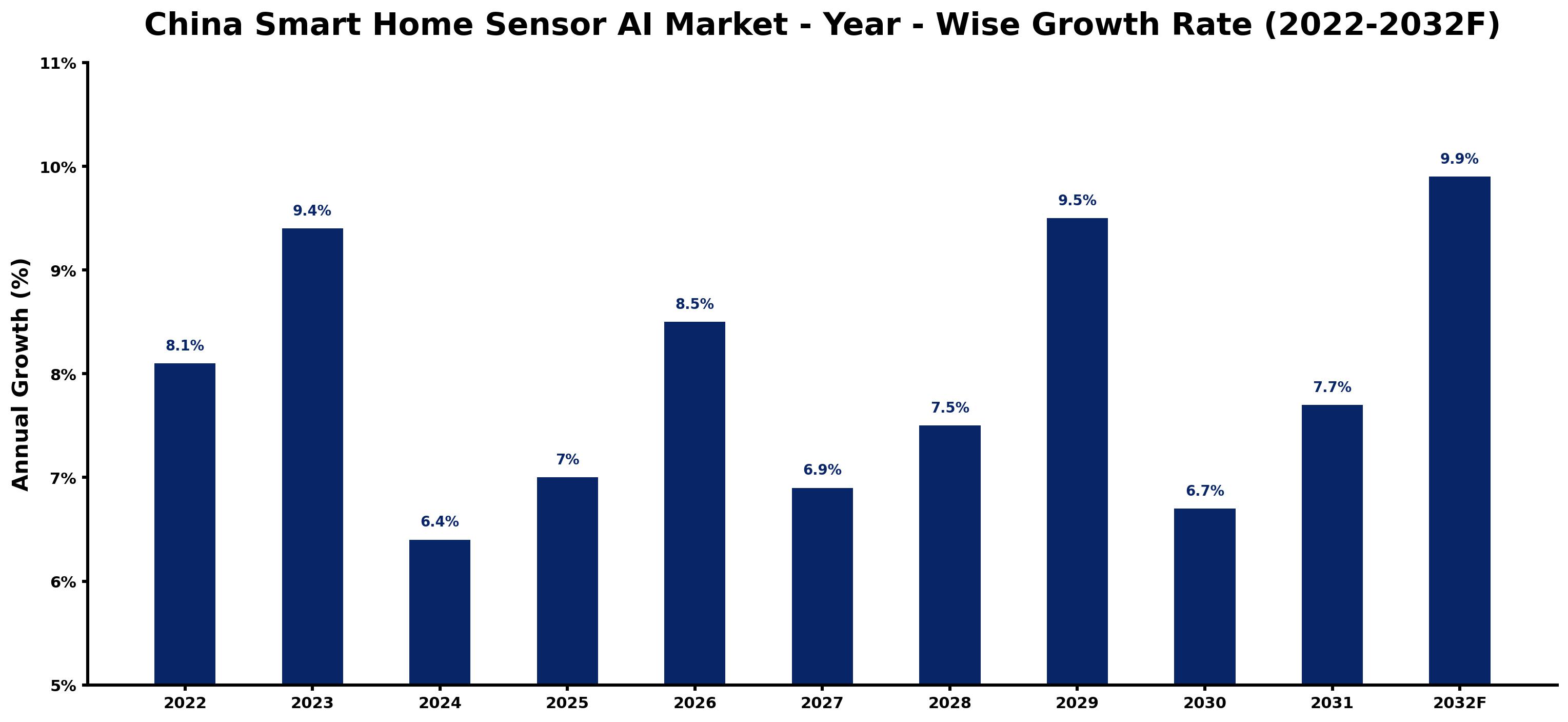
Below, each year's estimated growth is shown next to the factor that most influenced it.
| Year | Estimated Annual Growth (%) | Market Rationale |
| 2022 | 8.1 | The market experienced solid growth driven by increasing consumer interest in home automation technologies. |
| 2023 | 9.4 | Demand surged as the number of smart home users surpassed 400 million, boosting sensor adoption. |
| 2024 | 6.4 | Growth slowed due to market saturation as many households reached optimal device levels. |
| 2025 | 7.0 | The market rebounded with increased investments in smart home technologies and energy management solutions. |
| 2026 | 8.5 | Demand accelerated as the average household installed more smart devices, enhancing automation capabilities. |
| 2027 | 6.9 | Growth decelerated as competition intensified among smart home technology providers. |
| 2028 | 7.5 | The market saw a resurgence as new applications for smart sensors gained traction in urban areas. |
| 2029 | 9.5 | Demand increased significantly due to heightened awareness of energy efficiency and smart home benefits. |
| 2030 | 6.7 | Growth slowed again as consumer spending stabilised amidst economic uncertainties. |
| 2031 | 7.7 | The market picked up pace with rising investments in AI-integrated smart home solutions. |
| 2032 | 9.9 | The peak growth year is driven by advancements in AI technology and expanding market penetration. |
Note: Market size estimations and growth projections presented in this report are based on 6Wresearch's proprietary forecasting methodology, utilizing the latest available industry data, government publications, and primary research inputs.
China Smart Home Sensor AI Market Synopsis
Smart Home Sensor AI in China includes sophisticated sensors that leverage artificial intelligence to improve home automation. These sensors facilitate security monitoring, energy management, and environmental control. The market is flourishing, valued at over 100 billion yuan in 2022, supported by over 400 million smart home users. Initiatives such as the 'Smart Home Development Plan' and the growing number of smart device installations in households are driving growth, suggesting a robust future for smart home technologies.
Market Dynamics Impact Analysis (2026–2032)
| Factor | Type | Impact | Primary Segment Affected |
| Growing consumer interest in energy-efficient solutions | Driver | High | Motion Sensors |
| Increased urbanisation leading to smart home adoption | Driver | High | Security |
| Rising demand for integrated smart home solutions | Opportunity | High | Motion Sensors |
| Expansion of smart home technology in urban areas | Opportunity | High | Motion Sensors |
| High initial costs of smart home installations | Restraint | Medium | Smart HVAC Providers |
| Limited interoperability among different smart home devices | Restraint | Medium | Occupant Behavior Prediction |
| Supply chain disruptions affecting component availability | Challenge | High | Air Quality Sensors |
| Regulatory approvals causing delays in product launches | Challenge | Medium | Leakage Sensors |
Evaluation of Drivers in China Smart Home Sensor AI Market (2026–2032)
Key forces behind demand, with the segment each one moves most, are listed below.
| Drivers | Primary Segment Affected | Why It Matters (Evidence) |
| Increase in smart home installations | Lighting | The average household in urban China has 2-3 smart home devices, driving demand for lighting solutions. |
| Growing focus on energy efficiency | Adaptive Climate Control | The average energy savings reported by smart home users is approximately 20%, encouraging investment in climate control solutions. |
| Rise in environmental awareness | Air Quality Sensors | The 'Green Home Initiative' promotes energy-efficient solutions, increasing demand for air quality monitoring technologies. |
| Technological advancements in AI | Occupant Behavior Prediction | The integration of AI in smart home systems improves user experience, leading to higher adoption rates. |
| Expansion of urban smart home projects | Security | The Beijing-Tianjin-Hebei region accounts for 30% of smart home sensor demand, driving growth in security applications. |
Market growth for Smart Home Sensor AI in China is underpinned by increasing consumer interest in energy-efficient solutions, expanding urbanisation, and technological advancements. In 2023, the total installed base of smart sensors reached 200 million units, improving home automation capabilities. The average investment in smart home technology per household is around 5,000 yuan, further driving demand. The 'Smart Home Development Plan' promotes technology integration, encouraging households to adopt smart solutions. The rise in energy management awareness supports the adoption of smart home technologies.
Evaluation of Restraints in China Smart Home Sensor AI Market
The following restraints limit how fast demand can grow.
| Market Restraint | Primary Segment Affected | Why It Matters (Evidence) |
| High initial costs of smart home installations | Smart HVAC Providers | The average investment in smart home technology per household is around 5,000 yuan, limiting affordability for some consumers. |
| Limited interoperability among different smart home devices | Occupant Behavior Prediction | The 'National Standard for Smart Home Systems' aims to improve interoperability, but challenges remain in implementation. |
| Supply chain disruptions affecting component availability | Air Quality Sensors | Recent global supply chain issues have delayed the availability of critical components for smart sensors. |
| Regulatory approvals causing delays in product launches | Leakage Sensors | Approval processes can extend timelines, impacting the introduction of new smart home products. |
| Market saturation in urban areas | Lighting | As many households reach optimal device levels, growth in urban areas may slow down. |
China Smart Home Sensor AI Market Challenges
The China Smart Home Sensor AI market faces a skills gap that limits innovation, costing producers up to 20% in potential revenue as they struggle to fill essential technical roles. Supply chain disruptions arise from difficulties in sourcing microelectromechanical systems, causing delays in product launches and increasing costs for buyers by about 15%. Buyers also face significant regulatory challenges, particularly with the National Standard for Smart Home Systems, which can extend project timelines by up to six months. Fluctuating demand in urban areas, where 30% of sensor sales occur, leads to unpredictable inventory levels for suppliers, complicating their operational planning.
Trends in the China Smart Home Sensor AI Market
Several trends are reshaping the China Smart Home Sensor AI Market; the most important are set out below.
- Launch of the Smart Home Development Plan: The 'Smart Home Development Plan' initiated in 2023 seeks to promote technology integration across urban areas, accelerating smart home adoption. This initiative is anticipated to substantially increase the installed base of smart sensors, which reached 200 million units.
- Shift towards energy-efficient smart home solutions: There is a notable trend towards energy-efficient smart home solutions, spurred by the 'Green Home Initiative' launched in 2022. This initiative encourages households to adopt technologies that can reduce energy consumption by approximately 20%.
- Increased focus on security applications: The demand for security applications in smart homes is on the rise, particularly in the Beijing-Tianjin-Hebei region, which accounts for 30% of sensor demand. This trend reflects a growing awareness of home security needs.
- Adoption of AI in smart home technologies: The integration of AI in smart home technologies is gaining momentum, with the 'Home Automation Technology Standard' updated in 2022 to incorporate AI features. This shift is expected to enhance user experiences and drive further adoption.
Investment Opportunities in the China Smart Home Sensor AI Market
The following opportunities in the China Smart Home Sensor AI Market pair current demand with a clear way in.
- Supply of energy-efficient smart home devices: With average energy savings reported at around 20%, there is a strong opportunity for suppliers of energy-efficient devices. Collaborating with home automation firms can facilitate market entry.
- Entry into urban smart home projects: Urban areas are rapidly embracing smart home technologies, creating opportunities for joint ventures with local firms. Targeting regions like Guangdong province can strengthen market presence.
- Development of integrated smart home solutions: The growing demand for integrated solutions presents opportunities for technology providers. Focusing on partnerships with smart HVAC providers can drive innovation and market growth.
- Expansion of smart home startups: Jiangsu province has experienced notable growth in smart home startups, with over 100 new firms established in 2023. This environment offers opportunities for partnerships and investments.
Government Initiatives in the China Smart Home Sensor AI Market
The 'National Standard for Smart Home Systems' established in 2021 by the Ministry of Industry and Information Technology aims to standardise smart home technologies and improve interoperability. This regulation requires producers to adhere to specific guidelines, ensuring compatibility across devices. Additionally, the 'Green Home Initiative' introduced in 2022 by the Ministry of Ecology and Environment promotes sustainable smart home solutions, focusing on energy efficiency and environmental impact, affecting both producers and buyers.
The Ministry of Housing and Urban-Rural Development oversees the implementation of the 'Smart Home Development Plan' launched in 2023, which funds projects aimed at enhancing technology integration in urban areas. This initiative supports the development of smart home technologies and encourages collaboration among stakeholders, providing a framework for innovation and growth in the sector. Furthermore, the 'China Smart Home Industry Alliance' formed in 2020 fosters collaboration and innovation, facilitating the sharing of best practices and standards in the industry.
Future Insight of the China Smart Home Sensor AI Market
Several forward-looking factors should support the China Smart Home Sensor AI market over the coming years. The 'Smart Home Development Plan' will improve technology integration, enhancing user experience and increasing adoption rates. By 2025, the installed base of smart sensors is expected to exceed 300 million units, reflecting rising consumer interest. Advances in energy management, driven by the 'National Energy Administration', will encourage households to invest in smart home solutions, aligning with the 'Green Home Initiative' for energy efficiency.
Market Segmentation Analysis
The report offers a comprehensive study of the following market segments and their leading categories in the market.
By Sensor Type – Motion Sensors Dominated, Temperature Sensors Expected to Grow Fastest
According to Dhaval Chaurasia, Assistant Manager at 6Wresearch, Motion Sensors accounted for a 45% market share by sensor type in 2025. Motion sensors dominate the market due to their widespread use in security and automation applications. Their reliability in protecting homes has made them a top choice among the vast population of smart home users in China. The quickest growth will come from Temperature Sensors, forecast to expand at a CAGR of 10.5% between 2026 and 2032. Temperature sensors are seeing rapid growth as they are vital for maintaining climate control in smart homes. The government's initiatives, such as the 'Smart Home Development Plan', are accelerating their adoption, reflecting a strong emphasis on energy efficiency. Suppliers should focus on expanding their temperature sensor product lines to capitalise on the increasing demand for climate control solutions.
By AI Feature – Occupant Behavior Prediction Dominated, Adaptive Climate Control Expected to Grow Fastest
With a 48% revenue share in 2025, Occupant Behavior Prediction was the largest ai feature category. Occupant behaviour prediction holds the largest market share as it effectively optimises energy use by adapting to the habits of residents. This feature is particularly sought after by homeowners looking to reduce energy costs while ensuring comfort in their environments. Adaptive Climate Control is projected to grow fastest, at a CAGR of 9.9% during 2026–2032. Adaptive climate control is the fastest-growing feature, seamlessly integrating with HVAC systems to enhance efficiency. The surge in smart home adoption is driving the demand for such advanced climate management solutions, ensuring ongoing growth in this segment. Buyers should consider AI features that improve energy efficiency to maximise their returns on smart home investments.
By Area of Application – Lighting Dominated, Security Expected to Grow Fastest
The largest area of application category in 2025 was Lighting, with a 37% share of total revenue. Lighting applications lead the market as they are essential for developing smart lighting solutions that improve both aesthetics and functionality in residences. With the average urban household equipped with multiple smart devices, lighting remains a key area of focus for homeowners. Security is set to record the highest CAGR in this split, 10.3% over 2026–2032. Security applications are witnessing the fastest growth, driven by heightened concerns regarding home safety. The increasing demand for dependable home security systems is propelling this trend, making it a priority for developers in the smart home industry. Suppliers must prioritise security features to meet the rising demand for effective home safety solutions.
By End User – Homeowners Dominated, Smart HVAC Providers Expected to Grow Fastest
Homeowners held a 50% share of the China Smart Home Sensor AI Market by end user in 2025. Homeowners account for the largest share of the market as they are the main users of smart home technology. With a substantial base of smart home users in China, their influence on market growth is clear. Over 2026–2032, Smart HVAC Providers are expected to post the fastest growth, at a CAGR of 10.0%. Smart HVAC providers represent the fastest-growing segment as they adopt advanced solutions for improved climate management. This trend aligns with government efforts to promote smart home technologies, ensuring continued expansion in this area. Suppliers should tailor their products to address the unique requirements of smart HVAC providers to seize this growing market opportunity.
Key Attractiveness of the Report
- 10 Years of Market Numbers
- Historical Data Starting from 2022 to 2025
- Base Year 2025
- Forecast Data until 2032
- Key Performance Indicators Impacting the Market
- Major Upcoming Developments and Projects
Key Highlights of the Report:
- China Smart Home Sensor AI Market Outlook
- Market Size of China Smart Home Sensor AI Market, 2025
- Forecast of China Smart Home Sensor AI Market, 2032
- Historical Data and Forecast of China Smart Home Sensor AI Revenues & Volume for the Period 2022 - 2032F
- China Smart Home Sensor AI Market Trend Evolution
- China Smart Home Sensor AI Market Drivers and Challenges
- China Smart Home Sensor AI Price Trends
- China Smart Home Sensor AI Porter's Five Forces
- China Smart Home Sensor AI Industry Life Cycle
- Historical Data and Forecast of China Smart Home Sensor AI Market Revenues & Volume By Sensor Type for the Period 2022 - 2032F
- Historical Data and Forecast of China Smart Home Sensor AI Market Revenues & Volume By Motion Sensors for the Period 2022 - 2032F
- Historical Data and Forecast of China Smart Home Sensor AI Market Revenues & Volume By Temperature Sensors for the Period 2022 - 2032F
- Historical Data and Forecast of China Smart Home Sensor AI Market Revenues & Volume By Air Quality Sensors for the Period 2022 - 2032F
- Historical Data and Forecast of China Smart Home Sensor AI Market Revenues & Volume By Leakage Sensors for the Period 2022 - 2032F
- Historical Data and Forecast of China Smart Home Sensor AI Market Revenues & Volume By AI Feature for the Period 2022 - 2032F
- Historical Data and Forecast of China Smart Home Sensor AI Market Revenues & Volume By Occupant Behavior Prediction for the Period 2022 - 2032F
- Historical Data and Forecast of China Smart Home Sensor AI Market Revenues & Volume By Adaptive Climate Control for the Period 2022 - 2032F
- Historical Data and Forecast of China Smart Home Sensor AI Market Revenues & Volume By Pollution/CO2 Monitoring for the Period 2022 - 2032F
- Historical Data and Forecast of China Smart Home Sensor AI Market Revenues & Volume By Predictive Water Risk for the Period 2022 - 2032F
- Historical Data and Forecast of China Smart Home Sensor AI Market Revenues & Volume By Area of Application for the Period 2022 - 2032F
- Historical Data and Forecast of China Smart Home Sensor AI Market Revenues & Volume By Lighting, Security for the Period 2022 - 2032F
- Historical Data and Forecast of China Smart Home Sensor AI Market Revenues & Volume By HVAC Systems for the Period 2022 - 2032F
- Historical Data and Forecast of China Smart Home Sensor AI Market Revenues & Volume By Environment Monitoring for the Period 2022 - 2032F
- Historical Data and Forecast of China Smart Home Sensor AI Market Revenues & Volume By Bathrooms/Kitchens for the Period 2022 - 2032F
- Historical Data and Forecast of China Smart Home Sensor AI Market Revenues & Volume By End User for the Period 2022 - 2032F
- Historical Data and Forecast of China Smart Home Sensor AI Market Revenues & Volume By Homeowners for the Period 2022 - 2032F
- Historical Data and Forecast of China Smart Home Sensor AI Market Revenues & Volume By Smart HVAC Providers for the Period 2022 - 2032F
- Historical Data and Forecast of China Smart Home Sensor AI Market Revenues & Volume By Home Automation Firms for the Period 2022 - 2032F
- Historical Data and Forecast of China Smart Home Sensor AI Market Revenues & Volume By Plumbers & Contractors for the Period 2022 - 2032F
- China Smart Home Sensor AI Import Export Trade Statistics
- Market Opportunity Assessment By Sensor Type
- Market Opportunity Assessment By AI Feature
- Market Opportunity Assessment By Area of Application
- Market Opportunity Assessment By End User
- China Smart Home Sensor AI Top Companies Market Share
- China Smart Home Sensor AI Competitive Benchmarking By Technical and Operational Parameters
- China Smart Home Sensor AI Company Profiles
- China Smart Home Sensor AI Key Strategic Recommendations
Market Covered
Segments analysed in this report are listed below.
By Sensor Type
- Motion Sensors
- Temperature Sensors
- Air Quality Sensors
- Leakage Sensors
By AI Feature
- Occupant Behavior Prediction
- Adaptive Climate Control
- Pollution/CO2 Monitoring
- Predictive Water Risk
By Area of Application
- Lighting
- Security
- HVAC Systems
- Environment Monitoring
- Bathrooms/Kitchens
By End User
- Homeowners
- Smart HVAC Providers
- Home Automation Firms
- Plumbers & Contractors































