India Smart Housing Market Size & Growth Rate
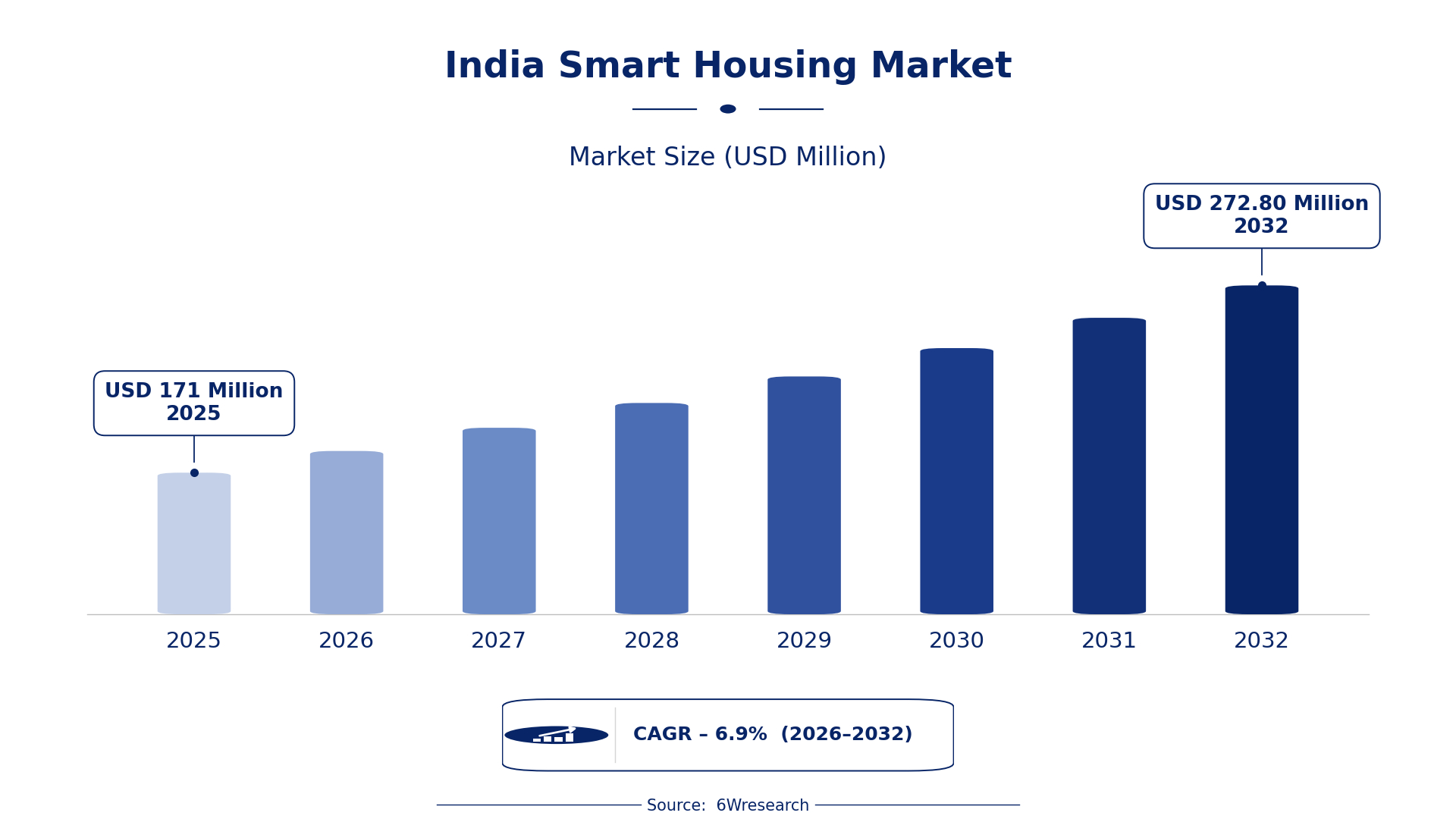
According to 6Wresearch internal database and industry insights, the India Smart Housing Market was valued at USD 171.0 million in 2025 and is projected to reach USD 272.80 million by 2032, growing at a CAGR of approximately 6.9% during 2026–2032.
India Smart Housing Market Highlights
| Report Metric | Details |
| Report Name | India Smart Housing Market |
| Market Size 2025 | USD 171.0 million |
| Market Size 2032 | USD 272.80 million |
| Absolute Growth 2025–2032 | USD 101.80 million |
| CAGR 2026–2032 | 6.9% |
| Peak Annual Growth | 8.7% in 2026 |
| Forecast Period | 2026–2032 |
| Historical Data | 2022–2025 |
| Base Year | 2025 |
| Leading Housing Type, 2025 | IoT-Enabled Apartments (49% share) |
| Leading Smart Integration, 2025 | Centralized Automation Hub (43% share) |
| Leading Energy System, 2025 | Solar + Smart Meters (42% share) |
| Leading End User, 2025 | Real Estate Developers (48% share) |
| Fastest-Growing Housing Type | Modular Smart Homes (9.4% CAGR) |
| Fastest-Growing Smart Integration | AI HVAC + Water Monitoring (8.3% CAGR) |
| Fastest-Growing Energy System | Net-Zero Systems (9.1% CAGR) |
| Fastest-Growing End User | Assisted Living Groups (9.1% CAGR) |
| Growing Sector | Real Estate Development |
| Key End Users | Real Estate Developers, Urban Planners, Smart Housing Companies, Assisted Living Groups |
India Smart Housing Market Year-wise Growth Rate and Key Drivers (2022–2032)
This graph illustrates the annual growth rates of the market from 2022 to 2032, highlighting a steady upward trajectory and projected market expansion over the forecast period.
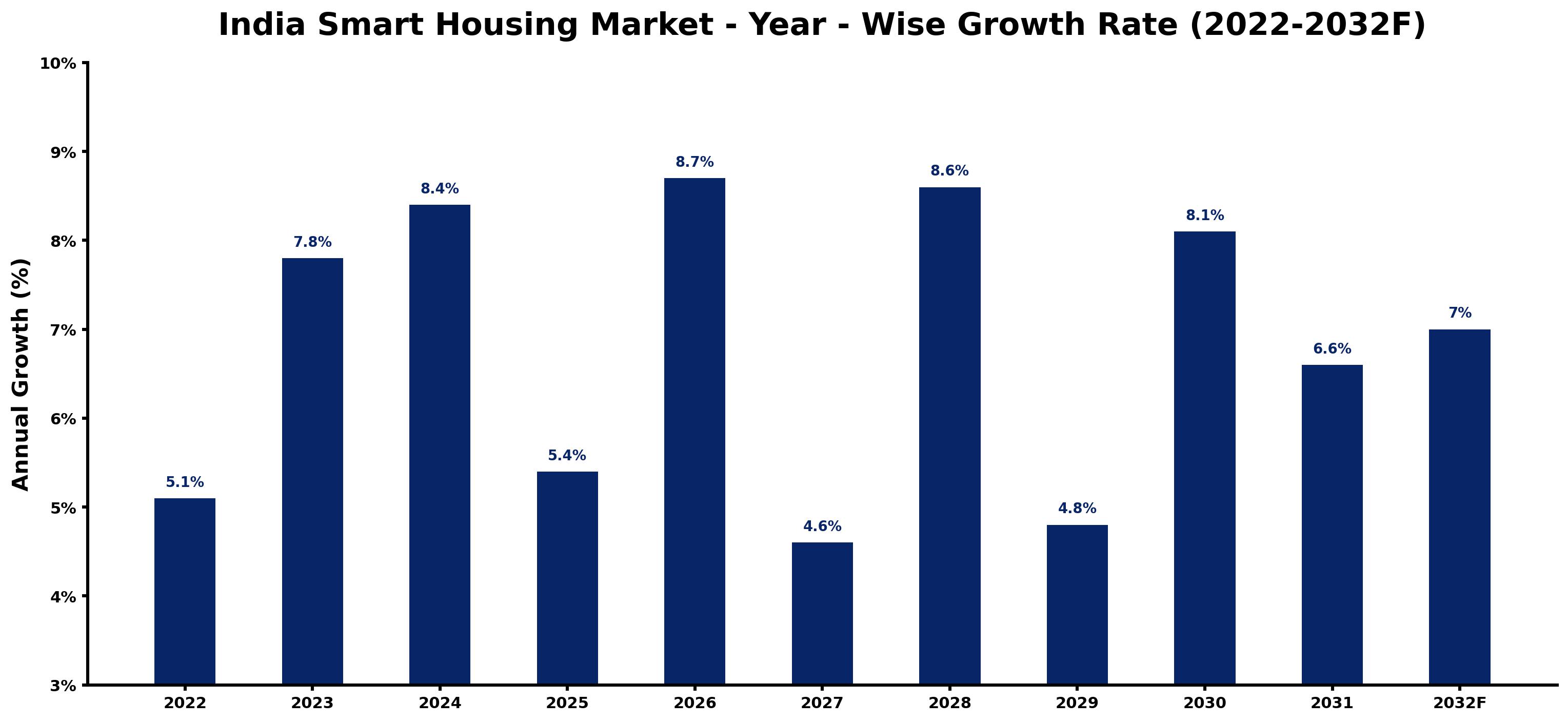
Below, each year's estimated growth is shown next to the factor that most influenced it.
| Year | Estimated Annual Growth (%) | Market Rationale |
| 2022 | 5.1 | The market experienced steady growth as urbanisation continued to drive demand for modern housing solutions. |
| 2023 | 7.8 | Demand for smart housing surged, supported by the Smart Cities Mission and rising urban populations. |
| 2024 | 8.4 | The market reached a historical peak, driven by increased investments in smart technologies and housing projects. |
| 2025 | 5.4 | Growth slowed slightly as project completions increased, but demand for smart housing remained strong. |
| 2026 | 8.7 | A renewed interest in smart housing is anticipated to accelerate growth, driven by advanced technologies and urban development. |
| 2027 | 4.6 | Market growth will decelerate as project saturation begins to influence new developments. |
| 2028 | 8.6 | Increased adoption of energy-efficient systems is projected to revitalise demand for smart housing solutions. |
| 2029 | 4.8 | A further slowdown is expected as market maturity sets in, yet demand for modern housing will persist. |
| 2030 | 8.1 | Growth will accelerate again as urban planners focus on integrating smart technologies into housing. |
| 2031 | 6.6 | The market is projected to see a slowdown as competition increases among developers for smart housing projects. |
| 2032 | 7.0 | Demand for smart housing is expected to rise again as urban populations continue to grow. |
Note: Market size estimations and growth projections presented in this report are based on 6Wresearch's proprietary forecasting methodology, utilizing the latest available industry data, government publications, and primary research inputs.
India Smart Housing Market Synopsis
Smart Housing in India integrates advanced technology and sustainable practices to improve living environments. It employs IoT devices, energy-efficient materials, and modular designs to enhance energy efficiency and security. The India Smart Housing Market is growing due to urbanisation and a burgeoning middle class seeking modern living solutions. The Smart Cities Mission, initiated in 2015, has influenced this growth by promoting sustainable urban development. By 2031, India's urban population is projected to reach 600 million, further driving demand for smart housing solutions.
Market Dynamics Impact Analysis (2026–2032)
| Factor | Type | Impact | Primary Segment Affected |
| Urbanisation and a growing middle class drive demand for modern living solutions. | Driver | High | IoT-Enabled Apartments |
| Investment in smart technologies enhances the appeal of new housing projects. | Driver | High | Sustainable Villas |
| The Smart Cities Mission promotes urban development and smart housing integration. | Opportunity | High | Modular Smart Homes |
| The National Affordable Housing Policy encourages the development of smart housing. | Opportunity | High | Senior Living Units |
| High costs of smart technology can deter some developers from adopting these solutions. | Restraint | Medium | Centralized Automation Hub |
| Limited awareness among consumers about smart housing benefits may slow adoption. | Restraint | Medium | AI HVAC + Water Monitoring |
| Competition among developers can lead to price wars, affecting profitability. | Challenge | High | Solar + Smart Meters |
| Supply chain disruptions can delay project completions and increase costs. | Challenge | Medium | Home Grid & Batteries |
Evaluation of Drivers in India Smart Housing Market (2026–2032)
The table below links each growth driver to the segment it affects and the evidence for it.
| Drivers | Primary Segment Affected | Why It Matters (Evidence) |
| Urbanisation increases the need for modern housing solutions, leading to more IoT-Enabled Apartments being developed. | IoT-Enabled Apartments | India's urban population is projected to reach 600 million by 2031. |
| Investment in energy-efficient materials attracts buyers to Sustainable Villas. | Sustainable Villas | Over 50% of new housing projects incorporate smart technologies as of 2023. |
| The Smart Cities Mission encourages developers to integrate smart technologies into Modular Smart Homes. | Modular Smart Homes | This initiative aims to develop 100 smart cities across India. |
| The National Affordable Housing Policy promotes the integration of smart technologies in Senior Living Units. | Senior Living Units | This policy was revised in 2023 to emphasize smart housing. |
| Growing awareness of energy efficiency drives demand for Centralized Automation Hubs in new projects. | Centralized Automation Hub | The Bureau of Energy Efficiency sets standards for energy-efficient buildings. |
Growth in the Smart Housing market in India comes from rising urbanisation, increased investments, and a growing middle class seeking modern living solutions. India's urban population is expected to reach 600 million by 2031, boosting demand for smart housing. More than half of new housing projects incorporate smart technologies as of 2023, reflecting a shift towards modern living. The Smart Cities Mission, initiated in 2015, promotes the development of 100 smart cities, driving further investment in smart housing. Standards set by the Bureau of Energy Efficiency encourage the adoption of energy-efficient technologies in new projects.
Evaluation of Restraints in India Smart Housing Market
The table below lists the restraints and the evidence behind each.
| Market Restraint | Primary Segment Affected | Why It Matters (Evidence) |
| High costs of implementing smart technologies can deter developers from adopting these solutions. | Centralized Automation Hub | Developers may find it challenging to justify the initial investment for smart systems. |
| Limited consumer awareness about the benefits of smart housing may slow adoption rates. | AI HVAC + Water Monitoring | Many potential buyers remain uninformed about energy efficiency advantages. |
| Regulatory hurdles can complicate the approval process for smart housing projects. | Solar + Smart Meters | Compliance with various building codes can delay project timelines. |
| Supply chain disruptions can lead to increased costs and project delays. | Home Grid & Batteries | Global supply chain issues have affected the availability of essential components. |
| Intense competition among developers can lead to price wars, impacting profitability. | Sustainable Villas | Aggressive pricing strategies may reduce profit margins for developers. |
India Smart Housing Market Challenges
The India Smart Housing Market encounters several practical challenges, starting with intense competition among builders. Many developers are quickly adopting smart technologies, leading to price wars that can erode profit margins and restrict reinvestment in quality materials. The rising costs of energy-efficient materials, which have increased by 15% over the past year, place pressure on suppliers and disrupt project timelines. Buyers often hesitate due to high initial costs, with smart installations averaging ₹50,000 per unit, potentially delaying their purchasing decisions. A shortage of skilled labour for smart technology installation creates bottlenecks, extending project timelines by up to six months for developers.
Trends in the India Smart Housing Market
Several trends are reshaping the India Smart Housing Market; the most important are set out below.
- Shift towards Energy-Efficient Housing: In 2023, more than 50% of new housing projects incorporate smart technologies, indicating a trend towards energy efficiency. This movement is driven by rising energy costs and consumer demand for sustainable living solutions.
- Emergence of Modular Smart Homes: The adoption of Modular Smart Homes is gaining momentum, with a projected CAGR of 9.4% from 2026 to 2032. This trend is influenced by the need for faster construction methods and urban housing demands.
- Growing Demand for Senior Living Units: As the population ages, demand for Senior Living Units is on the rise, with a CAGR of 9.1% anticipated from 2026 to 2032. These units integrate health monitoring systems to cater to the elderly.
- Integration of Smart Technologies in Urban Planning: The Smart Cities Mission, launched in 2015, is driving the integration of smart technologies into urban planning. This initiative aims to create sustainable living environments across 100 smart cities.
Investment Opportunities in the India Smart Housing Market
Some of the investment opportunities in the India Smart Housing Market are mentioned below.
- Investment in Smart Housing Projects: With the urban population projected to reach 600 million by 2031, there is a notable opportunity for investment in smart housing projects. Real estate developers can capitalise on this demand by integrating smart technologies.
- Expansion of Sustainable Housing Solutions: The National Affordable Housing Policy emphasises the need for sustainable housing, creating opportunities for developers. By focusing on eco-friendly materials, they can attract environmentally conscious buyers.
- Development of Smart Integration Systems: There is a growing need for Centralized Automation Hubs to manage smart devices in homes. Real estate developers can meet this demand by investing in advanced integration technologies.
- Growth in Energy Systems: The demand for Solar + Smart Meters is increasing as consumers seek renewable energy solutions. Developers can enter this market by offering energy-efficient housing options.
Government Initiatives in the India Smart Housing Market
The Ministry of Housing and Urban Affairs oversees various schemes that fund smart housing projects. The Atal Mission for Rejuvenation and Urban Transformation (AMRUT), updated in 2022, includes smart housing as a key focus area, providing funding for urban development initiatives. The National Affordable Housing Policy, revised in 2023, emphasises the integration of smart technologies in affordable housing projects, facilitating approvals and funding for developers.
The Ministry of Electronics and Information Technology supports the Digital India initiative, which promotes smart technologies in housing. This initiative encourages the adoption of digital solutions, enhancing the efficiency of housing projects. Additionally, the Bureau of Energy Efficiency plays a crucial role in setting standards for energy-efficient buildings, ensuring compliance with regulations.
Future Insight of the India Smart Housing Market
Several forward-looking factors should support the India Smart Housing Market over the coming years, with transformative changes expected by 2032. The Smart Cities Mission aims to develop 100 smart cities, which will enhance the demand for advanced housing solutions. By 2031, India's urban population is projected to reach 600 million, necessitating a shift towards modern living environments. The Pradhan Mantri Awas Yojana will continue to influence trends, focusing on affordable housing, while the Bureau of Energy Efficiency's standards will promote the integration of energy-efficient technologies in new projects.
Market Segmentation Analysis
The analysis below covers each segmentation, its leading category in 2025 and its fastest-growing category through 2032.
By Housing Type – IoT-Enabled Apartments Dominated, Modular Smart Homes Expected to Grow Fastest
According to Dhaval Chaurasia, Assistant Manager at 6Wresearch, IoT-Enabled Apartments accounted for a 49% market share by housing type in 2025. IoT-Enabled Apartments hold the largest market share due to their widespread adoption in urban areas, appealing to tech-savvy residents. With over 50% of new housing projects incorporating smart technologies, these apartments are at the forefront of modern living solutions. Modular Smart Homes are projected to grow fastest, at a CAGR of 9.4% during 2026–2032. Modular Smart Homes are experiencing rapid growth as they cater to the increasing demand for quick and efficient housing solutions. The trend towards prefabricated components aligns with the needs of India's urban population, projected to reach 600 million by 2031. This trend indicates that suppliers should focus on developing IoT solutions tailored for modular construction to capture emerging opportunities.
By Smart Integration – Centralized Automation Hub Dominated, AI HVAC + Water Monitoring Expected to Grow Fastest
Centralized Automation Hub held a 43% share of the India Smart Housing Market by smart integration in 2025. The Centralized Automation Hub commands the largest market share by effectively managing multiple smart devices, allowing homeowners to streamline their living environments. This capability is particularly attractive to urban residents who seek a seamless integration of technology into their daily lives. Over 2026–2032, AI HVAC + Water Monitoring is expected to post the fastest growth, at a CAGR of 8.3%. The AI HVAC + Water Monitoring system is witnessing rapid growth due to heightened awareness around energy conservation and sustainable living. This trend reflects a broader shift towards smarter, more efficient home management solutions that cater to environmentally conscious consumers. Suppliers must prioritise the development of integrated solutions to meet the increasing demand for smart housing technologies.
By Energy System – Solar + Smart Meters Dominated, Net-Zero Systems Expected to Grow Fastest
With a 42% revenue share in 2025, Solar + Smart Meters was the largest energy system category. Solar + Smart Meters dominate the market share as they promote renewable energy use, aligning with government initiatives for sustainable housing. The push for energy-efficient buildings, backed by the Bureau of Energy Efficiency, further solidifies this segment's position. The quickest growth will come from Net-Zero Systems, forecast to expand at a CAGR of 9.1% between 2026 and 2032. Net-Zero Systems are rapidly gaining traction as they address the growing need for sustainable energy solutions in urban housing. The focus on balancing energy consumption and production resonates with environmentally conscious consumers. This trend suggests that suppliers should invest in technologies that facilitate the development of net-zero energy homes.
By End User – Real Estate Developers Dominated, Assisted Living Groups Expected to Grow Fastest
The largest end user category in 2025 was Real Estate Developers, with a 48% share of total revenue. Real Estate Developers hold the largest market share as they are crucial in the planning and execution of smart housing initiatives. Their involvement is vital to accommodate the demands of a burgeoning urban population seeking modern living solutions. Assisted Living Groups are set to record the highest CAGR in this split, 9.1% over 2026–2032. Assisted Living Groups are growing swiftly as they leverage smart technologies to enhance care and convenience for their residents. This trend underscores the rising significance of technology in improving living conditions within care facilities. Suppliers should tailor their offerings to align with the specific needs of assisted living groups as they increasingly adopt smart housing solutions.
Key Attractiveness of the Report
- 10 Years of Market Numbers
- Historical Data Starting from 2022 to 2025
- Base Year 2025
- Forecast Data until 2032
- Key Performance Indicators Impacting the Market
- Major Upcoming Developments and Projects
Key Highlights of the Report:
- India Smart Housing Market Outlook
- Market Size of India Smart Housing Market, 2025
- Forecast of India Smart Housing Market, 2032
- Historical Data and Forecast of India Smart Housing Revenues & Volume for the Period 2022 - 2032F
- India Smart Housing Market Trend Evolution
- India Smart Housing Market Drivers and Challenges
- India Smart Housing Price Trends
- India Smart Housing Porter's Five Forces
- India Smart Housing Industry Life Cycle
- Historical Data and Forecast of India Smart Housing Market Revenues & Volume By Housing Type for the Period 2022 - 2032F
- Historical Data and Forecast of India Smart Housing Market Revenues & Volume By IoT-Enabled Apartments for the Period 2022 - 2032F
- Historical Data and Forecast of India Smart Housing Market Revenues & Volume By Sustainable Villas for the Period 2022 - 2032F
- Historical Data and Forecast of India Smart Housing Market Revenues & Volume By Modular Smart Homes for the Period 2022 - 2032F
- Historical Data and Forecast of India Smart Housing Market Revenues & Volume By Senior Living Units for the Period 2022 - 2032F
- Historical Data and Forecast of India Smart Housing Market Revenues & Volume By Smart Integration for the Period 2022 - 2032F
- Historical Data and Forecast of India Smart Housing Market Revenues & Volume By Centralized Automation Hub for the Period 2022 - 2032F
- Historical Data and Forecast of India Smart Housing Market Revenues & Volume By AI HVAC + Water Monitoring for the Period 2022 - 2032F
- Historical Data and Forecast of India Smart Housing Market Revenues & Volume By Plug-and-Play IoT for the Period 2022 - 2032F
- Historical Data and Forecast of India Smart Housing Market Revenues & Volume By Health + Motion Alerts for the Period 2022 - 2032F
- Historical Data and Forecast of India Smart Housing Market Revenues & Volume By Energy System for the Period 2022 - 2032F
- Historical Data and Forecast of India Smart Housing Market Revenues & Volume By Solar + Smart Meters for the Period 2022 - 2032F
- Historical Data and Forecast of India Smart Housing Market Revenues & Volume By Net-Zero Systems for the Period 2022 - 2032F
- Historical Data and Forecast of India Smart Housing Market Revenues & Volume By Home Grid & Batteries for the Period 2022 - 2032F
- Historical Data and Forecast of India Smart Housing Market Revenues & Volume By Wireless Sensor Networks for the Period 2022 - 2032F
- Historical Data and Forecast of India Smart Housing Market Revenues & Volume By End User for the Period 2022 - 2032F
- Historical Data and Forecast of India Smart Housing Market Revenues & Volume By Real Estate Developers for the Period 2022 - 2032F
- Historical Data and Forecast of India Smart Housing Market Revenues & Volume By Urban Planners for the Period 2022 - 2032F
- Historical Data and Forecast of India Smart Housing Market Revenues & Volume By Smart Housing Companies for the Period 2022 - 2032F
- Historical Data and Forecast of India Smart Housing Market Revenues & Volume By Assisted Living Groups for the Period 2022 - 2032F
- India Smart Housing Import Export Trade Statistics
- Market Opportunity Assessment By Housing Type
- Market Opportunity Assessment By Smart Integration
- Market Opportunity Assessment By Energy System
- Market Opportunity Assessment By End User
- India Smart Housing Top Companies Market Share
- India Smart Housing Competitive Benchmarking By Technical and Operational Parameters
- India Smart Housing Company Profiles
- India Smart Housing Key Strategic Recommendations
Market Covered
Segments analysed in this report are listed below.
By Housing Type
- IoT-Enabled Apartments
- Sustainable Villas
- Modular Smart Homes
- Senior Living Units
By Smart Integration
- Centralized Automation Hub
- AI HVAC + Water Monitoring
- Plug-and-Play IoT
- Health + Motion Alerts
By Energy System
- Solar + Smart Meters
- Net-Zero Systems
- Home Grid & Batteries
- Wireless Sensor Networks
By End User
- Real Estate Developers
- Urban Planners
- Smart Housing Companies
- Assisted Living Groups































