China Smart Housing Market Size & Growth Rate
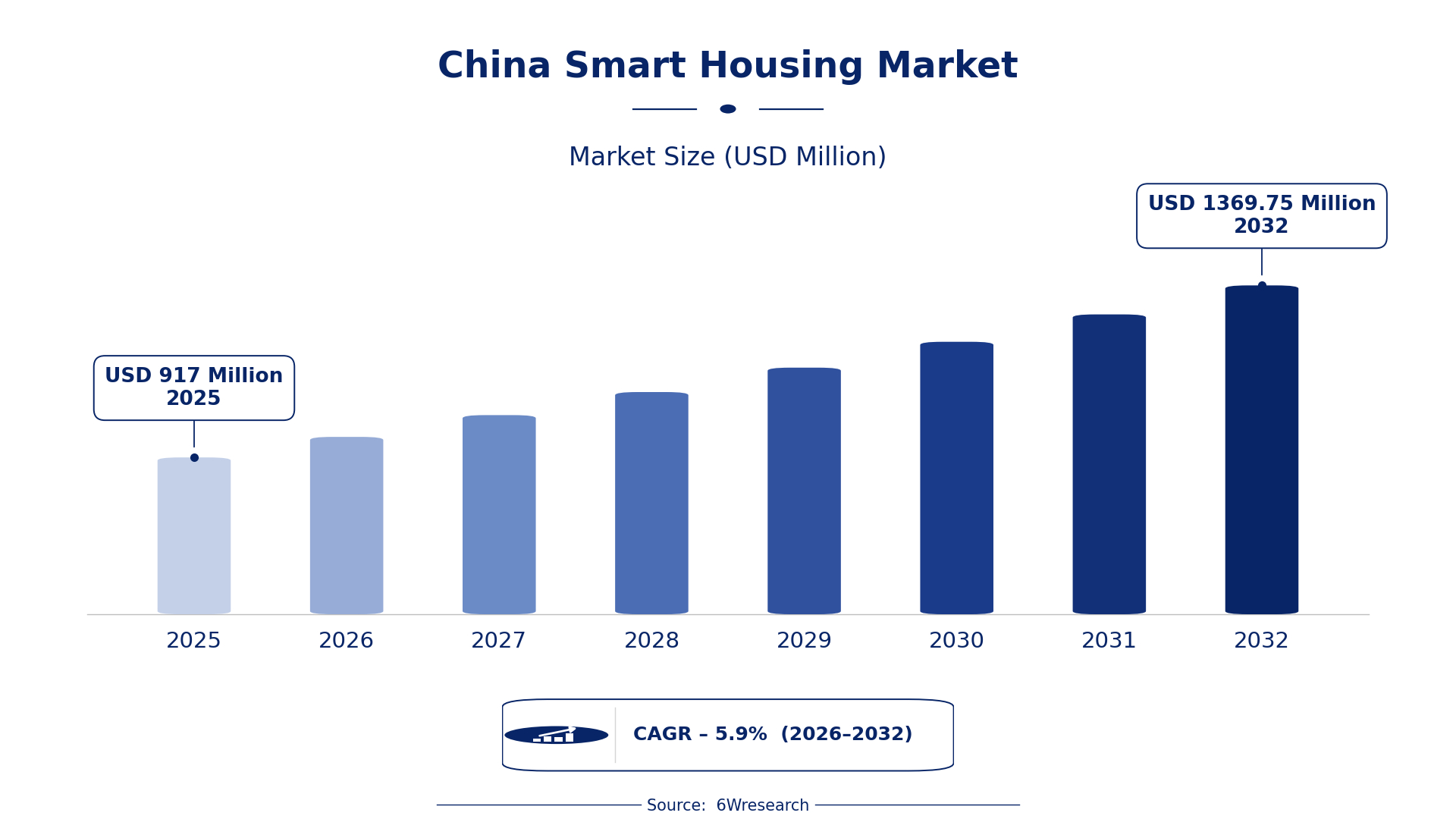
According to 6Wresearch internal database and industry insights, the China Smart Housing Market was valued at USD 917.0 million in 2025 and is projected to reach USD 1,369.75 million by 2032, growing at a CAGR of approximately 5.9% during 2026–2032.
China Smart Housing Market Highlights
| Report Metric | Details |
| Report Name | China Smart Housing Market |
| Market Size 2025 | USD 917.0 million |
| Market Size 2032 | USD 1,369.75 million |
| Absolute Growth 2025–2032 | USD 452.75 million |
| CAGR 2026–2032 | 5.9% |
| Peak Annual Growth | 7.9% in 2027 |
| Forecast Period | 2026–2032 |
| Historical Data | 2022–2025 |
| Base Year | 2025 |
| Leading Housing Type, 2025 | IoT-Enabled Apartments (47% share) |
| Leading Smart Integration, 2025 | Centralized Automation Hub (41% share) |
| Leading Energy System, 2025 | Solar + Smart Meters (46% share) |
| Leading End User, 2025 | Real Estate Developers (44% share) |
| Fastest-Growing Housing Type | Modular Smart Homes (6.9% CAGR) |
| Fastest-Growing Smart Integration | AI HVAC + Water Monitoring (7.0% CAGR) |
| Fastest-Growing Energy System | Net-Zero Systems (7.0% CAGR) |
| Fastest-Growing End User | Smart Housing Companies (8.0% CAGR) |
| Growing Sector | Residential Housing |
| Key End Users | Real Estate Developers, Urban Planners, Smart Housing Companies, Assisted Living Groups |
China Smart Housing Market Year-wise Growth Rate and Key Drivers (2022–2032)
This graph illustrates the annual growth rates of the market from 2022 to 2032, highlighting a steady upward trajectory and projected market expansion over the forecast period.
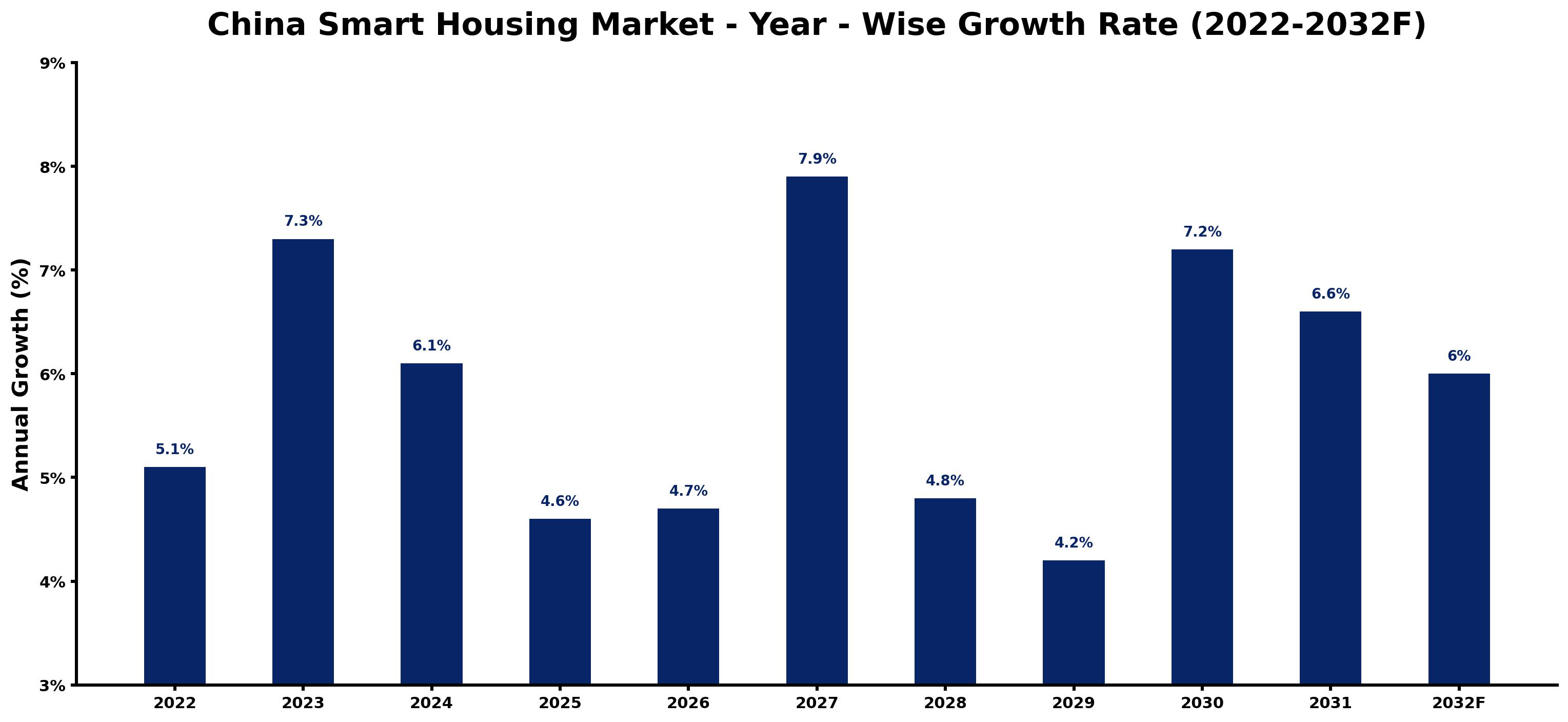
Below, each year's estimated growth is shown next to the factor that most influenced it.
| Year | Estimated Annual Growth (%) | Market Rationale |
| 2022 | 5.1 | Demand for smart housing solutions increased as urbanization continued in China. |
| 2023 | 7.3 | The Smart City initiative accelerated the adoption of smart technologies in new homes. |
| 2024 | 6.1 | Growth slowed as the market adjusted to the National Standard for Smart Housing and project timelines. |
| 2025 | 4.6 | Demand remained strong, but growth rates slowed due to market maturation and the Green Building Action Plan. |
| 2026 | 4.7 | The introduction of new energy-efficient technologies is expected to spur renewed interest in smart housing. |
| 2027 | 7.9 | A surge in investments for urban development projects is projected to boost market growth. |
| 2028 | 4.8 | Growth is anticipated to slow as the market faces challenges in meeting new regulatory standards. |
| 2029 | 4.2 | Demand is expected to continue rising, but at a slower pace due to increased competition in urban areas. |
| 2030 | 7.2 | Technological advancements in smart integration will revitalise interest in smart housing. |
| 2031 | 6.6 | Growth rates will decrease as the market stabilises following previous rapid expansions. |
| 2032 | 6.0 | The market is projected to maintain steady growth as sustainability becomes a priority. |
Note: Market size estimations and growth projections presented in this report are based on 6Wresearch's proprietary forecasting methodology, utilizing the latest available industry data, government publications, and primary research inputs.
China Smart Housing Market Synopsis
Smart Housing in China integrates advanced technologies like IoT and renewable energy systems to improve living environments. It focuses on energy efficiency and user comfort, with primary applications in residential living and urban development. The China Smart Housing Market is expanding rapidly, driven by urbanisation and government initiatives. By 2025, the government aims for 30% of new homes to be smart under the Smart City initiative, reflecting strong demand for advanced housing solutions. The market is projected to create over 1 million jobs by 2025, highlighting its economic impact.
Market Dynamics Impact Analysis (2026–2032)
| Factor | Type | Impact | Primary Segment Affected |
| Urbanization and population growth are driving demand for smart housing solutions. | Driver | High | IoT-Enabled Apartments |
| Government initiatives promote sustainable construction practices, increasing project investments. | Driver | High | Sustainable Villas |
| The rising need for energy-efficient homes presents opportunities for new developments. | Opportunity | High | Net-Zero Systems |
| Investment in smart housing infrastructure is essential to meet urban demands. | Opportunity | High | Modular Smart Homes |
| Regulatory compliance can increase project costs and timelines for developers. | Restraint | Medium | Real Estate Developers |
| Market saturation in urban areas may limit growth potential for new projects. | Restraint | Medium | Smart Housing Companies |
| Competition among developers can lead to price wars, affecting profitability. | Challenge | High | Smart Housing Companies |
| Technological integration challenges may delay project completions and increase costs. | Challenge | Medium | Real Estate Developers |
Evaluation of Drivers in China Smart Housing Market (2026–2032)
The table below links each growth driver to the segment it affects and the evidence for it.
| Drivers | Primary Segment Affected | Why It Matters (Evidence) |
| Urbanization is increasing the demand for housing solutions, particularly in urban centres. | IoT-Enabled Apartments | In 2023, over 50% of new residential projects in urban areas incorporated smart technologies. |
| Government support for sustainable housing drives investments in eco-friendly developments. | Sustainable Villas | The Green Building Action Plan promotes energy-efficient housing solutions across China. |
| Technological advancements in smart integration improve user experience and efficiency. | Centralized Automation Hub | The National Standard for Smart Housing established in 2022 regulates industry practices. |
| Growing consumer awareness of energy efficiency is pushing demand for smart housing. | Net-Zero Systems | The National Energy Administration supports solar energy integration in smart homes. |
| Investment in smart housing infrastructure is critical for urban development. | Modular Smart Homes | In 2023, the government allocated $1 billion for smart housing infrastructure development. |
In 2023, over 50% of new residential projects in urban areas incorporated smart technologies, driving demand for innovative solutions. The Green Building Action Plan promotes energy-efficient housing solutions across China, enhancing the appeal of smart homes. The National Standard for Smart Housing established in 2022 regulates industry practices, ensuring quality and safety.
Evaluation of Restraints in China Smart Housing Market
Below mentioned are some major restraints and their influence on market dynamics.
| Market Restraint | Primary Segment Affected | Why It Matters (Evidence) |
| Regulatory compliance can increase project costs and timelines for developers. | Real Estate Developers | The National Standard for Smart Housing requires adherence to strict guidelines, impacting project budgets. |
| Market saturation in urban areas may limit growth potential for new projects. | Smart Housing Companies | In 2023, urban areas saw a rise in smart housing projects, leading to increased competition. |
| High construction costs can deter investment in new smart housing developments. | Sustainable Villas | The Green Building Action Plan mandates sustainable materials, raising overall project expenses. |
| Limited availability of skilled labour affects project timelines and quality. | Modular Smart Homes | The demand for skilled workers in smart housing construction has increased, causing delays. |
| Technological integration challenges may delay project completions and increase costs. | IoT-Enabled Apartments | Complexity in integrating IoT systems can lead to unforeseen project hurdles. |
China Smart Housing Market Challenges
The China Smart Housing Market faces practical problems, beginning with supply chain disruptions that have delayed projects by an average of six months. These delays arise from a shortage of local suppliers for advanced technology components, forcing developers to rely on imports and increasing costs by up to 15%. Rising construction costs also challenge the market, with materials becoming 10% more expensive in 2023, impacting budgets for developers and buyers. A skills gap in the workforce limits the availability of qualified personnel, resulting in project slowdowns and increased labour costs for contractors. Buyers also face difficulties navigating new regulations from the National Standard for Smart Housing, complicating compliance and extending project timelines.
Trends in the China Smart Housing Market
The trends below show where the China Smart Housing Market is heading.
- Shift from Traditional to Smart Housing: In 2023, urban planners in Shanghai increasingly adopted smart housing solutions, with 20% of new projects classified as smart housing. This shift reflects a growing preference for integrated living environments.
- Transition to Energy-Efficient Housing: The Green Building Action Plan launched in 2022 is driving the transition to energy-efficient housing. By 2025, the government aims for 30% of new homes to incorporate smart technologies.
- Emergence of Modular Smart Homes: The rise of modular smart homes is reshaping the housing market, particularly in Beijing. By 2026, this segment is expected to grow at a CAGR of 6.9%, reflecting increased demand for efficiency.
- Prioritisation of Sustainable Practices: The National Energy Administration's Renewable Energy Integration Program is promoting sustainable practices in housing. The program targets a 25% increase in solar energy installations in smart homes by 2025.
Investment Opportunities in the China Smart Housing Market
Several openings in the China Smart Housing Market merit attention from investors.
- Partnerships with Local Developers: Now is the time for foreign investors to collaborate with local developers in urban areas. With over $1 billion allocated for smart housing infrastructure, such partnerships can improve project success.
- Investing in Smart Integration Technologies: The growing demand for smart integration technologies presents a compelling investment opportunity. The Centralized Automation Hub is leading this segment, with a projected growth rate of 7.0%.
- Expansion into Emerging Urban Areas: The increasing urban population creates a gap in smart housing supply. Developers should focus on emerging urban areas, where demand for sustainable housing is rising rapidly.
- Certification for Green Building Standards: Now is an ideal time to invest in certification for green building standards. The Green Building Action Plan supports eco-friendly housing initiatives, creating opportunities for compliant developers.
Government Initiatives in the China Smart Housing Market
The Smart City Development Plan 2021-2025, issued by the Ministry of Housing and Urban-Rural Development, aims to integrate smart housing in urban planning with a focus on sustainability. This plan encourages local governments to adopt smart technologies in new residential projects, ensuring that 30% of homes are smart by 2025. The initiative is expected to create job opportunities in the construction and technology sectors, stimulating economic growth. Additionally, the Green Building Action Plan, launched in 2022, allocates funds to promote energy-efficient housing solutions across China, further supporting the development of smart housing.
In 2023, the Renewable Energy Integration Program was introduced by the National Energy Administration, targeting a 25% increase in solar energy installations in smart homes. This program provides funding for solar energy projects and supports developers in integrating renewable energy solutions into their housing projects. The initiative aims to improve energy efficiency and reduce carbon emissions in residential buildings, making smart housing more attractive to buyers. Furthermore, the Ministry of Industry and Information Technology's IoT Development Strategy 2021-2025 aims to expand IoT applications in housing, enhancing user experience and efficiency.
Future Insight of the China Smart Housing Market
Several forward-looking factors should support the China Smart Housing Market over the coming years. The government's Smart City initiative aims for 30% of new homes to be smart by 2025, driving demand for advanced housing solutions. Integration of renewable energy systems will improve energy efficiency, benefiting both buyers and suppliers. By 2025, smart housing projects are set to create over 1 million jobs, stimulating the economy and attracting skilled workers. The National Energy Administration's support for solar energy integration will encourage investments in sustainable housing technologies.
Market Segmentation Analysis
The report offers a comprehensive study of the following market segments and their leading categories in the market.
By Housing Type – IoT-Enabled Apartments Dominated, Modular Smart Homes Expected to Grow Fastest
According to Dhaval Chaurasia, Assistant Manager at 6Wresearch, IoT-Enabled Apartments took a 47% share of housing type in 2025, more than any other category. IoT-Enabled Apartments dominate the market share due to their widespread adoption among urban residents seeking enhanced living experiences. In 2023, over 50% of new residential projects in urban areas are integrating IoT technology, indicating strong buyer demand. Modular Smart Homes are set to record the highest CAGR in this split, 6.9% over 2026–2032. Modular Smart Homes are witnessing rapid growth thanks to their efficient construction methods appealing to environmentally conscious consumers. The government's Smart City initiative aims for 30% of new homes to be smart by 2025, significantly driving this segment's expansion. Suppliers should concentrate on developing modular designs that align with the increasing consumer preference for smart housing.
By Smart Integration – Centralized Automation Hub Dominated, AI HVAC + Water Monitoring Expected to Grow Fastest
Centralized Automation Hub accounted for a 41% market share by smart integration in 2025. The Centralized Automation Hub holds a substantial market share as it provides seamless control over various smart home devices, catering to tech-savvy homeowners. This integration enhances user experience and convenience, making it a highly preferred solution in smart housing. AI HVAC + Water Monitoring is projected to grow fastest, at a CAGR of 7.0% during 2026–2032. AI HVAC + Water Monitoring systems are growing rapidly as they effectively optimise energy use and monitor water consumption. With rising energy costs, homeowners are increasingly seeking solutions that can reduce their bills and environmental impact. Suppliers should focus on creating integrated smart solutions to meet the rising demand in this segment.
By Energy System – Solar + Smart Meters Dominated, Net-Zero Systems Expected to Grow Fastest
The largest energy system category in 2025 was Solar + Smart Meters, with a 46% share of total revenue. Solar + Smart Meters hold the largest share as they enable homeowners to generate and monitor their energy use, aligning with the government's push for renewable energy integration. This is particularly relevant in urban areas where energy efficiency is a priority. The quickest growth will come from Net-Zero Systems, forecast to expand at a CAGR of 7.0% between 2026 and 2032. Net-Zero Systems are rapidly gaining traction as they promise energy self-sufficiency, appealing to environmentally conscious consumers. The government's allocation of $1 billion for smart housing infrastructure development further fuels this growth. This suggests that suppliers should invest in advanced energy solutions to meet the rising demand for sustainability.
By End User – Real Estate Developers Dominated, Smart Housing Companies Expected to Grow Fastest
With a 44% revenue share in 2025, Real Estate Developers was the largest end user category. Real Estate Developers dominate the market, driving the adoption of smart technologies in new housing projects. Their substantial investments in urban developments reflect the increasing trend towards smart living environments. Over 2026–2032, Smart Housing Companies are expected to post the fastest growth, at a CAGR of 8.0%. Smart Housing Companies are growing rapidly as they specialise in creating tailored smart housing solutions. This aligns with the rising consumer preference for homes equipped with advanced technologies and smart features. This indicates that suppliers should collaborate with these companies to align their offerings with market needs.
Key Attractiveness of the Report
- 10 Years of Market Numbers
- Historical Data Starting from 2022 to 2025
- Base Year 2025
- Forecast Data until 2032
- Key Performance Indicators Impacting the Market
- Major Upcoming Developments and Projects
Key Highlights of the Report:
- China Smart Housing Market Outlook
- Market Size of China Smart Housing Market, 2025
- Forecast of China Smart Housing Market, 2032
- Historical Data and Forecast of China Smart Housing Revenues & Volume for the Period 2022 - 2032F
- China Smart Housing Market Trend Evolution
- China Smart Housing Market Drivers and Challenges
- China Smart Housing Price Trends
- China Smart Housing Porter's Five Forces
- China Smart Housing Industry Life Cycle
- Historical Data and Forecast of China Smart Housing Market Revenues & Volume By Housing Type for the Period 2022 - 2032F
- Historical Data and Forecast of China Smart Housing Market Revenues & Volume By IoT-Enabled Apartments for the Period 2022 - 2032F
- Historical Data and Forecast of China Smart Housing Market Revenues & Volume By Sustainable Villas for the Period 2022 - 2032F
- Historical Data and Forecast of China Smart Housing Market Revenues & Volume By Modular Smart Homes for the Period 2022 - 2032F
- Historical Data and Forecast of China Smart Housing Market Revenues & Volume By Senior Living Units for the Period 2022 - 2032F
- Historical Data and Forecast of China Smart Housing Market Revenues & Volume By Smart Integration for the Period 2022 - 2032F
- Historical Data and Forecast of China Smart Housing Market Revenues & Volume By Centralized Automation Hub for the Period 2022 - 2032F
- Historical Data and Forecast of China Smart Housing Market Revenues & Volume By AI HVAC + Water Monitoring for the Period 2022 - 2032F
- Historical Data and Forecast of China Smart Housing Market Revenues & Volume By Plug-and-Play IoT for the Period 2022 - 2032F
- Historical Data and Forecast of China Smart Housing Market Revenues & Volume By Health + Motion Alerts for the Period 2022 - 2032F
- Historical Data and Forecast of China Smart Housing Market Revenues & Volume By Energy System for the Period 2022 - 2032F
- Historical Data and Forecast of China Smart Housing Market Revenues & Volume By Solar + Smart Meters for the Period 2022 - 2032F
- Historical Data and Forecast of China Smart Housing Market Revenues & Volume By Net-Zero Systems for the Period 2022 - 2032F
- Historical Data and Forecast of China Smart Housing Market Revenues & Volume By Home Grid & Batteries for the Period 2022 - 2032F
- Historical Data and Forecast of China Smart Housing Market Revenues & Volume By Wireless Sensor Networks for the Period 2022 - 2032F
- Historical Data and Forecast of China Smart Housing Market Revenues & Volume By End User for the Period 2022 - 2032F
- Historical Data and Forecast of China Smart Housing Market Revenues & Volume By Real Estate Developers for the Period 2022 - 2032F
- Historical Data and Forecast of China Smart Housing Market Revenues & Volume By Urban Planners for the Period 2022 - 2032F
- Historical Data and Forecast of China Smart Housing Market Revenues & Volume By Smart Housing Companies for the Period 2022 - 2032F
- Historical Data and Forecast of China Smart Housing Market Revenues & Volume By Assisted Living Groups for the Period 2022 - 2032F
- China Smart Housing Import Export Trade Statistics
- Market Opportunity Assessment By Housing Type
- Market Opportunity Assessment By Smart Integration
- Market Opportunity Assessment By Energy System
- Market Opportunity Assessment By End User
- China Smart Housing Top Companies Market Share
- China Smart Housing Competitive Benchmarking By Technical and Operational Parameters
- China Smart Housing Company Profiles
- China Smart Housing Key Strategic Recommendations
Market Covered
The report offers an extensive study of the following market segments.
By Housing Type
- IoT-Enabled Apartments
- Sustainable Villas
- Modular Smart Homes
- Senior Living Units
By Smart Integration
- Centralized Automation Hub
- AI HVAC + Water Monitoring
- Plug-and-Play IoT
- Health + Motion Alerts
By Energy System
- Solar + Smart Meters
- Net-Zero Systems
- Home Grid & Batteries
- Wireless Sensor Networks
By End User
- Real Estate Developers
- Urban Planners
- Smart Housing Companies
- Assisted Living Groups































