India Smart HVAC Control Market Size & Growth Rate
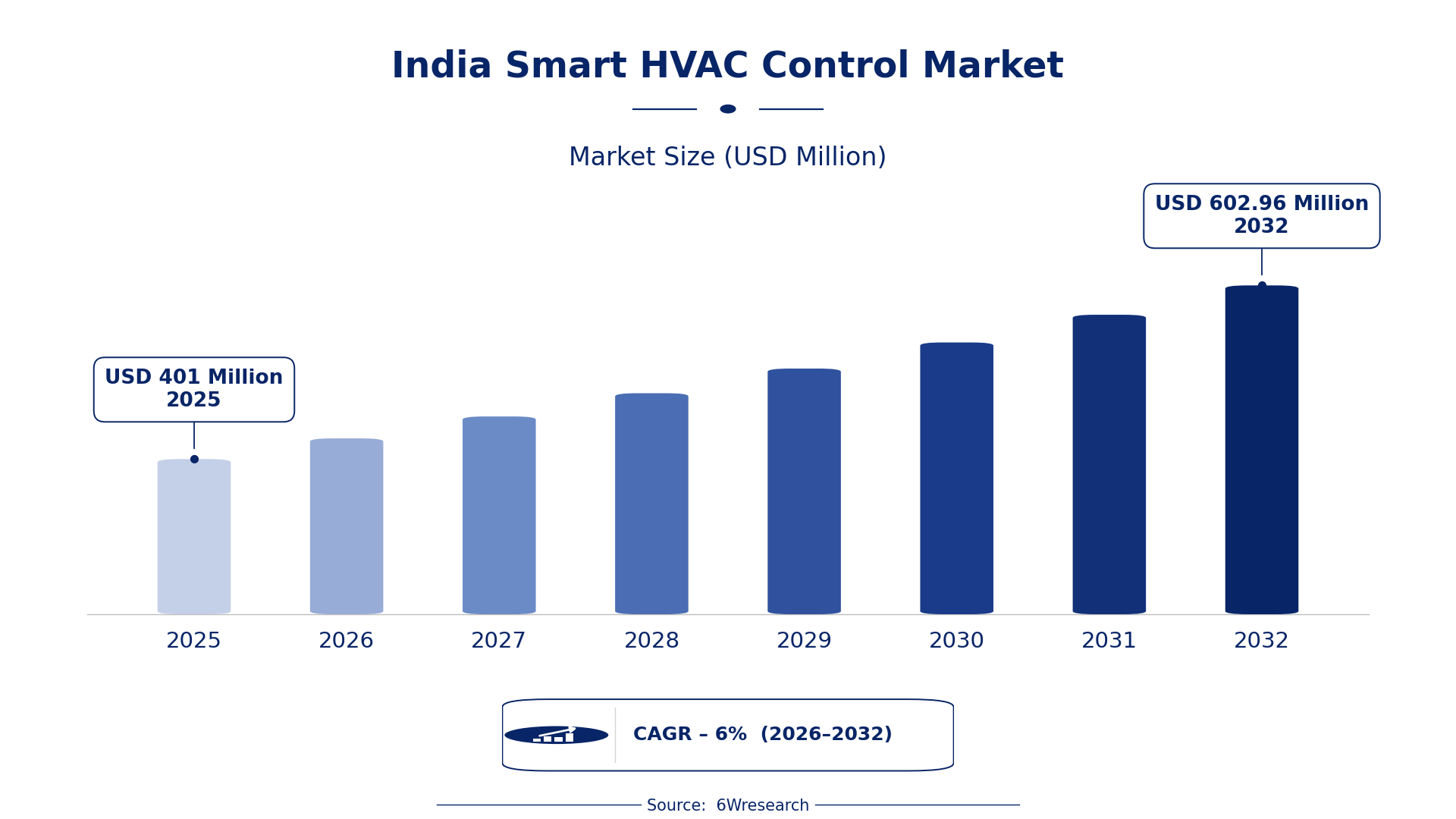
According to 6Wresearch internal database and industry insights, the India Smart HVAC Control Market was valued at USD 401.0 million in 2025 and is projected to reach USD 602.96 million by 2032, growing at a CAGR of approximately 6% during 2026–2032.
India Smart HVAC Control Market Highlights
| Report Metric | Details |
| Report Name | India Smart HVAC Control Market |
| Market Size 2025 | USD 401.0 million |
| Market Size 2032 | USD 602.96 million |
| Absolute Growth 2025–2032 | USD 201.96 million |
| CAGR 2026–2032 | 6% |
| Peak Annual Growth | 8.6% in 2032 |
| Forecast Period | 2026–2032 |
| Historical Data | 2022–2025 |
| Base Year | 2025 |
| Leading Control Type, 2025 | AI Predictive Control (50% share) |
| Leading Feature, 2025 | Remote Temperature Setting (43% share) |
| Leading Connectivity, 2025 | Wi-Fi (40% share) |
| Leading End User, 2025 | Residential Users (46% share) |
| Fastest-Growing Feature | Learning Behavior Patterns (7.8% CAGR) |
| Fastest-Growing Connectivity | Edge AI (7.2% CAGR) |
| Fastest-Growing End User | Smart Buildings (7.8% CAGR) |
| Growing Sector | Smart Buildings |
| Key End Users | Residential Users, Smart Buildings, HVAC Companies, Smart Home Installers |
India Smart HVAC Control Market Year-wise Growth Rate and Key Drivers (2022–2032)
This graph illustrates the annual growth rates of the market from 2022 to 2032, highlighting a steady upward trajectory and projected market expansion over the forecast period.
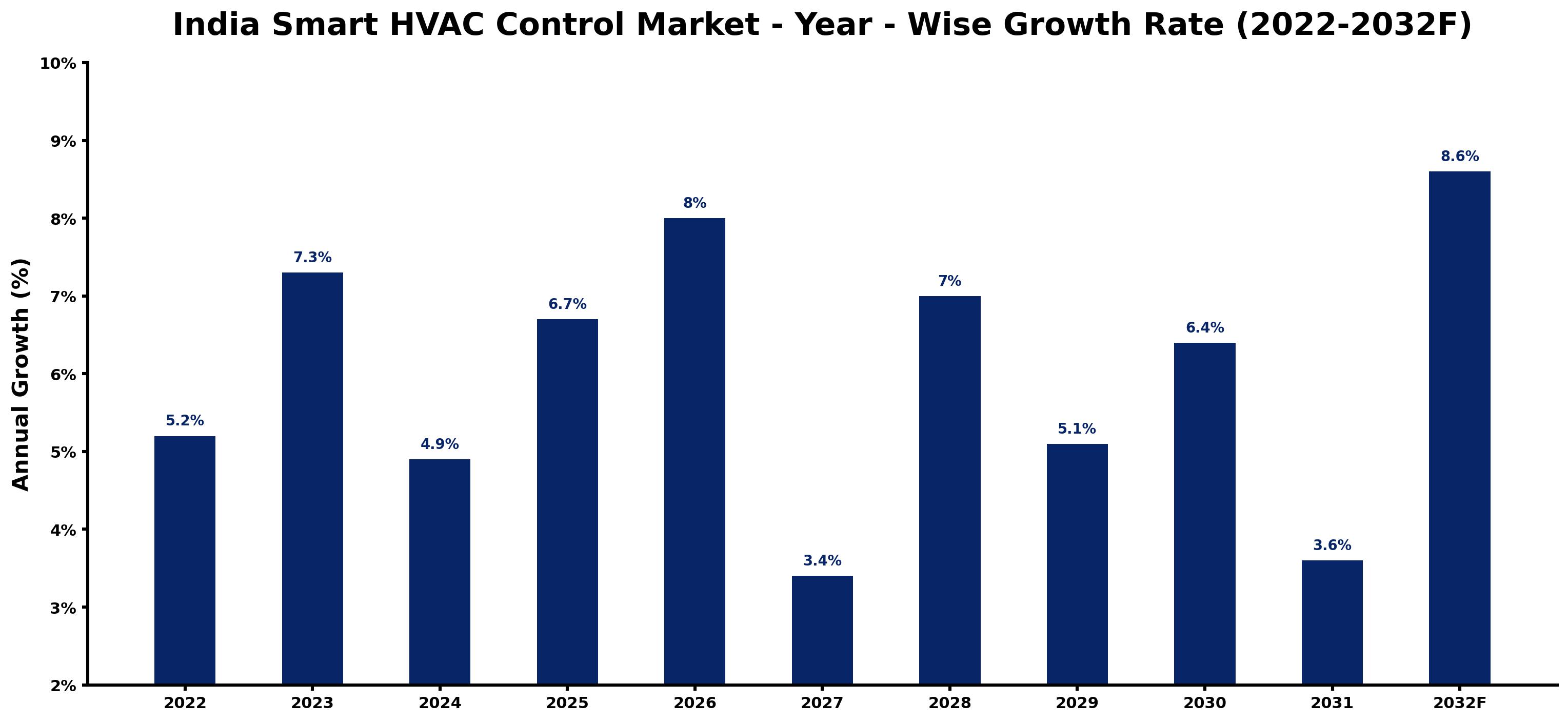
Each row of the following table gives one year's estimated growth and the event or demand shift that explains it.
| Year | Estimated Annual Growth (%) | Market Rationale |
| 2022 | 5.2 | The market experienced steady growth due to rising energy efficiency awareness among residential users. |
| 2023 | 7.3 | Demand surged as smart building projects gained momentum across urban areas through the Smart Cities Mission. |
| 2024 | 4.9 | Growth slowed as some residential users delayed HVAC upgrades amid economic uncertainty. |
| 2025 | 6.7 | Increased investments in smart technologies drove a rebound in market activity, particularly in urban developments. |
| 2026 | 8.0 | The introduction of advanced AI features is expected to boost demand for smart HVAC systems. |
| 2027 | 3.4 | Growth is projected to slow as market saturation begins to impact new installations. |
| 2028 | 7.0 | Demand is expected to increase as urban development projects incorporate energy-efficient HVAC solutions. |
| 2029 | 5.1 | A slowdown is anticipated as economic factors lead to cautious spending on upgrades. |
| 2030 | 6.4 | Growth is projected to pick up again as energy conservation initiatives gain traction. |
| 2031 | 3.6 | Demand is expected to moderate as the market adjusts to previous growth rates. |
| 2032 | 8.6 | The market is projected to peak as smart HVAC systems become standard in new constructions. |
Note: Market size estimations and growth projections presented in this report are based on 6Wresearch's proprietary forecasting methodology, utilizing the latest available industry data, government publications, and primary research inputs.
India Smart HVAC Control Market Synopsis
Smart HVAC Control in India refers to advanced systems that optimise heating, ventilation, and air conditioning through intelligent automation and connectivity. These systems improve energy efficiency, comfort, and indoor air quality. The India Smart HVAC Control Market is expanding, driven by the growth of smart buildings and residential users adopting energy-efficient solutions. With over 500 smart buildings reported in major cities, the demand for these systems is anticipated to rise. Government initiatives aiming to reduce energy consumption by 30% by 2030 further support this growth.
Market Dynamics Impact Analysis (2026–2032)
| Factor | Type | Impact | Primary Segment Affected |
| Growing investments in smart building infrastructure drive demand for advanced HVAC systems, particularly in urban areas. | Driver | High | Smart Buildings |
| Increased energy efficiency awareness among homeowners leads to higher adoption of smart HVAC controls in residential properties. | Driver | High | Residential Users |
| The demand for energy-efficient HVAC solutions is rising due to government initiatives targeting a 30% reduction in energy consumption by 2030. | Opportunity | High | AI Predictive Control |
| The expansion of the Smart Home Market, projected to reach $4 billion by 2025, presents significant investment opportunities for HVAC suppliers. | Opportunity | High | Smart Home Installers |
| Skills shortages in the HVAC workforce hinder the adoption of smart technologies, affecting installation timelines. | Restraint | High | AI Predictive Control |
| Supply chain issues, with over 30% of components imported, lead to price hikes that can increase project costs for builders. | Restraint | High | AI Predictive Control |
| Intense competition among suppliers results in price wars, which can erode profit margins for HVAC producers. | Challenge | Medium | AI Predictive Control |
| Regulatory compliance challenges arise from the lack of standardisation in energy efficiency measures, leading to costly reworks. | Challenge | Medium | AI Predictive Control |
Evaluation of Drivers in India Smart HVAC Control Market (2026–2032)
The table below links each growth driver to the segment it affects and the evidence for it.
| Drivers | Primary Segment Affected | Why It Matters (Evidence) |
| Growing investments in smart building infrastructure. | Smart Buildings | Over 500 smart buildings reported in major cities drive demand for advanced HVAC systems. |
| Increased energy efficiency awareness among residential users. | Residential Users | The residential sector accounted for 40% of total HVAC energy consumption in 2022. |
| Government initiatives promoting energy-efficient technologies. | Smart Buildings | The Bureau of Energy Efficiency promotes energy-efficient HVAC systems under its Energy Conservation Building Code. |
| Technological advancements in AI and IoT for HVAC systems. | Smart Buildings | AI Predictive Control technology improves energy efficiency by predicting usage patterns. |
| Rising disposable incomes leading to higher spending on home comfort. | Residential Users | The Smart Home Market in India is projected to grow to $4 billion by 2025. |
Expansion of the Smart HVAC Control market in India is backed by growing investments in smart building infrastructure, which drives demand for advanced HVAC systems. The residential sector accounted for 40% of total HVAC energy consumption in 2022, prompting increased energy efficiency awareness among homeowners. Technological advancements in AI and IoT improve HVAC systems, enhancing their efficiency and functionality. Rising disposable incomes are also contributing to higher spending on home comfort solutions, particularly in urban areas.
Evaluation of Restraints in India Smart HVAC Control Market
Below mentioned are some major restraints and their influence on market dynamics.
| Market Restraint | Primary Segment Affected | Why It Matters (Evidence) |
| High installation costs of smart HVAC systems. | Residential Users | Many homeowners find the initial investment for smart HVAC systems prohibitive, with costs rising by 15% for some projects. |
| Limited awareness of smart technology benefits. | Smart Buildings | Some builders and developers remain unaware of the advantages of integrating smart HVAC solutions, hindering adoption. |
| Integration challenges with existing HVAC infrastructure. | HVAC Companies | Many companies face difficulties in retrofitting smart systems to older buildings, complicating installations. |
| Regulatory compliance with energy efficiency standards. | HVAC Companies | Meeting compliance can delay project timelines and increase costs for contractors. |
| Market saturation in urban areas. | Smart Buildings | As more buildings adopt smart technologies, new installations may decline, limiting growth opportunities. |
India Smart HVAC Control Market Challenges
The India Smart HVAC Control Market still has to solve a few problems, starting with skills shortages; only 20% of HVAC technicians are trained in smart technologies, which delays installations for residential users. Supply chain issues persist, as over 30% of components are imported, causing price hikes that can increase project costs by 15% for builders. Competition among suppliers is fierce, with 50% of companies struggling to differentiate their offerings, resulting in price wars that erode margins for producers. Regulatory compliance poses challenges; the lack of standardisation in energy efficiency measures can lead to costly reworks for contractors, impacting project timelines.
Trends in the India Smart HVAC Control Market
Several trends are reshaping the India Smart HVAC Control Market; the most important are set out below.
- Shift towards Energy-Efficient HVAC Systems: The Smart Cities Mission continues to support the integration of energy-efficient HVAC systems in urban developments. With over 500 smart buildings reported, demand for these systems is rising, reflecting a growing trend towards sustainability.
- Adoption of AI Predictive Control Technology: In 2022, AI Predictive Control technology gained traction among HVAC companies, improving energy efficiency. This shift is likely to drive further adoption as companies seek to optimise energy consumption.
- Growth of Smart Home Installations: The Smart Home Market in India is projected to reach $4 billion by 2025, indicating a trend towards smart technology adoption in residential settings. This growth will likely increase demand for smart HVAC controls.
- Integration of IoT in HVAC Systems: The integration of IoT technology in HVAC systems is becoming more prevalent, with many companies adopting smart features. This trend supports energy management and improves user comfort in residential and commercial buildings.
Investment Opportunities in the India Smart HVAC Control Market
The following opportunities in the India Smart HVAC Control Market pair current demand with a clear way in.
- Partnerships with Smart Home Installers: Now is an ideal time to partner with smart home installers to supply smart HVAC systems. With the Smart Home Market projected to grow to $4 billion by 2025, this presents an opportunity for suppliers.
- Investing in Smart Building Projects: With over 500 smart buildings reported in major cities, investing in smart building projects is essential. Collaborating with urban developers can facilitate entry into this expanding market.
- Certification for Energy-Efficient Technologies: The Bureau of Energy Efficiency's initiatives create a gap for certified energy-efficient HVAC technologies. Suppliers can enter this market by obtaining necessary certifications and approvals.
- Focus on Residential User Demand: As the residential sector accounts for 40% of HVAC energy consumption, targeting residential users is vital. Engaging with homeowners through educational campaigns can drive adoption of smart HVAC systems.
Government Initiatives in the India Smart HVAC Control Market
The Energy Conservation Building Code (ECBC), updated in 2021 by the Bureau of Energy Efficiency, mandates energy-efficient standards for HVAC systems in buildings. This regulation impacts HVAC producers by requiring compliance with stringent energy performance criteria. Additionally, the Smart Cities Mission, initiated in 2015, continues to support the integration of smart HVAC systems in urban areas, improving infrastructure and sustainability. The National Smart Grid Mission, launched in 2020, includes provisions for integrating smart HVAC systems into energy management, further promoting energy efficiency in buildings.
The Energy Efficiency Financing Platform (EEFP) supports financing for energy-efficient HVAC projects, assisting buyers in implementing advanced technologies. The Ministry of Housing and Urban Affairs oversees the Smart Cities Mission, which funds urban infrastructure improvements, including HVAC systems. These initiatives aim to improve energy management and reduce consumption, benefiting both producers and buyers in the HVAC sector.
Future Insight of the India Smart HVAC Control Market
By 2032, buyers and suppliers in the India Smart HVAC Control Market can expect transformative changes due to several key factors. The Smart Cities Mission will enhance urban infrastructure, contributing to a projected 30% increase in smart HVAC installations. The adoption of ISO 50001 standards will promote better energy management practices, increasing operational efficiency for suppliers. The Energy Efficiency Financing Platform will facilitate funding for energy-efficient HVAC projects, fostering a more sustainable market. With over 60% of new residential projects incorporating smart HVAC technologies, the transition to energy-efficient solutions will gain momentum.
Market Segmentation Analysis
Each segment group is reviewed below, with the leader by share and the fastest grower by CAGR.
By Control Type – AI Predictive Control Dominated and Is Expected to Record the Fastest Growth
According to Dhaval Chaurasia, Assistant Manager at 6Wresearch, AI Predictive Control accounted for a 50% market share by control type in 2025. AI Predictive Control holds the largest share due to its ability to significantly enhance energy efficiency by accurately predicting usage patterns. This technology is particularly favoured in residential projects, aligning with the Indian government's energy reduction goals. Its lead should widen, with a projected CAGR of 7.3% during 2026–2032, the highest in this split. The growth of AI Predictive Control is propelled by its proven effectiveness in energy savings, with over 60% of new residential projects adopting this technology. As energy efficiency becomes increasingly crucial, its market dominance is set to widen further. Suppliers should prioritise the development of AI Predictive Control solutions to satisfy the rising demand for energy-efficient HVAC systems.
By Feature – Remote Temperature Setting Dominated, Learning Behavior Patterns Expected to Grow Fastest
The largest feature category in 2025 was Remote Temperature Setting, with a 43% share of total revenue. Remote Temperature Setting commands a substantial share as it allows users to conveniently adjust temperatures from anywhere, greatly enhancing user experience. This feature is especially appealing to residential users who prioritise comfort and control over their HVAC systems. Over 2026–2032, Learning Behavior Patterns are expected to post the fastest growth, at a CAGR of 7.8%. Learning Behavior Patterns is experiencing rapid growth as it adapts to user habits, thereby improving the efficiency and usability of HVAC systems. This trend indicates a shift towards more responsive and intuitive systems in the market. Buyers will benefit from features like Learning Behavior Patterns that improve comfort and efficiency, making smart HVAC systems increasingly attractive.
By Connectivity – Wi-Fi Dominated, Edge AI Expected to Grow Fastest
Wi-Fi held a 40% share of the India Smart HVAC Control Market by connectivity in 2025. Wi-Fi leads the market as it directly facilitates remote access and control of HVAC systems, which is essential for modern smart homes. Its widespread adoption among residential users significantly boosts its market share. Edge AI is projected to grow fastest, at a CAGR of 7.2% during 2026–2032. Edge AI is quickly gaining traction due to its ability to process data in real-time, enhancing the overall functionality of HVAC systems. As the demand for connected solutions grows, this segment is well-positioned for rapid expansion. Suppliers should focus on Wi-Fi and Edge AI technologies to meet the increasing demand for connected HVAC solutions.
By End User – Residential Users Dominated, Smart Buildings Expected to Grow Fastest
With a 46% revenue share in 2025, Residential Users was the largest end user category. Residential Users dominate the market as they directly utilise smart HVAC controls to enhance home comfort. With 40% of total HVAC energy consumption attributed to this sector, their market share reflects a robust demand for advanced systems. The quickest growth will come from Smart Buildings, forecast to expand at a CAGR of 7.8% between 2026 and 2032. Smart Buildings are emerging as the fastest-growing segment, directly implementing smart HVAC controls for efficient energy management. This trend is supported by government initiatives that promote smart urban infrastructure. Suppliers must target both residential users and smart building developments to capitalise on the rising demand for smart HVAC solutions.
Key Attractiveness of the Report
- 10 Years of Market Numbers
- Historical Data Starting from 2022 to 2025
- Base Year 2025
- Forecast Data until 2032
- Key Performance Indicators Impacting the Market
- Major Upcoming Developments and Projects
Key Highlights of the Report:
- India Smart HVAC Control Market Outlook
- Market Size of India Smart HVAC Control Market, 2025
- Forecast of India Smart HVAC Control Market, 2032
- Historical Data and Forecast of India Smart HVAC Control Revenues & Volume for the Period 2022 - 2032F
- India Smart HVAC Control Market Trend Evolution
- India Smart HVAC Control Market Drivers and Challenges
- India Smart HVAC Control Price Trends
- India Smart HVAC Control Porter's Five Forces
- India Smart HVAC Control Industry Life Cycle
- Historical Data and Forecast of India Smart HVAC Control Market Revenues & Volume By Control Type for the Period 2022 - 2032F
- Historical Data and Forecast of India Smart HVAC Control Market Revenues & Volume By App-Based Thermostats for the Period 2022 - 2032F
- Historical Data and Forecast of India Smart HVAC Control Market Revenues & Volume By AI Predictive Control for the Period 2022 - 2032F
- Historical Data and Forecast of India Smart HVAC Control Market Revenues & Volume By Occupancy-Based HVAC for the Period 2022 - 2032F
- Historical Data and Forecast of India Smart HVAC Control Market Revenues & Volume By Voice-Integrated HVAC for the Period 2022 - 2032F
- Historical Data and Forecast of India Smart HVAC Control Market Revenues & Volume By Feature for the Period 2022 - 2032F
- Historical Data and Forecast of India Smart HVAC Control Market Revenues & Volume By Remote Temperature Setting for the Period 2022 - 2032F
- Historical Data and Forecast of India Smart HVAC Control Market Revenues & Volume By Learning Behavior Patterns for the Period 2022 - 2032F
- Historical Data and Forecast of India Smart HVAC Control Market Revenues & Volume By Motion Sensor Integration for the Period 2022 - 2032F
- Historical Data and Forecast of India Smart HVAC Control Market Revenues & Volume By Command-Based Adjustment for the Period 2022 - 2032F
- Historical Data and Forecast of India Smart HVAC Control Market Revenues & Volume By Connectivity for the Period 2022 - 2032F
- Historical Data and Forecast of India Smart HVAC Control Market Revenues & Volume By Wi-Fi for the Period 2022 - 2032F
- Historical Data and Forecast of India Smart HVAC Control Market Revenues & Volume By Edge AI for the Period 2022 - 2032F
- Historical Data and Forecast of India Smart HVAC Control Market Revenues & Volume By Multi-Zone HVAC for the Period 2022 - 2032F
- Historical Data and Forecast of India Smart HVAC Control Market Revenues & Volume By Alexa/Google Assistant for the Period 2022 - 2032F
- Historical Data and Forecast of India Smart HVAC Control Market Revenues & Volume By End User for the Period 2022 - 2032F
- Historical Data and Forecast of India Smart HVAC Control Market Revenues & Volume By Residential Users for the Period 2022 - 2032F
- Historical Data and Forecast of India Smart HVAC Control Market Revenues & Volume By HVAC Companies for the Period 2022 - 2032F
- Historical Data and Forecast of India Smart HVAC Control Market Revenues & Volume By Smart Buildings for the Period 2022 - 2032F
- Historical Data and Forecast of India Smart HVAC Control Market Revenues & Volume By Smart Home Installers for the Period 2022 - 2032F
- India Smart HVAC Control Import Export Trade Statistics
- Market Opportunity Assessment By Control Type
- Market Opportunity Assessment By Feature
- Market Opportunity Assessment By Connectivity
- Market Opportunity Assessment By End User
- India Smart HVAC Control Top Companies Market Share
- India Smart HVAC Control Competitive Benchmarking By Technical and Operational Parameters
- India Smart HVAC Control Company Profiles
- India Smart HVAC Control Key Strategic Recommendations
Market Covered
This report examines the market across the segments below.
By Control Type
- App-Based Thermostats
- AI Predictive Control
- Occupancy-Based HVAC
- Voice-Integrated HVAC
By Feature
- Remote Temperature Setting
- Learning Behavior Patterns
- Motion Sensor Integration
- Command-Based Adjustment
By Connectivity
- Wi-Fi
- Edge AI
- Multi-Zone HVAC
- Alexa/Google Assistant
By End User
- Residential Users
- HVAC Companies
- Smart Buildings
- Smart Home Installers































