China Smart HVAC Control Market Size & Growth Rate
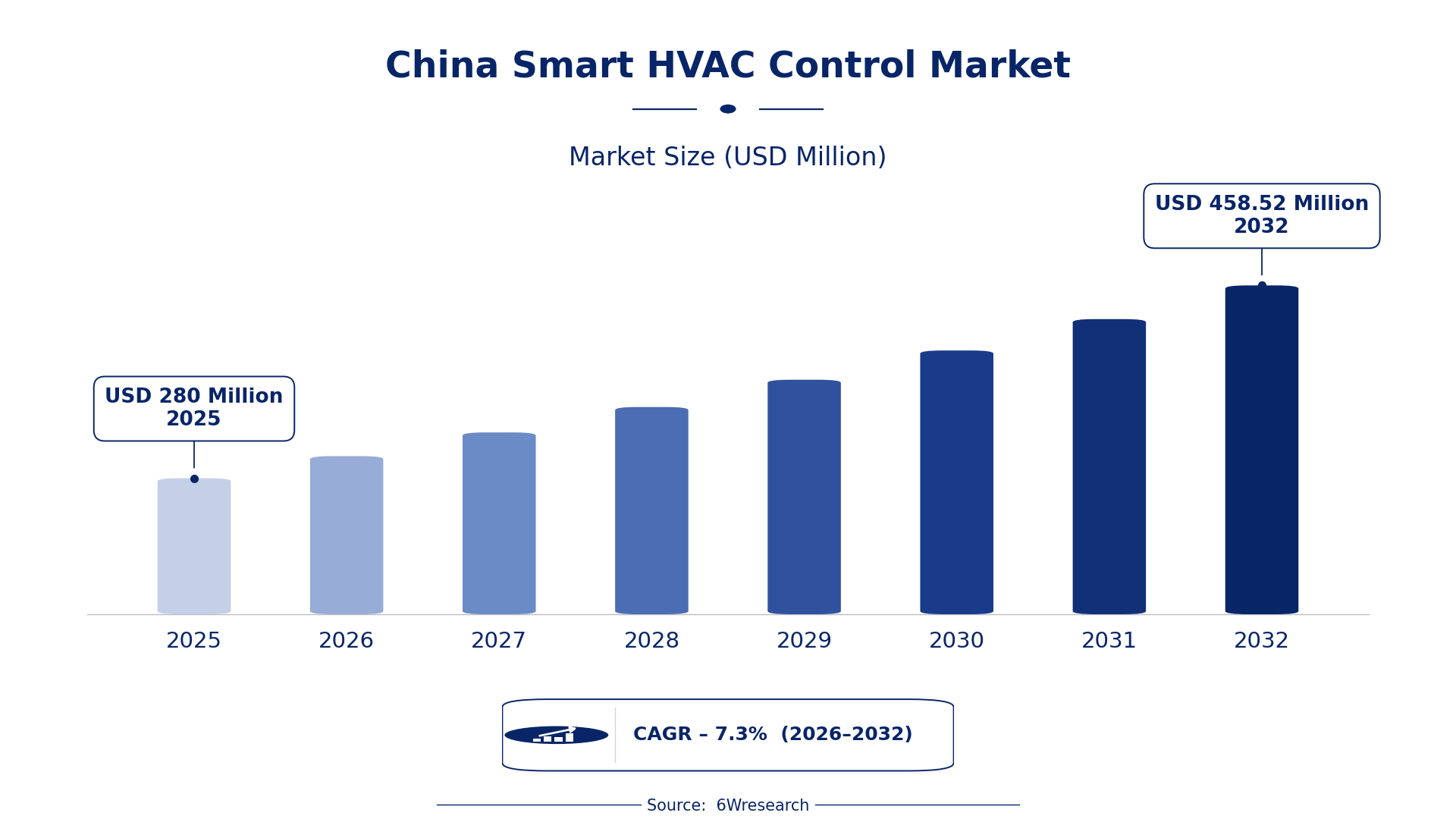
According to 6Wresearch internal database and industry insights, the China Smart HVAC Control Market was valued at USD 280.0 million in 2025 and is projected to reach USD 458.52 million by 2032, growing at a CAGR of approximately 7.3% during 2026–2032.
China Smart HVAC Control Market Highlights
| Report Metric | Details |
| Report Name | China Smart HVAC Control Market |
| Market Size 2025 | USD 280.0 million |
| Market Size 2032 | USD 458.52 million |
| Absolute Growth 2025–2032 | USD 178.52 million |
| CAGR 2026–2032 | 7.3% |
| Peak Annual Growth | 9.8% in 2032 |
| Forecast Period | 2026–2032 |
| Historical Data | 2022–2025 |
| Base Year | 2025 |
| Leading Control Type, 2025 | AI Predictive Control (39% share) |
| Leading Feature, 2025 | Learning Behavior Patterns (38% share) |
| Leading Connectivity, 2025 | Wi-Fi (37% share) |
| Leading End User, 2025 | Smart Buildings (43% share) |
| Fastest-Growing Feature | Remote Temperature Setting (9.4% CAGR) |
| Fastest-Growing Connectivity | Edge AI (8.9% CAGR) |
| Fastest-Growing End User | Residential Users (9.0% CAGR) |
| Growing Sector | Residential Users |
| Key End Users | Smart Buildings, Residential Users, HVAC Companies, Smart Home Installers |
China Smart HVAC Control Market Year-wise Growth Rate and Key Drivers (2022–2032)
This graph illustrates the annual growth rates of the market from 2022 to 2032, highlighting a steady upward trajectory and projected market expansion over the forecast period.
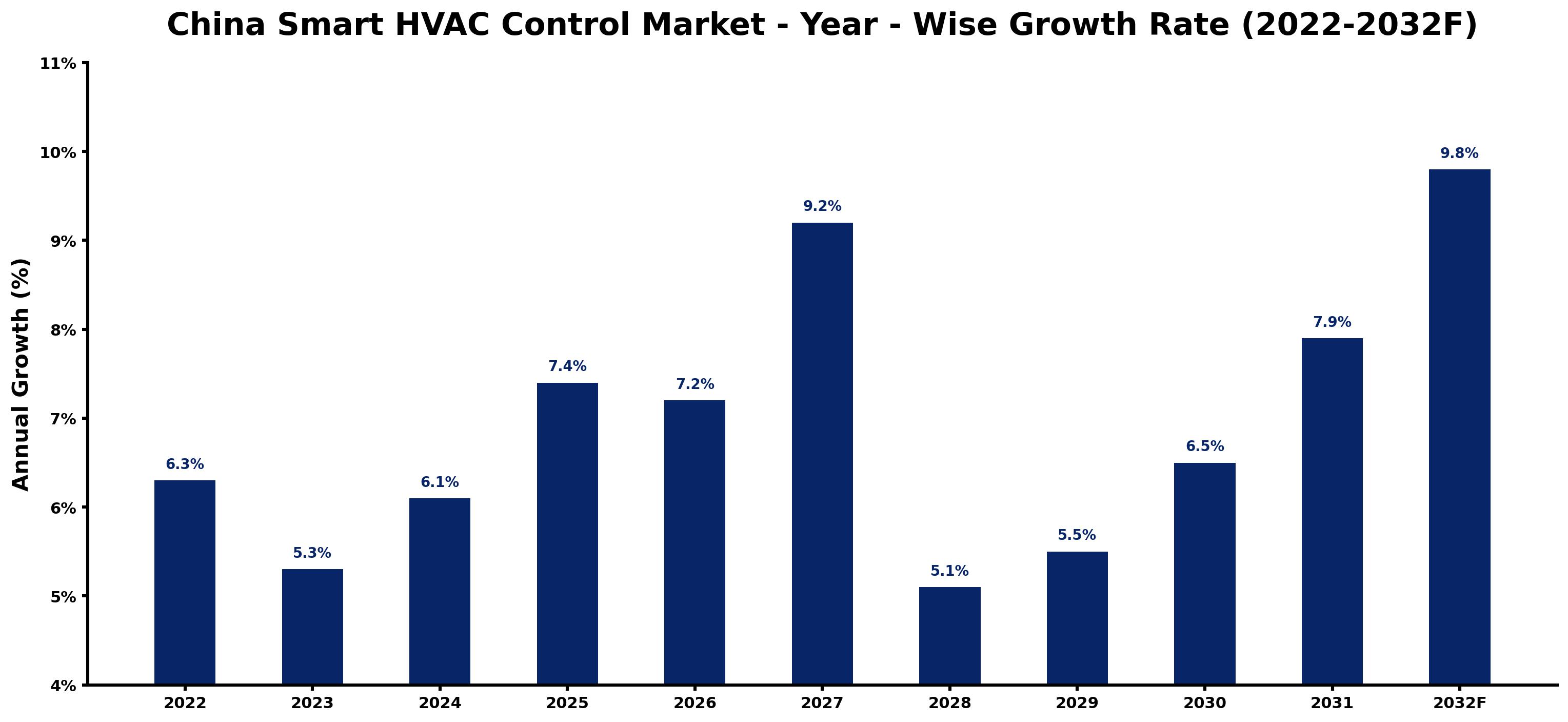
Year by year, the estimates below pair each growth rate with the development that shaped it.
| Year | Estimated Annual Growth (%) | Market Rationale |
| 2022 | 6.3 | The market showed steady growth due to increasing urbanization and energy efficiency initiatives. |
| 2023 | 5.3 | Growth slowed as the market adjusted to the 'Green Building Action Plan' and changing consumer preferences. |
| 2024 | 6.1 | Demand increased as smart buildings adopted advanced HVAC systems for better energy management. |
| 2025 | 7.4 | A surge in installations occurred, driven by the government's energy efficiency policies. |
| 2026 | 7.2 | Growth slowed as market saturation began to affect the pace of new installations. |
| 2027 | 9.2 | The market rebounded with increased demand for energy-efficient solutions in urban areas. |
| 2028 | 5.1 | Growth slowed again as competition intensified among HVAC providers and technologies. |
| 2029 | 5.5 | Demand picked up as residential users sought more energy-efficient HVAC options. |
| 2030 | 6.5 | The market continued to grow as smart home technology integration became more prevalent. |
| 2031 | 7.9 | Increased installations were driven by rising living standards and urban development. |
| 2032 | 9.8 | The market is projected to peak due to widespread adoption of smart HVAC systems in new constructions. |
Note: Market size estimations and growth projections presented in this report are based on 6Wresearch's proprietary forecasting methodology, utilizing the latest available industry data, government publications, and primary research inputs.
China Smart HVAC Control Market Synopsis
The China Smart HVAC Control Market encompasses advanced systems that optimize heating, ventilation, and air conditioning through technology. These systems improve energy efficiency and user comfort, primarily used in residential climate control and smart buildings. The market is growing due to urbanization, energy efficiency initiatives, and government support. The 'Green Building Action Plan' and rising living standards are key factors driving this growth. In 2022, the market was valued at approximately 50 billion yuan, reflecting the increasing demand for efficient HVAC solutions.
Market Dynamics Impact Analysis (2026–2032)
| Factor | Type | Impact | Primary Segment Affected |
| Urbanization and energy efficiency initiatives are driving demand for smart HVAC systems. | Driver | High | Smart Buildings |
| Integration of smart HVAC in residential units is increasing. | Driver | High | Residential Users |
| Growing demand for energy-efficient solutions in urban areas creates opportunities. | Opportunity | High | Residential Users |
| Investment in smart HVAC technologies is needed for new constructions. | Opportunity | High | Smart Buildings |
| High installation costs can deter potential buyers from adopting smart HVAC systems. | Restraint | Medium | Residential Users |
| Limited consumer awareness about smart HVAC benefits restricts market growth. | Restraint | Medium | Smart Buildings |
| The Smart HVAC Control market in China faces regulatory hurdles that slow adoption. | Challenge | High | Smart Buildings |
| Competition among HVAC providers leads to pricing pressures affecting profitability. | Challenge | Medium | Residential Users |
Evaluation of Drivers in China Smart HVAC Control Market (2026–2032)
Below mentioned are some major drivers and their influence on market dynamics.
| Drivers | Primary Segment Affected | Why It Matters (Evidence) |
| Increasing urbanization drives demand for energy-efficient HVAC solutions. | Smart Buildings | With over 1.4 billion residents, the need for efficient HVAC systems is rising. |
| Government initiatives promote smart HVAC adoption in new constructions. | Residential Users | The 'Green Building Action Plan' encourages energy-efficient building standards, targeting a 30% penetration of smart HVAC by 2025. |
| Growing awareness of energy savings boosts market demand. | Smart Buildings | In 2023, smart HVAC installations surged by 15%, reflecting increased interest in energy-efficient solutions. |
| Technological advancements improve HVAC system efficiency and user experience. | Residential Users | The adoption of AI predictive control improves energy management capabilities, enhancing user comfort. |
| Integration with home automation systems boosts consumer interest. | Smart Buildings | Smart HVAC systems are increasingly being integrated into smart home technologies, driving consumer adoption. |
In 2023, smart HVAC installations increased by 15%, highlighting the rising interest in energy-efficient solutions. The 'Green Building Action Plan' promotes energy-efficient standards, encouraging residential users to adopt smart HVAC technologies. The integration of AI predictive control enhances energy management capabilities, leading to improved user experiences. As a result, the market is expected to experience substantial growth in the coming years, particularly in smart buildings and residential applications.
Evaluation of Restraints in China Smart HVAC Control Market
The key brakes on demand, and where they bite hardest, are shown below.
| Market Restraint | Primary Segment Affected | Why It Matters (Evidence) |
| Rising costs of advanced components burden buyers, making energy-efficient solutions less accessible. | Residential Users | Increased prices can escalate project budgets by up to 20%, limiting adoption. |
| Supply chain disruptions hinder suppliers, delaying critical component sourcing. | HVAC Companies | Delays can extend project timelines by several weeks, impacting installation schedules. |
| Regulatory compliance requires significant adjustments from manufacturers. | HVAC Companies | Evolving energy efficiency standards can delay product launches, affecting market entry. |
| Skills shortages in the workforce complicate installation and maintenance. | Smart Home Installers | The demand for trained technicians outpaces supply, leading to increased labour costs. |
| Market saturation is limiting the pace of new installations. | Smart Buildings | As competition intensifies, growth rates are expected to slow. |
China Smart HVAC Control Market Challenges
The China Smart HVAC Control Market faces rising costs that burden buyers, particularly due to increasing prices of advanced components and installation services. These costs can escalate project budgets by up to 20%, making energy-efficient solutions less accessible for residential users. Supply chain disruptions hinder suppliers, as delays in sourcing critical components can extend project timelines by several weeks, impacting installation schedules. Evolving energy efficiency standards create regulatory challenges, requiring manufacturers to make adjustments that can delay product launches by up to three months. Skills shortages in the workforce complicate matters, as the demand for trained technicians outpaces supply, resulting in increased labour costs for installation and maintenance by approximately 15%.
Trends in the China Smart HVAC Control Market
Several trends are reshaping the China Smart HVAC Control Market; the most important are set out below.
- Shift Towards Energy-Efficient Solutions: Residential Users are increasingly adopting energy-efficient HVAC systems, driven by rising living standards. In 2023, smart HVAC installations surged by 15%, reflecting this growing trend.
- Integration of Smart Home Technologies: The integration of smart HVAC systems into home automation is becoming prevalent. The 'Smart Home Development Plan' aims for a 30% penetration of smart HVAC in new homes by 2025.
- Adoption of AI Predictive Controls: AI Predictive Control is gaining traction in the HVAC sector, improving energy management. This technology is projected to grow at a CAGR of 8.5% from 2026 to 2032.
- Focus on Government Initiatives: Government initiatives are driving the adoption of smart HVAC solutions. The 'Green Building Action Plan' launched in 2023 promotes energy-efficient building standards.
Investment Opportunities in the China Smart HVAC Control Market
Investors looking at the China Smart HVAC Control Market should consider the following areas.
- Investment in Smart Building Technologies: With a projected 15% increase in smart HVAC installations, there is a significant opportunity for suppliers to invest in smart building technologies. Residential Users are actively seeking these solutions.
- Expansion of AI Predictive Control: The adoption of AI Predictive Control is set to grow rapidly. Suppliers can target Smart Buildings, utilising this technology to improve energy management capabilities.
- Development of Energy-Efficient Solutions: The need for energy-efficient HVAC systems is rising, driven by urbanisation. Suppliers can focus on developing solutions that meet the standards set by the 'Green Building Action Plan'.
- Partnerships with Smart Home Installers: Collaboration with Smart Home Installers presents an opportunity to integrate HVAC systems into broader home automation solutions. This can enhance market penetration and user adoption.
Government Initiatives in the China Smart HVAC Control Market
The '14th Five-Year Plan for Energy Conservation and Emission Reduction' launched in 2021 by the National Development and Reform Commission focuses on promoting smart HVAC systems. This measure aims to improve energy efficiency and reduce emissions in the HVAC sector, benefiting both producers and buyers. The 'Building Energy Efficiency Standard' was updated in 2023 by the Ministry of Housing and Urban-Rural Development to include smart HVAC requirements, ensuring compliance for manufacturers and enhancing product offerings.
In 2023, the 'Green Building Action Plan' was introduced by the Ministry of Housing and Urban-Rural Development, promoting smart HVAC adoption in new constructions. This initiative aims to increase the penetration of smart HVAC systems in residential buildings, supporting energy efficiency goals. The National Energy Administration's 'Energy Efficiency Improvement Program' encourages the use of smart HVAC technologies in commercial buildings, with funding allocated to projects that meet energy-saving criteria.
Future Insight of the China Smart HVAC Control Market
The China Smart HVAC Control Market is poised for growth by 2032, supported by urbanisation and government initiatives promoting energy efficiency. The 'Green Building Action Plan' aims to integrate smart HVAC systems in 30% of new homes by 2025, enhancing market adoption. Advancements in technology will streamline installations and improve user experience, while the national standard GB/T 19519-2017 will ensure consistent energy efficiency across products. Consequently, buyers will benefit from more accessible and efficient solutions, while suppliers will see increased demand for their offerings.
Market Segmentation Analysis
The analysis below covers each segmentation, its leading category in 2025 and its fastest-growing category through 2032.
By Control Type – AI Predictive Control Dominated and Is Expected to Record the Fastest Growth
According to Dhaval Chaurasia, Assistant Manager at 6Wresearch, AI Predictive Control held a 39% share of the China Smart HVAC Control Market by control type in 2025. AI Predictive Control dominates the market share due to its ability to optimise energy efficiency, which is crucial for smart buildings in cities like Beijing and Shanghai. The technology's alignment with national energy efficiency standards reinforces its widespread adoption across various facilities. The same category is also set to grow fastest, at a CAGR of 8.5% during 2026–2032. The rapid growth of AI Predictive Control is fuelled by the increasing demand for energy-efficient solutions, exemplified by a 15% rise in smart HVAC installations in 2023. This segment's leadership will continue to expand as urbanisation and energy initiatives persist. Suppliers should focus on enhancing AI Predictive Control technologies to meet the growing demand for energy-efficient HVAC solutions.
By Feature – Learning Behavior Patterns Dominated, Remote Temperature Setting Expected to Grow Fastest
In 2025, Learning Behavior Patterns led the feature split with a 38% share. Learning Behavior Patterns captures a significant market share as it improves user comfort by adapting to individual preferences, making it highly desirable in smart buildings. This feature aligns with the increasing emphasis on personalised climate control in urban environments. Over 2026–2032, Remote Temperature Setting is expected to post the fastest growth, at a CAGR of 9.4%. Remote Temperature Setting is experiencing rapid growth because it allows users to manage HVAC systems from afar, reflecting the trend towards convenience and smart home integration. As consumer preferences shift towards remote management, this feature is poised for substantial market expansion. Buyers will benefit from features like Remote Temperature Setting that enhance convenience and energy management in their HVAC systems.
By Connectivity – Wi-Fi Dominated, Edge AI Expected to Grow Fastest
Wi-Fi accounted for a 37% market share by connectivity in 2025. Wi-Fi is the leading connectivity type, essential for remote access and integration with smart home devices, making it critical in the growing smart building sector. Its widespread adoption ensures effective communication between devices, which is vital for optimal HVAC control. Edge AI is projected to grow fastest, at a CAGR of 8.9% during 2026–2032. Edge AI is rapidly gaining traction as it enhances real-time decision-making in HVAC systems, a key factor for improving energy efficiency. As smart buildings evolve, the demand for advanced connectivity solutions like Edge AI will continue to rise. Suppliers must prioritise advanced connectivity options like Edge AI to stay competitive in the fast-changing smart HVAC market.
By End User – Smart Buildings Dominated, Residential Users Expected to Grow Fastest
Smart Buildings took a 43% share of end user in 2025, more than any other category. Smart Buildings represent the largest market share as they are a primary application area for advanced HVAC systems, driven by urbanisation and energy efficiency regulations. The integration of smart HVAC controls in these structures is essential for compliance with modern energy standards. The quickest growth will come from Residential Users, forecast to expand at a CAGR of 9.0% between 2026 and 2032. Residential Users are the fastest-growing segment, reflecting the increasing demand for smart HVAC solutions in homes, particularly with government initiatives promoting smart home technologies. As more residential units adopt these systems, this segment's growth is expected to accelerate further. Suppliers should target the residential market to capitalise on the rising demand for smart HVAC solutions in homes.
Key Attractiveness of the Report
- 10 Years of Market Numbers
- Historical Data Starting from 2022 to 2025
- Base Year 2025
- Forecast Data until 2032
- Key Performance Indicators Impacting the Market
- Major Upcoming Developments and Projects
Key Highlights of the Report:
- China Smart HVAC Control Market Outlook
- Market Size of China Smart HVAC Control Market, 2025
- Forecast of China Smart HVAC Control Market, 2032
- Historical Data and Forecast of China Smart HVAC Control Revenues & Volume for the Period 2022 - 2032F
- China Smart HVAC Control Market Trend Evolution
- China Smart HVAC Control Market Drivers and Challenges
- China Smart HVAC Control Price Trends
- China Smart HVAC Control Porter's Five Forces
- China Smart HVAC Control Industry Life Cycle
- Historical Data and Forecast of China Smart HVAC Control Market Revenues & Volume By Control Type for the Period 2022 - 2032F
- Historical Data and Forecast of China Smart HVAC Control Market Revenues & Volume By App-Based Thermostats for the Period 2022 - 2032F
- Historical Data and Forecast of China Smart HVAC Control Market Revenues & Volume By AI Predictive Control for the Period 2022 - 2032F
- Historical Data and Forecast of China Smart HVAC Control Market Revenues & Volume By Occupancy-Based HVAC for the Period 2022 - 2032F
- Historical Data and Forecast of China Smart HVAC Control Market Revenues & Volume By Voice-Integrated HVAC for the Period 2022 - 2032F
- Historical Data and Forecast of China Smart HVAC Control Market Revenues & Volume By Feature for the Period 2022 - 2032F
- Historical Data and Forecast of China Smart HVAC Control Market Revenues & Volume By Remote Temperature Setting for the Period 2022 - 2032F
- Historical Data and Forecast of China Smart HVAC Control Market Revenues & Volume By Learning Behavior Patterns for the Period 2022 - 2032F
- Historical Data and Forecast of China Smart HVAC Control Market Revenues & Volume By Motion Sensor Integration for the Period 2022 - 2032F
- Historical Data and Forecast of China Smart HVAC Control Market Revenues & Volume By Command-Based Adjustment for the Period 2022 - 2032F
- Historical Data and Forecast of China Smart HVAC Control Market Revenues & Volume By Connectivity for the Period 2022 - 2032F
- Historical Data and Forecast of China Smart HVAC Control Market Revenues & Volume By Wi-Fi for the Period 2022 - 2032F
- Historical Data and Forecast of China Smart HVAC Control Market Revenues & Volume By Edge AI for the Period 2022 - 2032F
- Historical Data and Forecast of China Smart HVAC Control Market Revenues & Volume By Multi-Zone HVAC for the Period 2022 - 2032F
- Historical Data and Forecast of China Smart HVAC Control Market Revenues & Volume By Alexa/Google Assistant for the Period 2022 - 2032F
- Historical Data and Forecast of China Smart HVAC Control Market Revenues & Volume By End User for the Period 2022 - 2032F
- Historical Data and Forecast of China Smart HVAC Control Market Revenues & Volume By Residential Users for the Period 2022 - 2032F
- Historical Data and Forecast of China Smart HVAC Control Market Revenues & Volume By HVAC Companies for the Period 2022 - 2032F
- Historical Data and Forecast of China Smart HVAC Control Market Revenues & Volume By Smart Buildings for the Period 2022 - 2032F
- Historical Data and Forecast of China Smart HVAC Control Market Revenues & Volume By Smart Home Installers for the Period 2022 - 2032F
- China Smart HVAC Control Import Export Trade Statistics
- Market Opportunity Assessment By Control Type
- Market Opportunity Assessment By Feature
- Market Opportunity Assessment By Connectivity
- Market Opportunity Assessment By End User
- China Smart HVAC Control Top Companies Market Share
- China Smart HVAC Control Competitive Benchmarking By Technical and Operational Parameters
- China Smart HVAC Control Company Profiles
- China Smart HVAC Control Key Strategic Recommendations
Market Covered
Segments analysed in this report are listed below.
By Control Type
- App-Based Thermostats
- AI Predictive Control
- Occupancy-Based HVAC
- Voice-Integrated HVAC
By Feature
- Remote Temperature Setting
- Learning Behavior Patterns
- Motion Sensor Integration
- Command-Based Adjustment
By Connectivity
- Wi-Fi
- Edge AI
- Multi-Zone HVAC
- Alexa/Google Assistant
By End User
- Residential Users
- HVAC Companies
- Smart Buildings
- Smart Home Installers































