India Smart Infrastructure Sensor Market Size & Growth Rate
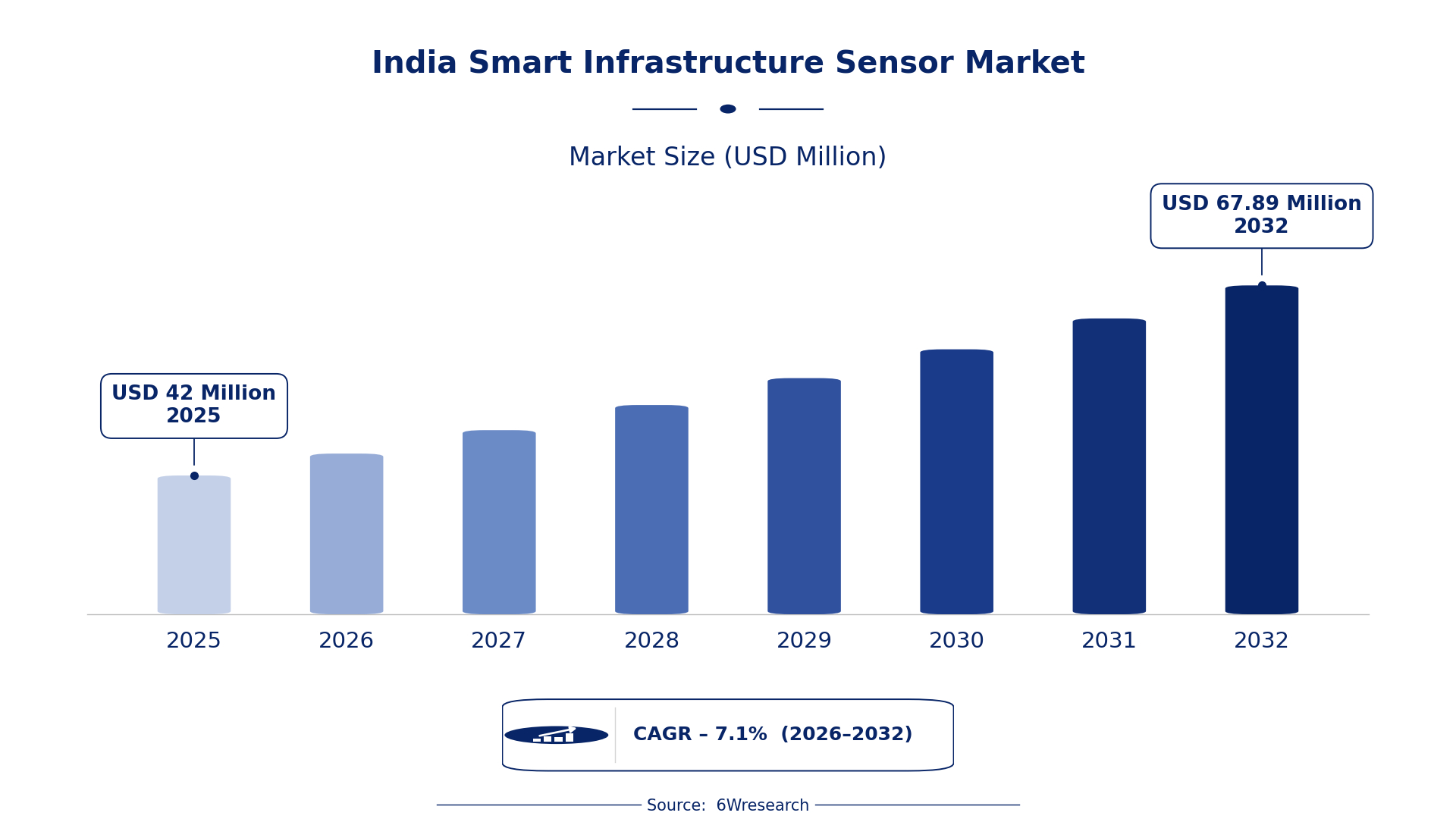
According to 6Wresearch internal database and industry insights, the India Smart Infrastructure Sensor Market was valued at USD 42.0 million in 2025 and is projected to reach USD 67.89 million by 2032, growing at a CAGR of approximately 7.1% during 2026–2032.
India Smart Infrastructure Sensor Market Highlights
| Report Metric | Details |
| Report Name | India Smart Infrastructure Sensor Market |
| Market Size 2025 | USD 42.0 million |
| Market Size 2032 | USD 67.89 million |
| Absolute Growth 2025–2032 | USD 25.89 million |
| CAGR 2026–2032 | 7.1% |
| Peak Annual Growth | 9.9% in 2032 |
| Forecast Period | 2026–2032 |
| Historical Data | 2022–2025 |
| Base Year | 2025 |
| Leading Sensor Type, 2025 | Strain Sensors (48% share) |
| Leading Monitoring Feature, 2025 | Bridge Load Monitoring (49% share) |
| Leading Infrastructure Type, 2025 | Transportation Structures (45% share) |
| Leading End User, 2025 | Civil Engineers (49% share) |
| Fastest-Growing Sensor Type | Moisture Sensors (9.8% CAGR) |
| Fastest-Growing Monitoring Feature | Water Leak Detection (9.5% CAGR) |
| Fastest-Growing End User | Infrastructure Developers (8.7% CAGR) |
| Growing Sector | Infrastructure Development |
| Key End Users | Civil Engineers, Municipal Authorities, Infrastructure Developers, Water Authorities |
India Smart Infrastructure Sensor Market Year-wise Growth Rate and Key Drivers (2022–2032)
This graph illustrates the annual growth rates of the market from 2022 to 2032, highlighting a steady upward trajectory and projected market expansion over the forecast period.
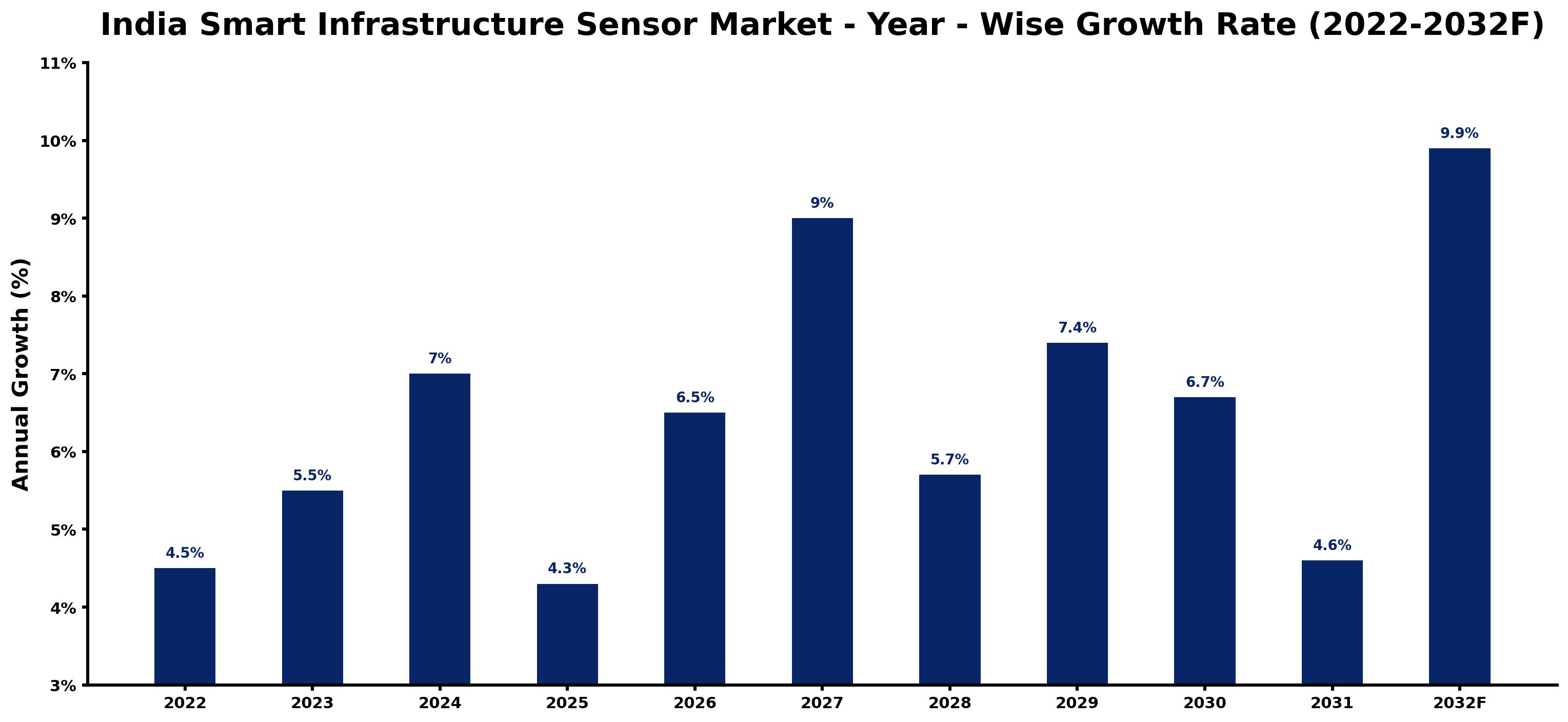
Annual growth estimates for each year appear below with the principal reason behind them, explaining the shifts that set the pace of the market.
| Year | Estimated Annual Growth (%) | Market Rationale |
| 2022 | 4.5 | The market experienced steady growth due to ongoing infrastructure projects, particularly the Smart Cities Mission. |
| 2023 | 5.5 | Demand increased as the Smart Cities Mission gained momentum, driving investments in smart technologies. |
| 2024 | 7.0 | Growth accelerated with the implementation of the National Building Code of India, enhancing safety standards. |
| 2025 | 4.3 | A slowdown occurred as project completions reduced immediate demand for new sensor installations. |
| 2026 | 6.5 | The market is expected to rebound with increased focus on disaster resilience and smart technology integration. |
| 2027 | 9.0 | Urban development projects are projected to surge, necessitating advanced monitoring solutions. |
| 2028 | 5.7 | A slight slowdown is anticipated as some projects reach completion, impacting new installations. |
| 2029 | 7.4 | Demand is expected to rise again as municipalities prioritise infrastructure safety and maintenance. |
| 2030 | 6.7 | Growth will moderate as the market adjusts to the saturation of certain urban areas. |
| 2031 | 4.6 | A further slowdown is projected as budget constraints limit infrastructure investments. |
| 2032 | 9.9 | The market is expected to peak with strong demand driven by new urbanisation initiatives and safety regulations. |
Note: Market size estimations and growth projections presented in this report are based on 6Wresearch's proprietary forecasting methodology, utilizing the latest available industry data, government publications, and primary research inputs.
India Smart Infrastructure Sensor Market Synopsis
The Smart Infrastructure Sensor Market in India includes advanced devices that monitor the structural integrity of critical infrastructure such as bridges and buildings. These sensors employ technologies like MEMS and IoT for real-time health monitoring and fault detection. The market is expanding due to extensive infrastructure development projects, with over 500,000 bridges needing regular monitoring. The Smart Cities Mission and the Digital India initiative are major drivers of demand for smart technologies, further broadening market potential. Civil engineers and infrastructure developers are the main buyers, actively integrating these solutions into their projects.
Market Dynamics Impact Analysis (2026–2032)
| Factor | Type | Impact | Primary Segment Affected |
| Increased urban infrastructure projects drive demand for smart sensors, as cities modernise their facilities to enhance safety and efficiency. | Driver | High | Strain Sensors |
| The push for local manufacturing of smart sensors reduces reliance on imports, encouraging domestic production and innovation. | Driver | High | Strain Sensors |
| The rising demand for smart monitoring solutions in urban areas presents opportunities for suppliers to engage with municipal authorities. | Opportunity | High | Municipal Authorities |
| Investment in smart infrastructure development is expected to rise, creating a growing market for sensor integration in new projects. | Opportunity | High | Strain Sensors |
| Outdated technology in existing sensors can lead to project delays, costing producers significant revenue losses. | Restraint | High | Strain Sensors |
| Supply chain disruptions due to insufficient local manufacturing extend lead times, affecting timely project execution for buyers. | Restraint | High | Strain Sensors |
| Regulatory compliance with standards like ISO 9001 can add substantial costs for buyers, impacting project budgets. | Challenge | High | Strain Sensors |
| Fierce competition among suppliers leads to price undercutting, reducing profit margins and compromising quality for producers. | Challenge | High | Strain Sensors |
Evaluation of Drivers in India Smart Infrastructure Sensor Market (2026–2032)
Below mentioned are some major drivers and their influence on market dynamics.
| Drivers | Primary Segment Affected | Why It Matters (Evidence) |
| Increased urban infrastructure projects necessitate real-time monitoring solutions. | Bridge Load Monitoring | With over 500,000 bridges requiring regular monitoring, demand for these sensors is on the rise. |
| The Smart Cities Mission encourages the integration of smart technologies in urban planning. | Transportation Structures | This initiative promotes urban infrastructure development, driving sensor demand significantly. |
| Growing concerns over structural safety lead to higher adoption of monitoring technologies. | Moisture Sensors | The National Building Code of India outlines standards for structural safety, increasing sensor integration. |
| Investment in disaster resilience drives demand for earthquake-resistant monitoring solutions. | Earthquake Resistance | The National Disaster Management Authority emphasises earthquake resistance in building codes, enhancing sensor use. |
| The push for local manufacturing of smart sensors increases market availability. | Vibration Sensors | The National Policy on Electronics targets 25% local production by 2025, boosting supply. |
Growth in the Smart Infrastructure Sensor market in India stems from increased urban infrastructure projects, rising safety concerns, and the push for local manufacturing. The Smart Cities Mission has allocated ₹100,000 crores for advanced monitoring solutions, boosting demand. With over 500,000 bridges requiring regular monitoring, civil engineers are increasingly adopting these sensors. The focus on disaster resilience is also leading to higher adoption rates of monitoring technologies. The integration of smart technologies is transforming infrastructure monitoring, ensuring safety and efficiency in civil engineering projects.
Evaluation of Restraints in India Smart Infrastructure Sensor Market
The main factors holding the market back are set out below.
| Market Restraint | Primary Segment Affected | Why It Matters (Evidence) |
| Limited awareness of the benefits of smart sensors hinders market growth. | Moisture Sensors | Many stakeholders remain unaware of how these sensors can improve infrastructure safety. |
| High initial costs for sensor installation deter potential buyers. | Tilt Sensors | The upfront investment required can be a barrier for smaller infrastructure projects. |
| Regulatory delays in project approvals slow down sensor deployment. | Vibration Sensors | Bureaucratic processes can extend timelines for necessary infrastructure upgrades. |
| Insufficient local manufacturing capabilities can affect supply chains. | Earthquake Resistance | Dependence on imports for sensors can lead to delays and increased costs. |
| Competition from traditional monitoring methods limits sensor adoption. | Strain Sensors | Established practices may resist transitioning to newer sensor technologies. |
India Smart Infrastructure Sensor Market Challenges
The India Smart Infrastructure Sensor market encounters significant hurdles that impede its progress. Producers face challenges with outdated technology, as many sensors do not meet the National Building Code, resulting in project delays that can cost them up to 20% in revenue. Importers deal with supply chain disruptions due to insufficient local manufacturing, extending lead times by several weeks, which affects timely project execution for buyers. Fierce competition among suppliers leads to price undercutting, reducing margins by 15%, compelling producers to compromise on quality. Buyers experience regulatory challenges, as compliance with ISO 9001 standards can add up to ₹50 lakhs in costs for large infrastructure projects.
Trends in the India Smart Infrastructure Sensor Market
Buyers and suppliers in the India Smart Infrastructure Sensor Market are adjusting to the following trends.
- Shift towards Smart City Initiatives in Maharashtra: Maharashtra is increasingly adopting smart city initiatives, integrating smart sensors for infrastructure monitoring. In 2022, the state allocated ₹1,000 crores for smart infrastructure projects, improving safety and efficiency.
- Transition from Traditional Monitoring to IoT Solutions: The market is transitioning from traditional monitoring methods to IoT-enabled solutions for real-time data. The Digital India initiative promotes this shift, with a target of 25% local sensor production by 2025.
- Emergence of Earthquake-Resistant Technologies: The focus on earthquake resistance is growing, with new building codes emphasising smart sensors. The National Disaster Management Authority's updated guidelines are driving this trend, improving infrastructure resilience.
- Increased Integration of Sensors in Urban Planning: Urban planning is increasingly incorporating smart sensors for infrastructure safety. The Smart Cities Mission, launched in 2021, is a key driver, with a budget of ₹100,000 crores allocated for smart technologies.
Investment Opportunities in the India Smart Infrastructure Sensor Market
Several openings in the India Smart Infrastructure Sensor Market merit attention from investors.
- Investment in Smart Infrastructure Projects in Gujarat: Gujarat is prioritising smart infrastructure projects, creating a demand for monitoring solutions. With an allocation of ₹1,000 crores, local partnerships can improve sensor integration in new developments.
- Focus on Disaster Resilience in Urban Areas: Now is the time to invest in earthquake-resistant monitoring solutions as urban areas expand. The National Disaster Management Authority's guidelines encourage the adoption of these technologies.
- Collaboration with Municipal Authorities for Sensor Deployment: Partnering with municipal authorities can facilitate sensor deployment in public infrastructure. With a growing focus on safety, there is a significant opportunity for local suppliers.
- Expansion of Smart Road Projects Nationwide: The Smart Road Project, launched in 2023, aims to implement smart sensors on national highways. This initiative presents a lucrative opportunity for suppliers to meet the increasing demand.
Government Initiatives in the India Smart Infrastructure Sensor Market
The Smart Cities Mission, launched by the Ministry of Housing and Urban Affairs in 2021, focuses on improving urban infrastructure with a budget of ₹100,000 crores. This initiative promotes the integration of smart technologies to enhance safety and efficiency in urban areas. The National Disaster Management Plan, updated in 2020, emphasises the integration of smart sensors for disaster resilience in urban infrastructure. The National Policy on Electronics, approved in 2022, promotes local manufacturing of smart sensors with a target of 25% production by 2025, benefiting producers by reducing reliance on imports.
In 2023, the Ministry of Road Transport and Highways introduced the Smart Road Project, aiming to implement smart sensors on national highways for real-time monitoring of traffic and structural integrity. The Bureau of Indian Standards published IS 456:2000, which includes guidelines for the use of sensors in structural health monitoring, ensuring compliance among producers. These measures collectively support the growth of the Smart Infrastructure Sensor market by promoting safety and innovation in infrastructure.
Future Insight of the India Smart Infrastructure Sensor Market
The India Smart Infrastructure Sensor market is projected to advance by 2032, driven by key initiatives like the Smart Cities Mission and the Digital India initiative. The population is expected to reach 1.5 billion, increasing the demand for advanced monitoring solutions. The Atal Mission for Rejuvenation and Urban Transformation will stimulate urban infrastructure development, creating new opportunities for suppliers. Enhanced integration of IoT technologies will improve sensor capabilities, facilitating better real-time monitoring and safety in civil engineering projects.
Market Segmentation Analysis
The analysis below covers each segmentation, its leading category in 2025 and its fastest-growing category through 2032.
By Sensor Type – Strain Sensors Dominated, Moisture Sensors Expected to Grow Fastest
According to Dhaval Chaurasia, Assistant Manager at 6Wresearch, Strain Sensors held a 48% share of the India Smart Infrastructure Sensor Market by sensor type in 2025. Strain Sensors hold the largest market share due to their critical role in measuring stress in structures, essential for ensuring safety in civil engineering projects. For instance, with over 500,000 bridges in India, these sensors are vital for regular monitoring and maintenance. Moisture Sensors are set to record the highest CAGR in this split, 9.8% over 2026–2032. Moisture Sensors are experiencing rapid growth as infrastructure projects increasingly focus on monitoring water levels to prevent damage. The allocation of ₹1,000 crores for smart infrastructure projects in 2022 highlights the urgency for effective moisture management solutions. Suppliers should focus on developing advanced moisture sensor technologies to meet the growing demand from infrastructure projects.
By Monitoring Feature – Bridge Load Monitoring Dominated, Water Leak Detection Expected to Grow Fastest
With a 49% revenue share in 2025, Bridge Load Monitoring was the largest monitoring feature category. Bridge Load Monitoring holds the largest share due to its essential role in ensuring the safety and integrity of India's extensive network of over 500,000 bridges. Compliance with the National Building Code of India necessitates regular monitoring, solidifying its importance in infrastructure safety. The quickest growth will come from Water Leak Detection, forecast to expand at a CAGR of 9.5% between 2026 and 2032. Water Leak Detection is witnessing rapid growth, driven by the pressing need to maintain the integrity of water infrastructure systems. The Smart Cities Mission's emphasis on smart technologies has significantly heightened the demand for effective leak detection solutions, ensuring continued expansion. Suppliers should prioritise advanced monitoring features to meet the increasing safety and compliance requirements in infrastructure projects.
By Infrastructure Type – Transportation Structures Dominated and Is Expected to Record the Fastest Growth
Transportation Structures took a 45% share of infrastructure type in 2025, more than any other category. Transportation Structures dominate the market share as they are crucial for monitoring the safety of roads and bridges, which are fundamental to India's infrastructure. The government's commitment to enhancing transportation networks further underscores the importance of this segment. Its lead should widen, with a projected CAGR of 9.4% during 2026–2032, the highest in this split. Transportation Structures are also the fastest-growing segment, with urbanisation and population growth driving the demand for improved monitoring solutions. Ongoing urban infrastructure initiatives ensure this segment continues to expand rapidly, reinforcing its market position. Suppliers should focus on developing solutions tailored for transportation structures to leverage this growth opportunity.
By End User – Civil Engineers Dominated, Infrastructure Developers Expected to Grow Fastest
The largest end user category in 2025 was Civil Engineers, with a 49% share of total revenue. Civil Engineers represent the largest share of users, as they are pivotal in integrating sensors into project assessments for structural safety. Their expertise is crucial for the effective implementation of smart infrastructure technologies in various projects. Infrastructure Developers are projected to grow fastest, at a CAGR of 8.7% during 2026–2032. Infrastructure Developers are the fastest-growing end user group, actively incorporating sensors into new construction projects to enhance safety and efficiency. The government's focus on smart city developments is further accelerating this growth, ensuring robust demand for these technologies. Suppliers must engage with infrastructure developers to align their offerings with the evolving needs of modern construction projects.
Key Attractiveness of the Report
- 10 Years of Market Numbers
- Historical Data Starting from 2022 to 2025
- Base Year 2025
- Forecast Data until 2032
- Key Performance Indicators Impacting the Market
- Major Upcoming Developments and Projects
Key Highlights of the Report:
- India Smart Infrastructure Sensor Market Outlook
- Market Size of India Smart Infrastructure Sensor Market, 2025
- Forecast of India Smart Infrastructure Sensor Market, 2032
- Historical Data and Forecast of India Smart Infrastructure Sensor Revenues & Volume for the Period 2022 - 2032F
- India Smart Infrastructure Sensor Market Trend Evolution
- India Smart Infrastructure Sensor Market Drivers and Challenges
- India Smart Infrastructure Sensor Price Trends
- India Smart Infrastructure Sensor Porter's Five Forces
- India Smart Infrastructure Sensor Industry Life Cycle
- Historical Data and Forecast of India Smart Infrastructure Sensor Market Revenues & Volume By Sensor Type for the Period 2022 - 2032F
- Historical Data and Forecast of India Smart Infrastructure Sensor Market Revenues & Volume By Strain Sensors for the Period 2022 - 2032F
- Historical Data and Forecast of India Smart Infrastructure Sensor Market Revenues & Volume By Tilt Sensors for the Period 2022 - 2032F
- Historical Data and Forecast of India Smart Infrastructure Sensor Market Revenues & Volume By Moisture Sensors for the Period 2022 - 2032F
- Historical Data and Forecast of India Smart Infrastructure Sensor Market Revenues & Volume By Vibration Sensors for the Period 2022 - 2032F
- Historical Data and Forecast of India Smart Infrastructure Sensor Market Revenues & Volume By Monitoring Feature for the Period 2022 - 2032F
- Historical Data and Forecast of India Smart Infrastructure Sensor Market Revenues & Volume By Bridge Load Monitoring for the Period 2022 - 2032F
- Historical Data and Forecast of India Smart Infrastructure Sensor Market Revenues & Volume By Earthquake Resistance for the Period 2022 - 2032F
- Historical Data and Forecast of India Smart Infrastructure Sensor Market Revenues & Volume By Water Leak Detection for the Period 2022 - 2032F
- Historical Data and Forecast of India Smart Infrastructure Sensor Market Revenues & Volume By Early Fault Detection for the Period 2022 - 2032F
- Historical Data and Forecast of India Smart Infrastructure Sensor Market Revenues & Volume By Infrastructure Type for the Period 2022 - 2032F
- Historical Data and Forecast of India Smart Infrastructure Sensor Market Revenues & Volume By Transportation Structures for the Period 2022 - 2032F
- Historical Data and Forecast of India Smart Infrastructure Sensor Market Revenues & Volume By Buildings for the Period 2022 - 2032F
- Historical Data and Forecast of India Smart Infrastructure Sensor Market Revenues & Volume By Pipelines & Tunnels for the Period 2022 - 2032F
- Historical Data and Forecast of India Smart Infrastructure Sensor Market Revenues & Volume By Industrial Foundations for the Period 2022 - 2032F
- Historical Data and Forecast of India Smart Infrastructure Sensor Market Revenues & Volume By End User for the Period 2022 - 2032F
- Historical Data and Forecast of India Smart Infrastructure Sensor Market Revenues & Volume By Civil Engineers for the Period 2022 - 2032F
- Historical Data and Forecast of India Smart Infrastructure Sensor Market Revenues & Volume By Municipal Authorities for the Period 2022 - 2032F
- Historical Data and Forecast of India Smart Infrastructure Sensor Market Revenues & Volume By Water Authorities for the Period 2022 - 2032F
- Historical Data and Forecast of India Smart Infrastructure Sensor Market Revenues & Volume By Infrastructure Developers for the Period 2022 - 2032F
- India Smart Infrastructure Sensor Import Export Trade Statistics
- Market Opportunity Assessment By Sensor Type
- Market Opportunity Assessment By Monitoring Feature
- Market Opportunity Assessment By Infrastructure Type
- Market Opportunity Assessment By End User
- India Smart Infrastructure Sensor Top Companies Market Share
- India Smart Infrastructure Sensor Competitive Benchmarking By Technical and Operational Parameters
- India Smart Infrastructure Sensor Company Profiles
- India Smart Infrastructure Sensor Key Strategic Recommendations
Market Covered
Segments analysed in this report are listed below.
By Sensor Type
- Strain Sensors
- Tilt Sensors
- Moisture Sensors
- Vibration Sensors
By Monitoring Feature
- Bridge Load Monitoring
- Earthquake Resistance
- Water Leak Detection
- Early Fault Detection
By Infrastructure Type
- Transportation Structures
- Buildings
- Pipelines & Tunnels
- Industrial Foundations
By End User
- Civil Engineers
- Municipal Authorities
- Water Authorities
- Infrastructure Developers































